Feeds:
Posts
Comments

News : It seems the pharma companies are worried   about  the new MCI  (Medical council of India ) guidelines  that restrict  sponsorship  for conferences and freebies to individual  doctors  . They think it is a  big set back  as it  may interfere with doctor’s  education and knowledge  !

ethics and pharma compnaies

They have proposed new amendments and  has asked  the health ministry to advice the MCI accordingly .(ie To help them bring back  the corrupt and bad practices  that  influence  doctors prescribing behavior  !)

It is true , for the  growth of medical science , we  require some sort of  a business model and  tax holidays for the companies for true  &  land  mark discoveries  . Currently the MCI allows to sponsor  medical  events or a conference  for an institution or organization .  But  what these companies want is  official permission to provide  incentives to individual doctors and influence them  ! .  More shockingly  they said  doctors knowledge will  suffer without these industrial support . It is an outright insult to all doctors who get educated  for over  decades* . In fact the heads of pharma companies require  few lessons from the medical fraternity  ,  how many drugs with  dubious scientific value  is playing havoc in  health of  the society !

Of course ,we can not blame the pharma companies  for  all . It is a collective evil.

Counter point

*This  is a  second  slap on the face of  medical profession  !  I am  sorry to say this ,  many of us ( Including  the blogger  ! )  are some way responsible for this state of affairs  . Shockingly ,  few of  our  colleagues are  proud  to  have illicit relationship with drug companies !  Younger generation   no longer consider  this as an offense  , since they are born and brought up with  capitation fee as their principal fodder. Commercial forces  has taken over  medical  profession . Many of the  colleges are owned by business barons and alcohol vendors  in India . It is a well known  fact , MBBS seats are now  sold for 50lakhs (like  3 bed room flats )  . Agents transact black money in secret basements of   medical colleges  once considered  as  temple  of  the  noble profession .

So what is  in-store  for the future ? . . .  Self regulation is best  regulation   . . .   Mahatma told us ! . It  may be  the most idealistic     solution   . . . but  currently   it appears   self  regulation is  as bad  as no regulation !

Link to the article
http://articles.timesofindia.indiatimes.com/2013-04-19/india/38673588_1_pharma-companies-pharma-industry-doctors

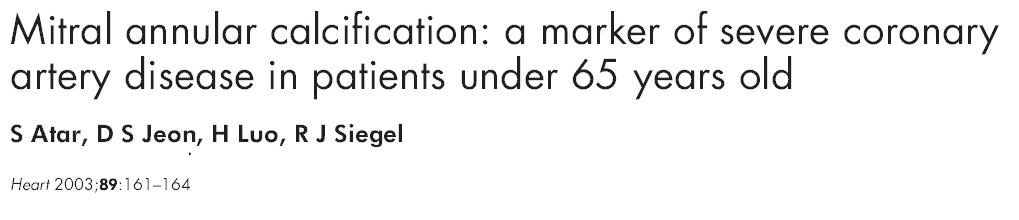
Why should mitral  annulus gets calcified ? .  Degenerative  calcification can be benign in  elderly .  If it occurs prematurely (say < 55 years )   there is enough reasons to worry .  This may represent a systemic vascular inflammation and  is considered a surrogate marker for athero- vascular -sclerosis .  A study from Cidar Sinai  , Los angels  has well documented the link way back in 2003  !

mitral annular calcification mac cad link

This is a  large study involving  17 735 patients (who were investigated for symptoms of CAD )   were screened.

The incidence  of MAC was high (As expected !)

  • 35% > 65 years
  • 5 %  < 65 years
Angiography  revealed more surprises .
  • The incidence of angiographic  CAD among those who had MAC and no MAC   was  88% v68% respectively ,( p = 0.0004),
  • Left main coronary artery disease  was (14% 4%, p = 0.009)
  • Triple vessel disease  was (54% v33%, p = 0.002).
mitral annular calcification  www_drsvenkatesan_co_in

Image source  S.Atar ,  Heart 2003 : 89, 161-164

Conclusion
This study concluded ,  CAD is more aggressive in patients with MAC. It can  also be  an independent  predictor of  high risk CAD .
Further Implications  of MAC
  1. MAC is more common in women, especially diabetics .
  2. Degenerative Mitral regurgitation  is common ,rarely  mitral stenosis
  3. Recurrent VPDs and even  trouble some mitral annular VT is possible
  4. Extensive calcific lesions in coronary  artery is also reported with MAC.
Link between Stroke and MAC .
This was well proven by this paper  published in  NEJM in 1992.
MITRAL ANNULAR CALCIFICATION AND STROKE NEJM  EMELIA BENJAMIN 1992
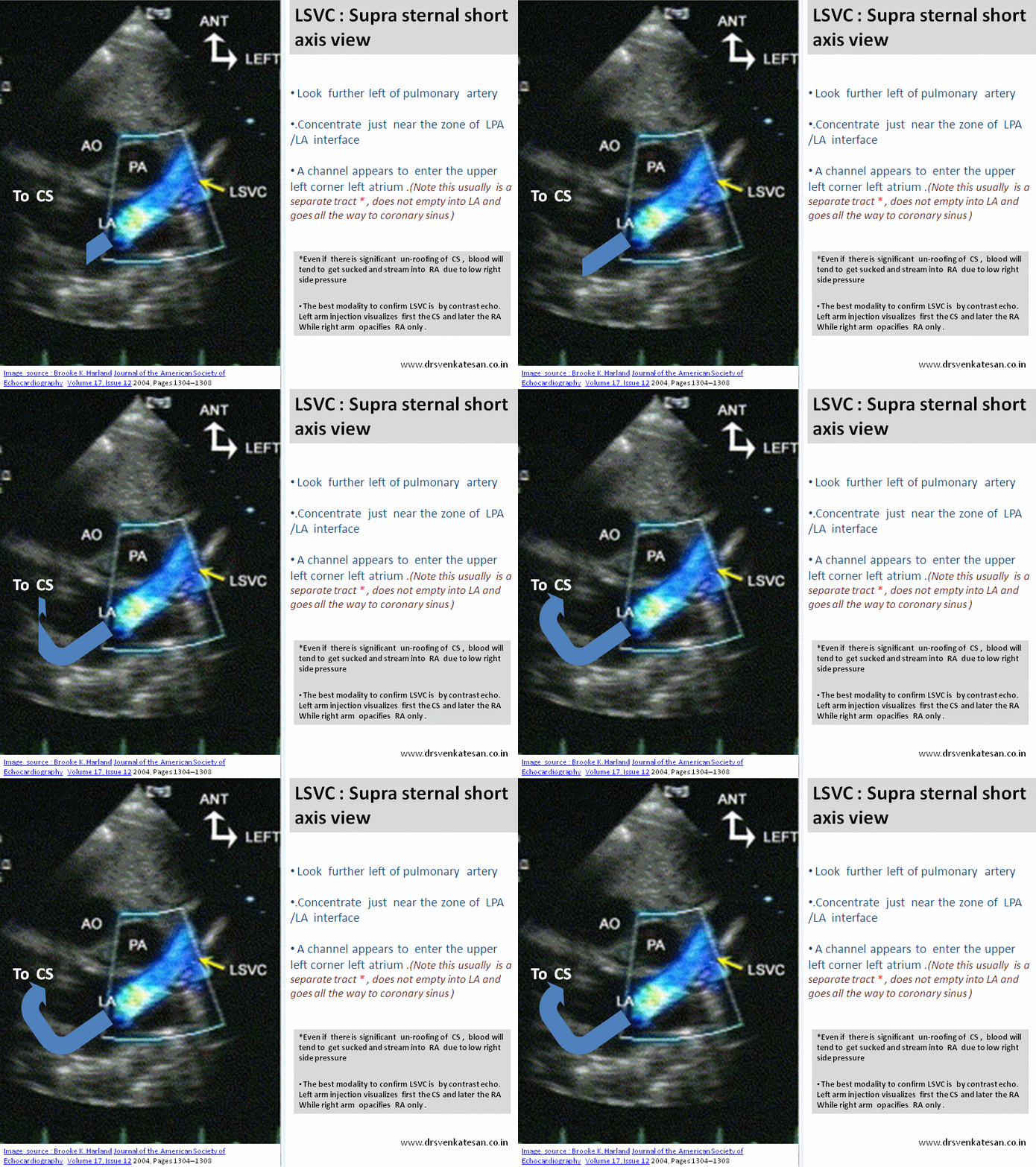
lsvc persisitence lsvc left superior vena cava

While 2D echo visualizes the LSVC , it is the color Doppler flow (in blue ) that confirms the flow going away from transducer towards coronary sinus .Please note , if the LSVC shows red flow it indicates the left vertical vein and the flow is from below up .This is supra cardiac TAPVC . It makes immense embryological sense to understand LSVC and and left vertical vein are both same entities only the connections are different .

Click over  for a high resolution Image


Those who answered  “Yes” ,  can leave this article . Those who answered  “No” read further .

* Logic would tell us myocardial revascularisation should correct  stress induced ischemia and it  should disappear promptly  . This does not happen in all cases  real world  ! That is  why medicine is  different  from mathematical science .

Some of the  reasons for  persistence of stress positivity even after an apparently successful PCI are  . . .

  1. Incomplete  correction of ischemia. (Ideally  to be referred as failed PCI )
  2. Error in Identifying culprit 9Angina related artery ) .Common feature of poorly worked up  multivessel CAD.
  3. Re-stenosis /Re-occlusion
  4. Doing very early stress test without giving time for revascularisation to work *
  5. Rapid progression of non culprit lesions .(Sub -optimal medical management )
  6. Chronic N0-Reflow phenomenon  surrounding  area of infarct .(Especially in  PCI of CTOs)
  7. Dyskinetic  or grossly remodeled ventricular segments  can result in non ischemic positive EST response (ST drag **)
  8. Associated systemic conditions especially  Anemia/ SHT & LVH -(False positive )
  9. Many diabetic patients may  continue to show stress ischemia due to  small vessel disease.
  10. A  patient with  syndrome X  characters  can have incidental  epicardial lesion as well . In such a patient EST will always be positive .

* Optimal time to do  EST  for assessing the  efficacy of  PCI/CABG is not established .Six months may be the reasonable point .If done within 2- 3 months it may  end  up  in embarrassment for the Interventionist . (So only it is kept at 6 months , this also help us  greatly  as  we can always blame it on poor life style control and progression of  the disease !)

** No reference  for this  , a  personal observation .We know  Q leads following MI ,  will show ST elevation during stress test especially if the segments are dyskinetic  . In leads diagonally opposite to q leads ,  ST depression is observed . This may not be  a evidence for true  ischemia . It probably represents   ST drag due to mechanical stretch .

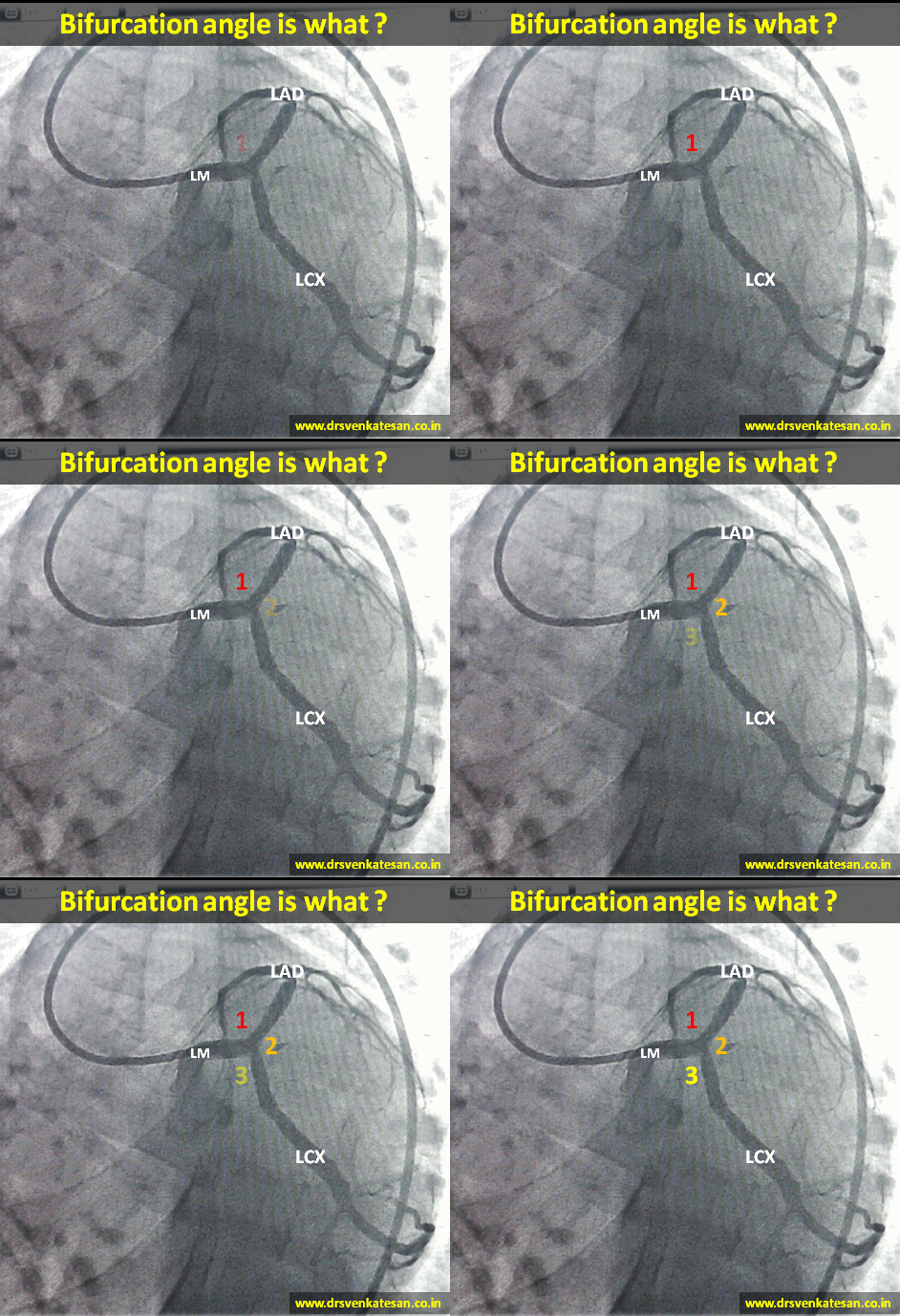
bifurcation angle

  • At any branch point three angles are possible .True bifurcation angle is formed between LAD and LCX .
  • The angle between LM and LAD or LM and LCX can also be important in specific situations ,especially when we encounter short left mains and Medina 1,1,0 lesions .
  • Major bifurcation angle can  occur in mid  segments  as well ,  between LAD / major Diagonal  , LCX and OM.
  • Logic would tell us the  left main  bifurcation  angle is relatively fixed by the anatomical AV and IV grooves. Still early course of LAD and LCX can be out of grooves.
  • Further ,the bifurcation angle is imparted some amount of dynamism by cardiac cycle . It can vary between 80 -120 degrees (LAD/LCX).
  • Most importantly various  angiographic views can alter the true angle (by illusion ) in dramatic fashion . RAO caudal view appear ideal to measure it. (LAO caudal make every bifurcation angle obtuse !)
  • Acute angled bifurcations are prone for stent related mechanical issues both during deployment and in the long term outcome . (When two stent technique is used) This is because ,  acute  angled bifurcations has a tendency to drift the carina , and  encroach  the lumen  which can create new  turbulence . Of course final kissing balloon is expected to reduce this hemodynamic side effect at least on paper !

Modern  men think they are invincible .  They can innovate every thing under the sun with their sixth sense . Alas  . . . we forget  human values  ! .It does not require a least of   that  special sense   . Reaching out to a life in distress   require  an animal sense !

HY05_BIODIVERCITY__1417604e

The Antics ! Crossing a bridge with fifth sense ! The Hindu  5th April 2013 Image : Michale Nongthombam.

A bunch of  Ants plan   how to  ferry   a daughter Ant  , across a broken bridge and execute it  efficiently with their tiny little cerebrum !  

While , we boast around  with the  later   . . . still   . . .   there is no end in sight for all those  self   inflicted sufferings . . .   these lesser mortals  live happily  in this human infested planet !

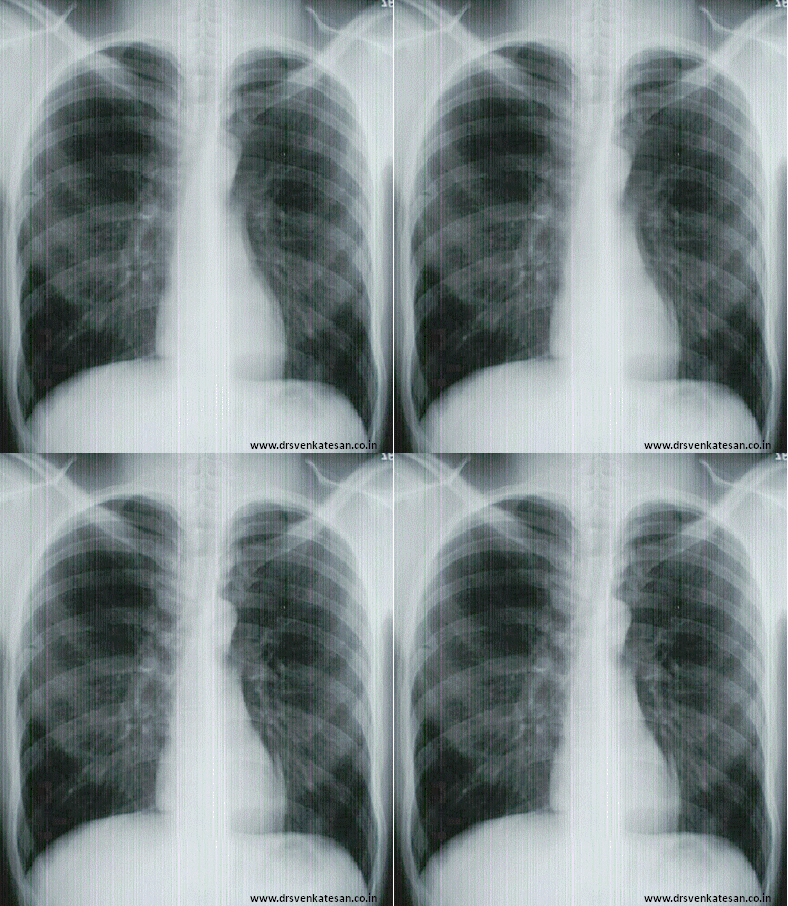
Have you ever wondered a given chest x-ray is taken in systole or diastole ?  We should . . .  isn’t ?  Statistically chances of a  X ray to  fall in  diastole is 10-20 % more than systole as the later phase is longer . The peculiarity of cardiac anatomy is that ,  the  profile of the heart alters so little between systole and diastole  .Still the blood is pumped  efficiently into both pulmonary and systemic circulation . The left ventricle shortens by 35%  and ejects 65 % of blood . Similarly RV shortens but with  lesser quantum.

ct ratio in systole and diastole influnce of cardiac cycle on ct ratio

In a simple and elegant study  by Stephen Gammill  in 1970  published in Radiology journal,

he concluded the following about the CT ratio between systole and diastole.

  • 52 %   showed changes of 0.3 cm
  • 41 per cent showed alterations of 0.4 to 0.9 cm,
  • Only  7 per cent  showed a significant  variation of 1.0 to 1.7 cm in transverse cardiac diameter.

(I wonder why any follow up studies on this vital issue is scarce !)

xray chest 002

In spite both ventricles contracting during systole the radiological transverse cardiac diameter is relatively undisturbed ! 

Importance of  Rotary , Twist ,Torsional  and Longitudinal motion

The fact that CT ratio does not alter significantly in most ,  imply the heart has some other  kinetic motion which does not compromise the transverse diameter during systole. They are the rotary , and twist  motion .The relative constancy  of  CT ratio  is a good evidence  for existence for such alternate motions .We have since  confirmed  this  by sophisticated echocardiographic techniques .

Another evidence for rotary motion  recognised in the bed side when the apical impulse hits you in the fingers even as the ventricle is supposed to go away from chest wall during systole . This is  the torsional  movement of  LV  apex  and adjacent inter ventricular septum .

Reference

http://radiology.rsna.org/content/94/1/115.abstract

Coming soon

Inspiratory and expiratory  x ray chest and  the effect on cardiac contours .

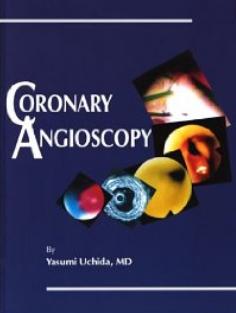
In the early 1980s , when cardiac physicians were confronting how to tackle intra coronary thrombus , one man from Japan  was  looking directly at the ground zero with fiber-optic coronary angioscope .He  provided live images  of coronary plaques and thrombus (long before the IVUS and OCT era) because of technical difficulties it did not get into  clinical utility  but gave us vital information like plaque morphology and behavior.

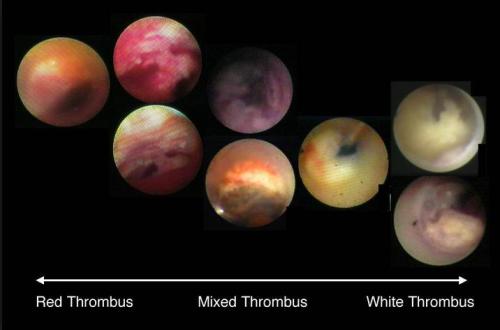
  • The concept of red and white thrombus
  • The yellow lipid enriched vulnerable plaques
  • Post lytic  clot surface
  • The fibrin strands within the clot etc.

coronary angioscopy Yasumi Uchida

The angioscopes have now given way to IVUS and OCT which provide indirect vision of the coronary arteries .Uchida has written a book tilted coronary angioscaopy which is a must read for all clinical cardiologists.

I think Japanese are  leading in this aspect of cardiac Imaging .Yasunori Ueda is another person who has  done lot of work on angioscopy . here is an  Image from his paper. Exciting  stuff  is isn’t !

coronary angioscopy  Yasunori Ueda www.invasivecardiology

Image source : Yasunori Ueda http://www.invasivecardiology.com

  Reference 

http://circ.ahajournals.org/content/104/24/e143.full

http://www.invasivecardiology.com/article/5571?page=3

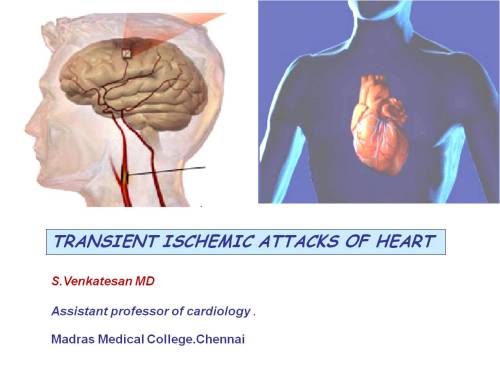
Is Transient Ischemic attacks (TIAs)  belong to the  exclusive domain of cerebral circulation ?  Can it occur in the coroanry arteries ?  If so what situations ?

This is a presentation in one of the cardiological society of India annual scientific sessions . A pdf download is  provided

transient ischemic attacks attack of heart coronary tia

Download  a PDF presentation

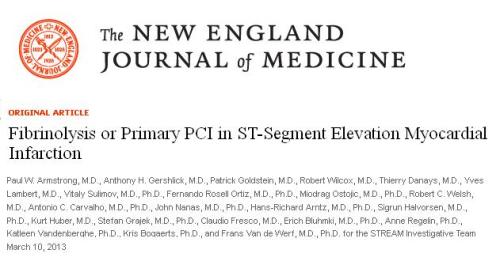
Primary PCI is presumed to be the ultimate  , undisputed reperfusion  strategy  in STEMI .  Still , time and again one study or  other strips down  this   “Numero Uno”  status of pPCI  .  If it is really supreme ,  such awkward  situation shouldn’t arise  too often . More importantly , the  major reason for  dubious real world record of  pPCI  goes beyond  the time and logistic factors (which is considered the only issue  for pPCI by most interventionist ! ) There is something more to it that is invisible ! (Is it the no reflow ?)

The nearly flawless study from Belgium ( STREAM Just released in ACC 2013/Sanfransisco ) , pre-hopsital or early fibrinolysis has proven to be superior in the prevention major end points at 30 days .

  1. Death
  2. Re-infarction
  3. CHF

STREAM STUDY NEJM PRIMARY PCI VS FIBRINOLYSIS

The major surprise was pre-hospital  fibrinolysis  showed less  incidence of cardiogenic shock . ( pPCI

group had more of this ( 4.4 VS 5.9 %  in STREAM )

Now . . .  shall I make a provocative statement ?

while pPCI may be treatment of choice for cardiogenic shock . . . but it may  also confer a risk of cardiogenic shock in otherwise low risk MI !

Caution  and  conclusion

STREAM population applies strictly to 1 to 3 hour time window . It does not apply to either before or after that ! Simply put,we do not have  guts to compare fibrinolysis and pPCI  in patients who arrive  within one hour into a facility where 24 hour cath lab facility is available .  We call it unethical to do a study like that !  I personally feel it is really unethical  if we do not do a study in this time frame . The reasoning is  simple and very personal .In a  large  Government  hospital   where  we do not have primary PCI program  our net mortality for STEMI never exceeded 7-8 %  over a period of 10 years  , Which  is almost at par with global data on pPCI. (Our door to needle time is an unbelivebale  8-12 minutes ! that  too only streptokinase !)

Adding Further controversy

pPCI  is indeed a superior reperfusion strategy . No one can dispute that .But its superiority  is not  realised  in  every patient  who gets it.  The benefits are accrued if and only if it is  used most judiciously . In Low risk , small regional  , branch vessel STEMI ,  pPCI has never been  shown superior . It is well recognised ,  upto 15 % of STEMI is likely to spontaneously abort or experience very good spontaneous recannalisation . By rushing these  patients very early into cath lab pPCI   meddles with the natural anti fibrinolytic mechanisms . It is this population who  invite all the procedural hazards. .

Is this the reason STREAM had  more  cardiogenic shocks in pPCI limb ?

I think STREAM has  strengthened the case in favor of fibrinolysis in this  ever ending debate .

I would  seriously believe  pPCI is hanging it’s superiority over fibrinolysis with a wafer thin mortality advantage . pPCI may  not be recommended in a routine fashion to all STEMI  population even if they arrive within 6 hours and able to perform the plasty fast .  Science is   . . .  after all . . .  continuing  confrontations with our  assumptions !

Counter point

STREAM is not an exclusive study comparing fibrinolysis and PCI . It is a  study comparing   Pharmaco Invasive approach vs  pure invasive approach . 80 %  of patients in the  fibrinolytic limb ultimately received PCI and  stenting . It simply doesnot make sense to conclude fibrinolysis is superior to PCI . Most of the beneficial  effects on 30 day outcome may reflect the timely PCI  in the lytic group.

//