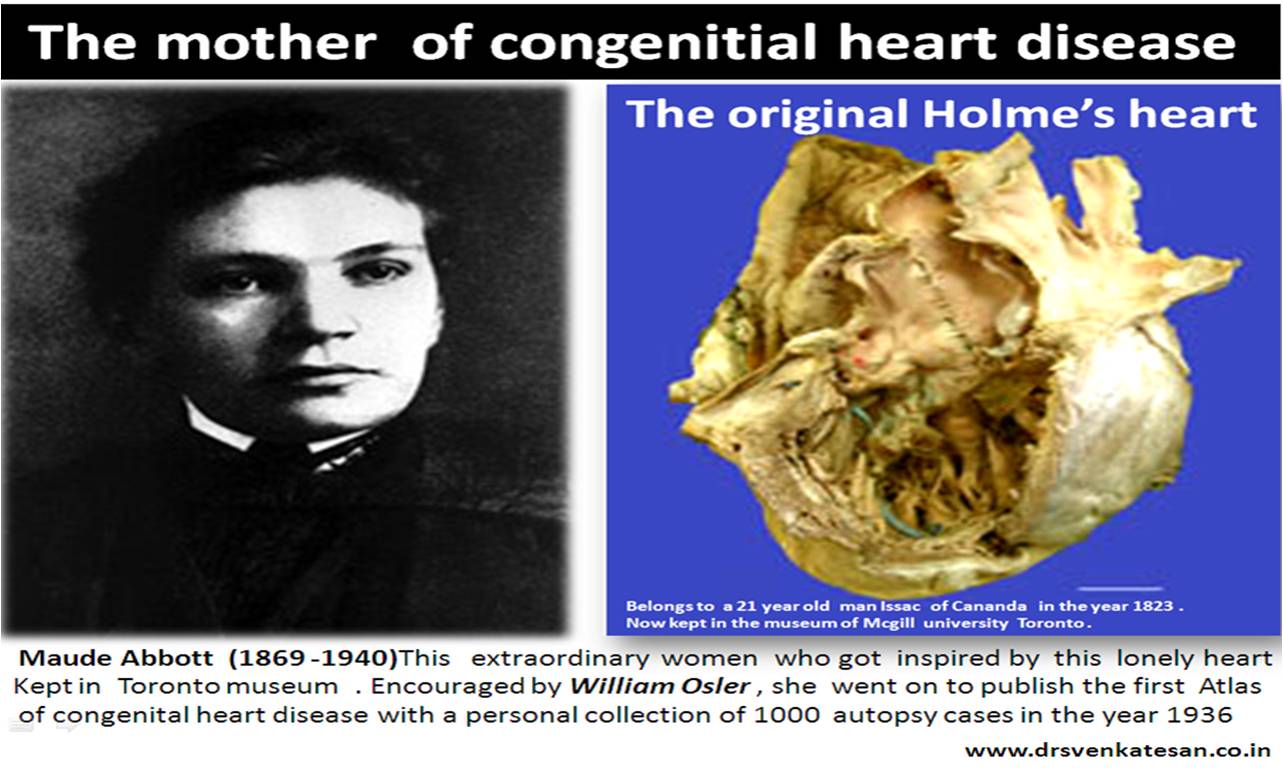
The first book on congenital heart disease

Posted in Cardiology-Land mark studies | Tagged maude abbott | Leave a Comment »
You are called in to control the BP . . . What will you do ?
Basics
Neurogenic HT is adrenergic dependent /stress related .It is often volume independent .Nitroglycerin worsens adrenergic hypertension by reflex tachycardia even though it may drop the initial BP .Sustained reduction won’t happen with NTG .Further , nitroglycerine is known to elevate the intra cranial pressure and worsen the stroke laden cortical / brain-stem ischemia
Best drugs
Not best ( Worst ? )
* IV NTG is useful in some of these patients for a instant effect. However , It has a huge risk of raising intra- cranial pressure .
Final message
Control of neurgenic HT requires correction of the primary trigger namely the neural insult .The second best option is to stop the effects neural signal outflow .Adrenergic blockers are the best way to do it . All other drugs like calcium/Nitric oxide /diuretics are non specific and only provide a transient relief and may in fact aggravate sympathetic mediated hypertension.There is no harm in giving calcium blockers but it should always be accompanied by beta blockers to bring aggressive control .
Finally , controlling hypertension in stroke is to be done with frequent confabulations ! with neurologists , as blood pressure lowering modalities has a competing interest with brain perfusion !
Posted in cardiology -Therapeutics, critical care ccu, Infrequently asked questions in cardiology (iFAQs) | Tagged alpha methyl dopa, neurogenic hypertension | Leave a Comment »
Some general rules are available
RBBB -Morphology -LV origin
LBBB morphology -RV origin
Exceptions : Interventricular septum is electrically RV or LV ?
Electrically it is more of a LV . Septal focus often have RBBB morpholgy . Exist points do matter
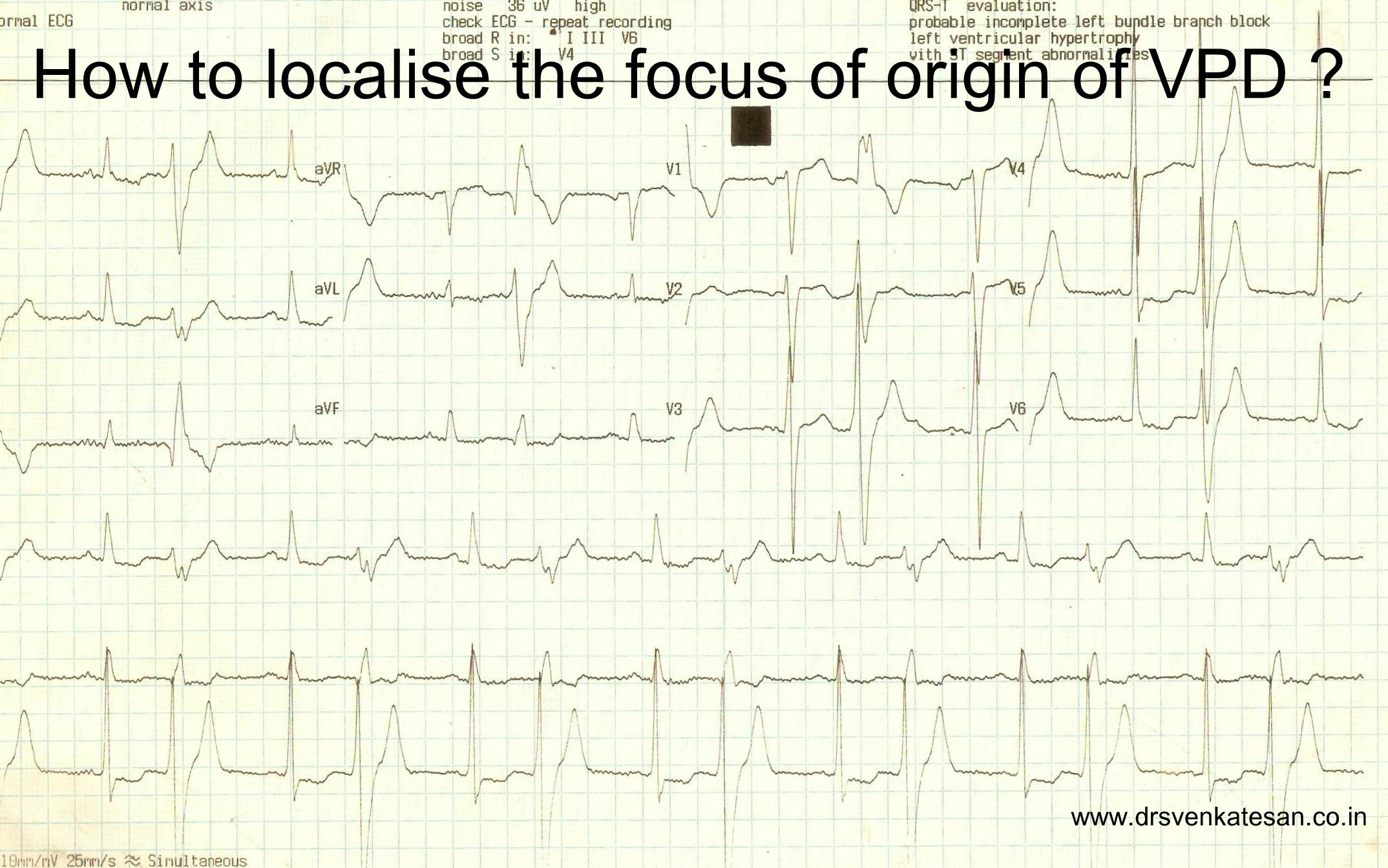
Three lead approach
Rapidly looking at lead V1 , V6 and AVR can give us a clue
AVR +ve will immediately tell us the VPDs are firing towards right shoulder .
RBBB morphology points to a LV focus .
Negative VPD in V5 will further confirm LV apex is in the trailing end of VPD
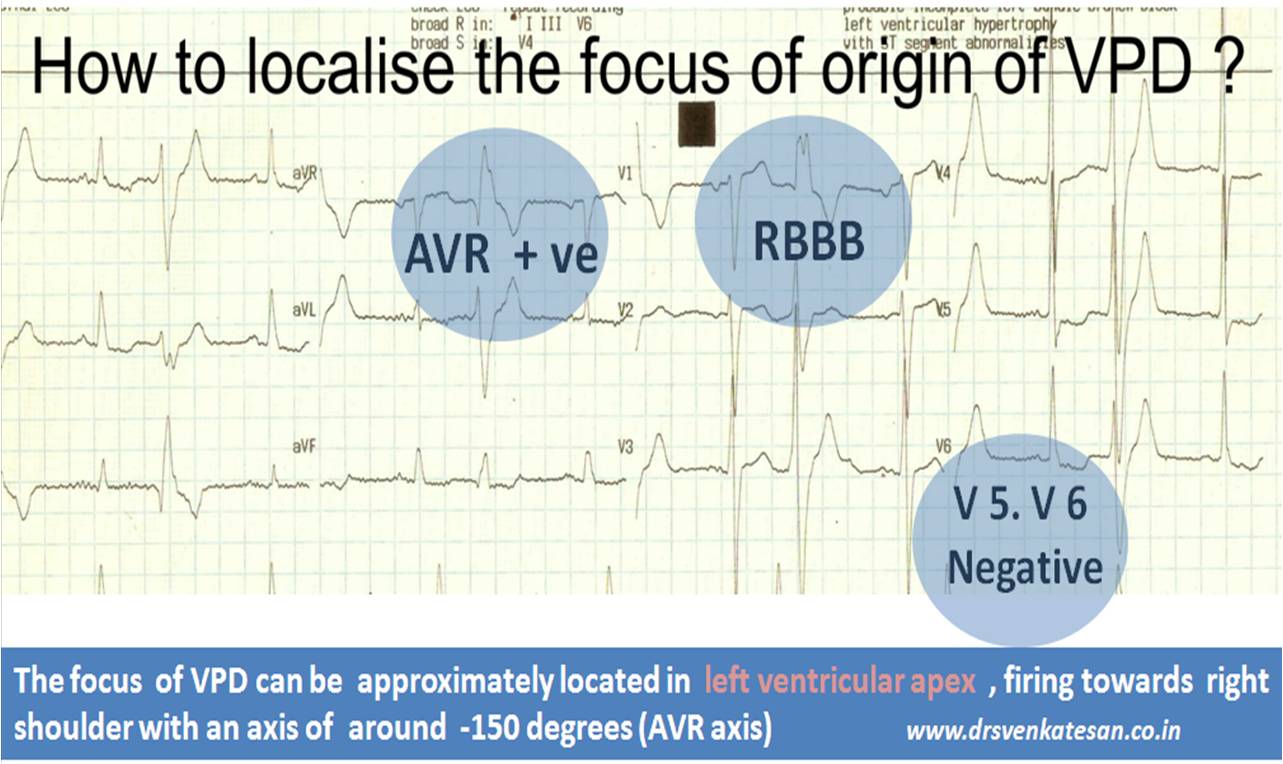
Common sites for post MI VPD
Which VPD morphology has better localising value RBBB or LBBB ?
It is the LBBB that has more localising value . LBBB invariably fixes the right ventricle
RBBB can either be right ventricle or left ventricle .
To be continued .
Posted in Cardiology - Electrophysiology -Pacemaker, cardiology -ECG, Cardiology-Arrhythmias | Tagged avr lead for localising vpd, how to localise the vpd from surface ecg, rbbb vs lbbb morphology vpd | Leave a Comment »
I guess ,the art of delivering medical lectures is gradually deteriorating . This is not because of lack of young brains in teaching profession .It is primarily due to onslaught of technology and multiple scattered source of knowledge . I do remember some of my physiology professors take class in the first year medical school in the early 1980s .
I wonder I could go back in time machine to hear the voice of Dr Kieth who delivered this grand lecture of anatomy of heart in the year 1918 .in the famed auditorium of Royal college of surgeons . We should profusely than the BMJ for providing the text of that lecture free to us in almost 100 years later.
By the way . . . for those who do not know , Kieth is one of the inventor of SA node the pacemaker of the heart .
\
http://www.ncbi.nlm.nih.gov/pmc/articles/PMC2340034/pdf/brmedj06937-0003.pdf
Highlights
Posted in history of cardiology, Quotes | Tagged Functional anatomy of mitral valve, Harveian lecture, KIETH HARVEY LECTURE 1918 LONDON, SA node | Leave a Comment »
Answer:
Your guess was correct if only it is “C”
Reference
Suvarna JC. Watson’s water hammer pulse. J Postgrad Med ;54:163-5 :2008
Posted in Clinical cardiology, valvular heart disease | Tagged collapsing pulse of aortic regurgitation, mechansim of collaspe in aortic regurgitation, water hammer pulse, watson pulse | Leave a Comment »
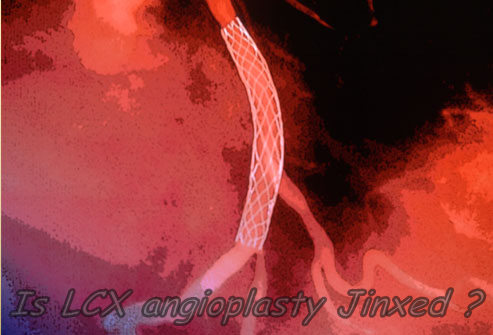
We frequently hear a comment about LCX angioplasty being a tricky intervention . Even many experienced cardiologists do agree with this .
What could be the apparent explanation for this seemingly important observation in cath lab ?
Final message
It is true LCX angioplasties can not be taken casually . One can not afford to have a prolonged procedure within LCX.Whether dominant or not LCX delivers blood supply to more vital areas of myocardium that typically includes lateral free wall and mitral valve function .It is possible septal ischemia is relatively well tolerated while free wall ischemia triggers an early mechanical deterioration .
Posted in Cardiology -Interventional -PCI, cardiology -Therapeutics, Cardiology -unresolved questions | Tagged angioplasty ptca left circumflex, issues during pci | Leave a Comment »
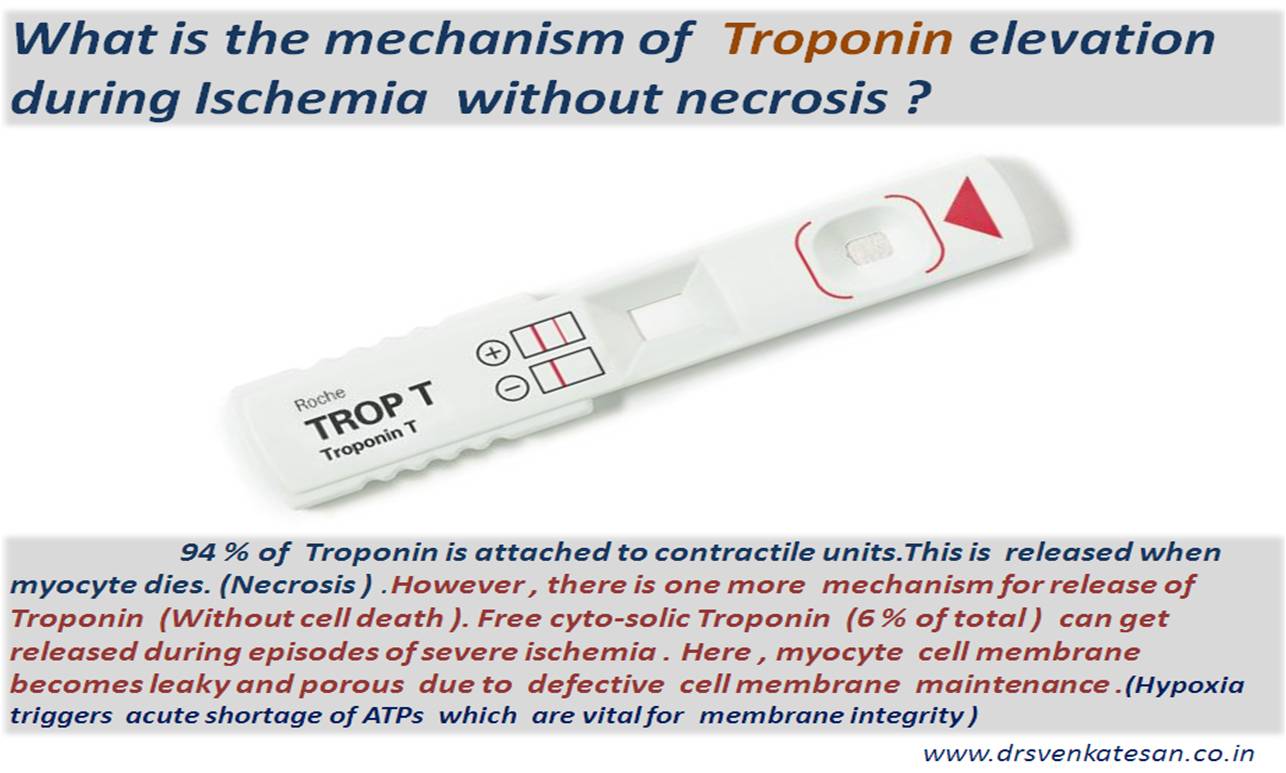
Does Troponin release during Ischemia ? (Without myocyte necrosis )
How often this happens ? . Some believe , it is rare . Here is a possible explanation for it .I feel the mechanism is still not clear . It all depends upon the degree of ischemia.
Posted in Cardiology - Clinical, Cardiology -Interventional -PCI, Cardiology -unresolved questions, cardiology- coronary care, STEMI-Primary PCI | Tagged bio markers in nstemi, ischemia mediated troponin realese, mechanism of eelvation of troponin in unstable angina, troponin i, troponin in ischemia, troponin t | 1 Comment »
It doesn’t make news if police arrest Robbers , militants , or Terrorists ! Here is a shocking news !
A news clip from the Forbes November 11th 2012 .

Nine doctors were arrested . . . 12 device and pharma companies have been banned form entering Italy.
Reason : They indulged in inappropriate coronary interventions which has caused fatal injuries .
Do you think these cardiologist are at fault ?
Posted in Uncategorized | Tagged ethics in medicine, hippocrates, inappropriate stents, italian cardiologists | 2 Comments »
I don’t know, any one has tried to differentiate the mechansims of dyspnea with reference to systolic and diastolic dysfunction .We have made some observations in certain group of patients during EST . I do not know how far one would agree with this .
For the same amount of stress or work load persons with systolic dysfunction behave differently . However ,both will complete the activity but the onset and perception of dyspnea is slightly different in patients with predominant diastolic dysfunction.

Diastolic dyspnea (Dyspnea due to predominant diastolic dysfunction / HFPEF)

The pressure volume loop in various forms of heart disease will determine the degree of myocardial stretch and the resultant dyspnea .Image source : http://www.1cro.com/medicalphysiology/chapter10/chap_10.htm
Systolic dyspnea (Dyspnea due to predominant systolic dysfunction )
Summary
In primary diastolic dysfunction ,the maximum stress to ventricle occurs when the venous return peaks that usually happen in the exercising muscles , as they shed vaso-dilatory property in post exertion phase .
Management Implication
Fluid overload , Tachycardia are more related to diastolic dysfunction .(Beta blockers by prolonging the diastole can , provide important relief of dyspnea in diastolic dysfunction (In HOCM patients this action could be more important that the much hyped negative inotropism !)
Final message
Dyspnea is a complex cortical perception , influenced by filling pressure of heart, stretch receptor in lungs , respiratory and exercise muscle . It is further impacted by number of biochemical parameters (Lactate/ O2 etc )
Of-course , it could be a far fetched imagination to split dyspnea mechanism with reference to cardiac cycle. Combinations of both systolic and diastolic dysfunction is the norm in many cardiac conditions . However , I believe we need more insight in the pathogenesis of this , “most important symptom” that emanate from the heart .
Posted in Cardiology - Clinical, Cardiology -unresolved questions, Clinical cardiology | Tagged diastolic dyspnea, dyspnea recovery time, heart rate recovery vs dyspnea, mechanism of dyspnea, systolic dyspnea | 2 Comments »
Top 5 conditions that closely mimic and often mistaken for STEMI !
ERS
The repolarisation is due to K + efflux . The K channel porosity is subjected to high degree of genetic variations .If the repolarisation starts even by 10 milli- second earlier, it would have early take off from descending limb of R wave and the J point ST segment appear elevated.
* STEMI in ERS : The issue becomes too delicate , if a patient with ERS develops a true ACS . ERS being a common ECG pattern in general population , it is not wise to label every chest pain in ERS patient as benign . Suspicious ones demand observation in step down units , at least !
LBBB
“Any patient with LBBB & chest pain . . . suspect MI” .
Unfortunately, this rule is too reverently followed by physician community. In fact , ACC/AHA guidelines reinforced this behavior , as it added a key word in their STEMI guidelines “New onset” or “presumably new onset ” LBBB is an indication for PCI/Thrombolysis .( Physician presumption is a too delicate thread to hang our concepts ! )
Every LBBB is new onset unless you have a documented proof otherwise . . . it seems to suggest !
Probably , this is the reason many of the LBBBs are thrombolysed when they present to ER in an acute fashion . Of course , we can apply criteria of Sgarbossa to differentiate ! however flimsy it may appear . It help us to exclude few benign LBBBs. Still , Sgarbossa will struggle to differentiate an acute STEMI in Chronic LBBB from an acute LBBB in old AWMI .
Simply put . . . even old MIs are at risk of acute intervention if they have LBBB and vague chest pain !
How to overcome this ? Always rely on clinical features . If STEMI is causing the LBBB , it should be a large extensive one and you can not expect the patient to be comfortable .(Logic would suggest necrosis of large parts of IVS is necessary to cause LBBB ) Chronic LBBBs are relatively comfortable .
Of course , there is one another issue to comprehend ie transient ischemic LBBB .We do not know the true incidence and long-term significance of this entity . Here , LBBB is not due to necrosis of the bundle but due to ischemia . (Almost impossible to differentiate it from rate dependent LBBB with aberrancy )
Role of enzymes and Echocardiogram in LBBB and suspected STEMI .
You can always ask for Troponin T / CPK MB .(They are helpful only if 3 hours have elapsed , can we afford to wait ? ) . LBBB due to STEMI will purge a large quantum of cardiac enzymes from the infarcted zone . (So a marginal elevation is not going to help!)
Unfortunately, LBBB can induce wall motion defect in septum that may awkwardly simulate an ischemic wall motion. Even experts have erred in this . One clue is, the motion defects can not extend into anterior wall . It is confined to septum ,the second clue is a little delayed post QRS thickening of IVS (Septal beaking sign will vouch for benign LBBB with fair degree of success )
LVH
Hyperkalemia.
With aging population and rampant acute and chronic renal disorders it is becoming a daily affair to get calls from medical units for ECG changes .We know the rapidity of efflux potassium is responsible for ventricular re-polarisation .Phase 2, and 3 are K + exit zones. This is the same phase ST segment and T wave are inscribed.In hyperkalemia K + accumulates inside the cell and keep ST/T segment elevated .T wave also becomes tall . It can mimic both as hyper acute STEMI .
Read a related article (Dialyisable current of Injury )
Pericarditis
Link to Read regional pericarditis
Brugada syndrome
Brugada syndrome is an ECG -Clinical complex in which ST elevation in pre-cardial leads is associated with ventricular arrhythmia. The defect lies in sodium channel . It reflects a mis -match between RV and LV epicardial repolarisation forces .It keeps the RV epi-cardial current afloat and the pre-cardial leads facing the RV records ST elevation that mimics STEMI. It often shows a RBBB pattern and varying patterns of ST morphology . The ST segment is also subjected to dynamism , due to change in autonomic tone and myocardial temperature .(Febrile VTs)
After thoughts
Other close contenders for the top 5 slots
Myocarditis
Acute pulmonary embolism
Dissection of aorta
More
(Cocaine hearts / Coronary arterial spasm / LV dyskinetic segments and LV aneurysms were not nominees ! )
Posted in cardiology -ECG, Cardiology -Interventional -PCI, cardiology- coronary care, Cardiology-Coronary artery disese, Infrequently asked questions in cardiology (iFAQs), STEMI-Primary PCI | Tagged brugada syndrome, Early reploarisation syndrome, Hyperkalemia, Left bundle branch block/ Left ventricular hypertrophy, pericarditis, sgarbossa criteria, STEMI differential diagnosis | 4 Comments »



 Dr.S.Venkatesan MD