Feeds:
Posts
Comments

Posts Tagged ‘ECG’

STEMI is the commonest cardiac emergency . Many believe , we  are close to  conquering  it .  It is hardly the truth .

  • The  mortality is  up to  30 % out of hospital and another 6-8  % within CCU  and another 2 %   at  30 days due to recurrent ACS   .This  is followed by an   annual attrition rate OF 25  due to progressive LV failure  .
  • The commonest mode of death is electrical,  ie primary VF.
  • Mechanical deaths are also equally important. Free wall rupture carries 100% mortality . Ischemic MR, Ventricular  septal rupture (VSR ) may also result in deaths.

Here is a case history and ECG of a  patient with STEMI .

After thrombolysis , the paradox happened . ST elevation  increased by 4mm and soon the patient became restless with worsening pain and became silent instantaneously ,  with monitor showing EMD and asystole .A diagnosis of free wall rupture was made.
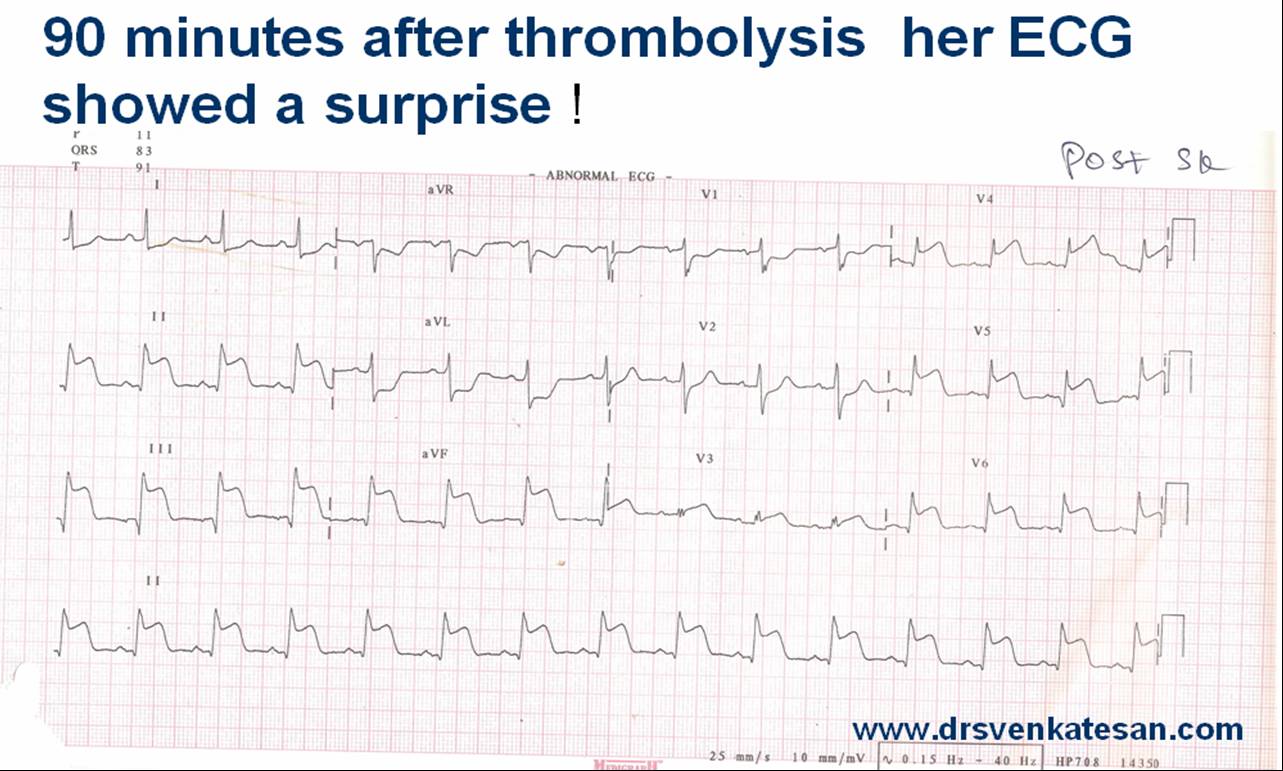
What we used refer  in our CCU (Madras medical college Chennai .One of the oldest CCU in  South Asia )

as   “Action pontentialisation”  of surface ECG . This ECG finding has  great  clinical significance .

Here is a zoomed up view of a qrs complex of  the patient , which is very

closely resembles an action potential

Picture courtesey  http://ocw.tufts.edu/Content/50/lecturenotes/634488/634591

Pathological basis of  “Action potenial”  Like ECG

  • When the ST elevation is huge and wide it mimics  an action potential .
  • Myocyte action potentials are normally recorded epicardially in physiology lab where a  micro electrode with glass pipettes directly enter the myocyte.
  • A giant ST elevation and a sustained dome indicate , the quantum of  electrical injury is  very large and the  ECG electrodes is picking up the myocyte electrical events like that of a intra cellular electrode.
  • It is to be recognised  ,  ST elevation in chest leads is substantially taller than limb leads   because the exploring electrode  is located just above the myocardium . But,    when a  huge  ST elevation  is recorded  over a limb lead (as in this patient )  one can imagine ,   how intense the electrical  charge  of  the myocardium  should  have been  !

This heavy downpour of electrical energy that  emanate from the myocardium   means two things

  • The area of infarct is very substantial
  • The tissue in question is  very unstable .

Clinical correlates of  action potential ECG

  1. Damage is transmural , the   infarcted area is soft, friable and often hemorrhagic .
  2. The pericardium is also  likely to get involved in the injury process .
  3. The myocardium is  rupture prone or already torn .
  4. Even minor hemodynamic stress can be fatal in these patients
  5. An episode of vomiting, a fall in blood pressure,   an episode of  LVF or a short run of VT is suffice  to result in a fatality.

The death happens by a sudden rupture ,  EMD and asystole .

Can a life be saved  by the much fancied Emergency PCI  ?

Not really. The PCI  can not reverse the myocardial damage ,  so it’s role is little . But , any way it should be done and  .  .  . it  will  be done  in most institutions to give the benefit of doubt (Of course , with  a definite the risk of doubting  !)

What is the risk  of  PCI in these situation ?

The infarct related artery * if opened up can convert a bland infarct into a  “angry red”  hemorrhagic  infarct .This   is as good as  giving  the patient ,  a  farewell  party for his journey to heaven !

Note : Primary PCI  definitely  saves life in STMI . The  * is applicable only in persistent ST elevation , late after an acute MI.

How could  have the above death prevented ?

As one of the comments to this article  suggested, we need to have methods to identify impending rupture early and accurately .This should  followed by a prophylactic  surgical intervention (Reinforcing the friable myocardium – with a patch or mesh  )  .This is again not  a easy decision to make .

Final message

When the ECG  assumes  a shape of an  action potential ,  it is often a sign of  imminent  death  . Even though it may sound a pessimistic  view  it is often the truth  . Of course , an  emrgency PCI or  CABG  are  the only options available , we have  to be remember the above truth  ,   as we   play  those sophisticated  games  within their coronary arteries.

Read Full Post »

Human body is  now  approached by many of the physicians as  collection of  multiple  organs . This is  the price we pay for modernity in medical science. The era  of great physicians  in general medicine has gone . Now, a  super specialist  of one organ  is  rarely concerned about what is happening to the patient’s  other organ ,  it is  considered    foreign to him  ! While ,  this is the dominant thinking pattern of   modern-day specialist

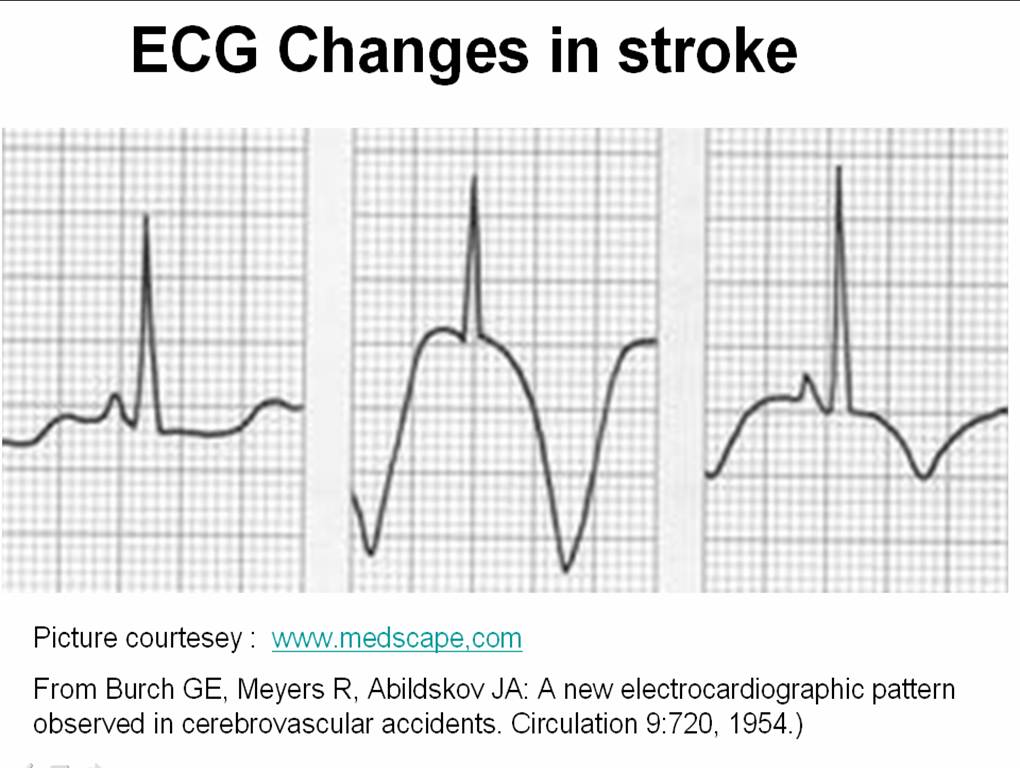
Let us  travel intime  and  go to the year 1954 . . .

Three  physicians from Michigan ,USA  published  one of greatest observation in clinical sciences , namely the ECG changes in various forms of stroke .

Now , a shrewd physician  , will  suspect a subarachnoid hemorrhage (SAH) by looking at the ECG when the clinical situation demands . But , what we need is every one should develop that skill . We have seen errors happening  even in big institutions (or is it because it is big ?)  when  an elderly person comes with deep T  inversions with or without  altered sensorium being rushed into  CCUs  & cath labs instead of  neurology units.

We  need to teach  our junior  colleagues  . . .  That ,  ECGs of patients with  acute neurological syndromes  (ANS)  can mimic as acute coronary syndromes (ACS) ( especially in elderly ) .

The following ECG changes * are observed during stroke

  • Deep  T wave inversion –   Sub arachnoid hemorrhage
  • Cerebral thrombosis   –      Prolonged QT interval, U WAVES
  • Cerebral hemorrhage –      ST segment  shifts /T inversion


The ECG changes tend to occur very early after CNS injury.May last up to 1 week. They are not useful to identify the type of stroke. But , deep T wave inversions strongly suggest SAH rather than ICH or thrombotic stroke.

What is the mechanism of these ECG changes ? 

It is a clear proof that heart and brain are interconnected by neural network. All the noted changes occur during myocardial repolarisation . (ie ST segment )  The current thinking is  (Ofcourse , it is same as our thinking  in 1950s !)  it is mediated by adreneergic surge  initiated by CNS insult  transmitted to  myocardium by the sympathetic system.

Why should SAH produce more  ECG changes than others ?

It is possible the net adrenegic drive from the brainstem and spinal cord will be greater in SAH as it  spreads the entire CNS  through the cerbro spinal fluid. While localised ICH and infarct is  likely to generate less adrenergic impulse. 

Reference

Read the link to circulation 1964 .With courtesey to circualtionaha.com

http://circ.ahajournals.org/cgi/reprint/9/5/719.pdf

This came 50  years  ago , we still quote their work and no one has improved their work . 

Final message

If  only  we make the  clinical bed side teaching as a  regualr habit ,  we  do  justice to   our  great  physicians of the past ,   who enriched  our  life  with their  clinical  skills  and  passion for knowledge  sharing .

Read Full Post »

  • It is only rarely a journal of International caliber is published from India . IJEP is one such journal.
  • Cutting edge articles on Electrophysiological science  break here !
  • This is an online journal . No print issues . Enjoy, it is free !

Here is the  Link

Just sample an article  : A great review about cardiac arrhythmias in congenital heart diseases , Must read by  all cardiologists    http://www.ipej.org/0906/khairy.htm

Read Full Post »

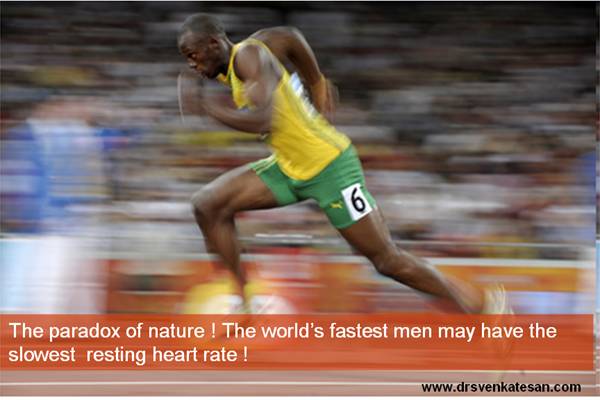
ECG of an athlete is many times difficult to interpret. The influence of autonomic tone in  athlete’s heart is an complex one.Contrary to our expectations the parasympathetic tone is higher in well trained athletes. The resting heart rate can be as low as 30/mt which is 99.9 times pathological in non athletes.This happens due to a concept called accentuated antagonism.The athletes who have episodic surge of high catecholamines keep stimulating the para sympathetic neurones in a constant fashion.

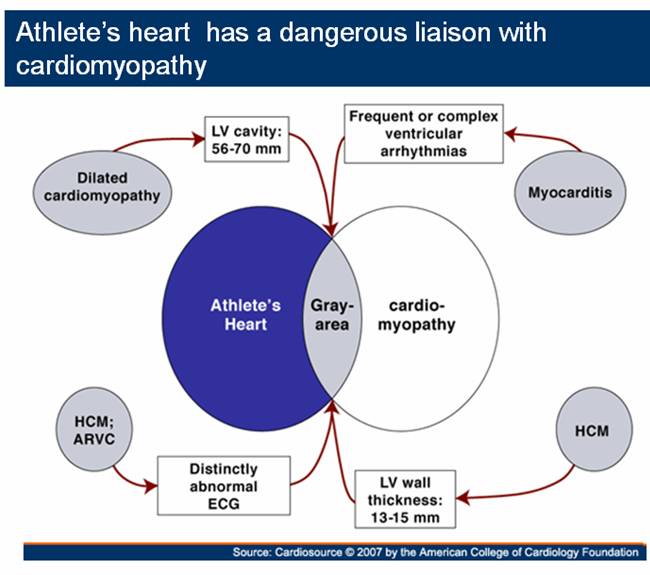
LVH is the most common feature.Here there is simple myocyte hypertrophy, without pathological fibrosis.This differentiates athlete’s, heart from HOCM .

Many ECG abnormalities are reported in athletes.

Excerpts from the ACC recommendation

1. Electrocardiographic findings that are common and training-related and that do not require additional evaluation are sinus bradycardia, 1° atrioventricular block (AVB), incomplete right bundle branch block (BBB), early repolarization, and isolated voltage criteria for left ventricular hypertrophy (LVH).

2. Uncommon and training unrelated electrocardiographic findings that mandate further evaluation include T-wave inversion, ST-segment depression, pathological Q waves, atrial enlargement, a hemiblock, right ventricular hypertrophy, a BBB, or a Brugada-pattern of ST-segment elevation.

3. Training-related electrocardiographic findings are more common in men than women, athletes of African descent, and high-endurance athletes such as cyclists.

4. Sinus rates <30 bpm and sinus pauses >2 seconds are common in highly trained athletes, particularly during sleep.

5. A normal chronotropic response to exertion and the absence of bradycardia-related symptoms distinguishes training-related sinus bradycardia from sinus node dysfunction.

6. 1° AVB and Mobitz I 2° AVB are common, but Mobitz II 2° AVB or 3° AVB should not be assumed to be training-related and require evaluation.

7. Early repolarization in Caucasian athletes most commonly consists of upwardly concave ST-segments and tall and peaked T waves; in black athletes, there often is convex ST-segment elevation and negative T waves, mimicking a Brugada pattern.

8. In the presence of voltage criteria for LVH, pathological hypertrophy should be suspected if there is left atrial enlargement, left-axis deviation, repolarization abnormalities, or pathological Q waves.

9. T-wave inversion ≥2 mm in ≥2 adjacent leads should prompt evaluation for structural heart disease.

10. Electrophysiological testing for risk stratification with possible catheter ablation is appropriate in athletes with ventricular pre-excitation.

Source :  Fred Morady, M.D., F.A.C.C.

http://www.ncbi.nlm.nih.gov/pubmed/19933514?dopt=Abstract

For an excellent article on the topic click here

Read Full Post »

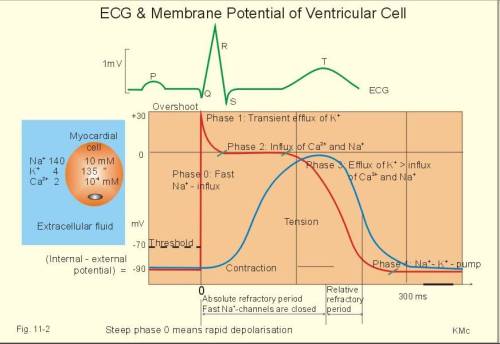
Here is  the link  to  one of  the best illustration for cardiac action potential  which I  have stumbled upon !

Spend some time on the following illustration  depicting  the  normal  cardiac  action potential that  explain the ionic movements . Understand why a cardiac muscle has two refractory periods , why there is a sustained dome for  myocardial action potential  and this is missing in SA and AV nodal potential ?

Click below to reach the online book

Textbook in  Medical Physiology And Pathophysiology

Essentials and clinical problems Copenhagen Medical Publisher

Note :

Red curve indicates electrical action potential .Blue depicts the mechanical contraction . Both red and blue curves together form the electromechanical systole. Realise  ,   QT interval  represents electro mechanical systole . It  includes both cardiac depolarisation and repolarisation .

There is a inherent tendency for our brains  to equate depolarisation with systole and repolarisation with diastole .It is totally a wrong perception. Please , be aware of this !

Identify the gap between the  red and blue curves that represent 50%  of ARP  .This is the time the myocytes can not be stimulated whatever be the  power of stimuli because the Na  channels are closed .

Understand ,the above action potential  represents only half of the cardiac cycle as diastole is not fully illustrated here .Recognise  the fact ,  diastole begins at the end of phase 3  and  goes into phase 4 as diastolic depolarisation  by a slow Na current.

After learning   the basics of action potential   read about the antiarrhythmic drugs . You will get to understand it better .

Learn  which drug acts on which receptors or channels and what does it do  to the various intervals  .For example ,  any drug that is prolonging an action potential  duration is fraught with risk of  ventricular arrhythmia as it is synonymous with prolonging QT interval (Eg Class 1 A /1B/Class 3) .

Sicilian gambit is the receptor & channel based classification for anti arrhythmic drugs . (Sicilian gambit 2 )

  • Understand the paradox of  QT interval getting shortens with Class 1 B (ligocaine /Mexilitine ) while 1 A  does the opposite !

Class 1   Drugs blocks sodium channels .The blockage  occurs in  a complex rate dependent fashion . It blunts the slope  the phase 0 and hence prolongs the action potential .

Class 2 . Beta blockers

Class 3 . Blocks K + Channels and hence prolongs the AP

Class 4  .Calcium blockers

Finally  don’t forget to say thanks to Copenhagen medical  publishers  for this excellent illustration .

Read Full Post »

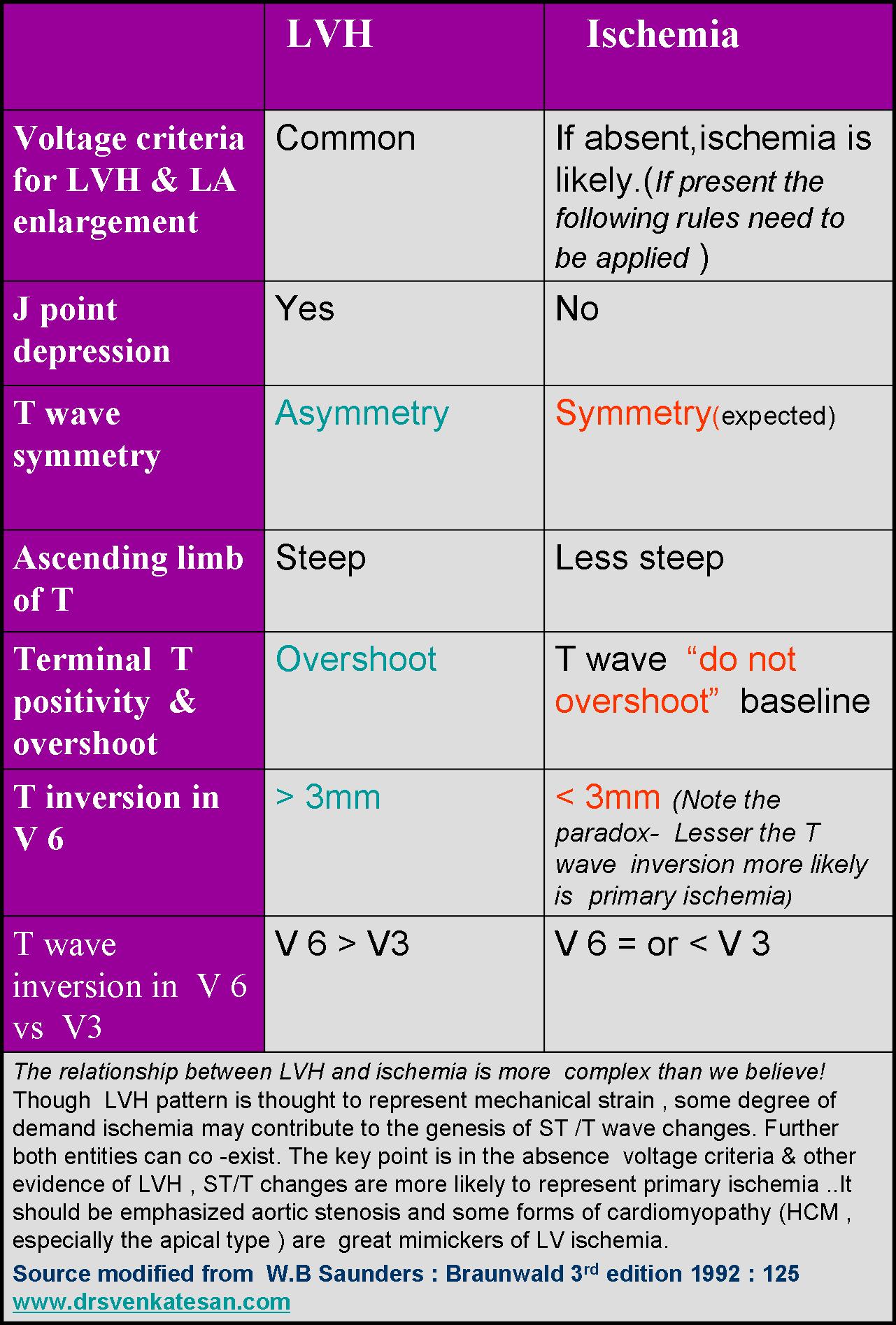
The most common ECG dilemmas one encounters is to differentiate between the ST segment depression and T wave inversion due to LVH from that of primary ischemia.

Very often  , the entity is misdiagnosed . The implication can be serious , and adding further complexity is exercise stress testing is alos prone for errors in these group of patients as false negative or positive results are very common due to basline  ST/T changes.So it needs a CAG to confirm or rule out CAD in many .

Still the clinical acumen with the help of ECG can help us to a great extent !

A rough and approximate way to identify primary ischemia is given below.

Though these  humble ECG features may not be specific to diagnose CAD . One  need to remember even a normal coronary angiogram is  not synonymous with normal coronary arteries !

Read this blog on limitations of CAG .

Read Full Post »

Looks very much a infarct of  infero posterior territory is it not ?

Have a look at her 2D echo still picture . . .

Are you convinced ?

This women had normal LV systolic and diastolic function with no evidence of constriction.

The explanation for the asymptomatic pericardial thickening is due to a healed  chronic pericarditis .This sort of localised thickening in the posterior aspect is all the more likely following a loculated pericardial effusion.Tuberculosis is a very likely etiology.But this women do not have any markers for tuberculosis.Since she is symptomatic no treatment was offered.She is being followed up.

Discussion .

Q waves are not ” sacred waves” to diagnose myocardial infarction.It simply indicates the  direction of current flow is away from the  recording lead of the ECG .Any thing  electrically inert , that come in the interface between the heart and the recording electrode   can record a q waveWhat are the pathological entities that can produce q waves other than infarct ?

  • Fibrotic myocardium(DCM-Cardiomyopathy)
  • Myocardial Scars
  • Myocyte dis array(LVH, HCM)
  • Air,fluid in pericardium /pleural space
  • Pericardial thickening (As in this patient)
  • Electrical shortcircuits (WPW syndrome)
  • Rarely pure ischemia without necrosis can produce q waves (Electrically stuned myocardium)

Final message

Localised pericardial thickening is  a rare  (?unrecognised) cause for pathological q waves , that may mimic a MI.

Read Full Post »

Wide qrs tachycardia has a unique place in clinical electrocardiography .It is  a much fancied and glamorous entity for the simple reason , it continues to be the  cardiologist ever solved puzzle .For over three decades of research, clinical debates , symposiums , seminars have effectively failed to take away the uncertainties in decoding the wide  QRS  tachycardia . (Specifically ,  VT vs SVT with aberrancy)

Some wondered , should we really waste our efforts in differentiating the two . In emergencies it never matters , in fact one need  not attempt to do this often futile exercise !

Few dedicated criterias like Brugada etc have helped us .

While the difficulties in differentiating between VT and SVT with aberrancy remain over the decades .A less reported  , but more common issue is  confronting  us .

It is  the big question of  differentiating a  wide  QRS tachycardia from a narrow QRS  tachycardia

wide qrs tachycardia vt svt aberrancy

This  occurs  more often than we realise  ,because we define wide  QRS  tachycardia in a vague manner

  • Normal qrs width between Up to 80 / up to 100 ms acceptable  ?*
  • Narrow qrs tachycardia 80 ms?
  • Wide qrs tachycardia i> 120ms  ?
  • Definitely wide qrs >140msec

* The confusion is mainly because 20ms difference between limb leads and chest leads .

In reality one may not be able to all  tachycardia into narrow or wide .

There is big  overlap zone that need to be labeled a intermediate qrs tachycardia

If we can  triage the tachycardias into three instead of two it may help us arrive  fast  ,  to the  correct diagnosis

Narrow QRS tachycardia ( qrs 80ms)

  • Sinus
  • All svtS (avnrt etc)

Intermediate QRS tachycardia 90-120

  • Most of the SVT with  aberrancy  ( Except antidromic SVTs which are really to wide !)
  • Septal VTs*
  • Fascicular VTs*
  • VT in PPM and ICD /CRT patients **

*  Any VT that arise near the major conducting system of ventricle conduct  fast and hence qrs are relatively narrow.

**These are rare entities where  base line wide QRS getting narrower with the onset of VT . (Ref : http://europace.oxfordjournals.org/cgi/content/full/eun254v1)

Wide qrs tachycardia >120ms

  • Most of the genuine VT (Ischemic , myocardial origin)
  • Post MI VTs
  • SVT aberrancy especially AVRT
  • Any SVT with preexisting BBB
  • Marked electrolytic disorders

Unresolved questions

  • Which lead we should look for measuring the width of qrs ?
  • Should we take the narrowest qrs or widest qrs or should we take the average ?
  • Should we calculate how much the tachycardia has widened the qrs from the baseline  width of a given patient ?  Is it not possible , what is wide for some may be normal for another !
  • If  there is no isoelectric line  and ST segment  blends with qrs complex  how to mark end of qrs ?
  • If  limb leads show a narrow qrs and chest leads shows  wide qrs what is the significance  ?
  • In precardial leads  if one lead alone shows a narrow qrs , what is the significance ?
  • Can a narrow qrs VT conduct  with aberrancy and making it  really  wide ?

Final message

When we are  able to solve   complex electrophysiological  problems  , we must also realise  even   simple  tasks can be demanding in medicne ! It is proposed to create a  new  group “Intermediate QRS tachycardia “that can help solve the issue where we have difficulty in labeling these  tachycardias which fall  in the  greyzone .We can try &  apply the modern EP based VT criterias  to this group and find out the hidden truths !

Read Full Post »

AV dissociation is  common clinical situation that can occur  during both    bradyarrhythmias  and tachyarrhythmias .

Bradycardias

  • Complete heart block
  • During pacemaker rhythms

Tachycardias

  • Accelerated junctional  rhythm
  • Idioventricular  rhythm
  • Ventricular  tachycardia

AV dissociation is essentially an  ECG diagnosis. But it is associated with some  clinical  signs   ,which can be detected by an astute physician in the bedside. At rapid heart rates  it may be really difficult at times to recognise theses findings, but a  cardiology fellow should look for these whenever they encounter AV dissociation  in ECG.

  1. Varying pulse volume
  2. Varying korotkoff  sounds during BP measurement.
  3. Cannon a waves in JVP
  4. Varying intensity of first heart sound on auscultation
  5. Mitral regurtitant murmur may be heard
  6. Hypotension in compromised hearts

What is the mechanism of clinical signs of AV dissociation ?

During AV dissociation , the atrial and ventricular contractions occur  out of phase  and the sequential contraction  is lost. So atrial contractions  might  occur with a closed AV valves .  This result in reflux of blood into the neck resulting in cannon waves . It may be visible only in few beats as the retrograde conduction VA conduction , is highly variable.

Further , only some atrial beats contribute for ventricular filling some do not.This results  in varying LV volumes and this  could result in changing pulse volume.Occasionally the ventricular and atrial   contraction occur simultaneously  .When this happens ,  some amount of blood  reguritates through the open tricuspid valve and mitral valve  which result in MR or TR .

Clinical utility

This could be important , in differentiating  the perennial  issue   of decoding the   wide qrs  VT from  SVT with  aberrancy .A rapid clinical assessment  here could  aid in the diagnosis  of VT  by  identifying  AV dissociation  . An experienced cardiologists will realise even in a given  ECG  with VT  identifying or ruling out  AV dissociation is not always a  pleasant excercise !

In this era of  high tech gadget  oriented cardiology is it not too much  to call for clinical   recognition of  this  entity ?

Definitely not , if  we know Wencke bach  recognised  the classical type 1 2nd degree  AV block in late 19th century even before the ECG machine was  invented ,

Simply by looking at the neck , by carefully observing progressive prolongation of  distance between a and c waves and subsequent dropping of c waves . Amazing isn’t it ?

Read Full Post »

The right ventricle  is a unique  chamber of the heart . It is the anterior most chamber and  triangular in shape.  Even though  the walls of RV are  not  clearly demarcated ,   it does  have  anterior ,  posterior, and lateral free surfaces   . Anatomically it has a inflow  body, apex and outflow portions . The apex of right ventricle , blends with the lower IVS at an acute angle.

How does RVH occur anatomically ?

The anatomy of RV is such that  it does not allow  it  a concentric  RVH ( like LVH ) . In fact , there is a  disproportionate free wall , anterior  wall   hypertrophy  many  situations  like  PHT/Pulmonary stenosis. The  infero posterior aspect of RV rarely show hypertrophy.

Since RV is the anterior most chamber, located just beneath the left border of sternum   RVH brings the RV  further closer to chest wall .This makes the V1 lead to show  tall R in V1.

What happens in RVMI ?

Unfortunately, when we  refer to RVMI , we generally do not make any efforts to locate or estimate it’s  size.  Since RV has , anterior , lateral and posterior surface  , the site  and  the  extent of the  mI will have a major impact  on the  ECG  features .

Most often  the RVMI occur as a  part of infero posterior MI  .Hence ,  it is uncommon for the anterior surface of RV to get involved.  But ,  it can be involved if  RCA gives of a   large RV branch  that reach the anterior surface of RV.

Anterior RVMI can occur as a part  of LAD MI  , if a large conal branch cross the RV surface.

What prevents the lead V1 from showing the  ST elevation of RVMI ?

  • Most of the RVMI do not involve the anterior surface of the RV so , less chances for ST elevation
  • Further , if a true posterior wall  MI  occur as a part of  RVMI (Which is often the case !)  V1 can never  show ST elevation  as the  posterior MI  tend to have a ST depressing effect in the V1, V2 leads.
  • Extensive IWMI , can have reciprocal ST depression in V1-V2.This again , prevents V1 lead to show the ST elevation

So many times , even though V1 lead is just sitting over the chamber RV it fails  to  pick  the  ST elevation forces of RVMI

Advantage of V4 R ?

V4R records remote RV forces , as these  signals are not contaminated by the inferio posterior ST forces. Hence  a  1mm ST elevation in right sided chest leads have good sensitivity  and specificity to diagnose RVMI .

When can V1 show ST elevation in RVMI ?

If the RV anterior wall is predominantly involved (Ie Anterior RVMI ) ST elevation can occur in V 1 like a anteroseptal MI.

rvmi ecg

Rarely a q RBB can occur in V1 in isolated RVMI.

Final message

V1 lead , though anatomically proximal to RV has less value in diagnosing RVMI since this lead picks up  Infero posterior  negative ST forces  and  the anterior  forces of RVMI get neutralised . So relying on lead V1 to diagnose RVMI is not adviced , except when  the anterior surface of RV is predominatly  involved.

Read Full Post »

« Newer Posts - Older Posts »