Feeds:
Posts
Comments

Posts Tagged ‘ECG’

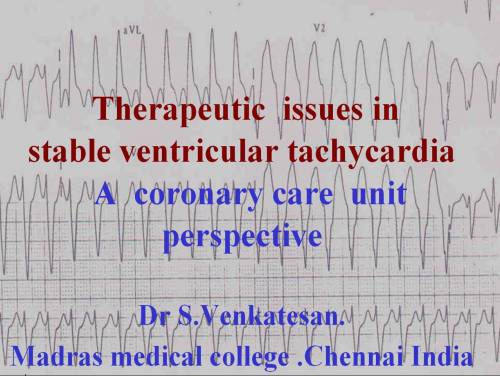
Ventricular  tachycardia (VT)  is one  of  the   dangerous form of  cardiac arrhythmias.

When it occurs , it may present  in  many ways

  • Cardiac arrest with immediate degeneration into ventricular fibrillation. 
  • Pulseless VT in a  conscious patient but in  in shock.
  • With pulse, relatively stable , not much fall in blood pressure.
  • Incidentally detected.*(Rare)

This , gives us  an idea  that VT  as an electrical abnormality has wide clinical presentations , life threatening  at one end and,  patient walking into the hospital with minimal palpitation on the other hand !

The management issues

  • In patients with hemodynamic instability , decision making is easy as there is only option of DC shock.
  • In patients with stable VT, it is natural for the physicians to get tentative or even confused.This is because , dangers of shocking a stable patient has to be weighed against the currently available excellent antiarrhytmic drugs( Amiodarone, Ibutilide etc) .


The major issue here is  in  ruling out underlying structural heart disease.

Never shock a stable VT, without knowing the myocardial and valvular function.There has been many occasions underlying  severe LV dysfunction is missed   and they may go for asystole.

VT in the setting of cardiomyopathy, Post MI(Scar mediated) are often refractory even to DC shocks.It is the drugs that will  ultimately control the arrhythmia.DC shock is just used to terminate the VT.

VT  structurally normal heart , especially arising the outflow tracts of LV or RV  behave very differently (Fortunately they are more benign)

  • Have less hemodynamic  impact as it involves the outflow tract and  not over the  the pumping  zone of LV as in conventional ischemic myocardial VT .
  • They  respond to calcium blockers  verapamil to be precise (As they share properties of SVTs)
  • Sensitivity to verapamil by no way convey a meaning of Amiodarone resistance.Out flow tract VTs will also respond to Amiodarone many times.
  • Degeneration into VF is rare.


Also  read  Therapeutic issues in stable ventricular tachycardia

Presented and published in Indian heart journal
vtvt-therapeutic-issues1

Click  on link download PPT ventricular tachycardia


Related topics

Why some ventricular tachycardias are resistant , even to multiple DC shocks ?
Read Full Post »

  • Gastric pain is a great mimicker of cardiac pain.
  • It may have , almost all the typical characters of angina . . . in some cases ECG changes too.
  • The confusion is complete ,  as esophageal pain can also  be relieved by sublingual nitrates !
  • The issue is further complicated, when  esophagus and coronary artery share  the same neural codecs, and each may induce spasm among themselves !
  • It is thought , of course with  some  evidence !  many of the syndrome X  patients ( positive stress test with normal coronary arteries )  have esophageal motility disorders.
  • The ST segment depression during EST  in these patients  is apparently attributed to  stress induced esophageal spasm !
  • And many of the patients with variant angina  ,  have associated esophageal sapsm .

Read this land mark concept paper  documenting the neural link between esophagus and the coronary artery

Click on the article

esophagus


Final message

  1. Don’t ever forget the esophagus in your scheme of things when evaluating  CAD.
  2. Realise  that esophageal disorders  not only cause non cardiac pain but also cause    ischemic chest pain (Also called linked angina)
  3. EsophagEal  smooth muscle cell  can  exert electrical influence on the ST segment of  cardiac ECG !(After all every cell

has an action potential )

Read Full Post »

ecg-ventriculophasic-21

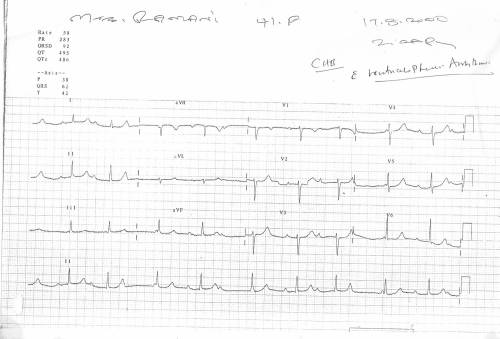
Ventriculophasic sinus arrhythmia is a non-respiratory sinus arrhythmia seen in complete AV block.

The PP interval enclosing a QRS complex is shorter than a PP interval not enclosing a QRS.

The Mechanism 

ecg-ventriculophasic-sinus-arrhytmia1

The proposed mechanism is the  increased blood flow into the SA node artery  during ventricular systole  stimulating it to produce an early pacemaker activity and thus shortening the sinus cycle length.

Clinical significance : None for the patient  Academic purpose for the students

Read Full Post »

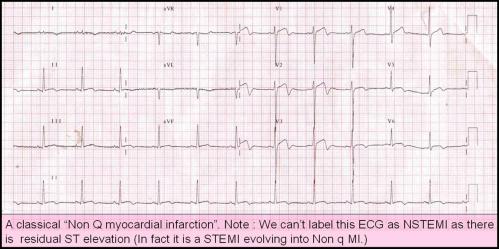
                                Acute coronary syndrome (ACS) is currently classified as STEMI and NSTEMI.This classification came into vogue  primarily to  triage patients for thrombolysis eligibility , as ST elevation is the  only criteria for thrombolysis.The  earlier term  non q MI  is largely used  to denote the  present day NSTEMI. In the past q  MI was referring to transmural MI non q MI  to non transmural  pathologically.(Of course , now we know  the relationship between q waves and transmurality is not good )

So when can we still use term non q MI ?

These terminologies of STEMI and NSTEMI are made on admission  at the emergency room.  ACS being a dynamic entity these  patients can  have rapidly changing  ST shifts , from depression to elevation and vice versa. Fresh T wave changes can also occur .Q waves  may or may not develop ,  depending upon the damage sustained to the myocardium and the efficacy of thrombolysis / PCI. So it should be emphasised here STEMI,  NSTEMI ,  q  MI ,  non q MI are the  descriptions of the  same group of patients in different time frames. The common mode of  evolution  of  STEMI  is  to q MI and NSTEMI  into non q MI. Cross overs can occur.


 The problem here is NSTEMI getting converted into STEMI  is quiet common and has no nomenclature issues . But  when   STEMI down grades  into NSTEMI  there is apparent  nomenclature incompatibility .This category of  patients have  no other labelling option other than “A STEMI evolving into non q MI”. Because one can’t label  STEMI  evolving into NSTEMI as  many of  them  will  have a residual ST elevation as well.

What is the final message ?

The term non q MI is still relevant and is used at discharge , in a patient with STEMI when he or she evolves without a q wave .In the setting of unstable angina , NSTEMI has largely replaced  the term  non q MI either on admission or at discharge.

Before I close

                 The important point to remember here  is NSTEMI getting converted into STEMI  is an adverse outcome and  in fact, it is  a complication and the patient should get an immediate  thrombolysis or PCI , while a STEMI getting converted into non Q MI is generally a  major therapeutic success.( Effective salvaging and preventing q waves )

//

Read Full Post »

Ventricular fibrillation is invariably fatal if not treated . When can atrial fibrillation be fatal ? 

                                     Atrial fibrillation is relatively a benign arrhythmia especially when it occurs in isolation with  structurally normal heart.This is sometimes referred to lone atrial fibrillation . Even otherwise, atrial fibrillation is rarely fatal except in few situations.But AF commonly destabilises the patient  who have baseline valvular or myocardial disease.(Post MI, dilated cardiomyopathy etc)

There are few situations where AF can be life threatening

  • In patients  with WPW syndrome*where , AF  enters into a electrical short  circuit , downhill to enter the ventricle and make it fire at the same rate as that of atria . ( ie 400-600) and result in ventricular  fibrillation.Note , even here it is the VF that kills  not , AF per se.
  • AF in acute MI  often precipitates LVF , but rarely fatal.
  • In patients with critical aortic stenosis, or hypertrophic cardiomyopathy, sudden onset of AF can result in acute cardiac failure.
  • AF is often a terminal event in primary pulmonary hypertension

While atrial fibrillation is  less likely to cause  death , it is  a highly morbid arrhythmia .It is one of important cause of stroke in elderly as well as young !

Read Full Post »

Chest pain is one  of the commonest presenting symptom  in any  hospital both as  an emergency  or non emergency. Reaching an accurate diagnosis is very important. The main  purpose of evaluation of chest pain is to recognise it as cardiac or non cardiac origin . Cardiac chest pain almost always means ischemic chest pain . That is called angina. (Of course there are few important causes for non ischemic cardiac chest pain which Will be discussed later).

Standard features of typical angina.

Chest pain which falls short of typical features are called atypical chest pain . Some recommend at least three typical features to label it as angina.
After the clinical examination patients  should be categorised in one of the following .

  • Typical angina
  • Atypical chest pain
  • Non cardiac chest pain** Non cardiac chest pain is not a diagnosis. Any physician (or a specialist)  should take some effort to localise it. (Muscle, nerve , pleura , anxiety  etc) . But  generally once these patients are ruled out of cardiac pain  they become less special and are simply referred back to their  family physician, only to return back  with  another cardiac  pseudo-emergency  in a different hospital .

    Why we are diagnosing atypical chest pain liberally ?

    Currently   more number of  patients as well as  the physicians  are   aware of the looming epidemic of CAD. The other major reason is the  lack of application of mind during  foirst clinical appraisal  and examination. Many of the patients with non cardiac chest pain  (Muscle, nerve , pleura )  are termed as atypical chest pain. Though some of the popular texts use atypical  chest pain  and non cardiac chest pain interchangeably , it is not  correct to do so. For example don’t ever label a  patient with chest pain with chest wall tenderness as atypical chest pain and order a cardiac work up .It  is a poor model to  emulate , that consumes time and resources!.Instead they should be diagnosed a confident non cardiac chest pain and dealt properly.

Once a patient is diagnosed  atypical chest pain what’s next ?

They should get a  complete physical examination,ECG, and  undergo exercise stress test.   In the  screening of CAD , angina can be termed a hard sign,  atypical chest pain is a soft sign,  resting ECG is surprisingly  a soft sign again (unless you record it during chest pain). Exercise stress testing is  the ideal  investigation in evaluation of  chestpain.( 70-80% accuracy). This can be improved upon by Thallium, SPECT, stress echo etc. As of now coronary angiogram is considered the ultimate gold standard (Not pure gold !) to rule out  CAD.

It is also worthwhile to remember non anginal  chest pain can also be an emergency and life threatening

  • Pulmonary embolism
  • Pneumothorax
  • Thoracic tumors
  • Aortic aneurysm (Dissection and non dissection)  The list is not  exclusive

Final message

What do we really mean by  atypical chest pain ?

In reality we don’t mean any thing !

When a  cardiac  physician is confused or rather , unable to  rule out angina , at the same time he is not confident of calling it as non cardiac chest pain,  he has the luxury of using this terminology . It is obvious  this terminology  should  minimally  be used.  Once diagnosed  these patients  can’t carry on with this tag  for long. They should be reinvestigated , (Right from history  and clinical ex) .They should either enter the cardiac work up  protocol  or  a non cardiac source for pain should be fixed  immediately.

Read Full Post »

Is reciprocal ST  segment changes  occur  only in STEMI ? Can it occur in UA/NSTEMI ?   


                      Even   after   100 years of electro cardiology   the electrophysiological mechanism of ST elevation in STEMI  and ST depression in Unstable  angina is   still in the hypothetical stages. One popular theory   says that the   current of injury   as we see   as  ST  segment elevation  in surface ECG  is  actually   an illusion. It’s   apparently due to   constant negative current    pushing down the   rest of ECG segments. Ironically   the concept   of  reciprocal ST depression in patients who have  ST elevation is well debated  for over 3 decades and  is considered  a  settled issue. It   probably   represents , a  purely electrical phenomenon where the  tail end  of the  lead   picks up the opposite vector. Even   as   conflicts   continue to confront the basic electro physiological   concepts management    strategies   of   acute coronary syndromes is witnessing   great strides.
Aim
                                     We   hypothesized   if   ST depression occurs as response to ST elevation it’s logic to expect strong ST depressive forces should  possibly elevate The ST segments in the reciprocal leads .
In fact  we have seen this phenomenon in three distinct  clinical situations. 
1) ST   elevation   in posterior leads: Patients who present   with isolated   ST depression in V1,  V2 , V3  and  ST elevation in posterior chest leads V7, V8 .These patients were initially thought to have isolated posterior MI. But later the cardiac enzymes were found to be normal   indicating no myocardial necrosis   echo evaluation revealed wall motion defects in anterior segments rather than in posterior segments. CAG revealed critical   LAD disease .  This we believe a pure reciprocal ST elevation in the posterior leads to  a  ST depressive forces in anterior leads.
 2) Inferior  ST   elevation   with ST depression   in   V4- V6 : Few  patients who present with  infero    lateral STEMI   later  do not  evolve into  Q  MI but as a NSTEMI .The initial ST elevation  was found  be transient and  disappeared  much earlier,  while the  ST depression  lateral leads persisted.
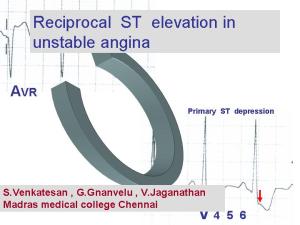
 3) ST elevation in AVR   in high risk unstable angina :As   already reported in the literature,  we have seen  ST  elevation in AVR  in patients with  high risk unstable angina. This was   more often observed when there is > 3mm ST depression in V4-V6. The AVR  ST elevation  possibly   represents   the  reciprocal  vector.
    Conclusion
                                            ST elevation in certain   specific leads in   some of the patients with ACS,   could   be   a pure reciprocal   electrical phenomenon   to   dominant ST depressive forces in Opposite leads .  And hence   ST elevation in the surface ECG during early hours of ACS   should be interpreted more cautiously. The   sanctity   assocociated with ST segment   elevation   could  be  opened   for debate. 
 
                                     To down load full PPT  click on  the slide

//

Read Full Post »

« Newer Posts