Feeds:
Posts
Comments

Posts Tagged ‘stemi’

Thrombus formation  and subsequent lysis  either spontaneous or pharmacological is the key events in acute vascular emergencies .We know both STEMI and acute strokes can get aborted  naturally.

The thrombus which initially forms , triggers a natural lytic mechanism and this fights vigorously against the clotting process , and tries to get rid  of the intravascular clot.

The early  minutes are vital. (Like the T 20 cricket )  the win or loss is decided in the first few overs . The mantra is unrelented attack of the ball . . .ie thrombus !  In some patients  the clot  can never grow big to fill the lumen.These are lucky few .The mechanisms are common in both cerebral and coronary circulation. Here is were comes the role of antiplatelet agesnt .An aspirin or clopidogrel administered within minutes can prevent the genesis of  central core of the thrombus .(This is the  secret of aspirin scoring over stretokinase in STEMI in ISIS2 study done three deaceds ago !)

It should be realised,  our understanding about spontaneous lysis is very little considering explosive growth of other aspects of cardiology. It is mediated by circulating  TPA and antithrombin 3  .  Remember  every humans have it in their  blood .But how much ? How to augment it ‘s power at times of thrombotic crises ?

What could be the clinical correlates of spontaneous thrombolysis ?

  1. In brain classically it is TIA .
  2. In heart do we have TIA equivalents ?  .Yes it transient rest angina

Link to video on TIA of the heart

Read this article to get a glimpse of  natural cerebral thrombolysis  and shall we   extrapolate it to coronary spontaneous thrombolysis  .Why not ?

Arch Neurol — Nonocclusion and Spontaneous Recanalization Rates in Acute Ischemic Stroke: A Review of Cerebral Angiography Studies, December 2002, Kassem-Moussa and Graffagnino 59 (12): 1870

Read Full Post »

Chest pain as a symptom in  acute MI is vitally important as it only  brings the patient  to the ER. (Realise ,silent MIs  can never reach the hospital in time ! ). Heart is  located  few  centimeters beneath the chest wall and extend up to  15 cm posteriorly.The location heart within the chest wall  , make it a  three dimensional structure .Theoretically  pain can initiate in one focus and radiate to any direction. Traditionally , when we say  chest   pain , we mean the anterior chest wall on either side .Technically , chest contains a lateral  and a posterior wall .The posterior  surface of the chest is called back of chest , or some times simply the  back .

We know , chest pain can radiate to many sites , of course the  much hyped  (May not be common yet !) being  the radiation to left shoulder , and arm.

The ischemic chest pain , even though described  as classical angina over a century ago . It applies mainly to stable exertional  angina .In    STEMI  or  unstable angina  these rules are   can not be expected to be followed  strictly.

We often think the pain of MI comes only from the myocardium ,  but there are many potential sources

  • The adjacent pericardium
  • coronary artery dissection, plaque fissures
  • Neuralgic pain from the  ischemic  nerve terminals
  • Finally dermatomal  reference pain

What is the quantum of pain signals  arise from each of these  components ?   Obviously ,  myocardial pain should be the dominant one .Here again ,  there is a dichotomy .Whether   the infarct segment elicits more  pain or the surrounding  ischemic   segment is also not clear. The  is an important difference the character of pain infarct pain is a  severe continuous  dull  aching .Some believe in   a fully infarcted segment where the nerve terminals are dead can not carry  pain  signals and pain is absent, while partially dead muscle produce maximum pain.

The somatic nervous system , that mirrors the visceral pain  into the dermatomes that the patient  feels as if the pain is originating from these sites. Heart is a huge middle mediastinal structure , primarily reflects the pain to the anterior chest wall , but  no surprise if it deflects  the pain signals posteriorly  also. Of course , the spine and the thick posterior chest muscle walls tend to  block this transmission.

But , on many occasions  patient who are admitted with ACS in CCU complain pain in the   back of chest

the following things has been observed.

  • Severe back pain in  a patient with large STEMI invariably indicate a myocardial tear .
  • Mesentric and coeliac artery occlusion
  • Aortic dissection

Back pain only STEMI

Every cardiologists would have seen atleast   few cases of STEMI presenting only as back pain.The problem here is they land up in varied departments .We have on instance of  a STEMI landing to a ortho surgeon .He was good enough to suggest an ECG and that showed an extensive infero posterior MI and later shifted to coronary care unit.

Back pain as marker of impending rupture

Severe back pain in an established STEMI is a ominous  sign as it is often a  marker of impending rupture. Here the patient is in extreme distress, and may become violent and restless .(Hypoxia adds to woes!)

Does posterior  MI  more likely to produce back  pain or posterior chest pain ?

Not proven  but distinctly possible.  ( posterior MI -Posterior pericarditis- Back  pain .)We emphasize  posterior  chest leads  in  ECG V7  to V10 in inferoposterior MI .  We  expect  the injury current to  flow to  the back , is it not logical  some of the neural signals would  also  reach the back.

Final message

Never underestimate back pain. We are tuned to think chest  has only one surface that is anterior .This is a gross missense .After all , there is a huge area(> 30X 30 cm )  of chest wall located behind us .

Take an ECG in all patients with  acute  pain  in the back of the chest . Even though this may look a  funny advice   . . . it is  an  important clinical tip   for all those  budding physicians  of this world. If  one life   is  saved per 100 innocent back pain cases ,  this article  acheives it’s purpose !

Read Full Post »

Drug eluting stents are liberally used  worldover .

It is very unfortunate ,while the jury is still confused about the role of DES  “even”  in chronic coronary syndrome ,

There has been widespread use of DES in  the   potentially hazardous    thrombotic milieu  of STEMI  . It is well known  the DES ( polymer and drug)   has a dangerous liaison  with the thrombus.

Even as the evidence base was about to accumulate against the DES in STEMI , there was  an undue haste in the use of  this stent in STEMI .

Now in 2010 the results are out the DEDICATION trial

  • The culprit is out
  • The truth exposed
  • DES kills more life than bare metal stents   during primary PCI

Read this article  ,just released in Atlanta 2010

http://www.cardiosource.com/clinicaltrials/trial.asp?trialID=1618

Read Full Post »

Common sense would  indicate  medical care is  meant for the sick and ill  . Relieving  the mankind  from all those  suffering  with a healing hand has made the  medical profession noble and sacred .Medical science   grew with this sole aim  many centuries ago  .Some  times  we succeeded   and many times we failed  and the journey is  continuing .

In those days ,scientists were dedicated , inventions were genuine and were driven by a need to conquer a diseases .Some where along the line, (May be in the last 2-3 decades?)   our quest for money power exceeded commonsense  . Commerce entered   every  walk of life and  medical science became the biggest causality.

The purpose of noble   profession was forgotten . Simultaneously   public awareness and quality if life vastly improved in many of the developed countries . So the traditional illnesses  either disappeared  or reduced   to a great extent . Then came the life style diseases.The cost of treating  an illness spiraled too much especially   in the scientifically advanced countries . What was perceived  as great health care system  became  the  most ridiculed  health system in the planet  ?

Why ?  The simplest answer to this q  is

In the name of science  and  modernity , medical treatment  was glorified beyond the level it deserves ,  and hence  the  cost of treatment is  kept at artificially  & foolishly high  (This often involves  diagnostic   exploration of human body with modern gadgets without any meaningful   purpose )  .

ie , In  a  nutshell  of modern medicine is   often a medical mirage than a miracle . We know ,  the chances of success  as we  try  to chase it. If we think the  world is   waking  on this issue .

We are in for a surprise ! Even as  every one  is asking for outcome analysis in modern health care

more and more countries just imitate the failed ( Scientific and moral failure ) western models of health care .

When major illness are reducing in a society what will the health care providers do ?

Feel happy ?  Yes that’s what   a  sane   mind  would   do .  In a capital  rich ,   health conscious ,   knowledge  driven  society the opposite happens .

When  the patient  input  into a top hospital  reduces , the MBAs   in  them plan strategies  to bring  increase the bed occupancy rate and  maintain  patient  parity.

If sufficient  patients  are not there in a community what shall we do ?

Create  more  patients

Creating  new patients is a too dangerous game ,  what shall we do ?

In the  name  of preventive screening   let  us  label   normal  persons as patients .

How to do it ?

The following examples  are personal observation made in  huge city of educated elite  in a developing country . Excuse me if it offends a few  . . .

Define, redefine all criteria that define the disease (There are

  • Make, 130/85mmhg of blood pressure as pre hypertension and make them visit our HT clinic every month.
  • In the  name of risk stratification do CRP, Micro HDL , Apo a   etc and  catch them  for primary risk reduction for a non existing illness
  • Let us  label  all the   age related  bone loss as  deadly osteoporosis and do bone graft.
  • Let us  call  the occasional post dinner stiff stomach as non ulcer dyspepsia   and  insert a  endoscope  into the patient tummy .
  • Do a 64slice CT  in a master health check and convert many  of the healthy  normals into carriers   soft  coronary plaques.
  • Do a ultra sound scan  in every one who takes alcohol and  give our brains a temptation to label  the normal  fatty streaks  as infiltrative  fat disorder .
  • Do routine pelvic scan and detect  sub clinical fibroid uterus as potentially  malignant and  post them for hysterectomy on the next operation day.
  • Convert all healthy women as a  potential cervical cancer  and administer  herpes vaccine and help  the vaccine company share  move up in wall street !
  • Finally , screen  all  our  playful   kids for   learning disability and   label them as slow attention deficit disorder  and  make their  life permanently   miserable .

The list is endless  . . .

Final message

We  are in a  era ,  where  even   a  simple  illness  ( common cold ? )  can be converted into a billion dollar industry . ( Are you aware of H1N1 fiasco ,  The role of   WHO  and  mystery labeling of pandemic !)

While the above  misadventure  with scientific excesses   goes  on merrily  , lest we forget , millions of children  and adults  suffer in misery for want of  live saving  investigations and drugs  in any country .

When a person with a head injury dies due a  missed   subdural  hematoma for want of CT scan in one hospital  ,  ” in the adjacent hospital”  a wealthy and healthy man  ( who got admitted for master health check up ) undergoes  a series of scans  all over the body   even as he is  watching   the  satellite TV in  the comfort of a  five star suite   !

God will never  forgive  the  noble professionals   if they are part of this  negative health care  forces

Finally  ending with a very positive note !

The new   initiative by  Obama   , ” Health care  for  the uninsured ” is to be welcomed as great move  and will do a world of good .

But , our  only  request  to WHO ( or related   bodies )  is to create a forum or authority  to  impeach all fancy diseases from the medical   literature  !

Read Full Post »

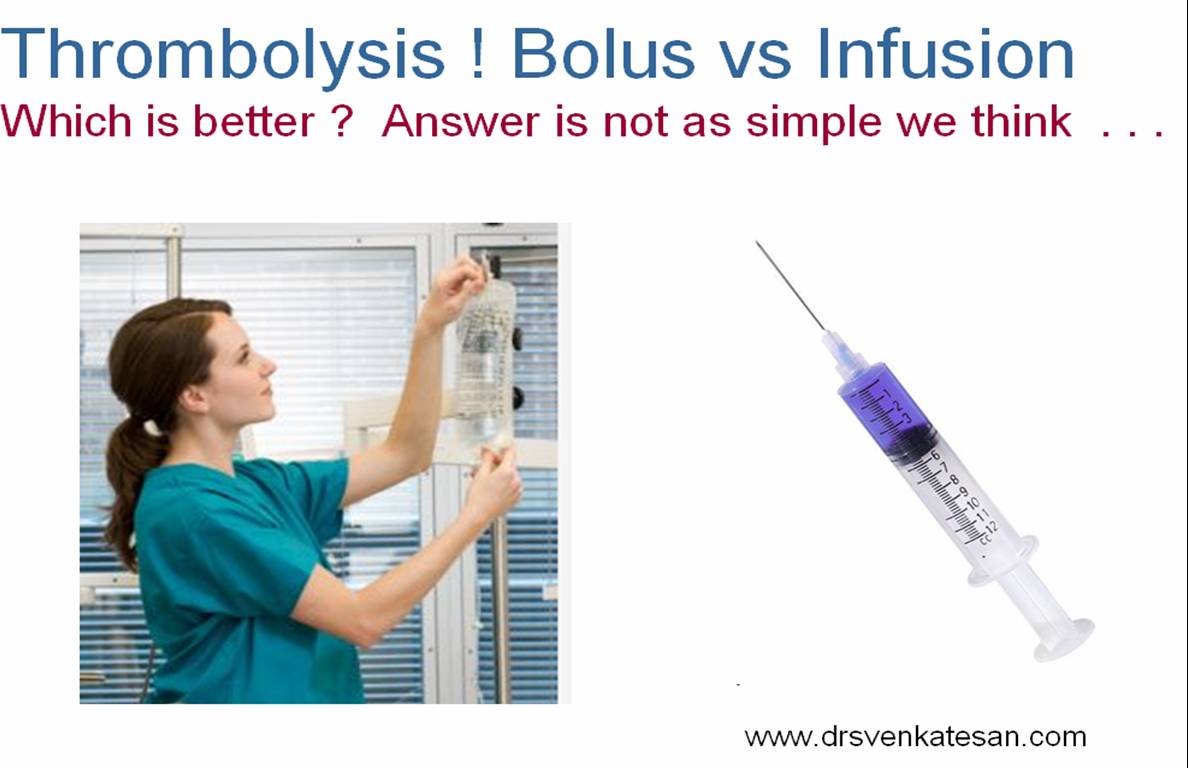
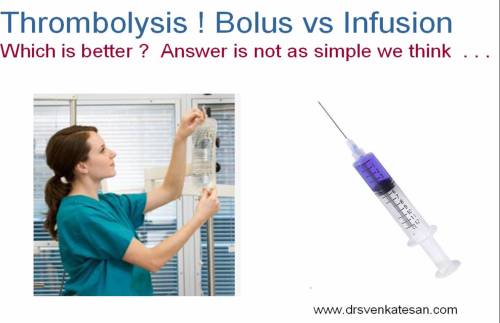
Thrombolytic therapy was a  mini revolution  when it was introduced two decades ago .It has since evolved  , not only in the  molecular structure  but also in it’s usage pattern.

The first generation streptokinase is continued to be used even today  . While the latest generation thrombolytic agent TNKTPA(Tenekteplase) is threatening  to push the  old warrior out of  CCU.
(Of course the  American Physician & Pharma  community  never  gave the due respect to  streptokinase  !)

The two common indications  for thrombolytic therapy  are

  • STEMI
  • Acute pulmonary embolism

Uncommon indications

  • Stroke( Can be common in few institutions)
  • Prosthetic valve thrombosis
  • Rarely DVT

From the beginning , there has been a controversy  about the thrombolytic  dosage and  the speed with which it is to be administered .Let us recall , streptokinase was initially  used  in  various regimes ( 5-30lakh units between a 10 -3hr infusion )  Later ,we arrived at a consensus at  15L units  in 1 hr infusion . TPA also experienced the same . Which  settled  for front loaded regimen(35 + 65mg)  . The confusion reappeared when we developed bolus thrombolytic agents( TNKTPA) .

In STEMI thrombus formation  is  often a one time process  while thrombolysis is a continuous process. In pulmonary embolism both  thrombus formation  and lysis  is often continuous process  .

The success of thrombolysis depends on the sustained  drug concentration ,  the pressure at which the drug interacts  the thrombus.

Many times it is prudent to administer  intensive heparin after thrombolysis  to prevent recurrent thrombosis. Further ,  most of the pulmonary embolisms  will require long term anticoagulants.

How to maximize the success of thrombolytic agents ?

  • Local catheter based thrombolysis can be tried  within the coronary ostium (Largely unpopular)
  • Within the pulmonary artery for pulmonary embolism (Still considered an useful option )

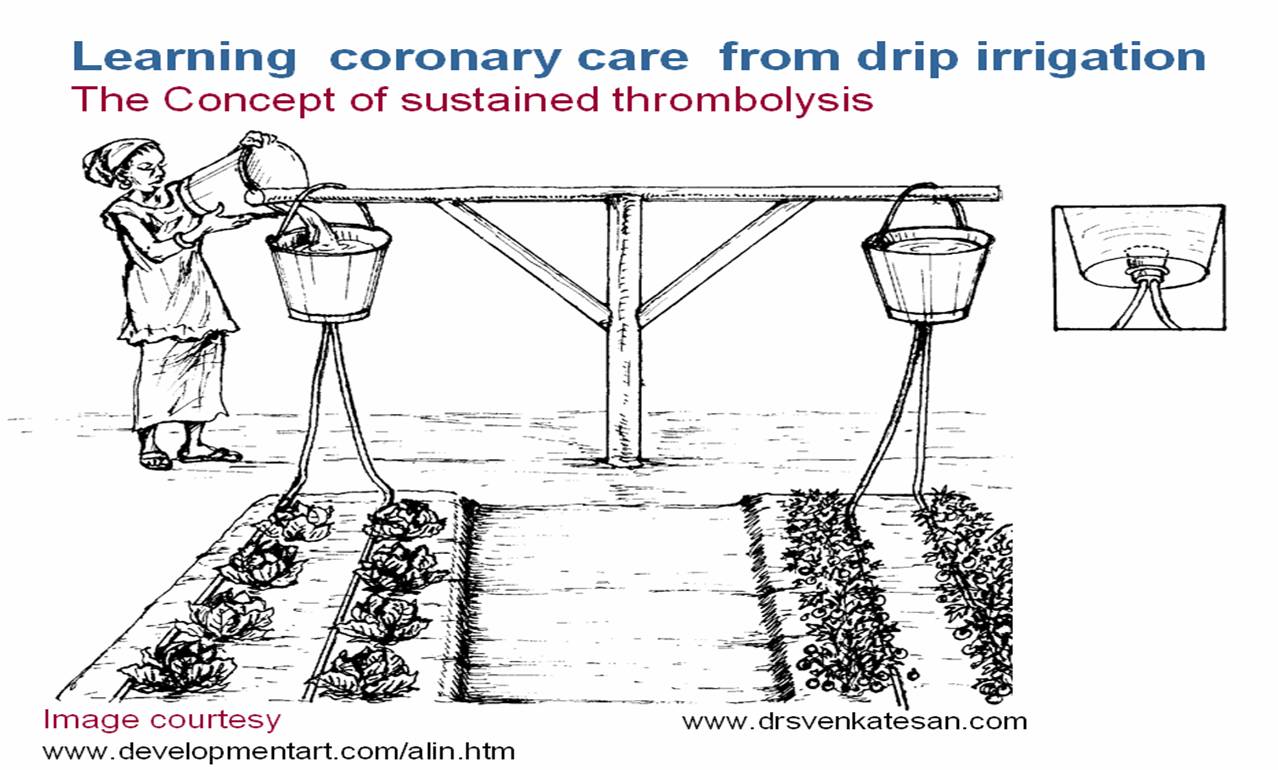
It  makes sense , to administer these thrombolytic agents over a prolonged period of time so that the lytic process gets wider recruitment of the natural lytic mechanisms.
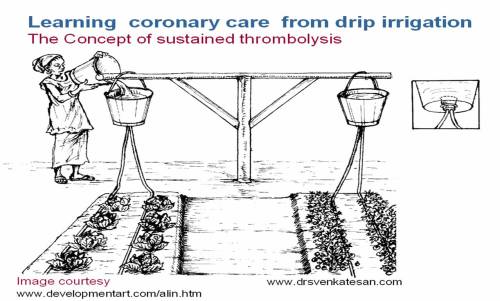
When a drug is infused continuously , the drug  reach the thrombus in  a pulsatile manner , which facilitates thrombus dessication  (Like drip irrigation ) . A long acting drug even with a high concentration may not be  very effective , since  the  drug is required to produce a mechanical effect  here . (Unlike say a long acting antibiotics !)

TPA in Pulmonary embolism

The inadequacies  of  2 hour infusion of TPA is  glaring in acute pulmonary embolism .We believe   a 48-72 hour streptokinase infusion   has a definte edge   over a short and brief TPA infusion.

Issues need answer

It is yet , not understood why we can’ t infuse TPA as  a   long term infusion like streptokinase .

Advantage  of bolus TNK TPA  in  pre-hospital phase of STEMI

The argument in favor of bolus dose  thrombolytic agent  is  the ease of administration .

The other the major advantage claimed  is ,  a 10 second  TNK TPA   in STEMI  can  substantially  reduce the time window   and facilitate  early completion of thrombolysis .

Counter point

But , the  later concept is hard to prove  . . .

In fact , there  are  no controlled studies  available for assessing the   efficacy of TNK-TPA   vs  Streptokinase   with reference to various time windows. We presume so many things. An  incomplete   early thrombolysis  may not be better than a  more  successful  but  slightly delayed TIMI3 flow .

As scientists,  when  we try  to answer these  question we  ask for data .  Are we getting it any way ?  Are the existing data reflect  fact ?     We  wonder,  will we may never get   an  hourly  angiographic  data base  about the IRA  patency  in  TPA bolus  vs streptokinase infusion .

It is most unfortunate,   with  many of the critical questions   still to be answered ,  the cardiology community believes ,  they  have  reached the  summit  of  knowledge  about thrombolytic therapy . Current perception is , the research on  existing  thrombolytic drugs  is  deemed to have been complete .

In this hyped  era of interventional coronary  care  ,   it is a remote possibility   to have any  further comparative studies on thrombolytic agents .

The greatest threat faced by  us  today  is the destiny  of  modern medicine is   often  decided in  few corporate board rooms  and   hence   research questions  rarely  emanate from bed side !

In this scenario, where we are not likely to generate   genuine  clinical  data ,  the only way to move   forward is   to go  by  our experience – ” Genuine  experience to be precise . . .”

Final message

Ease of administration should never be the criteria in choosing a thrombolytic agent . It   can severely    compromise the quality of thrombolysis  ! especially in pulmonary embolism and to a certain extent in STEMI.  Success   rarely  comes  with ease  . . .
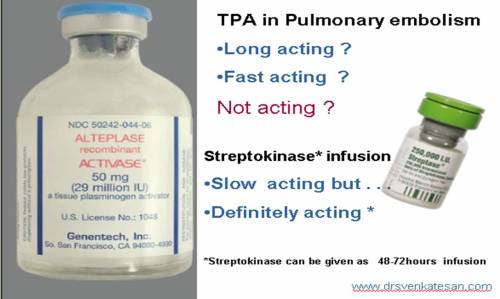
Many believe , the choice  between  streptokinase   & TPA    goes much beyond it’s academic reasons.  TNK TPA (Tenektepalse) has come in a big way to replace streptokinase  even   in developing countries.  Ofcourse it is backed by a huge study  ! (ASSENT) .

The cost effectiveness and worthiness  of TPA over streptokinase  was  never proved comprehensively.

Note of caution :

The observation made above is   based on personal  opinion  in  about   20 patients  . Readers are  argued to do their own  analysis on this issue and come to a conclusion .

Read Full Post »

STEMI is the commonest cardiac emergency . Many believe , we  are close to  conquering  it .  It is hardly the truth .

  • The  mortality is  up to  30 % out of hospital and another 6-8  % within CCU  and another 2 %   at  30 days due to recurrent ACS   .This  is followed by an   annual attrition rate OF 25  due to progressive LV failure  .
  • The commonest mode of death is electrical,  ie primary VF.
  • Mechanical deaths are also equally important. Free wall rupture carries 100% mortality . Ischemic MR, Ventricular  septal rupture (VSR ) may also result in deaths.

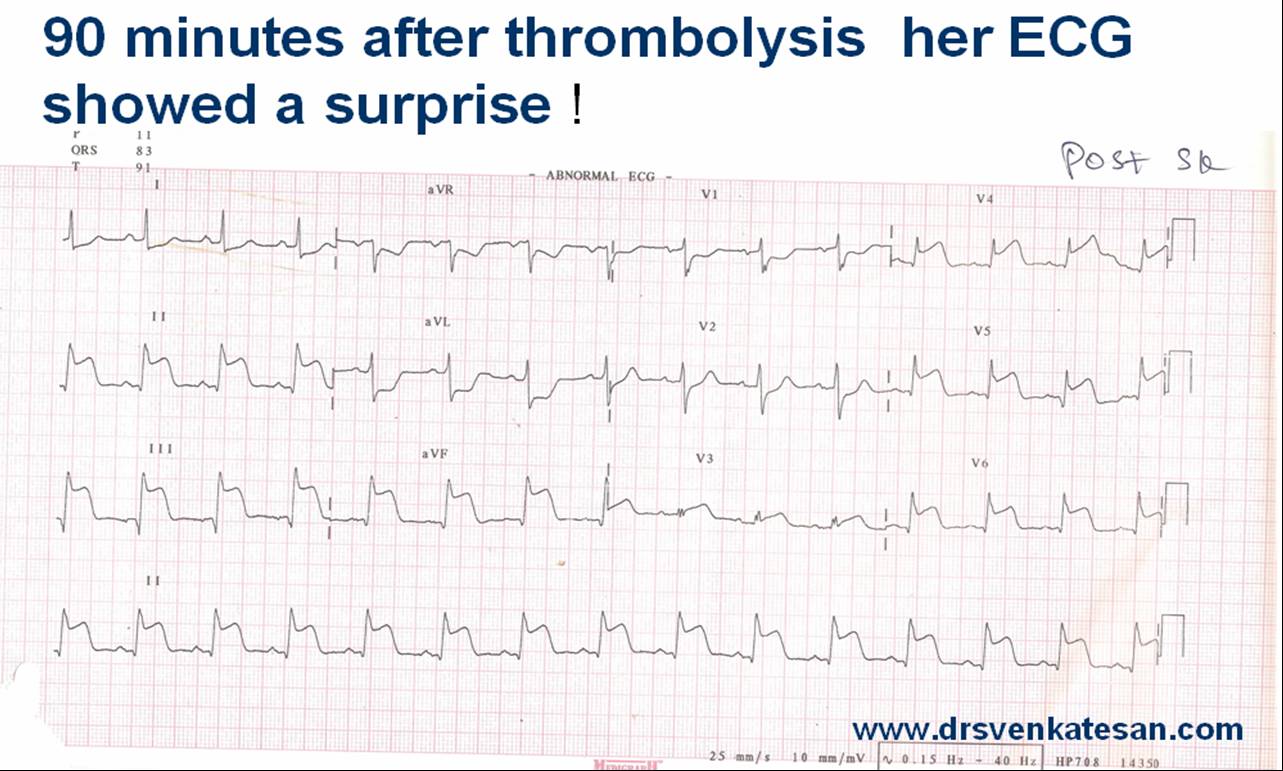
Here is a case history and ECG of a  patient with STEMI .

After thrombolysis , the paradox happened . ST elevation  increased by 4mm and soon the patient became restless with worsening pain and became silent instantaneously ,  with monitor showing EMD and asystole .A diagnosis of free wall rupture was made.

What we used refer  in our CCU (Madras medical college Chennai .One of the oldest CCU in  South Asia )

as   “Action pontentialisation”  of surface ECG . This ECG finding has  great  clinical significance .

Here is a zoomed up view of a qrs complex of  the patient , which is very

closely resembles an action potential

Picture courtesey  http://ocw.tufts.edu/Content/50/lecturenotes/634488/634591

Pathological basis of  “Action potenial”  Like ECG

  • When the ST elevation is huge and wide it mimics  an action potential .
  • Myocyte action potentials are normally recorded epicardially in physiology lab where a  micro electrode with glass pipettes directly enter the myocyte.
  • A giant ST elevation and a sustained dome indicate , the quantum of  electrical injury is  very large and the  ECG electrodes is picking up the myocyte electrical events like that of a intra cellular electrode.
  • It is to be recognised  ,  ST elevation in chest leads is substantially taller than limb leads   because the exploring electrode  is located just above the myocardium . But,    when a  huge  ST elevation  is recorded  over a limb lead (as in this patient )  one can imagine ,   how intense the electrical  charge  of  the myocardium  should  have been  !

This heavy downpour of electrical energy that  emanate from the myocardium   means two things

  • The area of infarct is very substantial
  • The tissue in question is  very unstable .

Clinical correlates of  action potential ECG

  1. Damage is transmural , the   infarcted area is soft, friable and often hemorrhagic .
  2. The pericardium is also  likely to get involved in the injury process .
  3. The myocardium is  rupture prone or already torn .
  4. Even minor hemodynamic stress can be fatal in these patients
  5. An episode of vomiting, a fall in blood pressure,   an episode of  LVF or a short run of VT is suffice  to result in a fatality.

The death happens by a sudden rupture ,  EMD and asystole .

Can a life be saved  by the much fancied Emergency PCI  ?

Not really. The PCI  can not reverse the myocardial damage ,  so it’s role is little . But , any way it should be done and  .  .  . it  will  be done  in most institutions to give the benefit of doubt (Of course , with  a definite the risk of doubting  !)

What is the risk  of  PCI in these situation ?

The infarct related artery * if opened up can convert a bland infarct into a  “angry red”  hemorrhagic  infarct .This   is as good as  giving  the patient ,  a  farewell  party for his journey to heaven !

Note : Primary PCI  definitely  saves life in STMI . The  * is applicable only in persistent ST elevation , late after an acute MI.

How could  have the above death prevented ?

As one of the comments to this article  suggested, we need to have methods to identify impending rupture early and accurately .This should  followed by a prophylactic  surgical intervention (Reinforcing the friable myocardium – with a patch or mesh  )  .This is again not  a easy decision to make .

Final message

When the ECG  assumes  a shape of an  action potential ,  it is often a sign of  imminent  death  . Even though it may sound a pessimistic  view  it is often the truth  . Of course , an  emrgency PCI or  CABG  are  the only options available , we have  to be remember the above truth  ,   as we   play  those sophisticated  games  within their coronary arteries.

Read Full Post »

Exercise stress testing(EST)  is one of the common investigation modality in the evaluation of CAD.he indication for EST  generally fall into two broad categories.

  • Diagnostic in patients suspected to have CAD
  • Prognostic evaluation in patients with established CAD .9Many times after a coronary angiogram)

Currently there is a major shift in our thinking,  patients with  classical angina  may undergo coronary angiogram  directly .This is understandable as the stress test  has little to   improve  diagnostic  sensitivity and specificity in patents with clinically obvious CAD.

So , it is now becoming clear , the diagnostic  value  is  increasingly  restricted in the evaluation of  o atypical chest pain .

What is a strongly positive response ?

  • Gross ST segment depression > 2-3mm
  • Occurring in stage one
  • Fall in blood pressure
  • Prolonged angina into recovery

What is the angiographic  correlates of strongly positive EST?

  • Critical left main disease
  • Near total proximal LAD /LCX
  • A severely compromised bifurcation lesion

Morphological correlation

  • These patients  often have eccentric lesions with irregular margins.
  • unstable  lesions
  • Lack collaterals

What is the effect of vigorous  excercise on a critical flow limiting lesion ?

The shear stress over the plaque  increases  with  exercise  and  the  transcoronary gradient can reach a theoretical 60-90mmhg .One can imagine the what this stress can do to the  unstable lipid core .This is the reason unstable angina is an absolute contraindication  to EST.

What does a strongly positive EST imply for the patient ?

  • It indicates he needs urgent CAG and  most likely an immediate revascularisation.
  • Often , these patients have prolonged angina , and mandates admission in a coronary care unit.
  • there has been many incidence of ACS in these  patients  within 24hours of EST.
  • Lives have been lost  on their  way back    ,   as  these patients are sent home , as EST is a  OP procedure .

Final message

  1. It need to be realised a strongly positive response to EST  could  be a  clinical equivalent of  unstable angina .
  2. The common response  from a   physician or cardiologist    after witnessing  a  gross ST depression to EST  would be   “Had  I known this  I would have sent him straight into cathlab instead of EST ”
  3. If only , we give little ear to our patient’s  history we can pick the high risk clue in 9 out of 10 cases !
  4. It can be argued ,  a strongly   positive  EST  by itself  is  “A  clinical diagnostic  failure”  ,   ie  failure  of the physician  to recognise  the likely hood of strongly  positive EST ie a left main disease.
  5. These patients  should never be sent home immediately  after the EST .This is fraught with a risk SCD
  6. Most of them will require observation in step down unit for 24 hours  and if feasible they should be posted for coronary angiogram in the earliest available slot.

Read Full Post »

Persistent ST elevation is the  general technical term for  failed thrombolysis.Regression of 50%  of admission ST elevation is the required criteria for susccesful thrombolysis .

Thrmobolysis fails in about 40-50% .

Main determinant is the timing of thrombolysis – not the thrombolytic agent ! do not get carried away with all those curent hoopla  about Tenecteplase stuff

If we take 100 patients with persistent ST elavation 90-95 will be in anterior LAD territory .

This is a stunning a cardiology secret no book of cardiology address . . . Implication of which could be very significant . Primary PCI  will always struggle to  prove it’s superiority over thrombolysis  in the right coronary artery .(Note LCX STEMI is different , infact it is more tricky than even even LAD .This issue will be addressed seperately in my blog.)

Read the following link  for  answer to the title question .

How common is persistent ST elevation in inferior leads following STEMI ? https://drsvenkatesan.wordpress.com/2008/09/22/why-thrombolysis-rarely-fails-in-right-coronary-artery/

Read Full Post »

Acute MI is a major medical emergency encountered in ER . Prompt adminstration of thrombolytic agents or rapid   triaging for a  primary PCI   may be required . The whole concept of management of STEMI  revolves around time as a therapeutic   target .Every minute counts . The beneficial effects of  reperfusion   and the resultant  myocardial salvage  rapidly declines over time . Hence ,  the symptom to door time  remains the ultimate determinant of  outcome in most situations.

So , estimating the  time window of  “Symptom to door time ” becomes an all important parameter. This is often done by paramedics .

The apparently  simple  job  measurement of time window  can be  misleading at times especially in elderly, diabetic and alcohol abusers .

When  a patient  says he has chest pain since yesterday straightaway he is excluded from reperfusion strategies as 12 hours  would have elapsed

When a patient  describes  chest  pain since two days , but  more intense  only since today morning what does it imply ?

  • The first episode of pain could  either  preinfarction angina or infarct
  • The second episode of pain could again be the continuation of same  angina or conversion of that angina into infarct

So ,  calculating the time window  when a  patient has recurrent episodes of angina prior to an MI is a real difficult issue.For the benefit of doubt, we have to take the last episode of chest pain  which was continuous and more severe as the infarct pain.

How does ECG help to time STEMI ?

When it is difficult  , to differentiate pre infarction angina from infarct pain, the ECG may give  useful clues to time the STEMI.

  • Degree  ST elevation
  • T wave inversion
  • Q waves

Among the  above three ,T wave inversion is most useful to time an infarct. If T wave begins to invert, it can generally assumed the acute  infarct process is  almost complete . Q waves are less reliable  to time a acute MI as ischemic stunning can in the  very early phase of STEMI   inscribe a q wave over the infarct territory.

How will you time a STEMI in silent MI ?

There is no symptom to door time in patients with silent MI . Many do not even reach the door , for the simple reason there is no symptom that drives them to hospital. Those who are refered  have vague non cardiac symptoms and incidental ECG  which shows STEMI like changes. Here , the decision to thrombolyse is taken entirely on the basis of ECG *finding .

Note : Cardiac enzymes are can also be  used  to  diagnose  to estimate the time window .

Read Full Post »

Primary ventricular fibrillation is the number one killer in STEMI.It is  believed to occur  ( Rather it occurs really !) in up to 25 % of all patients with STEMI before they reach the hospital and another 4% after reaching the hospital.

What triggers this primary VF  ?

Easily answered : It is the  acute ischemia in majority.

Why it triggers in only in some patients? The  rest reach the ER safely and  some  casually walk in to the  OPD  few days  after a STEMI

This can never be answered with our current knowledge base. Some call this as fate !

Scientists should work hard on this issue, if we know the answer we could  possibly prevent the number one killer of the mankind at bay.

ventricular fibrillation ecg

Many factors are being analysed  to find the reasons for primary VF

  • Extent of infarct
  • Area of infarct
  • Intensity of pain
  • Adrenergic drive
  • Gender
  • Myocardial critical mass
  • Is it the  left main STEMI ?
  • Is it a bifurcation STEMI ?

If nothing  explains the VF it is always safe to blame it on susceptibility and inherited risk for primary VF , which of course is very much likely as the K+ channel  activity and it’s response to ischemia  is largely inherited

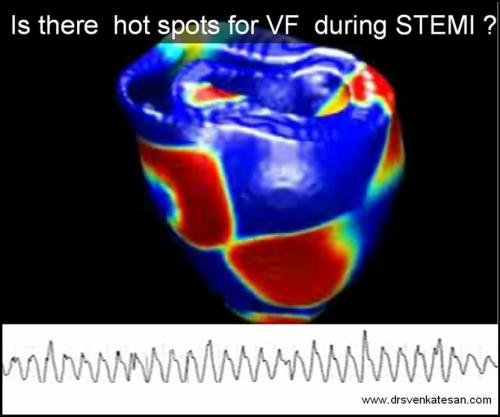
Is there any hot spots in the heart that are hypersensitive to ischemia ?

Some studies have clearly documented increased incidence of primary VF in infero posterior MI , and RV MI

than anterior MI .   J Am Coll Cardiol 2001; 37: 37-43

Why  ischemia of a certain location of heart should be more prone for  primary VF ?

The answer is any body’s guess.

Some intriguing possibilities are ,

  • RV is a anterior chamber , when infero posterior MI occur in association with RV MI  the ischemic zone encircles a almost 50% of heart like a band .This could be one explanation for more incidence of VF in infero postero RVMI.
  • Any MI which involves a  antero -posterior axis  of heart is likely to trigger a VF
  • Some of our patients  who survived a primary VF had a short left main  and early bifurcation with a large diagonal branch.The lesion was noted in the bifurcation.This raises a possibility ,  if a STEMI occur at a bifurcation with two divergent areas of  acute ischemia it has a high chance for precipitating a VF.

Related video by the author

Ignorance based cardiology -You tube

Potential research areas

Genetic susceptibility

Environmental Energy flows and primary VF

Some believe  a role for astrological  forces and  VF

Read Full Post »

« Newer Posts - Older Posts »