Dopamine and dobutamine are the most commonly used inotropic agents in clinical cardiology.
The following table represents a simple comparison of the two drugs.

Posted in cardiac drugs, Cardiology - Clinical, cardiology -Therapeutics, tagged adrenergic receptors, cardaic pharmocology, cardiac failure, catecholamine, dobutamine, dopamine, dopaminergic receptors, inotrpic agents, ischemic lvf, lvedp and dobutamine, nor epinephrine, pcwp and dopamine, renal dopamine dose on March 25, 2009| 6 Comments »
Dopamine and dobutamine are the most commonly used inotropic agents in clinical cardiology.
The following table represents a simple comparison of the two drugs.
Posted in cardiac surgery, Cardiology - Clinical, Cardiology -Interventional -PCI, Tutorial in clinical cardiology, tagged aortic band, aortic disscetion, aortic septum, cob webs in aorta, dissecting aneurysm of aorta, entry point in aorta, exit point in aorta, falp curvature, false lumen, false lumen of aorta, mri of aorta, stents for aortic aneurysm, tendrils, trans esophageal echocardiography, true lumen, true lumen of aorta, type a debaky, vinculum on March 24, 2009| 4 Comments »
This helps the interventional cardiologist to plan the specific therapeutic procedure .
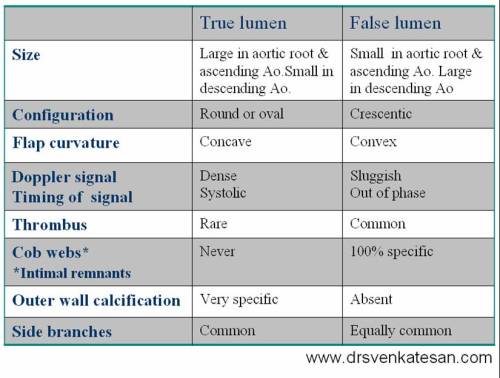
One may wonder , why is that difficult to identify the true aortic lumen by echo, after all , the LV empties the blood into true aortic lumen ! Yes , in aortic root dissections identifying the true from false lumen is rarely an issue.
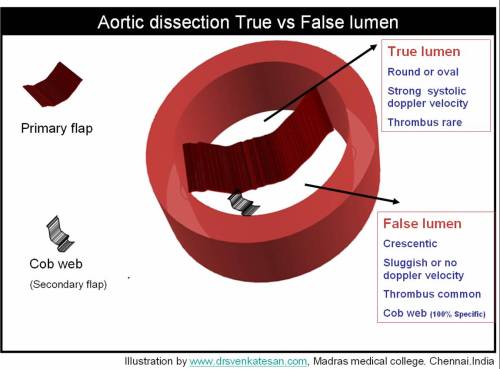
The issue becomes important and complicated as the propagation of dissection goes in a random and erratic way into the ascending aorta and arch and downwards.The situation could further get complicated by the fact there could be multiple communication between the two lumens .Some of these communication are hemodyanically patent others form a simple anatomical continuity.The size and the configuration of true and false lumen are not uniform it is highly variable.In the aortic root the size of the true lumen is usually large and when it reach the descending aorta as in type3 the whole thing could be reversed.
The enigma of these lumonomics , is that some of the native branches of aorta , would either be, subtended by false or true lumen. This is a real tricky issue for the surgeons . If a aortic vessel branch (Say bronchial artery . . .) is perfused successfully by the hemodynamically active false lumen should we meddle that at all ?
What are the types of false lumen ?
Usually single septae divide the aorta into two , one false lumen and true lumen.There can be other types.
Triple lumen aorta :This is usually seen in the aortic root following dissection .Usually there is two false lumen and and one true lumen in the centre
Double barreled aorta: A circumferential aortic dissection with a central true lumen surrounded by a circumferential false lumen mimicking a double barrel on within the other.
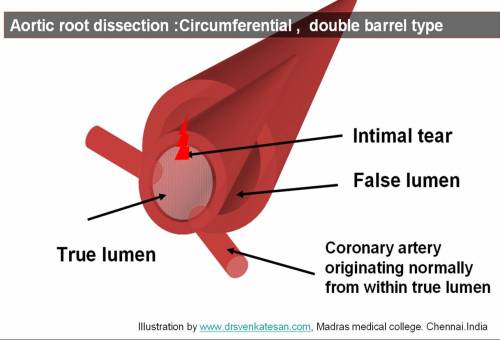
but more often multiple exit points can occur. Some points can have both two and fro flow as it may act as both as entry or exit points
Large thrombus can occur within false lumen.The presence of which , sometimes an advantage as
it limits further progression of false lumen (An organised thrombus is sort of natural stent graft !)
many of these patients do well with medical management.
C J Sanderso Thorax 1981;36:194-199;
Yes , but it is rare as the velocity is more .But it can occur in following situations.
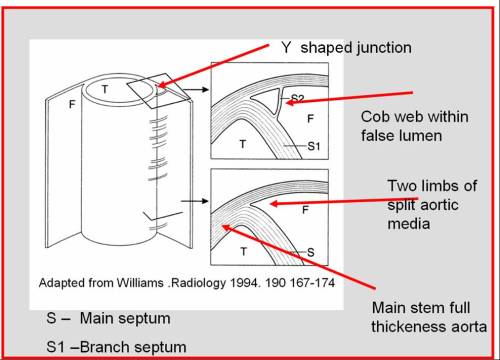
Cob web are the residual ribbons of dissected internal elastic lamina of aorta .
They are variably called as aortic bands, strands , septae, flaps etc.
The classic false lumen is crescent shaped. True lumen is either round or oval(Gibbous moon)
Tunction between false and true lumen has some characteristic feature.It mimics the letter Y. The mainstem of Y correspond to main( Normal full thickness)aortic wall of the true lumen.The oblique lines represent the outer wall of the false lumen and the septae dividing true (Fig 3)
Surgeons often leave the false lumen insitu , especially beyond the arch in type A dissection.
If false lumen is large >70% of aorta , secondary dissections may occur in the long term.
Even though MR angiogram and CT scans are shown to be good imaging tools in the evaluation of dissection of aortamany practical issues creep in doing MR or CT angiogram.Many of these patients are too ill and will be on multiple arterial and venous lines Doing an MRI is too dificult a task .Further these imaging modalities require a another arterial access .Requires contrast injection and CT has in addition , radiation hazard.
TEE is a simple investigation can be done even in unstable patients in the bedside .Further also help us us evaluate the aortic valve function and associated complications of dissection. TEE will be very useful peroperative also in assessing the repair.
*But MRI and CT can give a long axis , saggital cuts of aortic dissection depicting the entry and exit points in a single image
Posted in Cardiology -Interventional -PCI, cardiology -Therapeutics, tagged 2b 3a antagonists, acs, coronary dead space, coronary thrombosis, distal protection, drug eluting stent, expoert catheter, freed, ivus, pci, pci and thrombus, primary pci, ptca, stent approximation, tct md, thrombus and pci on March 22, 2009| Leave a Comment »
First and foremost is
Avoid the procedure if not really indicated.A lesion which has more thrombus load than a plaque and it is , subcritical and not limiting the flow , PCI may be inappropriate especially if the ACS is stabilised.
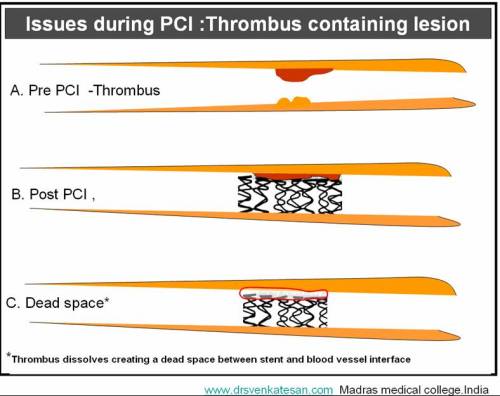
Fig 1
Posted in Cardiology - Clinical, Cardiology -Interventional -PCI, Infrequently asked questions in cardiology (iFAQs), tagged bifurcation lesion, coronary atherosclerosis, drug eluting stents, eccentric plaque, edge effect, europcr, freed, geographical miss, instent restenosis, left main, pci, plaque prolapse, ptca, saian, stent thrombosis, stents, syntax, tct md, what is plaque prolapse on March 20, 2009| Leave a Comment »
Coronary stents have revolutionised the management of CAD. Stents are metallic scaffolding devices that help keep the atherosclerotic plaque plastered within the coronary arterial wall.Thus it gained the name angioplasty. Stents have aradial strength that exerts a constant force on the plaque . Since metals are unfriendly partners for coronary artery , we need to have minimum metal within the coronary artery.The stent struts weave around the lumen generally the stento/ artery area ratio should be as less as possible (15%).
But this has a trade off .The uncovered area of plaque tend to project into the lumen .This is many times not significant.But can be a problem if the plaque is very soft and bulk of the lipid core may reenter the lumen.this event is called plaque prolapse.
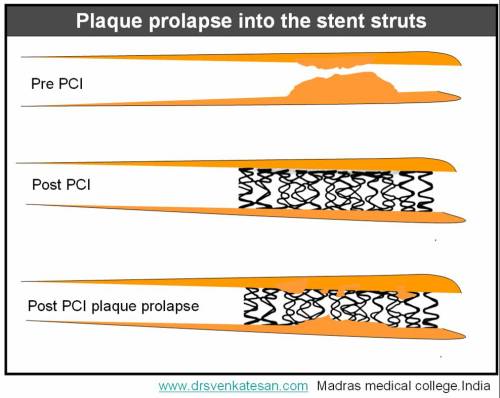
Generally it is late event.But it can happen immediately after the procedure also.
Eccentric and complex lesions especially with overhanging edges are prone for prolapse
It can be benign.If there is a erosion due to stent struts can precipitate an ACS.It progresses into instent restnosis in many.
Angiographically it often appears as luminal irregularity withi stented segment .
Many times , it may appear as a filling defect also.
Coornary artery is not drugged uniformly by the drug eluting stents.In fact contact lines of metalic struts , through it’s micropore oozes the drug with polymer.Pathological studies have revelaed non homogenous drug penetration and resultant irregularity on the plaque surface.This could amplify the plaque penetration preferentially in few areas.
It should be managed as any other instent restenosis.Plaque resection with atherectomy devices has not solved the problem to the desired levels.A second stent is the most common approach advocated by the cardiologists.(Whic is not ideal though !)
Posted in cardiac surgery, Cardiology - Clinical, Cardiology -unresolved questions, Infrequently asked questions in cardiology (iFAQs), tagged bi leaflet valve pannus, echocardiography, left atrail mass, mass in echo, medtronic hall pannus, pannus, pannus in prosthetic mitral valve, st jude pannus, starr edwards pannus, streptokinase, tee, thrombolysis for prosthetic valve, thrombosis, trans esophagela echo, urokinase, vediodensity, what is paanus ? on March 20, 2009| Leave a Comment »
Prosthetic valve obstruction is an important complication of artificial valves.The incidence of prosthetic valve obstruction is estimated to be 4% per year.
Data from Deviri (J Am Coll Cardiol, 1998; 32:1410-1417 )
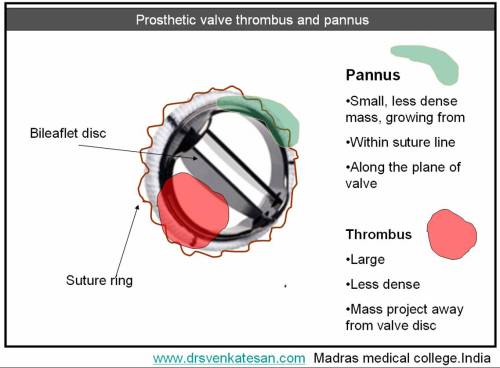
*Note statistically you are going to be right 3 times out of 4 if you diagnose thrombus over pannus
Pannus literally means a hanging flap of tissue. It is is a membrane of granulation tissue as an response to healing.It can occur anywhere in the body. When it occurs in the prosthetic valve tissue interface it has important consequences.It is same as excessive scarring , ( something similar to keloid formation ) .
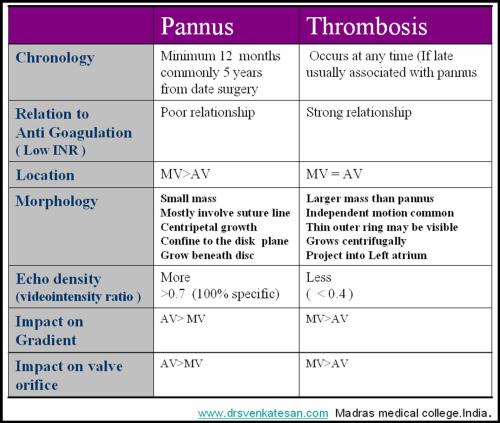
Prosthetic valve thrombosis is usually a acute or sub acute event as thrombus formation rapidly deteriorates the clinical situation.Pannus brings a patient with the complaints of chronic progressive dyspnea.(This rule is very subjective but . . .)
Time is the major determinant. minimum period required is 12 months. It is a avascular mass.It should be noted a injured pannus can predispose a thrombotic process and a chronic thrombus can trigger intravascular growth factors that promotes pannus growth.
The pannus grows , usually in the tissue valve interface.It tracks and creeps along the suture lines .Generally this does not encroach the valve orifice or chamber sapce , but occasionally the hanging edges can hit upon a leaflet.This is more common with tilting disc on the side of minor orifice. When excessive it can make a valve leaflet almost standstill.
Is relatively uncommon as the dynamic ball periodically interrupts the process of pannus in growth within the orifice.
Why is recognition of pannus important ?
Prosthetic valve thrombois is amenable to thrombolysis and it should be proptly differentiated for pannus.This is many times a difficult excercise, but the above observation will be helpful.
Further reading
Posted in Uncategorized, tagged acs, atherosclerosis, coronary dissection, eccentric plaque, plaque, plaque erosion, plaque fissure, spontaneous coronary dissection on March 19, 2009| Leave a Comment »
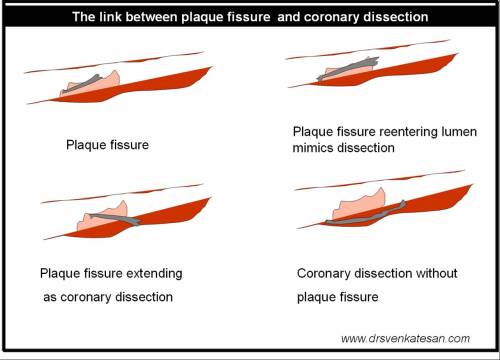
Plaques do not have neural innervation.So the plaque fissure is generally not painful.But when it extends into the media of vessel wall it can be severely painful.
Posted in Cardiology - Clinical, Cardiology - Electrophysiology -Pacemaker, cardiology -ECG, Cardiology-Arrhythmias, Cardiology-Coronary artery disese, Infrequently asked questions in cardiology (iFAQs), tagged gender difference in cardiology, gender issues in cardiology, qt interval, scd, stemi, sudden cardiac death, ventricuar fibrillation, women herat on March 17, 2009| Leave a Comment »

SCD continues to be the major mode of death of our population . Millions of men die every year instantly .The commonest mechanism is due to primary ventricular fibrillation following an abrupt closure of coronary artery due to a thrombus.Most die , within few minutes of the event, some before reaching the hospital , few within the ambulance and an unlucky few die on the CCU bed or cath lab table even after getting the best treatment.
If we analyse the data, there is a surprising fact ! Men form the bulk of these SCD victims.In our experience , out of 100 cases of consecutive in hospital primary VF only 6 were females , indicating an important biological phenomenon to be studied.The data for out of hospital primary VF is more difficult to get , but the log records of EMRI and emergency rescue team consistently confirm the male preponderance of primary VF .
The answer is not known . If we are able to decode this , one can replicate the same model in male .
QT interval represents a combination of electrical depolarisation and repolarisation .It is a well established scientific fact that women have relatively prolonged QT interval .This is determined by evolutionary biology and inherited characteristics of potassium channels during myocardial repolarisation
In simple terms, the female heart knows how to relax slowly and prolong the electrical relaxation time.(Not mechanical)
It is also a well known fact ischemia mediated a prolonged QT interval is a trigger for dangerous ventricular arrhythmia.This ischemia induced QT prolongation is less pronounced in females than males as the baseline QT itself is slightly longer in women.The percentage increment of QT interval during acute ischemia is significantly higher in male .This could be one reason for the preponderance of VF in men
The billion dolor question and a real challenge for the cardiologists is
What if , if we administer lignocaine spray straight over the (or sublingually ) in every patient with chest pain
as like a sport injury and try calm down the heart electrically !
Also read
1.Lignocaine the forgotten hero .
2.View this video -Ignorance based cardiology !
Reference
Posted in Uncategorized, tagged cabg, lima, synthetic graft on March 15, 2009| Leave a Comment »
CABG is the most common cardiac surgery done world wide. Traditionally saphenous vein graft and LIMA are used .Now radial artery is being used often. The life of venous grafts is short, so total arterial graft is preferred.The issue here is lack of good arteries for grafting especially when a second CABG is required .
Chronoflex, is one such graft under trial and is engineered to be pulsatile, biostable, torque-resistant and suturable. Once implanted, the graft is able to incorporate the patient’s own cells and tissue, so that the inner surface mimics the normal environment for blood contact. The material is also flexible, so that the graft can pulsatile like a vein as it carries blood to the heart.
Posted in cardiac surgery, Cardiology -Interventional -PCI, cardiology -Therapeutics, tagged cabg, left internal mamary graft, left main disese, lima on March 15, 2009| Leave a Comment »
CABG is tretment of choice for left main and complex proximal LAD lesions. So most patients get CABG in these situations.
The hemodynamic effects of LIMA graft on native left coronary artery can be tremendous and some times deterimental.
Posted in cardiac surgery, Cardiology - Clinical, Cardiology -Interventional -PCI, cardiology- coronary care, Cardiology-Coronary artery disese, Infrequently asked questions in cardiology (iFAQs), tagged akinetic myocardium, cabg, dead myocardium, echocardiography, fdg glucose myocardial, left ventricualr dysfunction, myocardial viability, pci, pet scan for myocardial viability, post infarct angina, post infarct follow up, revascularisation, stress echo dobutamine stress echo, stunned myocardium what is myocardail viability, viability studies on March 15, 2009| Leave a Comment »
Post myocardial infarction revascularistation either by PCI or CABG forms the bulk of the coronary interventions world wide.There has been considerable controversy in selecting the patients for the procedure.
Certain basic rules are to be applied.
This dilemma is due to a simple fact
coronary revascularisation has a great impact in relieving angina but has less impact in reversing
left ventricular dysfunction
One of the rules written by the cardiology community over the past few decades has been
We must document viable myocardium before doing a revascularisation procedures on them.
This rule was self imposed , to prevent inappropriate revascularisation in post MI population.
So , a gamut of investigations (Both invasive and non invasive came into vogue) to identify viable myocardium in post MI population. Stress echo, Thallium-sesta MIBI, PET to name a few .
Even after liberal usage of these invesitgations , we realised , the confusion in the optimal selection of candidates for revascularisation has not settled.
In fact, the correlation between viabilty and subsequent interventional benefit is inconsistent .Not withstanding this issue ,cardiologists inspite of the negative results of OAT and TOAT trials , started opening or by passing any occluded vessel irrespective of viability status.
1.Why viable myocardium is viable even in the adverse compromised vascular environment ?
It is viable for the simple reason it has some capacity to be alive . By it’s inherent survival capacity (Survival of the fittest ) or it somehow gets the nutrients by cell to cell perfusion.
2. It is viable allright , why it is not contracting ?
Because , it is biochemically and metabolically alive (Can be documented by FDG PET scan mismatch ) but it can not synthesise adequate ATPs to make the muscle contractile.
3.”Viable myocardium is viable ” what more you want from it ?
Simple viability is not suffice . How to make it mechanically active and contractile ?
4.Is viable myocardium synonymous with ischemic myocardium ?.
No, it is not (Contrary to the popular perception ) .
5. Is it not common to find dysfunctional segments with good TIMI 3 flow ?. So what is the purpose to document viability ?
It is not suffice to simply document viable myocardium but it is an absolute necessity to prove this viable segment is also critically ischemic .
7.If angina is a sign of viabilty why most of viable myocardium is painless ?
This again confirms the fact , much of the viable myocardium in the post MI phase is not ischemic but” still dysfunctional” waiting for healing time. This concept was introduced with great fanfare* as stunned myocardium , 20 years ago , which was subsequently rejected my mainstream cardiologists , as this concept tend to restrict the freedom of interventionists. * Even though ,the concept was genuine and proven scientifically !
6.Are we certain , the viable , non contractile myocardium (Which we painstakingly document ) will get back the contractility once the segment is revascularised?
Absolutely not. (With lot of PET study doumentation ) This, we can not guarantee even in ischemic, viable segments , while in the non ischemic, viable segment it is all the more unlikely.
7. What are the chances of these viable but non contractile myocardium regain the contractility by natural course ?
Very significant chances .In fact every patient recover some LV function spontaneously over time .



 Dr.S.Venkatesan MD