Feeds:
Posts
Comments

Archive for the ‘Cardiology-Coronary artery disese’ Category

Thousands of  coronary angiograms are done every day. Cardiologist no longer get excited to see exotic coronary lesions .Still , some images can be striking and dramatic. Here is an angiogram from a middle aged man  with stable angina  , who was  one among the routine early morning diagnostic studies  in our cath lab.
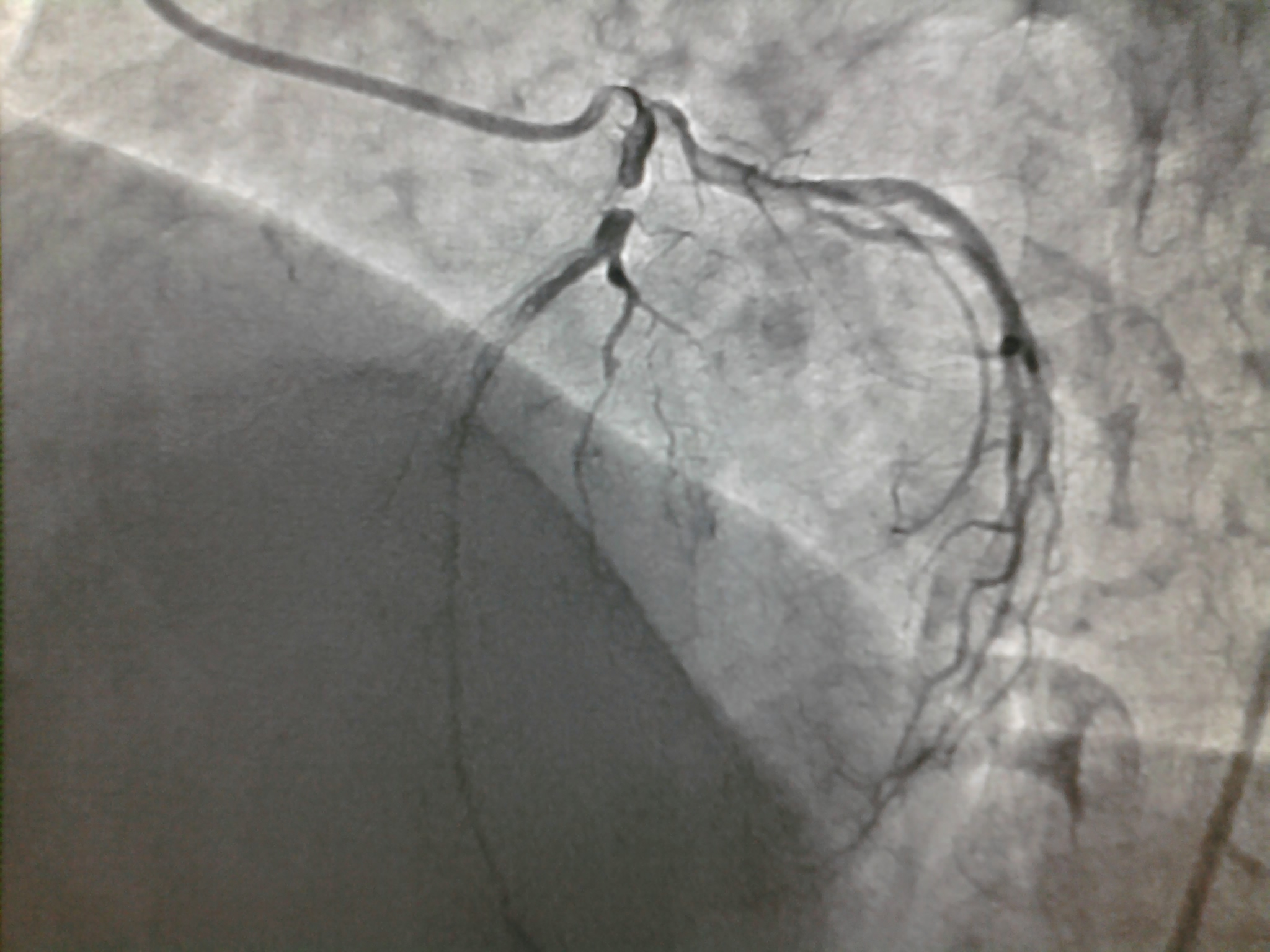
Who chopped the neck of this LAD ?

How this man was able to fill up the distal LAD almost completely? (With a complete cut off  right in the neck of LAD )
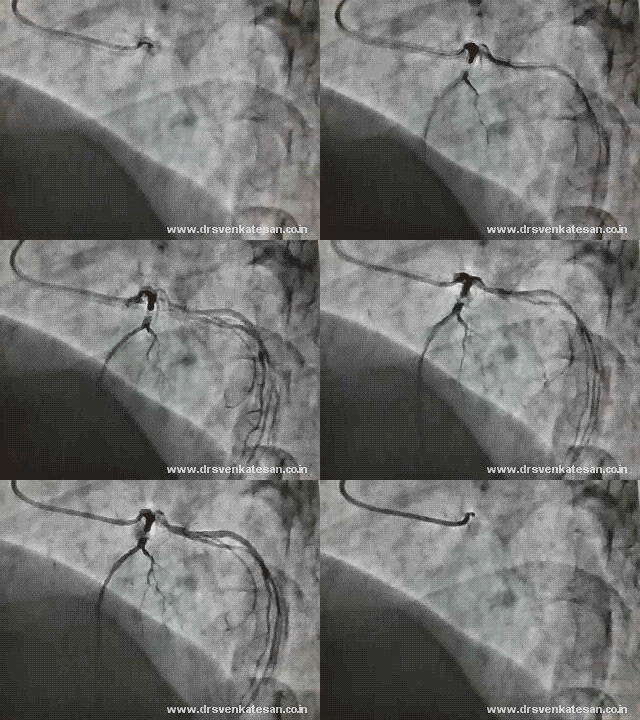
Are you sure there is antegrade flow ?

Do you get any clue ?

  • Can a trickle of  ante grade flow  sustain  a  TIMI 3 FLOW  ?
  • Or is it a  very efficient  instant collaterals  from LCX ?

Yes . The first one is right . An almost invisible antegrade channel  doing a exemplary job !

How is it possible ?

Realize an important fact . The distal flow beyond an obstruction  is not primarily dependent on degree of obstruction but the status of the distal vascular  bed .  If it is normal  even a hair-line patency  can  profusely perfuse the distal myocardial segment. This is what is happening to this man with a stable angina and perfectly normal micro vascular bed.

Lessens  from this Image.

Do not get fooled by the lay man’s logic. Realise there is  no simple relation  between  the degree of obstruction and degree of  blood flow impediment.It can be linear , curvilinear , or even inverse depending upon   the evolution and timing of obstruction  ,  number of lesions , presence or absence of collateral support , finally and  most importantly  the integrity of microvascular bed .

The  distal vascular bed drops its resistance drastically  once it senses  the problem in  proximal segment . This is based on Bernoulli principle and  is akin to how a  garden hose pipe  can simply increase  the velocity  by tightening the nozzle.*
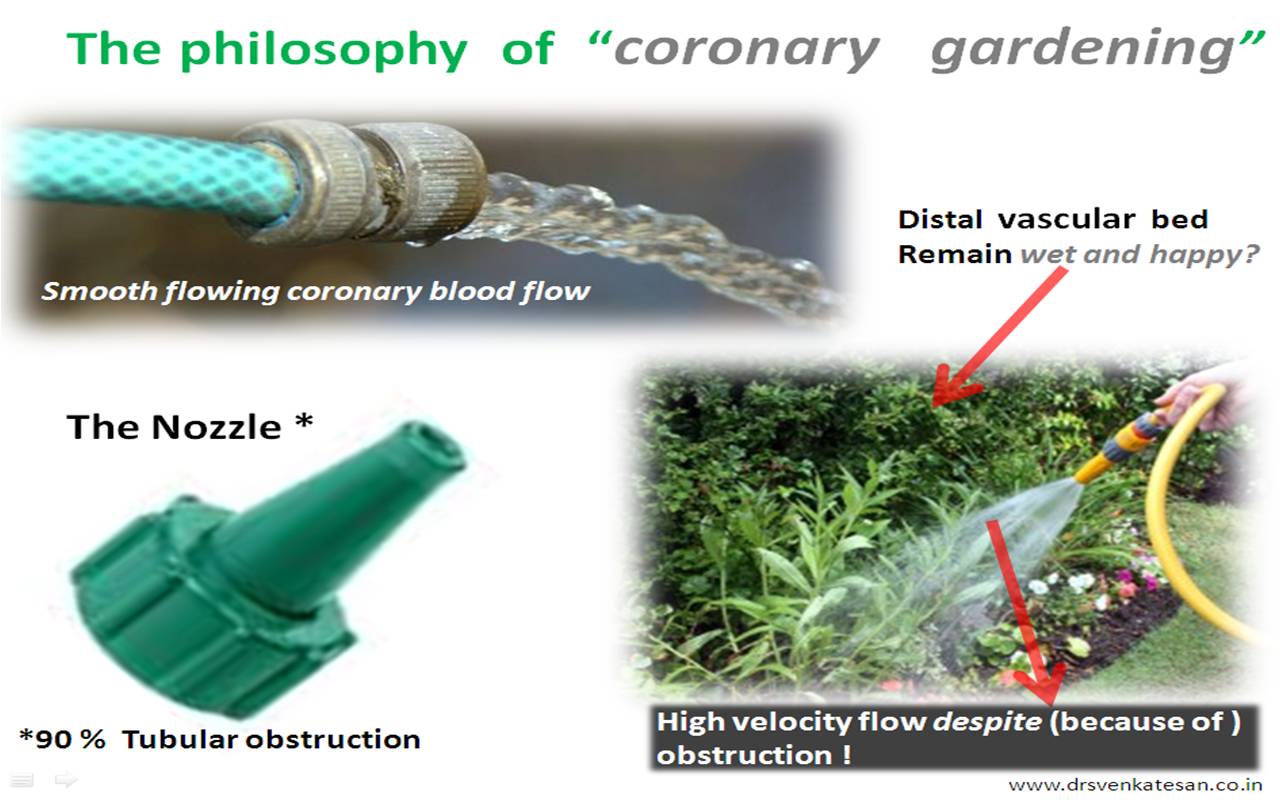

* The garden hose analogy is a gross simplification of   complex factors that determine coronary blood flow.But it effectively clarifies a point ie  coronary blood flow is least dependent on coronary  stenosis (until  very late stages)

**Note further : This  hemodynamic  principle may not apply in acute occlusion as in STEMI  , where   acute  obstruction  often has a linear relationship with the quantum of blood flow.

By the way what happened to the above patient ?

Since he had significant angina there were no debates regarding management.  He  is posted for elective PCI this week-end .(We  can’t  get a stent just like that unless it is a real emergency  .Ours is a  Govt hospital !)

What is your take . Is it a going to be tough cross ?

I feel so , but my colleague Dr Gnanavelu   strongly  differs !

Let me post  our experience during PCI shortly.
Read Full Post »

Coronary collateral circulation can be termed as one of the  mysterious  circulation in our body.Cardiologists generally do not  give much importance to it and some interventionists even ridicule it !  . But  ,  God has given it ,  with  a purpose. He adds a riddle though !  .Collaterals  grow  in  almost  every  individual  when   obstruction occurs gradually ( chronic coronary syndrome ) but only in  a few ,  it  will open up  during a real emergency like ACS !

How and why , only  few of us can  recruit  coronary collaterals   during   acute occlusion ?

God  blesses acute coronary collaterals only in selected few  , who  are on the right side of his good books .This can be  the other name for our  destiny !

Role of coronary collateral circulation  in acute coronary syndrome.

  • Limits  infarct size and volume
  • Promotes salvage
  • Converts q  MI to non q  MI
  • Prevents Unstable angina from becoming MI
  • Prevent primary VT and VF*

All  of the above can be vital  in saving a life  . Even as  we realise 30 % of STEMI do not even reach hospital  , it seems certain men and women with early collateral recruitment  will never  fail to reach the hospital alive

Is there a simple  method to identify  people who are blessed with acutely recruitable   collaterlas ?

I am afraid it is  almost equal to  asking   for a glimpse of GOD   !

Wait . . .  when we were on cath lab  few  days ago a  stunning  phenomenon happened  that could pave way for identifying  potential acute  collaterals  in any human being.  Follow this site  . . .the details will be posted !

Read Full Post »

We know  acute coronary syndrome  presents* with  either  STEMI or NSTEMI. (*It actually doesn’t present , it is our understanding and interpretation ).  Bifurcating  ACS into two is more by convention and convenience .Does  the intra-coronary  plaque  dynamics  really  permit us to divide ACS in to two distinct ECG  entities ?

Are we oversimplifying it ?  Probably yes.

The following paper was presented in the cardiological society annual scientific session in New Delhi few years ago (2006)

It generated an intense debate  , finally the chair person  reluctantly concluded such events are  possible. . .

but need more proof   . What is your take on this issue ?

DUAL   ACUTE   CORONARY SYNDROME

S.Venkatesan ,G.Gnanavelu,V.Jaganathan,

Department of cardiology . Madras Medical College. Chennai

Acute coronary syndrome (ACS)  is  classified into  STEMI  and NSTEMI and has gained universal acceptance. The classification was done by   clinical & electro physiological   findings    with   some   pathological basis. The   classification   came into vogue primarily to simplify the decision making process of thrombolysis. ( STEMI –Thrombolysis eligible .NSTEMI  Thrombolysis ineligible.) The limitation of this classification is well   exposed   as   we   now know,    STEMI can evolve into NSTEMI and NSTEMI can evolve into STEMI .   Identifying the culprit artery in ACS is   not straight forward especially in NSTEMI. Adding further complexity   is   the newer   observations that diffuse vessel inflammation,  and  multiple active plaques(MAP) are responsible for many of the episodes of  ACS.

In this scenario   there   could be two are more pathological processes   one   resulting   in  a total occlusion   and other sub total occlusion resulting in both patterns of ACS simultaneously .(STEMI & NSTEMI  Dual ACS)

We   describe two  patients  who had   presented to our CCU  . Both had STEMI one in  lateral  other in anterior wall . They   were thrombolysed   as per  criteria. Both patients had gross ST depression (>4mm)  elsewhere. In one patient it  corresponded  to the reciprocal  leads .The outcome of  thrombolysis  was turbulent .Both patients worsened and one developed  recurrent VT . Paradoxically the ST elevation   regressed   indicating a successful   thrombolysis  in the STEMI  territory  even as the ST depression  was worsening in the other leads. Angiogram   revealed   multivessel CAD with   recannalised  LAD  lesion with eccentric , thrombus containing  lesion in RCA/LCX. One patient expired and other was referred for revascularisation.

We   believe   both of our   patients  experienced  Dual ACS.

When to suspect dual ACS ?

Dual ACS is likely , when  STEMI is associated with ST depression  in at least 5mm in any two leads  or   when there is disproportionate  reciprocal ST depression ( > 2mm of primary). The reason for the poor outcome could be due to a therapeutic conflict between   STEMI & NSTEMI as the former  is  thrombolysis friendly while the later is not . Role of   thrombolysis in  such situations were ACS wanders between STEMI & NSTEMI is not defined. Another possibility is the concept of reciprocal ST elevation,   where in the index event  could be NSTEMI and STEMI is a secondary response  and  thrombolysis is apparently  contraindicated.

We conclude that in patients with ACS,   two or more   plaques can simultaneously get  activated  and  present  as a combination  of STEMI / NSTEMI   in the same  patient  in two different coronary arteries.(Dual ACS) .We suggest   that in every  patient who present with  STEMI  a possibility of   dual ACS  is to specifically considered,  as  thrombolysis could be disastrous  and  instead  they  should  reach   the  cath  lab directly.  .

Read Full Post »

Atherosclerosis  probably ranks first among all  human diseases that cause maximum suffering  to  mankind.Since it is a disorder of blood vessel  it has an easy  access to every  vital organ  in our body to inflict the damages . Histo pathologically , atherosclerosis is an all in one disorder where inflammatory , degenerative and lipid injury  collectively  contribute to the disease progression. Diabetes and hypertension play a vital amplification role.

Atherosclerosis begins very early in life as fatty streaks in every individual and takes different avatars ( or remain indolent)   depending upon the risk factors and life style.

How to estimate plaque burden ?

It has  always been a difficult task to estimate the  atherosclerotic  plaque burden inside the  coronary  arteries.The fundamental flaw for many years is ,  we always thought  if there is a plaque it must  encroach  into the lumen.

Coronary angiogram  , has become the  default investigation  in clinical cardiology . Since it   can  visualize  only the coronary lumen ,  this  flaw  got further  curious  with skewed  interpretation as well.

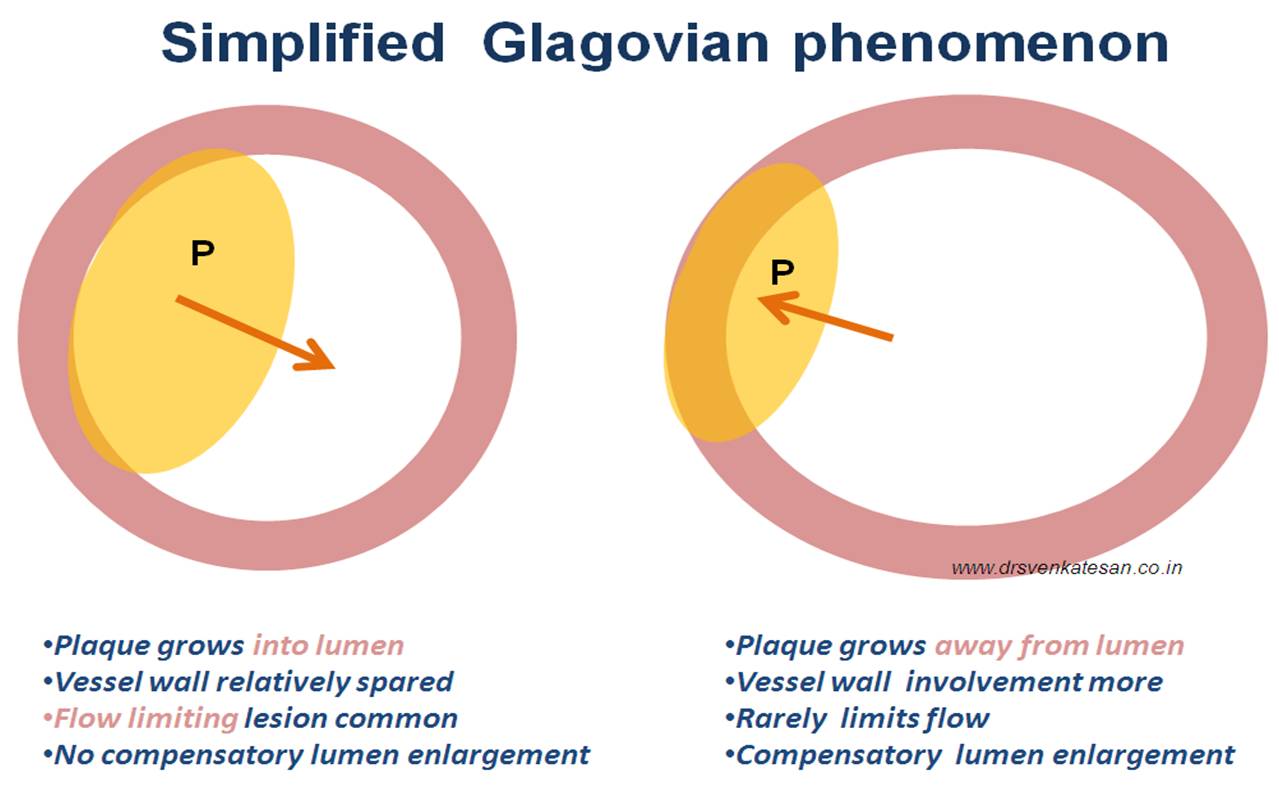
When things were as it is . . .  Glagov suggested , what  could  possibly be   the  most important  concept in the interpretation of coronary  angiogram .

The concept  suggested  the  atherosclerotic  process  could  actually spread  within the  vessel wall  in a predictable manner .

What determines a plaque to either grow into the lumen or grow away from the lumen?

If we could decode the mechanism of direction of plaque growth we will probably conquer the atherosclerosis  at least by mechanical means . The implications are too many.

A stented coronary artery may be re-engineered to grow the atherosclerosis  towards  the adventia .This could grossly reduce  the incidence of restenosis.

Further , in post Glagov days we realised  mechanical factors like plaque stiffness, eccentricity , plaque mass effect, drifting , lipid core density, medial lysis , elasticity of elastic lamina all could determine the   plaque  movement.

Why compensatory lumen enlargement does not occur in some lesions ?

We do not know the exact reasons . We may call it a fate . . . shall we ?

Curious blessing  : Atherosclerosis  for  some unknown  reason  blesses a  few with coronary artery  dilatation rather than narrowing .

This is called coronary  ectasia . Medial necrosis , weakness of internal elastic lamina or  destruction paves way for plaque shift towards the adventia . It is estimated , if the medial necrosis occurs in at least  50 %  of  circumference of vessel wall   it will  result in ectasia .And  paradoxically if  the media  shows resistance   the plaque grows into the vessel wall.

Endoleak  and Glagovian phenomenon.

Endo leak is the Achilles heel of   endovascular intervention . In fact , many would  consider  it as  a dignified terminology  for graft failure . Endo Leak   occurs when  the artery outgrows the stent  graft and bllood starts  collecting  in the graft vessel -wall interface . When the  scaffold is  placed  within the lumen ,  one may wonder how it is going to prevent  the  artery  dilatation . (Which is basic defect in any aneurysm}In fact , the aneurysm does continue to grow  along with   centrifugal  atherosclerotic  forces ,  possibly by  Glagovian phenomenon .

This makes it obvious  endo- leak is a distinct threat in every vascular  intervention.


Final  message

Most cardiologists  think their ultimate  job  in this world is to  deploy  a stent deep inside a LAD  or RCA.  While a few others indulge in more exotic  adventure of  crushing a plaque ,  trap the debris and  catch it with a  with  a basket .

There  are bigger and bigger   blind areas  in the vessel wall ,  infiltrated with  deadly atherosclerosis which is conveniently ignored  .If only we realize   this fact  , we  can move forward in our war against coronary atherosclerosis.

Of course the good old   medical  interventions  . . .  exactly try  to address  these issues . Let us  think  straight , and  not succumb to glamor  in cardiology !

http://heart.bmj.com/content/84/5/461.extract

Read Full Post »

Some say medicine is a funny science . . .  it is true  at times. It will remain so , as long as we convert  a fact into a myth and a myth into a fact at our convenience . It  is  often   fueled  by the  whims and fancies of modern research  ! This phenomenon is happening in a regular  fashion  for  many decades now.

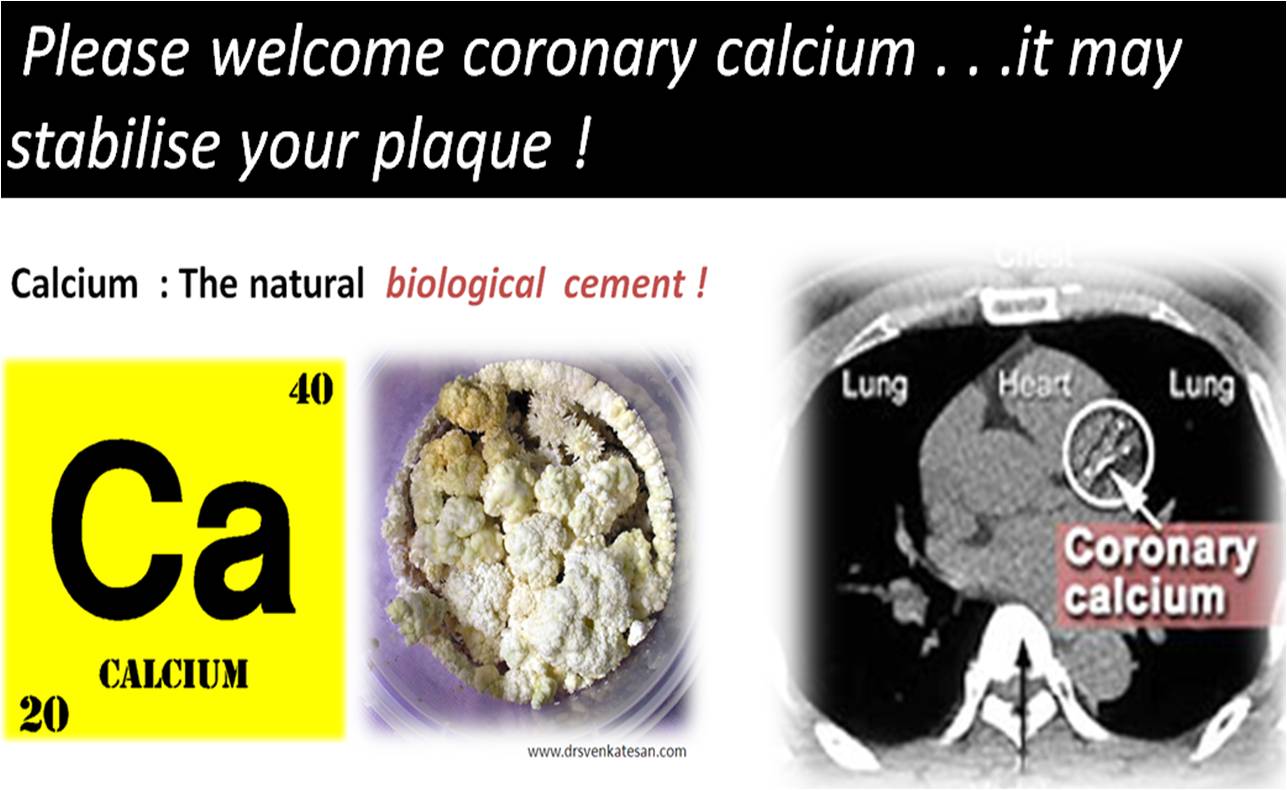
The number one killer disease of heart  is  the atherosclerosis  . Atherosclerosis means hardening  of arteries. The advent of coronary  calcium score with CT scans ,  it became a craze among many physicians . (It was   replaced later  by 64 /128 slice MDCT with unprecedented  commercial over tones !)

How can we  conquer the atherosclerosis ?   when the enigma of calcium in coronary artery is yet  to be solved.

The next few decades will be crucial   as  we are  trying to find answer to the following question .

Is  coronary calcium  good ,  bad or neutral   in CAD  ?

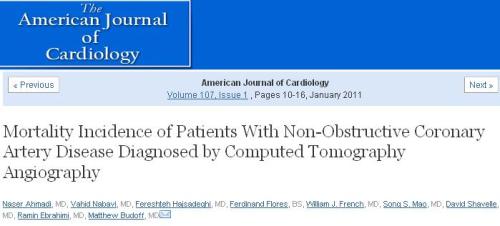
This article in American journal article begins the new year 2011  with good news for people , who show some calcium in their plaques.

What makes a plaque vulnerable ?

Plaque contents , it’s distribution and consistency make it vulnerable. Soft spots  formed by   lipids   may  result in  plaque cracks and fissure.   Semi solid  , mixed  ,  gel like soft  plaques   are dangerously prone for  rupture . Oxidation of LDL,  LDL  liquefaction and tissue metalloprotinase , thickness of fibrin caps , all promote softening.  If none of above  mechanism is operative in a given patient , the   plaque becomes  stiff and hard.

Calcification is the ultimate in hardening . Calcified plaque  is resistant to mechanical deformation.If  stiff  plaques   are less vulnerable , hard plaques ( ie calcified  plaques ) must be least  vulnerable . Calcification   can be called an end result of coronary atherosclerosis.

So , calcified  coronary artery  can be referred to as  a failed  mission of  atherosclerosis .It is  equivalent to  death  of atherosclerosis and denotes the end process of this dreaded disease process.

Calcification tames atherosclerosis  in it’s own den

What is the implication of a stiff hard, sharp calcified plaque lining  (or even projecting ) in the coronary lumen ?

As this study has shown , calcium in the walls of coronary artery is innocuous  . Of course , calcium should not be dense and obstruct the blood flow . This will  require  intervention. Many  consider , calcium as  a foreign body in the coronary artery . But the prevalent understanding is ,  presence of non obstructive calcium  is often  a  non issue or in fact a welcome issue in some.

After all , millions of  human beings  happily roam around  with the hardest possible substance  lining their  coronary artery called  stents.

Caution about calcium

This article does not portray calcium as a healing molecule in  CAD . In  the realistic senseit is  too complex to make such a generalization.  The  message is  , calcified lesions are less likely to result in acute coronary  events than soft , non calcified lesions.

It is well known ,  calcium can be problematic for the interventional  cardiologists  .It makes life tough for them in deploying  stents. Calcium rich lesions exerts  radial force in a diagonally opposite direction and interferes with stent approximation.

It is also believed localised , sharp calcium crystals may tear a plaque  and cause   plaque dissections. This  happens if the calcium is lying in an eccentric fashion overhanging the shoulder region of the plaque   abutting a soft spot.

Final message

It is now clear ,  why calcium  score in CT scans  failed miserably to predict  high risk subsets of CAD. In spite of repeated studies  the researchers failed  to show a positive correlation .  The studies are flawed  as they  were trying to look for a positive correlation  which is non existent . In fact , the above study seems to suggest calcium  score may indeed  predict low risk individuals!

Read Full Post »

Cleveland clinic is a leading centre for cardiac care .Major technological breakthrough occurs from this institute than any other place. Thousands of articles come out every year. Some articles , get global attention and make  a huge impact. These are usually related to a new hi- tech modality like CRT devices or percutaneous aortic valve deployment etc ,etc.

                                                Some articles , which are very important  may not get the due  attention . Journal editorial boards often  have a scorecard called impact factor .That is ,   how  a  journal  is  impacting the practice habits of  medical professionals . Ideally we need to have to grade individual   articles with impact factor .Many articles may not have any significant  impact  however good the impact factor of the journal.

Here is an article,  which excellently depicts the principles of management of ACS.  It was published in 2003 JACC,  by Steven Nissen  from Cleveland,  Ohio .It deserves more attention . Every cardiologist , involved in ACS management should read this, especially the interventionist.

Link to article placed her with courtesey of JACC

Read Full Post »

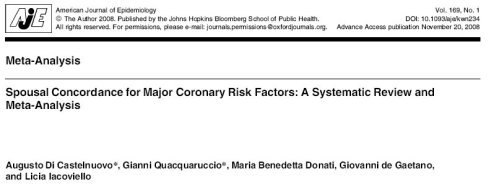
American journal of epidemiology in a land mark analysis has found , spouses share the same profile of coronary risk factors .This is a huge finding , considering the fact that , genetic factors are not involved here . So , it is something to do with family diet ? domestic issues, sibling effect ?

It is well-known lipid profile of family members are comparable . There are many Indian families who have high basal triglycerides .Mind you, husband and wife is the least (Zero link) linked genetically for familial dyslipidemia ,still they often share a similar lipid profile

Related issues without answers !

When a spouse gets a coronary event what are the chances of other to develop an event ?

Any body’s guess

In this era of bi- polar family life, can spouse behavior /unrest be a coronary risk factor ?

Yes . No surprises here .Apart form passive domestic smoking which is a well established coronary risk factor , in our coronary care unit , an initial survey of acute coronary syndrome patients revealed , a recent quarrel with their spouses, was a potential trigger for ACS. Further analysis of these data is being done

Spouse Ego : A powerful health risk

Spouse Ego : A powerful health risk

Divorce and coronary events ?

These are hypothetical observations in few families we have come across .

  • Forced divorce can be a definite coronary risk factor
  • Consensual divorce is not .
  • Women seeking divorce is more a risk for men than they inflict on women

Reference
Augusto Di Castelnuovo and others, Spousal Concordance for Major Coronary Risk Factors: A Systematic Review and Meta-Analysis, American Journal of Epidemiology, Volume 169, Issue 1, 1 January 2009, Pages 1–8, https://doi.org/10.1093/aje/kwn234

Read Full Post »

Cadiac resynchrnonisation (CRT) therapy , is  the most famed  as well as  ridiculed treatment modality for refractory failure . It is facing a real tough time for survival now .(At least in class 4 CHF.)

Confident and  authentic data  are emerging  now , that CRT should not be  used  in advanced heart failure .(This is in total contrast with the original concept  ,  when CRT was introduced nearly  a decade ago !  more  of class 3 and 4 were enrolled ) . Bad outcomes are expected in advanced CHF. This is something similar to whipping the tired horse concept  which  found inotropes   to increase the mortality in severe heart failure .

The article in the current issue of circulation  shows  no mercy to CRT  in advanced CHF

http://circ.ahajournals.org/cgi/content/abstract/CIRCULATIONAHA.110.956011v1

So what  is  the answer to the ailing CRT industry ?

Go and catch class 1 and class 2 CHF population* .You will get plenty  , of course  it got ratified by MADIT -CRT trial .

* It is attractively called prevention of cardiac failure

Read Full Post »

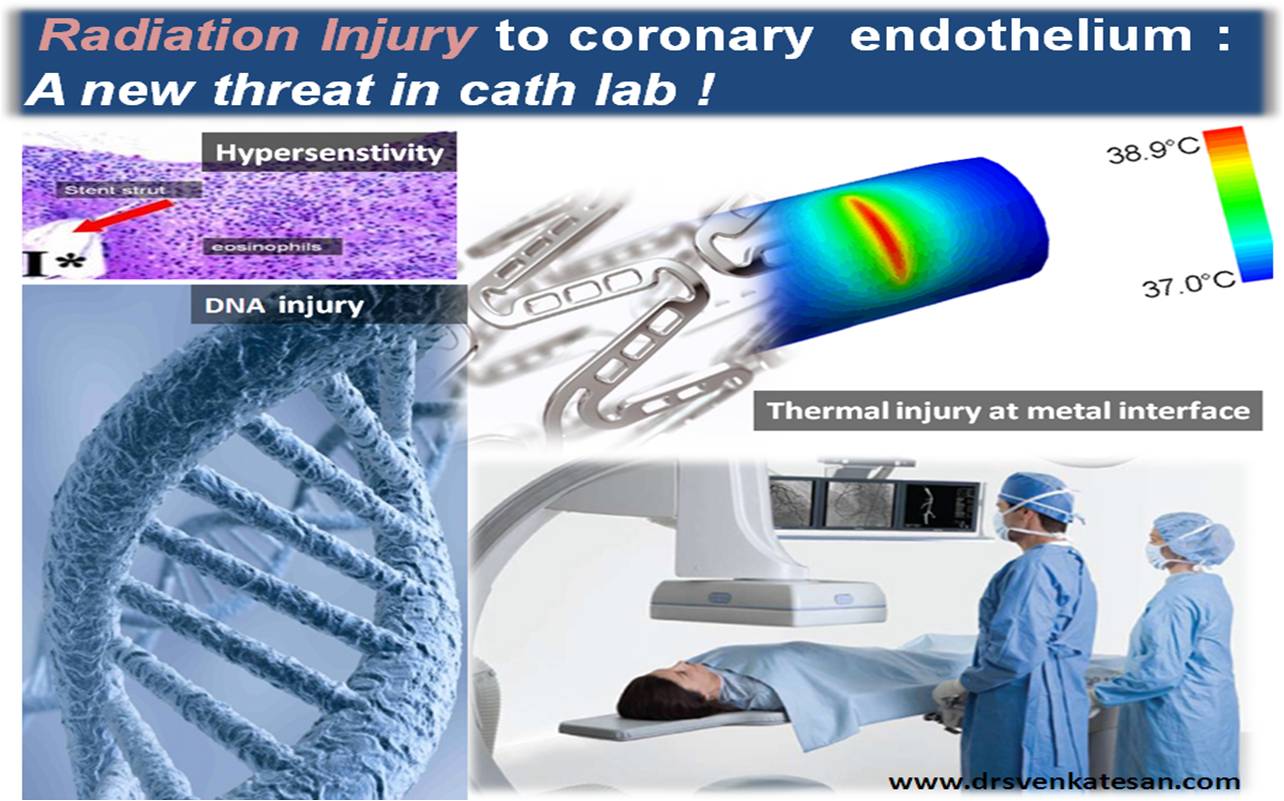
Radiation injury to coronary artery  is rarely given a thought , in spite of   prolonged fluro-scopic time  during  many complex angioplasties.While the cardiologists are fully protected the patient’s heart takes on the brunt of the attack.

What happens to the coronary endothelium -metal interface when X -rays pass through it ?

It is well known the radiation delivered to a tissue is many times  amplified if a metal interface is present. Further , the metals can produce heat on exposure to radiation . This absorption and heat varies with different metals .

The radiation injury to coronary endothelium  could be  significantly higher with DES , as the polymer in it absorbs more radiation than the bare metal stent. This could be responsible for late complications of DES.

The above  concept (unproven though !) is  proposed  by  http://circ.ahajournals.org/cgi/content/full/104/5/e23 .In this study Gold coated coronary stents were found to be less safe than conventional stent

It may take many years to know the truths  about  radiation injury caused by  of coronary stents  .

But always remember , unproven concepts are  not synonymous with wrong concepts !

Read Full Post »

Bifurcation lesions and ostial lesions  continue to  challenge the expertise of   interventional cardiologists.

Variety of techniques have been described. Geo positioning of a ostial lesions ,  exactly on the rim of ostium  is required  . This is very difficult in  many patients  , as stent migration either into side branch or protrusion into the main branch is common. Both reduce  optimal  PCI outcome  .

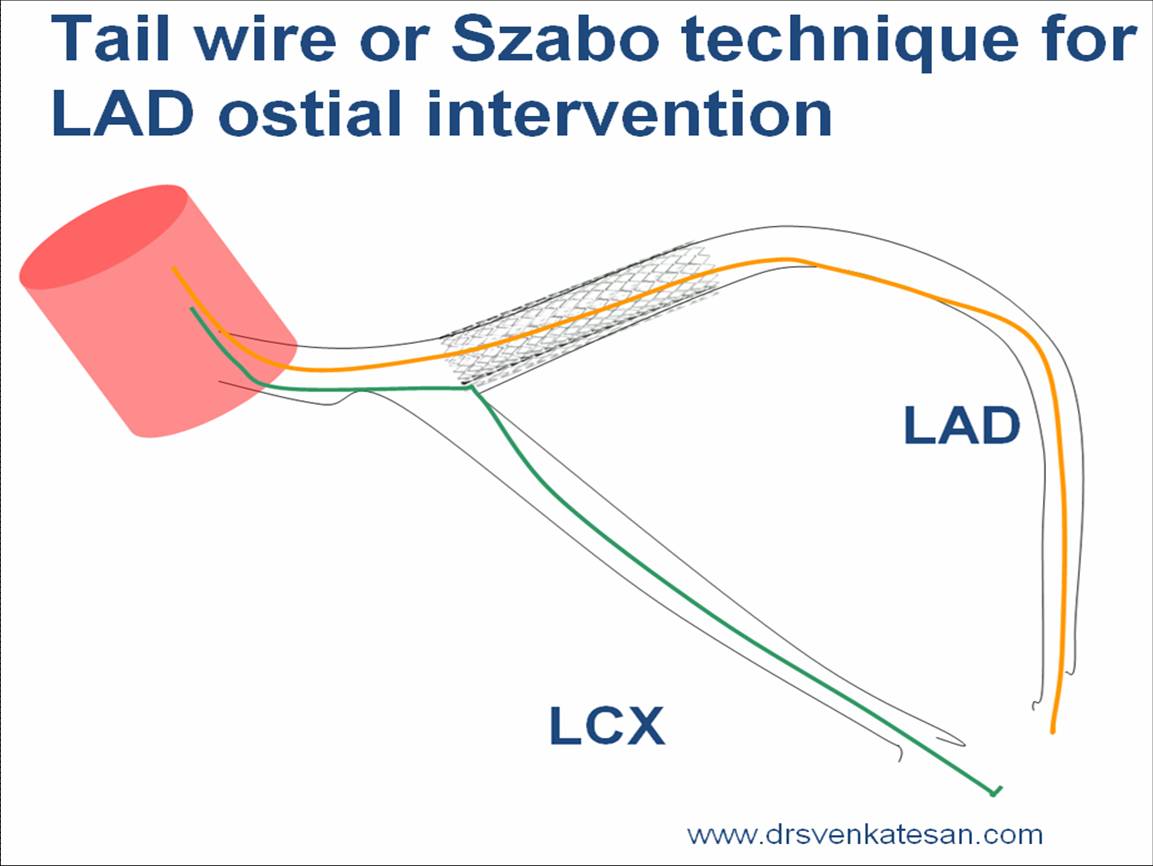
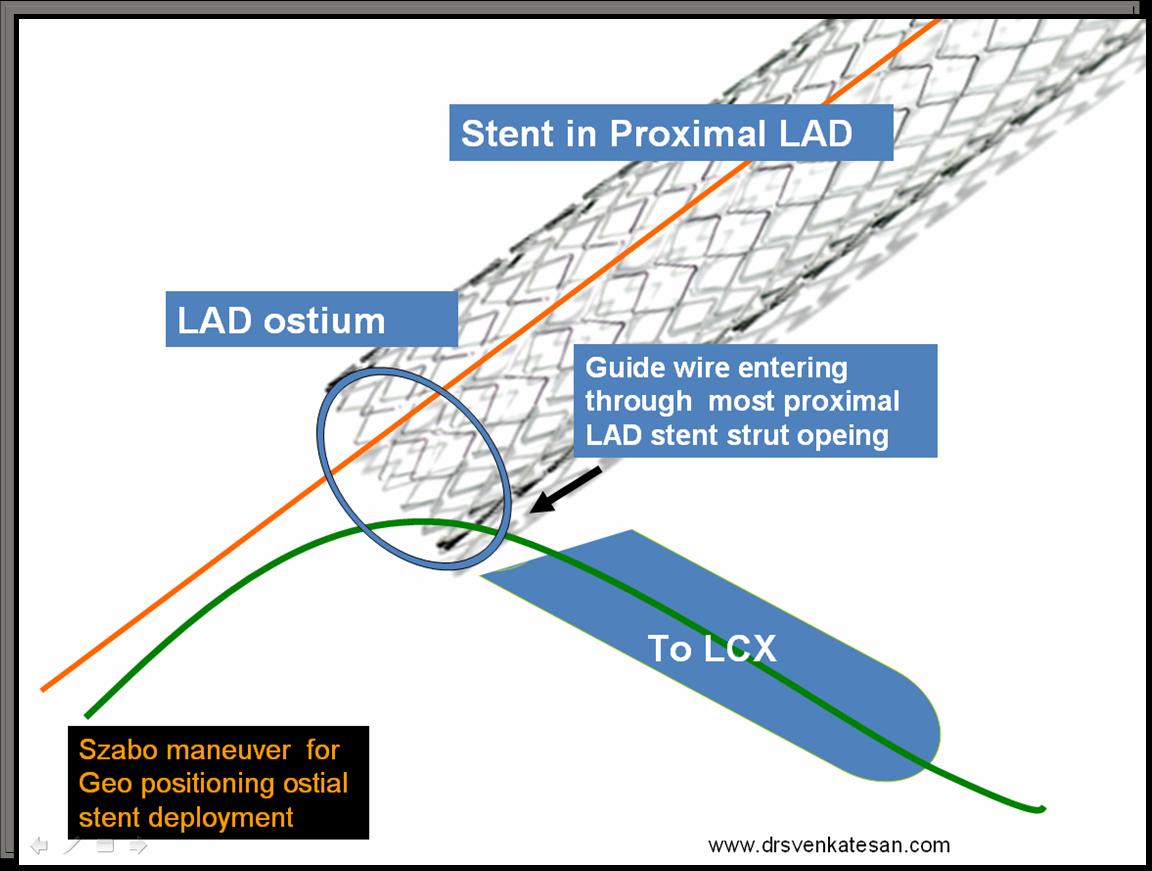
Here is a innovative  technique   described  first by  Szab0 in 2005 TCT conference .

Highlights of the technique

  • It is a twin guide  wire technique.
  • The Circumflex guide  wire  is threaded over the most proximal strut  of  balloon mounted  LAD stent .
  • The guidewire makes sure the LAD stent move beyond the LAD ostium .
  • Of course some technical limitation is  there, this seems to be a good option at least in some deserving  LAD ostial or LCX ostial lesions

Technical hitch

The balloon and stent is to be manhandled prior to deployment.  We are little awry to do it

The review article in the journal  Eurointervention

Read Full Post »

« Newer Posts - Older Posts »