Feeds:
Posts
Comments

Archive for the ‘cardiology- coronary care’ Category

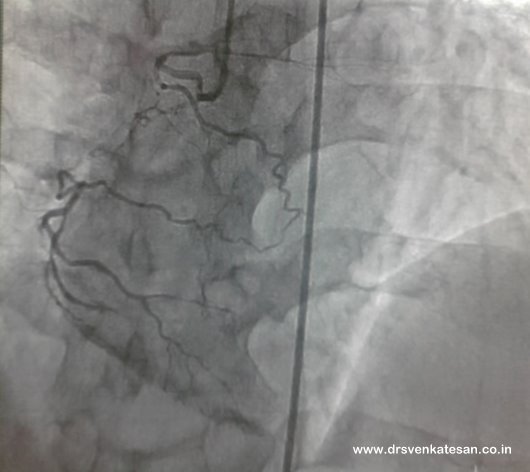
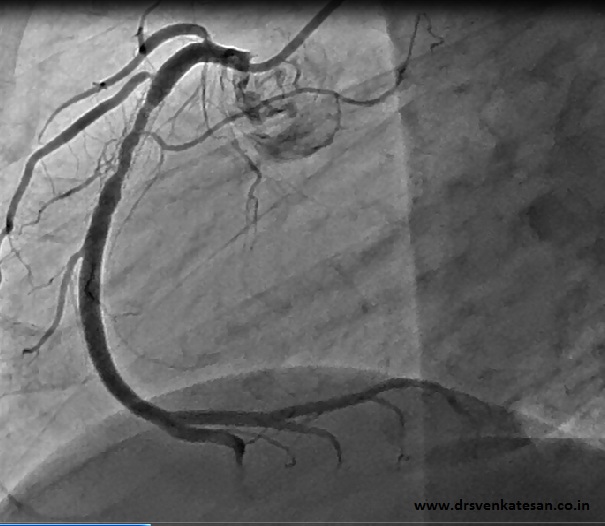
A middle aged man who owns a petty shop in a small  town of south India   came to us for stable angina .His RCA looked like this.

Normally if one coronary artery is obstructed the other comes to the rescue .It seems , this RCA do not trust it’s sibling LAD . See how it  self supports  its own  territory .(The most fascinating and mysterious aspect of coronary circulation is the collateral circulation. LAD  has big brother attitude  . . . it hesitates to help others while   RCA is more philanthropic , we know  it sends prompt  collateral to  LAD  whenever it is  distressed !)

However , there is one advantage of  such   self-sustenance of RCA  (Intra coronary/homo-collaterals ) . If  the  RCA  has to live  at the mercy of LAD  it  runs a risk of   neglect  at times of  distant LAD ischemia as well  !

Management

Single vessel disease , total occlusion , long segment lesion , still  the  PDA  is protected and the vital postero- basal area of heart perfused well ! What to do ?

Scientific  cardiologists  would like to meddle this  RCA with  multi-pronged guide-wires and other weapons  . Non -scientific cardiologists would  send him  home with medicines  . This patient preferred the later ! In the process  he  saved a  lakh ,  which  I  believe was meant for his daughter’s  education . He profusely thanked me for not hijacking his hard earned money for  frivolous  reasons . I said he should thank  his collaterals  and not me , for getting his money back  !

Read Full Post »

  • Acute myocardial  infarction is the number one cardiac emergency .
  • About a million papers and articles are available in  medical literature about STEMI.
  • Management of STEMI when they present early is addressed by every text book.
  • It is  really surprising to note there is no  simple and  specific guidelines  to manage STEMI when they present late to the ER .
  • Such a scheme is vital for physicians,  as experience suggest almost 40 % of all STEMI arrive late and are ineligible for specific reperfusion strategies.

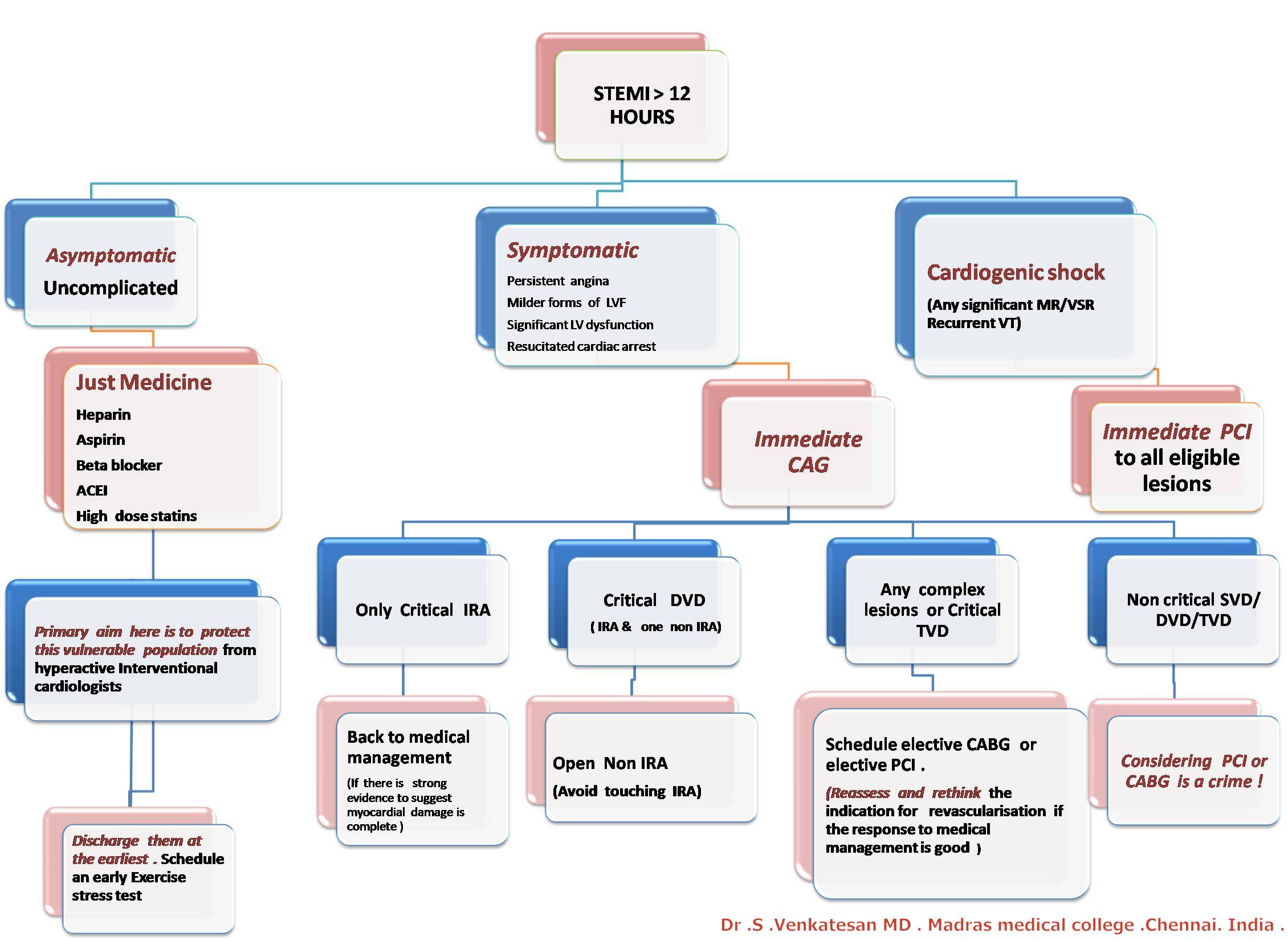
The following  flow  chart is  exclusively meant for usage in STEMI when they  arrive late >12 hours .

This is a personalised version based on working in one of the oldest CCU in  Asia which handles  about  2000 acute coronary syndromes every year with a mortality rate of 6-7 %  Hope one can bear with it !

Please click on the chart for a high resolution Image

Comments are welcome

Read Full Post »

Sustaining a STEMI  may be a  pathological  end  point  for  coronary  artery disease. But ,  from the  management point of view it is  actually  a starting point for CAD evaluation  .Strategies to prevent further   cardiac  events   must be formulated .

How do you manage a asymptomatic  un-complicated  post  STEMI   patient*  at discharge ?

  1. Do a sub- maximal symptom limited EST and then discharge.
  2. Advised  to come back after 2 months for a  stress test or Perfusion imaging
  3. Continue  with intensive  medical management without EST or  CAG and monitor only the symptoms
  4. Advice coronary angiogram   in all and decide depending upon the lesions (Pre -discharge CAG )
  5. I am a modern day cardiologist  . This question does not arise . . .  as I do only primary angioplasty for all my cases !

( *Please note ,  this forms the bulk of  STEMI population (up to 60 %  )

Answer : Your guess is the correct answer!

Why we need to risk stratify STEMI at discharge ?

The  morality and outcome in STEMI  though appears  to be a   continuously falling  curve ,  the slope is not linear.

The classical   mortality till discharge is about 6-8  %. Between discharge and 3oth day there is 1-2 % additional mortality

At end of first year there is  further   2 % mortality. From  second year onwards there is an annual attrition rate up to 3 %.

The aim of doing  a pre-discharge  EST is to do identify  ” patient  subset ” who are destined to die  within 30 days of STEMI.  If you schedule the   EST  after 6-8  weeks  one can not prevent these two deaths out of 100 !

( Of course ,  we assume   a prompt revascularisation in those vulnerable would prevent this !).  By doing so , we can avoid the bulk of unnecessary PCIs  that  happen  with  routine CAG following STEMI.

Pre discharge EST can be done safely  within 5-7 days  with  a symptom  limited test (70 % of  THR or up to HR of  120 /mt ) This  simple test if it is negative can virtually R/O  a  critical proximal  lesion with near 100% sensitivity.

Should we  risk stratify patients  who have undergone pPCI as well ?

Most of us  would love to believe ,   once  pPCI is  done to the  patient , he  reaches  a therapeutic end  point. But  it is not the truth . It is  the degree of  LV dysfunction ,  extent of contrary coronary lesion  ,   co existing risk   factors  and  the  intensity of medical treatment  only  would  determine the long term outcome.

It is very important to  realise  the pPCI is aimed at opening the IRA  and other lesions are  often left alone. So never  believe  pPCI   per se  would confer total risk reduction following a STEMI  .  There is considerable evidence to suggest  the opposite may be true at least in high high risk pPCI  ,where  metals are   placed  in  complex ,   vulnerable thrombotic milieu.  Hence it  seems logical  to risk  stratify  all patients   after primary PCI   (In fact, this population require  more vigilance )  .

When will you advice an  EST following  pPCI ?

It is usually not needed in the immediate discharge phase in single vessel disease which  would have been  tackled during pPCI.In multi-vessel CAD , where  only the IRA was tackled during pPCI  ,the same guidelines that of  thromolysed  STEMI shall apply  .Since we know the coronary anatomy already ,  EST helps us to evaluate the hemodynamic status of non IRA lesions if  there are any  . While ,  this is a  logical debate , logics has a rare place in medicine . It is ironical ,  stress test   is rarely  done  even after 6months following pPCI  in most centers.

Final message

It is  a  pity  ,  anatomical risk stratification  has squarely beaten  the scheme of   physiological risk stratification in most cardiology centers . A pre -discharge EST* was a  good concept that gave us an idea about the coronary reserve  after the ACS.  It was a collective wisdom of cardiologists  that has hanged this useful concept.  It is still more shocking ,  to note even the  scheduled  6 week   EST is  dropped from the  post MI work up in some  institutions.

* Many would consider  ordering an early EST in STEMI is an act of bravery ! The fear seems to be genuine   and most will agree with that.  But , please remember a physiological test  (Cheapest and simple is EST or a  Nuclear perfusion )  should precede  CAG  in all  asymptomatic  post STEMI  population  whenever possible . If  EST could not be done  prior to CAG for some reason   , at least do it following the CAG . It  will have  an  important impact  on the downstream decision making  which is often an  inappropriate  PCI  !

Read Full Post »

What is  the most important factor that  will decide  the revascularsation following a  STEMI  ?

  1. Patient’s  symptoms
  2. Residual Ischemia documented by stress  test /Perfusion scan
  3. Presence of  significant  LV dysfunction
  4. Coronary anatomy and lesion profile
  5. Wealth  of the  patient (Insurance  limit  and  other  financial  resources )

Response  2  is   academically correct ,   but    practically  and politically   response 5  would be   the right one  for most cardiologists . At  any given day  ,  affordability and availability  of PCI  will prevail over all other factors  .

Affluence based cardiology

Image courtesey : Jupeter images

What is the  height of  inappropriateness in modern cardiac care ?

This world will never forgive the medical profession , if they do not fight  against  grossly inappropriate medical  care system especially in the life saving situations  .While one  cardiologist    just watches   a  left main disease patient  with unstable angina die peacefully in a Govt institution ,  while  another  patient with asymptomatic  distal PDA lesion gets a 3rd generation drug eluting stent in a  nearby corporate hospital !

Please note : Harm is the ultimate outcome in both rich and poor.One suffers with non availability while the other is the victim  of   affordability .

Read Full Post »

The  OAT   extension study  ,   a  6 year follow-up study on total occlusion following STEMI has just out in circulation 2011  October , online first . http://circ.ahajournals.org

There were two  important conclusions  from this study

  1. Long term follow-up  to  6 years  confirmed  the  lack of benefit of routine PCI  in  post MI total occlusions.
  2. Inappropriately   done  PCIs convert   stable coronary occlusive  disease into potentially dangerous subsets  with  risk of re-occlusion (Which  could  very well be an acute coronary syndrome )

The second one is  of critical  important than the first  .In a nut shell ,  it  suggests  routine PCI in  CTOs  could  increase the   risk of ACS many fold in other wise stable patients.

Final message

This OAT extension study  should  not experience the same fate  of  COURAGE and OAT -1  which  were  successful bitten and buried  by most  interventional cardiologists.

This time they   have to  swallow  the  unpalatable truth ! If they don’t ,  our  patients  would be the ultimate  losers and

will pay the  price dearly !

Personal foot note :

One of my colleague asked me  . . . Why am I  always  after the Interventional   cardiology  community !

I said ,  it is not my job to pull down any one group.  I am just exposing   the  irony of  “selective usage” or “selective  neglect”   of scientific  data by many of us !

Read Full Post »

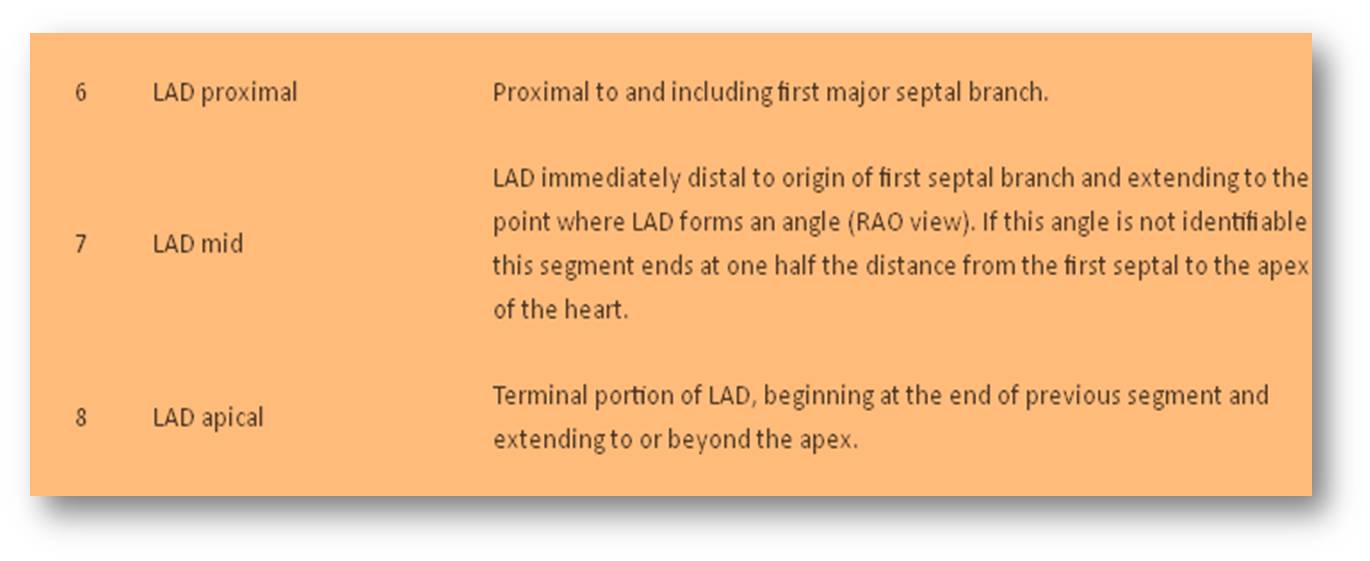
Proximal LAD lesions require  specific and early Intervention.Hence we need to know what exactly  we mean by proximal LAD disease.Unfortunately , it means different things to different cardiologists .There is no dispute regarding the  origin of  LAD since it begins with bifurcation point  .The problem comes with  this question !

Up to what distance LAD can be termed as proximal ?

  1. Bifurcation  to   “First   diagonal” of  any size
  2. Bifurcation  to   “First Major diagonal”
  3. Bifurcation to     “First septal”  of any size
  4. Bifurcation to    “First  major septal”
  5. Bifurcation  to   “Any major  first branch ” (Either septal or diagonal )

Answer : I think  4 is the correct answer . But many believe  5 can be correct as well !

Why  there is  confusion in the  definition of proximal LAD ?

This is because the first branch of LAD itself is not a  constant one  . It can either be a septal  or  uncommonly  a diagonal.

It should be noted , the septal and  the diagonal  branches  neither respect   seniority  nor follow a  hierarchy .The first diagonal may be diminutive while the   second or third diagonal may be major one  and vice versa .Further  ,  there can be a trade of  in length and caliber of   septal and diagonal branches  .This  phenomenon is also  common between  diagonals  and   OMs  . All these confound the picture .

Cardiologists even though they are  primarily physicians they are  pro-anatomy  like surgeons when it comes to coronary interventions .

                                  In the strict sense ,  we  need to differentiate a  lesion  from being   physiologically proximal  or anatomically proximal  !

Is there a proximal LAD equivalent ?

There are three  situations  this can occur .

  • Some times a lesion  by  definition may not fit in  as proximal  LAD  but physiologically  few major diagonals  will arise after the lesion.
  • Other situation is , LAD lesion may be  mid or distal but  a major first  diagonal may be diseased  , making it  equivalent  to proximal LAD in terms of physiology.
  • A mid LAD  with a large OM lesion which is running in the D1  territory

Final message

It is ironical  millions of cardiology interventions happen  for proximal  LAD lesions  every year without  even  proper understanding of what we mean by  it ! Youngsters are argued to ponder  over this issue whenever  they indulge in  such cases for revascularisation!

Reference

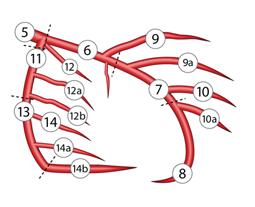
Text books differ in their definition about proximal LAD. Currently , the  SYNTAX  scoring system  has defined the coronary segments in a practical way.

http://www.syntaxscore.com/index.php?option=com_content&view=category&layout=blog&id=1&Itemid=32

Definition from SYNTAX

Read Full Post »

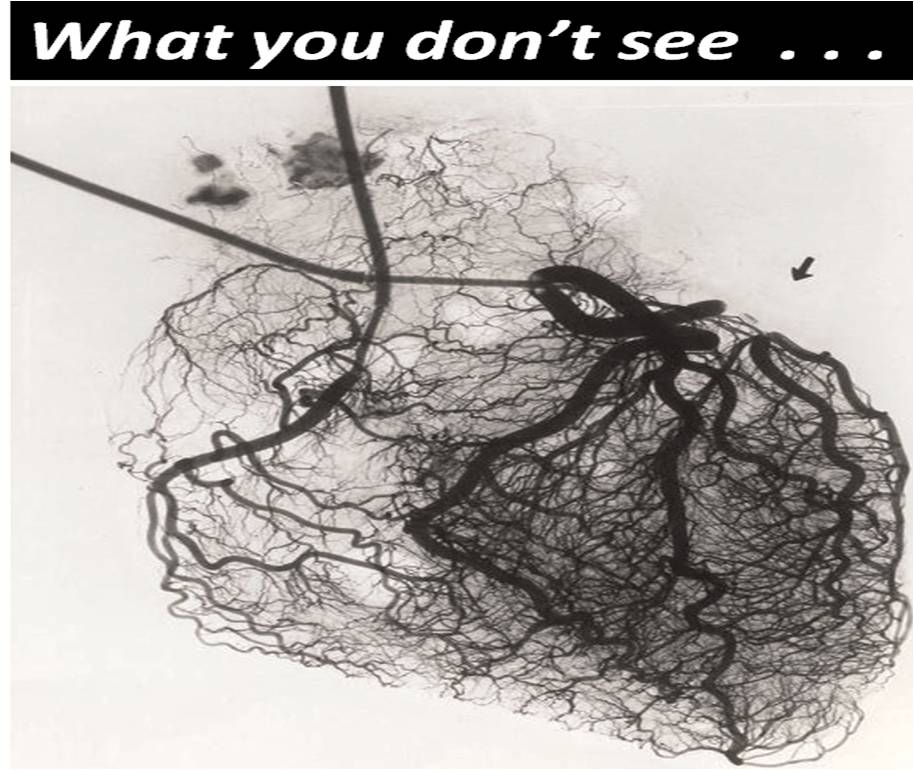
Human coronary circulation stands  unique among  others as it is a   life-sustaining circulation.It is  considered   a great  medical achievement   to visualise   the right and left coronary artery  system by coronary angiogram.  Actually  what we see is   only  a  fraction   of  the surface area  of  coronary circulation . The surface area of  epicardial coronary arteries   constitutes  less than 5 % of entire coronary vascular tree .

This  is the reason  normal coronary angiogram can never mean normal  coronary circulation !

This huge gap in our perception is the single important factor  that  explains the vagaries  of modern coronary care .

This also  make any coronary  scenario  a  reality .

“A patient with normal coronary angiogram getting a myocardial infarction the next day and a severe triple vessel disease living comfortably with medical management”

So ,  it is essentially a   false  sense of  scientific accomplishment   by the  cardiac scientists  at  least in the  of coronary circulatory physiology.

There are innumerable channels of micro vessels traversing across the heart, sharing , bridging , branching, penetrating  and  perfusing the muscle mass.They can be anatomicaly patent , physiologically non patent .They can be recruited by hemodynamic stress . It is also influenzed by  favirable growth milleu and hormonal and neural stimuli.

What determines the extent of these invisible circulation ?
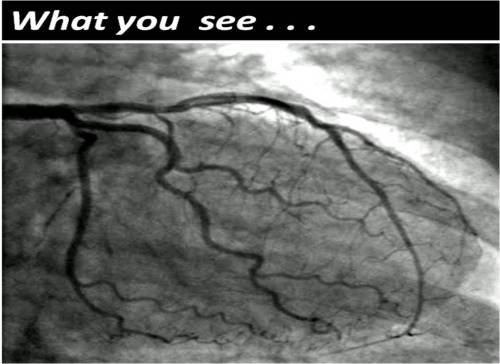
and

An in vitro heart with special catheters showing the true extent of coronary circulation: Courtesy http://eurheartj.oxfordjournals.org/content/28/3/278.full.pdf+html

Why many cardiologists   do not give due credit  the   coronary collateral  circulation  ?

Right from the days  of  Levine in 1970s( Who made a seminal contribution  about coronary collateral)  the  utility value of  coronary  collateral  circulation   was  never able to convince the cardiology professionals .

It has been our traditional  teaching ( without much evidence of course  !) coronary collateral circulation  is not effective to support blood flow during exercise . This fact has been  disproved  many times . Coronary collateral circulation was indeed useful in limiting damage in ACS and  relieve symptoms in stable angina.It helps  in reverse remodeling and provided electrical stabilty as well in post MI population.

Still  the concept  was  alienated  and   made   totally irrelevant  in the interventional  era  . Many   cardiologists  found well-developed collateral’s as an interference to their expertise and ego since it has a potential to alter the indication of PCI.They  continue to have  strong  scientific conviction (Pseudo ?)   that man made collaterals must always been superior to God made collaterals !

Whenever  some credible  reports emerge about  collateral circulation   being   equivalent to  revascularisation procedure , these concepts were  prematurely buried for some reason.

In the last decade there was a concern  about  performing  PCI in patients with well-developed collaterals  .The argument was , they tend to develop early stent occlusion and restenosis . It  was a genuine  query  raised by few thought leaders in the field as  collateralised vessels  suffer from  low flow states  after PCI ,   if the pre -existing collateral continue to function.

But then , few  studies countered this  , and   said PCI  is safe and  in fact may  fares well   in  patients  with  extensive collaterals .

In these  studies  interventionist’s  argument looked  amusing !  as they  seem to  define a  successful  PCI  as  not only to open the occluded vessel  but also  make sure to close  all functioning  collaterals  .(What a  a pity for our natural biological  angiogenic forces which had  worked  and  grown meticulously for months!)

Cardiac science in the current format,  makes   the future look  bleak for coronary a collateral circulation .With  early PCI  becoming a norm we will never ever allow the natural collaterals to  grow  ,  and even the  established collaterals  will have to face a stiff   fight  for survival  with  sophisticated coronary interventions .

Competing interest in the filed of  coronary collateral   research

While the basic scientists want  to  grow collaterals with angiogenesis ,  stem cells etc  interventionists   continue to  indulge in rampant angioplasties which  will suppress  collateral growth.

This implies we will struggle to  establish  the true  importance of  coronary collateral circulation .

Final message

Can it be an  effective form of revascularisation  ? 

My personal  inference  is   coronary collateral  circulation  “would and should”  have  a definite role  in at- least  some of the subsets  with chronic coronary  syndromes. If we think otherwise . . .    it’s against the principle of  natural biological science .

A good  collateral   system with optimal medical management  can save not only our  patient’s  lives but also  their hard earned currencies !

Reference

Here is a rare article in European heart   journal that discuses coronary collateral circulation  . Let us welcome such wonderful  reviews which keep the interest alive on the filed.

http://eurheartj.oxfordjournals.org/content/28/3/278.full.pdf+html
Read Full Post »
Human coronary artery anatomy would  rank  top among  all human biological mysteries. The variations in their branching pattern is next only to palmar creases and cerebral gyri !

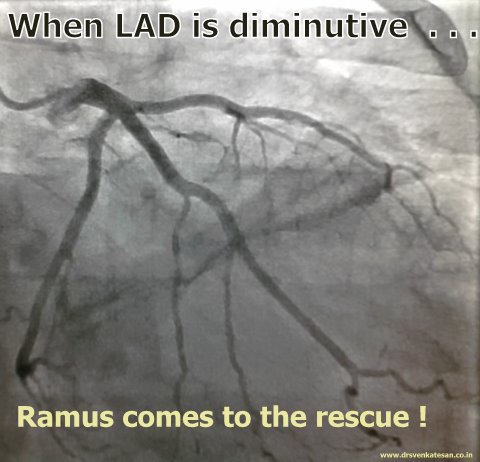
The left coronary artery can divide in to two , three  or even four branches occasionally.The trifurcation  occurs in upto 20 % of population .The ramus intermedious  can some times be a major division .Usually it supports the diagonal or OM territory.

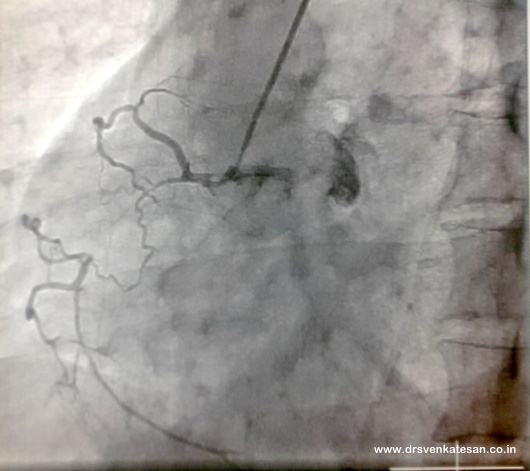
It is very rare to see a ramus  take a long course . Here  is a patient whose LAD is small  which  falls  short of LV apex . Sensing this , the ramus travels all the way to apex and support the LAD in distress !

RAO caudal view shows the Ramus reaching all the way to LV apex! Note the diminutive LAD and absence of true OMs from LCX.

* Technically  this can  also be  referred to as a rare form of dual LAD system .

Read Full Post »

Instent restenosis is a  common problem.

Diffuse long segment instent restenosis is somewhat rare.

We  encountered one such patient who had diffuse instent restenosis of RCA.

ISR is ssupposed to be rare in DES, but here ISR occured with a Cypher stent  one year following implantation

He presented with angina which  was relieved  by plain baloon angioplasty.

 link to a  related article in  this  site  regarding the mangementof ISR.

Read Full Post »

We know primary PCI is a race against time  both for the  patient  and his  physician.

What is the upper limit for this unique race where the stakes  are high   and it involves  human lives  and  big  corporate  warfares  ?

  1. 6 hours
  2. 12 hours
  3. 24 hours
  4. 36 hours
  5. 54 hours
  6. Time does not matter . You can do a PCI as late as possible as long as  patient has sufficient insurance coverage and we have the expertise

Answer :

Please note there is  only one exception  . Cardiogenic  shock has been given a extended  lease of time window (Which can be technically up to  54 hours ) . PCI can be performed   if the onset of shock  is   within 36 hours  of STEMI  and to be performed within  18 hours after the onset ! )

* Even though we  have a  well set criteria for re-perfusion which bans primary PCI to be performed after 12 hours , cardiologists have enough technicalities to overcome this hurdle and keep doing the futile pPCI well after 12hours.

How they are   able to indulge in these futilities   without  any ethical issue ?

The answer  is very simple. Instead of calling it as primary PCI they refer to it as delayed PCI or rescue PCI !  Strict time specific guidelines are only for primary PCI . By changing the terminologies they   make a mockery of the concept of time window which  is vital for any intervention for STEMI !

Read Full Post »

« Newer Posts - Older Posts »