Feeds:
Posts
Comments

Archive for the ‘Cardiology -Interventional -PCI’ Category


Coronary stents have revolutionised the management of CAD. Stents are metallic scaffolding devices that help keep the atherosclerotic plaque  plastered within the coronary arterial wall.Thus it gained the name angioplasty. Stents have aradial strength that  exerts a constant force on  the plaque . Since metals are unfriendly partners for coronary artery , we need to have minimum metal within the coronary artery.The stent struts weave around the lumen generally the stento/ artery area ratio should be as less as possible (15%).

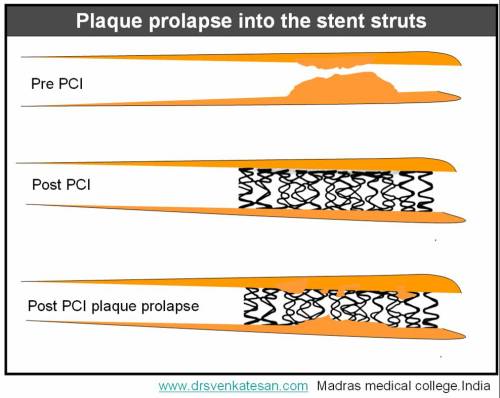
But this has a trade off .The uncovered area of plaque tend to project into the lumen .This is many times not significant.But can be a problem if the plaque is very soft and bulk of the lipid core may reenter the lumen.this event is called plaque prolapse.

plaque-prolapse

What is the time taken for plaque to prolapse ?

Generally it is late event.But it can happen immediately after the procedure also.

Which type of lesions are more likely to have plaque prolapse ?

Eccentric and complex lesions especially with overhanging edges are prone for prolapse

What is the sequale ?

It can be benign.If there is a erosion due to stent struts can precipitate an ACS.It progresses into instent restnosis in many.

What is the angiographic appearnce ?

Angiographically it often appears as luminal  irregularity withi stented segment .

Many times , it may appear as a filling defect also.

Is there any specific issues in plaque prolapse in drug eluting stents ?

Coornary artery is not drugged uniformly by the drug eluting stents.In fact contact  lines of metalic struts  , through it’s micropore oozes the drug with polymer.Pathological studies have revelaed non homogenous drug penetration and resultant irregularity on the plaque surface.This could amplify the plaque penetration preferentially in few areas.

How to manage plaque prolapse ?

It should be managed as any other instent restenosis.Plaque resection with atherectomy devices has not solved the problem to the desired levels.A second stent is the most common approach advocated by the cardiologists.(Whic is not ideal though !)

Read Full Post »

CABG is tretment of choice for left main and  complex proximal LAD  lesions. So most patients get CABG in these situations.

The hemodynamic effects of LIMA graft on native left coronary artery can be tremendous and some times deterimental.

  • One of the consistent observation has been , the moment LIMA is bypasssed into distal LAD the antegrade flow through left main is reduced .This is still more significant if circumflex is also grafted .
  • For inital few weeks there is competition between LIMA flow and LAD flow and invariably LIMA wins  , and native leftmain or LAD  flow regresses and many times  closes totally.
  • Some studies have observed accelerated left main and LAD atherosclerosis.
  • The native LAD and leftmain could be a source for thrombi and atheromatous debri and these migrate distally and have potential to block the LIMA entry point  into LAD
  • The advantage of having a patent native left main and LAD  is that if the LIMA  graft occludes later on native circulation may assist.

Read Full Post »

Post myocardial infarction revascularistation either by PCI or CABG forms the bulk of the coronary interventions world wide.There has been considerable controversy in selecting the patients for the procedure.

Certain basic rules are to be applied.

  • Never do any thing on a totally asymptomatic and fully functional patient.(Functional , means good exercise capacity of atleast( 10Mets).Just medical treatment with good doses of statins, beta blockers will do.
  • If a patient has persistent angina  following MI  ,the issue is relatively simple as  they are  candidates  for CAG  and intervention .
  • The issue becomes little complex when the primary complaint is breathlessness and echo showing  LV dysfunction.

This dilemma is due to a  simple fact

coronary revascularisation has a  great impact in relieving angina but has  less impact in reversing

left ventricular  dysfunction

So,  how do you approach a patient with LV dysfunction and exertional  breathlessness and absolutely no chest pain ?

  1. Do a  CAG
  2. Assess the lesions if any (Some times,  to our surprise there may not be any critical lesions at all ! )
  3. If there is / there are critical lesions try to corroborate with infarct segments.(Use Echo for this correlation)
  4. Don’t bother much,  if a  vessel has a lesion  that is supplying a scarred myocardium.
  5. If there is gross LV dilatation, mitral regurgitation and LV clot refer these pateints  may benefit  from surgical management

One of the rules written by the cardiology community over the past few decades has been

We must document viable myocardium before doing a revascularisation procedures on them.

This rule was self imposed ,  to prevent inappropriate revascularisation in  post MI population.

So , a  gamut of investigations (Both invasive and non invasive came into vogue) to identify viable myocardium in post MI population. Stress echo, Thallium-sesta MIBI, PET  to name a few .

Even after liberal usage of these invesitgations , we realised ,  the confusion in the  optimal selection of candidates for revascularisation has not settled.

In fact,  the correlation between viabilty and subsequent interventional benefit is  inconsistent .Not withstanding this  issue  ,cardiologists inspite of the negative results of OAT and TOAT trials ,  started  opening or by passing any occluded vessel irrespective of viability status.

Unanswered  &  Unasked questions in myocardial revascularisation ?

1.Why viable myocardium is viable even in the adverse compromised vascular  environment ?

It  is viable for the simple reason it has some capacity to be alive . By it’s inherent survival capacity (Survival of the fittest ) or it somehow gets the nutrients by cell to cell perfusion.

2. It is viable allright  ,  why it is not contracting ?

Because ,  it is biochemically and metabolically alive (Can be documented by FDG PET scan mismatch ) but it can not synthesise adequate ATPs to make the muscle contractile.

3.”Viable myocardium is viable ” what more you want from it   ?

Simple viability is not suffice . How to make it mechanically active and contractile ?

4.Is viable  myocardium    synonymous with ischemic myocardium ?.

No,  it is not (Contrary to the popular perception ) .

5. Is it not  common to find dysfunctional segments with good TIMI 3 flow ?. So what is the purpose to document viability ?

It is not suffice to simply document viable myocardium but it is an absolute necessity to prove this viable segment is also  critically ischemic .

7.If angina is  a sign of viabilty why most of viable myocardium is painless ?

This again confirms the fact , much of the viable myocardium in the post MI phase is not ischemic but” still dysfunctional” waiting for healing time. This concept  was  introduced with great fanfare* as  stunned myocardium ,  20 years ago , which was subsequently rejected my mainstream cardiologists , as this concept tend to  restrict the  freedom of interventionists. * Even though ,the concept was genuine and proven scientifically !

6.Are we  certain , the  viable ,  non contractile myocardium  (Which we painstakingly document )  will get back the contractility once the  segment is    revascularised?

Absolutely not. (With lot of PET study doumentation )  This,  we can not guarantee even in ischemic, viable segments  ,  while in the  non ischemic, viable segment it is all the more unlikely.

7. What are the chances of these viable but  non contractile myocardium  regain the contractility  by natural course ?
Very significant chances .In fact every patient recover some LV  function spontaneously over time .

Final message.

  • Revascularisation is non controversial in patients with angina
  • In patients with  primary symptoms of dyspnea  ,  it is less effective and documentation of myocardial viabilty per se will not guarantee successful outcome following revascularisation.Out come depends on  multiple factors .

Read Full Post »
Intraluminal filling defect is often  observed during coronary angiogram .Thrombosis  has become the default diagnosis in most situations.This has resulted in over diagnosis of thrombosis .In fact a strategically located plaque stained by the dye is an equally common cause for intraluminal filling defect.

In fact there are many recognised caused of filling defect

  1. Thrombus
  2. Dissection
  3. An eccentric plaque
  4. Dye trapped within  plaque fissures
  5. Calcification projecting into lumen
  6. Plaque prolapse from stent struts
  7. Artifacts-End on view of  side branches
  8. Static myocardial bridges
  9. Trapped air bubble(Transient filling defect)
  10. Streaming  effect  dye may mimic a filling defect

Message

It is  not advicable  to make a  default dignosis of coronary thrombosis in all cases of intraluminal filling defects

Read Full Post »

Why PCI  in   left main CAD is considered  an inferior modality than CABG ?

CABG is superior to PCI for the  simple reason it provides complete revascularisation virtually in all  patients with LMCAD , while PCI is possible only in a fraction of patients with LMCAD.

If  we take 100 patients  with left main  disease may be ten (At best !)   would be  suitable for PCI ! In other words PCI is contraindicated in vast majority of LMCAD  by technical criteria alone , while there can never be a contraindication for CABG in patients with LMCAD.(Except  when , comorbidity precludes surgery )

Why  PCI in  LMCAD difficult ?

It is  dependent on  technicalities

CABG does not tackle a lesion,  it simply avoids it  and by passes it ” No great brains required”

while PCI takes on the plaque frontally ,  in the dangerous  terrain of  left main artery  itself !

so,  much caution,  planing ,  logistics are required . Further ,  if there is a complication there is a potential

for catastrophe  as the only  supply line is cut off . This is the reason , cardiologists were worried to try this on

unprotected left main. (Protected LMCAD refers to left main disease following CABG  wherein atleast   LAD or LCX is  grafted )

Points to ponder in LMCAD

  • PCI is suited for isolated discrete LM disease.In realty  this is seen in less  than 5-8 % CAD.
  • LMCAD is very often associated  with  critical and multivessel distal CAD . So these patients will be candidates for CABG.
  • Left main ostium or LAD ostial  involvement makes PCI a tougher exercise
  • Calcification is more common in LMCAD that  again makes PCI difficult.

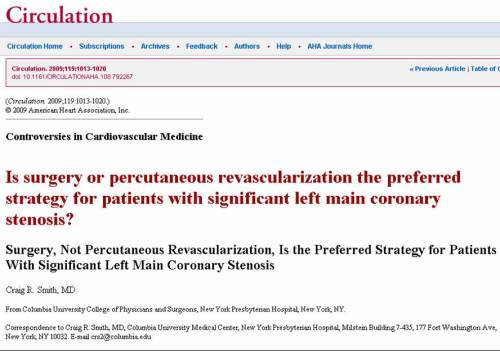
The following article in Feb 2009 is a major blow for proponents of  PCI for left main

http://circ.ahajournals.org/cgi/content/extract/119/7/1013

left-main

http://content.onlinejacc.org/cgi/content/abstract/51/5/538?ijkey=84c977d189e84327c3abbd4c1228de17dd99048a&keytype2=tf_ipsecsha

Final message

  • Conquering left main disease is an interventionist’s  ultimate dream.
  • But, before that they have  to tackle the bifurcation lesions .This is of vital importance, because 2/3 rd of left main  patients have  some form of bifurcation lesions. Current techniques , hardware  and outcomes are far below the idealistic solutions in bifurcation lesions.
  • Till that time ,  CABG would  remain the only choice for all , but for  a small fraction of isolated  left main disease where PCI may be possible.

Read Full Post »

Left main coronary artery disease (LMCAD) often evokes  a panic reaction  among cardiologists .Not every LMD deserve that re. To  label  it as  significant, we have a criteria ,  that is 50% diameter stenosis.  So what you do , for a tapering  or narrowed left main with 40% stenosis. Isolated insignificant left main is rare *, but real incidence is not known.  LMCAD  is  most often due to  , atherosclerosis of left main coronary artery without limiting the flow.

What are the options ?

  • Leave it alone, with intensive medical management assisted by high dose statin(80mg)
  • Elective PCI with stenting , even though the lesion is not significant.

*If associated LAD  or LCX is there decision making is easier .

How  significant is a coronary stenosis ?

The significance of a coronary lesion with reference to “lumen diameter obstruction” is basically flawed. The significance of a coronary stenosis, by tradition is  based on it’s hemodynamic impact ,right from the  CASS days in early seventies.Unfortunately our mind set has not changed even after realising    non obstructive – sub critical lesion is more prone for acute coronary syndrome.  Is it not ironical to call a  40% lesion a non significant one !

So, the  significance of coronary stenosis is two fold.

  1. Hemodynamic  significance
  2. Clinical and  pathologic significance

The former predisposes to often chronic stable angina, later likely to result in ACS.

How will you approach a apparently insignificant left main disease ?

A 40 % lesion in left main is hemodynamically not significant , but pathologically very significant.It needs intensive treatment. Plaque passification with medical approach is first choice.If the lesion morphology is eccentric,  has irregular margins or involves  LAD  or LCX ostium doing a PCI or even a CABG is to be considered in spite of the lesion is  hemodynamically insignificant .

Why , PCI is   considered  “not appropriate”  for   less tighter lesions , even though these lesions  have great clinical significance ?

The answer is simple, The risks  and the  potential cost are more than the benefit !

And further ,  stents are  not innocuous devices  either  , they  always carry a risk of sudden occlusion as like  a sub critical lesion  !

Answer to the title question

True incidence is not known . Our experince (Class 1 c evidence) would suggest Left main disease constitutes up to 10 % of CAD.Among this one third would be hemodynamically insignificant

Suggested reading

Handbook of Left Main Stem Disease


edited by Seung-Jung Park

hbleftmn

//

Read Full Post »

Ventricular tachycardia as a group , constitute a major  group of cardiac arrhythmias. Most of the VTs are managed  by cardioversion  followed by medical management.  Few require , implantable defibrillator when there is severe LV dysfucntion .(ICD) Localising the origin of  VT and subsequent , ablation is the treatment of choice in some of the  patients  with VT.

Traditionally VT was thought to arise fro the endocardial aspects of myocardium. Now  we realise many times VT originate from the epicardial aspects of  ventricle.

Epicardial VT : Defintion

Epicardial ventricular tachycardia (VT) is defined as VT in which the critical sites of the reentrant circuit (or the ‘sites of origin’) are located exclusively in the subepicardial tissue, as shown by entrainment manoeuvres or VT that is terminated within 10 s with standard radiofrequency (RF) pulses, or both.  E. SOSA,M. SCANAVACCA et  all  http://www.springerlink.com/content/w608142674154tp5/ 


 How to recognise epicardial origin of VT by surface ECG ?

  • Terminal S wave in V2 and q in lead 1 strongly suggest VT of sub epicardial origin.
  • Pseudodelta wave 
  • Intrinsicoid deflection time of  85 ms
  • RS complex duration of  >120msec

Suggest   epicardial origin of the VTs.

Important Links

http://www.circ.ahajournals.org/cgi/content/full/113/13/1659 

Berruezo      criteria ,http://circ.ahajournals.org/cgi/content/full/109/15/1842  ( Must  read)

http://cogprints.org/4222/2/tada.pdf


What is the clincal significance of epicardial VT ?

Endo cardial ablation  not likely to be successful

Trans pericardial approach may be needed.

Read Full Post »

                                         Ventricular  tachycardia is considered as a dangerous electrical rhythm abnormality .It can immediately degenrate into ventricular fibrillation and result in SCD in many.Ironically, it is also a fact , a patient with VT can  present silently  without any symptom  .Some VTs are slow and recurrent without much affecting The hemodyanmics.


In chronic recurrent, beningn VT (Some may consider it , ” height of  absurdity ” to call a VT beningn ! but it  is a reality , the term beningn denotes –  very remote chance of converting into VF) ” Is there any other therapeutic option other than convertng into sinus rhythm. “(  Read related topics)


The following paper was presented in the Annual scientific sessions of  Cardiological society of India,  Kochi , seven years ago in  2002


VENTRICULAR RATE CONTROL  IN  VENTRICULAR TACHYCARDIA 

S.Venkatesan,,. Madras Medical College. Chennai


                           Mangement of  hemodynamically  stable  recurrent   ventricular tachycardia  remains a  delicate clinical problem. Reverting to  sinus rhythm  is  considered as  the only aim  of  treating  VT.While rate control is accepted as a therapeutic  option  in atrial fibrillation,  it is not  so,  for  ventricular tachycardia.In this  context  we attempted to analyse  the effect of  Amiodarone on   ventricular  rate  in stable ventricular tachycardia  which fail to convert  to sinus rhythm.


                            The  study cohort consisted of 49 patients with stable VT  who were admitted in the coronary care unit  of  Govt. General Hospital  between 1998 to 2002.The criteria for inclusion   were systolic BP>100mmHg and absence of  hypoperfusion of vital organs  The mean age was 52 years (range 26-68)  with a male female ratio  of 4:1.   Of the study group 36 patients  were either reverted with  IV lignocaine , Amiodarone ( 150-300mg   bolus )  or  DC  cardioversion . 13  patients  who did not respond to   either of these   were  followed up  with  Amiodaroneinfusion(1000mg)  for 24 hours.  The baseline  diagnosis were old MI (6)) DCM (3)  Arrhythmogenic RV displasia(2). Idiopathic VT was diagnosed in  2 patients.All these patients had  VT  during  most part of  the   24 hour  follow up.


                         The pre Amiodarone mean  ventricular rate was  152  (124 –196).  Post amiadaorne (at 24hrs) mean ventricular rate was 128(88-142). The time taken for   50% heart  rate reduction was  6.6h (4-24h).  The average  systolic blood pressure  improved from  100   to  112mmhg . These patients were  discharged  in stable clinical status with oral Amiodarone and  were  referred for  EP study.


                          It is concluded that Amiodarone, apart from it’s cardioverting ability , has a distinct ventricular  rate controlling  effect  which  can be of therapeutic value in  at least certain subset of chronic recurrent VT.

Final message


Some of  the patients  with VT carry a very low risk of VF  and SCD .In these  patients , the only  other major  aim is to prevent tachycardiac cardiomyopathy  that can be done with drugs which  controls  the ventricular rate whenever  VT occurs !

Corrrecting the primary cause like cardiac failire , revascularisation ,detailed EP study  ,tachycardia mapping , followed by RF ablation and ICD implantation is  the state of the art approch in the management of VTs.But this small clinical observation was made to  impress rate control could also be an option  in patients  in whom these procedures are  contraindicated  or not  available . 


Read Full Post »

Angina is classified in many ways .The most useful , clinical classification is stable and unstable angina . While  ,the former generally is considered   innocuous  the  later conveys a sinister  signal to the patient as well as  the physician. 

Why stable angina is  stable ?

In stable angina

  • The patient knows how the pain is going to behave by his past experience.
  • Very predictable .The patient knows at what distance it’s going to come
  • He also knows when  it will disappear.(For some , with rest for others with nitrates)
  • He also knows where the chest pain will radiate.
  • If some thing is unusual it is unlikely to be  stable angina , also any  first episode of angina is considered unstable as one wouldn’t  know how the angina is going to behave !

How is that stable angina has such a learned behaviour ?

The main reason for  the beningn nature of  stable angina is the coronary artery has “stable plaques”

Stable plaques produce stable angina  ,Unstable plaques cause unstable angina

Stable plaque s restrict blood flow only at times of  increased demand( ie supply side ischemia.) There is no thrombus in these plaques.As soon as the exertion ends the angina is relieved.So in chronic stable angina, the patient is stable, the angina is stable , the palque is stable , the coronary blood flow is stable.

Unstable palques have erosion and thrombus , and it interferes with blood flow even at rest .So in  unstable angina, not only the angina is unstable , the plaque is unstable  ,coronary blood flow is unstable. So it is obvious unstable angina , may not be relieved by bed rest.It needs intensive treatment.

Is there a overlap between stable and unstable angina?

Yes. In fact it is more common than we realise.

Read this post https://drsvenkatesan.wordpress.com/wp-admin/post.php?action=edit&post=2177

Related topics

How is a stable palque converts into a unstable plaque ?

How do you identify these vulnerable plaques ?

————————————————————————————————————————————————


Read Full Post »

  • Gastric pain is a great mimicker of cardiac pain.
  • It may have , almost all the typical characters of angina . . . in some cases ECG changes too.
  • The confusion is complete ,  as esophageal pain can also  be relieved by sublingual nitrates !
  • The issue is further complicated, when  esophagus and coronary artery share  the same neural codecs, and each may induce spasm among themselves !
  • It is thought , of course with  some  evidence !  many of the syndrome X  patients ( positive stress test with normal coronary arteries )  have esophageal motility disorders.
  • The ST segment depression during EST  in these patients  is apparently attributed to  stress induced esophageal spasm !
  • And many of the patients with variant angina  ,  have associated esophageal sapsm .

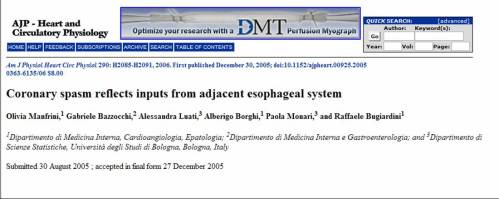
Read this land mark concept paper  documenting the neural link between esophagus and the coronary artery

Click on the article

esophagus


Final message

  1. Don’t ever forget the esophagus in your scheme of things when evaluating  CAD.
  2. Realise  that esophageal disorders  not only cause non cardiac pain but also cause    ischemic chest pain (Also called linked angina)
  3. EsophagEal  smooth muscle cell  can  exert electrical influence on the ST segment of  cardiac ECG !(After all every cell

has an action potential )

Read Full Post »

« Newer Posts - Older Posts »