Feeds:
Posts
Comments

Archive for the ‘cardiology -Therapeutics’ Category

Coronary  atherosclerosis is the number one killer of mankind. Many would consider it as an  essential  process of aging .Modern  life styles and habits make this appear  very early in life . There is currently an endemic (or even  a pandemic ) of   CAD due to premature  atherosclerosis. We need to recognise CAD is not a  primary heart disease  .It is an irony, heart is an  innocent bystander  to the  biological derangement  of coronary  vascular system  when  it is infested with atherosclerotic plaques .

So , when we  are confronted  with  serious atherosclerotic lesions in a coronary artery   what shall we do ?
We have three options

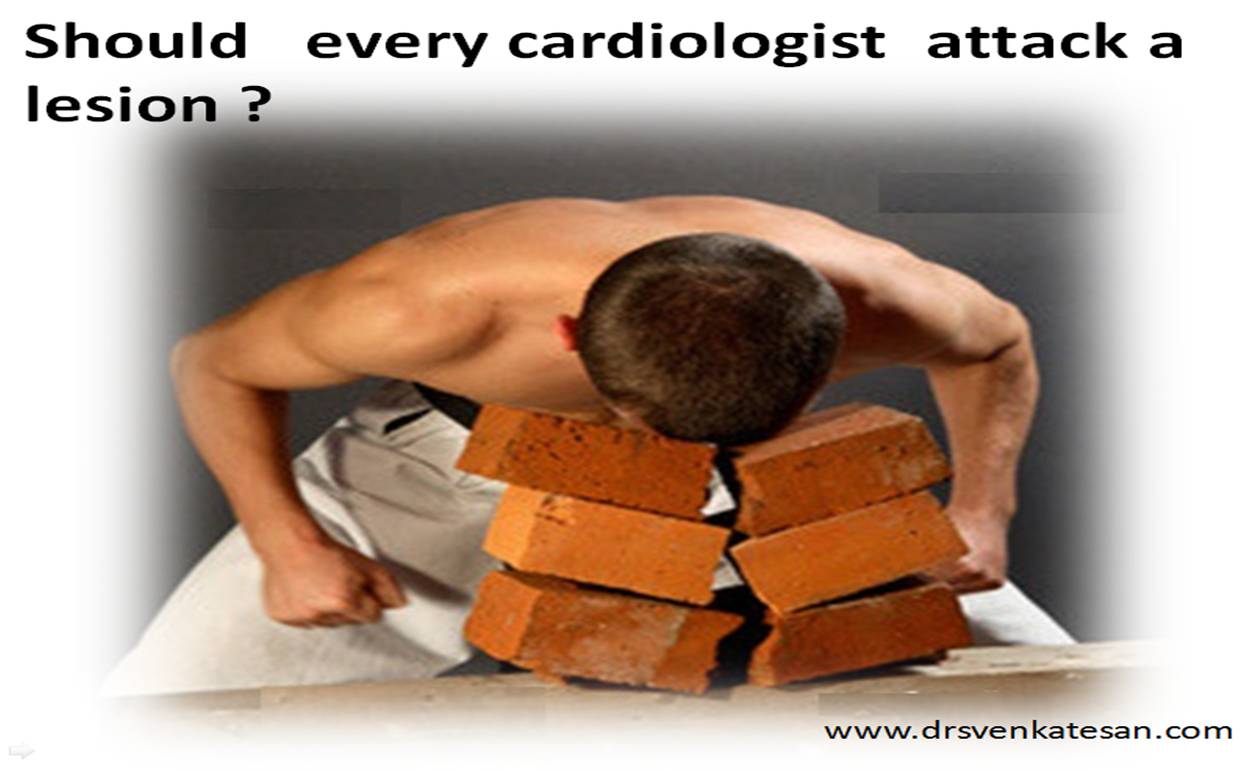
  1. Take on the enemy in a direct confrontation (Like war on terror ) : This is  some times called as Interventional cardiology .Caution is required as the battle  is within the human coronary artery ,  cross fires and collateral  damage  are unavoidable.
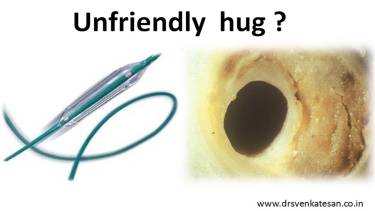
2 .Next  method  is to  find the basic cause  of  terrorism , identify  the perpetuates, facilitators    and try to correct the   root cause of it (CAD ) .This approach  also refered to as medical management  in cardiology community*  . It  aims  at regression of plaque  by statins, and life style modification and preventive cardiology. This modality is most ridiculed and  insulted by the main stream cardiologists.

*Comparable to  bilateral peace talks for a political solution to terror

3. And third option is a  real  surprise !   This  neither  confronts   the lesion   nor does it  address the initiating factors . It   just ignores  the lesion and by pass it with a LIMA /SVG  fly over ,  as if  nothing has happened in this vital high way leaving the culprit scot-free  .This option is  executed by surgeons as  CABG surgery . . . and  for mysterious reasons  this is a  well accepted one .
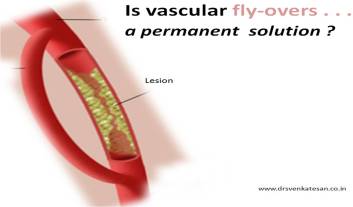
CABG :Here the atherosclerotic  burden is untouched by surgery . The graft can get diseased  sooner or later , native vessel disease  shall  progress some times encroaching  the ostia of distal graft site . Incidence of acute coronary syndrome following CABG is not greatly reduced for the simple reason we are not doing anything primarily to the inflamed plaques .These issues  are left ,  to be  taken care by the  medical  management .

* This article  does not want to defame these great development in cardiology(PCI/CABG) . They have a  specific role to play. CABG AND PCI remain the only option for critical  lesions with limiting angina .But please remember without  proper  medical management  ( ie Targeting  the perpetuates of  crime )  both  PCI and CABG will be a big sham !

Final  message

Avoiding   the  lesion  or  attacking the lesion  is a  primitive  method to tackle CAD  . Passifying   the lesions  in a slow and gentle manner,   preventing  further progression  or regression  of lesions is the only  “sane” method for combating CAD   . PCI and by pass surgeries  can be termed  as  21st century’s   medical  adventure sports  which  has  limited role ,  in the overall control  of CAD  for the human kind .

And  now  answer this question . . .

Cardiologists attack the lesion and  surgeon avoids the lesion ?  Who is the winner in our fight against CAD  ?

Both of them are  clear losers .The winners are  all those  humble physicians and parmedical workers (or even the responsible lay public ) who  help recognise  the early forms  of  CAD  and  counsel properly to prevent it .

This is  what  Dean Ornish   in 1991  documented in  Lancet  which was never considered scientific   for the simple reason it has no commercial value !

Reference:

http://www.thelancet.it/journals/lancet/article/PII0140-6736(90)92230-F/fulltext
http://en.wikipedia.org/wiki/Dean_Ornish

Read Full Post »

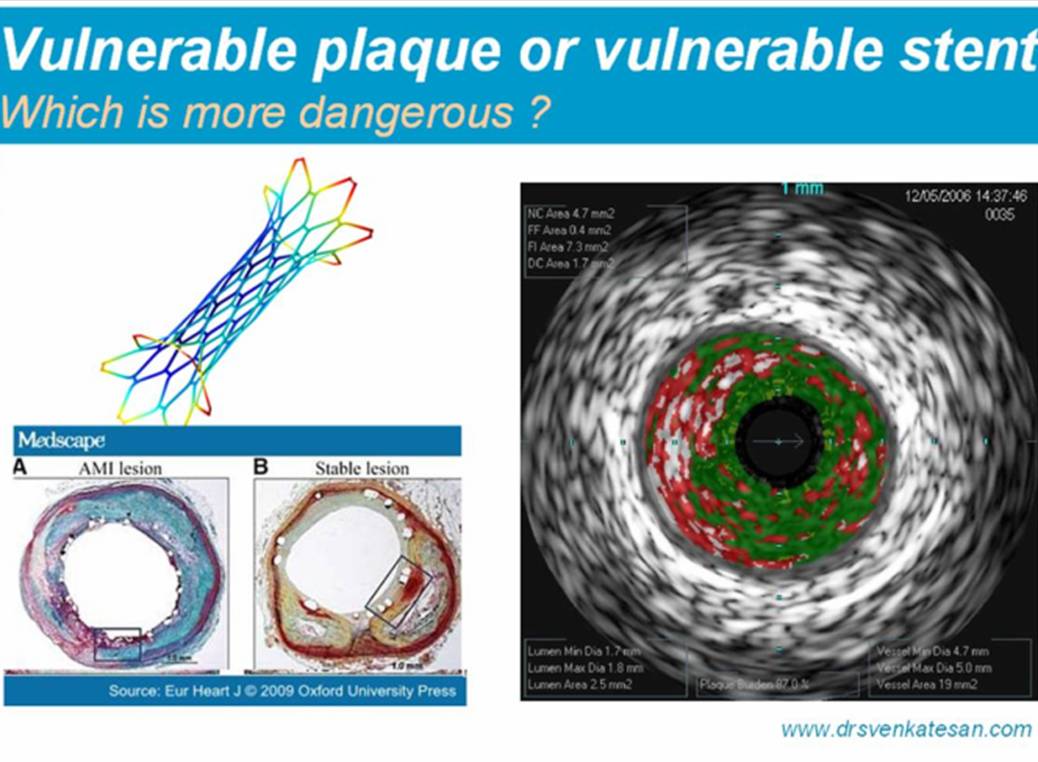
An atherosclerotic  plaque is termed  vulnerable when it’s  future behavior is unpredictable .A vulnerable  plaque has a  tendency to get occluded at any time.

Anatomically  a  vulnerable  is  present  , if the lipid core is more , fibrous cap is  thin  and  a  large lipid  core hanging eccentrically. A plaque with high temperature (Hot plaques ,febrile plaques)detected by OCT/Raman spectroscopy or thermography

Note the T cells and macrophages wage a losing battle against a metal monster !

What is the best method to calm down these vulnerable , hot ,inflamed plaques ?

A stent which scaffolds a plaque is believed to stabilse it  and  make it less vulnerable to rupture. This is the most optimistic view on coronary stenting .

Here comes  a pessimistic view !

A metal inside a coronary artery covering is  additional  threat .A metal  is   perennially  thrombogenic  ,especially the drug eluting stents which suppress the normal endothelial  function .

What  is the realistic view  ?

A stent should be used cautiously and judiciously in coronary plaques  with   high risk features  .Here  a  stent  in all probability  converts a vulnerable plaque  into a  relatively stable plaque

When stenting is done indiscriminately( without application of mind )  in stable non flow limiting lesions  stability is replaced with vulnerability.

Is it not curious to know  any angina  in a patient  who  had   PCI  for chronic  stable angina  is labeled  as unstable angina. 

Vulnerable stents

Following are typical  clinical scenarios   where stents could  carry a vulnerability  tag . 

  1. Poorly deployed  stents
  2. Properly deployed (but unnecessarily deployed especially in chronic stable angina )
  3. All Bifurcation stents
  4. Distal left main stents
  5. Stents with plaque prolapse
  6. Finally and most importantly all  drug eluting stents are considered  vulnerable ! (That’s why  our patients has to  live at the mercy of dual platelet blockers , life long.  Of course , there is no life time warranty   that  drugs do their  job properly)

And now . . .  you answer my  question !

Can  stenting convert a stable plaque  into vulnerable plaque ?

  • If  “yes’ is your answer your patients are in safe hands .
  • If  ” No”   is  your  answer ,  you are  fit to become a leading  interventional cardiologist !

Read Full Post »

Medical  research can be divided into few  broad  categories

  1. Basic science  research  in animal models
  2. Basic science  research   in Human
  3. Clinical : Bedside-  observational
  4. Clinical:  Epidemiological
  5. Community based long term data analysis
  6. Interventional -Drug /Device/Surgical

*Logically the  top 5  should  constitute  the bulk of research  ,  in reality    last one wins the race with considerable ease . Why ?

The important issues that  confront  today’s medical research  starts  right from the  “Aim” of the research ,  methods , materials statistics,  and  goes on  to   ethical issues , conflicts, futility ,  gimmicks  0f  publication  ,  marketing and ultimately left  for human assimilation .

(Read a related article in this blog   can  Aim of a study be wrong ?)

Data(s)  won’t  lie  . . .humans do  !

Science is nothing but collection of  facts ,  rechecking  the facts , and  finally confirming ,  they are indeed  facts. So medical  data collection becomes vital .  Data,  if  properly collected ,  wont lie.   Bias is always an issue in prospective trials. Further ,  and whenever and wherever  scientifically  motivated  human  beings interact with  data  the later   becomes a vulnerable  target and  get manipulated   for various reasons . (Read the famous article on data torturing  in  NEJM : I will link it soon  ) So blinding  becomes  mandatory   and it should  be total as some studies  tend  to  gain vision half way through !

Image courtesey : Jupeter images

Simplicity of observational studies.

We  give undue importance to RCTs . What we fail to understand is RCTs are required only  in selected situations in medical research (New drugs and interventions ) Meanwhile , we can do wonders with retrospective observational  data. These  data  can not be  manipulated  as the events  have occurred already and those people who collect or record the data  wouldn’t know this data is going to be utilized  for a study (This  , in fact  is  equivalent  to 100 % natural blinding and constitute a  real world study )

Observational  study can involve  patient behavior ,    disease behavior  , community impact, drug action, investigation modality , etc  . . .etc  . Your mind is the limit . Cost of doing a observational study is less but the impact on the society can be great .

Observing skills are the  biggest causality in modern medical times , This was  only scientific weapon of  our ancestors had , which they  used in an exemplary fashion .( Recall how Heberden described angina and Harvey taught us about circulation without even ECG and X RAY chest )

Fraud in medical research

Wherever big money is flowing corruption and fraud is unavoidable . . .at the  least . . .  we  should recognize it

( Many journals  just point out this possibility by simply displaying message of conflicts .They do not bother more than that  . . . just a warning message  )

Now in the modern scientific world  ,   even as the   genuine contributions   from our ancestors  left to  stare  the back of us  , we try to indulge in all sort  of unpleasant things.

In an audit against fraud in medical  research ,  it was found most of the fraudulent research happened with drug and device trials and few in basic science involving genetics and molecular medicine . It  was  rare to identify fraud in research involving purely clinical and  epidemiological  analysis .

Drug trials  need to be prospective . Vested interest can play  havoc in prospective data .There is a  thing called steering committee in all major studies   . . . we do not know what does the  word  steering really   mean .

There has been many  occasions  even well conducted studies turn out be  fraudulent . Now we realise many such studies are struggling to prove its worthiness .

In fact  it is argued every study before getting published   should undergo a  global ,  independent  trial   monitoring  board for genuineness  of the study . (Not the customary  peer review !)

Final message ( Sorry its  a  long one !)

We have a huge problem  here . I am afraid  we  haven’t even  understood ,  what  we  mean by medical  research !

For today’s   youngsters  medical  research means doing sophisticated  tests in nano- labs  , human genome  mapping ,  space age imaging modalities  or  involving a multi- billion dolor drug trials . This is absolute  falsehood.

What we need to do is   “search” , ” search”  ,  search again (That is   why it is called re-search )  for all those elusive  problems  our patients   face .Not only in their body , in their  home , in their community,  etc . Every  patient  teach us  few points,    observing and learning new things  and  publishing is  also an important aspect of  research .One can do  a instant   research in the crowded  OPD of a hospital   , in the wards , (What is the profile  of fever pattern in a winter season in your hospital ? does it reveal a new viral epidemic ?)

An ideal research  should  identify a problem and suggest a practical solution to a given problem .There are millions of such issue waiting for our attention in the bed side.  But what is happening  currently ? Current medical research is largely direction less ,  fueled by vested interest ,  makes  sure it avoids  all genuine problem areas !

Many studies  happen  based on  flimsy scientific   basis  .We are still  wasting our time to increase human HDL levels. ( Not with standing  the famous Torcetrapib fiasco  )   .Hundreds  of thousand of dollars   are pumped into this  research even after realising  only the  endogenous HDLs generated by natural methods like  exercise   are  the really  good HDL !)

While we do million dollar research   with a dubious risk factor called  high sensitive C reactive protein  ,   there is  no takers against number one killer disease of human kind  namely  “The  poverty” (WHO ICD codeZ59.5 )*

Let us prey   God  to instill common sense to all of us  . Patients  suffer with disease and we suffer from irresponsibility  or reduced responsibility ! It  makes us happy at-least few forces  like Lancet  , British medical journal etc are fighting lone war  against this  ailment  medical science is suffering .

*Please note :  http://www.icd10data.com   WHO labeled poverty as disease many years  back without much fanfare ! It is rarely mentioned in  any  graduate student**  medical text  in whom our future lies .  I do not know whether  Wars  and terrorist acts  been included as disease  or not !

**Our students  rattle about  about the  exotic  tick borne  Lyme disease happening once a year in remote hills ,    while  most will stare blank   when asked  how to diagnose and  treat  nutritional  anemia with  which millions suffer  every day !

Read Full Post »

While anatomical  grading of obstructive  coronary lesions are  quiet easy ,functionalc assessment is always difficult.The famous TIMI grading system had one unique problem .TIMI 1 and 2 grades are relatively easy to grade. TIMI 3 flow  which corresponds to normal penetration  and normal  distal perfusion  . This distal perfusion was entirely optical .

This was an important issue , in assessing post  PCI or thromolysis patients . It was realised much later , TIMI 3 flow is  stunningly  heterogenous group  .It was  ironical  ,  even after a successful PCI ,  restoration of TMI3 flow  could not be relied upon as an index of successful PCI  .

So , the PAMI study group included time as additional factor in grading TIMI 3 flow. PAMI 3 is  essentailly same as  TIMI 3  flow but  with a  condition , complete  distal vessel filling  must  occur within 3 cardiac cycle . PAMI 3 can be termed as a   refined version of TIMI 3 introduced in the evaluation of success of primary PCI . This helps us  define  or  diagnose   slow filling .

What are the other ways  to grade TIMI 3 flow

  • Myocardial blush index
  • TIMI frame count ( < 25 frames )

PAMI : Primary angioplasty in myocardial infarction

TIMI :  thromolysis in acute myocardial infarction

Reference:

http://circ.ahajournals.org/cgi/content/full/circulationaha;104/6/624

Read Full Post »

Is hypertension really a major risk factor for CAD ?

    1. Yes it is !
    2. No . . . it is not !
    3. May be !
    4. I don’t think so !

Ans : Any of the above can be a  right response , depending upon our basal and perceived  level of knowledge .

Answer analysis

  1. SHT  is  one of the risk factor for CAD  agreed ,  but definitely not a major one , as SHT per-se rarely precipitate a STEMI
  2. Unless SHT occurs with dyslipidemia, smoking or diabetes it is  rare to cause ACS.
  3. The only  adverse effect of SHT  is  , it has a potential  to aggravate atherosclerosis  by promoting epithelial injury and dysfunction.
  4. Hypertension is a well known  major risk factor for cerebro vascular disease while it is minor risk factor for CAD !
  5. We do not know yet why cerebral vessels are intolerant to high blood pressure while coronaries are pretty happy  with it !

Final comment

SHT is not a major risk factor  for CAD ! At worst , it can propagate chronic CAD. This sort of reasoning  may be considered a huge controversy  . . .but it is really not !

  • One evidence for the above observation is  , we  have  been struggling hard  for over a half a century  to prove a elusive  point that controlling blood pressure  to optimal levels  would  dramatically reduce  cardiac   events !
  • Further,HT’s  relationship with acute coronary syndrome especially STEMI  is vague , it is very rare for patients with accelerated hypertension or malignant hypertension to  present with STEMI *

* Caution :Young doctors should not get confused with this seemingly  controversial observation .This write-up , tries  to convey  a point  , SHT may not be that bad for coronary arteries when compared to cerebral arteries . However BP control remains  vital in  all patients who have  developed a cardiac  event or in patients with multiple risk factors .

Please note ** SHT is still  a powerful risk factor for cardiac failure.(Acute LVF to be precise ) ***SHT can aggravate unstable angina , but very  rare to precipitate unstable angina.**** SHT ./High intra-coronary  pressure can theoretically  dissect or fissure a plaque . (The fact that , HT is so prevalent in a community  but spontaneous  coronary  dissections are not !  should make us think further !)

Read Full Post »

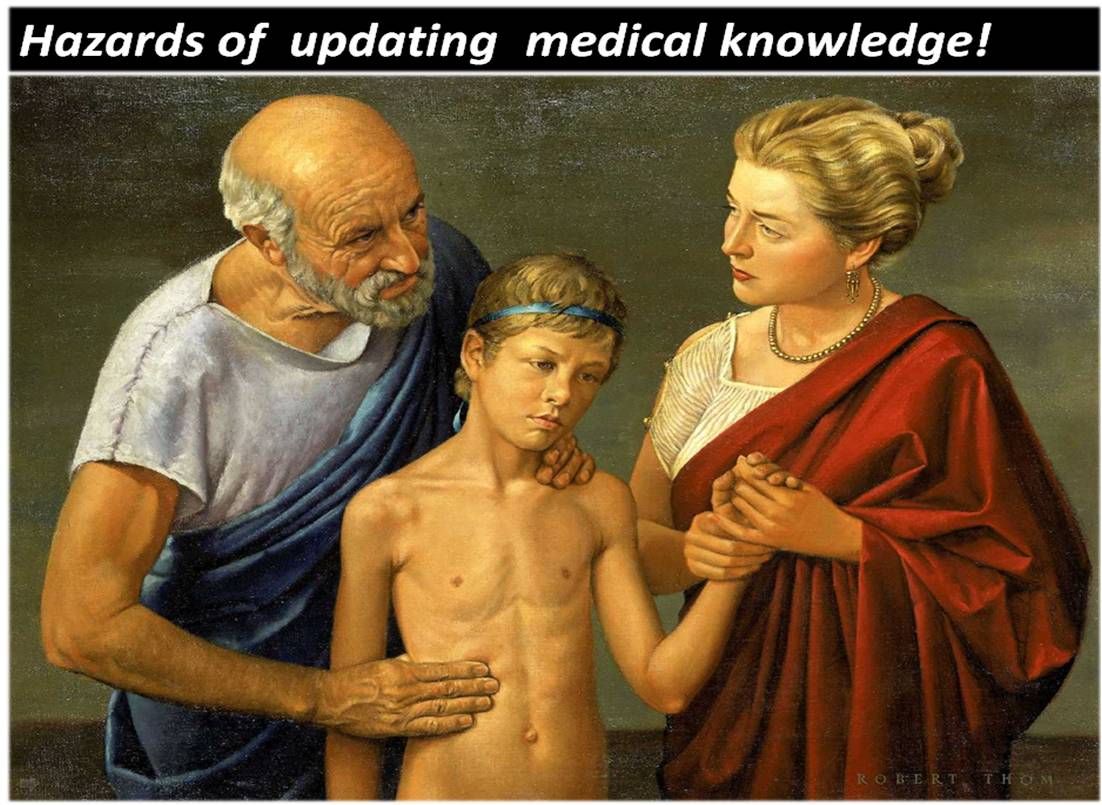
One of the greatest medical sermon of our times  is   “Doctors must   constantly update their knowledge , Continuing medical  education is as sacred as their profession  !  If you are not updating your knowledge you cease to a doctor “

It is fashionable , but true  to state  modern medicine lacks humane  care . Modern medicine  is  challenged by a huge  technological ,  commercial  onslaught  where common sense takes  the back seat

Hence , doctors need to renew not only  their  academic competence   but also  their ethical  fitness  every  year !

Aggression  could be the other  name for  modern medical care . For every  new  invention , treatment   or guideline that  is  approved  an equal number  is shelved after few months or years  for safety reasons.

Bulk of  medical updates  for  current age physicians  is nothing , but asking   them to forget  all those wrong things that has been meticulously uploaded in their brains in the recent past  ( Recall the classical story of drug eluting stents )

If this is the  case . . . then  . . .  what for  we  are  updating ?   and  for what  we are  learning and forgetting  ?  and  . . . how frequent we need to forget ?  Of course  , there is a big chunk of   human tribe  who  can never master the art of forgetting ! Some mistakes are permanently etched in their terra byte hard disks .

Is there a place  for backdating and discontinuing  medical  education  ?

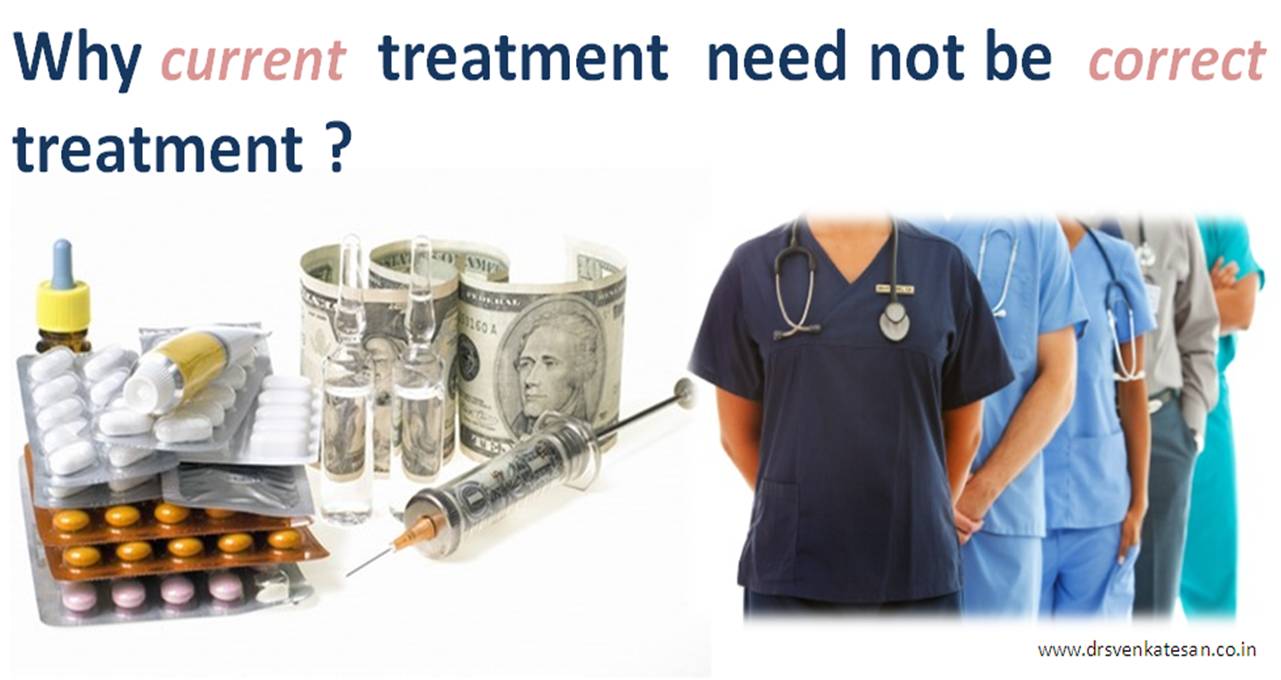
What  man- kind needs  at times of  medical  crisis  ,  is  not  the current  treatment  but the correct  treatment    .It is our duty  to  find  all those  trustworthy  drugs  & treatment modalities  that were  sent  to  the gallows by the modern medical forces   for various reasons !

If  some of  the gems in  medicine are  left behind in  past  “time domain”  ,  it is  mandatory  for us  to go  back in time and   catch it , adopt it and disseminate it !

Further ,  whenever  the  hyped   “medical updating sessions ”  turns out to be  synonymous with adding nonsense (It is  becoming all too common these days   !) we should resist   it by all means !

For many . . . Hippocrates and his medicine sounds dirty now !

If  only we back-date  our knowledge   .  .  .

Todays  youngsters  can learn a secret that liver enlargement can be diagnosed easily  with their  hands ,  without  waiting for a  CT scan report !

If only we back-date  our   knowledge  . . .

We can realise  Aminophylline can save so many  lives of cardiac  failure  , which  our newer inotropic agents are struggling to accomplish .

If only we  back- date  our knowledge  . . .

We can calmly manage  acute MI with lignocaine  even in a country side  .  Amiodarone unfairly replaced  this  efficient  anti  VT  molecule  for no academic reasons !

If only we back- dat our knowledge  . . .

We  can  advice simple non pharmacological intervention for  stage 1 HT   than prescribing the  glamorous  sartan molecules  form a  multinational  ARB shoppe.

If only we back- date our knowledge  . . .

We can  promptly recognise  cardiac failure  without  ordering  for the error prone   BNP . Back dating also  helps us to under stand  that post infarct angina is a  glaring sign  for presence of   viable myocardium  and prevent us from undertaking a  2000 $ PET  excursion !

If only we back- date our knowledge  . . .

We can  send  all our uncomplicated , asymptomatic   STEMI  patients ( in class 1 )  straight to  their  home rather than to cath lab  play grounds !

Read Full Post »

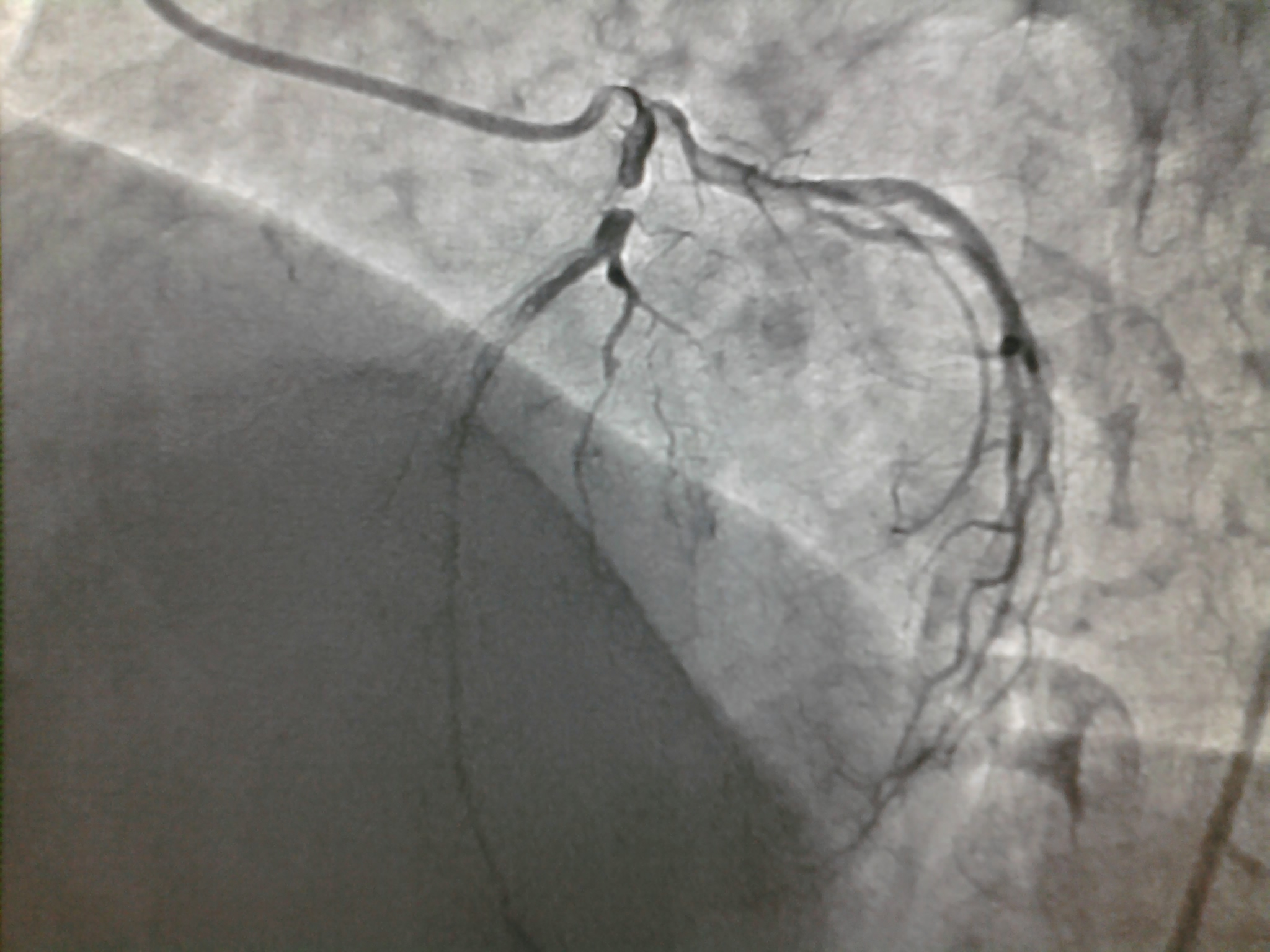
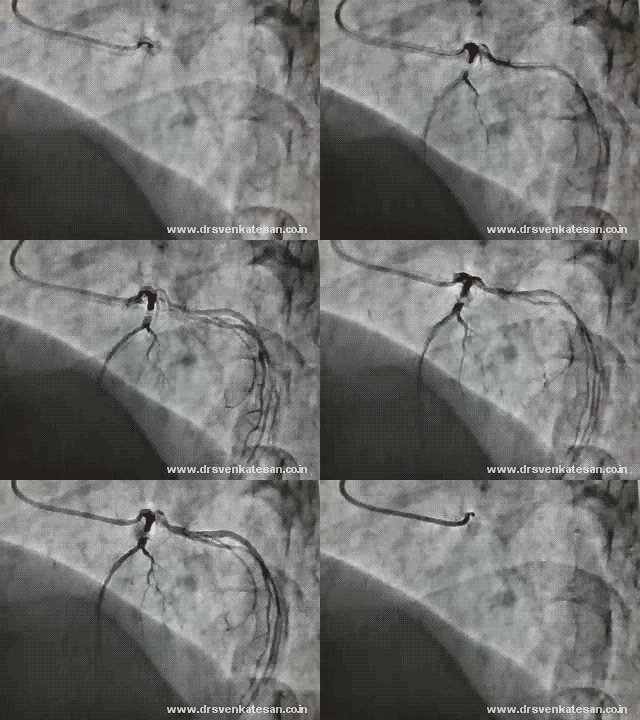
Thousands of  coronary angiograms are done every day. Cardiologist no longer get excited to see exotic coronary lesions .Still , some images can be striking and dramatic. Here is an angiogram from a middle aged man  with stable angina  , who was  one among the routine early morning diagnostic studies  in our cath lab.

Who chopped the neck of this LAD ?

How this man was able to fill up the distal LAD almost completely? (With a complete cut off  right in the neck of LAD )

Are you sure there is antegrade flow ?

Do you get any clue ?

  • Can a trickle of  ante grade flow  sustain  a  TIMI 3 FLOW  ?
  • Or is it a  very efficient  instant collaterals  from LCX ?

Yes . The first one is right . An almost invisible antegrade channel  doing a exemplary job !

How is it possible ?

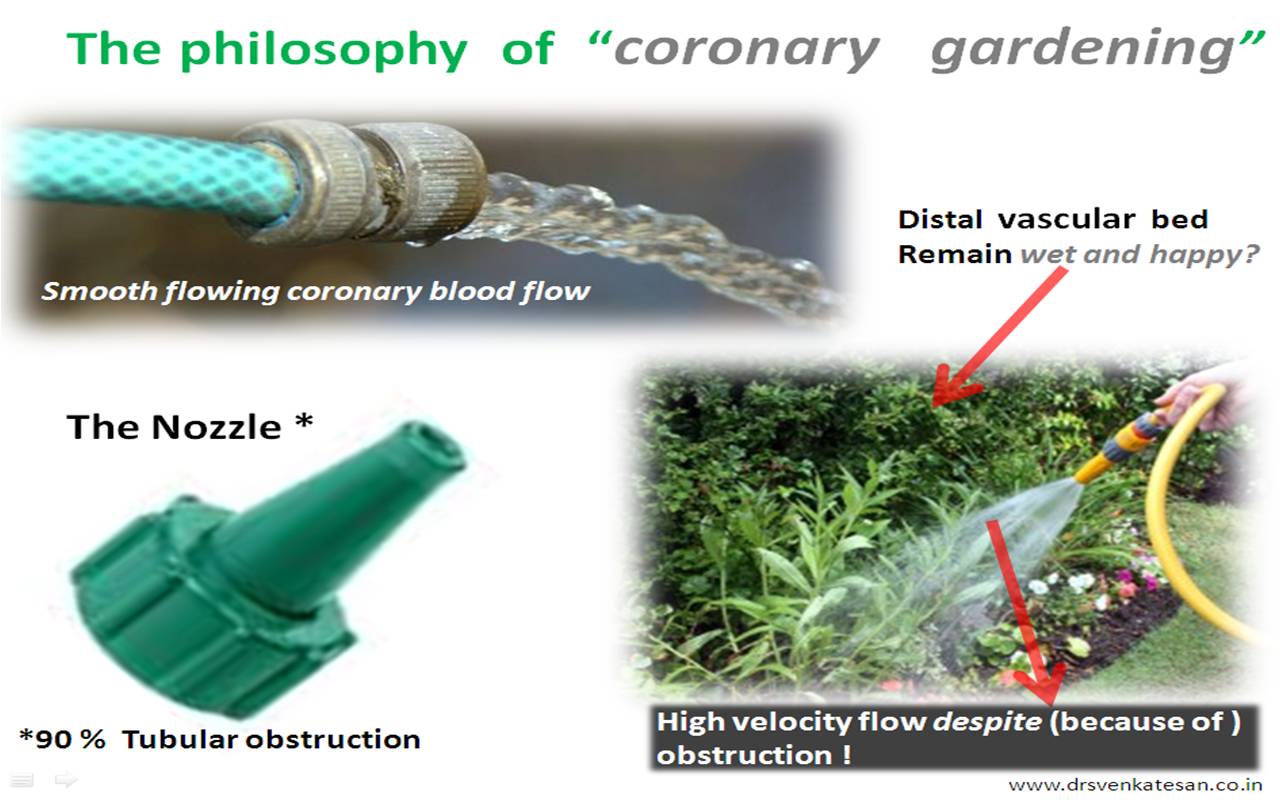
Realize an important fact . The distal flow beyond an obstruction  is not primarily dependent on degree of obstruction but the status of the distal vascular  bed .  If it is normal  even a hair-line patency  can  profusely perfuse the distal myocardial segment. This is what is happening to this man with a stable angina and perfectly normal micro vascular bed.

Lessens  from this Image.

Do not get fooled by the lay man’s logic. Realise there is  no simple relation  between  the degree of obstruction and degree of  blood flow impediment.It can be linear , curvilinear , or even inverse depending upon   the evolution and timing of obstruction  ,  number of lesions , presence or absence of collateral support , finally and  most importantly  the integrity of microvascular bed .

The  distal vascular bed drops its resistance drastically  once it senses  the problem in  proximal segment . This is based on Bernoulli principle and  is akin to how a  garden hose pipe  can simply increase  the velocity  by tightening the nozzle.*


* The garden hose analogy is a gross simplification of   complex factors that determine coronary blood flow.But it effectively clarifies a point ie  coronary blood flow is least dependent on coronary  stenosis (until  very late stages)

**Note further : This  hemodynamic  principle may not apply in acute occlusion as in STEMI  , where   acute  obstruction  often has a linear relationship with the quantum of blood flow.

By the way what happened to the above patient ?

Since he had significant angina there were no debates regarding management.  He  is posted for elective PCI this week-end .(We  can’t  get a stent just like that unless it is a real emergency  .Ours is a  Govt hospital !)

What is your take . Is it a going to be tough cross ?

I feel so , but my colleague Dr Gnanavelu   strongly  differs !

Let me post  our experience during PCI shortly.

Read Full Post »

                                                     Every day thousands of  hearts  end their life   due to terminal heart failure . Much more  lives are  confined  to their bed rooms.In refractory cardiac failure and severe LV dysfunction the only  long-term option is cardiac transplantation.

Medical therapy has reached its saturation point.  Neuro- humoral modulation shows some promise. The other modalities like cardiac resynchronisation ,LV assist devices ,  ventricular  reduction surgeries ,  restriction devices , mitral valve splinting  are  still experimental .

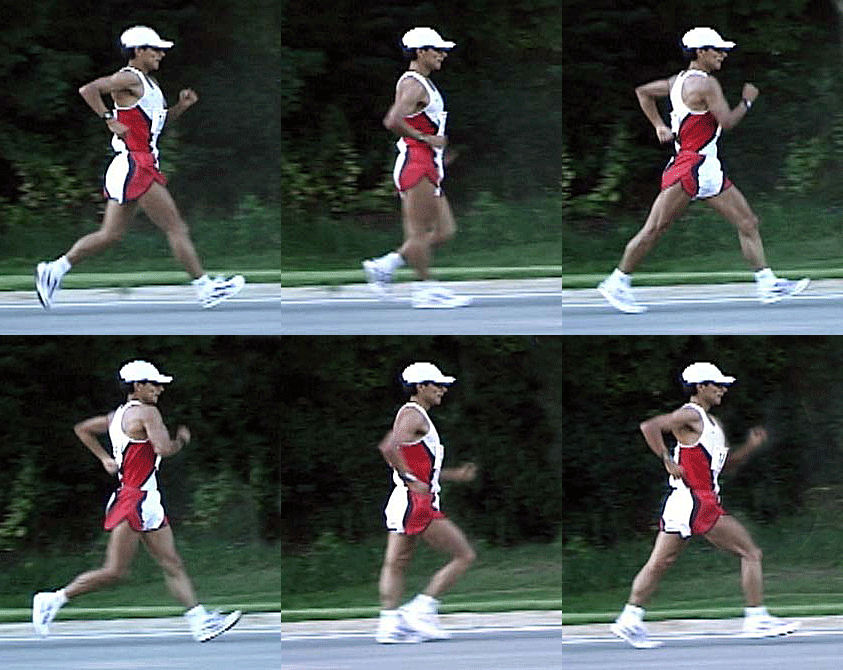
Simply watch this Image : Your heart will get Energy

Modern day  cardiology is trying to add life to these dying  hearts  .

There are two aims

  • To prolong survival
  • Improve functional capacity (Make them at least take care of daily activities and live a fairly independent live)

This is the purpose of the  mushrooming heart failure clinics all over the  world . These clinics , though started with  good intention , ultimately   become  feeding  centres for so many experimental  bridge modalities  , sometimes  with an  infinite wait for  a potential donor  or at the mercy of their insurance companies  . (Many time it turns out to be a  bridge to heaven as the patient fails to cross it !) .

Even though there is strict criteria for terminal  heart failure ,  in practical terms it has many issues .Temporary functional deterioration is misinterpreted   often .

Premature  dependence on LV assist devices and  indulgence  in inappropriate  mitral valve reconstructive  procedures are the currently most important pseudo cardiac interventions .( Myosplint/AV groove tying etc)   Some where along   the  academic  corridors ,   we failed to realise many patients can bridge themselves  to a  transplant (or even   self de-list  from transplant programme  )  provided we are willing to wait and take few   risks  .

It is observed exercise training  programme is awfully inadequate in most centres  who deal with late stages of cardiac failure.

The hidden link  between skeletal muscle and  cardiac muscle

Skeletal muscle  function is impaired in cardiac failure . This impairment is attributable  to both  dis-use and low cardiac output.  Proper training of these muscles can not only improve the functional capacity  but also  sets in  a positive hemodynamic cycle  that   ultimately improves cardiac function as well.

In  our  country we have data  of  thousands of patients  with severe LV dysfunction living with the much ridiculed  digoxin   ,   diuretics ,  ACEI  and minimal exercise living a comfortable life for over 10 years .  It is often said in  cardiology class rooms ,  do not whip a tired horse  as the   failed heart needs rest  .This statement  has  truth  in it even in  this  space age cardiology !

Whipping  a failing heart with electrodes in the name of CRT   could be as  bad as  whipping with inotropic agents . This is not a  personal joke ! This fact has been repeatedly  proved by various inotropic  studies in terminal heart failure(Dobutamine to be specific ) Even CRT  is a suspect .These patients walk for 30 meters  further  with  no convincing survival  benefits .(Of course it requires a ICD -Combo to prevent sudden deaths ) Zero impact in non sudden deaths ?

Can  we propose a  new therapeutic  concept to our  patients   ?

Do you  want to   live with a  low functional capacity (Restricted  life   still  happy  )    for 5 years   or live  apparently unrestricted  life   and die prematurely ?

                         In simple terms,  for all those patients with severe  grades of  heart failure   the  best advice could be . . .to  avoid the levels  of exertion that cause dyspnea / Modern gadgets  may help relieve  exertion for a short  while  , but it  can cut short your longevity * (* This is not a threatening message. This applies to near terminal stages of cardiac failure .All other minor grades of CHF are encouraged to exert up to 70 % of their limits.)

Peripheral mechanism in cardiac failure.

We know cardiac  failure is not a simple  mechanical failure of heart , it activates a complex neuro endocrine system which makes it a systemic disorder .Many of the current research is aimed at favorably modify this. It is now certain Skeletal muscle function is a  major determinant of  cardiac failure outcome and hence a therapeutic target .

If you have good muscle mass ,  good diaphragm and intercostal muscles one can  compensate the compromise inflicted by the heart to a large extent.  We know,   the entire vascular tree has a mechanical function  to do . The stiffness and compliance of aorta , other  major vessels, the muscles  through which these vessels  traverse determine the  ultimate  efficiency  of  circulation.We know  the pulse wave , as it  travels to the periphery , gets amplified. This amplification is not without any significance. It aids in muscle  blood flow . This agumnetation is missing in poorly trained cardiac failure patients. Further muscle respiration is synonymous with  functional capacity . Numerous defects (Both structural and functional )  in skeletal muscle mitochondria are reported.

This is why meticulous  exercise training  becomes an important   intervention in  cardiac failure . There are very good studies that document   muscle respiration defects  getting reverted  with  proper exercise training and  muscle  care  .  Among all muscles the   calf  and thigh muscles show great promise.   We have observed  cardiac failure patients  with good calf muscles ,  outperform others with identical ejection fraction.(Will be published shortly )

Strangely there is no comparative  studies between calf muscle  efficiency   and other available modalities  in cardiac failure .

The concept of  Venous pump vs  Arterial pump

Skeletal muscle mass acts not only as venous pump  it also has a modulating  effect on the arterial pulse transmission .A good venous  pump will activate  vascular  tone . In congestive heart failure  a the RV filling pressure is raised,  blood tends  to  move sluggishly  in right heart chambers .  A proper venous tone  can alleviate this . Well trained  calf muscle  can exactly do this  by a controlled elevation  of  IVC pressure at times of exertion . 

 Dyspnea  of muscular  origin (Peripheral dyspnea)

The symptomatology of cardiac failure has an intimate  realtionship with skeletal muscle integrity  !

Lactate in blood and  hypoxia  in   exercising muscles  can trigger   non hemodynamic dyspnea . Further , there is strong reason to believe  the sensation of dyspnea   is perceived at the chest muscle level  (By muscle spindle length/tension   mismatch ) .It is not known whether lower limb  muscles can generate a feeling of dyspnea  !

But , one thing is certain   by altering the tone of the muscle  spindle and the  optimising the  stretch signals the peripheral component of cardiac dyspnea can be significantly neutralised . This  is what  happens in well-trained   cardiac  failure patients .

How to train the skeletal muscles ? ( In to heart friendly  muscle )

  • Passive stretch
  • Simple 6 minute walking three times a day will help .
  • Muscle massage and toning
  • Drugs like Trimetazidine may improve muscle metabolism by better ATP utilisation
  • Diligent use of diuretics (Excess diuretic can make your muscle exhausted )
  • Chest exercise for improving intercostal muscle function


Final message

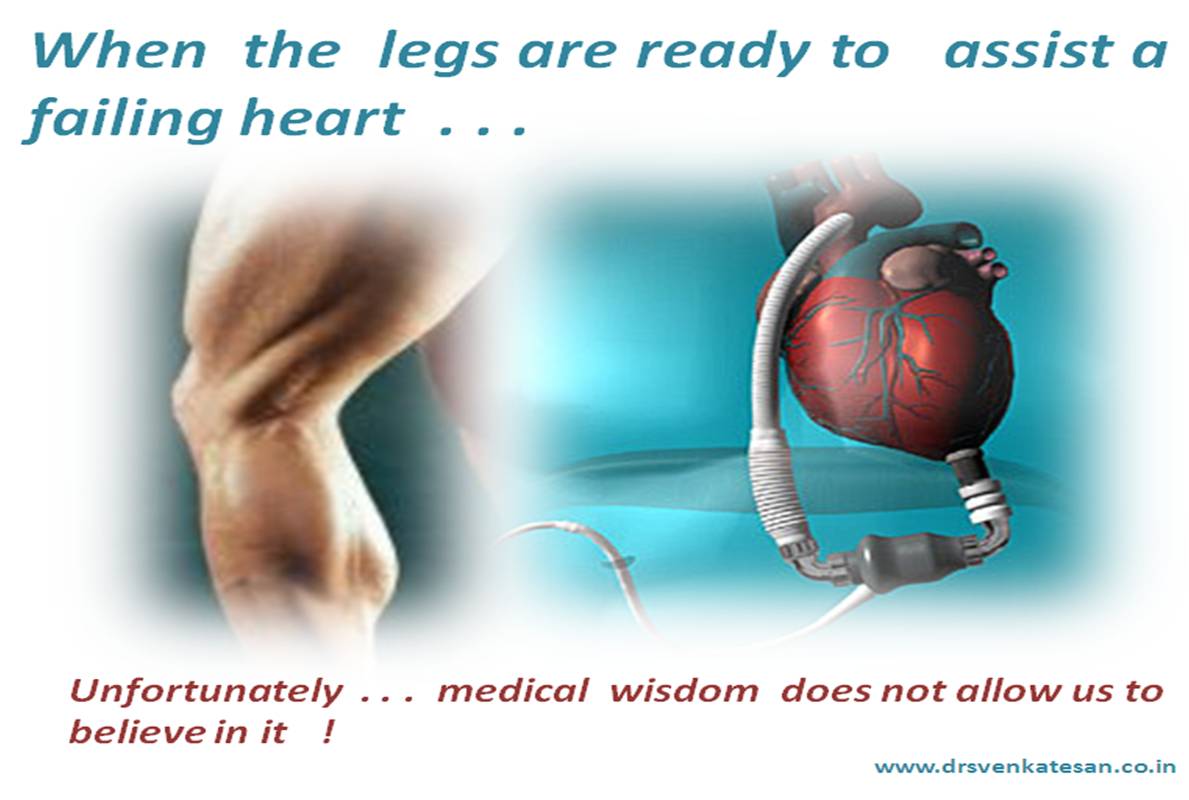
Skeletal muscle training  in cardiac  failure  could be as important as  the  digoxins  , diurteics   and ACEI .When a 300 grams of heart muscle is struggling  , God  is willing to  help  it with huge muscle mass that lies elsewhere , we should read the silent  signals of nature . Many cardiac failure patients  realise this and live  a happy live without artificial assistance .This applies  in all grades of cardiac failure .

For  all those physicians  out there in modern hospitals who treat cardiac  failure , spend at least  few minutes  for prescribing a good exercise  program with a specific  mention about calf muscle function  . After all , it  may turn out be the most efficient  RV/LV assist device !

References

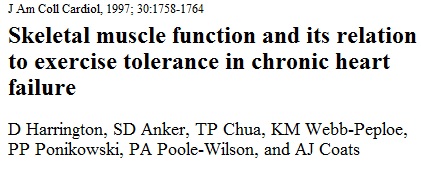
                                                                     http://content.onlinejacc.org/cgi/content/abstract/30/7/1758

 http://www.uptodate.com/contents/skeletal-muscle-dysfunction-and-exercise-intolerance-in-heart-failure

Read Full Post »

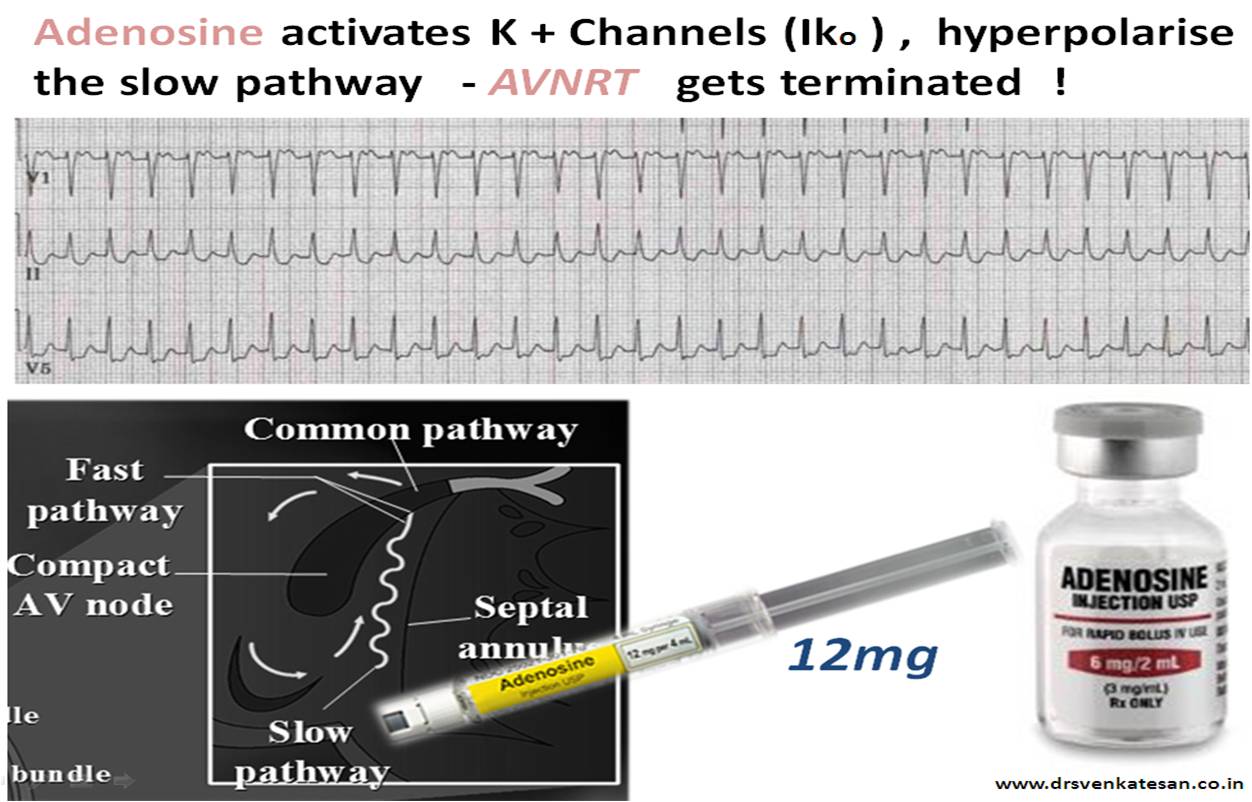
Adenosine is a  purine analogue. Acts by stimulating outward K+ channel  of AV nodal tissue, more specifically  in the posteriorly   located  slow pathway in the vicinity of  coronary sinus.

Another action of adenosine is inhibition of cAMP , which is similar to beta blocking action may also help in terminating the tachycardia.

Adenosine : A 10 second cardiac miracle

  • 12mg bolus is administered , preferably in a central vein (Not mandatory  though)
  • Termination is usually abrupt . Transient VPDs are observed during termination.
  • Transient flushing may occur.
  • If the patient is taking Aminophylline group of drugs (Which are adenosine antagonists) the AV nodal blocking action may be neutralised .

(It may be apt to recall  at this juncture ,  Aminophylline is used in sinus node dysfunction or AV block to increase heart rate )

Reference

A good one from Medscape http://www.medscape.com/viewarticle/585287_2

Read Full Post »

 Hypertension  ranks  number one  in the risk for future  stroke . Surprisingly this is true  for ischemic  as well as  hemorrhagic strokes.

 What  causes  thrombosis or  rupture of small cerebral arterioles ?

 It is somewhat similar to coronary events . ( With one major exception,  coronary vesels  are   not prone for rupture ) .It is  believed   sudden spikes of   blood pressure  and the resultant endothelial injury are responsible. Atherosclerotic plaque fissure and inflammation  also  contribute. 

Is embolic stroke related to hypertension ?

The vast majority of embolic stroke are believed to  arise from heart .This belief is getting gradually eroded , as we now know aortic arch and carotid arteries vie for this honour . .(This was indirectly proved in AFFIRM trial  when rhythm control failed  to reduce the incidence of  stroke inpateints with AF ,   implying much of the strokes arise  in the upstream rather than within the cardiac chambers )  

Meanwhile , there is no controversy  in  SHT  promoting  both cardiac  and non cardiac embolus to brain

Systolic ,  Diastolic or Mean pressure   which is  important  in the genesis of stroke  ?

All parameters  are  important , but the   systolic blood pressure  is vested with more  vigour  to damage the  cerebral arterioles. The reason  systolic pressure is more important lies  in the  fact ,  it  can  attain  high pressure peaks instantly ,  unlike diastolic or pulse pressure which  slowly builds up. Further , systolic BP  carries  leading edge of the pressure  curve with high Dp/Dt and hits  the target  first !

At what pressure the cerebral artery becomes  uncomfortable ?

We do not know  the answer as yet , but any systolic pressure above 180 mmhg is a huge stress for the cerebral arterioles.The rapidity with which the BP  raises  (Dp/Dt) also becomes  important  . High blood pressure increases the shearing stress .It  interferes with nitric oxide synthesis and promotes endothelin release which precipitates  cerebro vascular event.

How do you identify people who are at risk for stroke ?

While  cardiac physicians are obsessed with exercise stress test to predict CAD  very  few  are worried about  stroke . In fact the same exercise stress test can be used to stratify stroke risk. The exercise induced systolic blood pressure  raise  is a useful risk stratifying  tool. This concept is there for more than a decade without reaching the clinical domain.

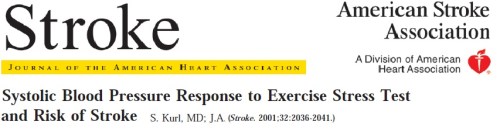
The following paper was  published in stroke journal (2001)  from the picturesque university of  Kupio Finland.(See below )  It is a wonderfully done study and throws great insight into the  new  emerging  science of  Intra cerebral hypertension .


The following can be summed up as risk factors for stroke during EST  (Derived from   various sources  and  . . .  with   liberal dose of personal  logic !)

  • Raise of 20 mmhg  SBP  at  2  minutes .
  • Increment of >  20mmhg in SBP any subsequent minute.   
  • Any  SBP  above 200mmhg during  EST
  • Failure to  reach baseline SBP  at 6 minutes recovery .
  • SBP  or DBP remaining high  even  after  the heart rate reaches baseline.


 Final message

For the kind attention  of all  cardiac physicians . . .  whenever you do an  EST for a cardiac indication ,  please spend the first  few  minutes  carefully ,and   look at the  blood pressure response . It is encouraged ,  to  specifically mention about the  behavior of  SBP  and write a remark about the propensity for  stroke in  every EST/TMT report .   Let us grow our brain  sense as well   . . .  for   the sake of our patients !

Thanks again  to Dr S.Kurl et all from Finland  for their  nice article which  stimulated  me to write  this post .

Reference

http://stroke.ahajournals.org/cgi/reprint/32/9/2036

http://heart.bmj.com/content/95/13/1072.abstract

Further queries

How common is stroke following a EST procedure ?  Can high blood pressure dislodge a carotid plaque during a stress test ?

The answers will be posted soon once I  get it . ( Of course you can do it if you know !)

Read Full Post »

« Newer Posts - Older Posts »