Feeds:
Posts
Comments

Archive for the ‘cardiology -Therapeutics’ Category

Myocardial infarction (STEMI)  occurs in two distinct arterial  territories .The anterior LAD circulation and postero- inferior RCA/LCX circulation.The incidence is equally shared.

There has been some  learned and unlearned perceptions about Inferior MI.

Inferior MI is less dangerous than anterior MI.  True or false ?

Answer: Essentially true in most situations.

Reasons.

Inferior wall of the heart (strictly speaking there is no walls for heart , only surfaces , which blends with adjacent areas)  inferior wall  is formed by diaphragmatic surface and posterior surface.Inferior MI can occur by either RCA or LCX obstruction.The outcome of inferior MI is determined by mainly by  the extent  of   LV myocardial   damage it inflicts.To  quantitate this  we need to know , how much of LV is supplied by RCA , or LCX or combination of both ? This depend on the coronary dominance .It is estimated , the bulk of the LV is supplied ( up to 75%  ) by LCA. This becomes further high in left dominant circulations . In fact , it is believed LV can never get involved in non dominant RCA occlusions. This has brought in a new terminology  called “Small inferior MI”.Inferior STEMI due to PDA  occlusion or in a co -dominant circulation is not yet studied

Apart from the above  anatomical considerations the following clinical observations  have  been made regarding inferior MI.

  • When thrombolysis was introduced , many studies  suggested the the ST elevation in inferior  leads toched the isolectric levels  in most situations even without thrombolysis.Technically, this implies spontaneous , successful thrombolysis are more common in RCA. Among the thrombolysed ,persistent ST elvation is a rare phenomenon.
  • The well known difference in the conduction defect between anterior and inferior MI  is an important contibutor for better outcome in the later.(AV blocks in inferior MI , are often transient, non progressive, supra hisian location rarely require permanent pacemakers)
  • During acute phase cardiogenic shock occurs in a minority (That too , only if RV shock is included )
  • Even in the follow up the ejection fraction in inferior MI is  almost always above  40%. In many EF is not affected at all.
  • Progressive adverse remodelling of LV is rare

When can Inferior MI be dangerous ?

Anatomical factors

Inspite of the  above  factors  inferior MI can not be taken lightly . Especially when it  extend into posterior, lateral , (Rarely anterior) segments.

While  posterior extension  is often  tolerated , lateral extension is very poorly tolerated .This is probably explained as  the extension involves the vital free wall of LV and the laplace forces could precipitate LVF. Free wall rupture is also common in this situation.

Posterior extension , predominantly involves the surface of RV which is less important hemodynamically. Of course incidence of MR  due to it’s effect on posterior mitral leaflet can be trouble some.
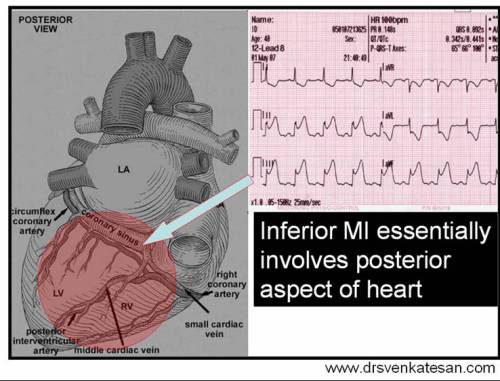
inferior MI ECG

High risk clinical catagories.

Out of hospital STEMI  are at  equal  risk irrespective of the territories involved  .This is because,  primary VF does not differentiate , whether  ischemia comes from RCA or LAD .

  1. In elderly , dibetics and co existing medical condtions  the the established  benign   character  of  inferior MI disappear, as  any  muscle loss  in LV has equally adverse outcome.
  2. Even though  inferior MIs are immune  to cardiogenic shock  , a equally worrisome  prolonged hypotension due to high vagal tone, bradycardia, plus or minus RVMI can create trouble. Fortunately , they respond better to  treatment. Except a few with extensive transmural RVMI outcome is good.
  3. Presence of  mechanical complications of  ventricular septal rupture , ischemic MR can bring  the mortality on par with large anterior MI.

How different is the clinical outcome of infero-posterior  MI with reference  to the  site of  coronary arterial  obstruction   ?

The sequence of  outcome  From  best to worse  : Non dominant RCA* → Dominant RCA but distal to RV branch → LCX dominant with large OMs

* It is believed   an  acute proximal  obstruction of a  non dominant RCA may not be mechanically significant, but can be electrically significant as it retains the risk of primary VF and SA nodal ischemia. The ECG changes  can be very minimal or  some times simple bradycardia is the only clue. One should be able to recognise this entity (Non dominant  RCA STEMI)  as the outcome is  excellent and these patients  would never require procedure like primary  PCI

** A inferior MI due to a dominant LCX and a large OMs have comparable outcome as that of extensive anterior MI. The ECG will reveal ST elevation in both inferior and lateral leads.

***In patients with prior CAD  and collateral dependent  multivessel disease  the  inferior anterior sub classification does not make much sense as  entire coronary circulation can be mutually interdependent.

Final message

Inferior STEMI  generally lacks the vigor  to cause extensive damage to myocardium in most situations .Further they respond better to treatment. Risk stratification of STEMI based on the location of MI has not been popular among mainstream cardiologists. This issue needs some introspection as  the costly and complex treatment modalities like primary PCI  is unwarranted in most of the low risk inferior MIs.

Related posts in my blog:

1.Why thrombolysis is more effective in RCA?

Read Full Post »

Total coronary artery occlusion is a common finding in CAD  especially in chronic stable angina. Normal coronary blood flow is 5 % of cardiac output  that amounts to 250-300ml/mt.At an average  heart rate of  70/mt  , each  beat  injects  about 5cc blood into the coronary circulation.This is shared between two coronary arteries.  This means , only few CC (2-3cc) of blood enters  each coronary artery with each cardiac cycle .

When one of coronary artery is totally occluded what happens to the coronary

blood flow ?

A.Total coronary blood flow  can be be  maintained   normal  at rest  as it  forms  only about 5% of cardiac output  (or it is only  slightly reduced )

B. It is believed , the unobstructed coronary artery  could receive the blood meant for the contralateral coronary artery. This  possibly explains the increased coronary artery diameter in the non obstructed artery.

C. It’s nature’s wish ,  that the  contralateral  coronary artery  shall share  50% of  it’s  blood through  collaterals if available.

D.If collaterals are not formed it , the unobstructed coronary  artery  may be over perfused with double the amount  of blood flow.

E. Some times , the collaterals steal  much more than what  the  obstructed coronary artery  deserves and make the feeding coronary artery ischemic. This is many times observed in  total RCA occlusion with well formed  collaterals  from LAD/LCX.

F.The collateral flow  in CTO also depend on whether flow is directed from LAD system to RCA or from RCA -LAD system. The LAD is better placed to assist RCA than vice versa.This is for two reasons.1.LAD blood flow is higher than RCA so it can share it.2.The driving pressure is more  from LAD -RCA , as RCA can receive  blood flow even during diastole .

F.During exertion , the coronary hemodynamics become further complex.The collateral’s are traditionally thought to be less than adequate during times of exercise.But it is more of a perception than solid scientific data.This rule  may be applicable in only certain group of patients. We know CTO patients with very good exercise tolerance who have documented collateral’s.

G.Collaterals can be either  visible or invisible by CAG. The strength of collateral circulation is not in it’s visibility but it’s capacity to dilate and  respond to neuro humoral mediators at times of  demand.  Currently  , there is lot to be desired  regarding  our knowledge about  the physiology  of visible collaterals , no need to  mention about invisible collaterals !

Final message

The above statements  are based  on logics and observations .

Is it not a  irony  in cardiac literature ,  where  thousands of articles  are coming out every month  to tackle  totally occluded coronary artery(CTOs) ,  there is  very little data   regarding the coronary hemodynamics in chronic total occlusion .   How  does a patient with CTO can manage a active life with only one functioning  coronary artery ?

Read Full Post »

Ventricular ectopic beats are the most common cardiac electrical abnormality for which cardiologist’s consultation is sought.VPDs are one of most benign observations in ECG and  and almost every  heart experiences it. In 24 hour holter recordings it was reported up to 25% of healthy  individuals .

In spite of this ,  the fear of  noting a VPD in a given tracing of ECG is genuine both for the patient and his physician.This is because  VPDs  can be  a forerunner of dangerous ventricular arrhythmias.

  • VPDs are often graded according to the count and morphology and frequency.(Lown’s ,Bigger’s grading)
  • VPDs that occur in single are less fearsome.( It may not be so . . .)
  • VPDs in couplets and  triplets raise considerable anxiety.( Again it need not be . . .)
  • A series of VPD lasting for 30 seconds is called non sustained ventricular tachycardia(NSVT)
  • If it exceeds 30second it called sustained VT.
  • VT may remain as VT in many.
  • VT may degenerate into VF  ventricular fibrillation in minority( ie cardiac arrest)

The importance of VPDs do not lie  in the number ,  morphology or frequency  but most importantly  in  the underlying etiology. If it occurs in a structurally normal heart it is largely benign.

New onset VPDs should be investigated thoroughly. The commonest symptom is palpitation.

vpd ectopic

Friendly VPDs : Some of  situations where VPDs are  commonly observed and has little significance are.

  • Exercise induced VPDs
  • Pregnancy induced VPDs  (PIH /Peripartum DCM are  rare possibilities)
  • Thyroid associated VPDs
  • Alcohol /Smoke related

What are the VPDs that could be clinically  important ?

VPDs with chest pain(Ischemic etiology )

VPDs in patients with dyspnea.(CHF , COPD)

Drug induced VPDs(Digoxin etc)

Renal failure associated VPDs

VPDs due to hypoxia/Hypokalemia

In patients with pre existing heart disease.(Congenital, valvular, myocardial disease)

What prevents a non sustained VT from becoming sustained ?

No one really knows the answer.Most of the NSVT self terminates.A healthy heart some how gets the capacity to self terminate the arrhythmia.The normal  LV  fails to sustain the abnormal electrical circuit . A diseased heart may not be able to do so . Further if there is electrolyte abnormality (low potassium), or lack of oxygen it may maintain a VT.

What are the most dangerous forms of VPDs ?

  • VPDs that occur during  acute coronary syndrome.
  • VPDs associated with cardiomyopathy( Ischemic , nonischmic,)
  • Some forms of primary electrical disorders of heart( Brugada syndrome, ARVD , CMVT etc)

How do you investigate patients with VPDs?

General medical work up in all.

Echocardiogram is usually necessary in most.

Holter monitoring in occasionally.

Coroanry angiogram rarely

Electrophysiological study in high risk category

How do you manage  patients with VPDs?

  1. Generally do not require any specific drugs in vast majority of individuals .
  2. Reassurance is the key
  3. Ask them to avoid potential triggers like smoke, alcohol, coffee, tea and related bevarages.
  4. If palpitation is troublesome beta blockers( Propronolol, Atenolol, metoprolol can be used.)
  5. Anxiolytic may also be given.

*If the patient has  systemic disorder like hyperthyroidsm , anemia  or underlying heart disease he has to get the specific treatment.

Caution:It has become fashionable for the physicians  to use powerful antiarrhythmic drugs like amiodarone (Cordarone) liberally in patients with asymptomatic VPDs with structurally normal hearts.this practice must be absolutely avoided as amiodarone is one of most toxic  cardiac drugs known  with great pro arrhythmic activity.

When to refer a patient with VPD to a electrophysiologist ?

Physicians   can  treat   most of these patients. But the following will require EP consultations

  • Patients with syncope
  • Patient who have LV dysfunction(Low ejection fraction EF%)
  • Has had an episode of ventricular tachycardia
  • Cardiac arrest

What will the Electrophysiologist  do ?

These patients will be evaluated for inducibility of VT/VF and if the LV function is poor (EF<30%  MADIT 2 criteria ) many would receive implantable cardivertor defibrillator(ICD) or life long anti arrhythmic  drugs.

Some times radiofrequency (RF ablation)  waves are used to ablate the focus of VT.This is possible only if it occurs close to endocardium as  intracardiac catheters do not have access to epicardial  focus. Among  ICD and RF ablation later could be preferred whenever feasible as it eliminates the arrhythmia , while  the former only tackles it only after it occurs .( Hence ICDs  , even though a technological marvel can not be labelled as curative ! )

Final message

VPDs are the   most common cardiac arrhythmia .Most of them are benign. Few of them require extensive investigation.

Read Full Post »

NSTEMI constitutes an important sub group of ACS. In fact it  forms the major  group. Real world data would indicate it   UA/NSTEMI could form up to 75% of all admissions for ACS in any cardiac emergency units. Risk stratification of NSTEMI is important and  is available. It is  one primarily with clinical features , ECG and troponin positivity. Classifying NSTEMI   with reference to underlying patho anatomy is not available.

Classifying  NSTEMI based on the following is  is suggested .

A.Based on the  extent  of infarct.( For example there is no entity called extensive NSTEMI  unlike STEMI)

B.Based on the Location of NSTEMI .

Currently , NSTEMI simply means there is an infarct some where in the heart ? Should we not localise it ? Is it not surprising , we have not attempted to localise  NSTEMI  so far ?

C.Based on the coronary anatomy : RCA NSTEMI vs LAD vs LCX NSTEMI.

The reason is two fold.

1.NSTEMI is often patchy , subendocardial . Some times  only islands of infarct can occur.But , .How common is segmental NSTEMI ? May not be common, still if wall motion defect occur it must be an segmental MI.Some estimate wall motion defect in NSTEMI is around 25%.

2.Is  there any clinical purpose for localising NSTEMI ?

Some would  think there is no real  purpose. That does not  mean ,  we should not attempt to do it. In fact there is an  important reason ,  we  need to  localise  NSTEMI. Triple vessel disease ,  is the common pathology underlying NSTEMI. They often have  multiple critical lesions as well. Identifying the  the  culprit lesion is not an easy task. If we know the site of infarct ,  however small it may be , it  helps us fix  the coronary artery.

A real dilemma could occur in patients  with NSTEMI , who has a  90 % lesion  in  RCA and  50 % proximal LAD lesion  . We ( tend to !)  take it as granted  ,  RCA  lesion is likely to be responsible for the NSTEMI. But  the real culprit  could be  the  recannalised LAD .  If it is so ,   the 50%  LAD lesion  could   be  more important and if you leave it free there is a strong  likely hood of recurrent UA. If we could some how located  the NSTEMI in the LAD region in this patient  , he could  get a PCI for LAD as well.

Of course , there is  an   universal approach available “Doing PCI for all suspected culprit lesion however mild it may be ”  . Unfortunately , it  increases the metal load for the  patient, which is an independent risk factor for a future ACS.

How to locate NSTEMI ?

So , it is often helpful to locate NSTEMI  . Of course ,  it needs little more efforts. A very meticulous echoc cardiography can aid in locating  the subtle  wall motion defects in NSTEMI . Perfusion studies/PET studies may be indicated in occasional patients.Myocardial contrast echo can be useful.

Coming soon

Difference between Anterior NSTEMI and inferior NSTEMEI

Read Full Post »

Thrombolytic therapy ,  has been  the specific treatment  for STEMI for  many decades. Primary PCI*  is  shown to be  superior  than  thrombolysis  if   performed   early  by an experienced  team in a dedicated facility. (*Conditions apply). It is estimated ,   currently only a  a fraction  STEMI  population get primary PCI (<5%) in ideal conditions . Another fraction , get  primary PCI by inexperienced cardiologists  in low volume centres.

So , thrombolysis   remains, and  would continue to remain ,   the    primary  mode of therapy for STEMI  in the  present and near  future !

How do you assess the successful  thrombolysis ?

It should be recognised ,  there is a fundametal flaw in this  question !

The aim of thrombolytic therapy is  not  to   lyse  the thrombus  , but also  to restore the coronary blood flow to the  myocardium – also called reperfusion . One may wonder , why the term ,  thrombolysis  should ‘t be  used interchangeably with reperfusion. 

A successful thrombolysis  never guarantees  a good reperfusion , for the simple reason ,  distal blood flow in an  obstructed coronary artery  is dependent on ,  many factors  other than relief of obstruction.

Apart from the potency of drug,     other   important factors  that determine  successful  lysis &  reperfusion are  . . .

  • Timing of opening of artery , if the thrombolysis is delayed  ,  the distal myocardium is dead , and   it won’t allow blood flow to enter the mycardium.
  • Microvascular integrity is as vital as epicardial vessels.
  • Distal microvascualture  plugging by the thrombotic debri . This is called”no reflow “

So , we should  primarily assess myocardial reperfusion rather than epicardial thrombolyis ! following thrombolysis .

What are the parameters available to assess successful reperfusion /thrombolyis?

  1. Clinical : Relief from chest  pain. Angina relief  , though subjective is an indication for adequate reperfusion of ischemic myocardium.
  2. ECG-ST segment regression > 50%
  3. Cardiac enzymes: Early flushing of  intra myocytic CPK into systemic circulation and hence early peaking of CPK MB (<1ohours instead of 24h)
  4. Reperfusion arrhythmias(AIVR-Less specific) .Primary VF is now thought to be reperfusion related.
  5. Infract related artery(IRA) patency by coronary angiogram
  6. Distal TIMI flow/ myocardial blush score/ TIMI frame count

ECG ST regression ,  is a direct indicator  myocardial reperfusion   as the ST segment shifts  towards baseline ,  implies  of infarct current of injury . ST regression almost always correlate with good  recovery of LV function  in STEMI .

IRA patency , is an epicardial index , it  does not give information about myocardial blood flow . But ,  a good  distal TIMI flow generally indicates good reperfusion.This  again ,  is  not a fool proof  index,  as even many of the TIMI 3 flow patients  have severely damaged myocardium by echocardiography .

Final message

For the above reasons, one should always  make a distinction between successful lysis and successful reperfusion . Surprisingly ,  ECG  is  the gold standard for assessing successful reperfusion of myocardium ,  while CAG tell us  about epicardial patency and possibly reperfusion also.

Read Full Post »

Apart from  acute  coronary syndrome,    cardiac  failure is   the most common clinical  presentation of  CAD. Cardiac failure ,  classically present with dyspnea on rest or on exertion , while angina is the dominant presentation in ACS.  

What if  ,  both these  occur together in an acute fashion ?

Yesif it occurs  together it is called ischemic cardiac failure . Fortunately , this is quiet uncommon . It has   an adverse outcome,  especially if it occurs  as a companion of NSTEMI . Let us see how . . .(  Most of the episodes of cardiac failure  in CAD  means only  LV failure )

For cardiac failure to occur , there need to be a mechanical contractile dysfunction or defect . In CAD population , this can  occur in  one of the following way.

  • Loss of LV muscle (Acute  Myocardial infarction as in STEMI)
  • Mechanical defects (Mitral regurgitation/VSR etc)
  • An arrhythmia (Commonly VT or AF / CHB )  can precipitate  cardiac failure

Apart from these three , there is  an important mechanism of acute LVF, namely ischemic stunning of major part of LV resulting in severe mechanical dysfucntion.This is a dangerous form of cardiac failure (Pathologivcclaly it is thought to represent  contraction  band necrosis !) this occurs in global ischemic situations manifested as gross global ST depression.

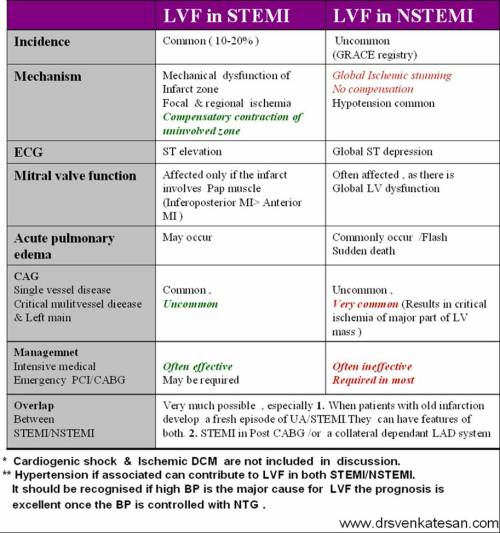
So,  there are two types of  ischemic LVF  .  STEMI   occuring due to infarct( ± ischemia ) Other  one (NSTEMI)entirely due to ischemia.

Logically ,  one  may n’t   refer  STEMI related LVF as  ischemic LVF at all  , as infarct has already occured. While , NSTEMI related LV could be the ” True ischemic LVF “


What are the differences between cardiac failure that occur in  STEMI and NSTEMI ?


lvf in nstemi stemi

Is post infarct failure  ( The commonly used terminology  , now out of vogue ! )  a type of ischemic LVF ?

In the strict sense , it is not . Here the dead myocardium , is responsible  for the   failure .To label a  LVF , as  ischemic , ongoing ischemia must  be  documented and further it  should  be shown to  contribute   for the  mechanical dysfunction .

This is of vital importance ,   if you wrongly attribute ischemia  as a cause for  the LVF , the patient may be taken up for emergency  revascularisation .It is not going to help much (Infact , it may  worsen !) as  this cardiac failure is not going to be corrected  .What we require ,  here is an  aggressive medical management  protocol .


Read Full Post »

Failed thrombolysis is an important clinical  issue  in STEMI   as  successful thrombolysis  occurs  only in  about 50-60%  of pateints . The typical criteria to define failed thrombolysis is  the  regression  of less than 50% of sum total( or maximum)  ST elevation in infarct leads.

So what do you do for these patients with failed thrombolysis ?

It depends upon the patient’s symptom, hemodynamic stability, LV dysfunction .

They  should  get one of the following .

  1. Conservative medical management  with /without CAG
  2. Repeat thrombolysis
  3. Rescue PCI
  4. CABG

Medical management is  thought to be  too inferior a  management,  many of the interventional cardiologists  do  not want to talk about . But  , there is  an important  group of patients (Not often addressed in cardiology literature)  who  technically fulfill the criteria  of failed thrombolysis  , but   still  very  comfortable , asymtomatic  and in  class 1. These patients ,  have  a strong option for continuing the conservative management .

Repeat thrombolysis does not have a consistent effect but can  be  tried in some  stable patients. CABG  can be a genuine option in few

Rescue PCI

This terminology  has become  the  glamorous one since the  catchy word  rescue is tagged in the title  itself. For most of the cardiac physicians ,  this has become the default treatment modality.This is an unfortunate perception . What  one should realise   here is  , we are  tying to rescue  the myocardium and  the patient ,   not the patient’s coronary artery !

Opening up a coronary obstruction is not synonymous with rescue .

For rescue PCI ,  to be effective it should be done within the same time window as that for thrombolysis (ie within 6 or at the most  12 hours) .This timing  is  of vital importance  for the simple reason , there will be nothing to rescue after 12 hours as most of the muscle  would be  dead. Reperfusing a dead myocardium has been shown to be hazardous in some ,  as it converts a simple  infarct into a hemorrhagic  infarct.This softens the core of the infarct and  carry a risk of rupture. Further,   doing a complex emergency  PCI  ,  in  a thrombotic milieu with   presumed  long term  benefit ,  is  a  perfect recipe for a potential  disaster.

While the above statement may be seen as pessimistic view , the optimistic cardiologist would vouch for the“Curious  open artery hypothesis” .This theory simply states , whatever be the status  of the distal myocardium ( dead or alive !)   opening an obstruction in the concerened coronary artery  will benefit the patient !

It is  huge surprise , this concept   continues to  be alive even after  repeatedly shot dead by number of very good clinical trials (TOAT, CTO limb of COURAGE etc ).

The REACT study (2004) concluded undisputed benefit of rescue PCI for failed thrombolysis  , only if the rescue was done  within  5-10 hours after the onset of symptoms.The mean time for  pain-to-rescue PCI was 414 minutes (6.5hours)

Final  message

It is fashionable to talk about time window for thrombolyis but not for PCI  .The time window for rescue PCI is an redundant issue  for many  cardiologists ! . But ,  the fact of the matter is ,  it is not . . .

The concept of time window in rescue PCI  , is as important as ,   that of  thrombolysis. Please , think twice or thrice !  if some body suggest you to do a rescue PCI in a stable patient  ,  12hours after the index event .

Important note : This rule   does not (  or need  not  ) apply for patients in cardiogenic shock  or patient ‘s with ongoing iscemia and angina.

Read Full Post »

NSTEMI constitutes a very heterogeneous population .The cardiac risk can vary between very low to very high . In contrast , STEMI patients carry a high risk for electro mechanical complication including sudden death .They all need immediate treatment either with thrombolysis or PCI to open up the blood vessel and salvage the myocardium.

The above concept , may be true in many situations , but what we fail to recognize is that , STEMI also is a heterogeneous clinico pathological with varying risks and outcome !
Let us see briefly , why this is very important in the management of STEMI

Management of STEMI has undergone great change over the past 50 years and it is the standing example of evidence based coronary care in the modern era ! The mortality , in the early era was around 30-40% . The advent of coronary care units, defibrillators, reduced the mortality to around 10-15% in 1960 /70s . Early use of heparin , aspirin further improved the outcome .The inhospital mortality was greatly reduced to a level of 7-8% in the thrombolytic era. And , then came the interventional approach, namely primary PCI , which is now considered the best form of reperfusion when done early by an experienced team.

Inspite of this wealth of evidence for the superiority of PCI , it is only a fraction of STEMI patients get primary PCI even in some of the well equipped centers ( Could be as low as 15 %)

Why ? this paradox

Primary PCI has struggled to establish itself as a global therapeutic concept for STEMI , even after 20 years of it’s introduction (PAMI trial) . If we attribute , lack of infrastructure , expertise are responsible for this low utility of primary PCI , we are mistaken ! There are so many institutions , at least in developing world , reluctant to do primary PCI for varied reasons.( Affordability , support system , odd hours ,and finally perceived fear of untoward complication !)

Primary PCI may be a great treatment modality , but it comes with a inherent risk related to the procedure.

In fact the early hazard could exceed the potential benefit in many of the low risk STEMI patients !

All STEMI’s are not same , so all does not require same treatment !

Common sense and logic would tell us any medical condition should be risk stratified before applying the management protocol. This will enable us to avoid applying “high risk – high benefit” treatments in low risk patients . It is a great surprise, the cardiology community has extensively researched to risk stratify NSTEMI/UA , it has rarely considered risk stratification of STEMI before starting the treatment.

In this context , it should be emphasized most of the clinical trails on primary PCI do not address the clinical relevance and the differential outcomes in various subsets of STEMI .

Consider the following two cases.

Two young men with STEMI , both present within 3 hours after onset of symptoms

  1. ST elevation in V1 -V6 , 1 , AVL , Low blood pressure , with severe chest pain.
  2. ST elevation in 2 ,3, AVF , hemodynamically stable , with minimal or no discomfort .

In the above example, a small inferior MI by a distal RCA occlusion , and a proximal LAD lesion jeopardising entire anterior wall , both are categorized as STEMI !
Do you want to advocate same treatment for both ? or Will you risk stratify the STEMI and treat individually ? (As we do in NSTEMI !)

Current guidelines , would suggest PCI for both situations. But , logistic , and real world experience would clearly favor thrombolysis for the second patient .
Does that mean, the second patient is getting an inferior modality of treatment ?

Not at all . In fact there is a strong case for PCI being inferior in these patients as the risk of the procedure may far outweigh the benefit especially if it is done on a random basis by not so well experienced cath lab team.
(Note : Streptokinase or TPA does not vary it’s action , whether given by an ambulance drive or a staff nurse or even a cardiologist ! .In contrast , the infrastructure and expertise have the greatest impact on the success and failure of PCI )
Final message

So , it is argued the world cardiology societies(ACC/ESC etc) need to risk stratify STEMI (Like we do in NSTEMI ) into low risk, intermediate risk and high risk categories and advice primary PCI only for high risk patients.

Reference

https://jamanetwork.com/journals/jamainternalmedicine/fullarticle/226907

Read Full Post »

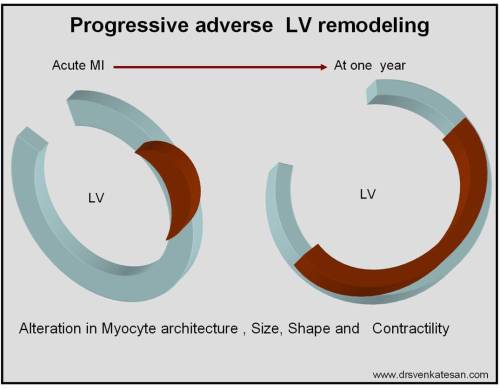
Ventricular remodeling  follows large myocardial infarction .This term denotes to  change in size , shape  and function  of the ventricle   due to altered  myocyte geometry .It is now believed  , this  process begins to occur very early  following a STEMI.(less than 24hours)

lv-remodeling

In which MI remodeling is more common ?

Any MI of large size , especially  anterior  and lateral MI.  Inferior and posterior MI are less affected by adverse remodeling.The incidence is up to 20% of all myocardial infarction ,  if left untreated. Ventricular aneurysm formation and dyskinetic segments can be termed as the worst form of remodeling. The old terminologies of infarct extension and expansion could by synonymous with ventrilar   remodeling .(Note : Every patient with STEMI undergoes some form of physiological remodeling that should not be confused with progressive pathological remodeling , we are discussing  here ! )

What is the clinical impact of remodeling ? How to prevent it ?

Progressive cardiac failure and a  poor outcome .  It may provoke ventricular arrhythmias. ACE inhibitors (CONSENSUS study 1992 )  has since revolutionized  the pharmacological  prevention of adverse remodeling.

How to recognise left ventricular remodeling ?

Many methods are available .

  • 2 D Echocardiography
  • Tissue doppler
  • LV angiogram
  • MRI

These imaging methods diagnose remodeling  only after it manifest* .We know remodeling is a cellular and molecular process .The earliest trigger for remodeling is the mechanical stretch and wall stress on the ventricles.Large areas of necrosed myocardium and  the adjacent normal myocardium sets a perfect stage for eccentric pulling of myocardial segments and unregulated slippage of myocytes.

* Diagnosing fully established  ventricular remodeling  serves ,  no great   purpose as it is very difficult to reverse it by pharmacological methods.it requires complex surgery.

What is the effect of mechanical stretch on cellular function ?

It is well known  myocyte granules secrete Type B  -Naturetic peptide  in response to stretch. It could be a very early sign of adverse remodeling. So monitoring of  BNP may give us an opportunity to intensively treat those patients who are likely to land in progressive cardiac failure.

A baseline level of NT-proBNP >120 pmol/L identified patients  prone for adverse remodeling .Serial measurements showed further increase. It is possible to identify adverse remodeling of LV by documenting fresh elevation of BNP following MI .

Reference :

1 )Nilsson JC, Groenning BA, Nielsen G, et al. Left ventricular remodeling in the first year after acute myocardial infarction and the predictive value of N-terminal pro brain natriuretic peptide. Am Heart J 2002;143:696-702.

2)http://content.nejm.org/cgi/content/full/352/7/666#R24

Read Full Post »

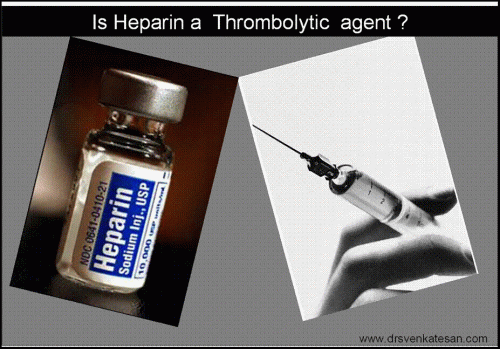
Heparin was invented accidentally by a 26 year old  , Jay McLean, a  pre clinical  medical student  in 1916 .It was one of the greatest discovery  in  medicine .It helped us prevent blood from clotting.Frozen blood inside human circulatory system constituted one of important mechanisms  of  human  death.This ranged from acute myocardial infarction to cerebral thrombosis  .

heparin3

As we decoded the mechanism of action of heparin , it was clear it bound to the  naturally occurring molecule antithrombin 3 and effectively blocks the intrinsic coagulation mechanism and thus behaves as an important anticoagulation agent.

How heparin acts as a thrombolytic agent ?

We know , our hematological system has a powerful  natural  fibrinolytic mechanisms  to protect against unwarranted( pathological ) intravascular coagulation. This is mediated by  anti thrombin, protein C , protein S  ,  plasminogen  system etc  . Natural concentrations of tissue plasminogen activator (Tpa)  also  help in lysing intravascular clots.

There is a constant  , delicate balance between procoagulant , anticoagulant and antifibrinolytic molecules .Intra vascular  clots occur when a vascular  injury triggers  a clot formation and the clinical event occurs.

But,   once insulted ,   the  circulating blood   does not remain a silent spectator . It is  constantly  on the look out for a foe to attack the thrombus that is interfering  with its natural flow  . Antithrombin 3 is one such molecule. Success  of lysis depends on the power of natural forces. There are hundreds of episodes of microlysis that take place every day  (Which happen without our knowledge ) .In  patients with vascular  disease these episodes are likely to be further more.

What does  Intravenous heparin in high doses  do ?

Heparin immediately  blocks of powerful procaogualtion activity .One of the important heamatological principle  is “Thrombus begets thrombus “. It is  a vicious cycle. This is immediately  tackled by heparin .The powerful trigger of thrombus induced thrombus propogation is shut off .

This makes a  2 cm sized clot to remain  in  2cm . After  making sure of this , the blood in the immediate vicinity   start percolating the clot.  The heparinised blood   switches to  a pro- fibrinolytic mode as the balance of forces  is fully tilted in favor of fibrinolysis or thrombolysis.

Is there clinical evidence to call heparin as thrombolytic agent ?

Yes . Contrary to the popular scientific  principle we have only clinical evidence  . laboratory evidence is not convincing as heaprin lyses clot only in vivo . Since ,  evidnece based medicine requires  laboratory evidence  we hesitate to call this as  thrombolytic agent !

It has been a strong clinical observation ,   many  major intracardiac or  intravascular  clots  regress in size

(or totally dissolve )  with intensive heparin  regimen .The effect is seen in 48-72 hours.Some times in first 24 hours.

What are the clinical situations where heparin has successfully lysed the clots*?

  • Pulmonary embolism
  • LV clot
  • LA clot
  • Cortical venous thrombus
  • Deep vein thrombosis
  • Coronary thrombosis**
  • Portal vien thrombois
  • Renal vein thrombois

* Plenty of case reports available for each condition

** Sustained micro  thrombolysis  is the major mechanism of benefit in NSTEMI

If it is true ,  heparin dissolves thrombus , why  it is not called as thrombolytic agent ?

Why not ?  You decide yourself !

How does heparin compares with  the great thrombolytic agents*  like  Strepotiknase, Urokinase,Altepase, Retepalse , Teneckteplase (TNK TPA) ?

Many (Rather most . . .)  would consider it ,  as  foolish , to compare heparin with these agents .But the fact of the matter is except for streptokinase there is no comparison studies available. Attempting such a study  in humans will  be considered unethical. Without   a proper scientific  data  heparin  can not be ignored either.

But ,  some of the control groups in major  studies of thrombolysis  through some light !

In pulmonary embolism thrombolytic agents and heparin have similar effects on intrapulmonary thrombus

An important point to remember here is   , the powerful thrombolyic agents are administered  in as short duration (Bolus / 1  hour infusion ) .This is invariably  followed by heparin infusion . Why do we  do that ? because we know it is important . One may never know , how much of lysis is done  by the trhombolytic agent and how much by heparin .

if you analyse the  data  success rate of thrombolytic agents are infact attributable  to the follow up heparin

Thrombolytic agents  piggy packs on heparin and claims the  credit for thrombolysis *

In thrombolytic  therapy  , heparin  is considered  as an adjunct to streptokinsae but in reality  streptokinase  may an  adjunct to heparin

Importance of  heparin In Acute MI (HEAP Trial)

It should be realized  there is a time window for heparin too . . .  early administration  can have  great benefit

Early heparin prevents formation of  core  of the clot .The   importance of acute administration of  aspirin  in suspected STEMI  is well recognized  by paramedics  .  A bolus of heparin (10000 u)  immediately  could have great impact on the outcome as well  .Paradoxically we talk more  about emergency PCI,  on  transit TPA  etc . . . We have seen  number of patients  referred  with  STEMI   from   suburban areas traveling for hours with out any anticoagulants but promptly getting sorbitarate tablets ! Unfortunately prehospital heparin is rarely stressed in literature .

Watch the video : Heparin : The forgotten hero

Final message

  • Heparin is   an  under rated drug  as a thrombolytic agent.
  • Just because it has no direct action  on thrombus it is considered an inferior agent.( One other reason  for it to be  considered  inferior ,   it  is  very cheap  !)
  • Heparin too ,  has a time window effect in acute MI (Class 3 evidence ie   wide clinical experience)
  • It’s  usage should be early  and  liberal , especially  in out of hospital setting in vascular  emergency.
    Note of caution : This article is not meant  to  defame  the thrombolytic agents.It only stresses a point that , heparin has also a role , as a thrombolytic agent. *Whenever rapid thrombolysis is required in life threatening situations specific thrombolysis is indicated as per guidelines.

Read Full Post »

« Newer Posts - Older Posts »