Feeds:
Posts
Comments

Archive for the ‘Cardiology -unresolved questions’ Category

Some say medicine is a funny science . . .  it is true  at times. It will remain so , as long as we convert  a fact into a myth and a myth into a fact at our convenience . It  is  often   fueled  by the  whims and fancies of modern research  ! This phenomenon is happening in a regular  fashion  for  many decades now.

The number one killer disease of heart  is  the atherosclerosis  . Atherosclerosis means hardening  of arteries. The advent of coronary  calcium score with CT scans ,  it became a craze among many physicians . (It was   replaced later  by 64 /128 slice MDCT with unprecedented  commercial over tones !)

How can we  conquer the atherosclerosis ?   when the enigma of calcium in coronary artery is yet  to be solved.

The next few decades will be crucial   as  we are  trying to find answer to the following question .

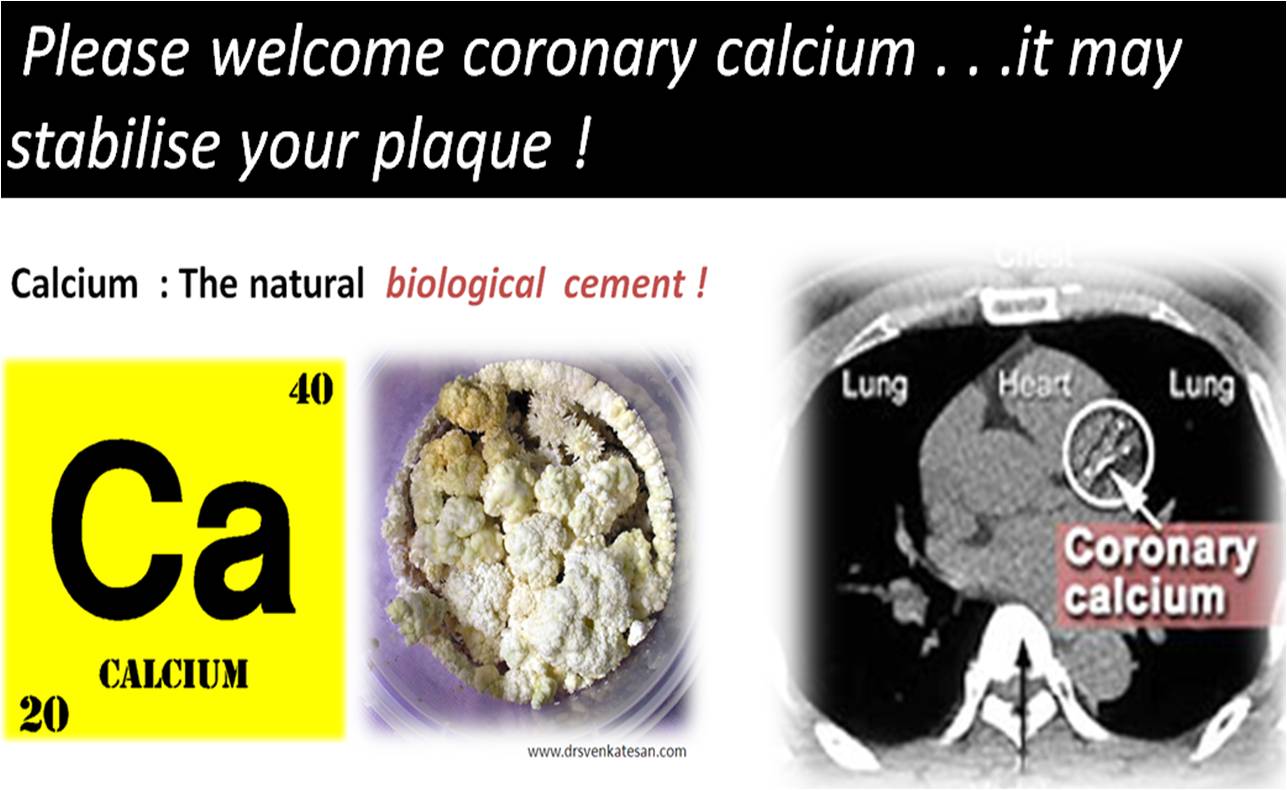
Is  coronary calcium  good ,  bad or neutral   in CAD  ?

This article in American journal article begins the new year 2011  with good news for people , who show some calcium in their plaques.
What makes a plaque vulnerable ?

Plaque contents , it’s distribution and consistency make it vulnerable. Soft spots  formed by   lipids   may  result in  plaque cracks and fissure.   Semi solid  , mixed  ,  gel like soft  plaques   are dangerously prone for  rupture . Oxidation of LDL,  LDL  liquefaction and tissue metalloprotinase , thickness of fibrin caps , all promote softening.  If none of above  mechanism is operative in a given patient , the   plaque becomes  stiff and hard.

Calcification is the ultimate in hardening . Calcified plaque  is resistant to mechanical deformation.If  stiff  plaques   are less vulnerable , hard plaques ( ie calcified  plaques ) must be least  vulnerable . Calcification   can be called an end result of coronary atherosclerosis.

So , calcified  coronary artery  can be referred to as  a failed  mission of  atherosclerosis .It is  equivalent to  death  of atherosclerosis and denotes the end process of this dreaded disease process.

Calcification tames atherosclerosis  in it’s own den
What is the implication of a stiff hard, sharp calcified plaque lining  (or even projecting ) in the coronary lumen ?

As this study has shown , calcium in the walls of coronary artery is innocuous  . Of course , calcium should not be dense and obstruct the blood flow . This will  require  intervention. Many  consider , calcium as  a foreign body in the coronary artery . But the prevalent understanding is ,  presence of non obstructive calcium  is often  a  non issue or in fact a welcome issue in some.

After all , millions of  human beings  happily roam around  with the hardest possible substance  lining their  coronary artery called  stents.

Caution about calcium

This article does not portray calcium as a healing molecule in  CAD . In  the realistic senseit is  too complex to make such a generalization.  The  message is  , calcified lesions are less likely to result in acute coronary  events than soft , non calcified lesions.

It is well known ,  calcium can be problematic for the interventional  cardiologists  .It makes life tough for them in deploying  stents. Calcium rich lesions exerts  radial force in a diagonally opposite direction and interferes with stent approximation.

It is also believed localised , sharp calcium crystals may tear a plaque  and cause   plaque dissections. This  happens if the calcium is lying in an eccentric fashion overhanging the shoulder region of the plaque   abutting a soft spot.

Final message

It is now clear ,  why calcium  score in CT scans  failed miserably to predict  high risk subsets of CAD. In spite of repeated studies  the researchers failed  to show a positive correlation .  The studies are flawed  as they  were trying to look for a positive correlation  which is non existent . In fact , the above study seems to suggest calcium  score may indeed  predict low risk individuals!

Read Full Post »

Calculating the pulmonary vascular  resistance (PVR)  has been a  big head ache for all those involved in pediatric and (for many )in adult cardiology as well  . The complex formulas , the delicate  oximeter samples, the catheters, a sick child , an arrhythmia prone right ventricle , restless staff  nurses , and  finally the mathematics  !  all make it a dreaded exercise .

Echo is a great physiological tool  . . . It is now been used  over 50 years . It is our earnest belief ,   Doppler can measure the flow and pressure any where within the heart   however dynamic  the chambers may be !

Then ,why can’t  we have a simple formula  by  this  non invasive method  to calculate PVR  ?

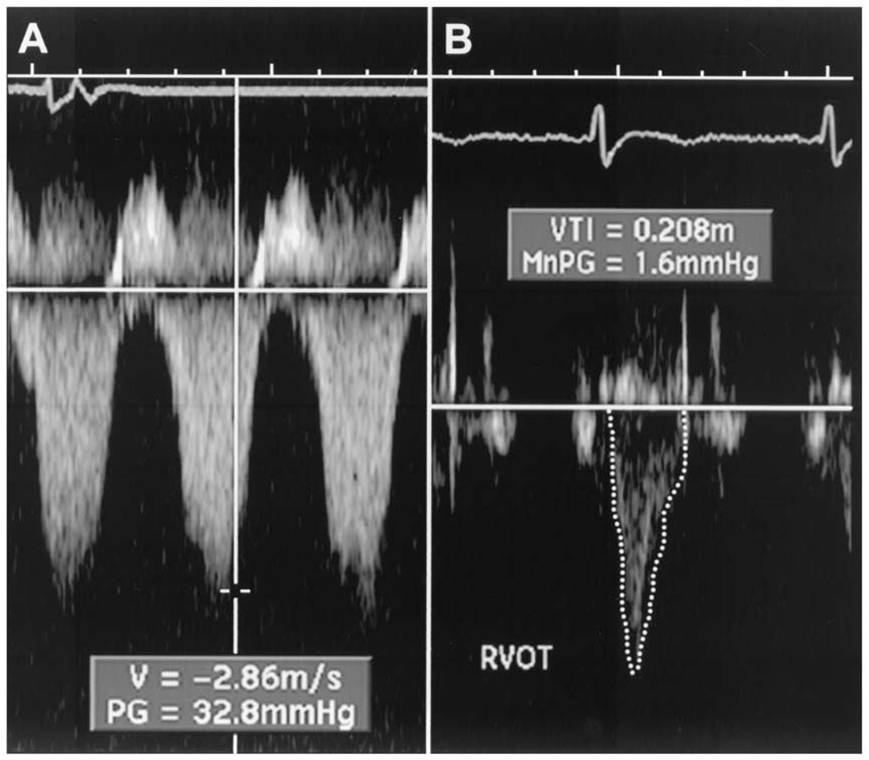
Yes ,  Dr Abbas et all  from the desert hospital  of Arizona  raised  this question and  reported a new equation to calculate PVR.

Their  hypothesis is as simple as this . . .

  • Pressure     =    Resistance X Flow
  • Resistance = Pressure /Flow

Pulmonary vascular resistance = PA Pressure/PA FLOW

Substitute PA pressure with TR jet

Substitute PA flow by   RVOT VTI (  Velocity time integral )

And  we  get

PVR = TR Jet velocity/ RVOT VTI x  10

This  is the simplest way to arrive at PVR at the bedside .

An example

Is it validated ?

Yes .

Then,why it is not being followed widely ?

It is  a  too  simple  method to  use   !  That  is  the biggest excuse ! We are tuned  to  think  ,  a  complex parameter can not be measured in a  simple manner  .  Any thing simple must be  wrong !

But the reality is  . . .

Cath calculations are   much more  complex with so many variables   which  can  get terribly wrong .

The irony  about this  hypothetical  science of PVR is ,  we do not know  which is  gold the standard ?   In fact , none can be  a standard .  So ,  to label PVR  derived by echo ,  as an   inferior modality  can not be accepted  .It is all the more funny ,  as  we are  trying to  define a new  formula    with  the help of   flawed and battered   parameter  namely  the cath derived PVR .

Final message

Abbas’s  formula  is  indeed a  realistic way of arriving at PVR by echocardiogram. If only we measure it routinely  /serially in as many patients as we can , a new data base  will  be created .Which can later be  proven as a fact.It is suggested every cath lab should try to validate this formula.

Link to full text article : Courtesy of JACC

Abbas AE, Fortuin FD, Schiller NB, Appleton CP, Moreno CA, Lester SJ. A simple method for noninvasive estimation of pulmonary vascular resistance. J Am Coll Cardiol 2003;41:1021-7.

Read Full Post »

STEMI is an cardiovascular emergency . We alert  instantly the services  of  911/108/1066 . What we fail to realise is , the  physician’s thought process  should also  be equally fast  . Before dispatching  a STEMI patient by ‘air mail” to the nearest cath lab ,   spend few thought full moments ! We have  a simple and   equally effective option  ,(If not superior )  of revascularisation  , right in your clinic or hospital ! Use it liberally , it is not a inferior treatment !

This article  is from the prestigious  journal  “Annals of emergency medicine” .It confirms a longstanding doubt regarding the efficacy of  air lifting of STEMI patients.

A shocking observation . . . is . . .  many of those patients who are air lifted  for primary PCI   receive none of revascularisation  modalities !  Learn  how  many  of our patients have a futile helicopter ride in the golden hour of STEMI  !

Final message

Even airdropping of STEMI patients to cath lab for primary PCI is not  enough in this unique   race against time  . So , in the management of STEMI ,  we need lots of non -medical  sense* !  .Please judge    “the delay”   due to transfer carefully   and  always consider administering  the thrombolytic agent  when a patient  with STEMI  arrives   within 30 minutes.

A definite primary thromolysis (Within 30 minutes ) is  often  better than a PPCI  (Potential primary  PCI), which  may  or may not materialize in time  !)

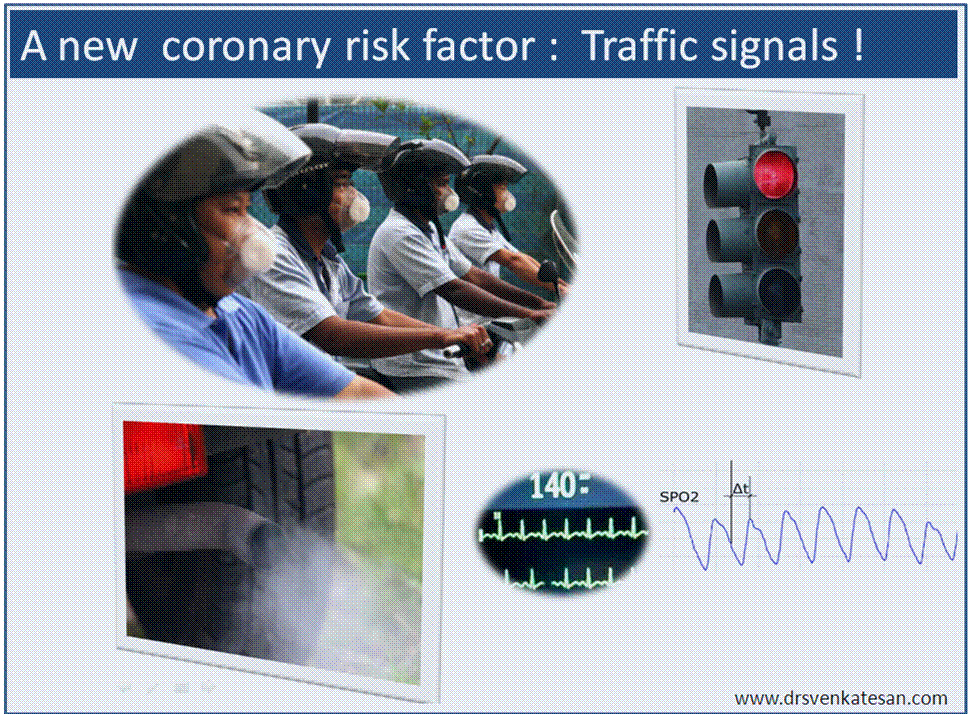
*Please  realise  even  inclement weather  and traffic jams can have a impact on coronary patency !

See  comment about this article in Heart wire

What next ?   On site  mobile cathlab ?

Read Full Post »

Sharing and caring for  others  is the  unique human nature . Some believe this is  now gradually   becoming  rare in human domain ,   but still  found in plenty among  animal species. While modern human  likes to live independently  wants to stand on his own legs  our  biological system still  think differently .

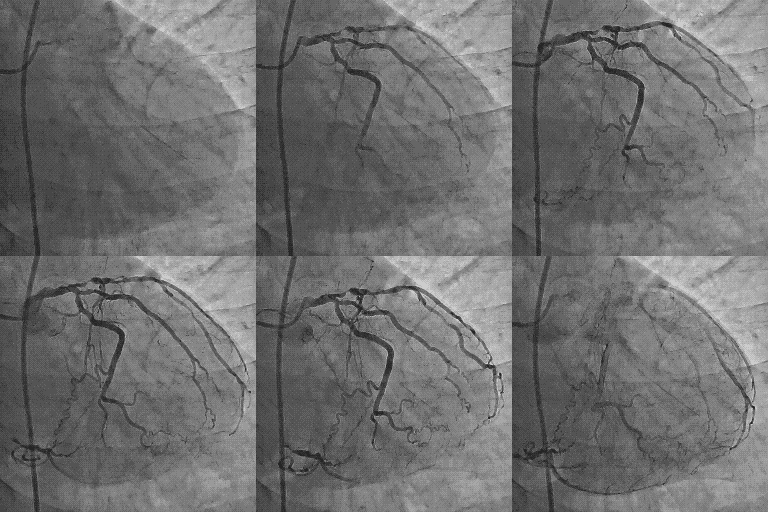
A 40-year-old man with diabetes and hypertension with class 3 angina had this angiogram

RCA to LAD collaterals

A different view

RCA to LAD in RAO caudal view

See , how a  pair of  human coronary arteries  mutually  help   their  colleague  at times of distress !

The astonishing observation is ,  the  RCA even as its suffering  with  a severe,   long segment disease it  helps out-of-the-way ,  with a long arm  of  support to  the entire LAD . While , the LCX reciprocates  the RCA by sending  thank you twigs to distal RCA

LCX sending reciprocating twigs to RCA

By the way , this patient was referred  for CABG after an   intense  debate in the cath meeting  .The argument ranged from medical management /PCI/CABG.

The key question were

  • How good is the collateral’s and what  are the chances of  graft flow  exceeding the collateral  blood flow ?
  • What is the effect of CABG on the existing collateral’s ?

Final message

Coronary arteries  has unique sense of sharing and friendship at times of vascular crises.

This is the fundamental basis for   coronary collateral circulation .

Read Full Post »

y

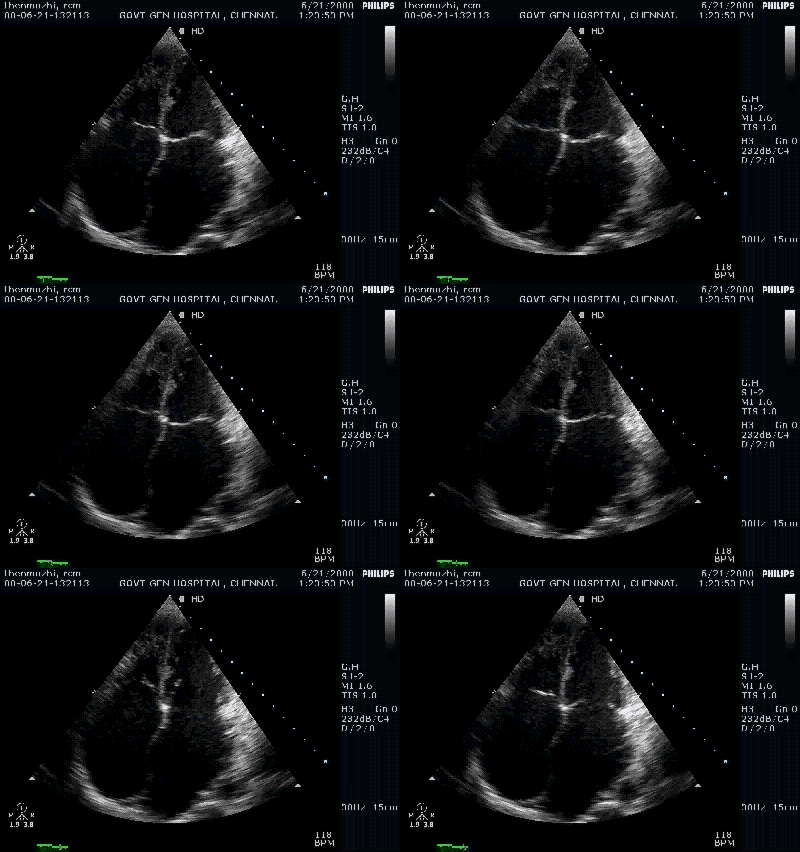
A classical restrictive cardiomyopathy . Both atria balloon out as they face stiff resistance from the ventricles

Restrictive cardiomyopathy(RCM) is a common form of myocardial disease which was difficult to recognise  in the past.It was also commonly confused with constrictive pericarditis. Today , one can easily recognise this entity.A simple clue is bi- atrial enlargement  with relatively normal ventricle size.The above case is a classical form of RCM.

In late stages of RCM ,both LV, RV begins to dilate and can mimic a dilated cardiomyopathy. Doppler filling pattern  , and tissue Doppler motion of mitral annulus are recently validated methods to identify RCM. Still ,  2D features  are  very useful .This implies , the anatomical changes in the chamber size  are as important as physiological AV filling profiles. It is generally believed , physiological impairment precedes anatomical defects.( But not proven concept yet ! )

Note: The ventricles are not dilated and retain good systolic function

In the above patient  , etiology could not be confirmed and was labeled as idiopathic RCM  as tests for amyloid and eosinophilic infiltrations were negative.

M -Mode of the same patient confirms good systolic function

One would  call  for doppler mitral filling profile here ,  to confirm restrictive physiology ( A short DT , Short IVRT  . A reversal in  pulmonary veins , E/E’ ratio etc etc ) But all these are redundant here.

How is RCM different from non dilated cardiomyopathy ?

A new entity is being recognised in the cardiac  muscle disease.This is often referred to as NDCM (Non dilated cardiomyopathy)  .Global  systolic LV dysfunction  with normal  LV dimension.This a similar to the terminology MDCM (Minimally dilated  cardiomyopathy  where LV dimension increases  not more than  15 % of basal size ) .

This is seen in CKD and diabetic individuals.Atria may be enlarged .Diastolic dysfunction may co exist.  It is no surprise,  this entity closely mimics RCM. But in RCM LV systolic function  is not greatly compromised till late stages , while NDCM it begins with systolic dysfunction. This is the only difference .There can be overlaps .

Many strongly believe ,  both  RCM  and NDCM are one and the same entities ,  that present in different time frames in their natural history.

Final message

Diagnosing RCM is no longer difficult in established cases* . The message from  this article is , 2 D echo can  strongly suggest  the possibility of RCM (or even clinch it)  .  Never ever  diagnose RCM with normal 2 D echo. Doppler filling profiles are useful  additional tools . We  can not diagnose RCM with doppler features alone , but we can  be fairly certain about RCM when we encounter  typical bi-atrial enlargement and a normal LV by  2 D echo.

Caution : Patients  with longstanding atrial fibrillation of any cause , can dilate their atria and could mimic RCM .They can be some compromise in LV function due to chronic tachycardia .

* Recognizing RCM ,  very early in the course is still a problem . Here the  newer modalities like Phase  MRI, tissue doppler, speckle tracking, and velocity vector imaging may be useful.

Read Full Post »

Coronary circulation is an enigma . This is true even after 50 years of coronary angiography.  What we visualise  in CAG is  only a  fraction ,  when  compared with what we do not see !  The intricacies of  coronary collateral circulation and micro circulation is comparable only to the  ultimate force of   invisibility “The  God ”

But , we will never ever believe what we do not see  . . .  but we have to accept the following  fact . How is it possible   for  some of the coronary  arteries  to maintain  a near normal blood flow from a donor (Contralateral ) coronary  artery  in spite of  100 % occlusion ?  Is it not common to see TIMI 3 flow even with 99 % occlusion .(Link to related article in  this blog  and  video ) . This is because the coronary  vascular bed has an extraordinary capacity to drop its distal pressure to negate the effects of obstruction.

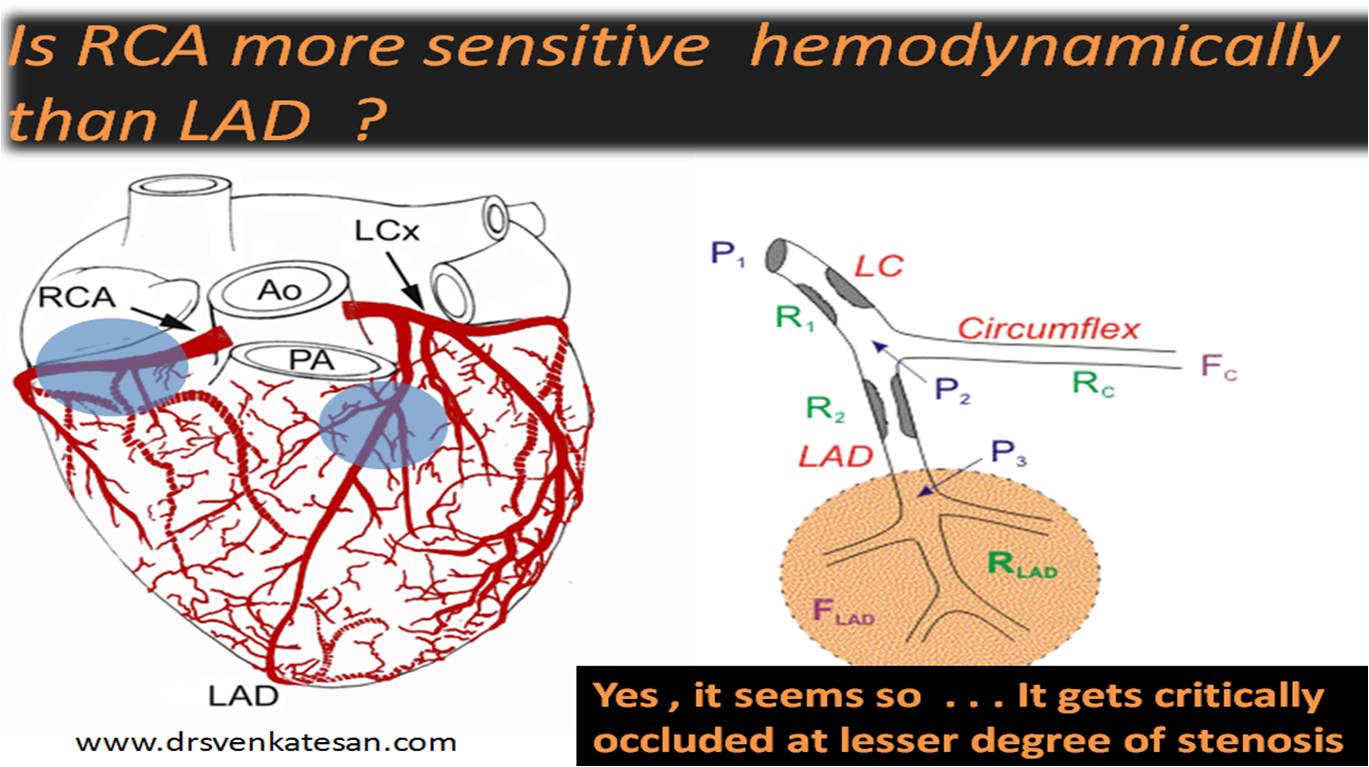
Does the distal vascular bed anatomy and physiology same in RCA and LCA ?

We presume it so . The problem in medical science  is , these   presumptions  often  become  facts in due course  ! Now we have (It is in fact 30 years old !) RCA has lesser ability to withstand the stress  of stenosis than LCA.

The prime reason for this observed difference could be the LCA has a well developed microvascular bed which can reduce the distal coronary resistance .(Again , this is my  presumption  . . . !!! )

This interesting article was published in Circulation 1980 .


Read Full Post »

This one is from Cleveland clinic in their CCJM 2009.  It answers all those tricky questions when we plan   anti – coagulation in  pregnant women .

  • Should heparin substitution/bridge   always necessary  during  pregnancy  ?
  • When is warfarin safe  pregnancy ?
  • Simple  cessation of warfarin around  the time of labor and resuming  it after delivery  (Without heparin  substitution  )  Is it an option ?
  • How safe is LMWH in pregnancy ?


The ultimate reference article 
on peri-operative anticoagulation


Read Full Post »

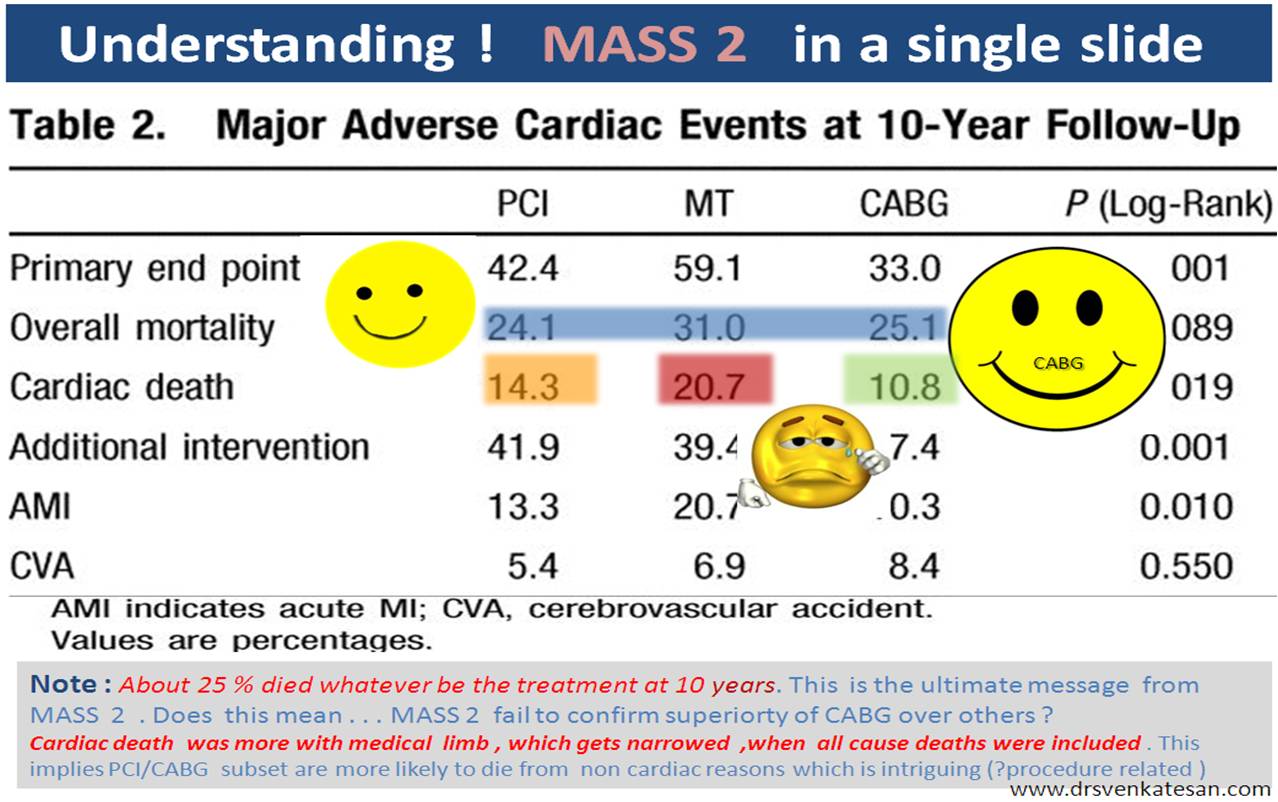
MASS 2  study , the 10 year follow-up results are just out in circulation   september 2010 .

It is a rare study , where “one  to one vs  one” was compared  ie  the effect of  medical,  CABG , and  PCI    in chronic CAD .This was done in a single centre in Brazil,  between 1995 -2000 . It was  followed  up till 2010. Interestingly ,  such a study  may not be possible in the future ,   as  many of us  have  prematurely  glorified  the PCI and CABG over medical therapy . Recruiting  patients   for medical therapy alone is becoming a  difficult  job even in  developing countries.  Even if we recruit , huge cross over is likely  to PCI, CABG for all fancy reasons.

So , in MASS 2 we have a rare treasure on hand . . . Let us give three cheers to those  Brazilians  who did this study ,  and  shall carefully analyse and  interpret the results.

Highlights ( According to my  interpretation)

  • A total of about  600 patients with 200 in each group.
  • The overall death at 10 years  is not greatly different . (Around 25 % )
  • But ,cardiac deaths were distinctly higher by few percentages in pure medical  arm
  • Need for crossover  from medical to surgery and PCI to surgery was significant.

CABG tended  to prevent future MI in this study . This  could be  most significant observation from  this study ,( A revelation in fact ! ).It is against the popular  belief  created by CASS  legacy.

What are  the observed difference  between MASS 2 –  5 year results , which was published in 2004 ,  and  the 10 year follow-up , as  on  2010 ?

At the end of 5 years in 2004 , the differences  among the three groups were not obvious.The benefits of CABG mainly appeared after the 5th year and at 10 years it was significant.

Shortcoming of MASS 2

  • It is a single centre study .Numbers were less (600) .
  • It need to be emphasised    CABG was done  with  pump in all patients  . So the currently prevalent off  pump CABG  may not be really  comparable with reference to outcome.
  • Only   bare metal stents were used in PCI .(If only DES was used  . . . Considering the host of issues for and against DES , it will  be a  wild guess to judge it’s implication .  It could  have  tilted , either in favor or against  the  PCI  limb .)
  • In medical  limb ,  statins were not used in all.  Further , the dose of statins were not aggressive.This makes medical therapy appear less effective.

Intriguing  thoughts

When we say medical   therapy is  being  compared with PCI and surgery , we are actually comparing ,

Medical therapy  alone

Medical  therapy+ PCI

Medical  therapy + CABG .

Every patient  in all three  groups  receive  statin , antiplatelet and beta blocking drugs and so on.  Even though  statistics  would  vouch for  additional  benefit ,  over and above medical therapy  , in a given CABG  individual ,  how much  of the  the  accrued benefit  is contributed by co- administering   medical therapy  .It  is beyond   reasoning even  with all  gimmicks of statistics.

To exactly quantify  the individual benefits and efficiency  of  PCI ,  CABG  and medical therapy  two more  study limbs are necessary .

  • PCI without drugs.
  • CABG without drugs.

Such a study is possible only in a virtual world ! .  Decision  making  in favor of CABG ,  especially   in chronic stable angina ,  will continue , to be  difficult in the absence of refractory angina .This is due to  the modest benefit of CABG ,   that is  expected,  at an additional risk , cost and  expertise.

Please remember, a person can survive  , only  with medical  therapy for > 10 years  but no one can ever live with PCI or CABG  for that period of time without  adjunct drugs  . Guess  which modality   is  going to win the race  against CAD  in the long run  ?

Final message

If  any one  asks  for  conclusion of MASS 2  study ,  don’t ever say  “CABG is superior to  medical therapy” . Please emphasize , “CABG + medical therapy could   be , marginally superior to medical  therapy alone in some of the patients with chronic stable angina. (Each word  in the above statement is  important !) .

So . . . MASS 2 : Is it a  shot in the arm or shot  in the head for CABG ,  we do not know !

http://circ.ahajournals.org/cgi/content/abstract/122/10/949

http://circ.ahajournals.org/cgi/content/full/122/10/949 .This study was done by Zerbini foundation Brazil

Read Full Post »

Coronary artery disease  can be termed  as   “New age plague” afflicting the mankind  !  It  probably has killed ( or Killing ) as  many lives  as   most other diseases  put together.  Why  only a section of  our  population is vulnerable is  not fully  understood .

We are familiar with coronary risk factors for too long  . . . still  . . .

We do not understand why 50% CAD occur in people who have no known coronary risk factor !

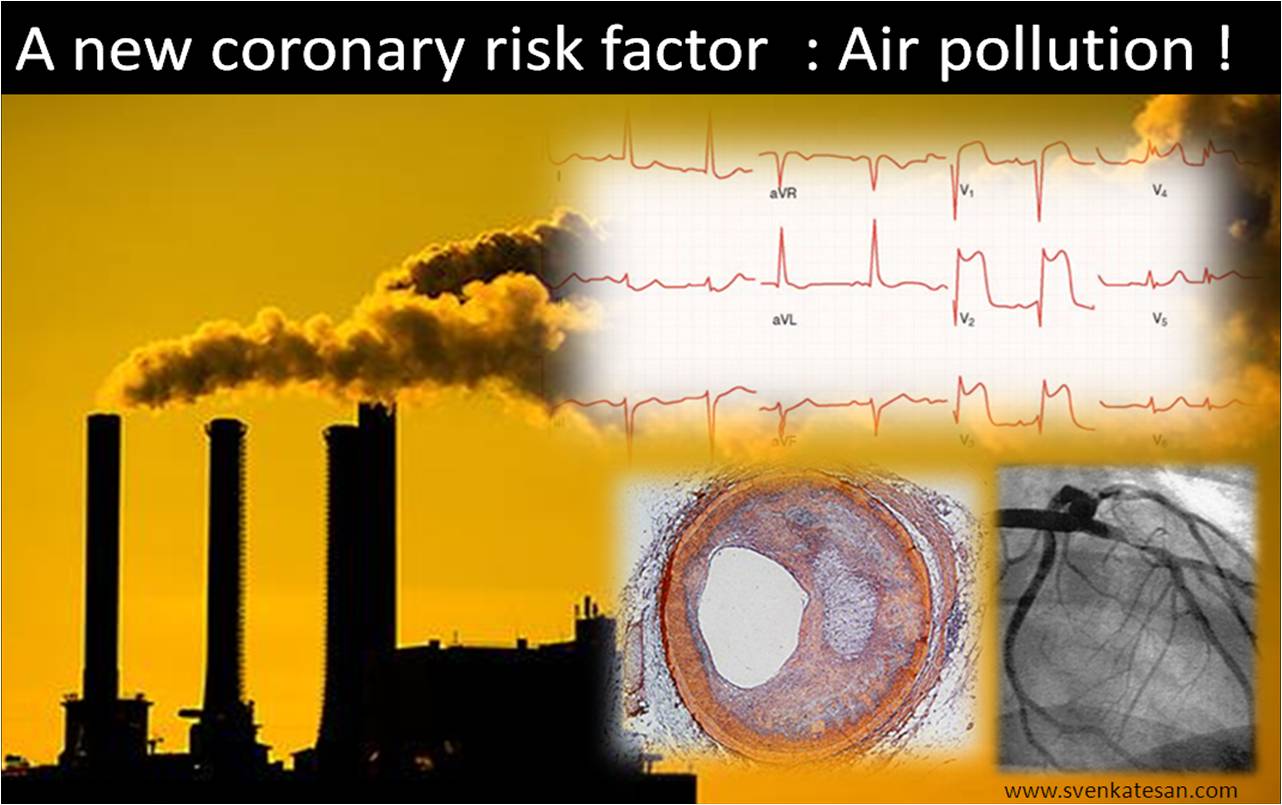
There has been propositions and dispositions  of various risk factors .  The latest one is  the  Air pollution. This is quiet interesting,  as air is the staple food of human survival . We  eat , drink ,  (Rather inhale )  about 500 ml /of  air every   3  to 4 seconds  for 24 hours a day for 365 days  , for our life time !

Does the air we breath reach the  largest cardiovascular  organ namely the vascular endothelium ?

Yes definitely  ,  not only it  reaches   the endothelium but also injures it  (When it contains gases other than oxygen  )  .While tobacco  is a well established  endothelium  destroyer , it is no surprise   community smoking ( Air pollution !)  will do the same job  with perfection .

What are the proposed toxins in the air pollution that harm the endothelium ?

It is a mixed  masala gas out there  over  our   polluted cities ! .(Atmosphere,  Industrial, Automative ,Domestic, Human , and other invisible  sources ) We need to analyse further to answer this question authentically .

Though , common sense  is  enough   to establish the  link between air pollution and CAD. We have  lots of evidence coming up  . . .

Reference

http://ajrccm.atsjournals.org/cgi/reprint/173/4/432?maxtoshow=&hits=10&RESULTFORMAT=&titleabstract=coronary&searchid=1&FIRSTINDEX=0&resourcetype=HWCIT

Further research

We will be shortly reporting our experience with endothelial  function assessment  in traffic police population of our city Chennai  ,India .

Read Full Post »

Belgium SOAP  wants a  knock out punch to  Dopamine in shock !

Vaso constrictors are  the mainstay  drugs  in the management of shock  syndrome. While ,the ultimate outcome depends on the primary  cause for shock, these vaso- constrictors  have  a critical role in sustaining life , till the organ function is recovered.

The physicians world  over,  differ  in their choice of  vasoconstrictor support .They  are almost divided   equally in their usage between  dopamine and norepinephrine  .

Surprisingly,  there  has been no one to one comparison trial till  this study   in 2010 .This trial  is called SOAP 2 published from  Brussels , BELGIUM .It  compared the usage of these two drugs in variety of shock  syndromes. It favors norepinephrine use ,  that includes  cardiogenic shock as well.

The disadvantages of dopamine noted in this trial was

  • Increased  risk of arrhythmias
  • Increased rate of death  in cardiogenic shock

The implication of this trial may force the ACC/AHA guidelines , which  advices  dopamine as the first choice in shock syndromes especially in cardiogenic cause.

Read Full Post »

« Newer Posts - Older Posts »