Feeds:
Posts
Comments

Archive for the ‘Cardiology -unresolved questions’ Category

Thrombolytic therapy was a  mini revolution  when it was introduced two decades ago .It has since evolved  , not only in the  molecular structure  but also in it’s usage pattern.

The first generation streptokinase is continued to be used even today  . While the latest generation thrombolytic agent TNKTPA(Tenekteplase) is threatening  to push the  old warrior out of  CCU.
(Of course the  American Physician & Pharma  community  never  gave the due respect to  streptokinase  !)

The two common indications  for thrombolytic therapy  are

  • STEMI
  • Acute pulmonary embolism

Uncommon indications

  • Stroke( Can be common in few institutions)
  • Prosthetic valve thrombosis
  • Rarely DVT

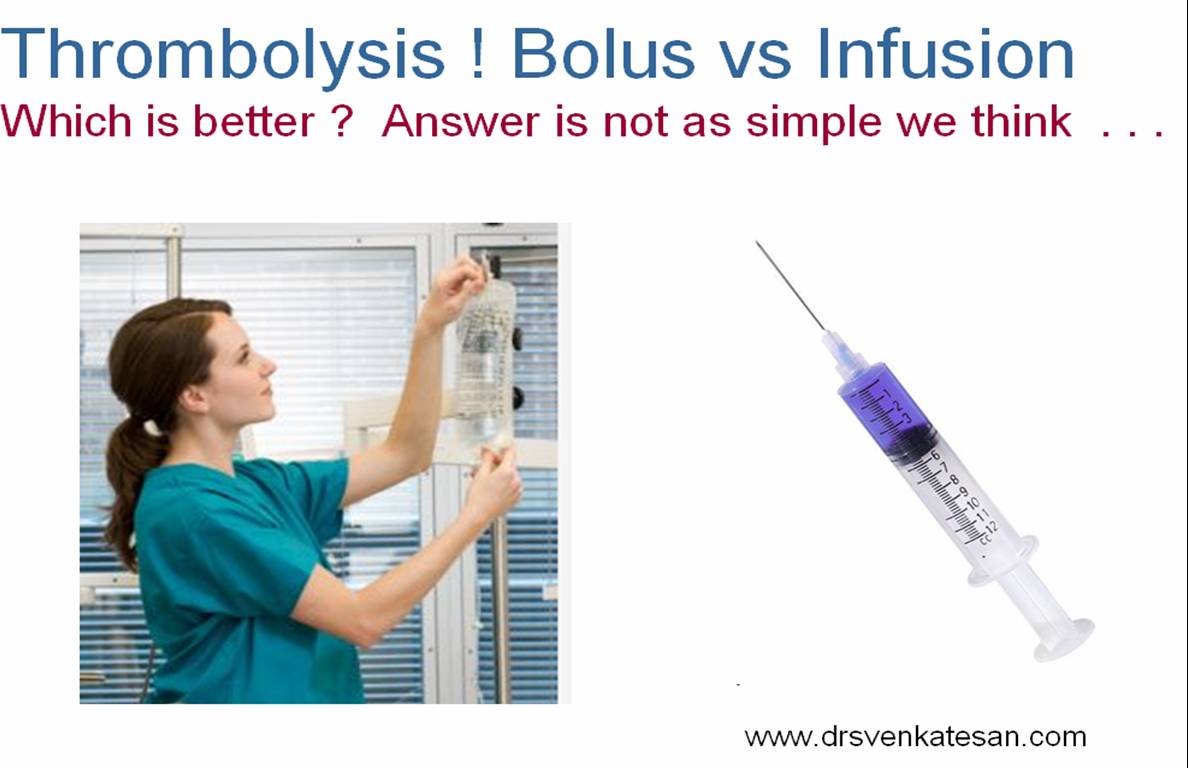
From the beginning , there has been a controversy  about the thrombolytic  dosage and  the speed with which it is to be administered .Let us recall , streptokinase was initially  used  in  various regimes ( 5-30lakh units between a 10 -3hr infusion )  Later ,we arrived at a consensus at  15L units  in 1 hr infusion . TPA also experienced the same . Which  settled  for front loaded regimen(35 + 65mg)  . The confusion reappeared when we developed bolus thrombolytic agents( TNKTPA) .

In STEMI thrombus formation  is  often a one time process  while thrombolysis is a continuous process. In pulmonary embolism both  thrombus formation  and lysis  is often continuous process  .

The success of thrombolysis depends on the sustained  drug concentration ,  the pressure at which the drug interacts  the thrombus.

Many times it is prudent to administer  intensive heparin after thrombolysis  to prevent recurrent thrombosis. Further ,  most of the pulmonary embolisms  will require long term anticoagulants.

How to maximize the success of thrombolytic agents ?

  • Local catheter based thrombolysis can be tried  within the coronary ostium (Largely unpopular)
  • Within the pulmonary artery for pulmonary embolism (Still considered an useful option )

It  makes sense , to administer these thrombolytic agents over a prolonged period of time so that the lytic process gets wider recruitment of the natural lytic mechanisms.
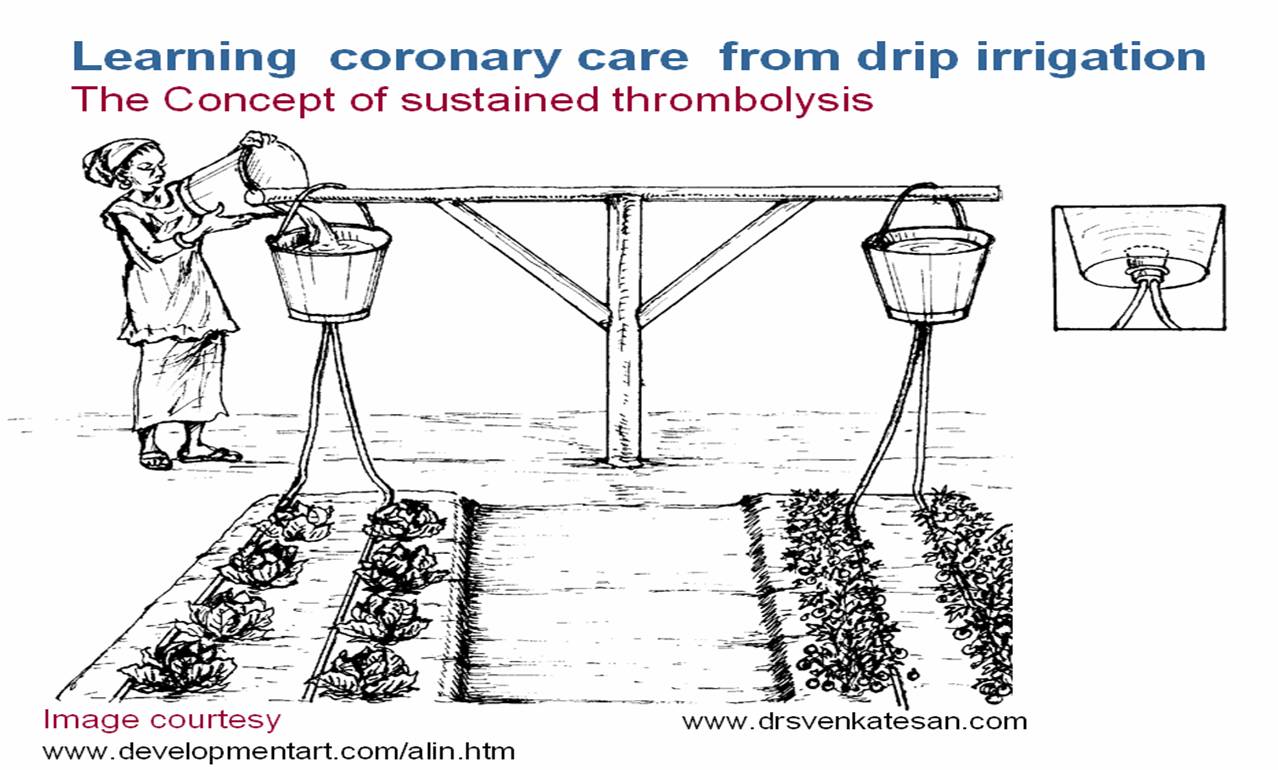
When a drug is infused continuously , the drug  reach the thrombus in  a pulsatile manner , which facilitates thrombus dessication  (Like drip irrigation ) . A long acting drug even with a high concentration may not be  very effective , since  the  drug is required to produce a mechanical effect  here . (Unlike say a long acting antibiotics !)

TPA in Pulmonary embolism

The inadequacies  of  2 hour infusion of TPA is  glaring in acute pulmonary embolism .We believe   a 48-72 hour streptokinase infusion   has a definte edge   over a short and brief TPA infusion.

Issues need answer

It is yet , not understood why we can’ t infuse TPA as  a   long term infusion like streptokinase .

Advantage  of bolus TNK TPA  in  pre-hospital phase of STEMI

The argument in favor of bolus dose  thrombolytic agent  is  the ease of administration .

The other the major advantage claimed  is ,  a 10 second  TNK TPA   in STEMI  can  substantially  reduce the time window   and facilitate  early completion of thrombolysis .

Counter point

But , the  later concept is hard to prove  . . .

In fact , there  are  no controlled studies  available for assessing the   efficacy of TNK-TPA   vs  Streptokinase   with reference to various time windows. We presume so many things. An  incomplete   early thrombolysis  may not be better than a  more  successful  but  slightly delayed TIMI3 flow .

As scientists,  when  we try  to answer these  question we  ask for data .  Are we getting it any way ?  Are the existing data reflect  fact ?     We  wonder,  will we may never get   an  hourly  angiographic  data base  about the IRA  patency  in  TPA bolus  vs streptokinase infusion .

It is most unfortunate,   with  many of the critical questions   still to be answered ,  the cardiology community believes ,  they  have  reached the  summit  of  knowledge  about thrombolytic therapy . Current perception is , the research on  existing  thrombolytic drugs  is  deemed to have been complete .

In this hyped  era of interventional coronary  care  ,   it is a remote possibility   to have any  further comparative studies on thrombolytic agents .

The greatest threat faced by  us  today  is the destiny  of  modern medicine is   often  decided in  few corporate board rooms  and   hence   research questions  rarely  emanate from bed side !

In this scenario, where we are not likely to generate   genuine  clinical  data ,  the only way to move   forward is   to go  by  our experience – ” Genuine  experience to be precise . . .”

Final message

Ease of administration should never be the criteria in choosing a thrombolytic agent . It   can severely    compromise the quality of thrombolysis  ! especially in pulmonary embolism and to a certain extent in STEMI.  Success   rarely  comes  with ease  . . .

Many believe , the choice  between  streptokinase   & TPA    goes much beyond it’s academic reasons.  TNK TPA (Tenektepalse) has come in a big way to replace streptokinase  even   in developing countries.  Ofcourse it is backed by a huge study  ! (ASSENT) .

The cost effectiveness and worthiness  of TPA over streptokinase  was  never proved comprehensively.

Note of caution :

The observation made above is   based on personal  opinion  in  about   20 patients  . Readers are  argued to do their own  analysis on this issue and come to a conclusion .

Read Full Post »

It is said every clinical diagnosis needs to be substantiated with  documented objective  evidence .

Probably,  the commonest cardiac emergency , that can be  diagnosed purely by history is UA.

Yes , unstable angina is a symptom not a  disease entity !

By definition UA is

  • Any  new onset angina  of severe grade
  • Progressive crescendo angina
  • Angina with radiation to new site
  • Angina not controlled by nitroglycerine
  • Any angina after a PCI /CABG

If you read the definition again, you will realise ECG or enzymes never come into the  diagnostic picture .UA can be diagnosed even before one has a look at  the ECG ! So, it is too obvious one can diagnose UA irrespective of whatever is recorded in the ECG. Normal ECG is one such possibility.

When a patient is having severe  compromise  in the  blood supply to his / her heart  , how  on earth ,  it  is possible to have a normal ECG ?

It only tells us,  ECG is not a fool proof method to exclude ongoing ischemia . When we know , ECG can miss even a STEMI  it is not a big deal it misses a UA.

Apart from  the electrical blind spots of conventional 12 lead ECG, following are the other  explanations offered for a normal ECG in UA.We know UA occurs with ST depression(Classical ) , T inversion,  rarely ST eelvation

So UA can occur with

  • Pseudonormalised t waves
  • Pseudo normalised ST depression
  • Cancellation effect of two  opposing  subendocadrial ST segment vectors ( As in multiple active plaques PDA   and LAD lesion )
  • Even Ischemic cascade

Final message

Even though  UA  CAN  occur with normal ECG  , we are uncomfortable to   diagnose  UA without   documenting ECG changes . We should realise this fact , as missing a diagnosis of UA , just beause the ECG is normal  could have very costly consequence !

Read Full Post »

Human body is  now  approached by many of the physicians as  collection of  multiple  organs . This is  the price we pay for modernity in medical science. The era  of great physicians  in general medicine has gone . Now, a  super specialist  of one organ  is  rarely concerned about what is happening to the patient’s  other organ ,  it is  considered    foreign to him  ! While ,  this is the dominant thinking pattern of   modern-day specialist

Let us  travel intime  and  go to the year 1954 . . .

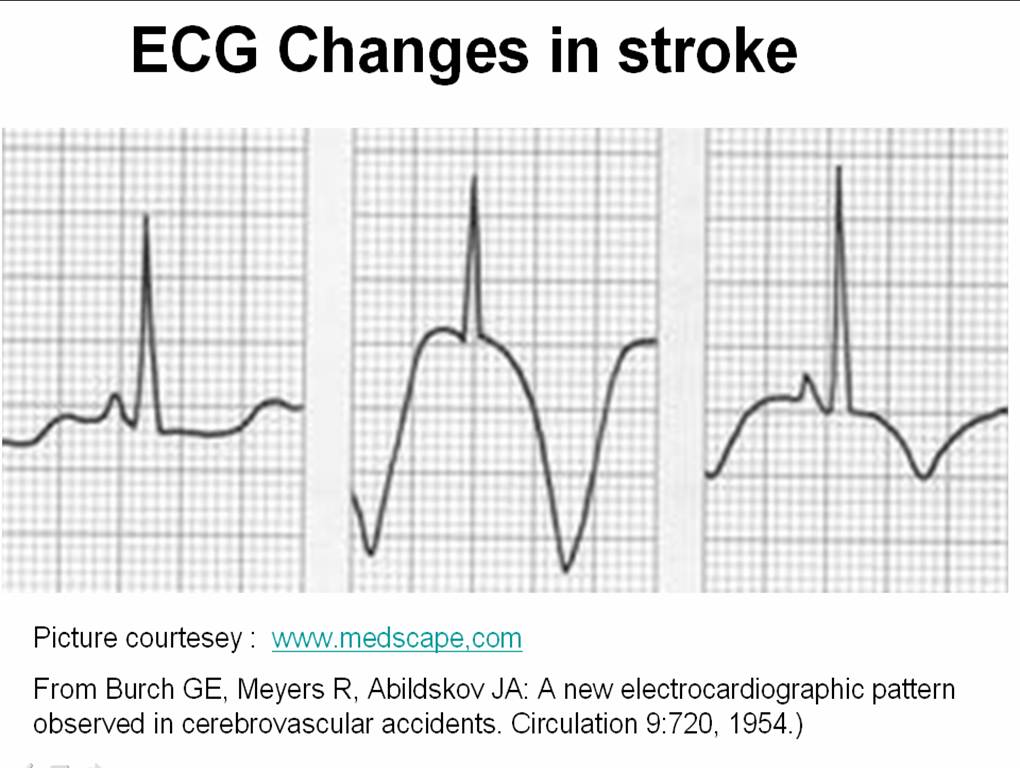
Three  physicians from Michigan ,USA  published  one of greatest observation in clinical sciences , namely the ECG changes in various forms of stroke .

Now , a shrewd physician  , will  suspect a subarachnoid hemorrhage (SAH) by looking at the ECG when the clinical situation demands . But , what we need is every one should develop that skill . We have seen errors happening  even in big institutions (or is it because it is big ?)  when  an elderly person comes with deep T  inversions with or without  altered sensorium being rushed into  CCUs  & cath labs instead of  neurology units.

We  need to teach  our junior  colleagues  . . .  That ,  ECGs of patients with  acute neurological syndromes  (ANS)  can mimic as acute coronary syndromes (ACS) ( especially in elderly ) .

The following ECG changes * are observed during stroke

  • Deep  T wave inversion –   Sub arachnoid hemorrhage
  • Cerebral thrombosis   –      Prolonged QT interval, U WAVES
  • Cerebral hemorrhage –      ST segment  shifts /T inversion


The ECG changes tend to occur very early after CNS injury.May last up to 1 week. They are not useful to identify the type of stroke. But , deep T wave inversions strongly suggest SAH rather than ICH or thrombotic stroke.

What is the mechanism of these ECG changes ? 

It is a clear proof that heart and brain are interconnected by neural network. All the noted changes occur during myocardial repolarisation . (ie ST segment )  The current thinking is  (Ofcourse , it is same as our thinking  in 1950s !)  it is mediated by adreneergic surge  initiated by CNS insult  transmitted to  myocardium by the sympathetic system.

Why should SAH produce more  ECG changes than others ?

It is possible the net adrenegic drive from the brainstem and spinal cord will be greater in SAH as it  spreads the entire CNS  through the cerbro spinal fluid. While localised ICH and infarct is  likely to generate less adrenergic impulse. 

Reference

Read the link to circulation 1964 .With courtesey to circualtionaha.com

http://circ.ahajournals.org/cgi/reprint/9/5/719.pdf

This came 50  years  ago , we still quote their work and no one has improved their work . 

Final message

If  only  we make the  clinical bed side teaching as a  regualr habit ,  we  do  justice to   our  great  physicians of the past ,   who enriched  our  life  with their  clinical  skills  and  passion for knowledge  sharing .

Read Full Post »

As the name suggests   dilated cardiomyopathy  would imply  cardiac chambers will dilate , at least some time in the course of the disease .It can be minimal, mild or massive. A new entity called  non dilated cardiomyopathy is also gaining wider acceptance . (That will be dealt seperately )

Logic would suggest , the first chamber to dilate in DCM  should be the left ventricle because it is  facing the direct load of systemic blood. But we also know , whenever  LV is stressed , left atrium comes to it’s assistance .

Left atrium does this    by total self sacrifice ( by all  means!)  increases  it’s  force of contraction, elevating it’s  mean pressure or even increasing it’s rate (AF) .

Like most  other critical questions in cardiology  ,  the factors that determine LV dilatation in DCM ,  is  also poorly understood !

  1. Is it the after load ?
  2. Is it the  muscle mass ? or it’s turgid  or flabbiness ?
  3. Is it the interstitial integrity?
  4. Is it the blood volume ?(LVEDV ,  LV residual volume )

When the issue is complex , it is  usual  to  make the   the unknown  genetic defects  ,  the scapegoat !

As of now the most important determinant of LV dilatation  could be  the behavior of the desmins, the gap junctions and myosins the titins etc

If  the LV of a DCM patient  refuses  or  resists  dilatation what  might happen ? Is it good or bad for the patient ?

Here is a catch .  A  LV  that does not dilate  obviously should be  be good for the patient  is in’t ? Medicine is not that simple.

When   LV  fails to  dilate  it means it has become  too  stiff and rigid    and pass on the  burden to  to LA which  faces the music. And in the process it dilates.This is the reason , we  observe  diastolic dysfunction in vast number of DCM patients.( Currently it is estimated > 75% DCM will have significant diastolic dysfunction )

So , now we can imagine how complex the sequence of hemodynamic stress in DCM that determine the chamber enlargement.( RA, RV  dimension in DCM is a separate issue !)

So now answer this question :  Which chamber dilates first in DCM ?

  1. Left ventricle
  2. Left Atrium
  3. Any of the above
  4. Both of the above dilate simultaneously

The answer must be 3 .

Why  recognising this sequence of  chamber enlargement  in DCM   is important ?

  • It gives us an opportunity to assess the dominant mechanism of LV dysfunction.There are reports , where some  DCMs  have more diastolic dysfunction than systolic dysfunction  .This will have important therapeutic implication.Further , many of the infiltrative   disorders of LV can have features of both DCM & RCM .
  • When a RCM begins to dilate it is usually  a harbinger of terminal heart failure. But,  it need not be always true .  A small restrictive LV  , when  dilates ,   may acquire a  slightly improved diastolic properties , as the  LV becomes more placid . And ,  if it happens the LA size may regress.
  • The role of LV restriction devices like, Acron mesh, Dor procedure, plication  in refractory  DCM is not well defined. All these   modalities actually  adds  a small dose of diastolic dysfunction in these patients who have grossly dilated ventricles. This fact is  very important  , as presence of any preexisting  significant diastolic dysfunction in DCM makes  the role of LV restrictive devices and surgery a big question mark !

Read Full Post »

Hypotension is one of the dreaded complication of acute STEMI.

  • It can be due to either a  mechanical complication or hypovolemia.
  • The hypotension in inferoposterior MI is  often related to enhanced vagal tone and easily correctable with atropine  and fluid  administration.
  • RVMI is the classical example of hypotension that may improve with fluid resuscitation
  • Hypotension,  if  not reversible within 12  hours  ,  is more likely to  represent a more sinister mechanism like pump failure, MR or ventricular  septal tear etc .

A new mechanism for persistent  hypotension is increasingly recognised.

This is due to the

1.Loss of LVOT dynamic activity.

2.Excessive  dynamism of LVOT.

LVOT contractile and ejectile falure

Even though LV  outflow tract  contain  less  contractile myocytes  , it has an important mechanical  job to do. We know , it’s  primary job is that of a  conduit  but  it also  has to  eject the blood into aorta with sufficient force.  In fact, it is thought much of the acceleration of blood velocity occur in LVOT . So, LVOT  plays a key role in maintaining the cardiac index.  An excessively dynamic LVOT will impede the forward blood flow as in HCOM.  Similarly  less dynamic contraction  of LVOT  results in  low velocity propulsion , that interferes with   proper delivery of blood from LV cavity into the aorta .

These factors get amplified in  acute MI , as it is a compromised situation with fluctuating HR and contractility. So a properly functioning  LVOT conduit is  absolutely mandatory.

STEMI due to a proximal LAD obstruction   located can involve the septal .If the first septal branch  happens to be a major one,  there will be  definite impact on the LVOT function.

Excessive dynamism  , LVOT   desynchrony  LVOT collapse .

LVOT has a medial border formed  by IVS , an  anterior surface and  a posterior surface .The lateral border is relatively boundary less , except it is guarded by  the anterior mitral leaflet.

But one should recall , the AML comes towards the LVOT only in diastole . When it comes in systole it becomes a pathological event  called  SAM  (Systolic anterior motion )

The LVOT wall desynchrony can occur in both anterior and posterior MI.In a mulivessel CAD  this can happen when there is disproportionate inferior to anterior wall motion defect.

Management.

  • There is no specific management strategies aimed at restoring LVOT function.
  • Emergency revascularisation will attenuate the mechanical dysfunction
  • Dosage of powerful inotropic agents should be moderated in dynamic LVOT obstruction.
  • Spontaneous recovery  may occur in few

http://circ.ahajournals.org/cgi/reprint/116/5/e110.pdf

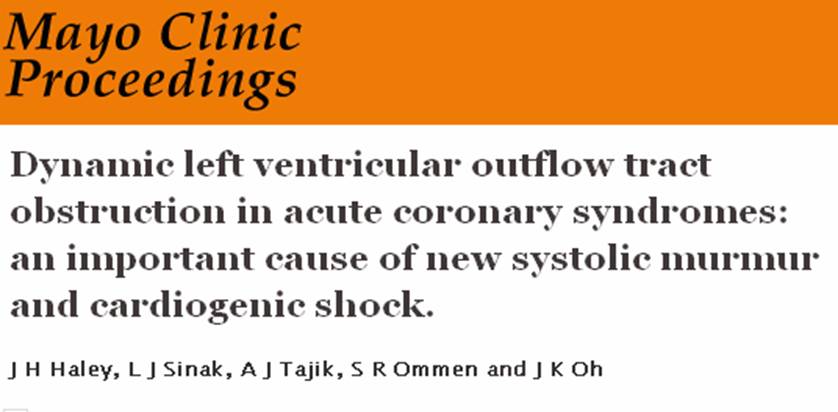
Haley et all Mayoclinciproceedings 1999

Read Full Post »

Exercise stress testing(EST)  is one of the common investigation modality in the evaluation of CAD.he indication for EST  generally fall into two broad categories.

  • Diagnostic in patients suspected to have CAD
  • Prognostic evaluation in patients with established CAD .9Many times after a coronary angiogram)

Currently there is a major shift in our thinking,  patients with  classical angina  may undergo coronary angiogram  directly .This is understandable as the stress test  has little to   improve  diagnostic  sensitivity and specificity in patents with clinically obvious CAD.

So , it is now becoming clear , the diagnostic  value  is  increasingly  restricted in the evaluation of  o atypical chest pain .

What is a strongly positive response ?

  • Gross ST segment depression > 2-3mm
  • Occurring in stage one
  • Fall in blood pressure
  • Prolonged angina into recovery

What is the angiographic  correlates of strongly positive EST?

  • Critical left main disease
  • Near total proximal LAD /LCX
  • A severely compromised bifurcation lesion

Morphological correlation

  • These patients  often have eccentric lesions with irregular margins.
  • unstable  lesions
  • Lack collaterals

What is the effect of vigorous  excercise on a critical flow limiting lesion ?

The shear stress over the plaque  increases  with  exercise  and  the  transcoronary gradient can reach a theoretical 60-90mmhg .One can imagine the what this stress can do to the  unstable lipid core .This is the reason unstable angina is an absolute contraindication  to EST.

What does a strongly positive EST imply for the patient ?

  • It indicates he needs urgent CAG and  most likely an immediate revascularisation.
  • Often , these patients have prolonged angina , and mandates admission in a coronary care unit.
  • there has been many incidence of ACS in these  patients  within 24hours of EST.
  • Lives have been lost  on their  way back    ,   as  these patients are sent home , as EST is a  OP procedure .

Final message

  1. It need to be realised a strongly positive response to EST  could  be a  clinical equivalent of  unstable angina .
  2. The common response  from a   physician or cardiologist    after witnessing  a  gross ST depression to EST  would be   “Had  I known this  I would have sent him straight into cathlab instead of EST ”
  3. If only , we give little ear to our patient’s  history we can pick the high risk clue in 9 out of 10 cases !
  4. It can be argued ,  a strongly   positive  EST  by itself  is  “A  clinical diagnostic  failure”  ,   ie  failure  of the physician  to recognise  the likely hood of strongly  positive EST ie a left main disease.
  5. These patients  should never be sent home immediately  after the EST .This is fraught with a risk SCD
  6. Most of them will require observation in step down unit for 24 hours  and if feasible they should be posted for coronary angiogram in the earliest available slot.

Read Full Post »

Many times , human coronary arteries are the sacred sites upon which  mankind’s history and destiny is written.We now have an pandemic of CAD in our hands. It has a  great impact not only on the cardiovascular  health but also the productivity of this world .

  • We  , work hard ,  day and night in cath labs  ,  to remove the blocks from the suffering CAD patients
  • Some  treat it medically.
  • Few others work in preventing CAD
  • Not even a handful  work on the anatomy of the problem !

How and why the human coronary arterial system behave so bizarrely ?

  1. From where does  coronary artery originates ?
  2. What determines the coronary collateral seeding and genesis ?
  3. Why some have only anatomical collateral without functional  use ?
  4. Why artificial  neoangiogenesis  has  not helped much in  CAD ?
  5. Why ,  one human being   lives  comfortably with a totally occluded coronary artery ,  while others suffer  with severe angina even with a 70% occlusion ?
  6. Why the COURAGE  and OAT study had the surprising  conclusion ?

Answers to  all these lingering questions   may be  clarified soon !

Read this  gem of an article   from Brazil in   a  less fancied   “Journal of morphology “

International Journal of Morphology – Origen y Desarrollo de las Arterias Coronarias

Read Full Post »

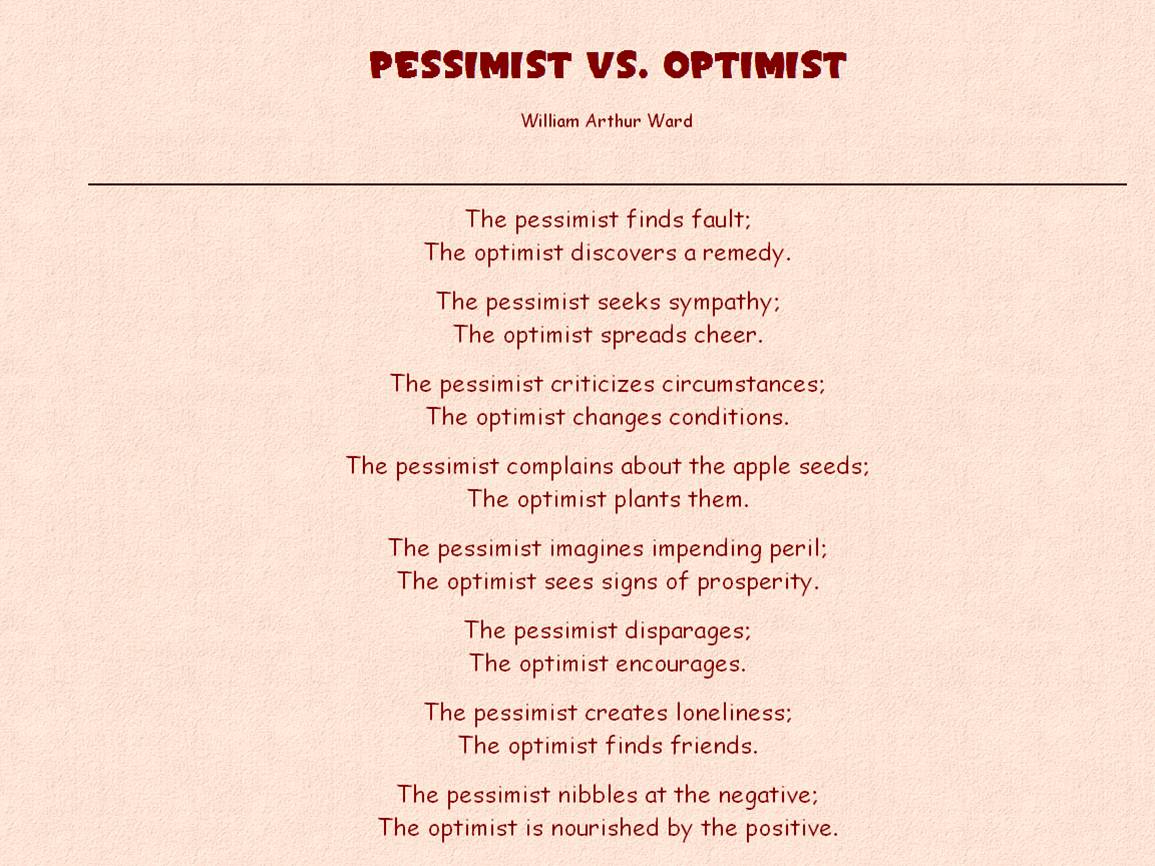
Pessimism, from the Latin pessimus (worst), is a state of mind which negatively colors the perception of life, especially with regard to future events.

Understanding pessimism is not that simple  . Some people argue  optimism   represents a strong mind while  a pessimism  is the domain of the weak . But it is not necessarily true.  Both pessimist and optimist are unreal , and playing the dangerous game of predicting the future. So realism is the answer .

In this era of information highways , commercial exploitation of science ,  our thought process is grossly determined by our perception of events.We hardly have an intention or time to analyse our thought process.

  • An optimist  ( Rather , unregulated optimist ! ) is a person who welcomes  any growth good or bad.*
  • A pessimist  is  a  person who welcomes only good growth.*

So how to identify good growth ? That is the million dollar question!

  • Many of the  optimists may not  bother about the final outcome of a treatment *
  • A pessimist bothers only about that .
  • An optimist  rarely asks questions, blindly accepts every thing !
  • A pessimist never believes any thing !

Actually the fundamental principle of scientific medicine lies in proving the null hypothesis null and void.Any treatment is useless until proved other wise .  So pessimist can be argued to follow true science , while  many of  the hardcore  optimists are blind believers ..

*It may be  a harsh   way of  interpreting an optimist  but  uncontrolled optimism  has played havoc in our  patients like many of the failed treatments (Some of them released prematurely into patient domain   has  killed many lives  . Power of positive thinking should be within the  realms of scientific feasibility !

So in  our  journey   to  conquer human health ,   we   may  proceed with  an optimistic mind and  a pessimistic eyes !

This understanding is all the more important in this era of contaminated science .It is a well known fact ,  now last 50 years of  planet earth has inflicted the maximum damage  to ourselves  than our ancestors did in 5000 years. That’s why we are compelled to meet at Copenhagen .(We never learn from our mistakes, that’s a different story !) .

There is definite and urgent  need for world summit  on  cleansing the medical science from  the clutches  of commerce  and ignorance . A medical green house effect, with dangerous holes in health care  is imposing on us (Another pessimistic thought . . . of course in the interest of human kind !)

World health organization ,  a sleeping giant has to be awakened on this issue


Final message:

Mankind has evolved over many millenniums ,  probably with a sole  purpose of living ,  that is reproduction and propagation of our genre without harming the environment and other species.

Unrestricted  and unregulated growth of any kind is dangerous we call it as malignancy in pathology .In science , we tend to call it a” great future ”

Our  sixth sense*  has  outgrown  miserably  out of  reality  , as have we decided to take on the nature and GOD .Now , many developing country men do not believe in death .They are fighting a losing battle against the God. And they suffer with escalating health costs of keeping the elderly ,  alive who are  knocking at the doors of heaven or hell . The same countries,  which deny funds for curable illnesses of the poor is a different story altogether !

The principle of modern medicine  would ideally  be

  • Reduce human suffering irrespective of economic status
  • Curing a illness if there is a cure
  • Prolonging life if there is useful purpose
  • Allow a good quality death if there is no cure.
  • Most importantly  , prey to god give us strength and capacity to identify which is good and which is bad for our patients  .

Read and learn for a  complete guide on optimism and pessimism

* It  is  important to recognise , the same sixth sense  has   made it possible to share our views through a great tool of  Internet  . So we should not be against the growth of science but against the misuses and wrong interpretations of it .

Pessimism

Optimism

The traditional characters  of  a pessimist

//

Read Full Post »

We know human heart contracts and relaxes in an active manner .Systole happens when calcium is pumped from the cytoplasm into the actin myosin complex and diastole occur when the calcium is  returnded back into the sarcoplasmic reticulam .The rate of calcium reuptake  is detemined by the  molecules calmodulin ,  phospholamban and it’s functional status .

When the heart fails acutely , as in asystolic cardiac arrest , does it fail in systole or diastole ?

The seemingly simple question can never be answered dogmatically.

Pathological studies of post moretm specimens suggest contraction band necrosis is a feature of systolic cardiac arrest .We are not yet sure  yet . . . How a heart will appear when it stops in diastole .In fact , if a heart gets struck in systole it means systole has actually  occured  and  because it fails to relax  it  assumes a  stone like contracture  state .

While  the  molecular basis  are pretty much confusing  , what is clear is we do get number of clinical situations where a acute diastolic dysfunction may occur.

Flash pulmonary edema

The mechanism in the former could be sudden afterload mediated mechanical stunning while in the later ischemia mediated acute contractile and diastolic dysfunction.

In both situations there is severe pulmonary venous HT and class 4 pulmonary edema. The credance to concept  of acute diastolic dysfunction came to light , when  we noticed many of  these patient with acute LVF had preserved EF %   and absence of MR to explain acute pulmonary edema .

*Coronary vasospasm–induced acute diastolic dysfunction in a patient with Raynaud’s phenomenon http://www.springerlink.com/content/g1774g34544q2482/

Read Full Post »

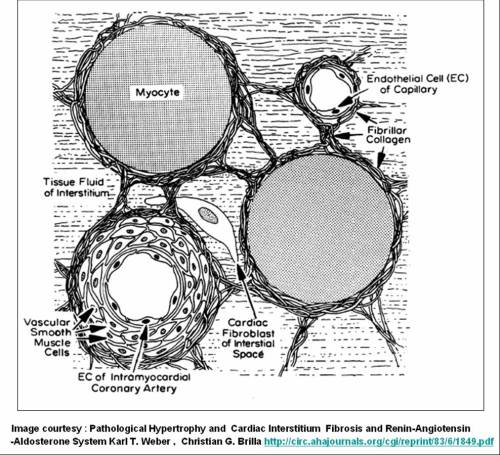
Human body is made up of trillions of cells. Some of these cells are specialised and connected together to form various organs.The cells that connect each other  provides the   structural  support  and   maintain the organ   shape  and function.  Traditionally  these supporting cells were  thought  to have little functional role. Now it is well recognised these cells   could be as  important as  the myocytes or   hepatocyte . God  has  never created any of the human cells with  out any purpose . They may  have  important paracrine function.  Healthiness  of these interstitial cells are vital for the intercellular communication, cell nutrition  and it’s  proper function . These cells are called by  various names , the old  terminology could be the connective tissue -the tissue that connects  cells. Many times  fibroblasts is the common name given to all interstitial cells . Interstitium is not only filled with some bizarre mesenchymal cells it is also a  depot of  sticky molecules.  Now we have  deeper knowledge about these  , and identified various intercellular adhesion molecules, matrix metallo proteins   , vitronectins, etc.

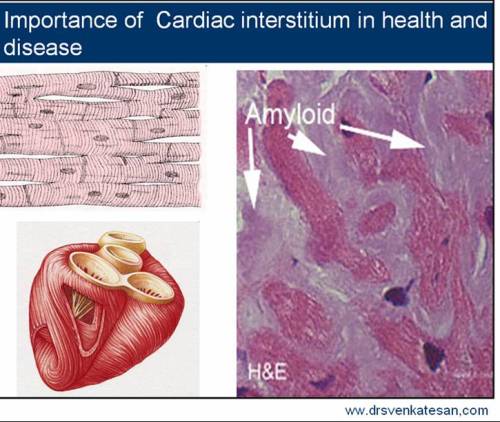
cardiac interstitum intersitial fibrosis amyloidosis

It is  a great  medical paradox   the specialised the myocytes, hepatocytesaxonal cells are given  due respect,  while the role of  cells and molecules that bind them together is least  appreciated . In fact in any given organ the functional cells constitute  only one third  of it’s weight.In the heart myocytes form only 30% of it’s weight. It is a clear cut case of discriminating the majority !

Interstitial disorders and  diseases

In the lung Interstitium becomes very much important because the gas exchange has to  traverse the interstitium and enter the alveloar cells. So any abnormality  here  is immediate and profound.The diffusion capacity reduces  .Patients  develop  progressive COPD.

In the kidneysinterstitium has a functional component as the absorbed fluid and electrolytes  has to reach the blood circulation .Hence  acute and chronic interstitial  nephritis are distinct clinical  entities .

In the brain dysfunctional  inter neuronal cells can interfere  with various CNS  functions dementia the major  disorder  id thought mainly contributed by the interstitial fibrosis.

cardiac interstitum interstitial fibrosis myocardial

So when each of the vital organ has a potential  to suffer from  interstitial    pathology How can heart  alone escape ?

No, it does not . The  currently popular entity   , heart failure with normal ejection fraction   could be nothing but   chronic  interstitial  carditis. or chronic progressive interstitial  fibrosis.  Hypertensive heart disease is a major cause . CAD can also contribute .

The interstitial  fibrosis  is also a feature of  dilated and restrictive cardiomyopathies. (Classical amyloid heart disease ) .Initially  these fibrosis do not affect the  contractile  function of  myocyte .In later stages it encroach  upon the contractile  cells and impair the EF. This explains  the natural  history of many of the RCMs which   go for dilatation and contractile dysfucntion in terminal state.

What is the difference  between myocyte relaxtion and  cardiac  relaxation ?

  • It is now recognised , cardiac  interstitium has a big  role in relaxation .
  • Cardiac relaxation is not synonymous with myocardial or myocyte relaxation .
  • For  myocyte to  relax ,  it has to eject back the calcium from the actin myosin complex  into the  sarcoplasmic reticulum where the calcium uptake protein   phospholamban holds it till the next systole.
  • As the myocyte relaxes  it has the additional  burden of stretching &  relaxing the adjoining  non myocytic cells  , unfortunately this   weighs 70% more than it’s own weight .One can imagine how much the heart is stressed during  even diastole ! So as  the sheets of myocytes feel the diastolic interstial stress the whole LV struggles to relax and LVED raises and diastolic dysfunction begins to set in.
  • The interstitial l plasticity and elasticity is vital for cardiac chamber to  reach it’s pre contractile  state . It is now recognised the rate of LV relaxation  (Negative dp/dt )  is directly proportional  to the interstitial  agility and turgor .

How to overcome interstitial  fibrosis and stiffness ? Anti fibrotic drugs ? .

We are in search for such a universal anitifibrotic drug that can work in liver fibrosis ( Cirrhosis ) lung  and myocardial fibrois. D penicillamine has  showed some promise. How to make the interstitial interface more flexible ? Collagenolytic agents , elastase MMP inhibitors etc may become the   future targets.  A much established  way to regress myocardial fibrotic process is ,  with ACEI and aldosternoe antogonists. (EPESUS, RALES study) .Some of the   anti myocardial remodelling  action of  ACEI is attributable to it’s  anti  growth factor properties and can  the resultant regression of  interstitial fibrosis.

Apart from the look out for sophisticated drugs ,  applying common sense can do  a “great deal of good “for the myocardium in  diastolic cardiac failure  . A stiff  skeletal muscle need physiotherapy. A stiff cardiac muscle will also   need exactly this. For  cardiac muscle physiotherpy can not be administered by a therapist  ! , we have to do it  , regular  exercises   to make it contract  and   relax  fast . So ,  it is important to recognise  exercise   prescription and training  could be the  most  important modality  for preventing progression of diastolic heart failure.

Clinical situations  where   cardiac interstitial pathology is  relevant

  1. All forms of cardiac failure
  2. Some forms  of myocarditis
  3. Myocardial interstitial  edema ,Post MI/Reperusion
  4. Myocardial interstitial edema mediated no reflow following primary PCI
  5. Acute and cardiac transplant rejection
  6. Drug induced adrimycin carditis .
  7. Cardiac interstitium arrhythmias : Many of the cardiac arrhythmias are due to re entry circuits mediated by cardiac interstitial fibrotic substrates.
  • Atrial fibrillation
  • Post MI ventricular  tachycardias

Final messge

Deep dissections  of  pathological hearts   in pursuit of   culprit cells has surprisingly ,  lead us  not into myocytes and conducting  cells but into inter cellular spaces” . There is  big secret  world over there within the cardiac interstitum.Young scientists and students  argued to   explore and unravel the mysteries !

Reference

A landmark article in Circulation 1991

Pathological Hypertrophy and  Cardiac Interstitium  Fibrosis and Renin-Angiotensin-Aldosterone System
Karl T. Weber, MD, and Christian G. Brilla, MD, PhD

http://circ.ahajournals.org/cgi/reprint/83/6/1849.pdf

Read Full Post »

« Newer Posts - Older Posts »