Feeds:
Posts
Comments

Archive for the ‘Cardiology -unresolved questions’ Category

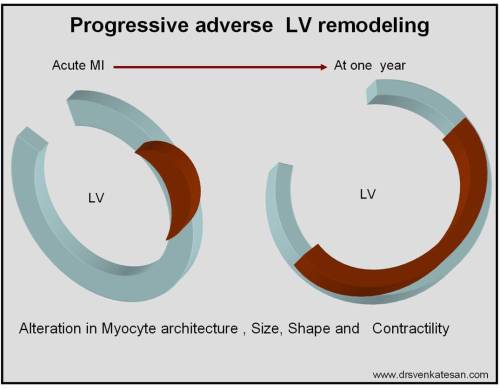
Ventricular remodeling  follows large myocardial infarction .This term denotes to  change in size , shape  and function  of the ventricle   due to altered  myocyte geometry .It is now believed  , this  process begins to occur very early  following a STEMI.(less than 24hours)

lv-remodeling

In which MI remodeling is more common ?

Any MI of large size , especially  anterior  and lateral MI.  Inferior and posterior MI are less affected by adverse remodeling.The incidence is up to 20% of all myocardial infarction ,  if left untreated. Ventricular aneurysm formation and dyskinetic segments can be termed as the worst form of remodeling. The old terminologies of infarct extension and expansion could by synonymous with ventrilar   remodeling .(Note : Every patient with STEMI undergoes some form of physiological remodeling that should not be confused with progressive pathological remodeling , we are discussing  here ! )

What is the clinical impact of remodeling ? How to prevent it ?

Progressive cardiac failure and a  poor outcome .  It may provoke ventricular arrhythmias. ACE inhibitors (CONSENSUS study 1992 )  has since revolutionized  the pharmacological  prevention of adverse remodeling.

How to recognise left ventricular remodeling ?

Many methods are available .

  • 2 D Echocardiography
  • Tissue doppler
  • LV angiogram
  • MRI

These imaging methods diagnose remodeling  only after it manifest* .We know remodeling is a cellular and molecular process .The earliest trigger for remodeling is the mechanical stretch and wall stress on the ventricles.Large areas of necrosed myocardium and  the adjacent normal myocardium sets a perfect stage for eccentric pulling of myocardial segments and unregulated slippage of myocytes.

* Diagnosing fully established  ventricular remodeling  serves ,  no great   purpose as it is very difficult to reverse it by pharmacological methods.it requires complex surgery.

What is the effect of mechanical stretch on cellular function ?

It is well known  myocyte granules secrete Type B  -Naturetic peptide  in response to stretch. It could be a very early sign of adverse remodeling. So monitoring of  BNP may give us an opportunity to intensively treat those patients who are likely to land in progressive cardiac failure.

A baseline level of NT-proBNP >120 pmol/L identified patients  prone for adverse remodeling .Serial measurements showed further increase. It is possible to identify adverse remodeling of LV by documenting fresh elevation of BNP following MI .

Reference :

1 )Nilsson JC, Groenning BA, Nielsen G, et al. Left ventricular remodeling in the first year after acute myocardial infarction and the predictive value of N-terminal pro brain natriuretic peptide. Am Heart J 2002;143:696-702.

2)http://content.nejm.org/cgi/content/full/352/7/666#R24

Read Full Post »

LV dysfunction , perhaps  is  the most common  medical term used by  physicians  world over.But surprisingly , It is not easy to infer what they mean by it ! The term literally means left ventricle is not functioning all right .

LV dysfunction can be classified by many  ways.

  • Symptomatic vs Asymptomatic
  • Global vs  Regional
  • Reversible vs Permanent
  • Systolic vs  Diastolic
  • Ischemic vs Nonischemic
  • Primary vs  Secondary ( Muscle vs valve  etc)

If you analyse the above classification LV dysfunction can mean different things to different people , at different times.Though systolic dysfunction ,  as reflected by low EF % ( Less than 50% ) is the major cause of LV dysfunction  the issue is not simple.

Is coronary artery disease ( CAD  ) a must for LV to  become dysfunctional ?

No , not at all .CAD  is the leading cause of LV dysfunction .Primary muscle disorders -cardiomyopathy is an equally common entity. Valve disorders especially  aortic valve stenosis is   another common cause for LV dysfunction. Further ,  systemic hypertension, diabetes mellites, renal failure, can result in serious impairment of LV function .Some drugs ( Adriamycin ) can either precipitate or aggravate LV dysfunction.

If  physicians themselves are confronted with such complexity , how are ,  our other medical  colleagues  (Forget about the patients !   ) will understand  the concept of LV dysfunction.

But , the  crux of the matter is every doctor believes  LV dysfunction is synonymous with low ejection fraction. A surgeon or an anesthetist is quiet happy to operate  if the ejection fraction is above 60% .

Can a patient  have significant LV dysfunction with normal Ejection fraction ? (EF )

Yes , this can occur in advanced degrees of diastolic dysfunction, where cardiac contractility is normal but

fails to relax adequately .

Is diastolic dysfunction less dangerous than systolic dysfunction?

May be , that is the dominant opinion   , but  there are sufficient evidence  emerging  that opinion is wrong.The main reason for diastolic dysfunction  to send a ” not so sinister signal ” is over diagnosis of  grade 1 diastolic dysfunction in the general population  . The echocardiologists considered it fashionable for a quiet a longtime (Many have changed since then !)  to report all patients  with reversed E :A ratio in the mitral inflow doppler profile as diastolic dysfunction. This has resulted in  thousands  of  asymptomatic , healthy people getting  labelled  as grade 1 diastolic dysfunction  undermining the importance of this entity.

The fact of the matter is true diastolic dysfunction is indeed dangerous , if not more dangerous than systolic dysfunction  for the simple reason ,  there is  no specific treatment for this condition

To improve the specificity to diagnose genuine LV diastolic dysfunction it is suggested to remove grade 1 diastolic dysfunction from the literature .

Other causes of LV dysfunction with normal EF

  • Some times , there can be wall motion defects  and   mitral regurgitation but still the EF can be normal .
  • Mitral valve dysfunction can be a part of LV dysfunction .The EF is either  not affected as ischemic damage  might be confined to papillary muscle.
  • Vigorous compensation from non ischemic areas  can normalise an EF

What is the difference between LV dysfunction and  LV failure ?

Many times  both these terms are perceived  to convey the same meaning .But it  can  never be used synonymously .Cardiac failure is a clinical entity while LV dysfunction  is  a  derived  technical parameter  by and large an echocardiographic enity. Cardiac failure   is defined classically as a clinical syndrome .(elevated jvp, edema * S 3 rales etc)  Neuroueohormonal activation  can occur with both.

A patient with   LV dysfunction    when destabilsed  develops   LV  failure and after stabilisation of   LV failure he is brought  back to  the baseline  LV dysfunction

*What is the link between LV dysfunction and RV dysfunction ?

RV can not be silent companion when the LV fails  . There always have been link between the two.

LV dysfucntion begets RV dysfunction   and LV failure can trigger a total heart failure

Apart from the classical concept of ventricular interdependence  ,  where  inter ventricular  septum plays a pivotal role , now there is strong evidence  to  prove  both LV and RV myocardial muscle  bundles are interwoven . In fact failing LV drags the muscle bundles over RV also (Friendly pull , let us die together !)  and this is classically seen in idiopathic dilated cardiomyopathy where all four chambers of the heart dilate. There is also biochemical  evidence the RV myocytes deplete thier norepinephrine stores  in LV failure.

Is there an entity called transient  or temporary LV dysfunction ?

The classical chronic reversible LV dysfunction also called hibernating myocardium is a different topic shall be discussed later.

Can acute ischemia cause LV dysfunction  ?

Yes .This can occur during ischemic stunning of myocardium during NSTEMI .This can result in acute pulmonary edema* at times.This can be termed as ischemic LV dysfunction  as there is no myocardial necrosis .

* The pulmoanry edema mentioned here is the  flash pulmonary edema carries very dis prognosis.

What is the cause of LV dysfunction in critical aortic stenosis ?

Is it fibrotic ?

Is it necrotic ?

Is it ischemic ? (Associated CAD )

Or is  it simply  a mechanical inability* to contract  as the outflow is closed ?

There is no specific answer . All the above factors may contribute .*But the fact that  most patients recover full normal LV function  following aortic valve replacement would make the last explanation more likely.

What does the term LV  dysfunction mean to a  cardiac surgeon when he plans  for  a CABG ?

LV dysfunction becomes an important determinant of overall  outcome   in  patients who  are  going  to receive a CABG .The surgeon will have contingent strategies  during peroperative and post operative phase while operating  in hearts with severe LV dysfunction.

How much  of LV function  is going to recover after CABG  ?

This  can not be predicted accurately but CABG  may not  resucitate all dying myocytes and bring life in them .The buttressing effect of blood within the dysfunctional segement can improve contractility and  reduce the wall motion defect(This is an indirect mechanism of improving EF )

Read Full Post »
Coronary collateral circulation is the God’s gift to mankind.It has potential  benefits  ( and  of course real benefit !)  both during acute and chronic coronary syndrome.

Collaterals in CCS

The classical role of coronary collateral is in patients with chronic stable angina.It is quiet common to see patients with totally occluded  LAD or RCA with normal  LV function maintained  by extensive collaterals .

Collaterals during ACS.

An intact and functional  collateral circulation can prevent an NSTEMI  from converting into STEMI.In fact many of the patients with unstable angina patients carry on with viable myocardium just because thaey have good collaterals.It gives us a time window to intervene .Some times the col laterals are good enough and help us avoid a revascularisation in toto.

Collateral’s in  STEMI.

This is not well understood. Some  researchers  reported opening up of collateral channels very early after a STEMI. Logic would suggest , anatomically patent functionally closed collateral channels are  always available at time of crisis. But not every one is blessed with such rescue mechanism.

What determines  the native collateral channel development in human cor0nary circulation ?

When  the answer is unknown , it moves to  the  genetic domain also called  – God’s domain .

Our ignorance in decoding coronary collaterals is vast.

The chief cause of this ignorance is we always  tend , not believe things which we don’t see.

Coronary collaterals channels need to atleast 1mm  to be visualised by CAG.There could be a vast network of micro collaterals out there within the myocardium invisible to current imaging methods. (In fact , this has a link with outcome  of the COURAGE study )

Is coronary collaterals have all the three layers of an artery ?

Yes .But the media lacks muscle.

Is coronary collateral less prone for spasm ?

May be.

The drugs we give , Calcium blockers , betablockers, and nitrates have same  hemodyanmic effects  as in native coronary circulation ?

We don,t know as yet. Nitrates are supposed to improve collateralisation

How common is atherosclerosis to involve the coronary collaterals ?

How often is an ACS precipitated by an collateral occlusion ?

May be more common than we think.

Can we stent a  2mm wide  collateral to maintain  the patency in case of a CTO  ?

A question need to be answered by current generation interventional cardiologists.

Is coronary collateral gives protection against primary VF ?

In one sense ,  the number one killer of mankind is  in fact not STEMI but the VF that follows it .

Why only a few develop a VF following an MI ? What determines the arrhythmic response to ischemia ?

Some anecdotal observation  of     suggest a role for early coronary collateral  opening in the prevention of VF .

Read Full Post »

Prosthetic valve obstruction is an important complication of artificial valves.The incidence of prosthetic valve obstruction  is  estimated  to  be  4% per year.

  • Pure thrombus 75%*
  • Pure pannus 10%
  • Combination of pannus and thrombus 12%

Data from Deviri (J Am Coll Cardiol, 1998; 32:1410-1417 )

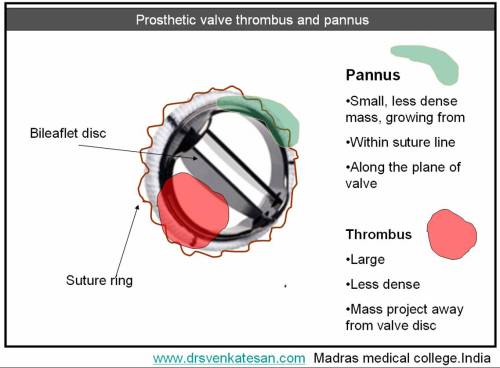
pannus-2

*Note statistically you are going to be right 3 times out of 4 if you diagnose thrombus over pannus

Pannus  literally means a hanging flap of tissue. It is is a membrane of granulation tissue as an response to healing.It can  occur anywhere in the body. When it occurs in the prosthetic valve tissue interface it has important consequences.It  is  same  as excessive scarring , ( something similar to keloid formation ) .

pannus

How do they clinically present ?

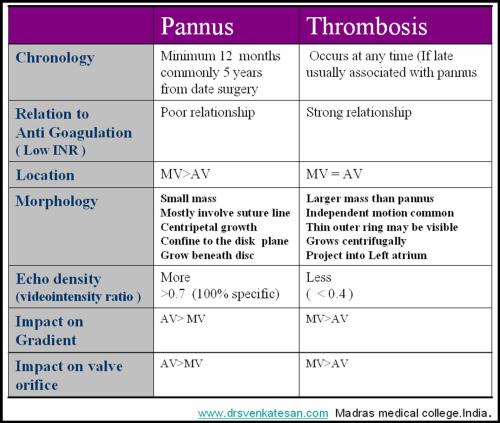
Prosthetic valve thrombosis is usually a acute or sub acute event as thrombus formation rapidly deteriorates the clinical situation.Pannus brings a patient with the complaints of chronic progressive dyspnea.(This rule is very subjective  but . . .)

What are the determinants of pannus growth ?

Time is the major determinant. minimum period required is 12  months. It is a avascular mass.It should be noted  a  injured pannus can predispose  a thrombotic process and a chronic thrombus  can trigger intravascular   growth factors  that promotes pannus growth.

What is the direction of growth of pannus in prosthetic valve ?

The pannus grows , usually in the tissue valve interface.It tracks and creeps along the suture lines .Generally this does not encroach the valve orifice or chamber sapce  , but occasionally the hanging edges can hit upon a leaflet.This is more common with tilting disc on the side of minor orifice. When excessive it can make a valve leaflet almost standstill.

How common is pannus formation in starr edwards valve?

Is relatively uncommon as the dynamic ball periodically interrupts the process of pannus in growth within the orifice.

Final message

Why is recognition of pannus important ?

Prosthetic valve thrombois is amenable to thrombolysis and it should be proptly differentiated for pannus.This is many times a difficult excercise, but the above observation will be helpful.

Further reading

http://content.onlinejacc.org/cgi/content/full/32/5/1410

Read Full Post »

Ventricular tachycardia as a group , constitute a major  group of cardiac arrhythmias. Most of the VTs are managed  by cardioversion  followed by medical management.  Few require , implantable defibrillator when there is severe LV dysfucntion .(ICD) Localising the origin of  VT and subsequent , ablation is the treatment of choice in some of the  patients  with VT.

Traditionally VT was thought to arise fro the endocardial aspects of myocardium. Now  we realise many times VT originate from the epicardial aspects of  ventricle.

Epicardial VT : Defintion

Epicardial ventricular tachycardia (VT) is defined as VT in which the critical sites of the reentrant circuit (or the ‘sites of origin’) are located exclusively in the subepicardial tissue, as shown by entrainment manoeuvres or VT that is terminated within 10 s with standard radiofrequency (RF) pulses, or both.  E. SOSA,M. SCANAVACCA et  all  http://www.springerlink.com/content/w608142674154tp5/ 


 How to recognise epicardial origin of VT by surface ECG ?

  • Terminal S wave in V2 and q in lead 1 strongly suggest VT of sub epicardial origin.
  • Pseudodelta wave 
  • Intrinsicoid deflection time of  85 ms
  • RS complex duration of  >120msec

Suggest   epicardial origin of the VTs.

Important Links

http://www.circ.ahajournals.org/cgi/content/full/113/13/1659 

Berruezo      criteria ,http://circ.ahajournals.org/cgi/content/full/109/15/1842  ( Must  read)

http://cogprints.org/4222/2/tada.pdf


What is the clincal significance of epicardial VT ?

Endo cardial ablation  not likely to be successful

Trans pericardial approach may be needed.

Read Full Post »

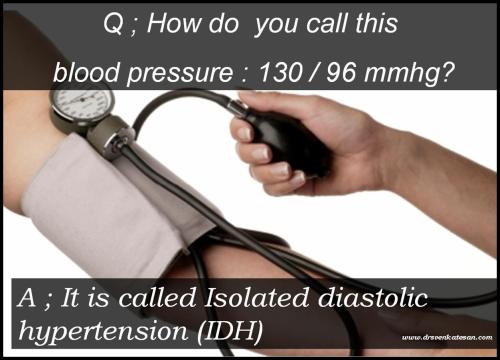
idh

  • Hypertension  is  major determinant of cardiovascular health  of our global population
  • Millions suffer,   hundreds of societies ,  and as many guidelines , and drugs are still struggling  to control the menace.
  • An important sub group of HT , (ie IDH ) population has been neglected and never received the scientific interest , which it deserves !
  • In our study it occured in 7.2% of all HT  patients.
  • JNC,  the world authority on HT never considered  IDH as a separate entity, and as of now there is no specific guidelines.
  • And the irony is complete . There is not  a  major study available to analyse the differential effects of anti hypertensive drugs on systolic and diastolic blood pressure.

If  a patient with the BP of 120/96 asks you , “Doctor , will the drug,   you have prescribed , selectively lower my diastolic blood pressure ” what will be your answer ?

A clear ,  I don”t know !

The following paper was presented in the World congress of cardiology Sydney  2002

Isolated  Diastolic Hypertension

S.Venkatesan,S.D.Jayaraj.Gnanavelu, Madras Medical College. Madras, India.

Abstract : Systemic  hypertension  continues to  be a major determinant of cardiovascular  morbidity. While isolated systolic hypertension(ISH) has been identified as a specific clinical entity, isolated  diastolic  hypertension(IDH) has not been reported as a separate group. When we analysed our data from our hypertension   clinic  we found  a distinct subgroup of patients who had  elevated  diastolic blood pressure   with  normal systolic pressure. We report the clinical profile of these patients. 440 newly registered hypertensive  patients between the year 1998-99  formed the study population. All  patients with secondary hypertension  were excluded.. IDH  was defined as  diastolic BP more than 90mmhg and systolic BP less than 140mmhg.

IDH was present in 32(7.2%) patients.  The male female ratio was 3:1, mean age was 42(Range32-56) The mean diastolic pressure was 96 mm (Range 90-110).The mean systolic pressure was 136mm(Range 128-140). LVH was observed in 4 patients(12.5%). Diastolic dysfunction was detected by echocardiography   in 20patients.(62%)

We conclude that isolated diastolic hypertension  constitute a  significant subset among  hypertensive  patients and they need further study regarding the pathogenesis, clinical  presentation and  therapeutic implication.

Link to PPT  will be available soon .

Read Full Post »

                                         Ventricular  tachycardia is considered as a dangerous electrical rhythm abnormality .It can immediately degenrate into ventricular fibrillation and result in SCD in many.Ironically, it is also a fact , a patient with VT can  present silently  without any symptom  .Some VTs are slow and recurrent without much affecting The hemodyanmics.


In chronic recurrent, beningn VT (Some may consider it , ” height of  absurdity ” to call a VT beningn ! but it  is a reality , the term beningn denotes –  very remote chance of converting into VF) ” Is there any other therapeutic option other than convertng into sinus rhythm. “(  Read related topics)


The following paper was presented in the Annual scientific sessions of  Cardiological society of India,  Kochi , seven years ago in  2002


VENTRICULAR RATE CONTROL  IN  VENTRICULAR TACHYCARDIA 

S.Venkatesan,,. Madras Medical College. Chennai


                           Mangement of  hemodynamically  stable  recurrent   ventricular tachycardia  remains a  delicate clinical problem. Reverting to  sinus rhythm  is  considered as  the only aim  of  treating  VT.While rate control is accepted as a therapeutic  option  in atrial fibrillation,  it is not  so,  for  ventricular tachycardia.In this  context  we attempted to analyse  the effect of  Amiodarone on   ventricular  rate  in stable ventricular tachycardia  which fail to convert  to sinus rhythm.


                            The  study cohort consisted of 49 patients with stable VT  who were admitted in the coronary care unit  of  Govt. General Hospital  between 1998 to 2002.The criteria for inclusion   were systolic BP>100mmHg and absence of  hypoperfusion of vital organs  The mean age was 52 years (range 26-68)  with a male female ratio  of 4:1.   Of the study group 36 patients  were either reverted with  IV lignocaine , Amiodarone ( 150-300mg   bolus )  or  DC  cardioversion . 13  patients  who did not respond to   either of these   were  followed up  with  Amiodaroneinfusion(1000mg)  for 24 hours.  The baseline  diagnosis were old MI (6)) DCM (3)  Arrhythmogenic RV displasia(2). Idiopathic VT was diagnosed in  2 patients.All these patients had  VT  during  most part of  the   24 hour  follow up.


                         The pre Amiodarone mean  ventricular rate was  152  (124 –196).  Post amiadaorne (at 24hrs) mean ventricular rate was 128(88-142). The time taken for   50% heart  rate reduction was  6.6h (4-24h).  The average  systolic blood pressure  improved from  100   to  112mmhg . These patients were  discharged  in stable clinical status with oral Amiodarone and  were  referred for  EP study.


                          It is concluded that Amiodarone, apart from it’s cardioverting ability , has a distinct ventricular  rate controlling  effect  which  can be of therapeutic value in  at least certain subset of chronic recurrent VT.

Final message


Some of  the patients  with VT carry a very low risk of VF  and SCD .In these  patients , the only  other major  aim is to prevent tachycardiac cardiomyopathy  that can be done with drugs which  controls  the ventricular rate whenever  VT occurs !

Corrrecting the primary cause like cardiac failire , revascularisation ,detailed EP study  ,tachycardia mapping , followed by RF ablation and ICD implantation is  the state of the art approch in the management of VTs.But this small clinical observation was made to  impress rate control could also be an option  in patients  in whom these procedures are  contraindicated  or not  available . 


Read Full Post »

Lignocaine , probably has saved more lifes  world over  than any other cardiac drug .

It was the only choice for ventricular tachycardia  till 1990s, both in pre and post  thrombolytic era.Every coornary care unit has reverted tens of thousands of  unstable VTs with this simple and cheap intravenous drug.the utility value of lignocaine is not limited to ischemic VT alone it is effective in in almost all forms of VT.It was classically administered in two or more boluses followed by an infusion.

What happened to this wonder drug  with great performance record ?

The  power of   statistics , and inappropriate interpretation by the scientific community  has left a serious blow to this wonder drug .Now the drug has been made redundant, and mainstream cardiac literature has made everyone feel  guilty , if  anybody  uses this drug for VT .

Why did lignocaine lose the battle ?  The reason is three fold

  1. The advent of  much fancied Amiodarone
  2. One negative study  for antiarrhythmic drugs in post MI period (CAST) 
  3. And two so called  positive studies  for Amiodarone (ALIVE & ARREST) has sounded the death bell for this drug  which has resuscitated millions of life !

CAST study http://content.nejm.org/cgi/content/abstract/321/6/406 

All , CAST  said was routine suppression of  asymptomatic ventricular arrhythmias  in the post MI period is unwarranted. But you know , how this  world interpreted it  “Lignocaine  has no role in ventricular arrhythmias in post MI setting ”  The most funny thing  was  lignocine was never used in CAST study .

The  studies involving one to one comparison  of Lignocaine and Amiodarone (ALIVE and ARREST study) was also not interpreted  properly.These studied only shock resistant VTs. What about the role of lignocaine where defibrillator was not available ?

Link to ALIVE and ARREST  read and make your own conclusion.

http://content.nejm.org/cgi/content/abstract/346/12/884

http://content.nejm.org/cgi/content/full/341/12/871?ijkey=8fa241f3cebb86a177632ec6ccadfb5a3ded7bc2

 Final message

  • Lignocaine is not  only a topical anesthetic  , it is powerful and gentle myocardial anesthetic when administered in post MI period.
  • With this property it  successfully cardioverts and prevents dangerous ventricular arrhythmias.
  • Time tested and worthiness proven.
  • While , we are made to believe  the success rate of  Amiodarone in VT is far superior than ligncaine .It is a falsehood.
  • Any experienced cardiologists will recognise ,  many times even  Amiodarone resistant VTs often respond to Lignocaine .
  • The fact of the matter is , without a good quality  one to one study  , lignocaine was ditched. One reason for this could be  Lignocaine ,  is a generic drug and has no market value.

Let us take home , the message (scientific or unscientific ! ) Lignocaine still has a great role to play in the management of dangerous ventricular arrhythmias .The only caution is ,  it should not be used routinely and indiscriminately in all asymptomatic patients with  VPDs or nonsustained VT . (Acknowledging CAST conclusion.)

Read Full Post »

Cannon waves occur classically, during  ventricular ectopic beats .(Commonly irregular) regular cannon waves occur during Junctional tachycardias with 1:1 VA conduction

Cannon like wave may appear  in the jugular vein if the VPDs is timed in a such a fashion ,the atrial systole occurs with a closed AV ( Tricuspid and mitral valve ) so the atrial  contractile wave is reflected back into the veins.This not only happen in right atrium but also  in the left atrium , but the cannon waves are sent into the pulmonary veins , which is not visible. As by  tradition  cannon waves are  meant to be seen only in neck veins , we rarely realise   the importance of such waves in the pulmonary veins.

There must be some significance for this  abnormal pulmonary venous waves  which  travel  in a retrograde fashion.In fact , with  the advent of echocardiography, we realise  pulmonary flow reversal is an important contribution for raised PCWP.

The dyspnea during multiple  VPDs can be due to

1.Transient Mitral regurgitation and resultant elevation of PCWP.

2.Pulmonary venous cannon waves and  it’s effect on  J receptors.

3.Many of the intermittent  episodes of  dyspnea  (Especially paroxysmal nocturnal dyspnea ) , other wise unexplained could be due to this pulmonary venous cannon waves.

4.It also need to be studied how this pulmonary venous cannon waves distribute themself into the 4 pulmonary veins.

//

Read Full Post »

Angina is classified in many ways .The most useful , clinical classification is stable and unstable angina . While  ,the former generally is considered   innocuous  the  later conveys a sinister  signal to the patient as well as  the physician. 

Why stable angina is  stable ?

In stable angina

  • The patient knows how the pain is going to behave by his past experience.
  • Very predictable .The patient knows at what distance it’s going to come
  • He also knows when  it will disappear.(For some , with rest for others with nitrates)
  • He also knows where the chest pain will radiate.
  • If some thing is unusual it is unlikely to be  stable angina , also any  first episode of angina is considered unstable as one wouldn’t  know how the angina is going to behave !

How is that stable angina has such a learned behaviour ?

The main reason for  the beningn nature of  stable angina is the coronary artery has “stable plaques”

Stable plaques produce stable angina  ,Unstable plaques cause unstable angina

Stable plaque s restrict blood flow only at times of  increased demand( ie supply side ischemia.) There is no thrombus in these plaques.As soon as the exertion ends the angina is relieved.So in chronic stable angina, the patient is stable, the angina is stable , the palque is stable , the coronary blood flow is stable.

Unstable palques have erosion and thrombus , and it interferes with blood flow even at rest .So in  unstable angina, not only the angina is unstable , the plaque is unstable  ,coronary blood flow is unstable. So it is obvious unstable angina , may not be relieved by bed rest.It needs intensive treatment.

Is there a overlap between stable and unstable angina?

Yes. In fact it is more common than we realise.

Read this post https://drsvenkatesan.wordpress.com/wp-admin/post.php?action=edit&post=2177

Related topics

How is a stable palque converts into a unstable plaque ?

How do you identify these vulnerable plaques ?

————————————————————————————————————————————————


Read Full Post »

« Newer Posts - Older Posts »