Feeds:
Posts
Comments

Archive for the ‘echocardiography’ Category

Few web sites provide   free  cardiology  service.  This one from cardiomath beats  all  ! It makes the job easier for all those cardiologists who spend  lots of time in echo lab . It provides  simple  online tool  for all common calculations in clinical echocardiography

Here is  the link to the website of cardiomath

With  due  Courtesy   to

Author: Dr. Chi-Ming Chow  Developer: Edward Brawer  Illustrator: Ellen Ho
Sponsored by  Canadian society of echocardiography

Read Full Post »

We know,  electrical deaths constitute the bulk of sudden cardiac deaths in MI.  Mechanical deaths due to pump failure, muscle rupture , valve leak , also cause significant deaths   .(Surprisingly many of the mechanical deaths   may also   fulfill  the sudden death criteria !)

Free wall rupture is  invariably a fatal event. Papillary  muscle trunk  rupture  leads to severe LVF and unless intervened sure to result in fatality.

The ones who tear their interventricular septum  are some what blessed ! Here ,  the rupture does not result in instant death as there is  no loss of blood ,   instead , there is an  volume over load of right ventricle  followed by the  left ventricle  after a  few beats. Hypotension is the  rule. Even though this is a major complication there is something about  VSR which makes it unique.

Sudden giving way of IVS has  a decompressing effect on the ailing left ventricle.This many times  bring a  temporary relief to LV and if the patient survives the first few hour he is likely to stabilise  further . In fact , sudden deaths within 24hours after the onset of VSR is an exception.This defect always gives the cardiologists and surgeon some time to plan the management. We need to use this time judiciously.

The natural history is delicate . Five themes are possible

  1. Very unstable Instant death( Fortunately a  rare theme )
  2. Unstable – Deteriorating further
  3. Unstable to Stable * fit for discharge even without surgery
  4. Stable from the onset and  continue to be stable* .
  5. Stable to Unstable (Probably the most common theme )

* Pleasant themes occasionally witnessed !)

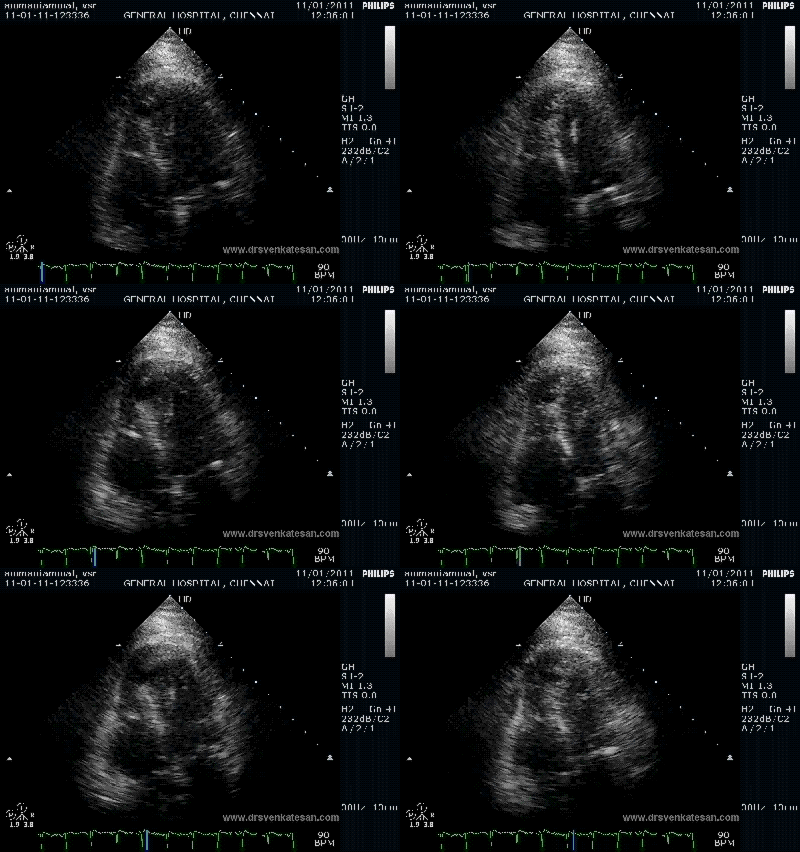
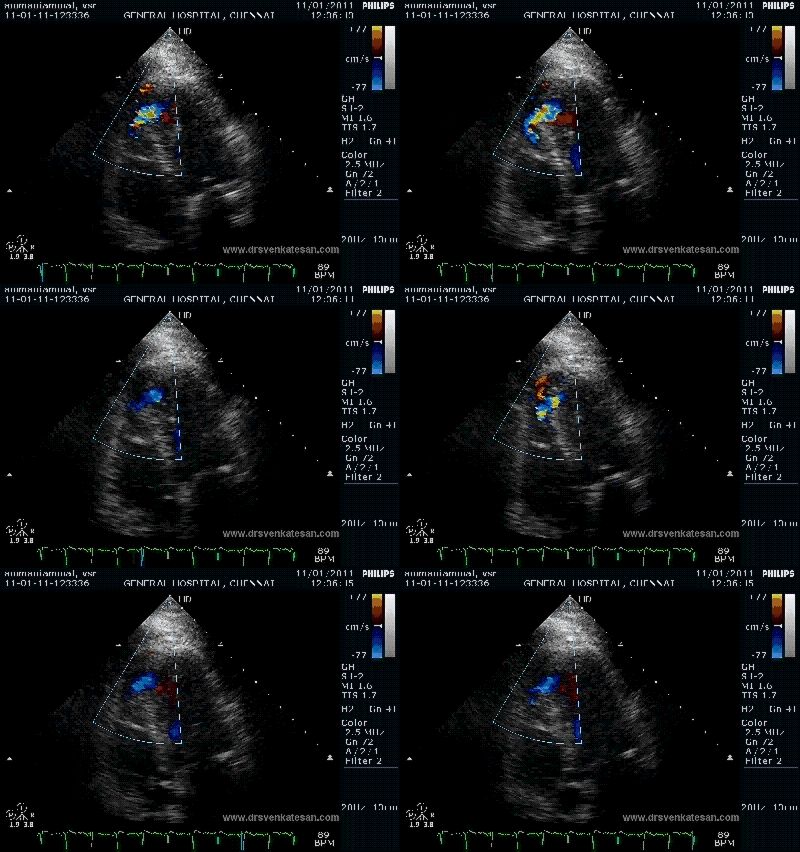
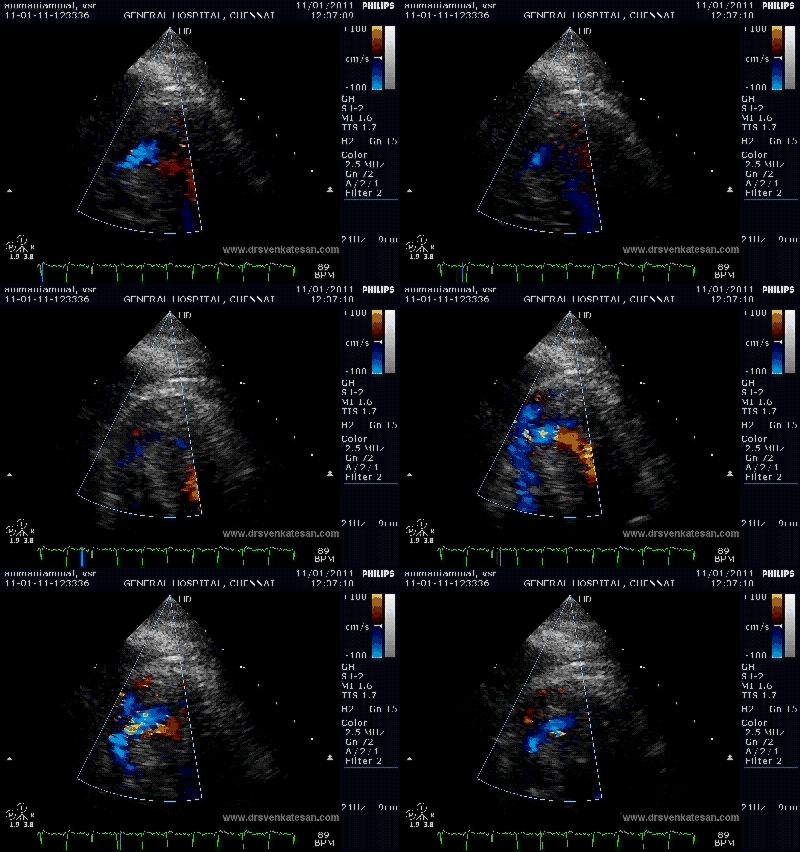
Here is 55 year old women came with extensive anterior MI with lower septal rupture.(She belonged to type 3 of the above scheme)

)

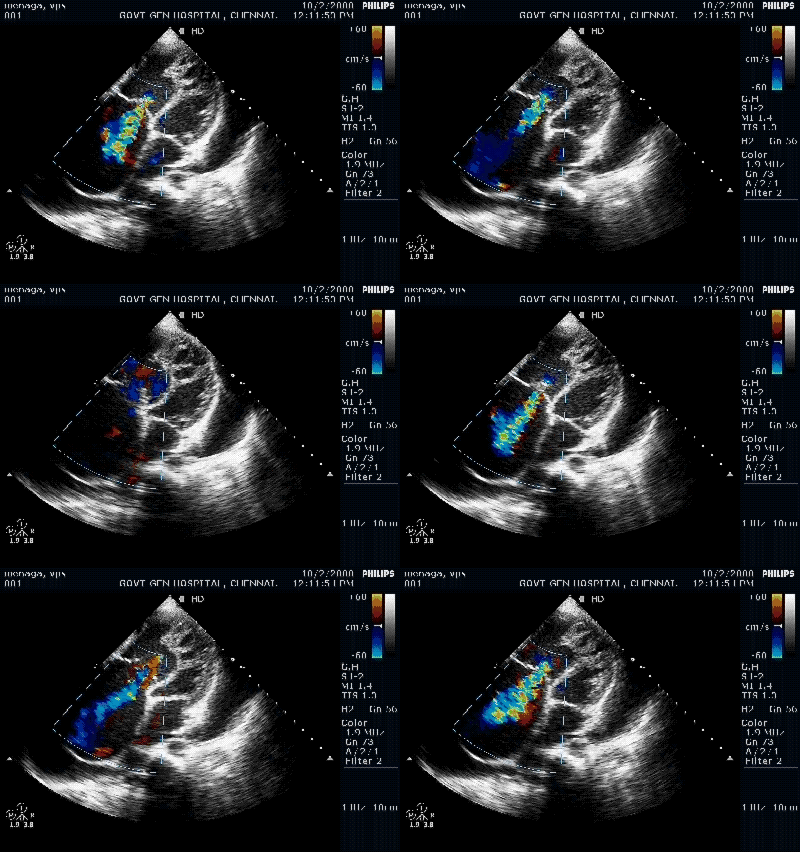
Note the septal rupture is visible even in 2D Echo


Color flow showing significant shunting from LV to RV.This shunt depends upon the LV contractile function, LVEDP and ofcourse the RV pressure


If there is severe RV dysfunction or bi ventricular dysfunction flow across the defect is inconspicuous.Brisk left to right shunting may be an indirect marker for good LV systolic function and absence of significant pulmonary hypertension.Both imply a better outcome.

The main determinant  of survival is the  underlying LV dysfunction and associated co morbidity(Renal function ) and complications .

Infero -posterior ruptures tend to be complex and  may have multiple irregular tracks  that makes it difficult to repair.

Investigations

Echo cardiogram is the mainstay .Serial echos should be done to assess the mechanical function and the progress of VSR.Hemodynamic monitoring may be done without injuring the patient .

Medical management

  • Often supportive , but  effective . Dobutamine infusion can maintain a life for few days.
  • Paradoxically , LV dysfunction and elevated LVEDP restricts volume overloading of VSD.
  • Associated MR, Arrhythmias  need to be taken care of .

Surgeons role

  • Very Vital.
  • Experience counts.(Individual as well as  Institutional )

Timing of surgery

Continues to be a controversy . Surgeons love to operate in a stable patient. But they need to realise , surgery is often needed to stabilise  many  patients. . The issue of tissue friability  is blown out of proportion in the literature .When a  life is  is at danger we can not worry about  friable tissues !

The rule of thumb could be

  • Operate as early as possible in unstable patient.
  • Post pone surgery in stable patient as late as possible ( Late here means . . .elective non emergent surgery )

Surgical options

  • Simple VSR closure without  knowing coronary anatomy
  • Simple VSR closure after knowing coronary anatomy
  • VSR closure with CABG ( total revascularization)
  • VSR closure with partial revascularization

In our experience  each of the above , has a role in a given patient depending upon the logistic , financial , social and even  the available expertise. (A good surgeon in bad Institution !)

Is coronary angiogram mandatory  before attempting to close VSR ?

Logically yes. If it is not available  just do not bother .  But, many times , when issue is saving lives , we can not afford to be too scientific , many lives have been saved by not following  such strict  protocols .A simple emergency  thoracotomy and closure of rupture site (Without even touching the LAD ) can be a distinct  and viable option in  a selected few .

Role of cardiologists

Contrary to the popular belief the role of cardiologists is minimal , except  to prepare  the patient and hand over to the surgeon.

Interventional approach to close  a VSR  is currently  be termed as an  adventurous option ! The VSRs  can assume unpredictable shapes  and the  tears can be multiple  in  different planes. The devices , catheters and  other hard ware are not specifically made to tackle these  issues  .An acquired VSR  should never be compared with congenital VSD.

Read Full Post »

Rheumatic heart disease is rampant in India.  Advanced forms of mitral stenosis are  still common.

Critical mitral stenosis with LA clot formation is often seen.

But here is a  women in late twenties  presenting for the first time with syncope .

And what  you see inside is  not a fiction  . . .

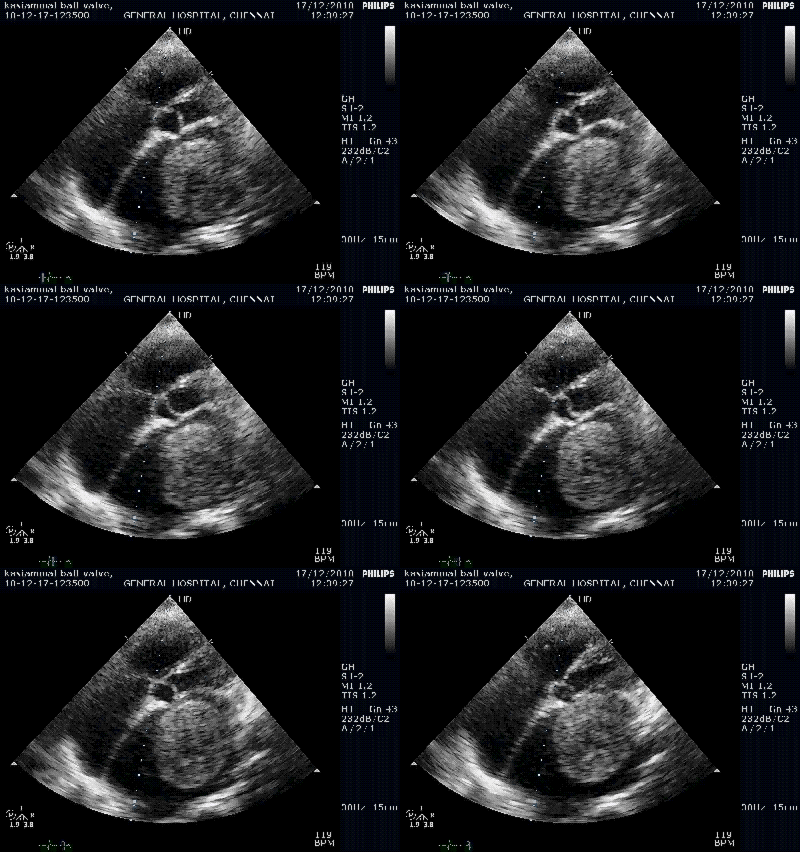
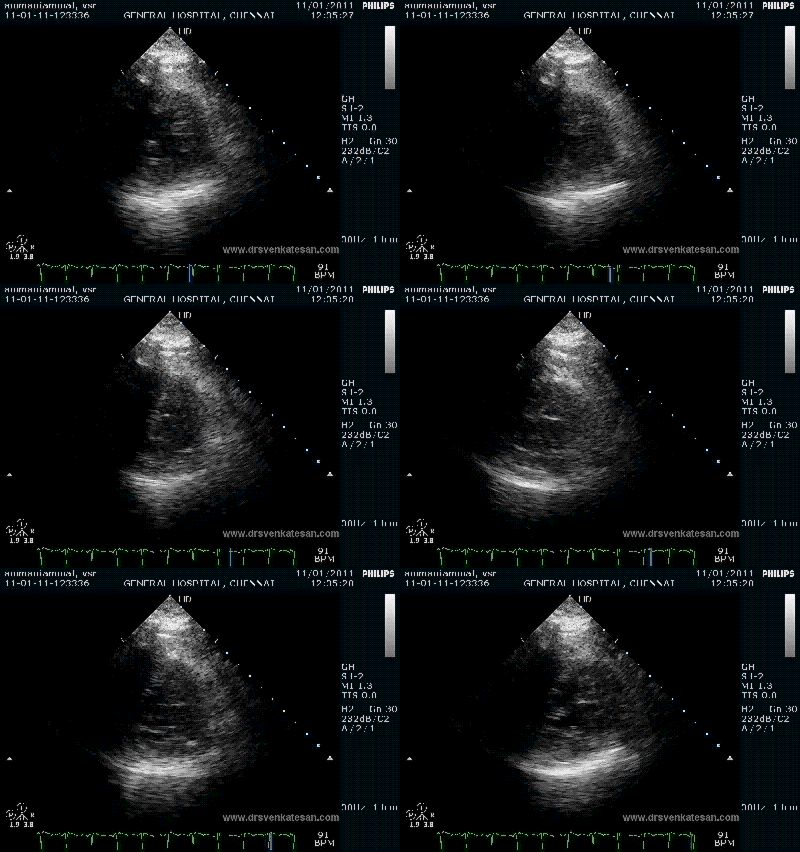
Left atrial clot occupying the whole cavity ! Where is the blood bound for left ventricle ?

4 chamber view

Luckily the clot is   so  big and MVO is less than 1 sq cm. It is highly unlikely the LA clot can negotiate the orifice.

Small fragments can dislodge .This patient developed syncope whenever she bends and lie down at a particular position.

What needs to be done in this patient  ?

Can it be lysed ? No ,Emergency surgery is required with concomitant mitral valvotomy or mitral valve replacement.

Is there a temporary aortic filter available to prevent systemic emboli from heart  ?

Distal protection devices are  available only temporarily in the coronaries and  carotids during interventional procedures.There is no aortic protection devices  for LA,LV clots in high risk patients .  When IVC filters  are used  block a potential pulmonary   clot why not aortic filters  for preventing systemic emboli  ?

Why we have not thought about  this  . . . is  surprising . May be intensive anti coagulation is as effective .

Read Full Post »

Calculating the pulmonary vascular  resistance (PVR)  has been a  big head ache for all those involved in pediatric and (for many )in adult cardiology as well  . The complex formulas , the delicate  oximeter samples, the catheters, a sick child , an arrhythmia prone right ventricle , restless staff  nurses , and  finally the mathematics  !  all make it a dreaded exercise .

Echo is a great physiological tool  . . . It is now been used  over 50 years . It is our earnest belief ,   Doppler can measure the flow and pressure any where within the heart   however dynamic  the chambers may be !

Then ,why can’t  we have a simple formula  by  this  non invasive method  to calculate PVR  ?

Yes ,  Dr Abbas et all  from the desert hospital  of Arizona  raised  this question and  reported a new equation to calculate PVR.

Their  hypothesis is as simple as this . . .

  • Pressure     =    Resistance X Flow
  • Resistance = Pressure /Flow

Pulmonary vascular resistance = PA Pressure/PA FLOW

Substitute PA pressure with TR jet

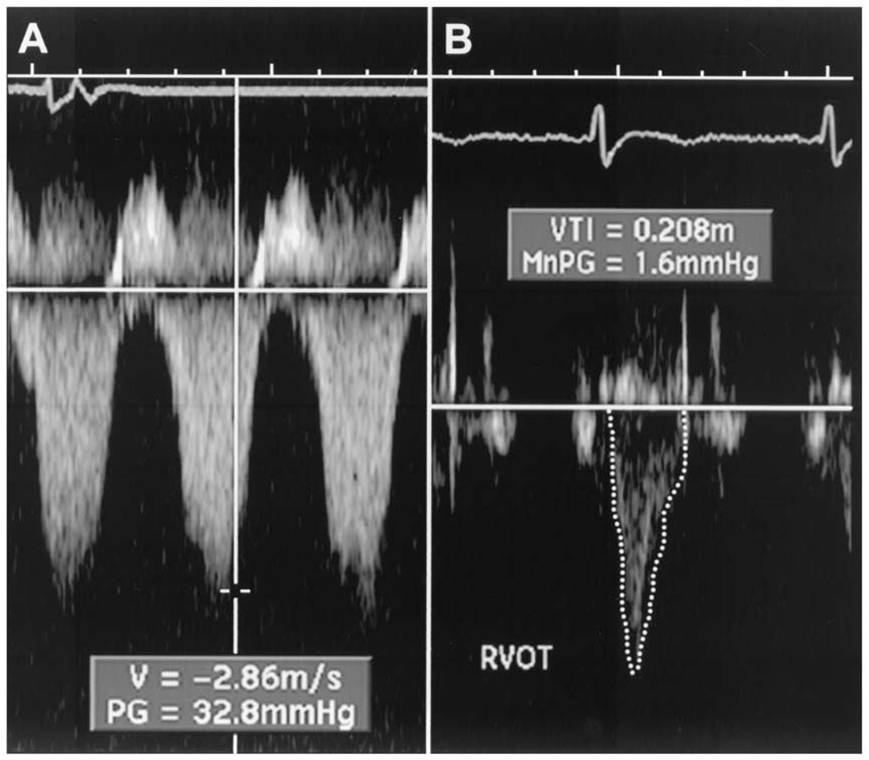
Substitute PA flow by   RVOT VTI (  Velocity time integral )

And  we  get

PVR = TR Jet velocity/ RVOT VTI x  10

This  is the simplest way to arrive at PVR at the bedside .

An example

Is it validated ?

Yes .

Then,why it is not being followed widely ?

It is  a  too  simple  method to  use   !  That  is  the biggest excuse ! We are tuned  to  think  ,  a  complex parameter can not be measured in a  simple manner  .  Any thing simple must be  wrong !

But the reality is  . . .

Cath calculations are   much more  complex with so many variables   which  can  get terribly wrong .

The irony  about this  hypothetical  science of PVR is ,  we do not know  which is  gold the standard ?   In fact , none can be  a standard .  So ,  to label PVR  derived by echo ,  as an   inferior modality  can not be accepted  .It is all the more funny ,  as  we are  trying to  define a new  formula    with  the help of   flawed and battered   parameter  namely  the cath derived PVR .

Final message

Abbas’s  formula  is  indeed a  realistic way of arriving at PVR by echocardiogram. If only we measure it routinely  /serially in as many patients as we can , a new data base  will  be created .Which can later be  proven as a fact.It is suggested every cath lab should try to validate this formula.

Link to full text article : Courtesy of JACC

Abbas AE, Fortuin FD, Schiller NB, Appleton CP, Moreno CA, Lester SJ. A simple method for noninvasive estimation of pulmonary vascular resistance. J Am Coll Cardiol 2003;41:1021-7.

Read Full Post »

Squatting is an excellent hemodynamic adaptation in patients with TOF. Children with TOF assume this posture   in  a natural and effortless manner . For years cardiologists are fascinated by this maneuver  and the mechanism by which it gives relief  to those patients with TOF.

Now , we have realised  this posture  has a new diagnostic role in echocardiography ! This paper was presented in the recently concluded  Annual scientific sessions of cardiological society of India held in Kolkatta December 2010

Download  the full   presentation in PDF  format  (  Squat Echo)

Read Full Post »

A female child aged 14 was referred for progressive breathlessness  and  abdominal distension

Abnormally dilated right atrium with significant pericardial effusion .www.drsvenkatesan.com

Can you guess the diagnosis ?

Apart form RA ,RV dilatation , the RV apex is seen filled with coarse treabeculations.This is believed to be a type of non compaction http://www.drsvenkatesan.com

Still difficult to conclude  ?   Look at the following Image.

Tricuspid regurgitation is significant . http://www.drsvenkatesan.com

If you have thought  . . .

  • ASD with TR
  • Severe PAH/COPD
  • RV cardiomyopathy

All are  acceptable  differential diagnosis

But the real diagnosis is none of the above .

Need  more time  . . . the following   Doppler tracing  will settle the issue !

Doppler velocity in RVOT at 88mmhg. http://www.drsvenkatean.com

The final diagnosis was . . .

  • Severe valvular pulmonary stenosis
  • Marked RV,RA dilatation
  • Acquired non compaction of right ventricle
  • TR -Moderate
  • Pericardial effusion -Moderate
  • This patient also had dilated IVC, Hepatic veins that  lead to clinical ascites.

Here , RV functional assessment becomes vital , but it is difficult many times. A simple clue is , as  the RV is able to generate 88mmhg pressure it implies ,   the   contractility  should be near normal .

RV EF %,  RV Dp/Dt , Tricuspid annular motion by  tissue Doppler are additional measures. Cine MRI can be a useful investigation prior to intervention.

Final message

  • VPS is a common acyanotic disease. Most are benign  and  milder  forms are the rule.
  • Dysplastic valves preclude balloon valvotomy. (In late stages   little  difference between dysplastic / non dysplastic VPS is noted  )
  • Severe progressive VPS  , like in this patient needs immediate balloon dilatation or surgery.
  • Long term outcome  is excellent except in advances cases where irreversible RV dysfunction sets in.

Read Full Post »

A young women  with Rheumatic heart disease .


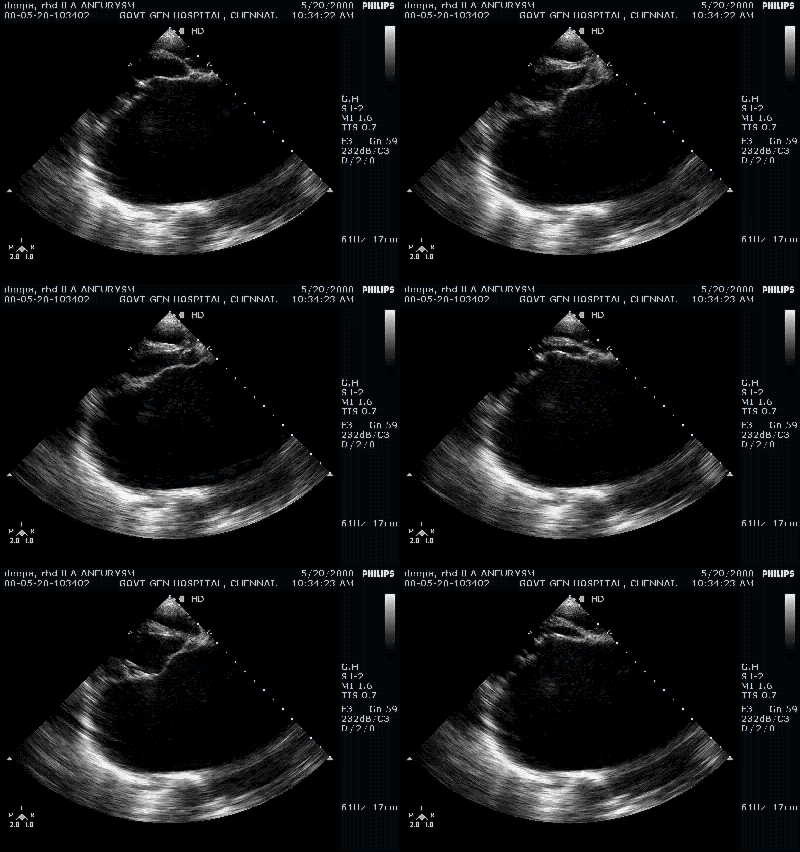
LA aneurysm

Giant left atrium in rheumatic MS . http://www.drsvenkatesan.com

Mitral regurgitation is significant .www.drsvenkatesan.com


When do you call  a left atrium as   giant  ?  When it is referred to as  Aneurysmal dilatation ?

It is all semantics. Whenever LA becomes more than 6 cm ,  at least in two diameters  many prefer to call it giant .

In India , 6 cm LA is such a common finding , we have kept a  cut off at an  arbitrary 9 cm .

What factors determine a LA to dilate like a balloon ?

The exact mechanism is not known.It could be  the  intrinsic weakness of LA wall ,  as very few with RHD develop this. Many LAs resists dilatation even in the midst of extreme LA pressure. But , it is a well-known fact , mitral regurgitation provokes greater LA dilatation than MS alone .This implies volumetrics  play a major role than  pressure dynamics  in determining LA size. Acuteness of hemodynamic insult is  inversely proportional to LA size.

By the way, what is the purpose of  recognizing  the LA as Aneurysmal ?

  • In plain X -ray chest , LA may  form the right heart border  over shooting the RA.
  • When LA becomes huge  , there is a  chance for mechanical complications  like dysphagia, phrenic nerve , bronchial compression etc .
  • Giant LA invariably increases the chance of LA clot.

Electro-physiological Issues

  • Atrial fibrillation , a usual accompaniment of giant LA ,  is often refractory . There is no  purpose  to convert to sinus rhythm . In fact ,  one should not attempt this. There was a time when surgical incisions  ,corridors , mazes were quiet popular.Now it is believed all these are adding further injury to the ill-fated LA .Electro-physiologists should be restrained . Pulmonary vein ablation should never be attempted in such cases as the focus of AF is elsewhere .

Implication in cath lab

During PTMC LA size can be an issue  as the plane of IAS is distorted and make things difficult for septal puncture . Further the balloon , guidewire  may often slip  back into RA .

Implication for the surgeon.

For the surgeon the implication could be more. As a cardiologist I can’t comment about that .One thing we have observed is when LA becomes huge , the size of mitral annulus is too fictitious and funnily enough we have recorded up to 6 cm of mitral annulus . No valve is available for this size . We learnt from the surgeons ,   large LA  rarely pose a  problem as they suture the much  smaller valve in a larger annulus .(Which  makes the task  that easier )

Does the LA size regress after surgery ?

In many  it does regress  , in as many it doesn’t. We have seen giant LAs continuing to trouble the patient even after a successful mitral valve replacement.

Read Full Post »

There were days when acute pulmonary embolism(APE) was almost always  diagnosed  post-mortem. We are in the era , where we can recognise most of  the  pulmonary  embolism  without any difficulty.

Experience has taught us ,  when to suspect this dreaded  syndrome . Any  unexplained, dyspnea, hypoxia, tachycardia , syncope* with  vague chest discomfort  and  a predisposing condition (DVT , post operative  state ,etc) will make  acute PE highly likely .

*Postural dyspnea and syncope is a classical finding in many.

Pulmonary Echogram

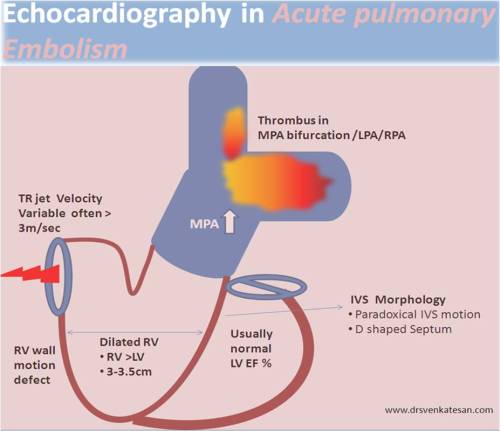
We have  advanced  multi detector CT scans  and MR angiogram , V/P scans and pulmonary angiograms  to diagnose and confirm Acute PE .What we fail  to realise  is we also  have a simple bed side tool  called echocardiography   to  rapidly detect,  assess the pulmonary  anatomy and its hemodynamic  status.  In fact ,  we can visualize  the entire  MPA, and its  bifurcation and to  certain extent RPA,LPA. It is strange  physicians  always  ask for pulmonary  angiogram to diagnose APE , when we have a totally non invasive  pulmonary echogram available at the bedside .It can  rule out almost all cases of  massive pulmonary embolism with a good festivity and specificity .
How often Echo miss a Acute PE ?

Echo may fail to image a thrombus if it is distal but it is very rare to miss a thrombus in MPA, and its bifurcation. Most of the patients with  massive pulmonary embolism , are likely  have a thrombus in the bifurcation.

Even if  echo  fails  to image a thrombus , the effects of  acute  pulmonary arterial  hypertension on the tender walled  right ventricle  is conspicuous. In fact, the  effect of Acute PE on the RV morphology and function  is  the  single most important feature to suspect APE . This is also  considered as an indication for thrombolysis.

The following  Echo features  suggest Acute Massive Pulmonary embolism.Imaging these patients may be difficult especially if they are acutely  dyspneic   .Luckily , pulmonary  artery short axis view can be obtained even in supine position  in most of the patients.

  • RV dilatation ( One popular criteria is End diastolic RV dimension > LV end diastolic dimension .It should be remembered ,  strict criterias  can not be followed in this high risk medical  emergency . Visual estimation of RV size is equally important.If in the para sternal long axis , RV is > 3cm it is significant . The only issue is, in patients with preexisting  COPD  RV size will not be useful to diagnose APE.
  • RA dilatation (this is also a usual accompaniment )
  • RV wall motion defect(Considered , as  RV SOS calls !)
  • Paradoxical septal motion
  • D shaped septum is  an absolute sign of distressed RV.
  • Tricuspid regurgitation(This depends upon the leaflet length and orientation, some may not develop in spite severe PAH )

Less common features

  • Pulmonary  regurgitation
  • RA , RA appendage , IVC ,  RV clots

Diagnosing  RV hypertension

TR jet

MPA  acceleration  time (Not useful in an emergency situation )

Other thinks to look in Echo

  • LV function (Hypoxic  dysfunction  or associated CAD )
  • IVC for  thrombus source .
  • IAS anatomy : PFO may increase the chance for stroke as these patients carry the risk of further  embolus. When the RVEDP, RA mean pressure raise to APE, the PFO becomes hemodynamcially patent and may develop propensity to shunt the incoming thrombus to left atrium rather than right ventricle  as LA pressure is considerably  less than RV

Unanswered questions

At what  pressure RV begins to dilate ?

This is not clear.The response of RV ,  to pressure overload is  not constant.  In acute raise of RV pressure ,RV tend to dilate  , while  in chronic PAH RV hypertrophies and dilates .It is  believed   , the first signs of dilation begin , even with a 30mmhg of PA pressure . So ,  even minor dilatation could become important in acute PE.

Can RV dilatation alone  , be taken  as evidence  for hemodynamic instability ?

Yes , but realise  ,  clinical , hemodynamic instability  is much more important than degree of RV dilatation  (Hypotension /hypoxia  )

The curious behavior of RV and TR jet in APE ?

Normal peak RV pressure is 25-30mmhg .In acute pulmonary  hypertension RV pressure is supposed to raise . But it does not always happen.It all depends upon how the RV respond to the sudden raise in its afterload.

Some RVs fight vigorously and take on the challenge  imposed by pulmonary  embolus.These are the  patients  who show strong TR jets which may reach 60 mmhg. More  often , the RV  is stunned and overwhelmed  by the unexpected sequence of events and  lose the battle from the beginning  .They become  flabby  and dilated.These  patients  do not  show any significant TR jet ,  in spite of raising PA pressure. This implies,  a  good TR jet > 3.5 could  virtually rule out  severe RV dysfunction.

(One  popular thought gaining ground is  , the primary determinant of   pulmonary artery  systolic  pressure  in Acute PE is the RV contractile force ,  rather  than pulmonary  impedance .)

Hypotension is common in APE .What is  the relationship  between PAH and systemic blood pressure ?

  • Inverse relationship is expected . This often result in syncope in these patients.
  • Bernhiem effect
  • Hypoxic LV dysfunction

Final message

RV  faces the brunt of the  hemodynamic attack of acute PE. .Differentiating simple RV involvement  from RV dysfunction  is a difficult and subjective  exercise. But ,  it need to be done accurately as  RV dysfunction becomes an indication  for thrombolysis  . RV dilatation  , wall motion defect, mild PAH, all  indicate RV dysfunction . Diagnosing RV dysfunction is  better  done by the  treating physician who has the  overall clinical data.

Read Full Post »

Planimetery is the age old method to measure the mitral valve  area( MVA) by echocardiography.

Advantage

  • Simple modality
  • 2D echo  is enough
  • Doppler errors avoided
  • In the presence of MR, planimetery orifice has an edge over other methods

Disadvantage

  • Optimal gain setting becomes  important .There is  significant inter and intra observer variability.
  • Shape of the orifice is not constant  ( MVO is funnel like) . Narrowest diameter is usually measured.
  • Planimetery is  a purely an anatomical orifice,while blood flows through both primary and secondary mitral orifices .Sub valvular fusion makes secondary MVO the  narrowest point  . Measuring it becomes difficult as it has no defintion of border.
  • Gross errors possible in calcified valve.
  • In post commissurtomy  the  lateral extent of split is often  not tractable

How to improve the accuracy of planimetery ?

Color Doppler aided  2D  planimetery . This can improve some of the limitations , as  it provides a hemodynamic MVO(Some what physiological ) Of course  , pressure halftime derived MVO is purely a physiological orifice .

Other options to measure MVO

  1. Pressure half time
  2. Continuity equation
  3. PISA method

Advantages and disadvantages  of Pressure half time derived MVO will be posted soon.

Read Full Post »

Mitral valve can be termed as  the most important valve of heart . The reason  for this  : It is the only valve that is dependent on the  Left ventricular function (The  parameter  which   determines the  ultimate outcome in any form CAD ! )

So , indirectly mitral valve function will invariably be affected by some degree  at least in  most  patients with LV dysfunction. (After all LV free wall , is a component of mitral valve apparatus.)

While , we have numerous modalities to assess mitral valve function  ,  the one that has fascinated the surgeons during  mitral  valve surgery is the intra operative TEE.

Many believe TEE provides live  images  of mitral valve   which are not possible  even under  direct vision ! The eye of the  TEE sees the mitral valve  from a  posterior location , (of -course It can see at any angle !)   while surgeon can see in one angle . The  types of repair , the adequacy  of repair, the annulus status,  even a trial mitral run ,  can be done with the help of TEE.

The TEE probe silently does  this job sitting inside the esophagus   , without  obstructing the surgeon’s operative field .

The success of TEE as an investigative tool did not come easy.Decades of  observation , innovation and learning( Especially from  department of cardiac science  Mayo clinic USA , where they standardized the views. )  are involved .

Now we have omni plane, real time 3D TEE probes .

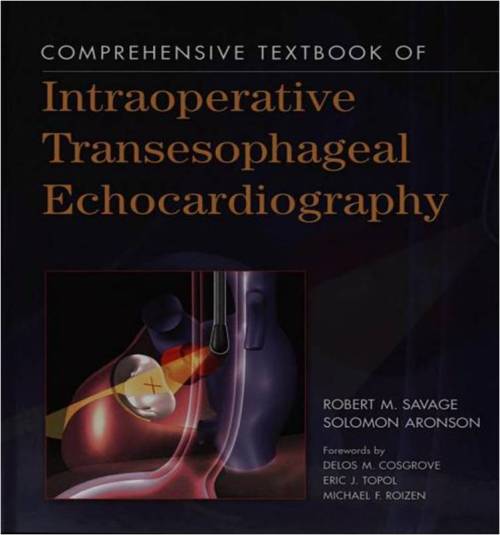
The books  which are  considered the best for  TEE aspects of mitral valve  and it’s  repair are

Read Full Post »
« Newer Posts - Older Posts »