Feeds:
Posts
Comments

Archive for the ‘Infrequently asked questions in cardiology (iFAQs)’ Category

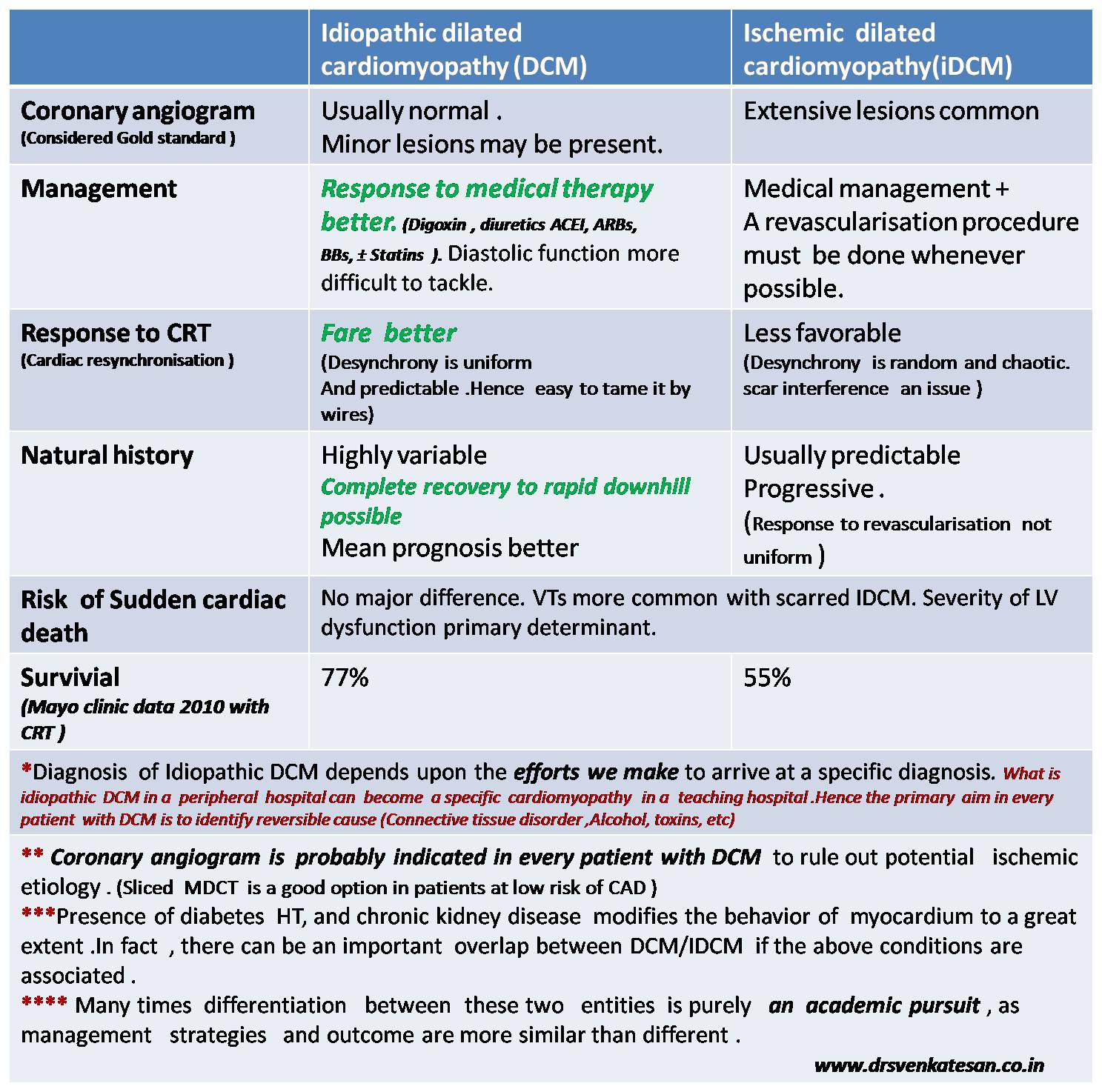
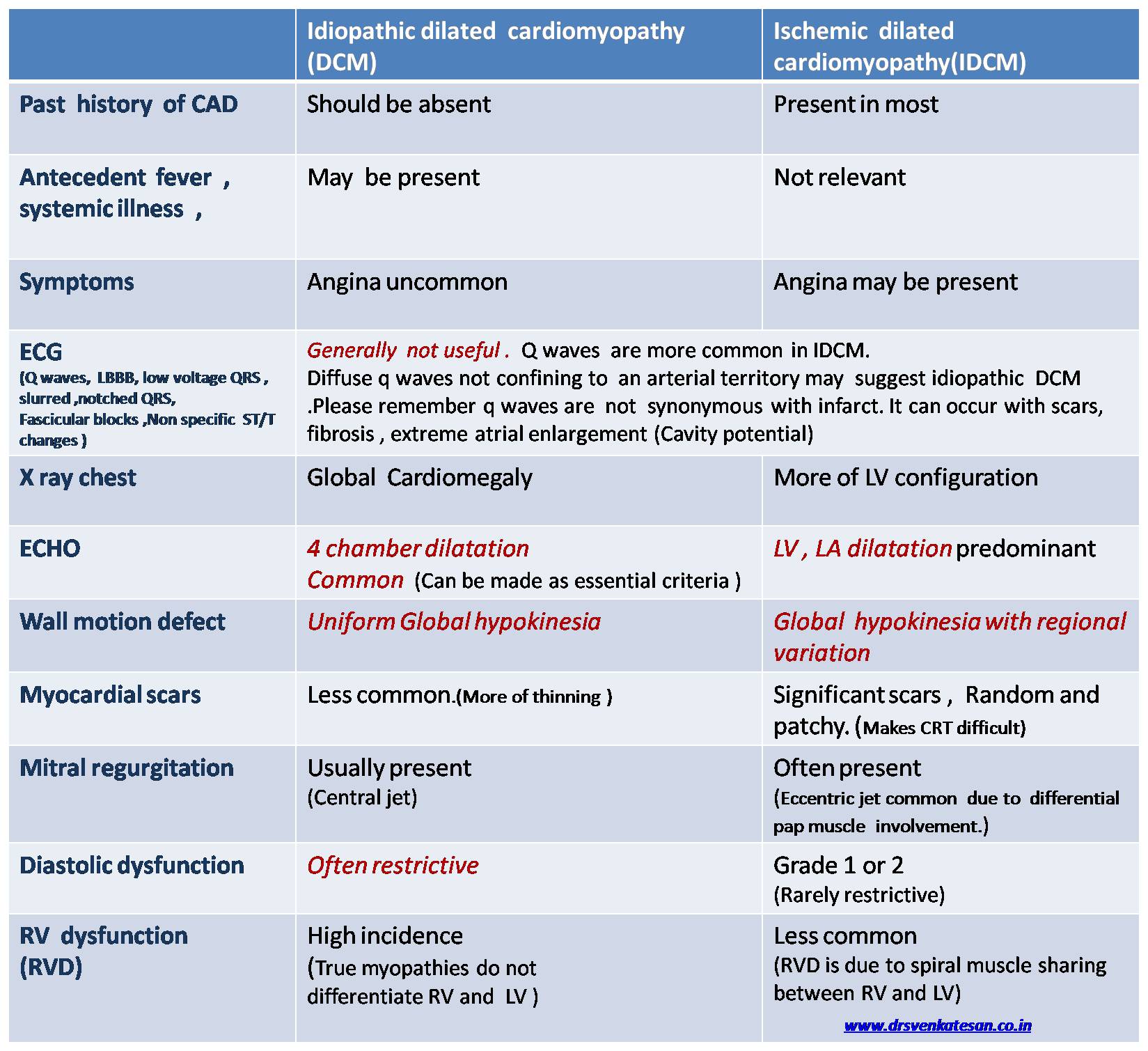
This seemingly straight forward question is often asked in cardiology boards.

The answer to this question is  important in the bedside as well ! Ironically ,  with  sophisticated  diagnostic modalities the complexities  has  also multiplied .

The following table attempts to simplify it. ( Mostly written with a personal knowledge and ignorance !)

Please click on the table to visualise a high resolution  image.

Read Full Post »

Constrictive pericarditis is a well known mechanical disorder  of heart that occurs due to the  compression  by thickened pericardium .Constrictive pericarditis is  the classical cause for  severe diastolic dysfunction.

We know , lungs are   prone for restrictive disorders due to chest wall , skeletal  disorders. Does the heart get mechanically restricted in extreme obesity ?

Not really , one may reason out . Chest wall fat can have little effect on cardiac function but when excess fat accumulates within the layers of heart , it is indeed possible for  the  fatty layer to impede mechanical filling of heart. This may be considered rare as of now , but many times it is not recognised ,  as most of the dyspnea in morbid obesity is attributed to some other known factors.

Dyspnea in obestity  can  due to

  • Pulmonary hypoventilation
  • Increased  MVO2 due to elevated cardiac mass
  • Diastolic dysfunction of  LV/RV
  • Increased demand  due to  excess BMI.

Image courtesey : http://www.onlinejacc.org

Now, we have evidence for  altered RV hemodynamics due to compressing effect  of epicardial fat pad. It may be due to   simple mechanical effect  of epicardial  fat over the distensiblity of RV or occasionally  LV. (The distribution of epicardial fat is mainly over the right ventricle or septal areas.)

This   paper  from Korean circulatory journal  succinctly describes this new possibility .

http://www.ncbi.nlm.nih.gov/pmc/articles/PMC2771803/pdf/kcj-39-116.pdf

Final message

Bed side cardiology  continues to  bring surprises  , it  never fails to fascinate us   !

Heart  is  a dynamic organ ,  has a potential to get restricted by  any  layer that  surrounds  it. Constriction by pericardium got huge attention so far .We need to realise , the epicardium which is  a part of pericardium has a variable fat depot  . It  can take a different avatar  in an occasional obese individual  and   exert  important hemodynamic impact.

Excess fat is excess load on heart . . .  we have  to unload it

It is possible , sucking out the  epicardial  fat in morbid obesity can bring important relief to  those patients with unexplained dyspnea . We  need to  explore this possibility.

Read Full Post »

The link between migraine and PFO is  . . .

  1. Incidental  & man-made
  2. Almost certain
  3. Definite
  4. A wild imagination

Answer : One of the above  is correct  , but  we do not know  which one is   !

There has been many  patients with TIAs , cryptogenic strokes , who  had  documented PFO  ,complain of prolonged  head aches . This was the beginning of suspicion of PFO as a cause for migraine .Then the device industry foresaw a huge opportunity . Things began to unfold and  the concept is currently as nebulous as it can be .

Mechanism of migraine in PFO

(All are  presumptions )

  • Right to left shunting of  vasoactive amines from venous circulation (Serrotonin)   which bye- passes  the lung where they are supposed to get filtered.
  • Venous micro emboli (Antiplatelet agents reduce migraine as well as TIA ! )
  • Hypoxia transient – cerebro vascular hypersensitivity
  • Atrial naturetic  peptide spills more into systemic circulation through  PFO

Counter arguments

  • If right to left shunting is causing the migraine , why it  is not fully disappearing even after closure of  PFO (MIST data with  starflex  device ,  migraine persisted in a significant chunk !)
  • What is the incidence of migraine in the  prototype  right to left to shunt situations like TOF, Eisenmenger , pulmonary AV fistula ?  if shunting is the mechanism , logically  migraine incidence  should be very high  in this population , but it is not .
  • Migraine occurs in 10 % of population, PFO  is present in 20%  .  What are  the chances of over lap ?  It could be the simple statistics at play !

Where is the evidence  ?  The mystery called MIST study.

This study , done in UK generated more controversy , which  it was supposed to remove  . Still  this  study is considered to be a major evidence for the link between PFO and migraine . Star flex device  was promoted by NMT medical Boston .

http://www.medscape.com/viewarticle/541260

Link to  best review article on PFO

http://chestjournal.chestpubs.org/content/130/3/896.full.pdf+html

Final message

The link between migraine and PFO can be a fact or myth depending upon our belief in current  methods of  research in  science. The issue is  debatable . Of course ,  one issue is probably  closed  forever  , even  if they  are  linked casually (or seriously )  device closure can  never be a  sensible treatment  option for migraine ! *

We  expect a  proof / disproof  in this   mysterious migraine -PFO  hypothesis very  shortly.  Of course , many  cardiologists  already  have their  own conclusions !


*Please note , PFO  device closure  for  stroke in young is a different story

Read Full Post »

Even as we make rapid strides in  conquering coronary atherosclerosis by all those fancy gadgets , the  fundamental coronary  hemodynamic principle   is poorly understood . Hence  there is no surprise  for the  “perennial ambiguity”  in the indication  and effectiveness of  coronary revascularization .

Why the hell ,   reliving  a  coronary obstruction  may  not provide the   expected hemodynamic benefit  or do not prevent future  heart attack  in many ?    One of my patients  asked ?

I told him . Wait , do not get  excited , we also do not know  . . .We are just beginning to understand mysteries of coronary  circulation.

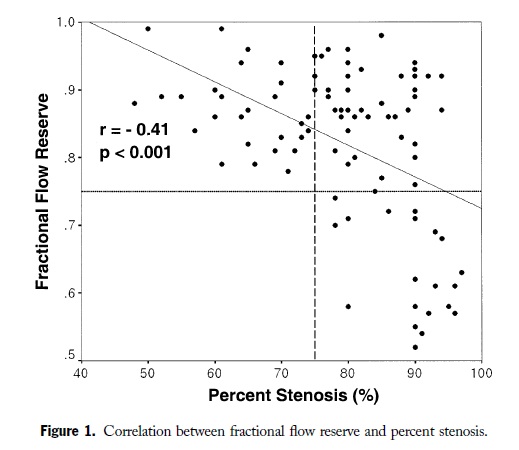
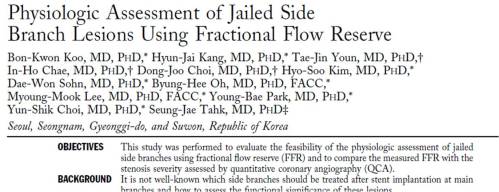
It is a well documented fact  ( but a  debatable )   that  lesser the  severiity of a  lesion more likely it is prone for an acute coronary  event .( Vulnerability , shearing stress or is it a simply a statistical mirage !) While the  vulnerability aspect is  complex , the hemodynamic  impact of  coronary  lesions  is   relatively better  understood. Here is  an important  documentation from Dr B . K  Koo from  Seoul , South Korea  who has elegantly shown the behavior of  fractional flow reserve (FFR ) in various grades of  stenosis  .This study was done in jailed side branches following PCI.

FFR  shows a surprise   relationship  with severity of coronary stenosis  . Even severe lesions showed equal if not more flow  reserve ?

and mild lesions might have lost all its reserve.

 How is it possible ?  Can it be true ?

Yes , it is indeed a  fact . God generally  keeps a stong link between anatomy and physiology  , structure and function . But he adds a rider and keeps  a reserve in every  human cell   meant for  emergency  back up . FFR is  one aspect of this , we have  partially discovered .  When we fail to understand this we are bound to get confused and make a wrong decision in cath lab.

Simply stated ,  flow across a coronary  artery is much more depedent on the status of microvascualture  than the hurdles they face in the epicardial highways !

Link to this original article from JACC .

How to do the FFR procedure ?

http://www.sjmprofessional.com/Clinical-Solutions/Intl/Radi-FFR.aspx

Soon to follow . . .  If less severe lesions are more  dangerous why we are ignoring it in cath lab ?

Read Full Post »

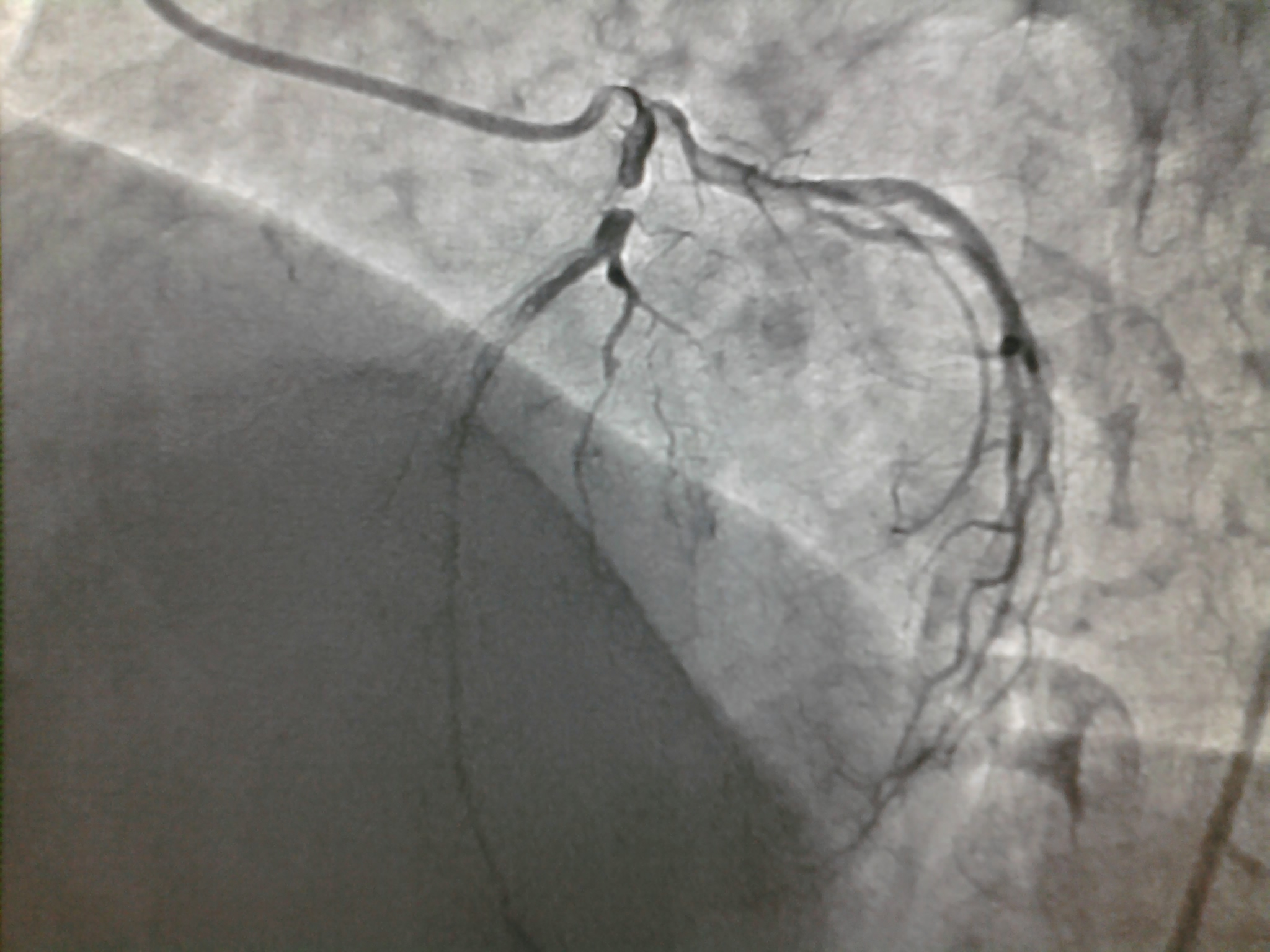
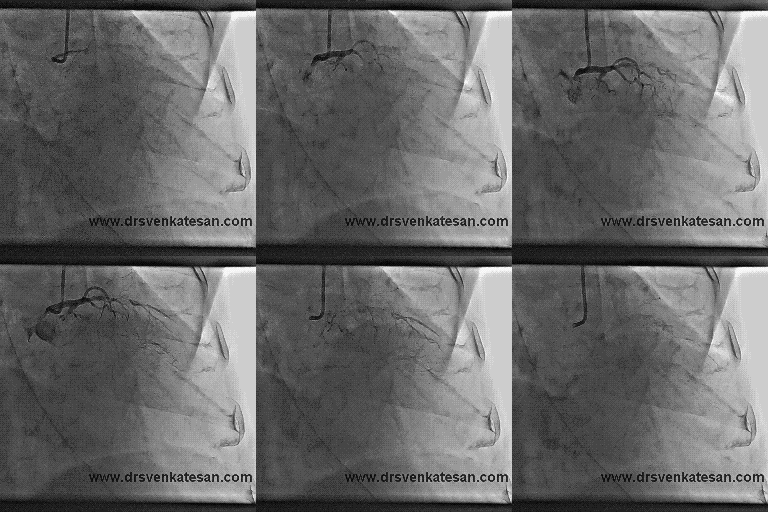
Thousands of  coronary angiograms are done every day. Cardiologist no longer get excited to see exotic coronary lesions .Still , some images can be striking and dramatic. Here is an angiogram from a middle aged man  with stable angina  , who was  one among the routine early morning diagnostic studies  in our cath lab.
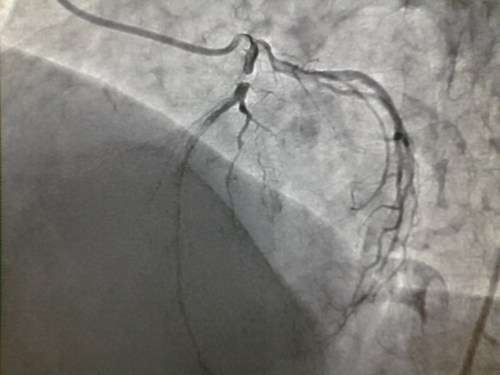
Who chopped the neck of this LAD ?

How this man was able to fill up the distal LAD almost completely? (With a complete cut off  right in the neck of LAD )
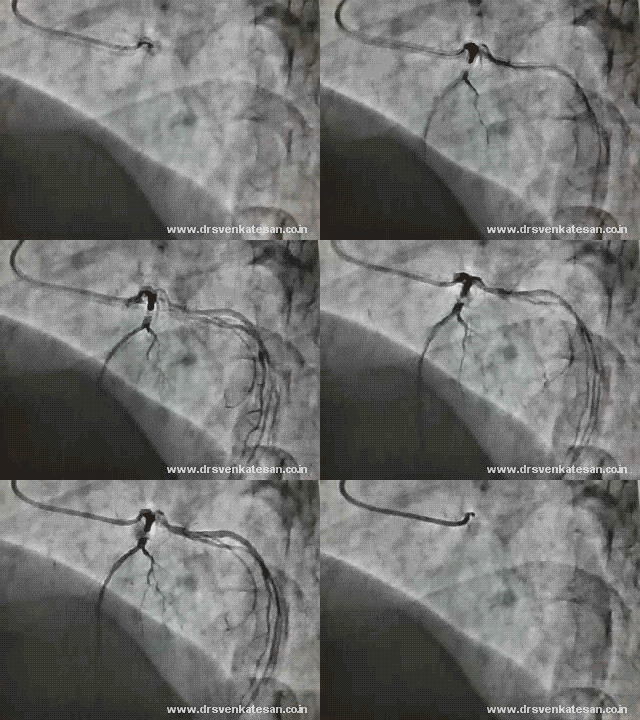
Are you sure there is antegrade flow ?

Do you get any clue ?

  • Can a trickle of  ante grade flow  sustain  a  TIMI 3 FLOW  ?
  • Or is it a  very efficient  instant collaterals  from LCX ?

Yes . The first one is right . An almost invisible antegrade channel  doing a exemplary job !

How is it possible ?

Realize an important fact . The distal flow beyond an obstruction  is not primarily dependent on degree of obstruction but the status of the distal vascular  bed .  If it is normal  even a hair-line patency  can  profusely perfuse the distal myocardial segment. This is what is happening to this man with a stable angina and perfectly normal micro vascular bed.

Lessens  from this Image.

Do not get fooled by the lay man’s logic. Realise there is  no simple relation  between  the degree of obstruction and degree of  blood flow impediment.It can be linear , curvilinear , or even inverse depending upon   the evolution and timing of obstruction  ,  number of lesions , presence or absence of collateral support , finally and  most importantly  the integrity of microvascular bed .

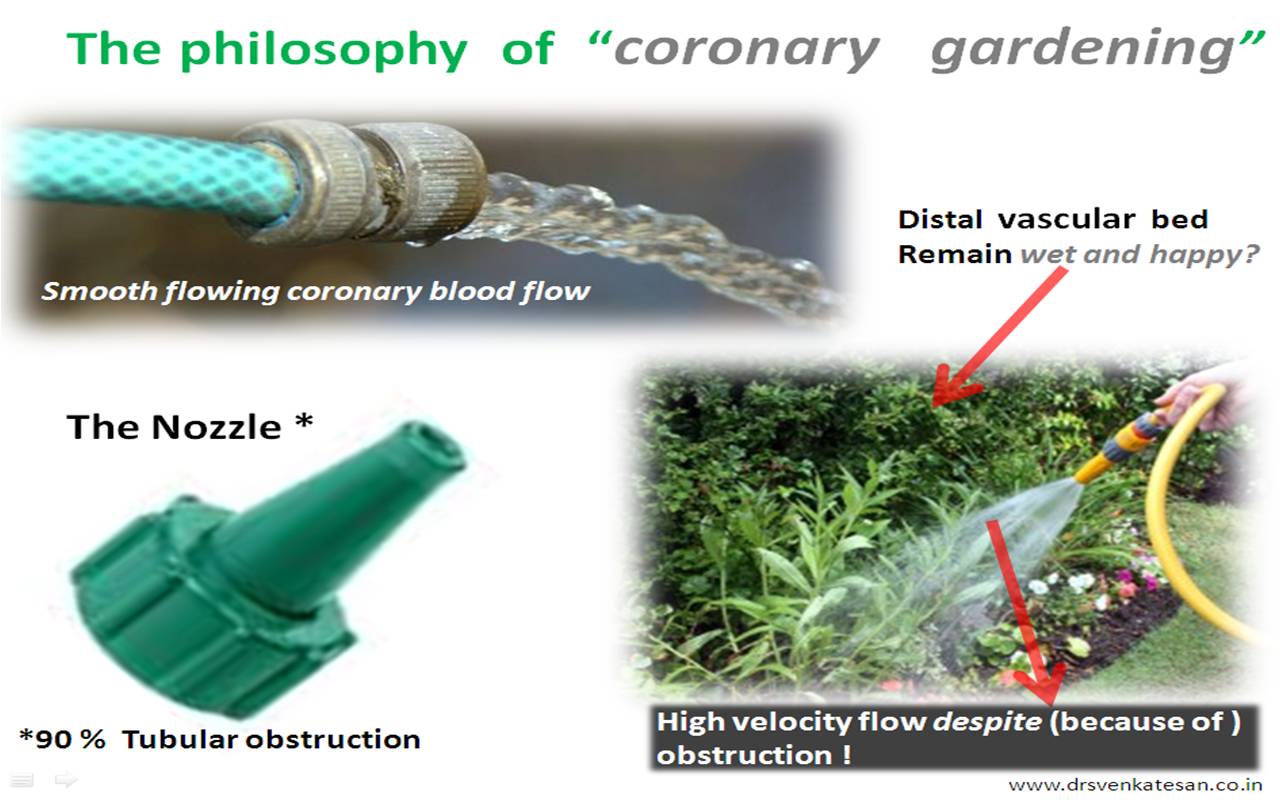
The  distal vascular bed drops its resistance drastically  once it senses  the problem in  proximal segment . This is based on Bernoulli principle and  is akin to how a  garden hose pipe  can simply increase  the velocity  by tightening the nozzle.*
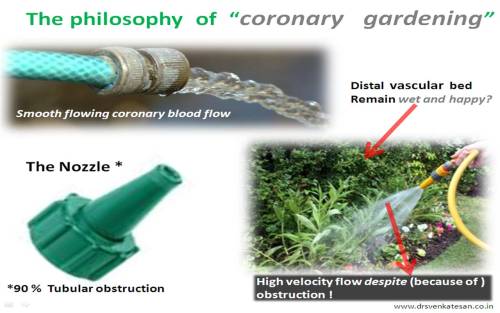

* The garden hose analogy is a gross simplification of   complex factors that determine coronary blood flow.But it effectively clarifies a point ie  coronary blood flow is least dependent on coronary  stenosis (until  very late stages)

**Note further : This  hemodynamic  principle may not apply in acute occlusion as in STEMI  , where   acute  obstruction  often has a linear relationship with the quantum of blood flow.

By the way what happened to the above patient ?

Since he had significant angina there were no debates regarding management.  He  is posted for elective PCI this week-end .(We  can’t  get a stent just like that unless it is a real emergency  .Ours is a  Govt hospital !)

What is your take . Is it a going to be tough cross ?

I feel so , but my colleague Dr Gnanavelu   strongly  differs !

Let me post  our experience during PCI shortly.

Read Full Post »
In this world of  evidence based medicine  the  funny bedside vocabulary of  medical statistics   has withstood the test of  time. The following words are liberally used by physicians of all walks of life.

We never bother to find what these words mean to our patients  !

Here is a crude and  wild   numerical attempt to  decode  these words.

  • Always                                    99 %
  • It s a rule                                  95-99%
  • Almost always                       90-95%
  • Very common                       > 90 %
  • Common                                  > 75%
  • Uncommon                            < 30 %
  • Rare                                          < 10 %
  • Very rare                                < 5 %
  • It is an exception                2 -5 %
  • Remote                                   < 2 %
  • Never                                     < 1%

Apart from the above   there two  hugely popular  medical words used over  million times every day in all walks of medical practice.

They are  ” May” and “May not”

The greatness of these words lies  in the fact   it can convey any of the above  10 meanings in a single phrase without any fuss !

Further ,  the words may and may not are numberless un-quantified statistical  jargons that   can convey a deep meaning or  . . . no meaning  depending upon the circumstances !

Doctor ,  is there a possibility of  my stent getting occluded    as i have skipped  the  clopidgrel ,and aspirin for the past two weeks

You may  be at risk  . . . but you may not develop  an heart attack immediately . I would advice you start the drug immediately .

Read Full Post »

Sudden cardiac death is the  most common cause of instant death.  We know , heart is  also  under massive neurological control . Still , heart can run for days even after brain dies ,   if respiration is supported.This implies ,  heart is independent  neurologically  !  what a paradox !  But this  independence of   brain  function after death makes the  human heart transplantation  possible.

Even  as we “wow” about this cardiac independence , we   witness  widespread deaths due to sudden neuro- cardiogenic  deaths .This makes medicine . . .  a wonderful puzzle  and  compels  us  to pursuit  the eternal    journey  of  knowledge !

When an area of brain fibrillates what will the heart do ?

When  the brain suddenly discharges  huge amount of electricity (Load shedding )  as in epilepsy or some other neurological  injury  , it  may  travel down  and make sure the heart also  shares  the electrical insult .Sudden deaths have been reported in many epileptic individuals and in  some forms of stroke .To distinguish   sudden brain deaths  from sudden cardiac death in such patients  is a very difficult task.

The message is ,  hypo-functioning  brain does not generally harm the heart (Men in coma live for years !) but , over -active brain can inflict major electrical damage to heart. This may  indirectly explain ,  how an  episode of  severe mental stress  could act  as a  trigger  for acute coronary  syndromes.

* We do not know , whether brain stem which has the cardiac high command  can fibrillate independent of cerebral  cortex .

Reference

Ictal asystole

Asystole during epilepsy could occur in significant numbers. As this  review   from France  reveals


Read Full Post »

Diabetes is a systemic disease affecting  almost every cell  that metabolises  glucose .What begins  as  a minor  functional impairment  ,   worsens gradually and ultimately   end up in severe  structural changes.The basement membrane of  cells  face  the brunt of the attack .  (In the strict sense every cell has a basement  but it is well  developed only in kidneys ) . We also  know , diabetes  is able to inflict universal damage by targeting the vascular endothelial cells.

In the kidneys DM makes the  glomerulus  more porous causing protein leak*  and ultimately damages the tubules and end up in CRF. In the retina it excretes the  proteinaceous  material into the vital layers  and result in  retinopathy and progressive visual loss.

* Micro/Macro albuminuria

In fact , there is  a very close link between eyes  and the kidneys  Nephrologists   hesitate to make a diagnosis  of diabetic nephropathy without ocular  changes. The peripheral vascular disease and diabetic foot are  another expression of this microvascular  dysfunction.

What is the impact on cardiac micro-circulation ?

Whenever significant diabetic nephropathy is present there must be a significant cardiac micro- angiopathy as well.This is now  a fact than an assumption. We are not recognizing it rather  ! (If only we have a cardiac  creatinine we can easily identify diabetic myocardial protein leak !)

When kidneys lose protein , cardiac capillaries  lose proteins to interstitial   space  and result  in progressive  fibrotic reaction . We know  extravasaation   of high osmolar  proteins   can play havoc  in cardiac interstitium  !

Proteins are the particles of life   . . . but in wrong places  it can  transform into deadly  molecules  in a fraction of time !

Hence ,  the cardiac protein leak in diabetes can cause  any of the following clinico -pathologic entities.

  • A mild left ventricular  hypertrophy .
  • Increase global  cardiac  mass (Similar to bulky kidneys  seen in early diabetic nephropathy )
  • Simple diastolic dysfunction.
  • Severe restrictive features
  • NDCM (Non dilated cardiomyopathy )
  • Finally a DCM  like  transformation

How to recognize cardiac protein leak ?

  • Clinically it presents either as  angina or early heart failure symptoms ( not both usually ) .Diastolic dysfunction  in echo,  positive stress test , patchy thallium uptake abnormality  often with  features  of   syndrome X  is also recognised.
  • Many of the low flow or slow flow phenomenon  in coronary angiograms  might reflect micro-circulatory dysfunction .
  • This is recognised by prolonged TIMI frame counts  and  prolonged  coronary sinus filling and emptying time .

What about macro-vascular  complications  in diabetes ?  How is it different from micro-vascular complications ?

Though we expect a direct  link between  micro and macro  vascular complication ,   the later  appears  to a  patho-genetically  independent  process . This will be addressed later.

Read Full Post »

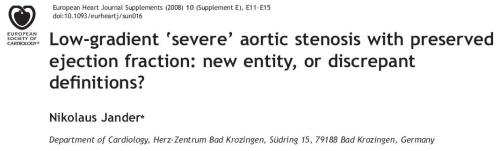
New concepts are created to clear confusion and bring clarity. We know all along low gradient AS is a hall mark of severe LV dysfunction. Now we suddenly invented normally contracting  LV can also cause  low gradient due to low flow when the aortic valve orifice becomes very critically narrow .

How can it occur ?  . . . few  suspect  it  to be  semantics  !

The terminology  that is  often used in recent times when describing severe aortic stenosis.This is called Low gradient severe AS with preserved LV function .

But logic would say blood flow is required to produce gradient .If it falls extremely low the gradient is likely to fall.

If that is the case every severe  AS patient will experience low flow at least in  few beats . Is this the reason why we find it very difficult to reproduce the exact gradient  ?

Low flow ,Low gradient aortic stenosis is not a  new entity .It is the way we look at the data. It  remains a fact  ,  severe  AS can be diagnosed with 2D features alone ,  without the help of Doppler.We also know  Doppler is less reliable than 2D in many situations for various  reasons .The most important being it’s dependence on angle of  doppler  intercept  and LV contractile force.

Read  the  argument by   Nikolaus Jander from Germany

http://eurheartjsupp.oxfordjournals.org/content/10/suppl_E/E11.full.pdf+html

Read Full Post »

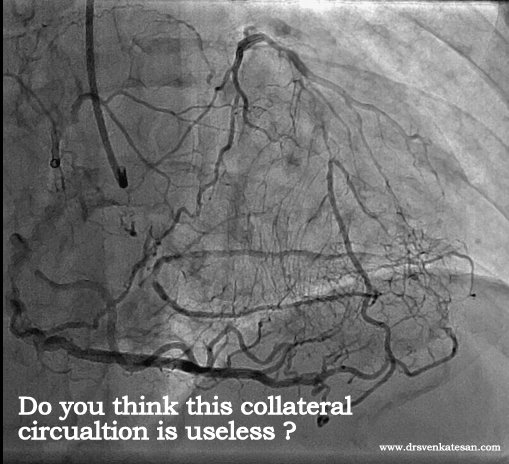
Coronary collateral circulation is probably the most poorly understood circulation than any other.This  is ignorance at it’s best ,  in spite of the life saving potential  of this circulation. A popular  (mis )perception is  coronary collaterals  can support only  resting blood flow and it would  struggle  to compensate at times of exertion. This is based on few case studies and not based on large , authentic scientific data.

Does this reasoning mean  , coronary  collaterals   can never / ever be complete  ?

If we believe so   . . .we are grossly underestimating the power of  nature .(In fact , mankind  was humiliated by the nature  time and again !)

Lessons  from  a unique patient we have  encountered.

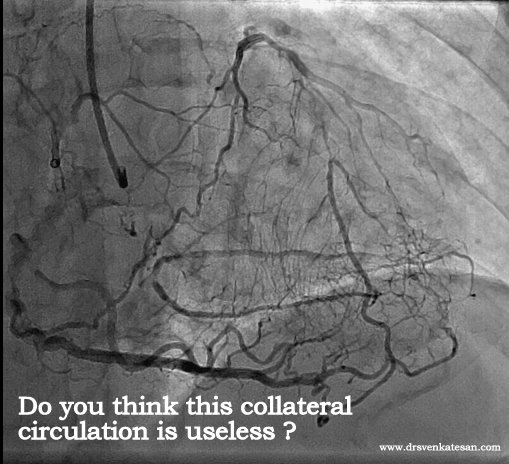
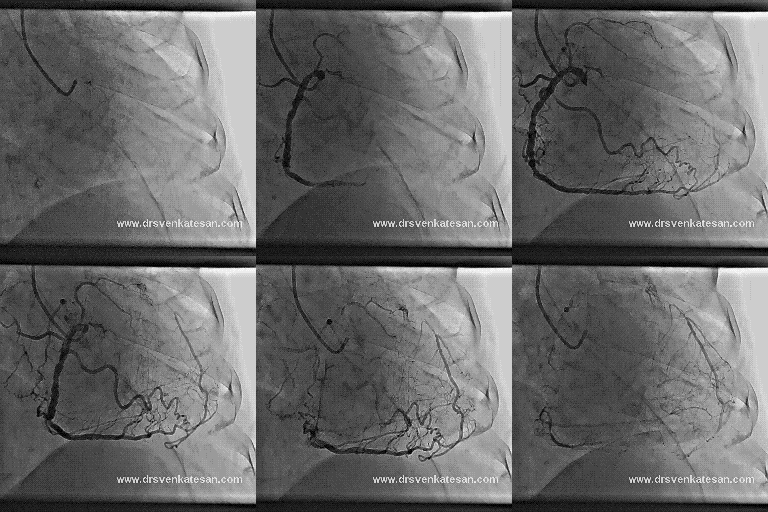
Here is an example of total LAD/LCX  occlusion with good collateral  from  RCA. He was having  stable  angina on medical  management . This patient  was not only  asymptomatic and was also negative for exercise  stress test at moderate work load .


There was an  intense debate about the management  when this angiogram was presented in the cath meeting .


  • Most of the cardiologists believed so !  But they had no answers why his stress test was negative.
  • The other argument for CABG was one can not allow a patient with a functionally single coronary  artery (RCA) However good is the collateral circulation.This at least  has some logic. not the first one !
  • One more suggestion was to quantitate  and map the real extent of ischemia by PET scanning and then decide about revascularisation.
  • One critical opinion was , since he was doing well with medical management what was the need to do coronary  angiogram at all ?

Any answers  . . .

He  ultimately went on to receive CABG (By popular opinion ) , but the point here is the collaterals were  good enough to support exertion.We have  documented quiet a few similar patients with collateral circulation supporting exercise.

What  happened to the collaterals  and (of course ) the patient after surgery ?

I will post you the  curious story soon   . . .

Final message

Coronary  collateral circulation , if well developed  can provide hemo-dynamically useful support even at times of exertion *

* The existing literature  is  biased against this concept. It generalizes all grades of collaterals into a single   entity. It is better  if we  spend more time to understand the nuances of coronary collateral circulation .

This is the  message from our observation. Do not ever believe whatever is published as facts in scientific literature. Observe, analyse , create your own inference ,  and concepts. Mainstream cardiologists would brand it unscientific  , Simply ignore it . Many times it is rewarding  to our patients.

Read Full Post »

« Newer Posts - Older Posts »