Feeds:
Posts
Comments

Archive for the ‘Uncategorized’ Category

What is a successful outcome in unstable angina ?

  • Preventing a STEMI
  • Preventing an NSTEMI ?
  • Complete cure of angina and patient becoming pain free
  • A negative stress test at 30 days
  • Converting him/her into  chronic stable angina  subset ?
  • Preventing recurrent ACS (Stable angina allowed >)

Achieving the above goal without a need a for PCI/CABG can be termed the ultimate success

  • UA is the most heterogeneous group of CAD population. The mortality and morbidity widely varies. All of the  above are therapeutic targets.
  • One of them is converting them into a chronic stable angina patient, which imply the plaques are passified, stabilised, and the risk of future  ACS is  minimized.
  • Further CSA patients are more amenable to longterm medical management.
  • It can be argued avoiding a revascularisation  procedure (PCI/CABG) by itself  , could  mean a success in the management  of UA .

This is because any revascularisation (ie meddling with human coronary artery with metals or grafts) confers an added risk of future  ACS* (Than a  naturally stabilised UA) This is because,  every future episode of  angina in a post PCI or post CABG patient  by definition becomes an unstable angina . Further , these patient’s  lifeline is dependent  on disciplined lifelong antiplatelet  protocol.

* Post PCI/CABG patients are  often  under  privileged care ! This may include pseudo emergencies due to non cardiac chest pain . This results in    unnecessary 911 calls , admissions , inappropriate coronary care ,burden of  check angiograms etc .This notonly  increases the cathlab burden but also  the economic burden of the  nation’s  ailing health resources.

Final message

It is suggested ,  the world cardiology community  should consider ” attaining  a medically manageable ” stable angina status is an acceptable therapeutic goal in patients who present with  UA. This is because,  the cost and consequences  of eliminating  angina  in toto , in  these patients  may not be  worthwhile and it is often  futile or some times  even fatal !

Read Full Post »

Magnesium is a powerful cell membrane stabilizing agent. It is well recognized to act on the cerebral motor cortical cells and  suppress seizure , especially in eclampsia of pregnancy .

Mg SO4 is still the drug of choice for seizures of pregnancy. It  was soon realised  ,  the  molecular basis of  cellular excitability    is    similar  for  every cell  . And  thus , we got this  great antiarrhythmic drug !

  • Magnesium is a  cofactor in the enzyme Na /K ATPase in the myocyte cell membrane
  • Integrity of this enzyme is essential for proper maintenance of the intracellular potassium levels.
  • Many times hypokalemia can not be  fully corrected by administration of K + alone .
  • Co- administration of magnesium  increase the intracellular K +    and hyperpolarize the cells and make  it less excitable.
  • Further , magnesium competes with ca++  ions  to enter the cells and thus   it is a natural calcium blocker. This property also helps in controlling refractory calcium dependent  cardiac arrhythmia.

Indications for magnesium

  • Torsades de pointes . Note:  Magnesium does not shorten the QT interval significantly but still effective in torsades.
  • Any refractory VT especially , post MI.
  • Digoxin induced , hypokalemia dependent atrial tachycardias, MAT

It is administered 1-2mg boluses of 2-3 boluses.

Where we should not use magnesium ?

Routine Use of magnesium in recurrent non sustained VT following MI is not recommended .(Courtesy ISIS -4 trial )

Reference

http://www.ncbi.nlm.nih.gov/pmc/articles/PMC1368485/

Magnesium : Nature’s own calcium blocker

http://www.ncbi.nlm.nih.gov/pmc/articles/PMC1368485/

ISIS 4

Some think ISIS 4 was a delibrate attempt to defame magnesium !

Read Full Post »

The term  left main disease (LMD)  invariably  creates  a  near  panic  reaction in   many of the   contemporary cardiologists . It may be acceptable   in  a broader sense, but it need to be realised , there  is a significant group of patients  with  isolated  non critical  LMD . Many times , these patients can be managed effectively with  intensive medical management.

However , the  following rules may be applied in the management of non critical isolated LMD

  • In patients  who present with unstable angina  ,there is nothing called non critical LMD .Any degree of lesion (Even a 20%)  is significant .
  • Lesions with irregular margins, hanging eccentric  plaques are always critical irrespective of obstruction.
  • LMD involving LAD /LCX ostium need to be tackled as an  emergency .

What are the safe left main disease ?

  • Isolated tapering  left  main artery .
  • LMD  with <  50% lesion.
  • A left main patient who is pain-free on a tread mill > 10 METS
  • Left main with stable angina responding well to medical therapy
  • New onset left main disease in a patient with functional LIMA to LAD /LCX *

*This is sometimes called protected  LMD.  Protects what ? Protects the LAD ,   in case of  complication occurring during LM stenting . If the  function of  LIMA graft is good enough to  protect LAD , why should we attempt to open  the diseased LM in the first place ?  It is an unanswered question !

Why is it riskier  to  stent an  insignificant  LMD or stable  LMD ?

A  left main artery ,  engulfed with a  50%   stable plaque is less riskier to develop an  ACS than an  artificially  normalised  left main lumen with a stent. This is especially true for the  drug eluting stents which need life long  dual antiplatelet therapy as the drug which is supposed  to  prevent  the  restenosis ,  interferes  with  the normal endothelialisation over the stent .

In effect,   PCI   especially  with a DES for a hemodynamically insignificant lesion is fraught with a risk of converting a stable  lesion into  potentially vulnerable lesion !

Final message

A discerning  reader may ask , is it possible at all ? . . .to  have a   patient  with LMD  & enjoying  good exercise capacity ?

Yes , it  may be  rare , but not “non existent” .  Remember ,  one of   the common cause  for  rarity in medicine is ” non recognition of a  fact” or   otherwise  called ” Ignorance”

It is an irony , LMD is considered  by many as a  homogenous  entity ,  even as we  acknowledge  there is a  huge spectrum of lesions among left main disease . There is a distinct (although small !  )  subset of LMD * where medical treatment could be ideal and PCI  may even carry greater hazard.

*The most important caveat in assessing a LMD  lies  in the   50% criteria. Calipers  we use ( often visual )are never going to estimate the lesion correctly considering the importance of  Glagovian  phenomenon . As of now ,  we have no simple means to  measure the vulnerability of a left main plaque .Thermography, OCR/Raman spectroscopy/ RF intravascular ultrasound would probable redefine the indications for intervention in LMD.

Legal issue in LMD

Can we  defend in the  court of law, if a patient loses  his life,  who was adviced  medical management for LMD ?

Any thing can be defended in this funny world of  judiciary . A person who kills in broad day light,  hundreds of  innocent lives can argue  he has never seen a gun ! and he may even,  be  acquitted  for want of evidence  !

How can we   prove  with evidence , the  death in question  occurred  “only because ” he was  adviced medical management ?

No court on the earth can prove it !

So , an occasional life lost due to an unintentional  judgment  error can  easily be argued in favor of the noble profession . Scientific  guidelines are only recommendations .If a person with a  significant LMD  due to  a smooth stable plaque , who has  little  symptoms , carry on with his daily activities comfortably  , his  cardiologist has every right to advice him  medical management.  The doctor , can not be penalised , provided  , he has explained  to the patient ,  that  he is deviating from the official guideline only  for the benefit of   the patient’s  health and  he   has  fully understood the issue.

Read further , for  more controversy !

Land mark  randomised control trials (RCTs) are generally  done in specialised centres with high degree of expertise . They rarely represent the real world patients  seen in  the remote towns (or even  cities ) of the  developing countries  .We can not equate a PCI  done in an  angiographic core laboratory , say in Cleveland or Mayo clinic  ,  with that of  cath labs  ,  that  works  with par time staff and non dedicated cardiologists . So , in these situations  intensive medical therapy (which do not have a geographical variation in efficacy! ) would score over complex procedures .

Read Full Post »

It is often said , old thoughts  die hard ! It is more so in medical science as we realise ,  perceived fears and  physician phobias  have a long shelf life . A  few  case reports of  verapamil induced acceleration of accessory pathway conduction  was enough , to create a   global  perception among physicians and cardiologists  that any drug which acts on AV node is dangerous in the management of AV nodal reëntry tachycardia (AVRT)

This is a gross perception problem due to dispropotinate importance given to a remote possibility  . Thus ,  a  great therapeutic concept was  put on the back burner.

AVRT is a macro reentrant tachycardia that traverses both AV node  , accessory  pathway  ventricle & atrium .This  tachycardia can be terminated by interuppting  the path way  any where in the circuit .

The most easy and simple option is  to block the   AV node ( Verapamil, beta blockers, even digoxin !)

These drugs have cured many thousands of AVRTs  in the past  .As our knowledge progressed , we  found  , it may not be safe to block the AV node in WPW as it could  divert incoming signals through accessory pathway and result in 1:1 conduction and  possibility of  VF

As soon as this concept was flashed all over the cardiology journals in early 1980s cardiologists  took it as sermon . At the same time, lots of new anti arrhythmic drugs were developed  and this concept came in handy to promote all these new class 1 c and class 3 drugs which are supposed  to act more on the accessory pathway and hence projected to eliminate the risk of  VF.  

It was never  minded ,  all these new group of drugs has it’s own pro arrhythmic  properties  like  prolonging   QT interval   and has a potential to precipitate dangerous ventricular arrhythmias 

So, by the turn of   millenium calcium blockers and beta blockers have been removed form the  cardiologist mind in the management of WPW/AVRT

What is the reality ?

Verapamil or betablocker induced sudden death in WPW is a grossly exaggerated concept in clinical cardiology .Treatments and procedures with many fold risks is being practiced in every walk of cardiac patients.

Complete heart block  and related morbidity  during RF ablation of WPW syndromes can easily exceed the   of verapamil induced  side effects  in WPW.

 How to  identify potential patients who are likely  to develop complications  with AV nodal blockers in WPW syndrome ?

The key determinant is the accessory pathway refractory pathway . If it is < 250ms  the chances of accelerated conduction is considered high. EP study is needed to measure accessory path refractory period.If it is > 300ms the accessory pathway is unlikely to condcut fast .

Is there a  non invasive bedside method  to estimate  accessory pathway refractory period?

NO, It is not possible , but some clinical clues are available .

  • All concealed accessory pathway have very high RP *thats why they are concealed .Since they can not conduct antegradely   resting  baseline ECG do not show any evidence for preexcitation . They  are  safe .
  • These patients can develop only orthodromic tachycardias as the accessory pathways allow only a retrograde conduction  and AV nodal blockers are ideal in them as there is no purpose to use Amiodarone and  related drugs as antegrade  condction thorough accessory pathway is naturally blocked .
  • Intermittent WPW syndromes  have negligible risk of fast antitrade conduction. As episodes of  disappearance of delta wave indicate the antitrade conduction has a tendency to get blocked so no great worries.This is especially important if the WPW disappears at higher heart rates .

This clearly tells us  , many times  accessory pathway  shares some of the decremental properties of AV node (Applying automatic  electrical  breaks at higher  heart rates ) and it is a safety mechanism .The exact incidence of such property is not known . So , it may be a good idea  to subject patients with WPW on a treadmill and look for it’s  influence on delta waves and degree of pre excitation  .Even a few normalised beats  or prolonged PR intervals can give us assurance  against  rapid rates at times of  AF .

*One should  also remember , if a concealed WPW , manifest only during excercise it is the most dangerous group of patients in whom AV nodal blockers are absolutely contraindicated . They are immediate candidates for ablation . The above phenomenon  tells  us  , during excercise  the  AV node expresses the decremental conduction properties while accessory pathway  does not !

 Final message

Verapamil and betablockers are not  the  drugs to fear upon in WPW syndrome.In fact ,  even in this era of  hi tech cardiac care , it has a  useful role to  play  in the chronic management of WPW .

May be ,  it need to be  used with  caution . Atleast  , some  efforts  must be taken to estimate the refractory period of accessory  pathway before prescribing these drugs.

Using with caution is not synonymous with contraindication   

Read Full Post »

Diastolic dysfunction  as concept  has  come a  long way after  initial hiccups . Now,  it is a well established  left ventricular pathology  , and has   a  sound physiological and molecular basis. Even though there are variety of methods available to quantify  LV diastolic function,  echocardiogram is the simple method to identify and grade diastolic dysfunction.

There are 4 grades of diastolic dysfunction

1.Impaired relaxation  (without elevated filling pressure)

Some  describe another grade  1 a  with elevated filling pressure

2.Pseudonormal mitral inflow

3.Restrictive -Reversible

4.Restrictive -irreversible

What is pseudo normal pattern ?

The grade 1 is the  most common type  diagnosed  . It is diagnosed when the  A  velocity is more  than E velocity . This  simply implies ,  ventricular filling needs greater assistance from atrial contraction than in resting conditions. It is so common , especially in elderly ,  many thought it should not be considered a pathology . In youngsters it is definitely pathological especially if it is persistent.

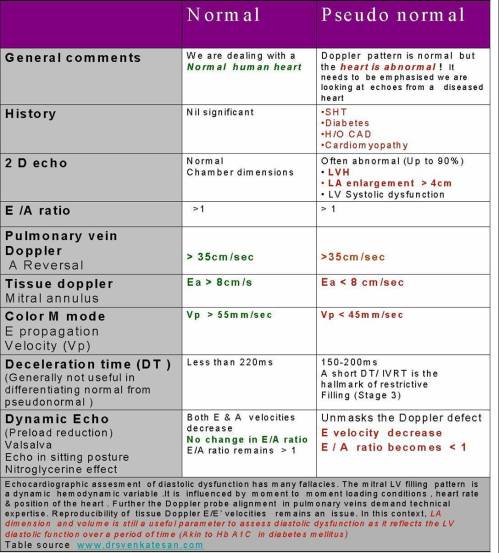
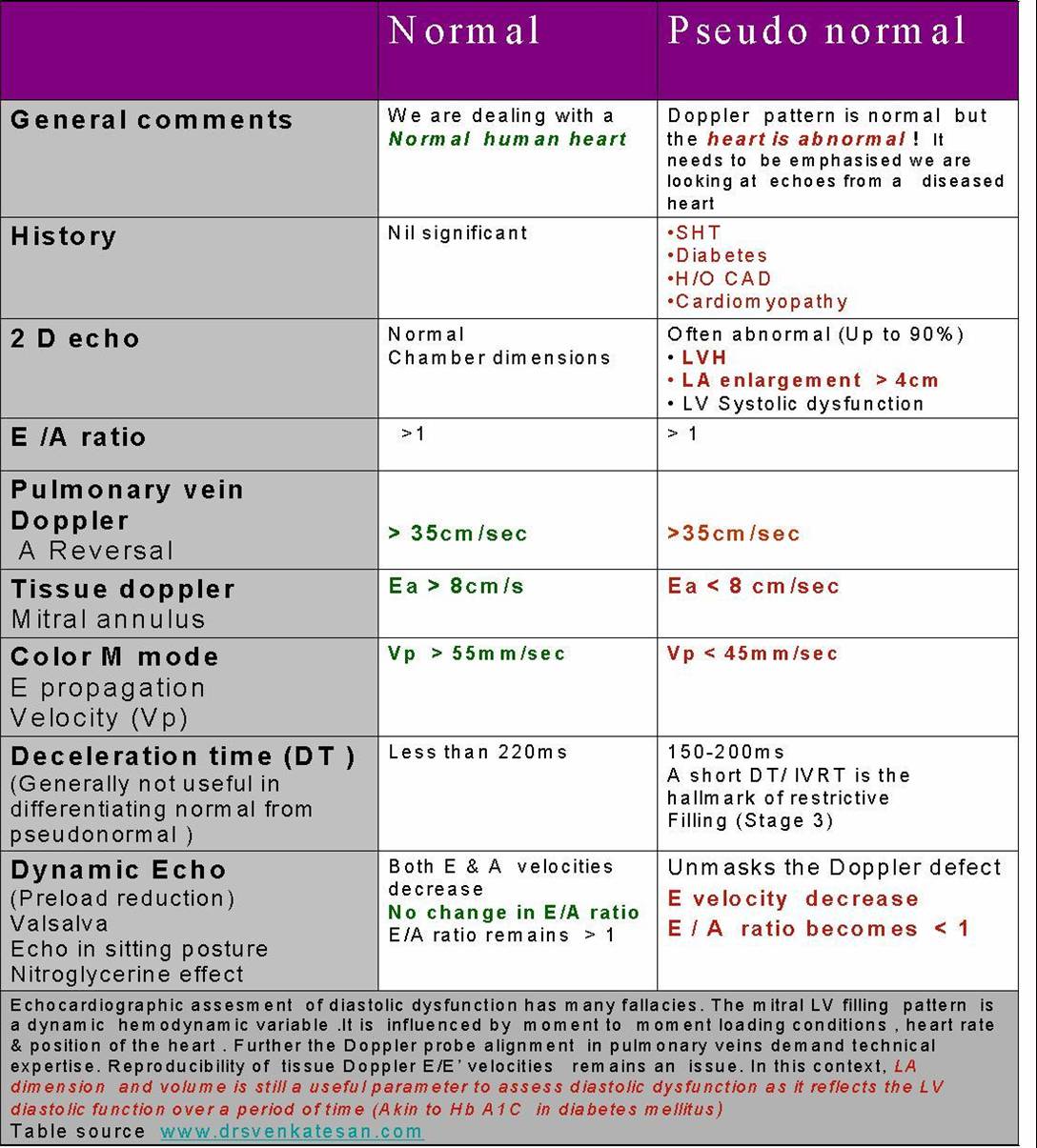
The issue that  really concerns  us  is  this  : When the diastolic dysfunction  progress  from grade 1  to grade 2  ,  the mitral the inflow  doppler pattern ,  instead of showing any  new changes simply nullifies the changes that occurred in grade 1 and  records a normal E : A velocity .

So , a person with grade 2 diastolic dysfunction will have a near normal pattern .Of course  deceleration time, and IVRT is shorter than in grade 1 but it is not very useful in differentiating it from normal .

Pseduonormal is  actually  equivalent to moderate diastolic dysfunction , but the abnormality is masked  as near normal  filling is restored with atrial assistance . So,  technically it a  assisted LV filling . A  superficial  look at the doppler pattern may exactly mimic normal . But there will be a  2 D echo  abnormality  that makes the patient  pathological . Our eyes need to look  beyond  doppler  ( in coherence with  2 D ) to differentiating  normal or pseudo normal.

It is learnt  ,  2D abnormality of LV or LA occurs in nearly 90 % of grade 2 diastolic dysfunction .(There can be a pure functional grade 2 diastolic dysfunction  without structural changes in LA/LVH in minority -This is poorly understood form of silent sub clinical CAD manifesting only as diastolic dysfunction  )

Traditionally  there are few methods taught  in echocardiaographic schools  all over the world to differentiate normal from pseudonormal

1.Pulmonary vein  doppler

2.Response to valsalva maneuver

3.Tissue doppler etc

One simple echo feature  that is   often forgotten , that can be really useful in differentiation of  normal from pseudo normal is    left atrial dimension

While patient with pseudonormal who  have  progressed   into  stage 2  will show a  definite left atrial abnormality .
When does a left atrium begins to enlarge in diastolic dysfunction?

  • It depends  on LA thickness  and  LA afterload (LVEDP is the afterload for LA)
  • It is generally believed  LAE  will be there in almost all cases of grade 3  diastolic dysfunction.
  • It is present in  majority of patients  with grade 2 as well . But the degree  of LAE may be less  ( 4-4.5cm)

It is yet unclear ,  the onset of LA enlargement in diastolic dysfunction .This is potentially a research topic for the fellows !

It is not uncommon  to find   LA enlarge  like a balloon even in stage 2  of diastolic dysfunction. So , in patients who are suspected to have  pseduonormal  doppler profile , look for the presence of LAE  , (however mild it may be !)  , there is no business for LA to enlarge in normal persons.

Ofcourse , if  you are a echo expert one can measure A reversal in PV doppler, tissue doppler echo etc .But remember a simple 2D echo feature like a LA dimension / LVH   may score over the sophisticated (Also read complex  . . .) parameters  in the grading of diastolic dysfunction

Final message

While  we  immerse  ourself  in   sophisticated doppler methods  to differentiate normal from psedunormal pattern, the fact that  , normal persons will  have normal hearts  is often forgotten , and    presence of left  atrial enlargement (Which is all too common in pseudonormal !)  straightaway   settles the issue . Detailed diastolic function studies are warrented only if the LA size is normal .

*Correction: in table A reversal in normal is less than 35cm/sec

Read Full Post »
Ectopic beats , other wise called premature depolarisaton are one of the common ECG abnormalities  diagnosed by physicians.

  • Atrial premature beats (APDs)
  • Ventricular premature beats(VPDs) 

APDs and VPDs  form  the bulk of all clinically important ectopic beats.

Heart has a specialised electrical conducting system , every cell in this system is capable of firing on it’s own. But why then only the atrium and ventricle produce ectopic beats .Other structures like AV node, His bundle , purkinje are relatively rare to produce ectopic beats .

Is the AV junction relatively immune to develop JPDs?

The answer to this question would be  “May be yes” . Yet, we need to recognise they may not be as rare as we think , many times we fail to  diagnose  it or rather recognise it !

Certain observation about Junctional premature depolarisation are made .AV junction has unique properties than any other parts of the heart.The basic purpose of AV junction ( AV node is not a preferred word as it has no anatomically distinct demarcation)  is to apply a electrical break on the incoming electrical signal .Nature does this with a purpose .   It is essential for the ventricles to fill adequately . We call it as PR interval.

So, when the basic purpose of AV junction is slow down the conduction it is logical to expect it won’t get irritated that  easily  and  result in ectopic beats. So JPDs are less common than other forms of ectopic beats.

What is invisible JPD and HIS ectopics ?

We should realise many of the JPDs  & his bundle ectopics are not conducted ,  the impulses simply dissipate down hill .  Unlike the atrium and ventricle the junctional and his tissue has no associated chambers to depolarise , hence they are not  often visible in the surface ECG.The only evidence in the surface ECG may be an unexpected pause which represents concealed conduction. A EP  study  of the bundle  ECG often unmask these silent JPDs and His VPDs.

 JPDs are  less common  , while  junctional escape beats are the  hall mark of any  severe supraventrcualr bradycardia . How  does  that occur ?

AV junctional cells have  an unique behavior in that , it comes to the rescue of the heart whenever the native SA node becomes too slow  . This happens as a passive response .We call this as junctional escape beat.The major difference between a JPD and Junctional escape beat (JEP or JED )  is in the initial timing of the beat . Escape beat comes late .The coupling interval of escape beat (We generally use coupling interval for ectopic beats only , but  it helps to understand )  will be longer than the previous sinus cycle. So escape beat is never premature (Rather a  post mature beat !) .Ectopic beats are always premature ,( except Interpolated ) and occurs earlier than the next anticipated beat.

The other difference is escape beats are tolerated well as the primary purpose is to rescue back up.Their rate is generally equal to the  intrinsic rate  of AV junction ie around 40-50.

General characters  of  Junctional  premature beats and tachycardia

  • Fortunately rare,  fires at a  higher rate.(Unlike junctional escape beats )
  • Enhanced automaticity is a common mechanism
  • Reentrant JPD is rare , unless the patient has AVNRT or it’s variant  physiology.
  • Manifest as narrow qrs complex . JPD with aberrancy is distinctly possible .In that case differentiation from VPD may be difficult.Retograde  P wave morphology may help.But it is non specific as VPDs also have varied atrial capture depending upon the VA conduction .
  • Causes include Hypoxia,  (Rarely ischemic junctional tachycardia. ) common causes include  digoxin induced , post operative states, incessant JT
  • JTs are Difficult to control.Overdrive pacing may be needed. May lead onto tachycardic cardiomyopathy.
  • A benign form of junctional ectopic tachycardia is also reported .

Importance of Junctional escape rhythm

The role of AV junctional escape is vital in extreme bradycardia , as if the junction fails to escape the dangerous ventricular cells take  over  electrical control  and that’s  bad news for the heart  with  sinister consequence.The situation can rapidly degenerate to VT  , what we call  as phase  dependent or brady dependent VT. The treatment for which is increasing the proximal heart rate. By isoprenaline or pacing. So the AV junction does  a delicate balancing act .At times of tachycardia it blocks unnecessary impulses.At times of extreme  bradycardia it assists the heart as escape rhythm . The problem here is many of the disorders that affect SA node , affect the AV node as well .So ,  AV node may not be able to help the SA node always.That is the reason many extreme myocardial end up with VT straightaway.

Final message

JPDs are not very uncommon as one would believe.It has some unique properties. There are vital difference between JPDs and junctional escape beats.JPDs can trnasform into JTs in local pathological milleu and as a rule they are difficult to control.

AVNRT is also a type of  junctional  tachycardia  but,  it  is delinked from  the ( unofficial  ! ) classification of JT  , not  with  any  academic purpose  but by tradition.

Read Full Post »

The commonest cause of ST elevation is  STEMI .

The non infarct causes of ST elevation include

  • Pericarditis
  • Early repolarisation syndrome
  • Hyperkalemia
  • Brugada syndrome
  • CNS injury

What is the mechanism of ST eelvation in pericarditis ?

The mechanism of ST elevation in STEMI  is  injury current coming towards the recording lead. In pericarditis  we are not  sure  about the presence of  injury current  because pericardial cells are not  capable of depolarising and repolarsing .But ,  the fact that  epicardium and visceral layer of pericardium are anatomically  are almost same entities .Attempts to rip off visceral pericardium from myocardium ie epicardium is often futile .This makes it very obvious  any true pericarditis  must involve epicardial layers of the heart.

How does inflammation of epicardium  lifts the ST elevation ?

This again is a mystery .The   effect of   inflammation   on the polarity of ST segment  is  complex one. Diffuse and global ST segment elevation with concavity upwards  is the hall mark of pericarditis. This makes us believe pericarditis has to be diffuse  and involve  the entire  circumference of the heart.

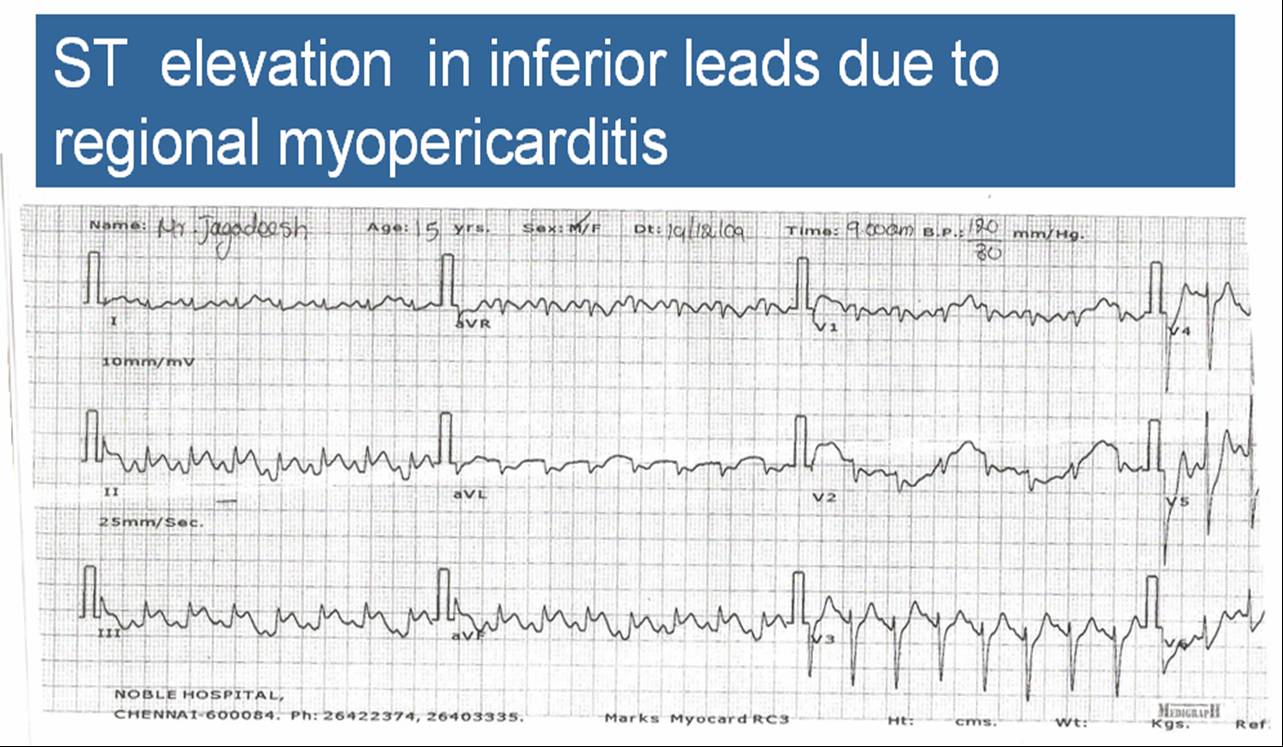
Logically and realistically  this happens rarely . Many of the pericarditis are localised and regional . Even regional constrictive pericarditis are reported .The factors that determine the ST elevation in pericarditis  depend on the  spread of the inflammatory process beneath the epicardium .If the inflammation is active  andeep  ST elevation is likely to be  prominent.

The ECG is  that of a 15 year old boy  with a febrile illness .  He developed  severe myopericarditis .The echocardiogram showed  global hypokinesia and severe LV dysfunction .Patient failed to respond  with  medical therapy and succumbed  after 48 hours of onset of shock .

Can we localise pericarditis with the help of ECG ?

It is possible. But there is no clinical purpose to do it.

Can troponin be elevated in pericarditis ?

No it should not happen in pure isolated pericarditis.But , epicardial involvement can result in inflammatory damage  to muscle and troponin can be elevated. When pericarditis occurs as an accompanying manifestation of pancaritis troponin  is bound to elevate (Fulminant pan carditis of acute rheumatic fever)

Final message

Pericarditis need not be diffuse and global infact pathologically it is rare to have global pericarditis  . Localised pericarditis especailly adhesive type , which involves the  posterior  /anterior  epicardial layers can mimic an  either inferior  or anterior  STEMI  . This has important clinical implication as unneccssary coronary interventions can be avoided.

Do not expect  text book descriptions for any ECG pattern in clinical cardiology .

We will be rarely  correct . . .

Read Full Post »

PAH  is  the major determinant of surgical outcome of left to right shunts. In this  modern era of cardiac care  allowing a child  with   left to right shunt   to progress to a  stage of   Eisenmenger syndrome  is  considered  as a  huge medical failure . But  , this is still rampant in many of the developing countries .

Cardiologists are divided over the issue of  operability of Eisenmenger syndrome .The confusion is largely due to the conflicting data of outcome in these patients. While  there is strong   data  when  PVR exceeds  SVR  ,  the death is imminent in the post operative period .

What has complicated the issue is   there are  many case reports  where severe PAH patients have been successfully operated. Most would think it is a statistical exception and one can  not alter the traditional criteria based on few case reports.

But ,it remains an irony as on 2009 ,  we do not have a proper methodology to assess reversibility of PAH in Eisenmenger syndrome . Further ,  there is a  significant number of  patients with high PVR  , who continue to experience  an  unabated left to right shunting .  We do not have an answer  for either the mechanism of such shunts and  how to manage these patients.

Click over the slide  to view full  PPT  presentation in PDF format .

This short paper was presented in the Annual scientific sessions of cardiological society of India 2009 regarding the usefulness of a new parameter to assess reversibility of PAH. This may not be called as  a study rather a report of  our experience  in  five  patients  with eisenmenger syndrome

Download the full PPT presentation in PDF  format.

pulmonary artery pulse pressure

Read Full Post »

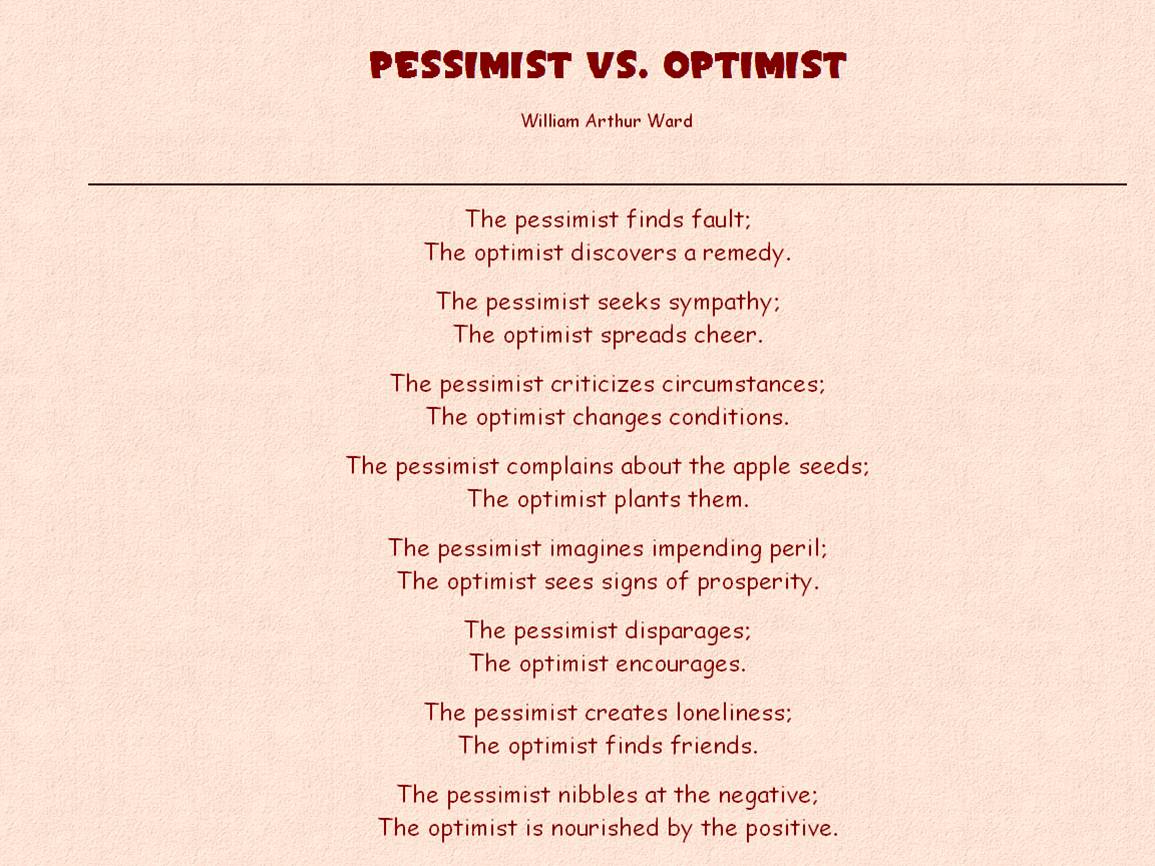
Pessimism, from the Latin pessimus (worst), is a state of mind which negatively colors the perception of life, especially with regard to future events.

Understanding pessimism is not that simple  . Some people argue  optimism   represents a strong mind while  a pessimism  is the domain of the weak . But it is not necessarily true.  Both pessimist and optimist are unreal , and playing the dangerous game of predicting the future. So realism is the answer .

In this era of information highways , commercial exploitation of science ,  our thought process is grossly determined by our perception of events.We hardly have an intention or time to analyse our thought process.

  • An optimist  ( Rather , unregulated optimist ! ) is a person who welcomes  any growth good or bad.*
  • A pessimist  is  a  person who welcomes only good growth.*

So how to identify good growth ? That is the million dollar question!

  • Many of the  optimists may not  bother about the final outcome of a treatment *
  • A pessimist bothers only about that .
  • An optimist  rarely asks questions, blindly accepts every thing !
  • A pessimist never believes any thing !

Actually the fundamental principle of scientific medicine lies in proving the null hypothesis null and void.Any treatment is useless until proved other wise .  So pessimist can be argued to follow true science , while  many of  the hardcore  optimists are blind believers ..

*It may be  a harsh   way of  interpreting an optimist  but  uncontrolled optimism  has played havoc in our  patients like many of the failed treatments (Some of them released prematurely into patient domain   has  killed many lives  . Power of positive thinking should be within the  realms of scientific feasibility !

So in  our  journey   to  conquer human health ,   we   may  proceed with  an optimistic mind and  a pessimistic eyes !

This understanding is all the more important in this era of contaminated science .It is a well known fact ,  now last 50 years of  planet earth has inflicted the maximum damage  to ourselves  than our ancestors did in 5000 years. That’s why we are compelled to meet at Copenhagen .(We never learn from our mistakes, that’s a different story !) .

There is definite and urgent  need for world summit  on  cleansing the medical science from  the clutches  of commerce  and ignorance . A medical green house effect, with dangerous holes in health care  is imposing on us (Another pessimistic thought . . . of course in the interest of human kind !)

World health organization ,  a sleeping giant has to be awakened on this issue


Final message:

Mankind has evolved over many millenniums ,  probably with a sole  purpose of living ,  that is reproduction and propagation of our genre without harming the environment and other species.

Unrestricted  and unregulated growth of any kind is dangerous we call it as malignancy in pathology .In science , we tend to call it a” great future ”

Our  sixth sense*  has  outgrown  miserably  out of  reality  , as have we decided to take on the nature and GOD .Now , many developing country men do not believe in death .They are fighting a losing battle against the God. And they suffer with escalating health costs of keeping the elderly ,  alive who are  knocking at the doors of heaven or hell . The same countries,  which deny funds for curable illnesses of the poor is a different story altogether !

The principle of modern medicine  would ideally  be

  • Reduce human suffering irrespective of economic status
  • Curing a illness if there is a cure
  • Prolonging life if there is useful purpose
  • Allow a good quality death if there is no cure.
  • Most importantly  , prey to god give us strength and capacity to identify which is good and which is bad for our patients  .

Read and learn for a  complete guide on optimism and pessimism

* It  is  important to recognise , the same sixth sense  has   made it possible to share our views through a great tool of  Internet  . So we should not be against the growth of science but against the misuses and wrong interpretations of it .

Pessimism

Optimism

The traditional characters  of  a pessimist

//

Read Full Post »

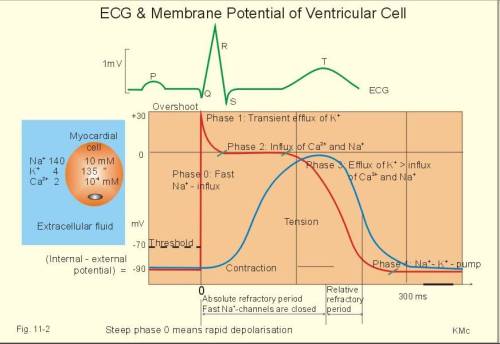
Here is  the link  to  one of  the best illustration for cardiac action potential  which I  have stumbled upon !

Spend some time on the following illustration  depicting  the  normal  cardiac  action potential that  explain the ionic movements . Understand why a cardiac muscle has two refractory periods , why there is a sustained dome for  myocardial action potential  and this is missing in SA and AV nodal potential ?

Click below to reach the online book

Textbook in  Medical Physiology And Pathophysiology

Essentials and clinical problems Copenhagen Medical Publisher

Note :

Red curve indicates electrical action potential .Blue depicts the mechanical contraction . Both red and blue curves together form the electromechanical systole. Realise  ,   QT interval  represents electro mechanical systole . It  includes both cardiac depolarisation and repolarisation .

There is a inherent tendency for our brains  to equate depolarisation with systole and repolarisation with diastole .It is totally a wrong perception. Please , be aware of this !

Identify the gap between the  red and blue curves that represent 50%  of ARP  .This is the time the myocytes can not be stimulated whatever be the  power of stimuli because the Na  channels are closed .

Understand ,the above action potential  represents only half of the cardiac cycle as diastole is not fully illustrated here .Recognise  the fact ,  diastole begins at the end of phase 3  and  goes into phase 4 as diastolic depolarisation  by a slow Na current.

After learning   the basics of action potential   read about the antiarrhythmic drugs . You will get to understand it better .

Learn  which drug acts on which receptors or channels and what does it do  to the various intervals  .For example ,  any drug that is prolonging an action potential  duration is fraught with risk of  ventricular arrhythmia as it is synonymous with prolonging QT interval (Eg Class 1 A /1B/Class 3) .

Sicilian gambit is the receptor & channel based classification for anti arrhythmic drugs . (Sicilian gambit 2 )

  • Understand the paradox of  QT interval getting shortens with Class 1 B (ligocaine /Mexilitine ) while 1 A  does the opposite !

Class 1   Drugs blocks sodium channels .The blockage  occurs in  a complex rate dependent fashion . It blunts the slope  the phase 0 and hence prolongs the action potential .

Class 2 . Beta blockers

Class 3 . Blocks K + Channels and hence prolongs the AP

Class 4  .Calcium blockers

Finally  don’t forget to say thanks to Copenhagen medical  publishers  for this excellent illustration .

Read Full Post »

« Newer Posts - Older Posts »