Feeds:
Posts
Comments

Archive for the ‘Uncategorized’ Category

                                                          Left main coronary  lesions are  fairly common  during routine coronary angiogram.These may be a critical or a innocuous lesion.The  word “left main” triggers a sort of alarm reaction to many cath lab staff as well as the cardiologists and surgeon.Many times, these left main lesions are detected in patients   with chronic stable angina who have stable symptoms. Left main disese has not been graded  clearly in literature . Often it is perceived , any lesion in LM is serious.

There is an unwritten rule,  rather a medical compulsion  to take a patient  with left main disease  for emergency CABG ( Now some centres ,emergency PCI) .Some institutions make it  a rule these patients  are posted  in the  next available slot in the theatre.

 The basic question we raise here is   “Should we consider all  left main  disease  as  an  emergency”?

Not really , especially when it occurs in a stable angina .One can wait , buy some time to fully evaluate and prepare  the patient  and may be the patient can be posted  as an elective case. It is a well recognised fact that, CABG carries adverse outcome when done as an emergency procedure. This is primarily due to inadequate pre op work up and resultant complications. It is also well known ,  surgical  back up team may not be available in full strength in odd hours .

This post is  to convey the message , that left main is  a serious disease but that doesn’t  mean it should elicit  a panic reaction and be taken as an ultra emergency . There has been many morbid and fatal outcomes in many hospitals due to this apparent  pseudo emergency !


Note* 1.Left main  disease during acute coronary syndrome is to be seen in different perspective.2.Some of the proximal LAD lesions are so tight and  could be more significant than left main lesions.
Read Full Post »

Is reciprocal ST  segment changes  occur  only in STEMI ? Can it occur in UA/NSTEMI ?   


                      Even   after   100 years of electro cardiology   the electrophysiological mechanism of ST elevation in STEMI  and ST depression in Unstable  angina is   still in the hypothetical stages. One popular theory   says that the   current of injury   as we see   as  ST  segment elevation  in surface ECG  is  actually   an illusion. It’s   apparently due to   constant negative current    pushing down the   rest of ECG segments. Ironically   the concept   of  reciprocal ST depression in patients who have  ST elevation is well debated  for over 3 decades and  is considered  a  settled issue. It   probably   represents , a  purely electrical phenomenon where the  tail end  of the  lead   picks up the opposite vector. Even   as   conflicts   continue to confront the basic electro physiological   concepts management    strategies   of   acute coronary syndromes is witnessing   great strides.
Aim
                                     We   hypothesized   if   ST depression occurs as response to ST elevation it’s logic to expect strong ST depressive forces should  possibly elevate The ST segments in the reciprocal leads .
In fact  we have seen this phenomenon in three distinct  clinical situations. 
1) ST   elevation   in posterior leads: Patients who present   with isolated   ST depression in V1,  V2 , V3  and  ST elevation in posterior chest leads V7, V8 .These patients were initially thought to have isolated posterior MI. But later the cardiac enzymes were found to be normal   indicating no myocardial necrosis   echo evaluation revealed wall motion defects in anterior segments rather than in posterior segments. CAG revealed critical   LAD disease .  This we believe a pure reciprocal ST elevation in the posterior leads to  a  ST depressive forces in anterior leads.
 2) Inferior  ST   elevation   with ST depression   in   V4- V6 : Few  patients who present with  infero    lateral STEMI   later  do not  evolve into  Q  MI but as a NSTEMI .The initial ST elevation  was found  be transient and  disappeared  much earlier,  while the  ST depression  lateral leads persisted.
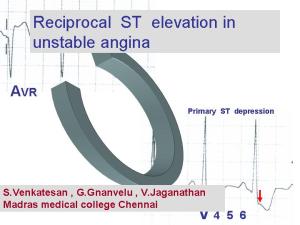
 3) ST elevation in AVR   in high risk unstable angina :As   already reported in the literature,  we have seen  ST  elevation in AVR  in patients with  high risk unstable angina. This was   more often observed when there is > 3mm ST depression in V4-V6. The AVR  ST elevation  possibly   represents   the  reciprocal  vector.
    Conclusion
                                            ST elevation in certain   specific leads in   some of the patients with ACS,   could   be   a pure reciprocal   electrical phenomenon   to   dominant ST depressive forces in Opposite leads .  And hence   ST elevation in the surface ECG during early hours of ACS   should be interpreted more cautiously. The   sanctity   assocociated with ST segment   elevation   could  be  opened   for debate. 
 
                                     To down load full PPT  click on  the slide

//

Read Full Post »

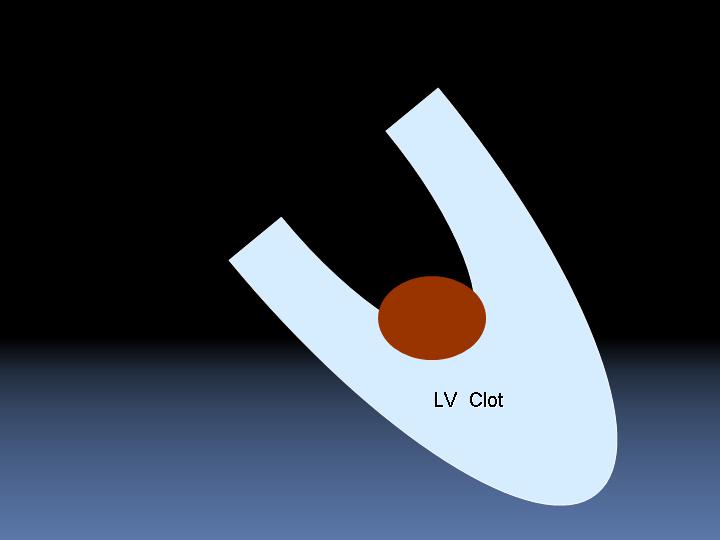
LV clot formation is one of the important complications of acute myocardial infarction. Preventing this is difficult and managing this problem is still more difficult.Some of these clots are linear and laminar along the shape of LV apex and carry less risk of dislodging.

 While mobile LV clots , even if it is small can cause a embolic episode. Most of these patients have a significant LV dysfunction and they are candidates for early CAG and revascularisation. Even If the coronary anatomy is very ideal for a PCI these patients are often sent for CABG and physical removal of LV clot . If  only ,we have an option to remove these LV clots by a catheter based modality, we can offer them a totally non surgical cure.

This is not impossible,  considering  we are in the era of percutaneous implantation of prosthetic valve in Aorta ! The only issue is potential embolism into carotids and periphery .A temporary distal protection at the level of aortic root will prevent that .

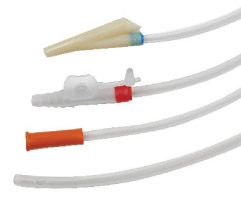
Device companies shall produce one such exclusive catheter system to remove LV clot.

Dr .S.Venkatesan, Madras medical college, Chennai,India

Read Full Post »

Atherosclerosis is  the number one killer of mankind  .It involves all medium and large sized blood vessels.Any intima and media can be invaded by the disese process.Most common to involve are  cerebral, carotid, coronary, aortic  and it’s branches, renal, and peripheral arteries. But how pulmonary artery is missing in this list ? Is it really true (or) are we missing it ? One logical explanation is pulmonary circulation is a low pressure circulation and the maximum presssure is less than  30mmhg . This pressure may be insufficient to induce endothelial injury that predispose lipid mediated injury.

Other explanation could be a structural difference in the media and intima compared to aorta .But in patients  with primary or secondary pulmonary hypertension where,   inspite of PA pressure being high ,  still atherosclerotic changes is very uncommon . or Is it the Heath Edwards pulmonary vascular sclerosis  grading  reflects nothing but pulmonary atherosclero-thrombosis !

If this is true there could be a major role for HMG Coa reductase inhibitors in altering the natural course of pulmonary obstructive vascular  disese . Statins might be tried in PPH  a disese with no specific  treatment !

Read Full Post »

The left atrium always  dilate to pressure overload.And it almost never hypertophies even whne the mean LA pressure raises to high levels. Why ?

1.The atrium basically has little muscle cells to hypertrophy.The left atrial thickness is only 2mm.

They are basically designed to passively fill the ventricles. But this is not always true  physiologically.We

 call it as booster pump and 30% of LV filling is  contributed by active pumping of  left atrium. 

2. The second reason for left atium not gettting hypertrophied  is ,  there are four decompressing exits

(safety  valves) in left atrium  namely, pulmonary viens. In fact it’s a paradox the back pressure across

pulmonary circulationmay result in RV hypertrophy

Inference & potential research areas

If by some mechanism if we can induce hypertophy of left atrium will it be a mechanical advantage for left ventricle in failing hearts .By cell therapy we can convert inert atrial cells into activley contracting cells.

DR.S.Venkatesan, madras medical college,  Chennai, India .

Read Full Post »

2b -3a antagonists have revolutinised ACS management .

But the irony is Reo pro is approved for use only  inside cath lab or on the way to cath lab ! when PCI is done . 

If PCI with stenting is planned,  then subsequently cancelled due to  minimal coronary lesion or spontaneous reperfusion  what will be the effect of Abxicimab on outcome ?

Message 1

Abxicimab (Reopro,Faximab)

Useful only if PCI and stenting is done.

Dont use it for regular managment of UA/NSTEMI

Read Full Post »

Aberrant cardiac conduction can occur in any of the specialized cardiac conduction tissues. Rate dependent aberrancy is the most common cause of aberrant conduction.

Generally it is thought only supra ventricular impulses can undergo aberrant conduction. But it is not always true.

Many of the ventricular tachycardia which  have inherently wide QRS complex can further widen their QRS width when it conducts fast down stream.This is especially true  in many of the septal VTs and fascicular VT  which  are falsely diagnosed as myocardial VT. These proximal VTs which other wise would have been a narrow QRS VT are converted into wide QRS VT by functional aberration .

Message :

Don’t always think SVT only has a potential to undergo with aberrancy

The VTs also can  behave similarly.


Read Full Post »

Patients  with permanent pacemaker  can have disastrous consequences  if inappropriate sensing of external  electrical events during surgery. Electro cautery or diathermy should be used judiciously .

1. Aviod diathermy if possible.

2. If neccessary use only bi- polar diathermy .

3. If bipolar diathermy not available use the indifferent electrode pad away from pacing  zone , behind  the thigh.

Other options.

A .Use a magnet to remove the sensing function of PPM. Application of magnet converts VVI into VOO mode so that external current will not be sensed by the pacemaker and diathermy can be safely used.

B.The other option is use the magnet only if interference problem occur .Magnet should be availableas safety measure.


Read Full Post »

« Newer Posts