Feeds:
Posts
Comments

A middle-aged obese man was referred  to me  for  an emergency  echocardiography

The patient was unable to lie  either supine or left lateral  . He could lie down only  right lateral posture  that too for a minute .An ultra fast echo gram was completed . It  was  entirely  normal . His ECG was also normal.

When I  asked for x ray there was a surprise

Note the shrunken thoracic space  on both sides .The  fundus of stomach is  almost fighting for place with left ventricle in the thoracic cavity .

No wonder he is severely orthopnic  (But fairly comfortable on erect posture )

He has a distended abdomen .He is  now waiting for a GE consult. His other complaint is belching   . Is that some form of gastric obstruction ?

I’m posting this image to re-emphasise the  classical  teachings in medicine .

Human body is  a highly integrated  biological  system .We in the name of modern science  has  disintegrated in to  multi organ entity.

This patient was labeled as acute pulmonary edema and the treatment was about to be started.

Here is a patient  with dyspnea and orthopnea  entirely  due to a non-pulmonary and non- cardiac cause !

                                                        All youngsters  . . .  always be alert  . Clinical medicine  is  notorious  for  throwing   surprises , especially when you least expect it !

There were times medical  profession’s  only purpose was to take care of the sick . Modern  principle of living  has contaminated  every walk of life .Medical profession  leads  by example in this race .

How can one justify celebrating a disease in a grand manner in public domain  in the name of increased awareness  ?

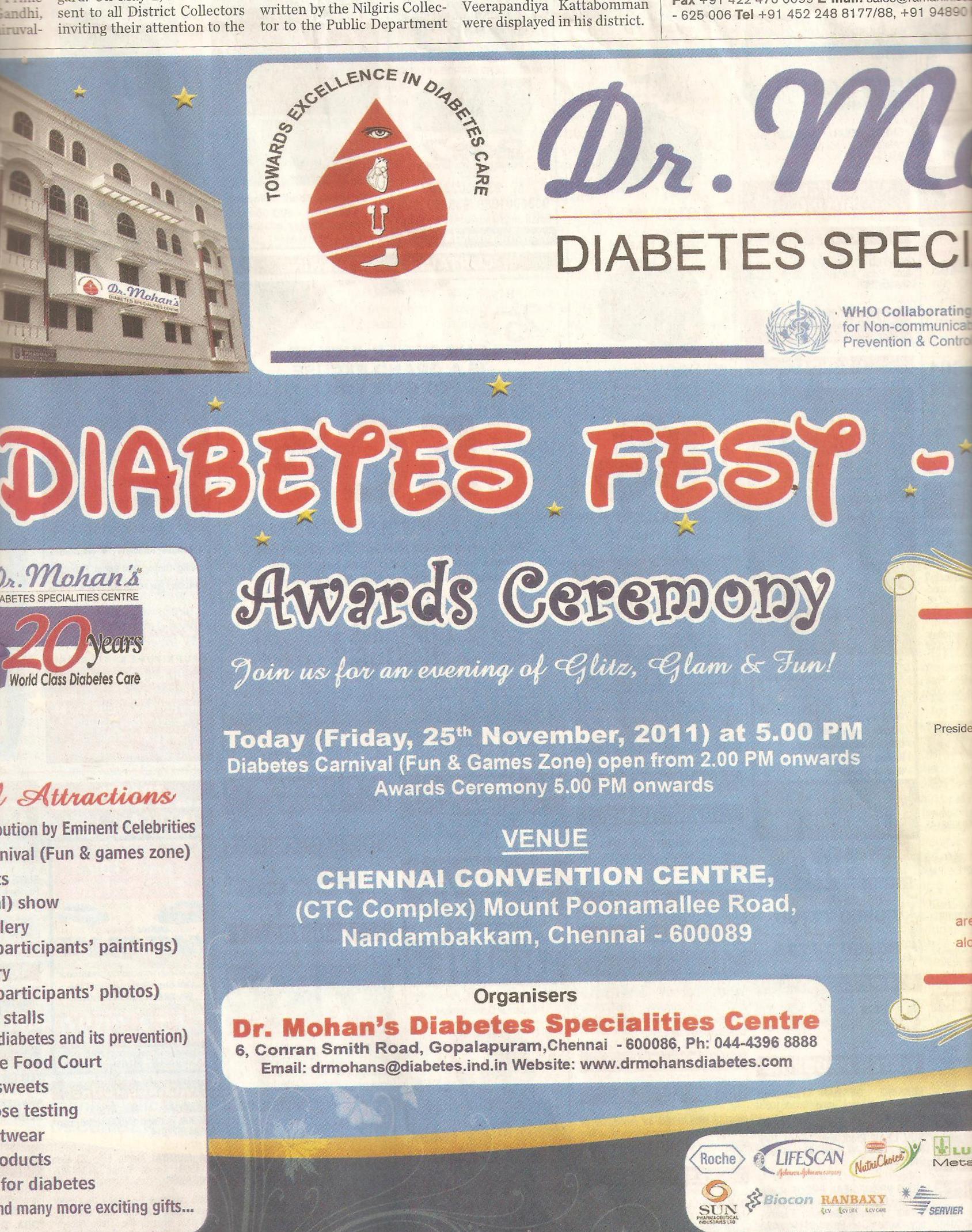
I am shocked to find an ad in a recent  The  Hindu Ad  (25-11-2011)

Some of the words  used are terrible and highly objectionable . It amounts to an  insult to all diabetic patients.

  • Diabetes award !
  • Diabetic  Carnival !
  • Join us in the fun of diabetes !
  • Glitz and glamor of diabetes!
  • Festival of diabetes !

How can a patient celebrate his illness ?

I think  the news paper  which  publish such ads  should also show some sensitivity .

I agree there are lakhs of diabetic patients who do require  intensive treatment  but the fair held in the air conditioned corridors of  a trade center is  never  going to address  this issue.

( Can I ask these organizers to  help and  serve the real diabetic burden in ill equipped public hospitals  across  our state ? )

It  is simply a commercial extravaganza   creating a fear complex among the healthy , rich men and women and make a living

out of   human anxiety . 

Who sponsors these medical  award nights ?

For those who are unaware  of the games doctors and pharma companies play,  here is a shocker – large amounts  of money is pumped into  such public events.

This is part of  a  larger board  room  strategies ( Can it be a conspiracy  !) to increase the per capital consumption of drugs of our population . And no doubt   doctors are integral part of this scheme with or without intention .

While MCI can penalize  a individual doctor  even for accepting a pen as gift from pharma company ,

they can do nothing but simply watch  as millions are  exchanged  in the name research , health education ,  and awareness .

The height  of  the  irony is  , these events are sponsored by WHO and the world  forums as well  !

Ironically   the  doctrine of  modern medicine  seems to suggest   . . .“Ethics is   primarily for individual physicians and do not  apply   for institution ”  This is the single   most dangerous  concept that is  playing havoc with human health”

It closely mimics the principle  of   war justice  . An  individual shooting another individual  is a definite  crime ,  while  multiple  individuals  killing  multiple   individuals   is not a crime , it is a war !

Disclaimer

The author has no  personal grudge  against any hospital or organization instigation. It ‘s   an expression  against so many commercial activities that occur  in the medical filed on day-to-day basis !

WPW syndrome is the prototype of cardiac pre- excitation . The accessory  AV pathway short circuits the ventricle .Since  there are two options  available   for the  incoming  atrial  impulse  to reach ventricle ,  often  times  the qrs is contributed by both .Hence a  fusion  occurs  within qrs complex and stretches it wide   ,  it also  generates a delta wave and short PR interval .

The complexities of  conduction   properties and refractionaries of AV node and  accessory  pathways determine the degree of pre- excitation. When an optimally timed  APD  gate crashes  into the  accessary pathway it gets blocked ,  only to recover little late ,  unfortunately  invites AV nodal impulse  from below  . This facilitates a  re- entry circuit from ventricle to atria and result in classical AV reciprocating tachycardia .

Antegrade conduction through AV node is  physiological and  benign as it inherently checks the heart  rate . Antegrade conduction  occurring through the  accessory pathway  (which  constitutes the pathological  component  ), is   potentially  dangerous  as it lacks the  electrical breaks (Technically called decremental conduction )

What  is the  specific  ECG evidence for  antegrade conduction thorough accessory pathway  in ECG ?

Delta  waves

So,  what does it mean if there is absent delta waves  in WPW syndrome ?

It can mean three things

  1. Concealed pathway
  2. Manifest pathway , but intermittently  blocked pathway.
  3. It is not WPW syndrome at all .

We know concealed  pathways are  safe* as it allows only retrograde conduction. ( Safe  regarding   risk  of  sudden cardiac death ,  still unsafe for AVRT !)

Intermittent WPW

Intermittent pathways are equally  safe  as intermittent absence of  pre-excitation   indicate  the  presence   of naturally occurring     breaking system within accessory pathway . Are these  accessory pathways blessed with some AV nodal cells ?  May be !  . Histological studies do suggest that .This explains   intermittent missing of delta waves  which is  electro-physiologically a good sign

(We also know   there are exclusive slowly conducting accessory pathways like  Mahim and variants  )

If  one is lucky to observe this phenomenon in ECG  it can be termed as  a poor man’s  EP study  . ( Which requires specialized methods to document the refractory period of accessory pathway  to be   < 250 msec)

Techniques to  screen for or / unmask this concept.

Whenever  we  diagnose  WPW one has to look   ,  whether the patient  harbors  this phenomenon .

  • Holter monitoring has a useful role in this regard .
  • If there is nocturnal   disappearance of pre- excitation it would  suggest a safe  accessory pathway.
  • Similarly , if pre- excitation disappear during exercise  stress  testing it  would indicate a  type of intermittent WPW syndrome.

Final message

An astute cardiologist shall  look for this intermittent nature of delta waves  and  help avoid a costly and  potentially harmful EP study !

How early one can shift a patient for rescue PCI after failed thrombolysis ?

  1.  Wait for at-least 24  hours.
  2. A minimum  cool off period of 2 hours is required.
  3. It is never an issue . Rush the patient  immediately to cath lab
  4. The question does not arise  . Often times ,  rescue PCI is a dead concept  as  sufficient damage has happened !

Answer

The irony of  medical science  lies in our belief that every medical query  has a specific answer ! In reality it is rarely true.   In this instance , any of  the above can be a correct response.

A patient with  failed thrombolysis can belong to any of the  64 possible combinations*  based on  time of  thrombolysis , extent of  MI,  associated complications, co- morbid conditions , presence of symptoms . (For example there is  a sub groups of patient with  failed thrombolysis still  asymptomatic  and comfortable )

The issues for rescue PCI  do not  arise  in a   sinking STEMI (Cardiogenic shock ) , or  STEMI with persistent angina. There  is  no  management issues in  these patients  .They need to be rushed to cath lab. Unfortunately  in  impending  LVF or manifest LVF (But not in shock )  decision making is tough , as doing a PCI in patients  with basal crackles  and hypoxia is a real challenge .These are the patients who are likely  to hit hard  from the hazards of the procedure .Extreme caution is required.

I have seen  significant cohort  of  asymptomatic hypotensive patients getting converted into   drug resistant, IABP dependent refractory shock after PCI  ,  making every one look  pathetic  !  The  only solace for the interventionist  is  the gratification  of  stenting the  IRA !

This  happens  , in spite  of having  multi national trained  in house critical care anesthetics and  dual core processing IABP  . Realise  what we need is delicate decision making ,  So use extreme diligence in selecting patients with impeding shock .

Your medical management can  provide  more teeth to stabilise your patient than a PCI .If you are doubt discuss with your learned colleagues .  ( If you  do not  ask for evidence for  this statement , probably  it would confirm  you  as  an  experienced   cardiologist  !)

Real issues pushed to the sidelines ?

While the real issue  in the timing of rescue PCI  may be  different , the discussion traditionally  revolves around   hemo-rheological aspects . We know  the lytics and PCI do not combine well for two reasons.

  • Pro-coagulant nature of lytic state .
  • Excess bleeding risk at puncture site.

Now ,  we have evidence to say fibrin specific lytics  TPA, TNKTPA has less of this issue . ( NORDISTEMI)

Patients who receive  fibrin specific lytics  can  safely  be  taken for rescue PCI  in case it is needed without any increased risk .

Bleeding complication  has dramatically reduced as radial procedures are done often even in emergency setting.

Vascular occlusive devices  have added to our comfort.

* The definition of failed  thrombolysis by  itself is not standardized . Is it symptom guided ?  or ECG / enzyme / echo guided  ? A patient with  infarct  related chest pain (dull aching )  after thromolysis can be labeled as post infarct refractory angina and rushed for emergency angiogram .(This is due to our ignorance  about  the  residual pain signals  through  type c pain fibres  for up to 24 hours )

Final message

The indication and  timing of rescue PCI is  primarily  related   to the  overall   patient profile  rather than the bleeding or pro-coagulant issues .

Although   pro-coagulant  lytic state is based on weak scientific  foundation , it  is a blessing in disguise  as it  can  act  as a deterrent  in restricting  inappropriate rescue PCI !


 Delta waves  are initial 20 ms  (or is it up to 40ms ?)  segment of  qrs complex that is  inscribed due to pre-excited depolarisation of the ventricle due to an accessory pathway .

It is more of a  fusion complex with  native normal qrs complex. The leads in which appear , the polarity and magnitude of these delta waves are determined by

  • Site of APs
  • Rapidity of  conduction through this AP
  • The quantum of native AV conduction
  • Influence of Autonomic tone  and the  refractory period of these accessory pathways .
  • Heart rate , distal conduction velocity , also can influence .

Can delta occur without AP ?
Like any other variation  isolated delta waves are reported in routine ECG finding.   It can be  be present in 0.15% to 0.25% of the general population. A higher  prevalence of 0.55% has been reported in first-degree relatives of   patients with accessory pathways.

How do you account for delta in general population ? We know concealed pathways can not record delta  . . . then it is possible some from of accelerated AV conduction  with twin pathway should be quiet common . ( It is very much possible  dual AV nodal pathway with grossly different conduction properties and distal insertion sites  inscribe a delta wave .)

  The crux of the discussion  of WPW syndrome revolves around  identifying delta wave and its direction .  If  the delta wave is well inscribed this job is easy  but at times  it  can be really difficult .

Many moods of delta wave

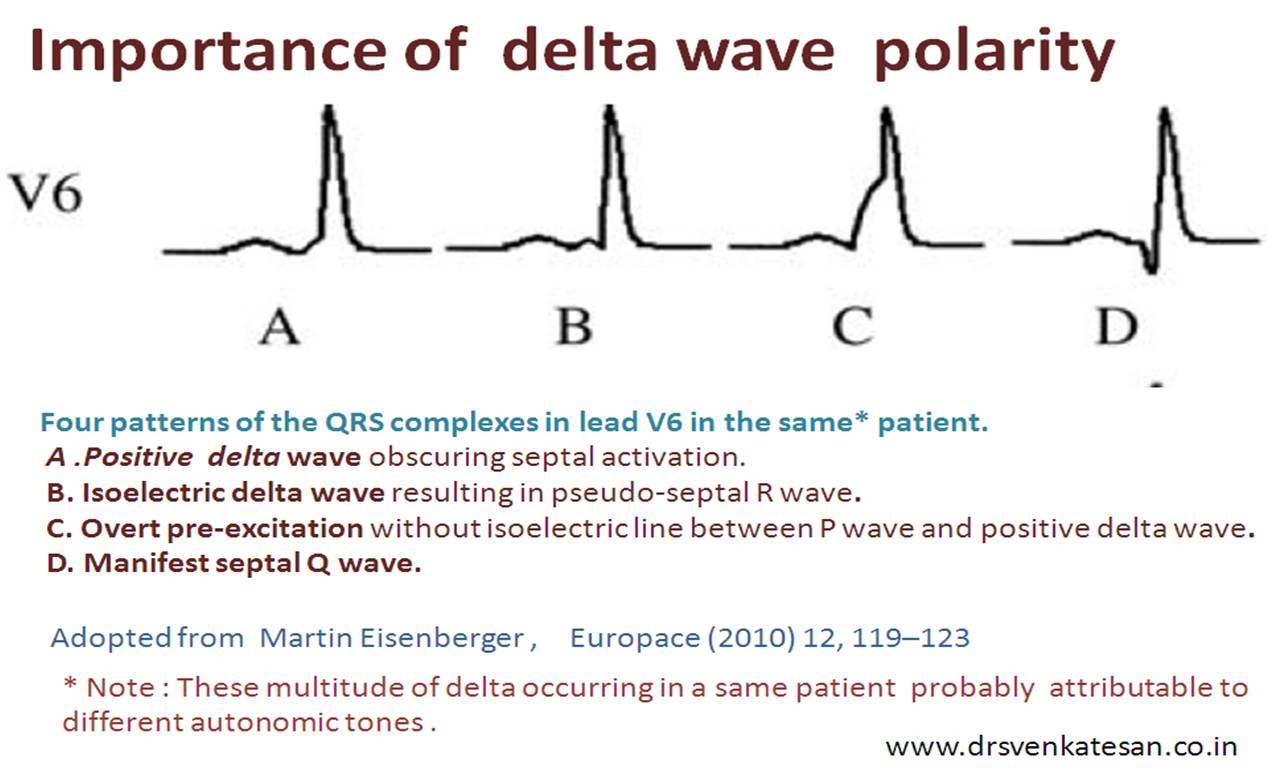
  • Positive delta  wave inscribes  above baseline. (See the above ECG  showing different delta in same patient )
  • Negative below baseline  and  iso-lectric on the baseline .
  • Please note , delta wave polarity and QRS polarity need not be in the same direction . If  they are in  the opposite  direction many time it appears as  small a pathological “q”  or pathological  “r”
  • It is likely  a delta wave can also drag  and  change the direction of qrs depolarisation  if  the  quantum pre-excitation  is large and with a fast conduction property.
  • It is also possible  the combined contribution of  negative delta with negative qrs together make a  deep  q waves . (Typical example is the LBBB type ECG in type B WPW in Ebstein anomaly )
  • Rarely the entire QRS can be  due to pre-excited  tract and native AV conduction contribute less.(This exactly happen in anti-dromic tachycardia ) but  this phenomenon is extremely rare to occur without tachycardia.

Final message

WPW  syndrome is such a dynamic  entity ,  one can realize how futile it will be to formulate fixed rules for ECG localization based on this wave .In fact,  we suffer from a  fundamental  electrical ignorance .How often delta wave polarity is discordant with qrs polarity and what is the  mechanism ? Standard text books do not discuss this issue . Many of the EPs skirt this question ! For this , we need  to critically decode the mechanisms of delta wave generation . Hope our youngsters take up the job !

What is a coronary risk factor ?

Right from the days of  Framingham study we have conferred a privileged   place   to  few  cardiac  risk factors.

they are

  • Diabetes mellites
  • Hypertension
  • Hyperlipidemia
  • Smoking
  • Obesity

They are referred to as conventional risk factors .  What is the convention ?  Do they deserve  the  cult  status they enjoy ?

Today we also have a  cluster  of non conventional risk factors like , Lip (a) , low HDL, Homocystenemia , CRP , Apo B etc . Currently ,  in any large cohort of CAD  up to 30 %  do not exhibit even a single conventional risk factor  . This is a huge number .Hence   we tend to give more importance to genetic make up and mental stress etc  .The search is still  on for newer risk factors .

Why some research  findings are difficult to comprehend ?

It is because we are yet to  decode the  intricacies  of  human biology  fully . Our knowledge is so superficial  , as we chase  a pseudo scientific  proofs   for  a  presumed  hypothesis.  The classical example is the concept called good cholesterol (HDL) and reverse cholesterol transport which  is never based on solid scientific foundations.

Take the sorry story of  Torcetrapib

Many consider  low HDL  as an independent CAD risk factor to be a  myth  or else why should we miserably fail  to have any positive effect of  increasing the HDL  levels by pharmacological means . (One argument is physiological  and natural elevation of  HDL  would still be beneficial  . But the issue is still wrapped in a statistical mystery

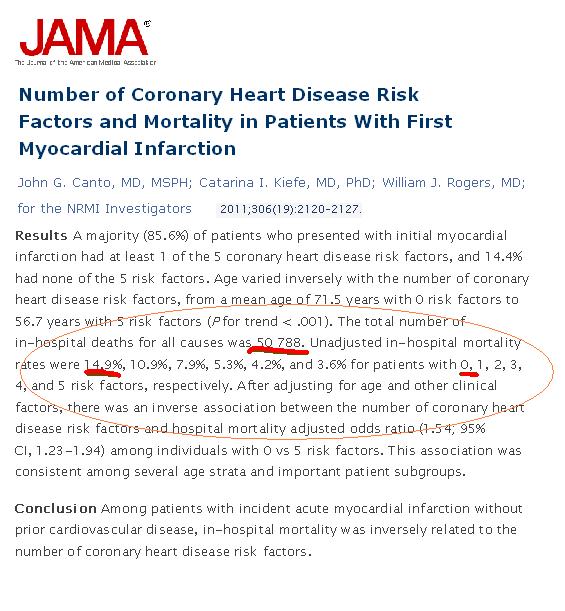
This  paper from  JAMA   adds further insight into our ignorance about  the  genesis of CAD .

The data is from  NRMI registry.

The statistics  reveal  a stunning fact .In  the overall CAD cohort ,  patients  with no major risk factors  experience  highest mortality and the ones with maximum   risk factors have least mortality ! What a shocker of a study ?

http://jama.ama-assn.org/content/306/19/2120

This  paper  would bring  jitters to the population ,  but in the real sense it sends an important message .

A significant population develop CAD without any  known risk factors.(14.5% in NRMI registry )

If a person develops  a CAD without any major risk factor  ,  it seems  . . . it is not at all a  good news   !  rather we need to introspect , why  without any risk factor he or she has suffered CAD ,

One inference is  their vascular system is more vulnerable ! Some hidden factors are operating . How to manage such  patients  without any target to intervene ?   A diabetic dyslipidemic smoker has a   definite  therapeutic target  .

What about these   lesser  humans  who   develop   CAD without any known risk factors  ? They  tend to suffer more !

Is  CAD  due to DM/SHT  is better than  others  ? This study seems to say so ” Known devils are better than unknown ones ”

Final message

Unlearning is an   “essential and fundamental”  component of   scientific learning .  In this progressive scientific world , this applies  most to   medical profession  than any other field !

Exertion and  acute coronary syndrome (ACS) has a tricky relationship. On the one  hand, it  would  appear they are not related at all  as only a miniscule of patients   give history of recent severe exertion prior to ACS   , while  few others  tell us  a clear- tale of   unaccustomed  exertion ,  just prior to the onset of chest pain.

Here is case history  of a  man  who was rushed to our  ER from  Madras central station ( Our hospital is located just opposite to it !  )

A  48 year bank officer  was  about to board  a train to Patna   . It was a rainy  November  evening ,  his car got struck in traffic .He along with  his family members were rushing to catch the rain  .He had  to run fast with his heavy luggage  .Even as they boarded  the train successfully and occupied their  seats  ,   within minutes  he  developed intense chest pain and sweating . The distressed family de-boarded the train and was rushed to our hospital  . Yes  you guessed it right   . . . he  was showing an extensive ST elevation  in anterior leads on arrival.

So what  has  happened ?  What is the coronary hemo-dynamics during heavy unusual physical exertion ?

The above patient did  not have any obvious risk factor . He vaguely recalled ,   one if his family doctors telling him ,  he had borderline high BP and was never prescribed a  drug . His wife told us  he has been a emotionally  liable individual .

It is well  known  , sudden exertion in an  emotional  milieu   would  result  in  intense  adrenergic drive  . (Here the emotion was anxiety/ fear of missing the train )  Adrenergic drive was  amplified with the  isometric exercise (heavy suitcases ) ,   shoots the intra  coronary blood pressure (normal 45-60mmhg)  into  dangerous spikes . (By the way , what happened to  coronary auto regulation  ?) . We also  realise simple raise  of  intra coronary pressure alone is not sufficient  .These patient  will  harbor at least some degree of  atherosclerosis  which face a  shearing stress and give way /tear  or fissure resulting in  a sudden substrate for intra coronary  thrombosis.  Some of them may manifest  only  as coronary vasospasm  .When sustained  it can also result in a full-blown acute coronary syndrome.

The concept of trigger vs risk factor

One should remember  both physical and mental exertion   act  mainly as a  trigger (They are not  major risk factors  like DM/HT/Smoking /Dyslipedemia) . All that is required ,  for  this   vulnerable population  to fire  is a trigger.  Physical exertion ( especially  isometric)  when  associated with  emotionally charged  brain  sends a  perfect  invitation  for an impending  ACS !

Another example  for untoward  effects of  exertion

A middle aged man who had  impaired glucose intolerance and dyslipdemia  was referred for an  EST.He did complete  12 minutes of  Bruce  protocol  comfortably . But  on the same day evening  ,  he felt  uneasy  and came to our ER ,   only to record a full blown STEMI .

These events may be rare but if properly understood   these  patients can teach  us  few   lessons in the genesis of ACS and coronary hemodynamics .

Special  issues  about   exertion in post PCI patients

One of the purpose of doing  PCI  for CAD  is to improve the  functional  capacity  (and possibly to prevent future ACS) . Paradoxically ,  we  continue  to have  some apprehension about subjecting post PCI  patients  into early stress testing . (I remember reading some guidelines that advice us to  avoid stress testing strictly for 6 months post PCI  ! Is it true ?)

If a  cardioloigst  is  not too comfortable  putting their  patients  into a  treadmill  post PCI ,  it only implies they doubt their efficacy ! It   would  also imply  these  patients   should  not be allowed to exert to their full capacity in day to day  life events as well .(Attention  cardiologists   . . . Yeh  . . . we have a  fundematal problem on our hand !)

Modern  day cardiology can do wonders. It can revive a sinking  patient in cardiogenic shock with IABP , LV  assist ,   multivessel angioplasty and bring back  life . On  the other  hand  , a young man with an infected mitral valve who is put on  intensive  antibiotic  regimen   , progressively deteriorates  throws an emboli into brain ,  raise his urea  creatinine  , cardiac   failure worsens and finally succumbs .

This is a clear case of failure  of medical therapy in infective endocarditis .  It is almost certain  surgery would have saved him .

Why  the delay ?

So the question that is been debated for so long is   “When to intervene with surgery in IE”  ?

While we show extreme  urgency for ACS , the same is not shown  with IE.This is going to change in the future .Thanks to the  EASE trial (Early surgery  in  endocarditis )  This land mark study from Korea  is likely to revolutionise  the way we will look into the  problem  of infective endocarditis. It was presented in the just concluded AHA annual scientific sessions  in Orlando

This was  our  observation  too . The issue was discussed in  the year 2008 .It reminds me ,  every  learned  thought or opinion is in fact a paper  but unfortunately modern science does not accept a  fact without evidence of a  study . Until then  it remains  as a crap !

I am glad  to note   genuine concepts will some day  get ratified . Kudos to the Korean team.It is a great study to do with  many ethical issues.

Click below to read the related article

Link to EASE Trial  http://www.theheart.org/article/1313215.do

Next question  on the cards

Should there be  a time window above which medical therapy should be   deemed (Doomed !) to have  failed  , so that the patient becomes a default candidate for surgery.

  • Acute myocardial  infarction is the number one cardiac emergency .
  • About a million papers and articles are available in  medical literature about STEMI.
  • Management of STEMI when they present early is addressed by every text book.
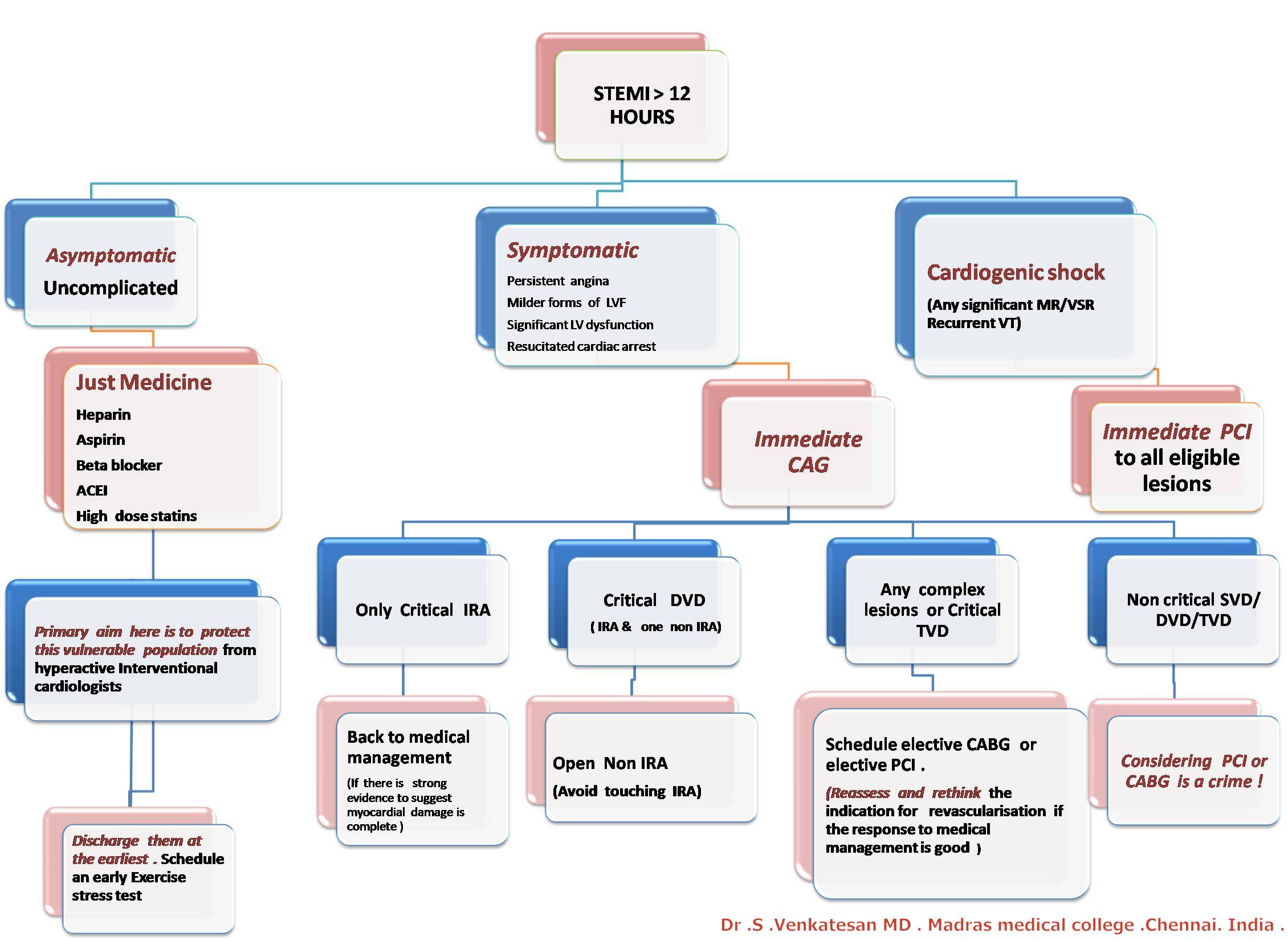
  • It is  really surprising to note there is no  simple and  specific guidelines  to manage STEMI when they present late to the ER .
  • Such a scheme is vital for physicians,  as experience suggest almost 40 % of all STEMI arrive late and are ineligible for specific reperfusion strategies.

The following  flow  chart is  exclusively meant for usage in STEMI when they  arrive late >12 hours .

This is a personalised version based on working in one of the oldest CCU in  Asia which handles  about  2000 acute coronary syndromes every year with a mortality rate of 6-7 %  Hope one can bear with it !

Please click on the chart for a high resolution Image

Comments are welcome