Feeds:
Posts
Comments
  • How do you classify  stent thrombosis ?

  • What is target vessel revascularisation ?

  • How do  you define  peri-procedural MI ?  Is  troponin elevation alone  enough ?

Want answers for all these ? Your search ends here  . . . The academic research consortium criteria committee provides everything free .

A must read for both  mature and immature  cardiologists . http://circ.ahajournals.org/content/115/17/2344.full.pdf+html

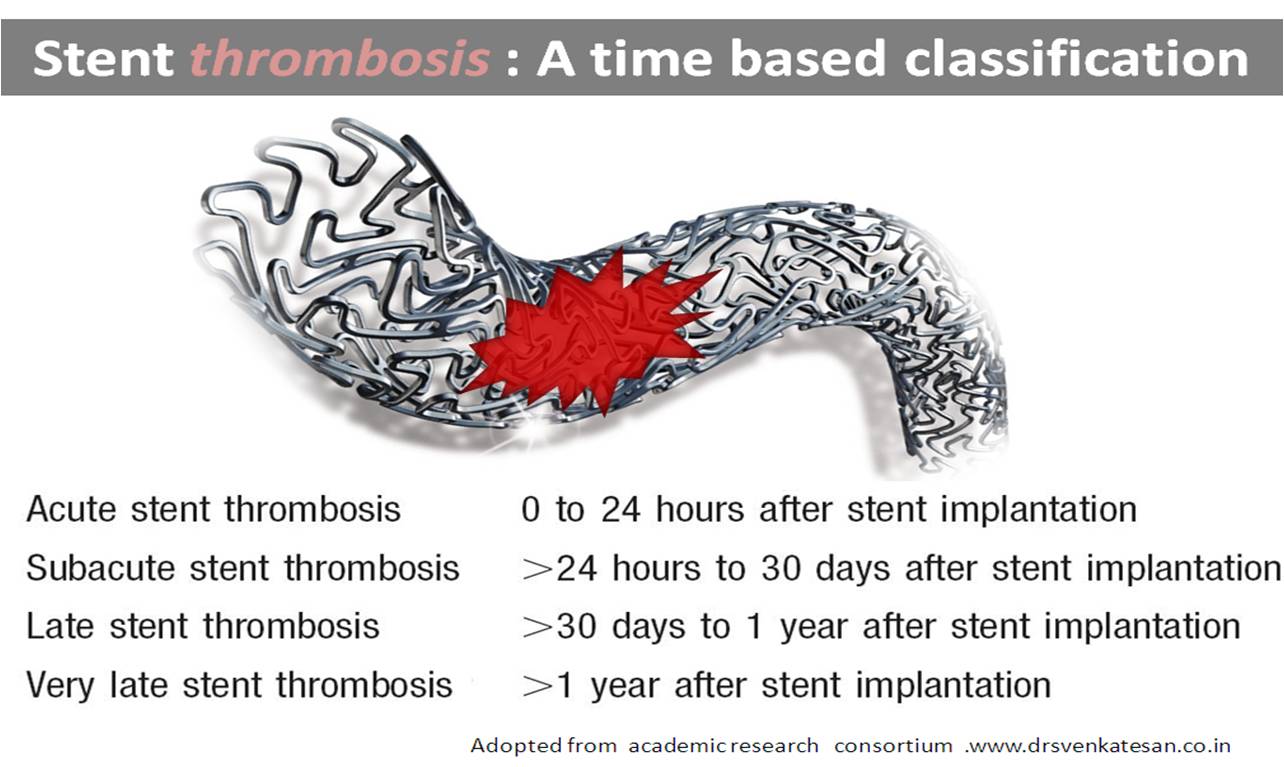
Here is a cartoon for classifying  stent thrombosis (Time based )

There is another etio-pathological /Geographical classification for  stent thrombosis  that will be discussed later.

( Entry block , exit block  , diffuse thrombosis  etc  Read -Geographical miss.)

A word about Academic research consortium

ARC is a consortium of clinical research  from the  Harvard medical school and their associates . The aim of which is  to bring clarity in the  definition of  medical  terminologies and study endpoints.A universal  criteria is being prepared  so that  the study results are comparable which currently use  different criteria  and end points.

For cardiology ARC came out with standardized definition in the year 2007.

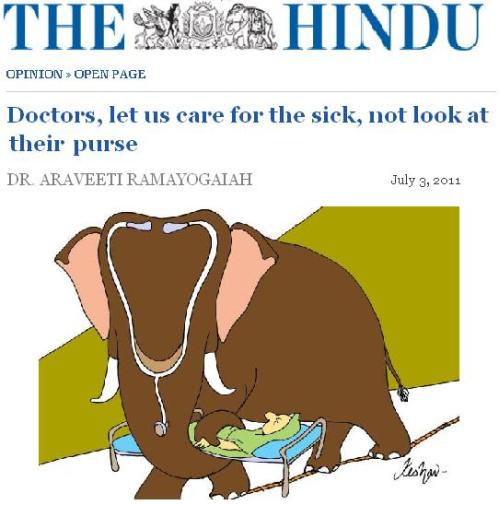
It is heartening to read a series of open page articles in the India’s  national news paper  recently  which  started a  lovely debate about how the medical profession and doctor’s behavior is being perceived in this country . It all began  with this article by Dr Araveethi with   serious criticism  of the ways  and means  ,  by which doctors  indulge in  forbidden unethical acts . (mainly involving  financial  benefits ) Click on the Image to read the article.(Hope it works)
.

While most agreed with his observation  surprisingly one  response by Dr. Manoramma Gadde  tried to justify it !  promptly  evoked strong reactions for and against.
And this   response from  Dr .A.R Antony  to  Dr Manorama Gadde   CAME A WEEK LATER  seemed a  best one. Read for yourself
I  enjoyed  the  entire article by Dr Antony ,   especially when he observes  ethical doctors are a rare breed and even   be a laughing  stock among their colleagues. This is very much true  but as he rightly points out ,  the majority  of goodness should prevail over the minority of evil . ( Let us hope it is not vice versa ,   as  evidence  is mounting  against this assumption  )

What is the role of modern science in  making medical  profession into a  self less service to  service only for self ?

Read  on this article   : Truths when silent are not heard in consultation rooms

Is there acceptable level of unethical   acts  for doctors  ?

100 %   perfection  is never  possible  in any field .

Like permissible carbon levels in environment and permissible  contaminant in tinned  foods  one can suggest  doctors can  also be allowed a quantum of  immorality ! (This is akin to making corruption legal  still the  ultimate aim  is  to control it ) .Probably this is what Dr Manorama tried to convey in his article  !

What is the patients role in the perpetuation  of un-ethicalness  of doctors ?

A patient with  half-baked ( internet  fed ) medical knowledge  asking for various tests   is quiet common phenomenon .  This is termed as pressure prescription . Patient  interference in medical  decision-making and doctors yielding to it is also a rampant phenomenon. Empowering patients beyond a level is unreasonable or not a desired goal.

Why  doctors  continue to be noble   but many hospitals are not  !  How is this possible ?

We have willfully  accepted  medical care  to  become an industry  .When corporate hospitals are listed in stock exchange what do you expect of them  ?  I do not know  how  the current generation of  prepaid medical professionals manufactured   from various  medical  education  factories  in our country side  will behave  . It is them , who are  running these dubious   hospitals and nursing homes . In my observation a genuine and meritorious  medical student is  never  interested in starting a  hospital or nursing home .   He lacks both the business sense and also the  resources . Hence  he  or she  often becomes an employee  of  a hospital  or institution  run   by  capitation fee fed neo- medical  graduates  with  Dalal street mentality.

Counter point

There are thousands of doctors especially in  primary health centres  and emergency wards  working round the clock  in all those ill equipped  poorly staffed  Govt hospitals trying to save lives desperately  .  Similarly  many private practitioners sitting in the remote towns and villages  spending their precious  evening   caring for the sick.

So , the problem lies  mainly in  the  proliferation of  pseudo  – modern medical science  in an unregulated fashion  mushrooming into the urban and semi urban areas .

Solution ?

Never believe the private sector in the present form (*Total chaos)   will provide an inclusive health care  to our population. The recent WHO statistics say India is the only country where  permanent assets like houses ,  livestock are sold by people to get a  seemingly  modern and scientific  health  care .(Poor villagers are  asked to spend their entire monthly salary to  do a costly PCR test (Now proved useless)  to diagnose a AFB positive open tuberculosis  !)

The  current model of health care  in most developing countries   especially India  , which  our corporates are actively pursuing  is counter productive for both rich and poor.

A rich old  man is simply not allowed to die a natural death  without spending a chunk of his accumulated wealth ,  while a young , active   poor  men of our country  die for want of  those  same facilities which goes futile  those dying elite bodies !

*Let me drift  to a  different topic .  The private sector health care is totally disorganized , lies in  complete chaos though  enriched with infrastructure and other resources. What they lack is the terrible common sense. While the Govt sector has  a organised administrative and functional model   with huge expertise  which lies mostly dysfunctional due to various  reasons. Which is causing more danger to society ?   The answer is tough one  It would a  close race between  hyperfunctional private sector  or dysfunctional  Govt Sector .

I dream a day when these private sectors  take over the  Govt hospitals  and vice versa so that both can  complement the best between them.

Final message

Most doctors are really  noble  in their thinking. In  few  ,their action may occasionally touch  the lines of immorality .( The definition of immorality or unprofessional acts are  often reset according to our convenience  ) .

Even if a conscious doctor wants to do  genuine  work in the existing system , he is  rarely allowed to pursue it .  So ,  in   the current situation  most doctors are at risk  of  tasting the bad fruit  every day with or without  their knowledge.

The doctrine of   hospitals  lack  ethical code , while  it is expected  from  individual doctors   is the single important factor that is responsible for the present chaos in medical care delivery

 So in my final analysis  I agree with many of the arguments on  both sides  .Even though  ethical doctors are available they are in a very short supply  . We need much ,  much more  . . .   I am afraid  the future looks bleak !  . . .  with humble excuses to all optimists out there.

What is  your  take on this issue ?
Possibly yes !

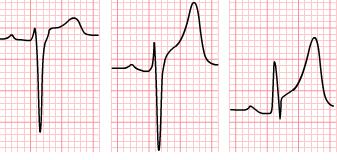
In a preliminary analysis of 50 consecutive ECGs with ERS pattern, only  3  were females .An  astonishingly low incidence of  6 % is it not ? . The 94 % exclusivity in males  demands a  detailed  EP analysis of this entity.


How often you see an ECG such as this one in young women ?

This finding may not be a  surprise ,  if  we  link  another fact  namely  ,  the   longevity of    QT interval  in  women. Repolarisation  begins   when  rapid  sodium channel extinguishes and  potassium  channel starts  firing and  efflux  this cation   from within the  cell  .This happens  during  interface between phase 0 and phase 1. This point  corresponds to the onset of repolarisation.

The onset of repolarisation is not entirely  related to K+ efflux  (Rather  K +  determines largely  the duration of  repolarisation).QT interval is prolonged in females because repolarisation is slow  in women .In men it is early ,  short  and swift .

The mysteries surrounding the ion channels especially the  K+  with vast genetic and gender  heterogeneity  is yet be unraveled. Influence of  sex hormones on  right from the early days of  fetus could be  one  such area for research.

Other  related  gender specific ECG findings include

  • In women T waves rarely grow beyond 5 mm. In young men tall T waves are the  rule
  • An iso- electric or even inverted T waves  especially in leads V 1 to V4  are  quiet a common finding in women.

Link  to  another article  on  Early repolarisation syndrome from this blog

Final message

It is a well recognised  fact  ,  repolarisation  is  brisk  in men  and slow in women  .It is  now  realised ,  the onset of repolarisation is also earlier in most men .  This has a direct bearing  in  the  impact  of ischemia  on fibrillation threshold . Arrhythmias  induced by EADs  are logically more common in  persons with ERS.

Statistics again reveal men are more likely  to have primary VF  during  STEMI  . ( Male Gender  by itself a  CAD risk factor !) .Recently Hassagure  et all   elegantly   documented  ,  ERS is  indeed a risk factor for primary  VF at times of ischemia

Reference:

In the above article , the  incidence of ERS was 72%   in males , considerably lower than our observation . Still ,  the male dominance is confirmed. We still feel  in our country true  ERS occurs in a negligible minority of women. This finding need to be  confirmed  with  data from other centers .

“Limitations of a study”   column appear in scientific articles  because . . .

  1. It  offers   lame excuses
  2. It  informs us  ,  not to get  fooled by  their  finding  .It could  be terribly wrong
  3. The editors won’t publish the paper  without this customary paragraph!
  4. Judge yourself . . . we are transparent !
  5. No study is 100% perfect . Just to make sure the readers are aware of it.

I fail to understand , why even  good articles are rejected for minor  errors  in methodology by many   journals.

Meanwhile ,  how on this earth it’ s  possible  ?   for  some articles to  appear in  top journals ( with questionable conclusions )  embellished
with   major errors in methodology ,  but has  a proud declaration and confession about the  flaws  of the study  in the “Limitations of study” column !

So , in this  modern scientific world  ,  it suggests to me ,  one can  can write whatever  you think as science , as long as  you  declare it and able to impress the editors  to  shift the errors into  limitations column ,  you  are likely to be excused  and also  rewarded !

Often general practitioners refer  ECGs  with abnormal resting  ST/T wave patterns  to cardiologists .

Following are few of them

  • ST elevation
  • ST depression
  • T wave inversion
  • Tall T waves
  • A relatively uncommon  finding is  a flat ST segment  , which  is discussed here.

The commonest( benign) abnormality   is  T wave inversion  in women and tall ST /T waves   reflecting  early repolarisation  pattern in men. A flat ST segment is an occasional finding in general population.

ST segment is inscribed  during the most important  time  of  cardiac cycle.This is the period the ventricle is doing its prime function , namely ejecting the blood in systole .Hence it is subjected to maximum stress . During times of ischemia  ST segment  gets elevated or depressed depending upon the severity of ischemia. For the same reason , even  subtle changes in this segment is  frowned upon by cardiologists. Most of them would receive a EST.

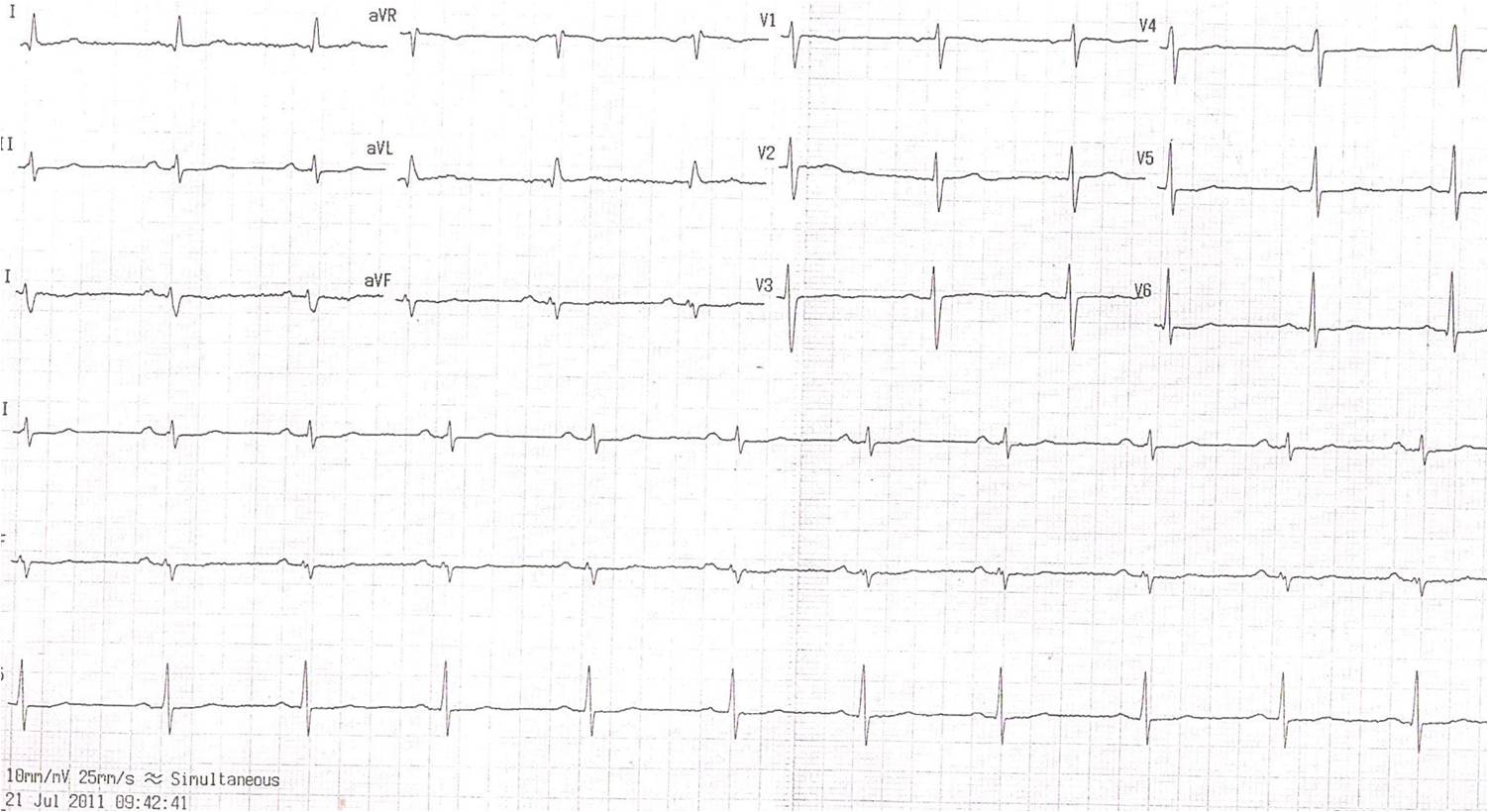
It is ironical to note  , few normal people  show almost silent electrical activity during this  crucial  phase of   their  ECG .ST segment is often  a flat line  in them . This is a ECG of a women referred as CAD. She was asymptomatic . Echocardiogram  was normal . She was asked to do  a EST.

This asymptomatic women was refered for ECG opinion

The peculiar thing about T waves  are ,   a 10 mm upright  as well as  5 mm inverted T wave ,  both can be normal. So .  there is no element of surprise  to note absent  T waves  or a flat  T wave  to be called as normal .

The curious case of lost ST segment !

* T waves are recorded when K+ efflux occur rapidly out of cells . Hypokalemia  can be an important cause of flat T waves.

It is still a  mystery to me  why some people inscribe a tall T when  potassium comes out  of cell and  an equal number (Esp women)  record a down ward T wave  for the same event !  I wish  I get an answer  to this  lingering  question from  any of the readers !

Is a flat T wave represent  a T wave in  transition  to become inverted T wave  later ?

Possible .But we  are not sure ! A static T wave is safer than a dynamic T wave .

Final message

Flat ST segment and absent T waves  represent a same spectrum of ECG  findings  which  are  referred to as  non specific ST segment changes in  clinical practice .Generally , they have  little clinical significance.* In our experience we have found , female patients, Anemia  hypothyroidism  are  often associated with flat ST segments  . If CAD is suspected exercise stress test  should be done. Some believe a flat ST segment  is more likely to  result in EST positivity (Not necessarily true positive !)

* Non specific ST/T changes by itself is a  huge topic.  Ideally the term non specific ST /T changes should be avoided , as it  primarily came into vogue  to denote non ischemic ST segment (Still , other pathologies are very much  possible) It is estimated there are about  50 causes for non specific ST/T changes , right from a  benign situation  like deep   respirations , to significant  myocardial disorders. However , it still makes   good clinical sense for a  general practitioner  , to refer to a cardiologist , whenever ST  segment deviates  without any reason .

Landing an aircraft is a high precision job. A pilot and co pilot with the help of air traffic control  must  do this job meticulously every time .They   are not  afford to make any mistake .Number of lives are at stake.

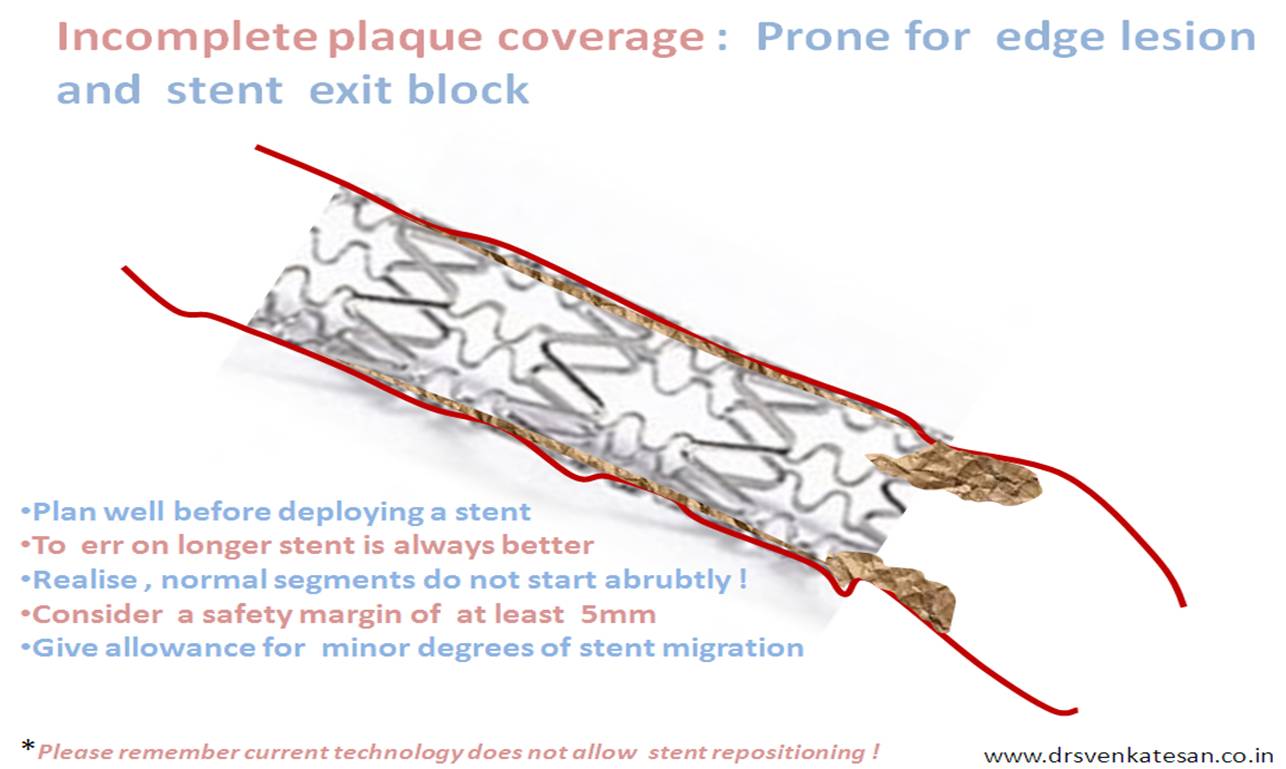
In cath lab something similar happens every day  although a single life is at stake !   We call this coronary stent landing  . If  it lands  wrongly  it is referred to as  geographical miss ,  a descriptive  terminology for a poorly deployed coronary stent !  ( In strict terms it  should be called as  failed PCI !)

But there are few vital differences   between the two . . .

If an aircraft overshoots  the  runway   it is visible to every body and it becomes a national news next day !

If you deploy a stent away from a lesion it is usually a  silent  event  . Only a few alert fellows and staffs know it ! Patient  often gets discharged  next day (of course after paying the bills )  and  the consequence is often delayed  by weeks  or months  when he comes back knocking  the  ER doors with an ACS !

Final message

The stent -plaque  dissociation is  much more common than we perceive ,  for the simple reason cardiologists have  learnt  to accept   luminal shadows  as surrogate markers for plaques . ( Coronary blindness !)

It is imperative to  apply all our senses properly  in the cath lab ,  like  our  pilots  do while they land  . Be prepared  for  turbulent weather which  is common in cath lab as well !

http://www.sciencedirect.com/science/article/pii/S0735109701011123

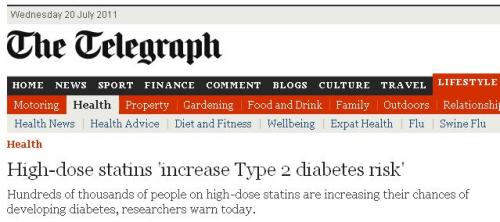
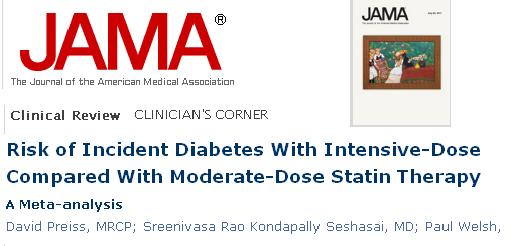
This  article is from the journal JAMA July 2011 , and  “The  Telegraph”  breaks  the News in general media because of   the immense  importance it has  for the public.

http://www.telegraph.co.uk/health/8589168/High-dose-statins-increase-Type-2-diabetes-risk.html

http://jama.ama-assn.org/content/305/24/2556.abstract

HMG COA reductase has a new side effect  when used in high doses. It is  now official ,  it is confirmed by this meta analysis.

According to this study the risk is mainly  with  80mg of Atrovastatin . But  the dose at which the diabetic risk develops is highly variable.

In simple terms  . . . It all depends upon how a  person’s liver responds to ingested statins.

Statins are not  divine molecules  that can heal atherosceloris. It mercilessly  blocks the vital  cholesterol synthesizing   enzyme HMG COA* located in every cell ,  especially  it has a  virulent action in the hepatocytes . We know liver  is the major metabolic hub  which co ordinates glucose and Lipid  metabolism and to certain extent amino acids as well . These statin infested   hepatocytes  can  interfere  with   glycolysis  ,  neo-glucogenesis   and  lipolysis in a complex fashion  . It  would  not require great brains to understand how diabetes can  be induced  by statins !

* Which also has a  indirect cell/  lipid servicing action.

Final message

It is becoming increasingly clear , statins should be used judiciously in whatever dose . We need to be in constant vigil even as   the  human lipid  is under siege  from the   corporate  board  rooms ,  who are  primarily  worried  about  the decline in the per capita consumption of these ubiquitous molecule !

Can you diagnose inferior MI with poor R waves ?

No , you need  a “Q ” that’s  for sure !   Do not diagnose inferior MI without a  q wave  . ( The luxury of diagnosing MI without q waves  is available  only for LAD region )

Any axis deviation ( even 30 degrees) from  base line  can alter the inferior lead qrs morphology to a great extent. R wave amplitude is  primarily determined by the  initial septal depolarisation .  So if the  inferior septum is intact  it will never allow to inscribe a q wave  . Further ,  limb leads are bi polar leads and they are   sum-mated  potential  reflected along the entire  bottom half of the  torso . Hence it is not  reliable to attribute  significance  to presence or absence of  r wave (Unlike  chest leads).

The lung and diaphragm  exert  not only electrical insulation but   also mechanical  alteration of septal profile with phases  of respiration.

Counter point

Not really  . . .  you do not need a  Q   waves  to diagnose inferior MI  ,  electrically  diminutive R  is same as  “Q”

There is  an alternate way of  reasoning  too  . R wave is muscle , We diagnose LVH with tall  R waves so muscle loss should be equivalent to R wave loss .We have innumerable examples where  low voltage R waves are  recorded in inferior leads after a well documented inferior MI.

How do you diagnose old inferior MI by ECG ?

  1. Near normal ECG with degeneration of q waves and regeneration* of  R waves
  2. Residual T wave inversion
  3. Simple low voltage inferior leads
  4. Slurred or notched qrs  complex in 2 3 AVF
  5. Rarely with atrial abnormalities and AV nodal prolongations

The concept of regenerated R is well established . And it brings to the age-old debate of R with live muscle Q is dead muscle

Regeneration is salvaged muscle (Natural salvage , awakening from hibernation etc)

How good is Echocardiogram in diagnosing old Inferior MIs ?

Surprisingly , echocardiography do not help much either .Technically inferior transmural MI  is expected to  leave  a residual wall motion defect.  But many times it do not. Many non q inferior MI (Is there such an entity ?)  do look perfectly normal by echo .

The primary reason  for this is ,  infero-posterior surface is anatomically remote and it makes  wall motion analysis difficult .Newer tissue motion analysis (Velocity vector imaging)  could aid us better.

Some times a trivial or mild  mitral regurgitation is the only sign of   old inferior MI  as  the pap  muscle  lags behind in it’s  functional recovery  while  free posterior wall is  fully salvaged and contracting well .

Final message

It needs  that extra bit of   of  knowledge to  expose  our ignorance.

Even in this  maddening   scientific  era  we have valid  reasons to  go back to fundamentals  of  R wave and Q  wave genesis in MI ,  where clarity  is lacking .

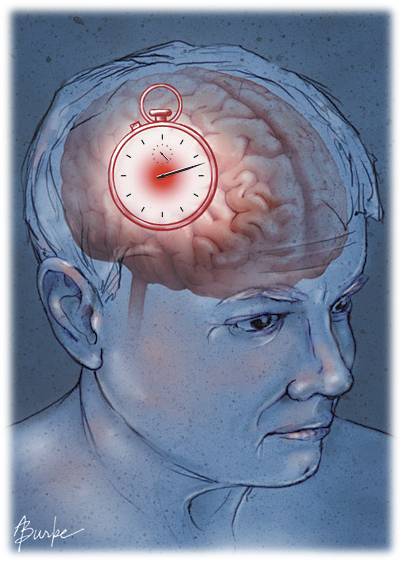
Cardiac myxoma  is  an  infrequent cause of  stroke in young . LA myxoma is the commonest  tumor  that can partially dislodge to cause a stroke.

It is not necessarily a  tumor emboli that causes the stroke  , super added thrombus is   common in cerebral artery histological  studies. ( In fact , some have advocated successful thrombolysis for myxoma and stroke !)

When do intervene in stroke due to myxoma ?

Image  courtesy: http://www.medicalscale1.com

As soon as cardiac  myxoma is diagnosed by echocardiography  it is customary to call the cardiac surgeons for their  opinion and feasibility of removing the tumor  at the earliest.

Myxomas need not be removed in an emergency surgery even if it has caused a stroke!

What is the optimal timing of cardiac  surgery in patients  with a cardiac cause of stroke ?

  • Stroke is a major vascular  event .Immediate cardiac  surgery is another major vascular  insult .
  • Extra corporeal circulation is known to affect cerebral perfusion  even in normal persons. In  patients with  acute stroke  this   can  have vital impact.
  • Anticoagulants used  peri -operatively  increase the risk of   converting  a simple stroke into hemorrhagic  one.

Hence , it is advisable to wait for 4 weeks after a stroke before removing the myxoma . One can not expect a controlled studyon this issue .  It  is to be  based on collective  experience of many.

Who should decide ?

A cardiologist, a cardiac surgeon and neurologist should  collectively decide along with patient’s input ( or his proxy)

When there is  a dispute in timing of surgery  Neurologists opinion shall prevail over others as the immediate concern is brain function.

Is there any  indication  at all for doing early surgery ?

High risk mobile tumors demand early removal as further strokes can be avoided. Individual discretion and institutional preferences apply.

Reference :

1 http://www.ncbi.nlm.nih.gov/pmc/articles/PMC2627525/pdf/TOCMJ-2-115.pdf

2.http://asianannals.ctsnetjournals.org/cgi/reprint/8/2/130

3.http://www.ncbi.nlm.nih.gov/pmc/articles/PMC3064861/pdf/crn0003-0021.pdf

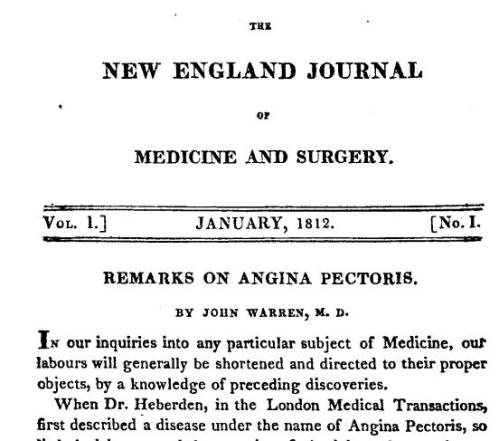
It was  the year 1812 ,  exactly 100 years before the Titanic sank  over the Atlantic  , a  small bulletin from  Massachusetts General Hospital was  released .  It  later on became  the  single most  important  journal  for the medical community.  The appearance of  an article about  angina pectoris in the inaugural issue ,   reiterates the  importance of cardiology  even in those   days of primitive  medical care .

The volume. 1  : No. 1  issue of NEJM egan with a classical and critical observation of angina pectoris written  by Jhon Warren .

http://www.nejm.org/doi/pdf/10.1056/NEJM181201010010101

The first issue of NEJM . . . Witness to 200 years of medical excellence

Those were the days  when angina  was treated with tincture  opium and Fowler solution (Arsenic  potash ) .They  can be  termed as  height  of  inappropriateness  and  also  condemnable acts  . . .  is it not  ? 

200 years  later   . . .  in 2012  what  do you think has changed ,  in terms   of  appropriateness  of management   of angina pectoris  ?

What a surprise ,  two centuries  later ,  even as we are  treating  angina  in hi-tech cath labs  with bio-degradable stents and metabolic modulators   ,   bulk of our  population is  grappling with inappropriate therapy for angina pectoris .

Today ,patients are subjected to  questionable modalities  in the management of CAD ,  which the following paper   tries to expose !

Keeping the inappropriate flag high . . .200 years later in 2012


What a way to progress in Medicine !  The reason for this  “200 year  old ailment”  is  attributed to  extreme scarcity of common sense !

( A study , which says regular exercise  can be  as good as PTCA in multivessel CAD ,  would  sound  as a  “nonsense article”  for most  cardiologists  of  current  generation  !)

Finale

When we look  at human history , where billions  lived ( and continue to live ) in this  age old planet , it  would appear  a trivial matter  whether you treat angina pectoris with Tincture opium / Arsenical potash or  Prasugrel  / Rosuvsatin . . .

Whatever be the scientific advancement  the ultimate outcome on human health will depend on how we apply it. So, all young  medical fellows beware of this   !