Feeds:
Posts
Comments

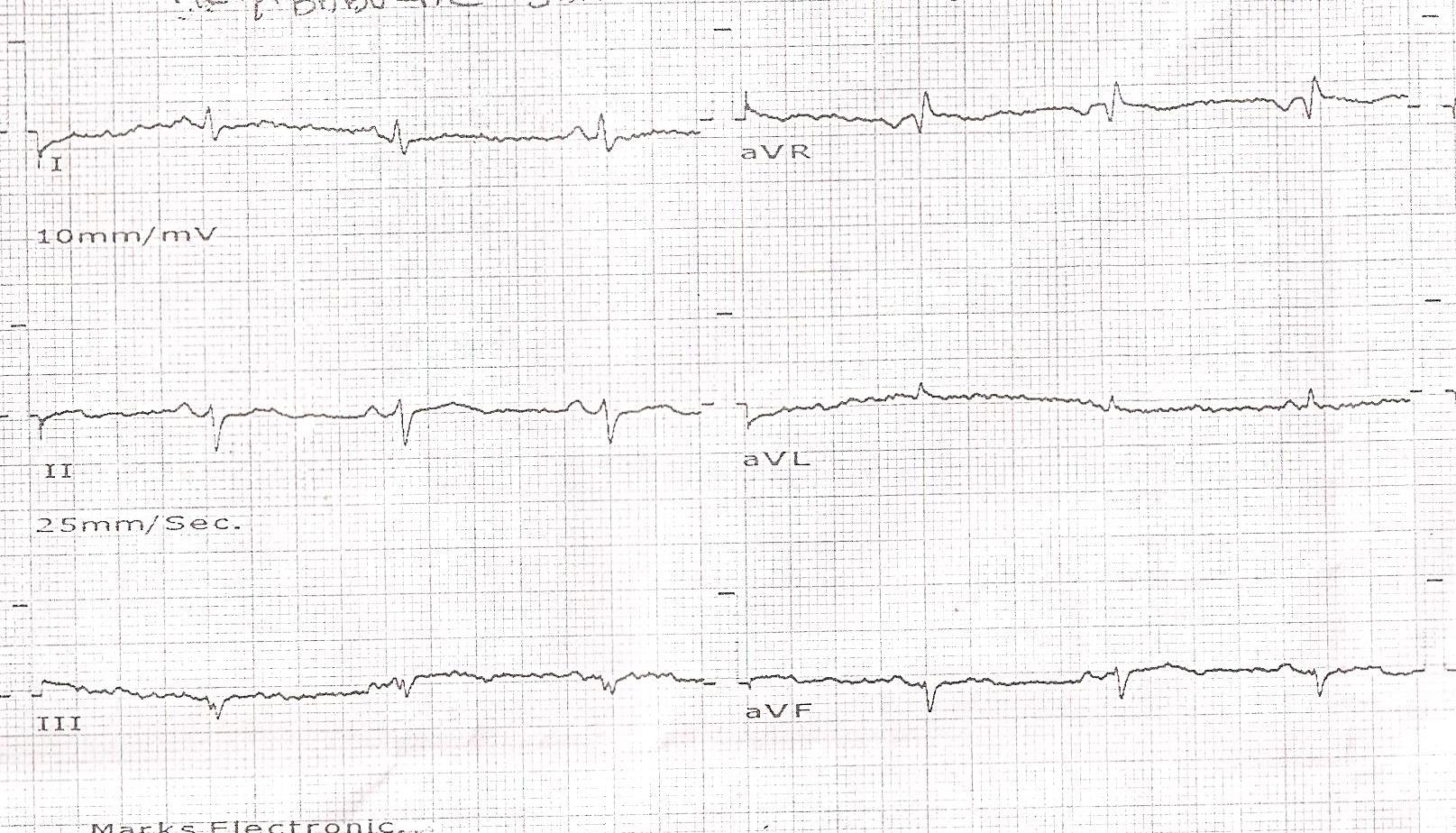
A 50-year-old man was referred to us with suspected  angina. Here is his ECG.

Epicardial fat : One more cause for Low voltage QRS

He was an obese man weighing 105 Kgs. He was put on a tread mill  .It  was convincingly  negative .
The echo cardiogram revealed a prominent epicardial pad of  fat measuring 6mm throughout the anterior surface.He had  normal valves and normal myocardial function.It was concluded the low voltage and poor R waves , and T wave inversion was due to the thick epicardial fat.

ECG -Fat correlation

The lack of R wave progression  is attributable  to the insulation effect of fat .Chest wall fat rarely dampen the electricity .Epicardial fat does it more.T wave inversion may not be  due to dampening effect of fat  .We think epicardial fat when adherent to true pericardial surface of the heart it alters  the epicardial  action potential  .It is possible  electrical  neutralisation by the fatty infiltration of epicardium  reverses the direction  of repolarisation  towards the epicardium .

Other ECG manifestation of thick  epicardial  fat

  • Poor R wave progression
  • Anterior Q waves
  • T wave inversion in ;leads v1 to v4 or V5

Final message
Epicardial fat deposits can have clinically  important influence on the surface ECG recording .
Simple chest wall obesity causes only diminutive  R wave . If fat encircles epicardium it has high chances of  producing repolarisation   abnormalities  in the form of T wave inversion or flattish   ST segment.

Human body is a bundle of mystery.   In an  average  life span of human beings,   millions of   afflictions come and go . Most are benign . Our body has a  full-fledged defense ministry    armed with sufficient weaponry in the form of , immune cells, thousands of regulating enzymes, hormones ,  cell service molecules  etc  .It can tackle most of  the ailments our body encounters  with out a doctors help (Jungle animals rarely die of disease!)  .

Of course , the body  needs  external help  when it’s  intrinsic resources fail . There are few   serious disorders that has to be intervened .However ,a big  fraction of them  will   die  in spite of whatever we do .

Is it not  fascinating to know more than  100s  of chemicals  act day in, and  day out ,  to  prevent our  blood  from clotting and keep it flowing .  If only the natural lytic mechanism fails  for an hour , and  create a  vascular  chaos   we will realise  importance of it !

Even as we debate appropriateness of medical care  in this  21st century   here is startling scenario ,

When a child  presents  with physiological hypertrophy of lymphoid tissue  , as their body begin to  learn and record the micro biological mysteries  of our environment  , it is  often “cross labeled ” as  tonsillitis  or appendicitis and  end up in surgical tables.

This article just released  in  European heart journal , tells us ,  how the rampant use of appendectomy and tonsillectomy in the early child hood  may make them susceptible for CAD in later age group.

The role of medical professionals is identify the trivia ! and prevent unnecessary interventions.

Unfortunately  or (Should I say dangerously)   many of  the   professionals  understood it  in a diagonally  opposite manner . Identify the trivia ,  instill fear in our patients  and intervene ,   in the process injure  our great biological system.This is also applicable to many cardiac  interventions.

Final message

Heavens sake ,  youngsters  , please  remember  , medical  profession is all about removing suffering from patients  . Do not fish out “non -existing” illness from your patients  body !   Let me remind you ,  professional approach means  , whatever you do it should be in the  interest of our patients . The moment  you deviate ,  you cease to be professional .

Also realise  ,  good   intentions can never be an excuse for  inappropriateness !

Reference

http://eurheartj.oxfordjournals.org/content/early/2011/05/27/eurheartj.ehr137.abstract

It is  a well proven concept   beta adrenergic blockers have a useful role in controlling   the  frequency, and intensity  of  vaso- vagal syncope .

One may wonder how an anti adrenergic drug help to counter hyper vagotonia syndrome !

This is because  during  vaso -vagal  syncope ,  the  inital trigger is  sympathetic . A   sudden hyper adrenergic  surge occurs   that stimulate the vagus, ( Which  overshoots the   initial  quantum of adrenergic signal)   and  cause a systemic vasodilatation ,  hypotension and bradycardia.

How does adrenergic surge stimulate the  vagus?

By two ways

  • Brain stem spill over effect in medulla (Vasomotor to tractus solitarius)
  • Cardiac  stretch caused  by hyperadrenergic activity . This stretch initiates a  vagal reflex  especially from  the base of the heart (Similar to Bazold Zarish reflex ). This  mechanism is  thought to be more important than brain stem spill over  , that’s why  it is referred to as  neuro-cardiogenic syncope .

How does beta blocker help?

  1.  It   sedates  the  adrenergic centre which  modulates the trigger  .It  also blocks the  sympathetic  afferent limb of the syncope circuit.
  2.  Anxiety  and panic reactions are close associate’s of vaso- vagal syncope. They are  not only  considered as  prodrome for syncope  but also act as  important triggers.This is effectively tackled by beta blockers .
  3. Finally , beta blockers  soothes the mycardial  stretch  receptors by reducing the  ventricular shear stress (Reduced contractility and wall stress )  hence neuro-cardiogenic  axis is  pacified.

It is important to remember beta blcokers can only  prevent/  reduce  episodes  of  vaso vagal syncope. It  may aggravate  the situation   if administered  shortly  after the event , as bradycardia and hypotension  is dominant  in the recovery phases.

*During an episode of vaso vagal syncope atropine group  of drugs is most useful .

Which beta blocker ?

Propronolol is the prototype  as it has non selectivity and good penetrance  of  blood brain  barrier ,  which is  the most appropriate site for suppressing hyper adrenergic drive.

Cardio selective beta blockers  do have a role as cardiac stretch  receptors is  one of the two target sites .

Final message

Ironically ,   in the long term management of  vaso-vagal syncope , anti adrenergic drugs  have a major role  rather than atropine like drugs .

There was a time  , even  cardiac catheterisation was contraindicated if the aortic valve  is  significantly calcified. LV angiogram was judiciously  avoided in all such patients . Why ? A significant increase in disabling strokes were witnessed .Those were the time  a sense of  fear (common sense ?)   prevailed . Every one was following this dictum with sanctity .

Now in 2010 .TAVI has  arrived with great fanfare . We not only cross the calcific valve , we literally play  a violent contact sport   in the aortic root  for over two hours with all sorts of pushes  and passes  on  a  fragile valve.And  we are happy to  claim that  stroke rate is comparable to aortic valve surgery and TAVI is not-inferior to AVR in high risk surgeries .

How is this possible ? As the times  changed ?  Is it true , our stroke  fears are just imaginations  or have we lost our  faculty of  reasoning and  sense ? (Will it be logical to  fund a research  if someone claims a  surgical  technique  to replace  aortic valve in  a beating heart without aortic cross clamping !)

Data shows  even if  distal protection devices are  used the stroke rates  can reach to  objectionable levels .It remained  a mystery ,  at least to me how no body was  questioning this ? I was happy to find this editorial in NEJM which  just stopped  short  of   banishing  this modality in its current form.

http://www.nejm.org/doi/full/10.1056/NEJMe1103978

What price it asks ?  and leaves the readers to guess  the answer ? NEJM wants to be too decent and polite , but in science politeness is generally not required  ,  as long as  your  observations are  correct !

For all those enthusiastic  interventional cardiologists  here is  a positive message .

Nothing comes easy in science.Great  inventions do have problems  initially .  Without  major hurdles  there can be no progress ! It is  because of   you  modern cardiology is making giant strides . Remember  the early days of angioplasty , early days of pacemaker  .  But  please realise  the most important issue  is ,  whatever  we   innovate or discover it  should be shown   superior to the  best  existing modality in all aspects(Technique,  procedural  complications, long term  outcome ,costs, side effects etc  ) .It is awful  to note   new drugs or devices  are  rarely compared with  the best treatment that is currently available .

A  new  treatment that simply  complements  or proves  non-inferiority  can never be considered an invention. How can we   portray radio frequency  renal denervation (  a complex  lab procedure ) for controlling blood pressure   as a great innovation for man kind  while we  have   so many drugs and  modalities  available  at a fraction of the cost  with  little  consequence .

Reference

http://www.escardio.org/congresses/esc-2009/news/Pages/Transcatheter-Aortic-Valve-Implantation.aspx

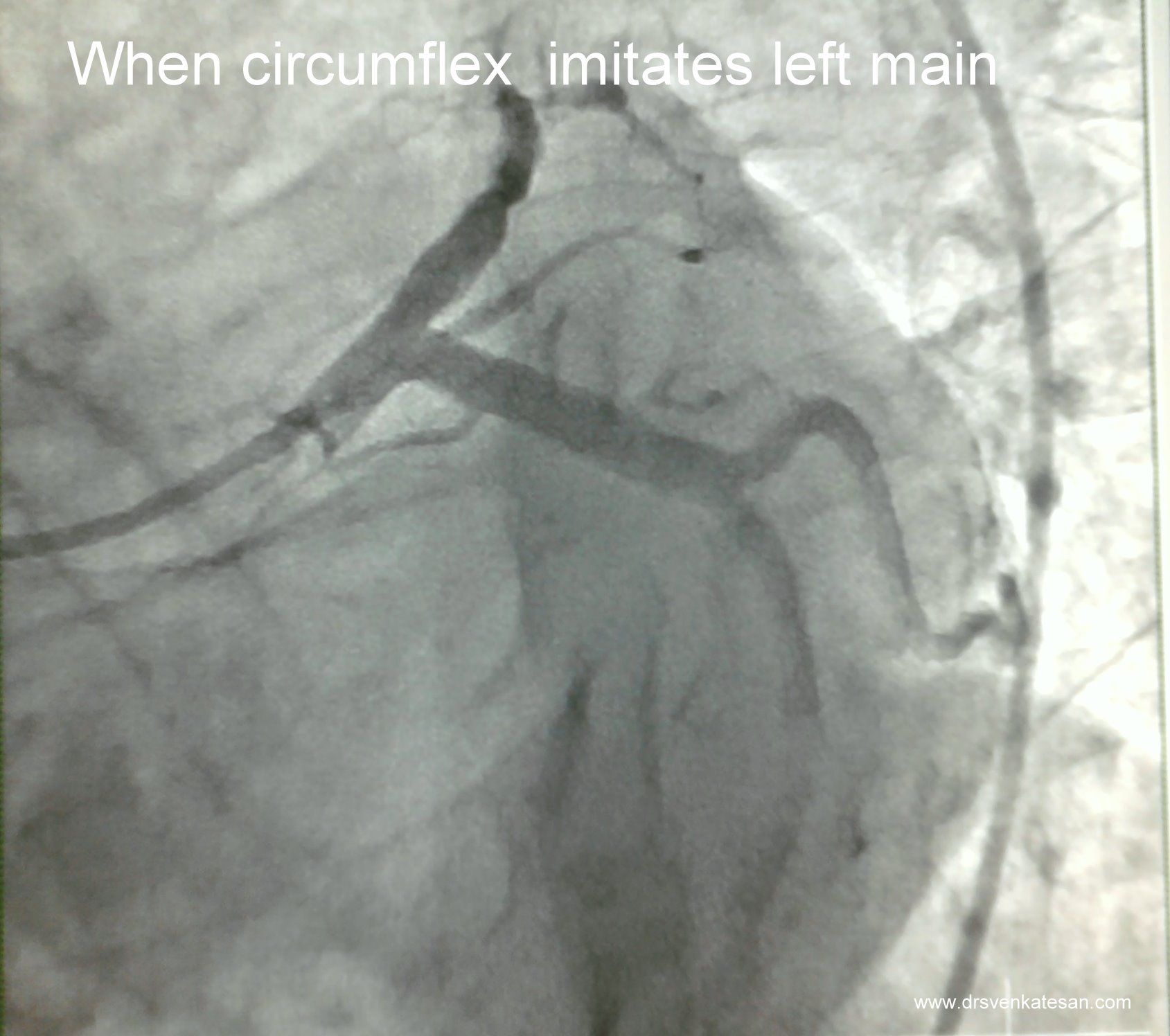
Human coronary artery branching pattern is unique in every  individual . Left circumflex shows many variations.

The important ones are  a separate origin , variation in the angle of bifurcation, the number of OMs  .Further, the length of  mainstem  LCX  and its course in the AV groove are quiet unpredictable.The diameter of LCX vs are generally equal  (or LAD >LCX).

The division of  left main is such that circumflex  generally gets a lesser share  of blood flow . If  LCX is dominant this  ratio  may be little balanced. But if the LCX  is huge LAD definitely suffers !When left circumflex equals the size of left main  the pattern is distinctly  unusual.

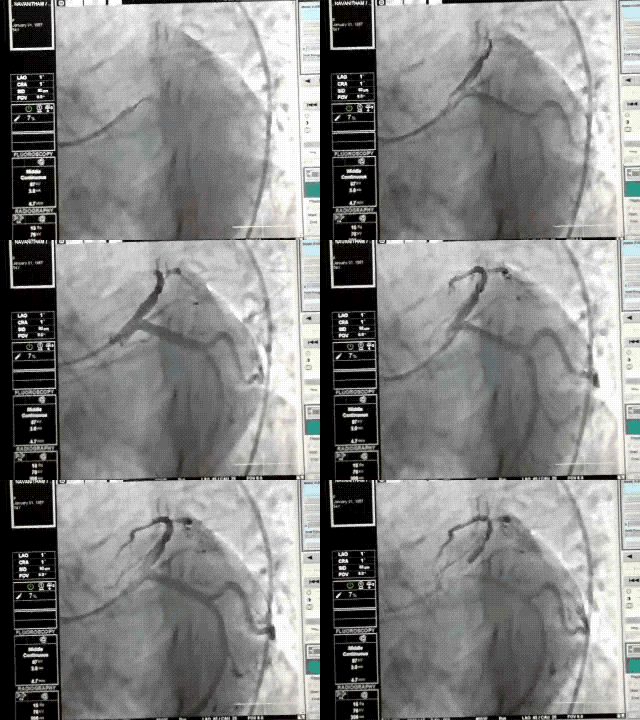
This patient   we encountered recently had 4mm sized LCX   and  presented with a tight LAD lesion .

This man's LCX probably will never sufffer from atherosclerosis !

Other observations about large bored LCX

  • Narrow ostiums are prone for  atherosclerosis .A large mouthed  LCX rarely involves  in left main  bifurcation lesions.
  • Disproportionate size of LCX when compared to LAD  can  have hemodynamic implication of provoking LAD disease  .

The implication of  differential  sharing of left main blood flow is not fully understood .It needs further insights.

Coronary  atherosclerosis is the number one killer of mankind. Many would consider it as an  essential  process of aging .Modern  life styles and habits make this appear  very early in life . There is currently an endemic (or even  a pandemic ) of   CAD due to premature  atherosclerosis. We need to recognise CAD is not a  primary heart disease  .It is an irony, heart is an  innocent bystander  to the  biological derangement  of coronary  vascular system  when  it is infested with atherosclerotic plaques .

So , when we  are confronted  with  serious atherosclerotic lesions in a coronary artery   what shall we do ?

We have three options

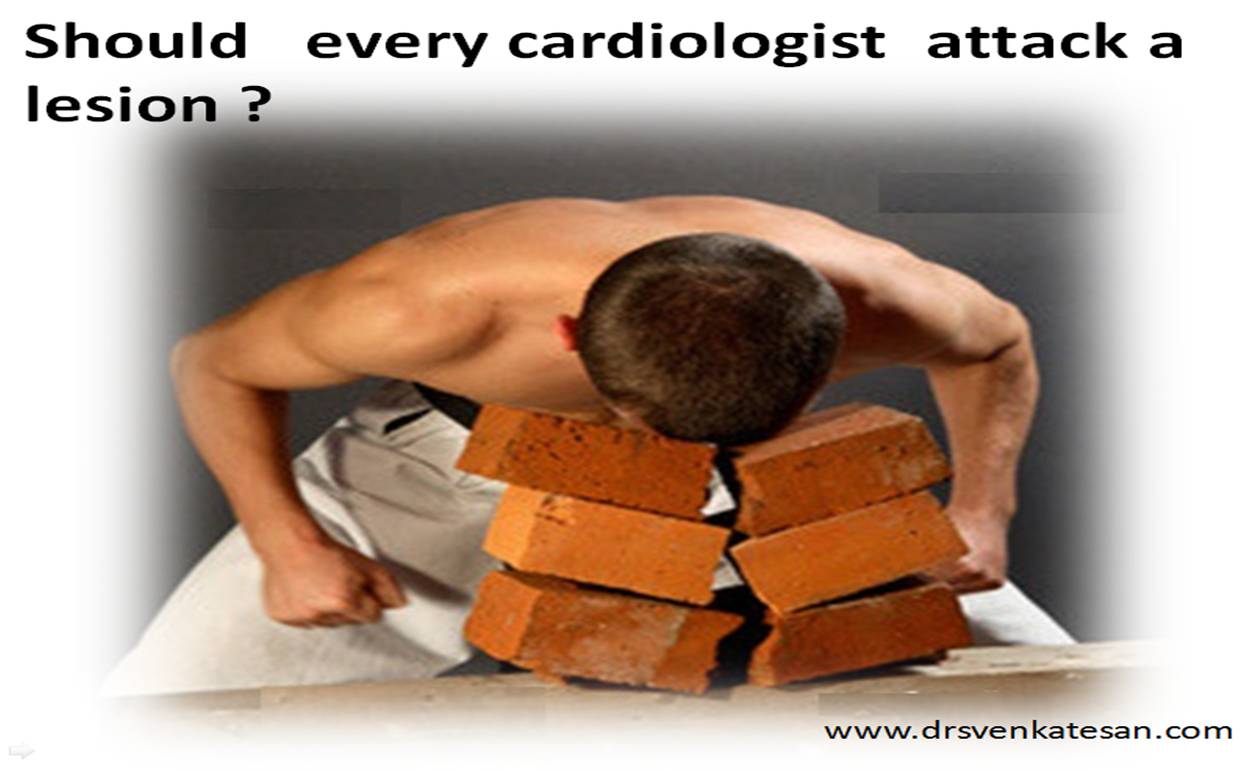
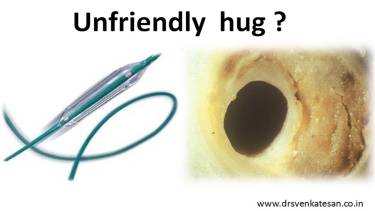
  1. Take on the enemy in a direct confrontation (Like war on terror ) : This is  some times called as Interventional cardiology .Caution is required as the battle  is within the human coronary artery ,  cross fires and collateral  damage  are unavoidable.

2 .Next  method  is to  find the basic cause  of  terrorism , identify  the perpetuates, facilitators    and try to correct the   root cause of it (CAD ) .This approach  also refered to as medical management  in cardiology community*  . It  aims  at regression of plaque  by statins, and life style modification and preventive cardiology. This modality is most ridiculed and  insulted by the main stream cardiologists.

*Comparable to  bilateral peace talks for a political solution to terror

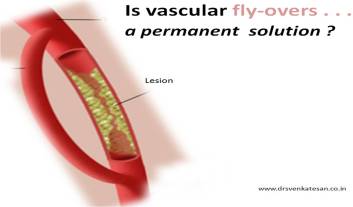
3. And third option is a  real  surprise !   This  neither  confronts   the lesion   nor does it  address the initiating factors . It   just ignores  the lesion and by pass it with a LIMA /SVG  fly over ,  as if  nothing has happened in this vital high way leaving the culprit scot-free  .This option is  executed by surgeons as  CABG surgery . . . and  for mysterious reasons  this is a  well accepted one .

CABG :Here the atherosclerotic  burden is untouched by surgery . The graft can get diseased  sooner or later , native vessel disease  shall  progress some times encroaching  the ostia of distal graft site . Incidence of acute coronary syndrome following CABG is not greatly reduced for the simple reason we are not doing anything primarily to the inflamed plaques .These issues  are left ,  to be  taken care by the  medical  management .

* This article  does not want to defame these great development in cardiology(PCI/CABG) . They have a  specific role to play. CABG AND PCI remain the only option for critical  lesions with limiting angina .But please remember without  proper  medical management  ( ie Targeting  the perpetuates of  crime )  both  PCI and CABG will be a big sham !

Final  message

Avoiding   the  lesion  or  attacking the lesion  is a  primitive  method to tackle CAD  . Passifying   the lesions  in a slow and gentle manner,   preventing  further progression  or regression  of lesions is the only  “sane” method for combating CAD   . PCI and by pass surgeries  can be termed  as  21st century’s   medical  adventure sports  which  has  limited role ,  in the overall control  of CAD  for the human kind .

And  now  answer this question . . .

Cardiologists attack the lesion and  surgeon avoids the lesion ?  Who is the winner in our fight against CAD  ?

Both of them are  clear losers .The winners are  all those  humble physicians and parmedical workers (or even the responsible lay public ) who  help recognise  the early forms  of  CAD  and  counsel properly to prevent it .

This is  what  Dean Ornish   in 1991  documented in  Lancet  which was never considered scientific   for the simple reason it has no commercial value !

Reference:

http://www.thelancet.it/journals/lancet/article/PII0140-6736(90)92230-F/fulltext

http://en.wikipedia.org/wiki/Dean_Ornish

It is a fashionable topic  in  cath meetings and workshops  to discuss  about thrombus loaded coronary arteries. Still  visualizing a  thrombus  in coronary angiogram is  never a  mean  task !  It needs  lots of  visual  acuity  and  imagination to recognise   intra coronary thrombus.

  • A lesion which looks fresh with multiple layers of  irregularity within the lumen is  often assumed to be thrombus.
  • An   intra luminal filling defect   is the  most often  used  “criteria  to suspect” a  thrombus

A long segment thombus with dye penetrating and coating the thrombus all around

Thrombus  vs plaque ?

Both are  radiolucent .  But a thrombus  or a plaque coated  with  dye  will make it radio opaque. The radio opacity of a thrombus is determined by extent of dye coating ,  the thickness of the dye layer, obliqueness to the x-ray beam . A thrombus plaque  interface can have two different  planes  of densities.

Theoretically dye can not encircle  a plaque  in its entire circumference as it will be attached to vessel wall (Unless  circumferential  dissection is present  )  Hence , dye can not coat a plaque fully ,  at best it can give  an appearance of eccentric filing defect  with over hanging edges .  While a  thrombus  can manifest with a  complete filling defect

Thrombus vs dissection

This is  still more complex   . Both can have a filling defect  .A  flap is a  line like  filling defect To complicate the issues further,  both thrombus and dissection occur together in the same spot .

How confidently  one can  identify a thrombus in coronary angiogram ?

During acute MI there is no difficulty in identifying it ,  as every acute  obstruction  must contain some thrombus* . Some interventionists  have special  ocular   sense   to   detect thrombus. Few others rely  on their intuition  rather than  solid evidence.

Sucking out a thrombus during primary angioplasty  has now become standard concept and is indeed  feasible  in most situations. It is obvious we have a task  on hand to identify thrombus correctly and quickly during primary PCI /UA .

Blind suction,  even though rewarding should be avoided.  Caution is required as blind  suction pulls a plaque with force !

A plaque debri  with a  thrombus, a dissected flap  all can combine together   to produce a complex  “masala”  of  coronary lesion especially after a difficult guidewire cross . This is refereed to as a battered coronary artery .These are the lesions which are prone for recurrent acute or sub acute thrombosis even if the lesion is  stented  properly.

During  primary PCI   thrombus coated dissected plaque  is just tucked  and  opposed behind the  gentle stent struts.The thin layers of thrombus between stent struts and the vessel wall is  missed  , 100 out of 100 times   by coronary angiogram . (IVUS very good in detecting this) .Because of this risk , Intensive anti -coagulation in complex PCI becomes mandatory

* Diagnosing thrombus in a chronic lesion is  much . . .much  difficult !

What are specific  modalities available  to  confirm thrombus

IVUS, Angioscopy, OCT are  hi tech tools to identify intra coronary  thrombus .(Which i feel  have little practical  value in real emergency situations)

Final message

Thrombus  may be a  key  finding  in acute coronary syndrome (Of course  the contribution of fissure, injured ,  plaques to the lesion can never be underestimated . ) Still , we have no simple , accurate method to identify it  ( Forget quantifying it) . Lots of assumption , guess work and gut feeling is at play in the cath lab .

We  expect better online , real time tools to improve out tentativeness inside the coronary artery  .

//

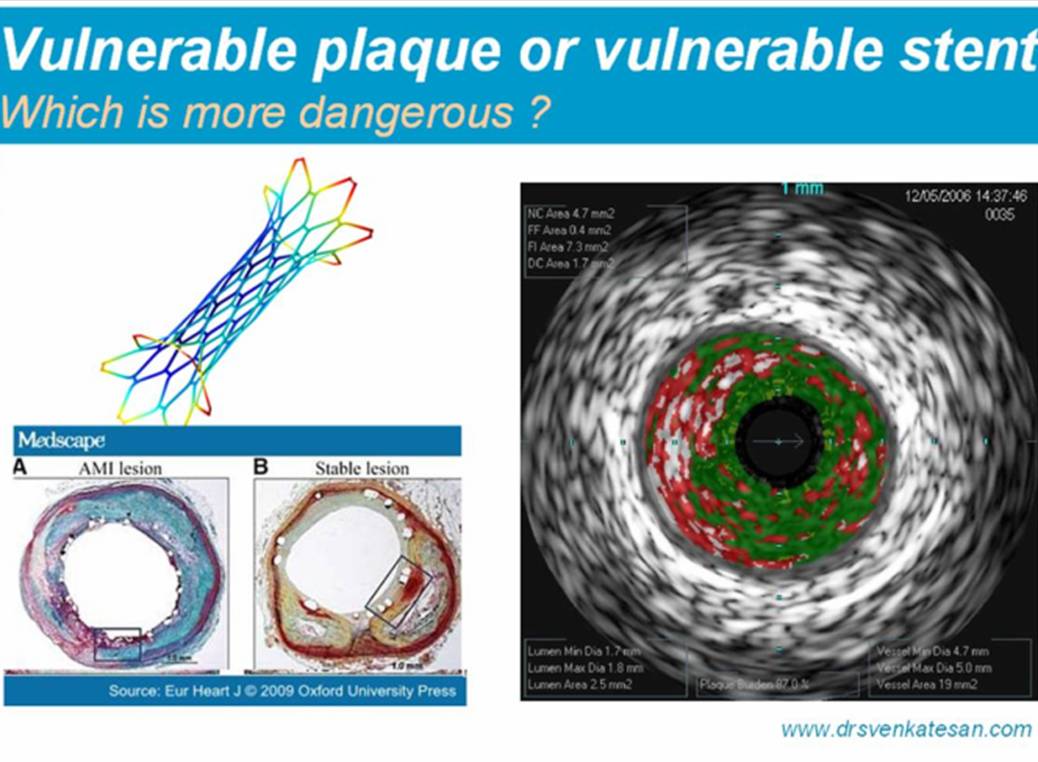
An atherosclerotic  plaque is termed  vulnerable when it’s  future behavior is unpredictable .A vulnerable  plaque has a  tendency to get occluded at any time.

Anatomically  a  vulnerable  is  present  , if the lipid core is more , fibrous cap is  thin  and  a  large lipid  core hanging eccentrically. A plaque with high temperature (Hot plaques ,febrile plaques)detected by OCT/Raman spectroscopy or thermography

Note the T cells and macrophages wage a losing battle against a metal monster !

What is the best method to calm down these vulnerable , hot ,inflamed plaques ?

A stent which scaffolds a plaque is believed to stabilse it  and  make it less vulnerable to rupture. This is the most optimistic view on coronary stenting .

Here comes  a pessimistic view !

A metal inside a coronary artery covering is  additional  threat .A metal  is   perennially  thrombogenic  ,especially the drug eluting stents which suppress the normal endothelial  function .

What  is the realistic view  ?

A stent should be used cautiously and judiciously in coronary plaques  with   high risk features  .Here  a  stent  in all probability  converts a vulnerable plaque  into a  relatively stable plaque

When stenting is done indiscriminately( without application of mind )  in stable non flow limiting lesions  stability is replaced with vulnerability.

Is it not curious to know  any angina  in a patient  who  had   PCI  for chronic  stable angina  is labeled  as unstable angina. 

Vulnerable stents

Following are typical  clinical scenarios   where stents could  carry a vulnerability  tag . 

  1. Poorly deployed  stents
  2. Properly deployed (but unnecessarily deployed especially in chronic stable angina )
  3. All Bifurcation stents
  4. Distal left main stents
  5. Stents with plaque prolapse
  6. Finally and most importantly all  drug eluting stents are considered  vulnerable ! (That’s why  our patients has to  live at the mercy of dual platelet blockers , life long.  Of course , there is no life time warranty   that  drugs do their  job properly)

And now . . .  you answer my  question !

Can  stenting convert a stable plaque  into vulnerable plaque ?

  • If  “yes’ is your answer your patients are in safe hands .
  • If  ” No”   is  your  answer ,  you are  fit to become a leading  interventional cardiologist !

Medical  research can be divided into few  broad  categories

  1. Basic science  research  in animal models
  2. Basic science  research   in Human
  3. Clinical : Bedside-  observational
  4. Clinical:  Epidemiological
  5. Community based long term data analysis
  6. Interventional -Drug /Device/Surgical

*Logically the  top 5  should  constitute  the bulk of research  ,  in reality    last one wins the race with considerable ease . Why ?

The important issues that  confront  today’s medical research  starts  right from the  “Aim” of the research ,  methods , materials statistics,  and  goes on  to   ethical issues , conflicts, futility ,  gimmicks  0f  publication  ,  marketing and ultimately left  for human assimilation .

(Read a related article in this blog   can  Aim of a study be wrong ?)

Data(s)  won’t  lie  . . .humans do  !

Science is nothing but collection of  facts ,  rechecking  the facts , and  finally confirming ,  they are indeed  facts. So medical  data collection becomes vital .  Data,  if  properly collected ,  wont lie.   Bias is always an issue in prospective trials. Further ,  and whenever and wherever  scientifically  motivated  human  beings interact with  data  the later   becomes a vulnerable  target and  get manipulated   for various reasons . (Read the famous article on data torturing  in  NEJM : I will link it soon  ) So blinding  becomes  mandatory   and it should  be total as some studies  tend  to  gain vision half way through !

Image courtesey : Jupeter images

Simplicity of observational studies.

We  give undue importance to RCTs . What we fail to understand is RCTs are required only  in selected situations in medical research (New drugs and interventions ) Meanwhile , we can do wonders with retrospective observational  data. These  data  can not be  manipulated  as the events  have occurred already and those people who collect or record the data  wouldn’t know this data is going to be utilized  for a study (This  , in fact  is  equivalent  to 100 % natural blinding and constitute a  real world study )

Observational  study can involve  patient behavior ,    disease behavior  , community impact, drug action, investigation modality , etc  . . .etc  . Your mind is the limit . Cost of doing a observational study is less but the impact on the society can be great .

Observing skills are the  biggest causality in modern medical times , This was  only scientific weapon of  our ancestors had , which they  used in an exemplary fashion .( Recall how Heberden described angina and Harvey taught us about circulation without even ECG and X RAY chest )

Fraud in medical research

Wherever big money is flowing corruption and fraud is unavoidable . . .at the  least . . .  we  should recognize it

( Many journals  just point out this possibility by simply displaying message of conflicts .They do not bother more than that  . . . just a warning message  )

Now in the modern scientific world  ,   even as the   genuine contributions   from our ancestors  left to  stare  the back of us  , we try to indulge in all sort  of unpleasant things.

In an audit against fraud in medical  research ,  it was found most of the fraudulent research happened with drug and device trials and few in basic science involving genetics and molecular medicine . It  was  rare to identify fraud in research involving purely clinical and  epidemiological  analysis .

Drug trials  need to be prospective . Vested interest can play  havoc in prospective data .There is a  thing called steering committee in all major studies   . . . we do not know what does the  word  steering really   mean .

There has been many  occasions  even well conducted studies turn out be  fraudulent . Now we realise many such studies are struggling to prove its worthiness .

In fact  it is argued every study before getting published   should undergo a  global ,  independent  trial   monitoring  board for genuineness  of the study . (Not the customary  peer review !)

Final message ( Sorry its  a  long one !)

We have a huge problem  here . I am afraid  we  haven’t even  understood ,  what  we  mean by medical  research !

For today’s   youngsters  medical  research means doing sophisticated  tests in nano- labs  , human genome  mapping ,  space age imaging modalities  or  involving a multi- billion dolor drug trials . This is absolute  falsehood.

What we need to do is   “search” , ” search”  ,  search again (That is   why it is called re-search )  for all those elusive  problems  our patients   face .Not only in their body , in their  home , in their community,  etc . Every  patient  teach us  few points,    observing and learning new things  and  publishing is  also an important aspect of  research .One can do  a instant   research in the crowded  OPD of a hospital   , in the wards , (What is the profile  of fever pattern in a winter season in your hospital ? does it reveal a new viral epidemic ?)

An ideal research  should  identify a problem and suggest a practical solution to a given problem .There are millions of such issue waiting for our attention in the bed side.  But what is happening  currently ? Current medical research is largely direction less ,  fueled by vested interest ,  makes  sure it avoids  all genuine problem areas !

Many studies  happen  based on  flimsy scientific   basis  .We are still  wasting our time to increase human HDL levels. ( Not with standing  the famous Torcetrapib fiasco  )   .Hundreds  of thousand of dollars   are pumped into this  research even after realising  only the  endogenous HDLs generated by natural methods like  exercise   are  the really  good HDL !)

While we do million dollar research   with a dubious risk factor called  high sensitive C reactive protein  ,   there is  no takers against number one killer disease of human kind  namely  “The  poverty” (WHO ICD codeZ59.5 )*

Let us prey   God  to instill common sense to all of us  . Patients  suffer with disease and we suffer from irresponsibility  or reduced responsibility ! It  makes us happy at-least few forces  like Lancet  , British medical journal etc are fighting lone war  against this  ailment  medical science is suffering .

*Please note :  http://www.icd10data.com   WHO labeled poverty as disease many years  back without much fanfare ! It is rarely mentioned in  any  graduate student**  medical text  in whom our future lies .  I do not know whether  Wars  and terrorist acts  been included as disease  or not !

**Our students  rattle about  about the  exotic  tick borne  Lyme disease happening once a year in remote hills ,    while  most will stare blank   when asked  how to diagnose and  treat  nutritional  anemia with  which millions suffer  every day !
While anatomical  grading of obstructive  coronary lesions are  quiet easy ,functionalc assessment is always difficult.The famous TIMI grading system had one unique problem .TIMI 1 and 2 grades are relatively easy to grade. TIMI 3 flow  which corresponds to normal penetration  and normal  distal perfusion  . This distal perfusion was entirely optical .

This was an important issue , in assessing post  PCI or thromolysis patients . It was realised much later , TIMI 3 flow is  stunningly  heterogenous group  .It was  ironical  ,  even after a successful PCI ,  restoration of TMI3 flow  could not be relied upon as an index of successful PCI  .

So , the PAMI study group included time as additional factor in grading TIMI 3 flow. PAMI 3 is  essentailly same as  TIMI 3  flow but  with a  condition , complete  distal vessel filling  must  occur within 3 cardiac cycle . PAMI 3 can be termed as a   refined version of TIMI 3 introduced in the evaluation of success of primary PCI . This helps us  define  or  diagnose   slow filling .

What are the other ways  to grade TIMI 3 flow

  • Myocardial blush index
  • TIMI frame count ( < 25 frames )

PAMI : Primary angioplasty in myocardial infarction

TIMI :  thromolysis in acute myocardial infarction

Reference:

http://circ.ahajournals.org/cgi/content/full/circulationaha;104/6/624