Feeds:
Posts
Comments

American journal of epidemiology in a land mark analysis has found , spouses share the same profile of coronary risk factors .This is a huge finding , considering the fact that , genetic factors are not involved here . So , it is something to do with family diet ? domestic issues, sibling effect ?

It is well-known lipid profile of family members are comparable . There are many Indian families who have high basal triglycerides .Mind you, husband and wife is the least (Zero link) linked genetically for familial dyslipidemia ,still they often share a similar lipid profile

Related issues without answers !

When a spouse gets a coronary event what are the chances of other to develop an event ?

Any body’s guess

In this era of bi- polar family life, can spouse behavior /unrest be a coronary risk factor ?

Yes . No surprises here .Apart form passive domestic smoking which is a well established coronary risk factor , in our coronary care unit , an initial survey of acute coronary syndrome patients revealed , a recent quarrel with their spouses, was a potential trigger for ACS. Further analysis of these data is being done

Spouse Ego : A powerful health risk

Spouse Ego : A powerful health risk

Divorce and coronary events ?

These are hypothetical observations in few families we have come across .

  • Forced divorce can be a definite coronary risk factor
  • Consensual divorce is not .
  • Women seeking divorce is more a risk for men than they inflict on women

Reference
Augusto Di Castelnuovo and others, Spousal Concordance for Major Coronary Risk Factors: A Systematic Review and Meta-Analysis, American Journal of Epidemiology, Volume 169, Issue 1, 1 January 2009, Pages 1–8, https://doi.org/10.1093/aje/kwn234

Mitral regurgitation jets can take many shapes

  • Symmetrical
  • Central
  • Eccentric

The direction of the jet depends upon

  • The angle of co-optation
  • The  plane of  orientation of regurgitant  orifice . It  can be entirely off track with  physiological  mitral orifice .
  • Degree of prolapse or shortening /subvalvular  fusion.
  • Flail valve tips can guide the jet selectively into anterior/superior  or posterior aspect of LV

Rheumatic mitral valve showing poor leaflet co-optation.Patient is having significant tachycardia


Perpendicular 90 degree MR jets


In rheumatic heart disease  eccentric jets are more common. In dilated cardiomyopathy MR jets are often symmetrical and central as the pathology is annular dilatation.

What are  the significance of eccentric MR jets ?

  • Anterior jets clinically mimic aortic stenosis as the murmur is  often well conducted to neck
  • Murmurs of  posterior jets well conduct to axilla .
  • Eccentric jets are often acute and compromise hemodynamics
  • Suspect early infective endocarditis.Carefully look for vegetation.
  • Eccentric jets make it difficult /risky  for PTMC (Note : In Mitral stenosis  +  grade 1  MR   with central jets  one can safely do PTMC)
  • Severe eccentric jets can flood one of the pulmonary veins and result in unilateral or regional pulmonary hypertension or even lobar /segmental pulmonary edema

It is well  recognised for STEMI  to get aborted   spontaneously or through intervention.

Can a glamorous procedure like  Primary PCI be redundant ?

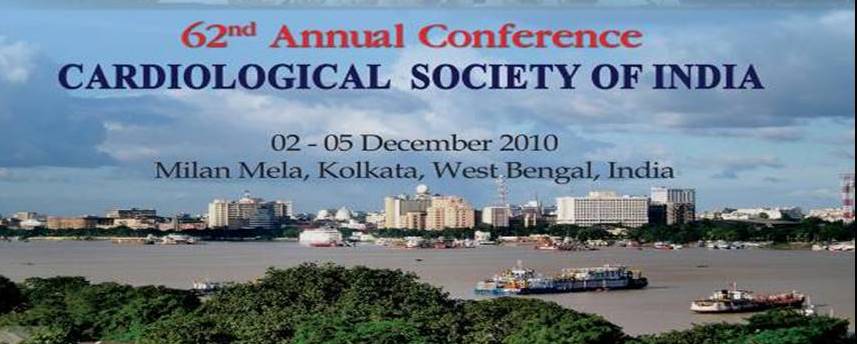
Yes of course . This paper,  is about how a planned  Primary PCI  can go awry  . . . Presented in the Annual scientific sessions of cardiological society of India Kolkatta December 2010.

Down load full presentation  in PDF format (primary_pci_)

Summary of the presentation

ABORTED  AND     ABANDONED    PRIMARY PCI

S.Venkatesan  G.Gnanavelu.R.Subramanian .Geetha Subramaninan

Madras Medical College. Chennai

Primary PCI has become the  standard of care  for acute STEMI in all  those eligible patients. Apart from the individual & institutional expertise ,the  key  to success  lies in  expediting   the symptom to balloon time to less than an hour.

Even though  STEMI   is characterized  by  acute total obstruction , it  is also a fact during this critical time window , a less recognised   positive  phenomenon takes place within the  ill fated coronary artery. Intrinsic fibrinolytic activity gets activiated and begins to take on the thrombus head on .It should be recalled this is the  earliest intervention in STEMI by natural forces , with zero time window . The power of this natural lytic process has  never  been easy to predict and quantiate . But  we  have  often realised  such a phenomenon do occur often and  is referred  by  various  terminologies like spontaneuous  thrombolyis, aboted MI etc .The exact incidence  is not estimated .In this era of  primary PCI we have found a new opportunity to confirm  this concept.

It has been  observed during  primary PCI ,  an occasional patient  may  have  either  a totally  patent IRA  or a minimal &  insignificant lesion  like luminal irregularity .This has  subsequently led on to cancellation of the procedure .We report our experience with  two patients with  this particular situation .One patient with IWMI with a time window   of  6hours had a totally patent  RCA.  Even , the luminal irregularities were difficult to locate .The other patient had anterior MI with ongoing ischemic pain.He was taken up for primary PCI.The initial angiogram  showed a total mid LAD  obstruction . As soon as the  guidewire reached the thrombotic lesion the  artery opened up   wth a TIMI  3 flow .There was no residual lesion or thrombus  noted. Both of the above  patients  were  young , smokers . 2b 3a antagonists were not administered. We infered, both had thrombotic STEMI and   presumed  to  had either spontaneous reperfusion , or  reperfusion assisted by dye injection & guidewire manipulation. They were  shifted out of cath lab with a new code of aborted primary PCI and  were discharged with normal LV function .It need  to be  realised here, a   distinction must me made between  aborted PCI  and   abandoned or failed  primary PCI  as  the later  connote a negative outcome. The  causes for abandoning  primary PCI are due to complex  lesions like bifurcation /Trifurcation lesions , triple vessel disease  with difficulty in identifying culprit lesions.A  Primary PCI is  considered failed  when the  IRA patency  is not accomplished or  failure to  sustain myocardial flow inspite of  IRA patency (No-Reflow) . These patients may end up in CABG or occasionally fall back on  thrombolysis  which was considered a inferior modality just few hours earlier !

.                                         We conclude , in the management of STEMI ,  primary PCI once contemplated need not always reach it’s  logical conclusion. There are situations  it can  get  aborted or abandoned  at various levels . Aborted  primary PCI  due to spontaneous  lysis though uncommon ,  can be a therapeutically and financially rewarding concept for the patient  and  physician .

Squatting is an excellent hemodynamic adaptation in patients with TOF. Children with TOF assume this posture   in  a natural and effortless manner . For years cardiologists are fascinated by this maneuver  and the mechanism by which it gives relief  to those patients with TOF.

Now , we have realised  this posture  has a new diagnostic role in echocardiography ! This paper was presented in the recently concluded  Annual scientific sessions of cardiological society of India held in Kolkatta December 2010

Download  the full   presentation in PDF  format  (  Squat Echo)

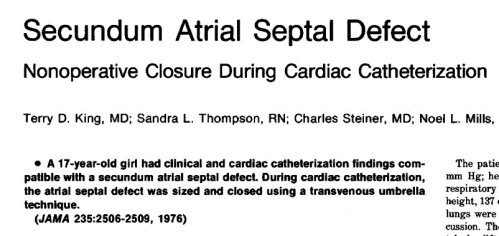
It was those great  years  1974 -1976.  Even before the concept of  PTCA was born, few  committed cardiologists  of New  Orleans were on a mission. Closing the ASD in cath lab. They  achieved it successfully with a umbrella device.


But 35 years later as on 2010 ,the concept though proven still struggles to prove itself.

Link to related article .

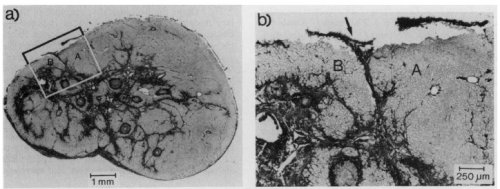
Myocardial scars remain forever ! It forms the focus for many chronic  ventricular tachycardias following MI. A healed scar is not often benign . It blocks the electrical wavelets and deflects into multiple directions some of them may reenter and form re-entrant VT .

This scar fascinated  one man from Holland -De Bakker . . . his quest for myocardial  scars produced this excellent paper .

No one  can do  such a meticulous work  today !

He did a extraordinary  study with the scarred  papillary muscle of infarcted myocardium . It included stunning histo-pathological analysis .He found for the first time , how the scar  even though mechanically idle conducts in multiple directions that precipitate the arrhythmias


We need to classify myocardial scar for understanding better the VT circuits. The newer imaging like Carto system can help us in imaging the ventricular scars.


A rough approach for myocardial scar classification could be .

Location

  • Epicardial
  • Endocardial
  • Transmural

Combined

  • Predominantly endocardial
  • Predominately epicardial

Septal scars

Anterior

Apical

Posterior scars

*With or with out Pap Muscle

Based on thickness and volume**

Small< 2CC  >5CC

Intermediate up to 10cc

Large >20cc

**Scar volume

Based on electro-physiological properties

  • Inert
  • Inducible
  • Spontaneous with clinical VT

Based on Metabolic activity

PET matched

Mismatched

Scars with reference to vascularity

  • Vascularised scars
  • Avascular scars
  • Revascularised scars

Further modification of the scheme by the readers are welcome


Clinical implication of scars apart from arrhythmias ?

CRT lead positioning


Coronary circulation is an enigma . This is true even after 50 years of coronary angiography.  What we visualise  in CAG is  only a  fraction ,  when  compared with what we do not see !  The intricacies of  coronary collateral circulation and micro circulation is comparable only to the  ultimate force of   invisibility “The  God ”

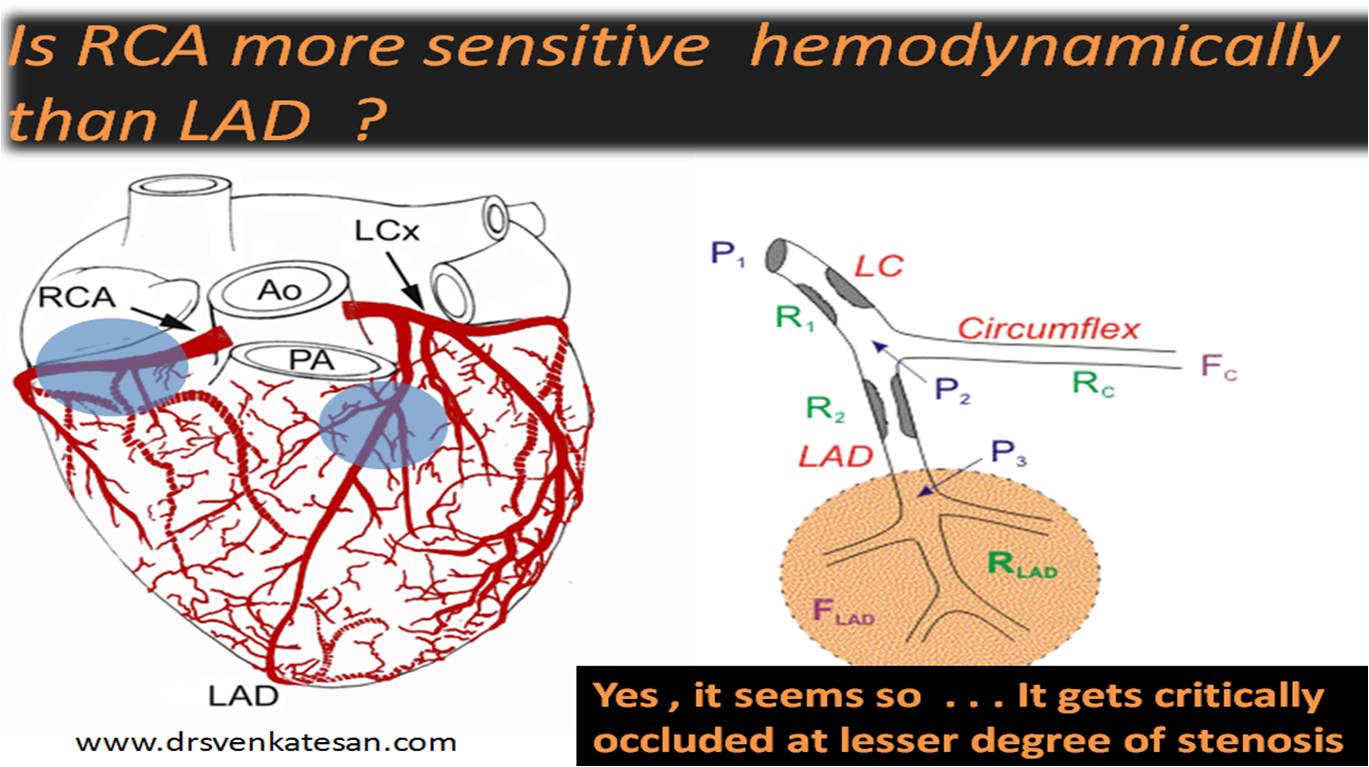
But , we will never ever believe what we do not see  . . .  but we have to accept the following  fact . How is it possible   for  some of the coronary  arteries  to maintain  a near normal blood flow from a donor (Contralateral ) coronary  artery  in spite of  100 % occlusion ?  Is it not common to see TIMI 3 flow even with 99 % occlusion .(Link to related article in  this blog  and  video ) . This is because the coronary  vascular bed has an extraordinary capacity to drop its distal pressure to negate the effects of obstruction.

Does the distal vascular bed anatomy and physiology same in RCA and LCA ?

We presume it so . The problem in medical science  is , these   presumptions  often  become  facts in due course  ! Now we have (It is in fact 30 years old !) RCA has lesser ability to withstand the stress  of stenosis than LCA.

The prime reason for this observed difference could be the LCA has a well developed microvascular bed which can reduce the distal coronary resistance .(Again , this is my  presumption  . . . !!! )

This interesting article was published in Circulation 1980 .


Great people  do not boast  . While there are thousands of hyped up publications in cardiology ,

This one form Qatar excels , which  I  stumbled upon recently  contains very useful information about wide ranging issues in cardiology .

Let us congratulate the   Hamad medical corporation for  their unique  academic vision  .

http://www.hmc.org.qa/hmc/heartviews/ARCHIVES/ARCHIVES.HTM

That was a slightly  modified title of an article published by the renowned Nephrologist from India Dr.M.K.Mani

Who is also involved in the fight against live kidney bazaar  in India.

In this article he shares  his experience  ,  how   desperately he is  trying to correct a major conflict in physician laboratory nexus in India . It is has been an  elusive search for  the past 15 years.

And  the article  seems to the conclude  , there is no other option   , we (And our patients )  have to live with it .

But , what we need to realize is  we have our own  watch dogs lie within our mind , and it need to bark every time a thief is seen .

Let us awake our self for the benefit of our patient kind .

By the way , how many  among us know such an important journal is published from India !

http://www.issuesinmedicalethics.org/044ed105.html

Further reading

No doubt ,  such kick backs and gifts and ads make medical care artificially high and unaffordable.

The pathetic stories of how modern medical care create new breed of  poverty.

the poor can not get even the basic  treatment because they are poor  , while  the rich get costly and  inappropriate  some times dangerous treatment and become poor .

Link to The WHO article that exposes the Issue

I know there is  a book written by Dr M.K Mani ,  Yamarj’s Brother

I have not read it .I wish i get it soon .That Iam sure will enlighten us

In any field  , errors and mistakes  transform into   experience in retrospect. (Of course only  if we  realize  our mistakes !) . Many would argue prevention of such errors is the  only way to move  forward in science  , but ,the opposite could also be true.

In Medicine ,

  • Most errors are mild ,
  • Some errors  can   be fatal but it helps us prevent further fatalities.
  • Some errors create history  and  re-define the science.

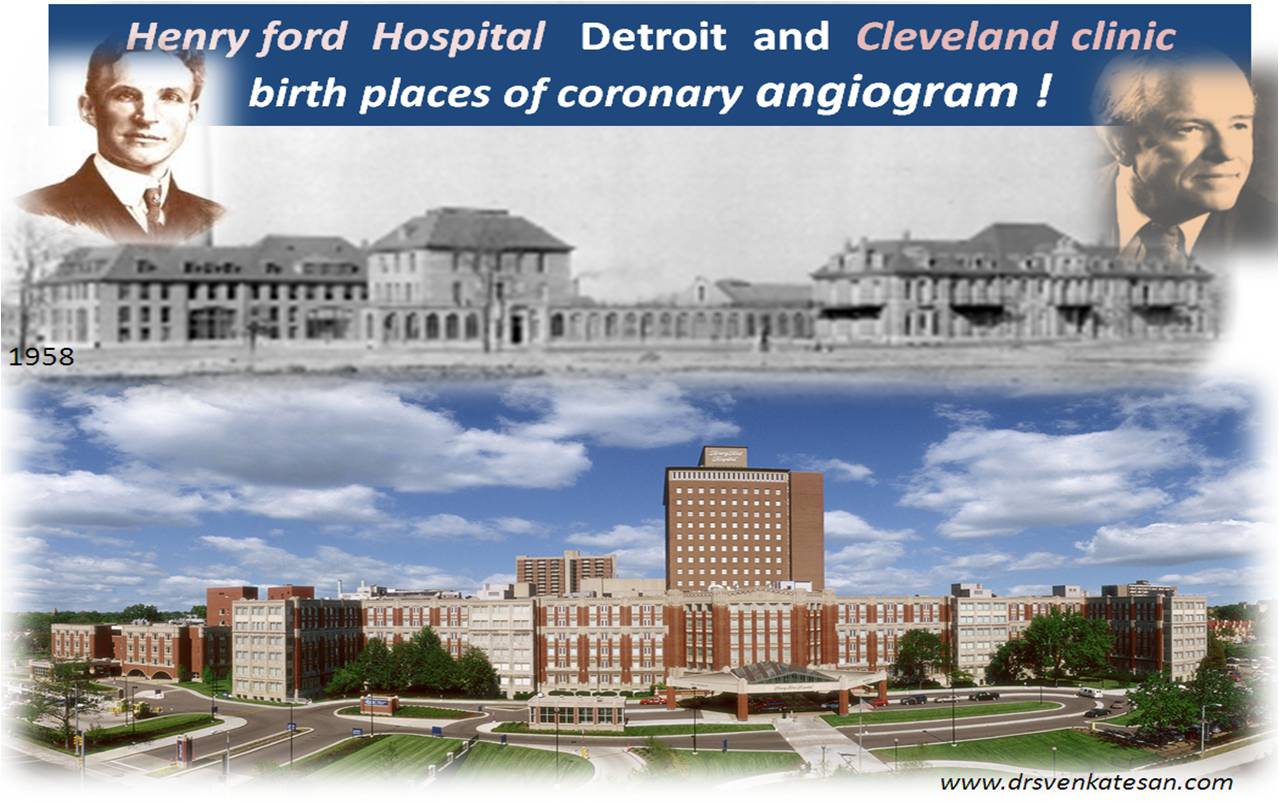
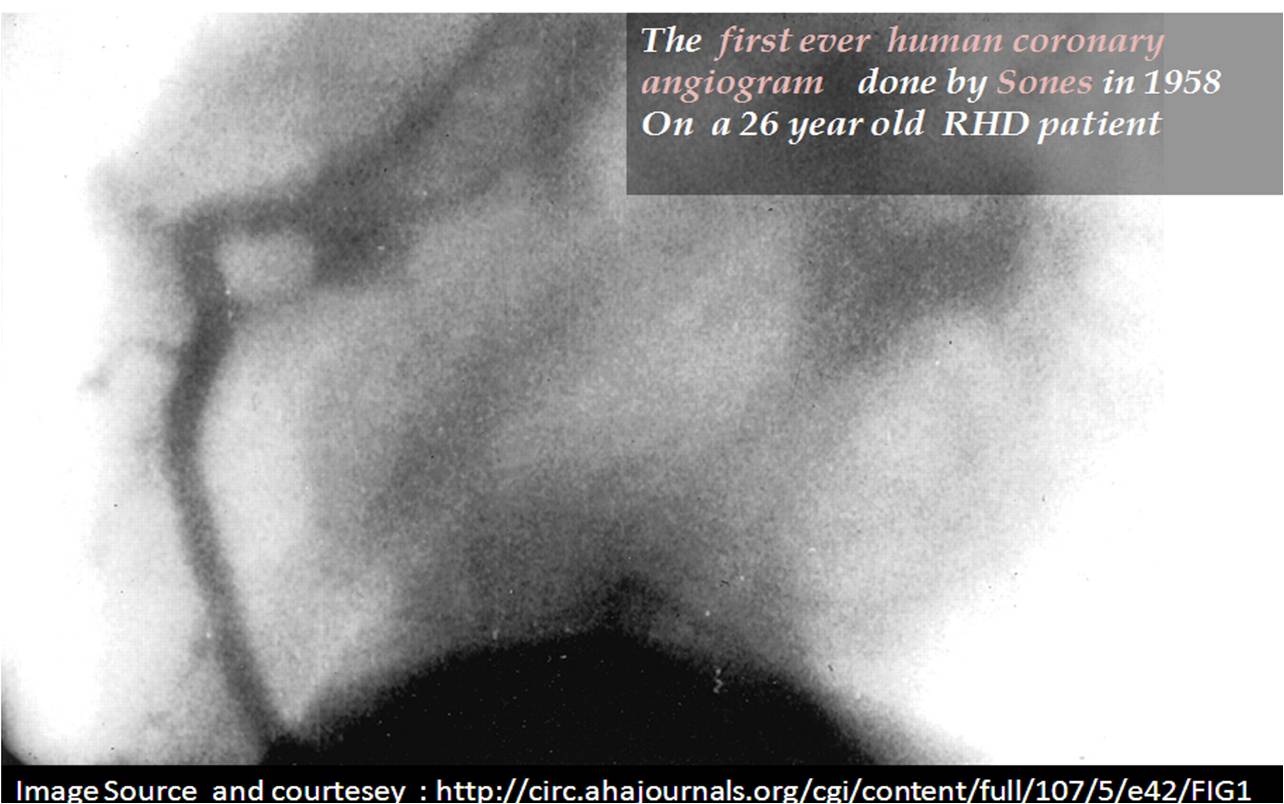
That’s   what  happened on 1958 , to be precise on  October  3oth , 1958  in a lonely laboratory of Henry  Ford hospital/Cleveland clinic *

*A correction -This  invention actually happened in Cleveland.  ( Sones learnt  all his techniques in Henry ford)

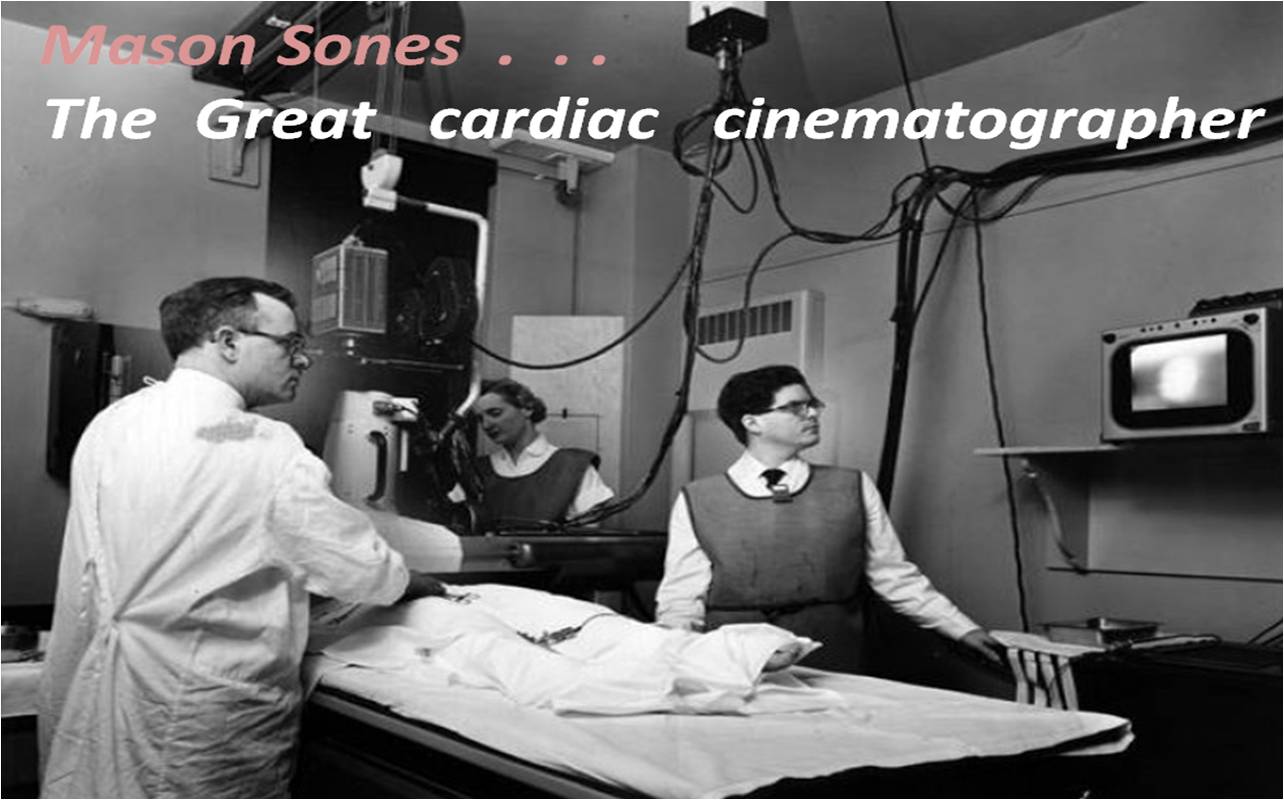
When  Sones along  with his assistant were trying  to do an  Aortogram in a patient with RHD,  the entire dye meant for aorta went straight  into  the right coronary artery.When every one was stunned ,the  patient happily  survived the injection  with a few skipped beats.

The man behind  this horrendous medical mistake was   Mr . Sones . He   was guilty for many days ,  spent many sleepless nights  ( In spite of  the patient surviving  the episode ). In fact , he was much amused  about the patient’s  survival . At that point of time,  even a spill over of dye into coronary artery was considered forbidden.  He pondered over the incident for months  .

Had  two queries  lingering in his mind .

  1. How the  right coronary artery  was able to withstand the 40cc dye  injected with  force .
  2. If 40 m l was tolerated ,  well what about routinely injecting  3-5 ml for visualizing the coronary  tree   by intentionally  seeking the coronary ostium .

That was the moment , the concept of diagnostic coronary  angiogram  was born . He published his observation as an  abstract in Circulation journal. Later he did many experiments  with video  engineering at Kodak labs , X  ray  technology to improve the cine imaging .By 1964 , he devised a perfect protocol  for doing  selective coronary angiogram. Then along with Rene Favaloro he pioneered CABG surgery in USA.

Final message

Cardiac  catheterisation was invented by  Forssman , Cournand , and Richards ,(Nobel prize 1956 ). It was  Sones who took it into the coronary arteries  and thus it was  made possible  for a whole new specialty  of coronary  diagnostics  and therapeutic PCI  which was  conceptualized by another extraordinary human life called   Gruentzig. Sones along with Gruentzig definitely deserve a Nobel in medicine which i think will happen soon ! They lived a great life constantly thinking, innovating  putting  patients interest in the fore front .

Mean while , I argue our youngsters  to  portray  the images of  these giants in  every   cath lab they  work   .You may get their blessings from heaven  , provided you do your interventions with integrity and honesty without any conflict of interest in the patient care.

Do not cry foul when some genuine errors happen in cath lab.Few among us (like Sones ) may innovate those mistakes into glory !

Reference

http://en.wikipedia.org/wiki/F._Mason_Sones#cite_note-3

http://www.wired.com/thisdayintech/2009/10/1030first-coronary-angiogram/