It may have , almost all the typical characters of angina . . . in some cases ECG changes too.
The confusion is complete , as esophageal pain can also be relieved by sublingual nitrates !
The issue is further complicated, when esophagus and coronary artery share the same neural codecs, and each may induce spasm among themselves !
It is thought , of course with some evidence ! many of the syndrome X patients ( positive stress test with normal coronary arteries ) have esophageal motility disorders.
The ST segment depression during EST in these patients is apparently attributed to stress induced esophageal spasm !
And many of the patients with variant angina , have associated esophageal sapsm .
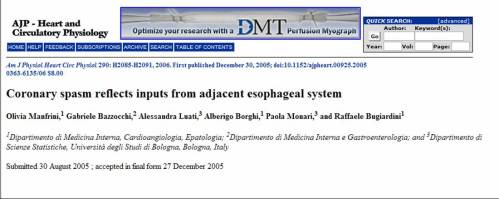
Read this land mark concept paper documenting the neural link between esophagus and the coronary artery
Click on the article
Final message
Don’t ever forget the esophagus in your scheme of things when evaluating CAD.
Realise that esophageal disorders not only cause non cardiac pain but also cause ischemic chest pain (Also called linked angina)
EsophagEal smooth muscle cell can exert electrical influence on the ST segment of cardiac ECG !(After all every cell
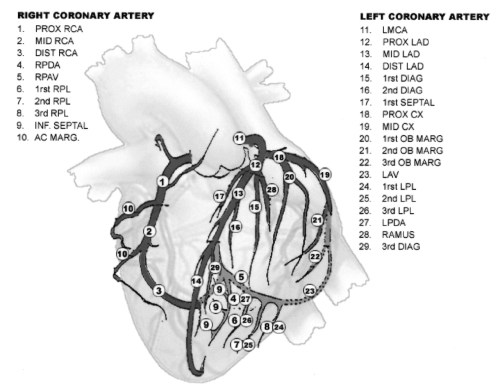
Coronary arteries are the major site for human atherosclerosis .CAD is considered the ultimate determinant of cardio vascualr health of our global population.Coronary atherosclerosis has a predilection for proximal sites and branching points.Typically it occurs in leftmain, LAD ostium, LCX ostium, proximal LAD, diagonal origins, OMs RCA and its branches .
Septal branches , even though divide very early from the LAD , it is uncommon to get affected by coronary atherosclerosis. Even for an experienced interventional cardiologist , it would be very rare to have performed a PCI for septal disease.
Why septal branches of LAD is rare to suffer from atherosclerosis ?
We don’t know the answer yet.
But , it is thought,septal branches are near perpendicular branches .The branching angle and incidence of atherosclerosis has a peculiar relationship.IAt any bifurcation point , the atherosclerosis tend to occur , if the angle is more acute , and is less common in abtuse angles .It is almost rare , if branching happens at exact 90 degree angle or so !
The other reason for septal branches being immune to atherosclerosis is , it runs within the muscle in its major course. The constant squeezing action(. . . and possibly bridging also) makes it difficult for the process of atherosclerosis to sustain and grow .
Can you still get a septal CAD ?
Yes, usually as a component of bifurcation or trifurcation lesion. Some times a diagonal and septal are very close together and atherosclerosis involves both ostia.
What is the implication for the cardiologist to perform a PCI with stenting in a septal branch of LAD ?
PCI and stenting in the septal branches are more prone for crushing and fracture as it is constantly exposed to the mechanical effects of muscle contraction.
Any other significance for septal branches of LAD ?
Isolated septal myocardial infarction can occur.This could be even a embolic manifestation.
Septal branches of LAD are potential target for therapeutic embolisation (By injecting alcohol) in patients with hypertrophic obstructive cardiomyopathy(HOCM) .This manover aims to produce a controlled septal myocardial infarction and thus paralysing the left ventricular outflow tract and reduce the dynamic LVOT gradient. This form of treatment, was glorified till recently now considered experimental !
Aortic dissection is a complex cardiac problem and a killer disease .Even though it is a fancier to make a diagnosis of aortic dissection in any intractable chest (or back )pain the most common error committed by physicians is failure to recognise it .
Is it possible to diagnose or atleast suspect aortic dissection by a rapid screening biochemical test ?
Yes, it seems so,
D Dimer , a product released consequent to intravascular thrombosis is elevated by >500ng in most of the patients with dissection.
Aortic smooth muscle heavy chain estimation is the other option.
What happens once a diagnosis of aortic dissection is made ?
It is not a great achievement to make a diagnosis of aortic dissection.It is only, a beginning of a long and often tedious decision making process . A real tough task , on hand for the cardiothoracic surgeons. It is a team work , needs the interaction of cardiologists, radiologists and cardiac surgeons to bring an optimal outcome.
The major issues are
Never try to manage this problem in a small hospital or facility. Always send the patient to a teaching hospital ( of course , not all teaching hospital can tackle this either , so enquire about their expertise ! )
No credits for making a simple diagnosis of dissection.One has to exactly locate the entry point and exit points if any.
Aortic root and arch involvement is of major importance in determining the modality of therapy.
Debaky classification is not of academic interest ! it has a purpose . Generally type A dissection(Proximal ) require emergency surgery
Differentiating true lumen from false lumen is of critical importance , it needs a meticulous transesophageal echocardiogram.( Some times one may , never be sure which is true and which is false lumen , funnily .in descending aortic dissection it may never matter for the patient !) Self healing of many dissections with thrombus is possible.
Controlling hypertension with powerful parentral antihypertenive drugs (Labetalol . . . ideally ) is vital.
Side branch involvement (spiral dissections) especially arch vessels and renal arteries make this entity much more complex
Isolated distal dissections and some low risk proximal dissections can indeed be managed conservatively(Also called non surgical ! ) Some cardiologists or even institutions hesitate to put a aortic dissection with medical management .They feel it is inferior form of treatment . . . but realise , it is not necessarily so !)
What is the other bichemical marker for disscetion ?
The aortic smooth Muscle Myosin Heavy Chain was proposed as a useful marker for diagnoisng dissection.
Diagnostic Implications of Elevated Levels of Smooth-Muscle Myosin Heavy-Chain Protein in Acute Aortic Dissection: The Smooth Muscle Myosin Heavy Chain Study Toru Suzuki, MD; Hirohisa Katoh, PhD; Yasuhiro Tsuchio, MD; Annals of internal medicine 3 October 2000 | Volume 133 Issue 7 | Pages 537-541
The abstract from annlas of internal medicine follows Readers from India can get the full text article free
Drugs are poisons , whenever it is administered without valid purpose. it can enter human body in many ways (Oral, intravenous, percutaneous etc ) And now we have another route namely intracoronary !
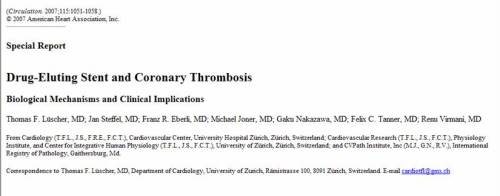
In quest for prevention of restenosis, many of the anti cancer drugs are now delivered directly inside the coronary arteries .These drugs are secreted like a sustained release tablet from the drug coated stents.These drugs are expected to prevent restenosis within the stented segment.But, after years of intense debate and research , we realised that , drugs eluted from the stent could damage the distal coronary vascular bed and coronary microcirculation.( And thus came the epidemic of acute stent thrombosis ! )
The tender and sensitive coronary microvasculature is constantly exposed to these powerful anticancer and immmunosuppresive drugs .It is a great surprise , no body thought of this dangerous drug -coronary artery interaction ! It required the genius of Renu virmani and others to point out this.
But still , the cardiology community by and large , fails to consider this an important issue.This is proven by the fact, usage of DES is still increasing and used mainly as an off label indication.
What is the long term effects of drugging a coronary artery ?
Is no reflow or slow flow more common after DES , because of the adverse drug reaction in the distal vascular bed ?
If a patient with DES undergoes a CABG later what would be the impact of the drug on the graft ? Will the functional vasodilatation affected ?
Final message
A drug , to get a legal clearance it has to undergo hundreds of rigorous tests . Finally it is cleared for that specific indication for which it is tested .Just because a drug is cleared for one purpose ( Paclitaxel for malignancy ) it does not mean it is safe to use for any other purpose for which it is deemed to be useful . Exactly the opposite is happening in the the field of interventional cardiology . No body wondered to think what would be the effect of these drugs on the normal coronary endothelial cells and vasculature.Is it not a crime , without analysing this particular issue , dozens of drug eluting stents have been released in the market . And now, sounds of crying foul is heard world wide !
Let us thank , the so called negative forces in cardiology for making this an issue . In science , the watch dogs should bark at times of danger not wag the tail !
Contrary to popular belief ,great things happen only rarely in medicine . It takes only few months of training or workshops , for a wrong or inappropriate concept to percolate our brains ! But , it would require, decades of time , energy and efforts , for correcting that wrongly assimilated concept in medicine!
Interventional cardiologists are among the rare breed of physicians, who always believe in evidence ! But , the quality of the evidence is rarely questioned ! 30 years of PCI & 20 years of stenting has failed our common senses ! Fortunately , today, we have 135 pages of new evidence ( Not really new , old evidence interpreted with sound logic !)
Hats off to ACC and associates for bringing out this much belated appropriateness guidelines for the interventional cardiologists.
ACCF/SCAI/STS/AATS/AHA/ASNC 2009 Appropriateness Criteria for Coronary Revascularization
A Report of the American College of Cardiology Foundation Appropriateness
Criteria Task Force, Society for Cardiovascular Angiography and Interventions,
Society of Thoracic Surgeons, American Association for Thoracic Surgery,
American Heart Association, and the American Society of Nuclear Cardiology
Endorsed by the American Society of Echocardiography, the Heart Failure Society of America, and the
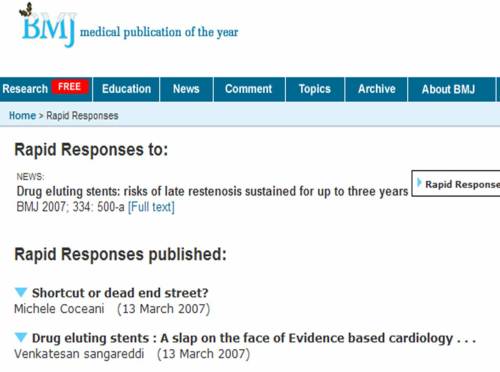
Drug eluting stents : A slap on the face of Evidence based cardiology . . .
Click the BMJ link or read below
It is often said science is sacred and unfortunately we forget , science is not a heavenly creation and it is the creation of scientist of varying grades of integrity fueled by the vested interest of medical industry . It has been a almost a daily affair , some of the devices and drugs are recalled or found to be unsafe on patients.
Now the big cat has come out .The Drug eluting stent has fallen from Hero to Zero in a short span of 5 years. It was projected to have zero percent restenosis in 2002 . And now we realize it is Zero percent truth.
What has started as anecdotal reports of late stent thrombosis has indeed become an epidemic in all DES patients. The five studies that has been published in the NEJM this month (March 2007) has convincingly proved how unsafe these stents are in most of the coronary population .
Millions of patients in whom this stent was implanted will carry an impending stent thrombosis and possibly an SCD . Who is to take care of them ?
The DES story is a clear cut case of getting premature approval for a dangerous form of treatment inside human coronary arteries.
It is amazing how the scientist’s eyes are shut by the illusion of knowledge and lure of wealth. How foolish they were to think drug which was administered via the stent will selectively prevent vascularisation and leave the normal endothelium intact . Now they realized , one should not suppress the endothelial growth around the stent and got the fundamental point wrong. Which was the key reason for the astonishing episodes of late stent thrombosis. When we play with biology of nature we have to be little more careful .God has created man and his heart for over a million years . One can not alter it by a 6 month follow up study of DES .
When ICDs were exposed last year , of similar disastrous outcome they were recalled and explanted . How are we going to unstent the millions of coronary arteries ?
Somewhere along the line the medical professionals have lost the battle against the Wall street and NASDAQ . Or how else we can explain repetition of similar events.
The wages for the modern technology , the patients have to pay a heavy price.
Let us all hope common man with common sense will reign supreme over the sixth sense of the uncommon man . . .
“Ignorance is better than illusion of knowledge”
Dr Venkatesan Sangareddi MD , Assistant Professor of cardiology , Madras medical college Chennai, India
Anginal pain is a type of visceral pain.It is carried by type C unmylinated nerve fibres.The perception of angina is a complex process.It is a combination of visceral and cutaneous referral pain.
How often is angina silent in diabetes mellitus ?
Presence of diabetes per se does not make an angina silent. In fact, if one takes 100 patients with diabetes , if angina occur in them , it is more often , manifest than silent. So , only few of the diabetic patients who develop diabetic autonomic neuropathy fail to have angina.The exact incidence is not known.It could be around 20%.
If angina can be silent in diabteics , can they have anginal equivalents ?
This again is not answered in literature. Among the anginal equivalents , the most common is dyspnea , which can occur in diabetics.But now , we know dyspnea also needs thoracic nerve signals from the intercostal muscle spindle and colgi organs.This can also be impaired in diabetics.
Can silent and mainfest episodes occur in a same patient ?
Yes.
Once silent does not mean always silent, and similarly once angina is felt it does not mean he is going to feel the next episode as well !
This strongly reminds us medical science is much a complex subject and what we know is very little in pain perception.
How is silent ischmia different from silent angina ?
There is considerable overlap between silent ischemia and silent angina
The questions to be answered are
Which is silent ? Is it the angina or is it the ischemia or both ?
Silent ischemia can occur in any individual , this is also called as silent CAD . When ischemia occurs but fails to generate pain it is silent ischemia .Undiagnosed CAD in asymptomatic individuals is also called silent ischemia or CAD.In this population Exercise stress testing detects CAD which was otherwise silent and masked.These patients may develop angina during EST.
During exercise stress testing many times patient has significant ST depression more than 2mm but still chest pain may not occur.These episodes may either be silent ischemia or ngina. Many times the EST is terminated before angina is manifest .( Chest pain is the last to occur in the chain of events following ischemia- Concept of ischemic cascade )
What are the other situations where angina can be silent ?
Pain perception and threshold level is high , so patient indeed has anginal signals but fails to feel it .
Patients on antianginal medication , fail to feel the angina.
Chronic betablocker therapy can exactly mimic autonomic neuropathy
Is it a blessing for the patient to have painless episodes of angina ?
When their ischemic colleagues , suffer a lot with chest pain it is tempting to think these diabetic patients are blessed!
Scientifically , this could be true in at least in some especially in a patients who’s coronary anatomy is known and devoid of any critical proximal lesions. For example a small PDA lesion can produce severe angina , but may be silent in diabetic and be comfortable .This lesion is insignificant other wise * !
It should also be recalled , pain relief has been an important goal for treatment of CAD .In olden days, thoracic sympathectomy was done for angina . In fact , even in CABG , one of the the mechanisms for angina relief is attributed to cardiac denervation.
Caution: Even a small episode of ischemia can trigger an electrical event .But it is rare.
How common is silent infarct (STEMI) in diabetic patients ?
In a simple questionnaire we asked the diabetic patients in our CCU how they felt their pain during MI.Most felt it normally as do other non diabetic . Diabetes does not make all anginal episodes silent. Severe episodes of ischemia may be painful while less severe episodes may be painless. Diabetic autonomic neuropathy is a least recognized and poorly understood complication of diabetes.Diabetes , involves the vasanervorum of the autonomic nerves.
The other mechanisms postulated in diabetic neuropathy are
Reduction in neurotrophic growth factors.
deficiency of essential fatty acids .
Reduced endoneurial blood flow and
Nerve hypoxia .
Is diabetic autonomic neuropathy treatable ?
Very difficult problem indeed.Controlling diabetes may partially correct the neural dysfunction.Many add on neuro vitamins and aminoacids are having a good market !
If you successfully treat diabetic autonomic neuropathy will my patient start feeling the hitherto silent episodes of angina ?
We don’t know.Logic would answer ” YES”
What is the ultimate effect of cardiac autonomic neuropathy.
The growth of medical science has been phenomenal .It is estimated , the quantum of break throughs and development in the last 50 years is nearly equal to 2000 years of evolution of our knowledge put together. Along with this growth , came the unavoidable misuse , and abuse of medical science. This is mainly due to contamination of medicine with commerce . Federal drug authority (FDA) and it’s variants were formed in all countries to monitor the proper usage of these technologies for the benefit of mankind. It has an authority to ban a drug or device , if it is found to bring more injury or side effects than benefit !
But , unfortunately there is no legal authority to ban an an investigation which is potentially or (really harmful )
or used extensively without any valid purpose .
The list of such investigation is increasing in every speciality
In cardiology
Doing a Troponin assay in patients wuth classical STEMI
MDCT in general population
Pro BNP in all suspected cardiac failure
Routine C reactive protein for CAD
Central venous catheters for all pateints with shock.
Is there a case for banning an investigation (Like banning a drug) for the benefit of our patients ?
Looking superficially , it may seem ironical. But we realise many seemingly innocuous investigations are responsible for uncontrolled misery for many patients.
This especially true in people who throng the wellness clinic (Also called master health check up)
A incidentally high C – reactive protein can lead on to forearm blood flow assessment of endothelial dysfunction and carotid intimal plaque that could lead onto carotid stents ! and life long anticoagulation , and an excess INR and sudden cerebral bleed and death !
This is one sample story in one particular speciality
There is a definite case for banning ( Either total or partial) some of the questionable investigations which are done routinely !
Just because these investigation do not have any physical , visible , adverse reactions like a drug , it should not be allowed to be abused .The consequence of false positive results of these investigations could be terrible and worse than the real disese itself !
A poorly deployed drug eluting stent isfar inferior to a properly deployed bare metal stents
Doing a plain old balloon angioplasty ( POBA) is not a scientific crime , millions of coronary lesion just need that! ( Click here -Why POBA is important ? )
PCI is most effective during an ACS than a chronic coronary syndrome
Primary PCI is a race against time and muscle , not a race against money ! Don’t do it for a evolved MI
Recognise , from the patient point of view the term no reflow is generally synonymous with failed primary PCI( It is semantics !)
Side branch can be more important than main branches , so don’t sacrifice it often
Attempting a trifurcation angioplasty is generally not in the interest of the patient but to show interventional expertise
Make sure surgical back up means, a table is reserved with a surgeon fully informed and ready
When in doubt , it is always better to err on a longer stent than a shorter one
The contents of the this blog is being published as Kindle E book , as per the request of many of the readers. Every article will continue to be open source in this site. Again I shall reiterate the book format is not aimed at any commercial intent. It is only to facilitate learning in a single book format Here is the link to book https://amzn.in/d/euhL5vu
Click below to see who is watching this website live !
This site will never aim for profit. Still ,this donation link is added at the request of few visitors who wanted to contribute and of-course that will help make it sustainable .
Please Note
The author acknowledges all the queries posted by the readers and wishes to answer them .Due to logistic reasons only few could be responded. Inconvenience caused is regretted.