Feeds:
Posts
Comments

I’m trying to get  a right  answer for this question for quiet some time. The literature on lipids is so vast  , one can never finish reviewing it.There are   nearly two dozen journals that  deal with lipids ,Atherosclerosis, obesity ,and vascular biology .

Yet  , the answer to this simple question is elusive to us .The Irony is complete when we have evidence for   two diagonally  opposite responses 4 and 5 .

My interpretation of the issue

Any lipid molecule if exceeds a critical  level ( Only  if   . . . associated with hypertension, or diabetes or smoking ) can penetrate the vascular endothelium. ( HT-pressure injury , Smoke- Endothelial dysfunction  due to Nitric oxide depletion) DM -Glycation of cell membrane  , finally some  unknown inflammatory component )

Though evidence  for direct endothelial  injury is more for LDL ,  less for TGL (Almost nil  for VLDL , but  TGL has more VLDL in it !)

Strangely ,these molecules , express a mob psychological behavior .In isolation they appear innocuous. But ,in an  unfavorable   setting it shows signs of  revolt. If a group of  LDL molecule start attacking a  dysfunctional segment  of endothelium , the other molecules  like TGL and VLDL fractions would love to join the crowd  and inflict further  damage . (Of course ,the lonely HDL may watch the chaos silently !)

Questions to ponder

If LDL is a sharp knife like molecule  trying to injure the blood vessel , every normal human being is potentially threatened  by this  lipid fraction . Mind you,  this is a physiological molecule  traversing the human vascular system  at concentration  of 130mg/dl  at the  velocity of blood .

So it is  foolish  to blame this  physiological molecule for all our ignorance.

I recall one recent definition for hyperlipidemia

The lipid levels at which a patient develops vascular injury is considered high for him !
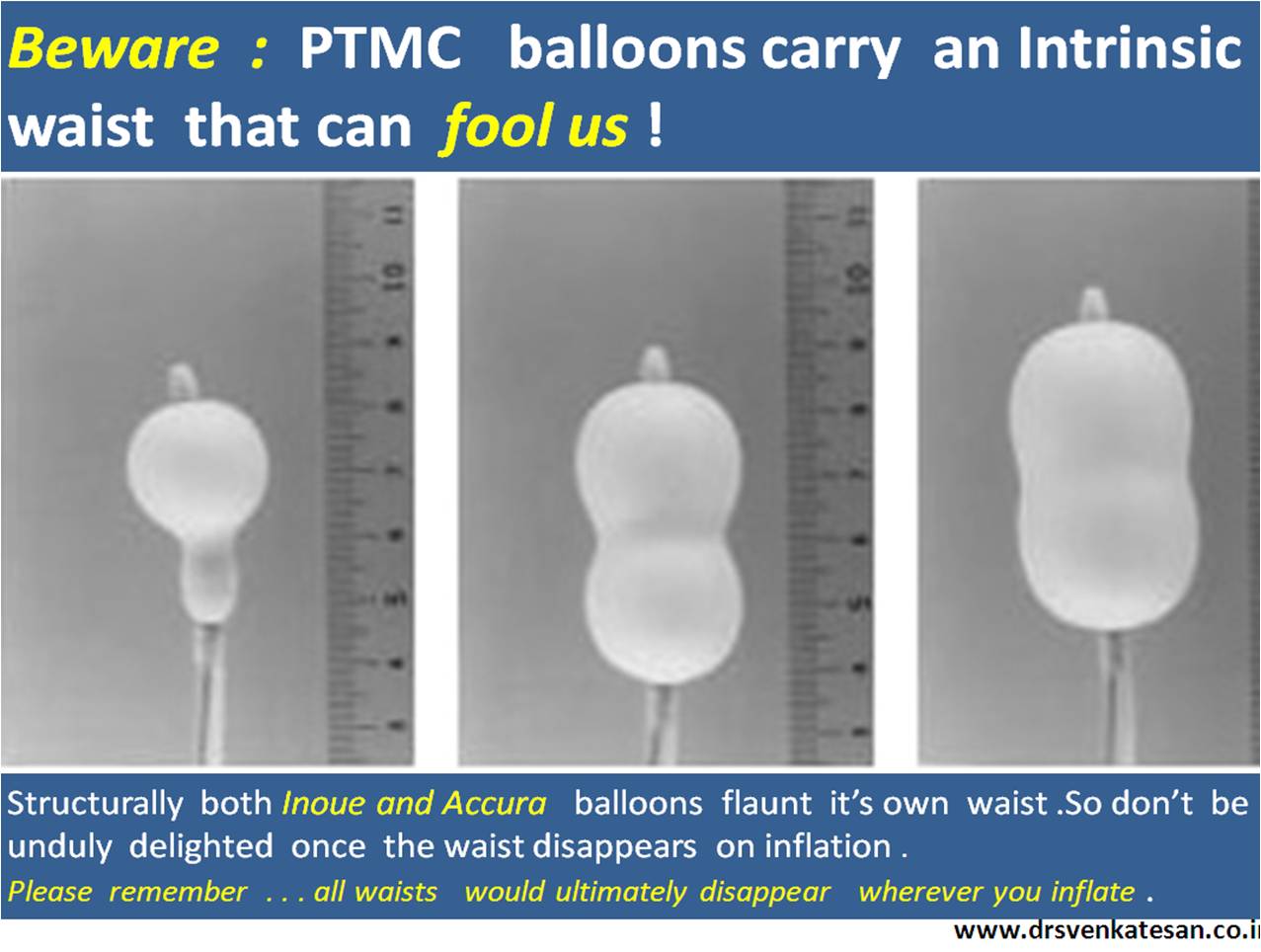
PTMC is a revolutionary    interventional cardiology procedure .A fibrosed obstructed  mitral valve is  opened up just like that , with few wires and a balloon  .The procedure  performed within 30 minutes .No  anaesthesia . No surgery .No scar.

Thousands of procedures are done world-wide (Rich countries excluded    they do not have RHD) .We in our institute , have gained considerable experience in PTMC ,  and  have  completed  nearly  200 procedures  in the last  few years .

As we gain experience surprises also galore ! .Suddenly I realised this  funny (At least for me !) phenomenon  from the unique PTMC balloon design.

The other day  , there was an intense argument between two of my  fellows , who were in a dispute  .One was arguing  , the PTMC  balloon  had dilated the tricuspid valve erroneously  while  other was adamant , and  wholesomely convinced  , since the waist  had disappeared it must be the stenotic mitral valve.

The issue came to me  . . .  ended after a nice  debate !

PTMC balloon accura Inoue waist mitral stenosis percutaneous mitral commissurotomy .

Both PTMC balloons  (Inoue ,Accura) are made with innovative design  conceptualized by Japanese genius Kanji Inoue . The balloon has two layers of latex with a nylon mesh sandwiched in between.The latex  is compliant while nylon limits  it  and generates the required pressure .

The balloon is glued in a such a way ,  central part is  constricted  like narrow band .This makes sure the distal part of balloon inflates first , followed by  the proximal and finally the central .This  also help us  to  geographically to fix  the balloon across the narrow mitral valve orifice .

While , we must agree  this a great  concept , there is an an inherent issue when handling a hour glass shaped balloon with a  natural waist .There would  be great deal of confusion when we take disappearing waist as an index of relief of mitral stenosis.

We know ,the key  requirement is that ,  balloon’s waist  should match anatomical MVO .But , it is estimated  exact match  happens in a minority.  The issue gets further complex  with  subvalvular disease , double mitral orifice, eccentric orifices . The efficacy of PTMC is also determined by the appropriate contact of the balloon’s various pressure points . ( It is a balance of intra balloon pressure(3-4 ATMs)  and  the surrounding tissue pressure !)

Disappearing waists is not synonymous with opening  MVOs .All PTMC balloon inflations will shrug of the waist at peak inflation wherever you inflate .(Intra chamber inflations included !)

Final message

Please realise ,  falling pressure gradients and echo  documentation of  MVO  rules supreme  in assessing successful PTMC. Often times , disappearing waist  is  meagerly an optical  Illusion or gratification.

We do know about left main equivalent . Do we have a proximal LAD  equivalent ?

Proximal LAD lesions deserve a special attention and probably urgent intervention. Medical management is not an option in most  patients. (Proximal alone is not suffice , it should be critical as well )

But we have another issue on hand .What really is proximal LAD ? .

  1. First 5 Cm of LAD ? (LAD normally measure about  15cm so 1/3rd becomes proximal .How logical it looks  isn’t ?  )
  2. Before any  S1 or D1 ?
  3. Before any major S1 or D1 ?
  4. Septal branch is not considered at all  . A lesion is said to be proximal if it is before a major D1
  5. Some others may argue if there are  three major branch  distal to lesion it should be considered proximal.

Proximal LAD equivalents .

LAD first or second   bifurcation  lesions ( Medina1 1 1 , 1 1 0 , 1 0 1)

Mid LAD lesion with major D1 ostial  lesions

For  a super-dominant LAD  even  mid segment  lesion  can  be a   proximal equivalent (By area at jeopardy )

If LAD is giving collaterals  to LCX /OM  /  due to  associated  lesions ,   LAD lesion at any level  becomes  a left main equivalent .

Read the related article in this site

Medical facts  exist in a  dynamic  fluid state . Finding the truth is often a herculean  task .Disagreeing is  easy . ( Proving  a point  may require   a hundred  experiments   . . .  but  for disproving  needs only one !)

Still , the essence of medical knowledge  is about distillation of medical facts and myths and extracting the truth.

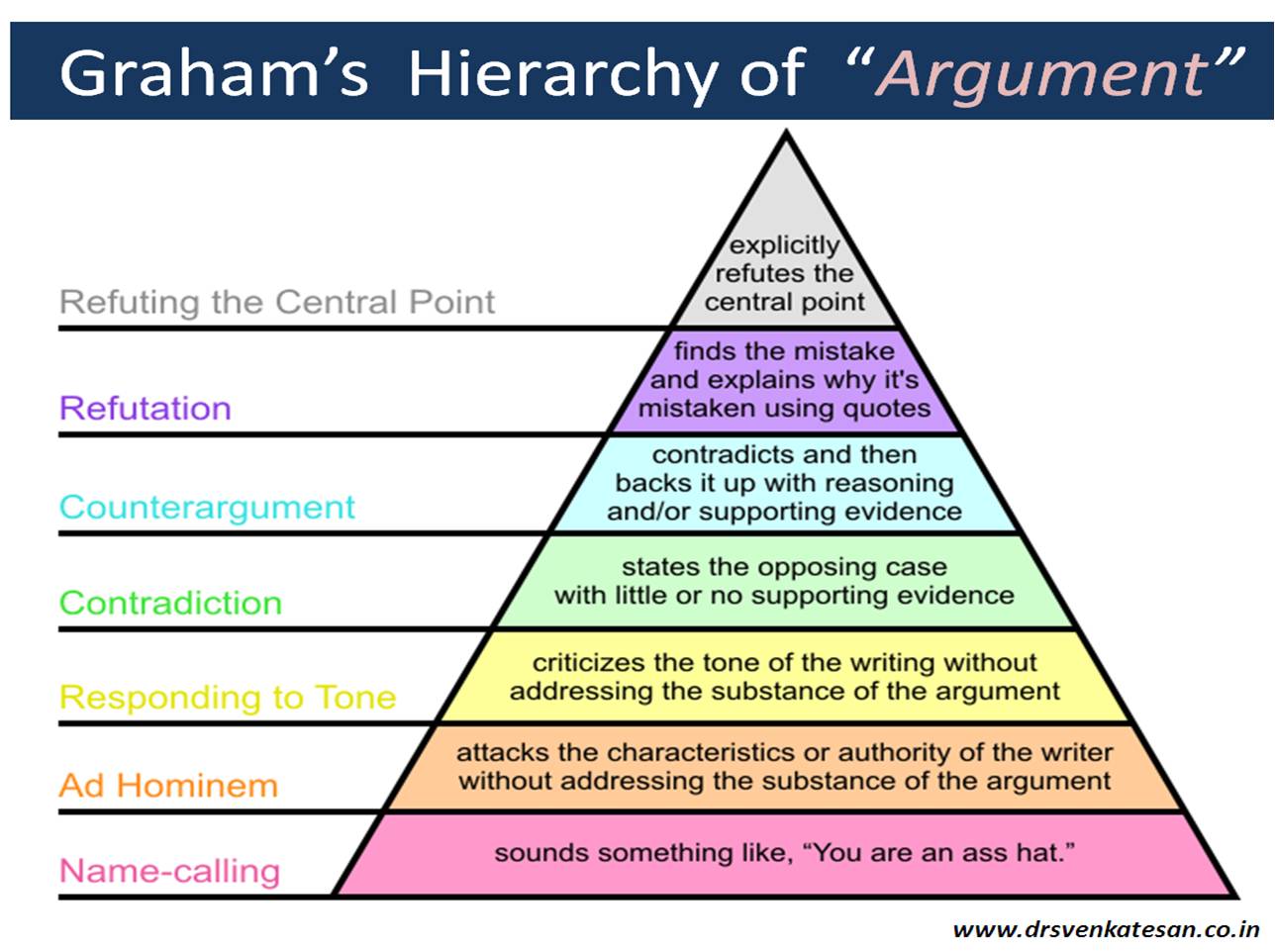
Do  you  know  the levels of  scientific  argument ?

There are seven levels  of  arguing .

Argument , agreement and disagreement are central to the growth  of science  especially so in medical science. It can vary between polite  refusal  to blunt antagonism . Graham’s levels  of disagreement  throws light  on this aspect of human intellect .

grahams grading og disagrrement argument

By default , most human brains live in the bottom of this triangle. Where  does the  medical professionals stand  in academic forums ?  I am afraid  they show  little  difference  from  that of  lay public . Ad Hominem is extremely common in medical journalism . I have  personally experienced  this from elite peers ! A paper sent from   a  third world country like India  is straightaway  rejected or regretted  without even  looking at  core content .

By  the way   . . . where do you like to  stand on Graham’s scale ?

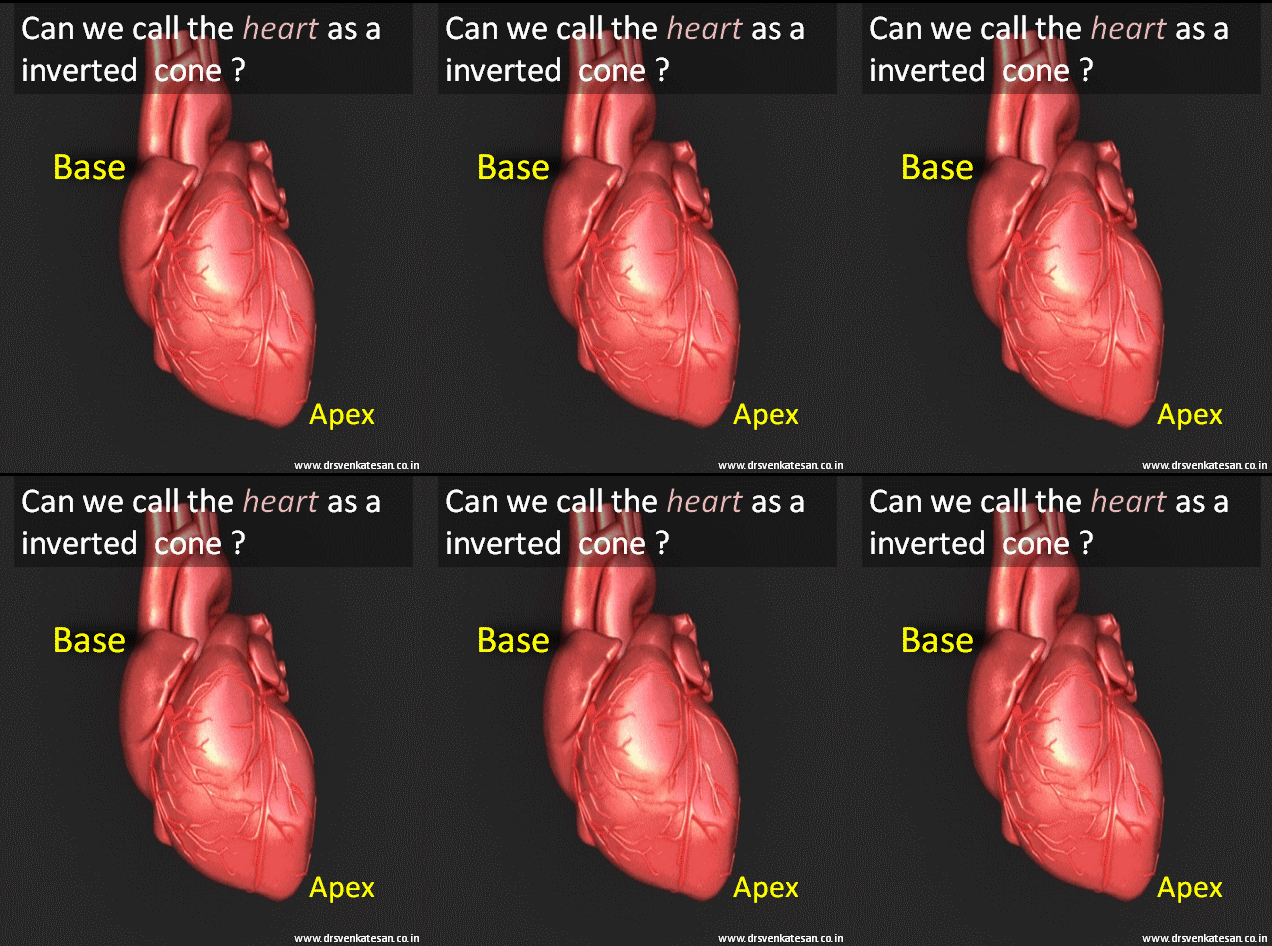
Any structure which has a foundation on which it  stands is generally called base or basement. By tradition   base is  synonymous  with bottom .Ironically , for  heart this rule does not apply. This is the core area of confusion. The heart is a complex shaped  3D organ with multiple surfaces with  4 chambers connected  each connected to its own  great vessel .

shape of the heart base and apex of heart

We know  heart is  simply suspended by these vessels inside the middle mediastinum and  anchored  with ligamentous attachment to chest wall, diaphragm  through pericardium .

Now, traditionally the heart was thought to  be cone like stricture with  apex located near the left mid clavicular line .

base of heart apex  waht is the shape of the heart

If there is  an apex there must be a base  .So ,  we  reasoned the highest and farthest part of the  heart  must be  the base .  Paradoxically , this base is at the top ,  and  not in the  traditional sense  of bottom .

Like wise ,  during auscultation  the  events  in the base represent the great vessel  and semilunar activity  (Anteriorly )

Baseless  base

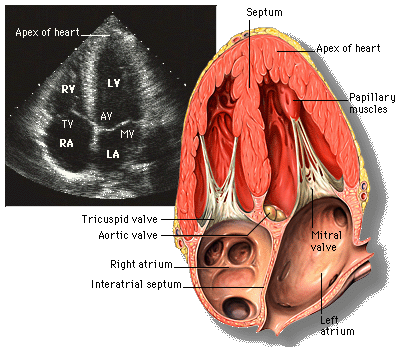
Clinical base is not the anatomical base . When a patient lies  on his back  essentially  the atria and posterior aspect of ventricles form the  base . In  erect posture the  diaphragmatic surface becomes  the true anatomical  base  of the heart .

Further confusion during  Echocardiography

It is well known , basal LV function is a critical determinant of LV function .But we should be very clear  what area we are talking about ! Basal  aspect   can  lie   either  superior , inferior , anterior  even  posterior surface  of left ventricle .(It took me years to realise this simple fact !)

Similarly   basal septum  can mean either a LAD zone or even RCA zone one has to specify basal  anterior septum to define LAD zone ischemia .

(Please note , this is contrast to clinical cardiology where  the  base of the heart refers only to anterior aspect of heart ! )

FInal message

Calling  a  particular portion of the heart as base  would be an  anatomical misnomer . This  nomenclature is based ,  more  by  tradition and  our faulty  perception .(As visualized   by anatomists and pathologists )

We have come a long way  from the Da Vinci  days. Modern cardiologists  with  sophisticated imaging techniques would like to  call  the basement of heart  differently  in the future and correct the nomenclature issues.

In one of  our patients  who had a recent STEMI , CAG revealed  70% LAD  lesion  with   TIMI 1  flow .The distal run off was slow .He had moderate LV dysfunction with no major symptoms. The angiogram was done routinely .( Yes . . . routine CAG- the term I do not relish ,  while it is becoming a way of  life for all learned cardiologists !)

I  was discussing   this case with my fellows and  about medical management of CAD. I  told them  Aspirin will help prevent ACS, statins will stabilise the plaques , beta blocker would prevent cardiac  events by blunting adrenergic surges and Nitrates is a powerful coronary vasodilator that  will improve the  coronary blood flow

A final year MD fellow  threw a  direct  question at me .

Sir,  do you mean  Nitrates  would increase the  TIMI  flow from 1 to 3  in the long term in this patient ?

I was taken-aback  for a moment . . .   and thanked my student for a valid question .

Nitroglycerine is  a powerful coronary vasodilator  we are taught for nearly  half a century . Oral nitrates are used  liberally in the chronic management of  angina. It is a multi billion  dollar market.

Has it been documented to improve coronary blood flow in the long term ?

No

Why then it is  used long term ?

It is a clear case  of  inappropriate medical therapeutics .

* The confusion is partly due to our mix up the mechanism of  relief of angina from coronary vasodilataion. Realistically , NTG should me known  more as a powerful venodilator reducing the preload . It  dramatically reduces the LV filing pressure  and relieves sub-endocardial stress  .This is the major determinant for angina relief .(Of course after-load reduction also helps)

Final message

Nitrates  should be used only for relief of an episode of angina or just to prevent It .This may surprise you  , Nitrates has no documented  efficacy  in the long term management  of angina.

Anatomically ventricles are separated by a single muscular wall namely inter ventricular septum.But physiologically it has to contribute to both ventricular function.

How does IVS  is able to achieve this ?

For the naked eye both ventricles appear to contract almost simultaneously , but there is an intrinsic delay , first the LV contracts , followed by about 70 milliseconds right ventricle generates the peak pressure. So the IVS is able to help in a sequential, & coordinated contractions.This is called ventricular interdependence. Please note pericardium also contributes to this  .

Final message

The mechanical function of  IVS is effectively  and intelligently shared by both chambers. The electrical  delay even in milliseconds is enough to facilitate this sharing .Such is the power of nature. From this concept it is obvious LV dysfunction can have an adverse effect on RV function & vice versa.Similarly any electrical delay( LBBB, RBBB  ) can impact the septal function. Fortunately the myocardium has much reserve function , bundle branch blocks in isolation rarely result in serious consequences unless there is loss of associated muscle mass.

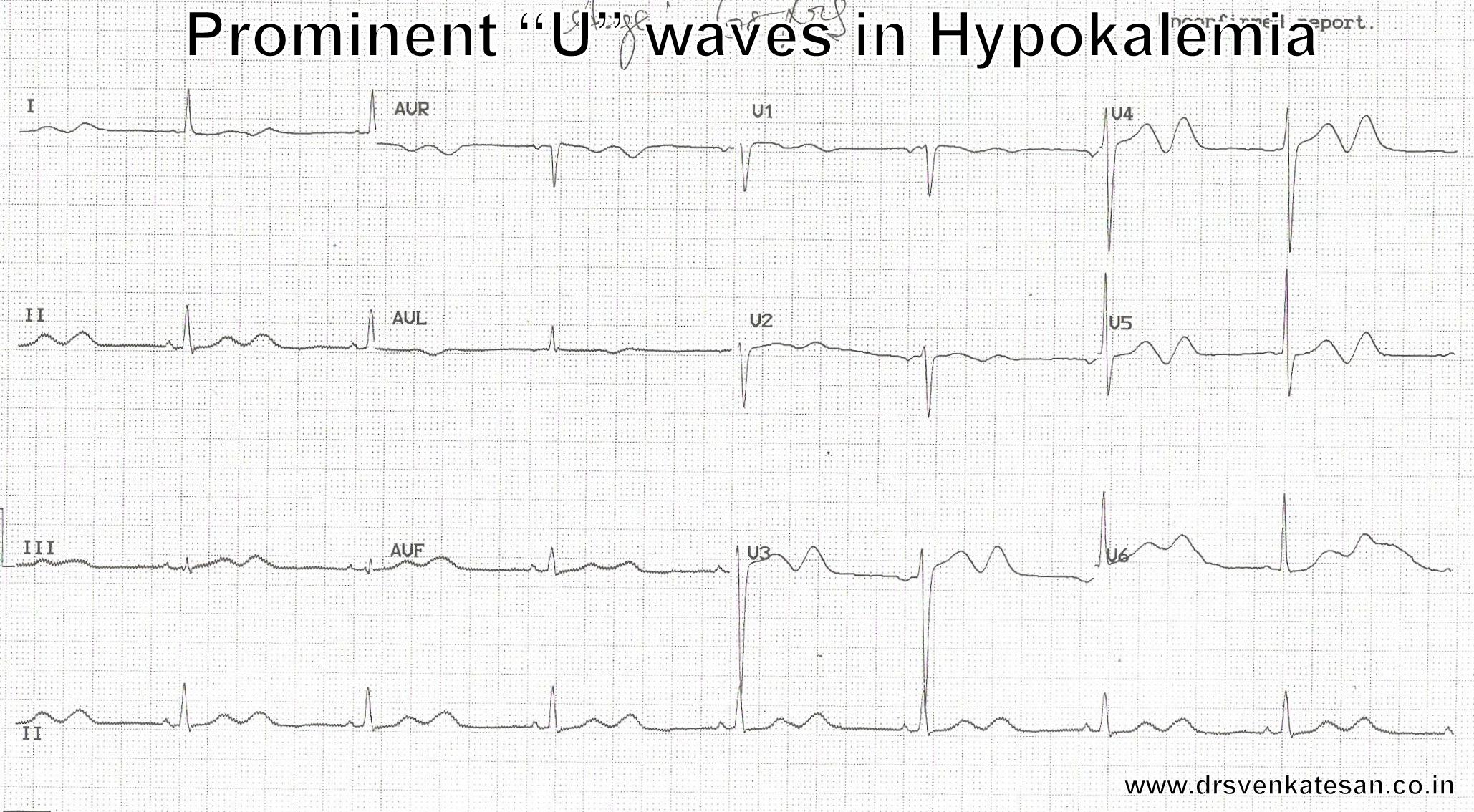
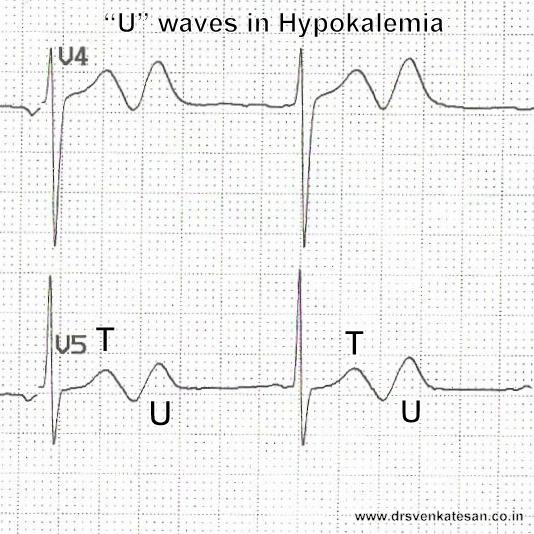
hypokalemia U wave ECGhypokalemia U wave ECG 2

characters of normal U waves

It is usually recorded in the same direction as that of T waves

If it is opposite  it should be given significance .(Ischemic U waves ?)

More prominent in bradycardia

Mechanism of U waves

There are Three hypothesis

  1. Repolarization of papillary muscle
  2. Late repolarization of M cells in Mid myocardium
  3. After potential  to QRS  ie a  form of depolarization

Currently  the third option appears  closer to truth

How hypokalemia  result in tall U waves ?

If Hyperkalemia elevates T waves  it is natural  to expect  hypokalemia  to blunt , flatten or Invert the T waves .Of course , this happens in many . In others with severe hypokalemia an intact  T  is accompanied by a tall upright U  as well .This adds a mystery twist* to the exact genesis of this wave .

* During diastole cell membrane is closer to k +  if K + is deficient it tends to drift . (Some where i heard this   . . . but I do not understand it fully !)

.

ECG U waves 2

Reference

Both  entities   refer  to contraction of vascular smooth muscle.Vascular smooth muscle tone  is under the control of autonomic neuro and humoral system.

Local mechanical , stretch  receptors also  play a role .( local temperature -Cold vasoconstriction  , warmth relieves it ) Abnormal elevated  vascular  tone occur in pathological situations ( Vascular interventions, surgery , drugs, extreme cold ,   )

Both terms are closely related often used interchangeably .There are some subtle differences though , mainly in the usage pattern.

Vasospasm

Is generally a   regional   phenomenon implying central mechanisms  are less  operative.

A local  trigger mechanical or biochemical .( Even a mechanical drag can cause a spasm

It is often transient .

Occurs primarily in small , medium blood vessels .(I  wonder whether  Aorta can go for  spasm !)

Clinical examples

  • Catheter induced vasomotor in cath lab (Radial spasm)
  • Spasm associated with plaque  Prinzmetal angina
  • Cerebral vessel spasm after sub arachnoid hemorrhage ( Need not be transient )

Vasoconstriction

This is also result in  constriction of blood vessels

But the blood vessels involved  are in  micro circulation like capillaries and arterioles .

Often sustained (If transient does it become vasospasm ?)

Vasoconstriction  often involves wide areas and may result in elevated regional or systemic vascular resistance . Hence  it often  result in elevated  blood pressure.

Clinical example

  • Normal Blod pressure  regulation y autonomic mediated vasoconstriction
  • Arteriolar  constriction with Nor adrenaline , dopamine .
  • Capillary Vasoconstriction  due to cold (Raynaud phenomenon )

* Please note other terms like vascular tone , vasomotion   closely competes with above .

Final message

Most of the confusion in medical terminologies are man-made.Both vasospasm and vasoconstriction are  often used  interchangeably .It  is ideal to use  the former for a transient , localised response  in large caliber vessel , and the latter when it occurs as  a general response to altered autonomic  tone and  involve the micro vasculature.

There is no primary rheumatic myocardial dysfunction .The LV dysfunction is related to the valvular lesion especially mitral regurgitation.While this is 100 % true in chronic RHD ,surprisingly it holds good even in acute rheumatic fever as well .(We have been thinking wrongly that acute myocarditis is responsible for most cases of cardiac failure in Acute rheumatic fever !)

( Incidence of LV dysfunction is still noted in 5% in RHD.This is may be due to chronic underfilling of LV in mitral stenosis, fibrosis secondory to hemodynmic stress as in Aortic stenosis or more commonly associated CAD.)

It is a paradox to note myocardits being a major component in acute rheumatic fever (ARF) ,still it does not persist long term .It invariably resolves and the injury to the valves goes on to result in progressive valve damage .
It is heartening to note this phenomenon in ARF as myocardial involvement behaves just like joint involvement.
Shall we modify the famous statement of the canadian Pathologist William Boyd Rheumatic fever licks the joint but bites the heart”
Though ARF bites the vlave , it simply licks the myocardium like the joints
Is there a chronic indolent myocarditis ?
It was Initially thought there could be process of chronic myocardial inflammation.But now it is almost proven there is no entity like that .
But , it is not uncommon some patients with RHD present with significant LV dysfunction which in all probability unrelated to rheumatic activity .
Assignment for cardiology fellows .
1.Where in the heart Ascoff bodies are densely found ?
  1. Mainly over the valve leaflets
  2. Atrial muscle
  3. Ventricular myocardium
  4. Pericardium
2.Does Ascoff bodies disappear in Chronic RHD ?
Reference