Feeds:
Posts
Comments

Here is a case report from Dr. Brugada’s group. What is your diagnosis?
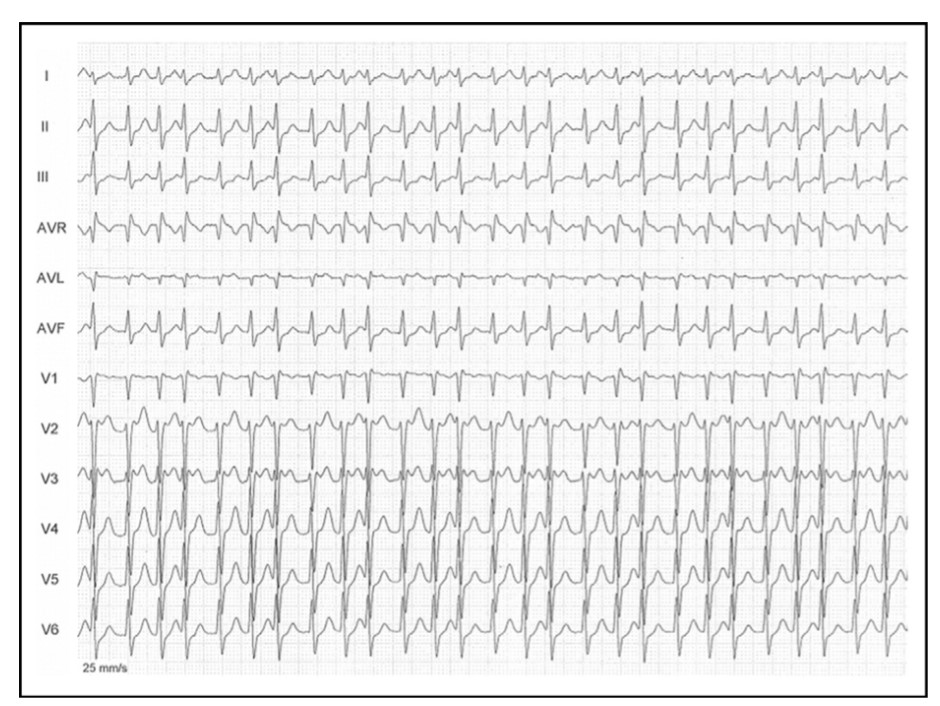
Source & Courtesy Sergio Richter, Joseph Brugada et all , 100(1), 154–156. doi:10.1016/j.amjcard.2007.02.067

Whoever diagnosed AF in the above ECG need not feel bad. The rhythm is not AF, though it mimics very closely. In cardiology, especially in electrophysiology, we can get surprises on a daily basis. (Read below)

Why the ventricular rate is irregular in AF?

Atrial fibrillation (AF)  may sound like a  simple clinical arrhythmia until we ask this delicate question. The traditional and fairly accepted answer is that, AV node with all its collective decremental property filters the incoming atrial impulses (Which varies 400-600/mt) in a random fashion and allows only about 1/3rd of impulses. So, technically it is  AV block of various degrees that makes the ventricular response irregular.

Any other explanation possible?

How about AV node playing out a silent game with Atria, deciding to block everything and start its own fast escape rhythm, rather than leaking out selectively atrial impulses. Some think this is fictional, some others feel it can be real too. When this happens it can be referred to as irregular junctional tachycardia or AF with varying AV blocks. It has been tough, to prove it is only the atrial impulses penetrating through the AV node complex and exiting on the ventricular side unscathed?

Understanding AV node is not easy 

AV node morphology and function still remain a mystery.( Katritsis DG.  Arrhythm Electrophysiol Rev. 2020)The AV node shows huge variation in its size, shape, orientation with LV long axis and AV plane in short axis. The approach to slow pathways with multiple inferior nodal extensions makes a dual (or even poly ) AV pathway in any human being real. How common is dualism or multilateralism within the AV node in the general population? (More than 30-40 % ?) . Let us also mind the traffic in this busy & complex AV flyover can change on a moment-to-moment basis based on neurohormonal and autonomic tone.

Any tachycardia can become irregular if the AV node wishes so !

Though rare ,multiple physiological splits in the AV node make it possible for a single atrial impulse can generate 2 or 3, even more, ventricular impulses. (1: 2 or 3  AV conduction) Since these pathways are dynamic they can make the ventricular response irregular as well (Unlike the regularly coupled Echo beats in classical AVNRT substrate ). Hence, any supraventricular tachycardia can masquerade as AF if AV nodal pathways decide to split and share the impulses this way. It is also interesting to note there has been a documented link between AVNRT and AF (.Ref 2) . Also, adenosine-induced AF is known (James E. Ip et al Circulation: Arrhythmia and Electrophysiology. 2013;6:e34–e37)

Final message

Irregular RR interval with absent/or invisible P waves is not always AF. It can be due to the aberrant behavior of the AV node.( anatomical or functional) It is termed Pseudo Atrial fibrillation as in the above case report. Why do we need to be aware of this entity? We need to be cautious, as any overzealous efforts to ablate the pulmonary veins in such patients will go in vain.

Reference

1.Sergio Richter; Antonio Berruezo; Lluis Mont; Tim Boussy; Andrea Sarkozy; Pedro Brugada; Josep Brugada (2007). Pseudo–Atrial Fibrillation, Rare Manifestation of Multiple Anterograde Atrioventricular Nodal Pathways. , 100(1), 154–156. doi:10.1016/j.amjcard.2007.02.067 

2.Schernthaner C, Danmayr F, Strohmer B. Coexistence of atrioventricular nodal reentrant tachycardia with other forms of arrhythmias. Med Princ Pract. 2014;23(6):543-50. doi: 10.1159/000365418. Epub 2014 Sep 3. PMID: 25196716; PMCID: PMC5586929.

A 5-minute session: Answers are my own. Please cross-check.

1. Is Brugada syndrome clinical or ECG diagnosis?

Always clinical. Never get confused on this.

2. Spontaneous type 1 vs Induced Type 1 (from type 2) which carries more risk?

Both are risky since they are close cousins. But, spontaneous type 1 is the dreaded devil. 

3. Is Brugada primarily a defect of myocardial depolarization or repolarisation?

Not clear. Often in both. In fact a mismatch between them. (Don’t ask how Na+ Channel defect affects repolarisation !)

4. Is Brugada VT is monomorphic, polymorphic?

Both. What determines morphology is not clear though. (All de-nova monomorphic VT will degenerate to polymorphic en route to cardiac arrest)

5. Should  Fever induced Brugada pattern be investigated further?

Better, it is not to be reported in ECG. May not be important in the majority if there is no adverse family history. (If the patient is well educated and afflicted  by Dr.Google and cardiologists can’t escape from ordering sophisticated tests)     

6. What is the overlap between ERS and Brugada?

It is all about the Idiosyncrasy of the K+ channel phenotypes ( Transmural dispersion heterogeneity )  

7. Is a benign Brugada better than a malignant ERS?

Yes, it would seem so. (Inferior or Infero -lateral ERS prone for primary VF in case they develop ischemic / ? also non-ischemic stress)

8. How important is the link between Brugada and Long QT 3 syndrome?

A rare entity, but It is double jeopardy for VT risk. The entire action potential width is vulnerable right from phase 0 to 3 or 4 A case report Sandhu A Clin Case Rep. 2017;5(8):1315-1319.

9. Is Amiodarone really contraindicated in VT?

Not really. Though Amiodarone unmasks Brugada, it can still be used during episodes of VT in patients with manifest or unmanifest Brugada. Maybe in Long QT 3 overlap, it may perpetuate the VT.

10. How important is the structural myocardial defect in Brugada?

Not important in the majority. Though localized RVOT abnormalities are noted in some..RV abaltion can be succesful in odd case.

11. What happens to the ST segment in Brugada during exercise stress?

ST-segment may normalize in some. A stress test can help to risk stratify.  Subramanian M, J Cardiovasc Electrophysiol. 2017 Jun;28(6):677-683.0

12. Which drug is probably best for Brugada as of now?

Quininde , A fairly specific blocker of Ito current. However, it needs to be used diligently. Management of Brugada Syndrome: Belhassen B, Rahkovich M, Michowitz Y, Glick A, Viskin S Circ Arrhythm Electrophysiol. 2015 Dec; 8(6):1393-402.

13. Is ICD definitive therapy?

Obviously not. But, definitely life-saving in high-risk survivors. I guess definitive therapy is possible for future generations through the science of genetic reprogramming of Na+ channels. (Of course, our planet shouldn’t succumb to man-made climatic arrhythmia, by then ) 

14. Does widespread genetic testing & screening of families help in the management and reduce anxiety?

Cracking the genomic code of cardiac ion channels is the ultimate sophistication (Blueprint of fate ?) However, there is no guarantee this information is going to ease out the family members who harbor a genocopy with or without a phenocopy. 

15. Is Brugada getting undue attention in cardiology literature compared to many other common arrhythmias?

      You can answer this …………………………………….


Further reading

Li KHC, Lee S, Yin C, et al. Brugada syndrome: A comprehensive review of pathophysiological mechanisms and risk stratification strategies [published correction appears in Int J Cardiol Heart Vasc. 2020 Dec 19;32:100699]. Int J Cardiol Heart Vasc. 2020;26:100468. Published 2020 Jan 21. doi:10.1016/j.ijcha.2020.100468


An Interaction in IMCU

How is Mr. K, who was shifted from ward 102 ?

Yes sir, It was acute decompensated LV failure, Patient was in impending pulmonary edema. In fact, he developed. He is fine now,

How did he come around? He was too sick I thought.

“Just pushed 60 mg Frusemide IV, luckily he also had good BP, so with an infusion of NTG, titrated Carvedilol a little bit, he came out nicely. I guess it is Ischemic DCM”.

“Good, You have done a nice job”

“Don’t make me embarrassed sir. It is such a routine in our ER. 

To make him curious, I asked “Which drug do you think that saved him”?

“Obviously, Frusemide sir. He was frothing out. I thought he will require a ventilator. It was a matter of 20 minutes, sort of flushing out 500 ml lung fluid through the urine”.

“No, you are wrong. As a professor and cardiologist, I need to tell you this. Diuretics never save lives heart failure. 

Sir, I guess, you are not kidding. Does this statement apply to acute heart failure? We have saved 100s of lives with Frusemide,  both in acute, acute on chronic, and even in chronic cardiac failures with metolazone.

Hmmm, I agree with you my dear student, Frusemide has saved not hundreds but lakhs of lives in the past decades in all forms of heart failure. It continues to do this fabulous job even now. But, don’t say it in exams or scientific forums. It has no evidence to show survival benefits. You can’t credit a drug without evidence. Also realize, saving lives by unscientific means by a cheap generic is not something to boast upon. We need the blessings of RCTs, or Kaplans Mayer curves, or Forrest blobbograms. Unfortunately . that is the current principle of practice of medicine.

But sir, who is preventing whom, to do such studies. Why they are not comparing diuretics one to one with these modern drugs of inotropes, calcium modulators, or SGLTis, etc? 

I am not sure. My guess is, there are no good friends in the cardiac failure research community for this old warrior drug. 

Loop diuretics 

Till 1960s, toxic mercurial compunds was the only option to drain water in heart failures. The Invention of  Na+/K+ /Cl channel blocker Frusemide, ( In the thick ascending limb of the loop of Henle) is the single most important event, that changed the way we manage cardiac failure in both acute and chronic settings. Still, the current evidence creators hesitate to call it a life-saving drug,

The meteoric rise of SGLT-2 Inhibitors 

Meanwhile, a few micrometers down the hairpin bend of Henle, drugs called phlorizin are doing wonders. These Apple root barks derivatives were since been invaded by Glyflozins Industry. They are made into a powerful glycosuric drug that drags water out of the system along with glucose. This seems to be the biggest revolution in cardiac pharmacology ever since DaVinci drew the heart and Harvey made it functional. I think we need a supercomputer to count the number of papers and analyze the data from Dapa & Empaglyflosin. It is now concluded officially, as an evidence-based life saver in HF.

I asked one Gen X Pharma-geek, “How do these magic drugs perform this miracle in heart failure”? He said beamingly, It is not merely Glyco-diuresis, as you academicians think, it is some mystery action from heaven, still not decoded. What a revelation I thought.

Continuing Medical Education: Choosing the correct path is never easy!

Final message 

Loop diuretics are powerful drugs that aid the failing heart to reduce both pre and after-load. It is a fact, indiscriminate use of these drugs leads to some electrolytes and metabolic issues. But, hiding behind a hazy and shaky evidence base, and trying to ridicule these life-sustaining drugs, is the height of senselessness in cardiac failure literature.

Reference 

(There is a tug of war of evidence between benefits and risks. I guess someone will bring out the truth, which is written clearly on the walls)

1. Chris J Kapelios, Konstantinos Malliaras, Elisabeth Kaldara, Stella Vakrou, John N Nanas, Loop diuretics for chronic heart failure: a foe in disguise of a friend?, European Heart Journal – Cardiovascular Pharmacotherapy, Volume 4, Issue 1, January 2018, Pages 54–63https://doi.org/10.1093/ehjcvp/pvx020

2.Faris R, Flather M, Purcell H, Henein M, Poole-Wilson P, Coats A. Current evidence supporting the role of diuretics in heart failure: a meta-analysis of randomized controlled trials. Int J Cardiol. 2002 Feb;82(2):149-58. doi: 10.1016/s0167-5273(01)00600-3. PMID: 11853901.

Postamble

It is to be noted,Eplerenone (EPHESUS trial )  & Finerinone  (FIDELIO-DKD trial) are new generation  K + sparing diuretics and mineralocorticoid antagonists may have better cardioprotection in cardiac failure.(Part of RAAS blockade)

Link to PDF download 

Good news: Nothing much has changed since 2008

  • Recognizing the clinical importance of AF and the need to rule out a systemic cause is the key, Further, a genuine bedside debate about the pros and cons of simple vs aggressive treatment discussion is welcome.
  • The nomenclature issue of valvular vs non-valvular has finally seemed to have settled. The latter is banished for good reason. (Funny to note Aortic valve  was considered as not a valve for  so long !)
  • The rate vs rhythm control debate still favors the former. (AFFIRM/RACE)
  • Stroke prevention is the concern  &  anticoagulation is the mainstay. OAC/DAPT /triple therapy has evolved a little more in the last decade. Though stoke is a major concern, we rarely see neurologists & cardiologists debate closely on risk profiling issues of such patients. (at least in this part of the world.)
  • Whether we have conquered AF or not we have become experts in creating an unlimited number of bleeding risk scores. Understanding and applying them at the bedside need special memory and expertise.
  • On the combative front, ablation strategies, however, advanced they look, are vested with the risk of injuring the surrounding structures. My biased opinion is that the risks are prohibitive except in very refractory and troublesome AFs. (with all these 4D, contact, cryo, etc)  Recall the CABANA study. We are beginning to understand, the true embryological face of pulmonary veins insertion points is so variable, and residual sleeves are very rampant that will sustain the AF even after an apparently successful ablation.
  • LAA appendage closure studies again don’t look rosy as the device itself is prone to thrombus at least in the early periprocedural period. (Watchman requires more security and protection than the Inmates !)

Final message 

AF is a simple arrhythmia in 9/10 patients. Please, let us not complicate it. We must ensure, systemic and non-permanent forms of AF should not drain our cardiac resources. We shall follow basic principles of managing a cardiac arrhythmia that will suffice in the majority. An occasional patient needs to be referred to an EP specialist.  

A new look at AF risk estimation for stroke

doi:10.1001/jamacardio.2021.3709

What is the true success in a scientific career?

It is not the number of publications in journals or getting those big awards or memberships in prestigious scientific societies. True success is “something else,” says the Nobel Medical Laureate  Dr Willam Kaelin 

Great thoughts. Just wondering, what are those elements beyond our controls he was alluding to?


Video courtesy and thanks : http://www.nobel.org

News: Series of clinical trials fail to clear the ongoing confusion in the business of cardiac revascularization.FAME 3 is the new addition. 

Caution: A non-academic journal review

There is no secret, about this cold war happening in an incognito mode for territorial rights between cardiologists and cardiac surgeons in glamorous cardiac suits for the past two decades. Of course, we keep believing this is a friendly fight in the overall interest of CAD patients. The ultimate winner should be the patient, not anyone else. Will that happen? Will anyone will allow that to happen? I am not sure.

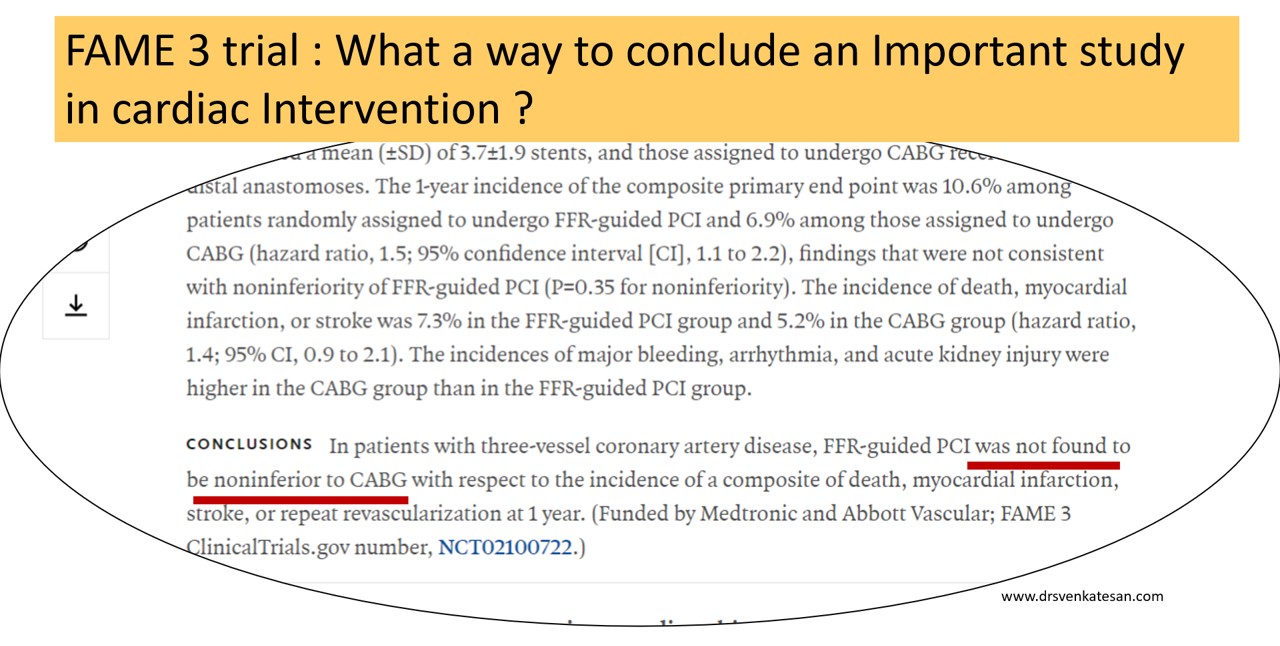
The FAME3 is a stunning large study from 50 centers FFR guided multivessel PCI, that failed to dethrone CABG (or at least it wanted to sit along with it) I am not a seasoned statistician but definitely can’t understand the logic behind the methodology* and the choice of words in the conclusion from a paper published from a renowned journal.


(*I can recall an article about Non-inferiority trial  from Lancet (Ref 1) )

FAME 3 aftermaths: A dizzy Interpretation

Before accepting the fact that, FFR guided PCI wasn’t able to show its superiority or to unable to prove its non-Inferiority, while CABG was clearly found to be non-inferior, (rather superior) to PCI, we should take into account an important caveat in the concept of FFR itself, which has at least half a dozen serious hyperemic and non-hyperemic flaws that demanded a more superior,non-hyperemic indices like iFR, RFR, qFR, etc.

Those of you who still believe PCI would be an undisputed modality in multivessel CAD  should take up the challenge and disprove the superiority of CABG by doing the same FAME 3 subset with iFR and other stuff. (Eagerly waiting for the hypothetical iFAME 4 trial)

One more way to Interpret FAME 3: How can we accept FFR guided multivessel PCI as inferior, unless we have an FFR guided CABG (FAME 3 didn’t do this) to compare? Can you guess if only pre-CABG FFR was mandatory criteria, that would have excluded or included important grafts, what would have been the impact of CABG? This is a more dramatic suggestion, that will say sorry to FFR,( the old physiological friend,) and label it as a new villain.

Final message 

Multivessel PCI still has a long way to go before trying to dethrone CABG.  But, strictly scientific cardiologists need not worry much and they can continue to indulge multivessel PCI without FFR, which is no longer unscientific ! Thanks to FAME 3. I think one of the Important indirect consequences (?purpose) of FAME 3 would be, playing the end game for FFR.

Reference

https://doi.org/10.1016/S0140-6736(07)61604-3

A young Indian superstar actor Punnet Rajkumar, suffered a sudden cardiac death last week during a workout at his gym. We don’t really know what happened, was it really a conventional heart attack ? or simply an exercise Induced arrhythmia or an isometric dissecting injury to the coronary arterial (or Aortic) wall. Only a postmortem would have thrown some light. (I am not sure what the ER room ECG showed though) He had excellent physical fitness and was following a good healthy lifestyle. One possibility is extreme physical exertion.

It is ironic, while a sedentary lifestyle is a chronic coronary risk factor, excessive physical activity in the background of emotional stress can be turn out to be an acute risk factor. (This is not to frighten all those young and energetic, it only conveys a simple message. Moderation is a must in any indulgences in life)

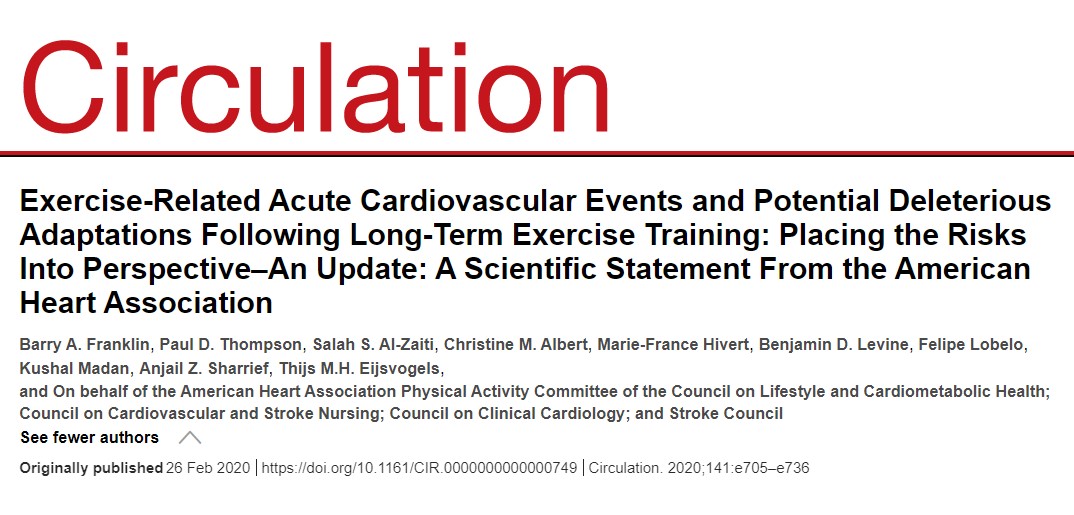
AHA has made an elaborate scientific statement on this Issue.

Meanwhile, the entire nation went into cardio-panic mode and TV media houses have become free cardiology consultation rooms. How many will realize sudden cardiac arrest and heart attacks can be totally two different entities. Further, who can teach the public, that endpoint of any life has to be cardiac arrest or a standstill. How unscientific does it sound when someone suggests a CT angiogram for all aged over 40 years ? Guess, who will enjoy whipping and sustaining such a frenzy.

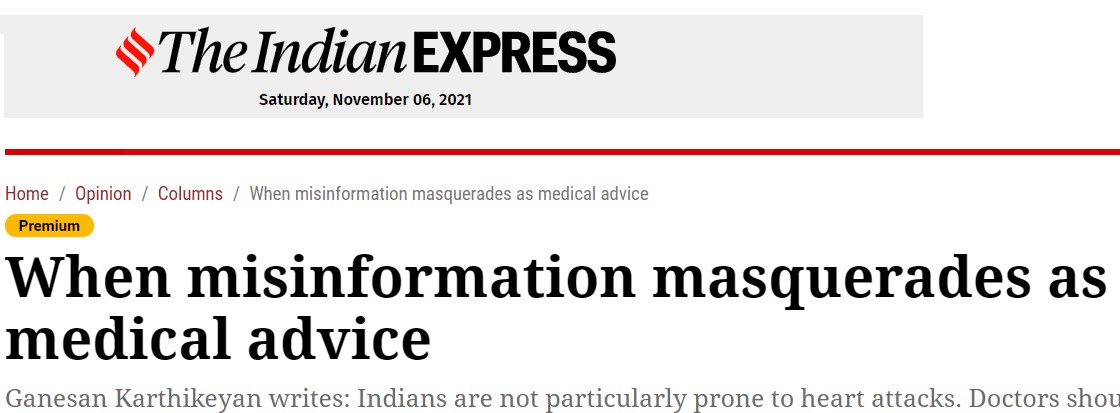
Here is a precise article in Indian express that puts this episode into perspective.

https://indianexpress.com/article/opinion/columns/puneeth-rajkumar-death-doctors-hearth-attack-health-7606581/

The author is Dr. Ganesan Karthikeyan, professor of cardiology at AIIMS with a Global reputation.


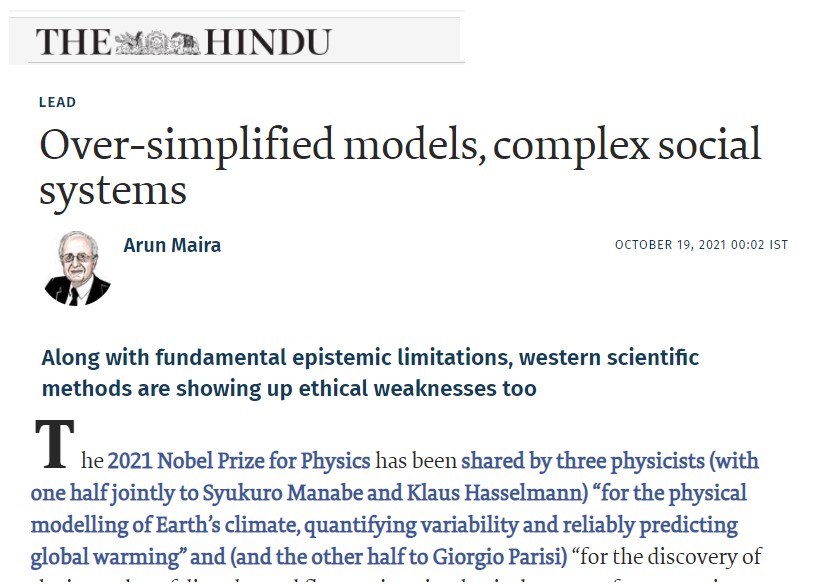
This piece of article by Mr. Arun Maira,(The Pakistan-born British Indian ex-planning commission member) is a real eye-opener in the manner we have understood science. All socially conscious scientists must-read. (If properly appreciated, the 15 minutes  you are going to spend on this is worth the time of one full semester in economics at a top-notch university )

Was the past perfect?  & Will the future be tense?

No is the answer to both questions. Noble prizes are increasingly given for some soul-searching simple researches. Complex research methodology is looked down on, especially in economics. Contributors of simple observational studies bordering on common sense shall be rewarded. Incidentally, this year’s physics prize was also different from other years (Given for finding faultlines in working models of climate change). It is heartening to note the shift in thinking and points to good times for true science. We have finally started to question the genuineness in the foundations of existing research models and epistemological purity of knowledge.Very soon, major global awards are waiting for the Innocuous looking amateurish research that is willing to expose trivia and the flawed understanding of science itself.

High stakes in the noble profession

Now, this has major Implications in the terrain of medical practice, a fragile scientific art that is dangling between facts and fakes, uncertainties of nature & certainty of greedy monetization, social inequalities, and finally the stupidity of half-baked knowledge.

I strongly believe the following two concepts if proven properly deserve the Nobel prize in medicine or economics with a huge Implication for humankind. 

1. In the global health care delivery, nurses and para-medical health workers have a multi-fold positive impact on universal health goals than the highly specialized doctors, who are at best have a minuscule role. There should be intensive restudy of their actual requirements and redefining  doctor vs nurse vs population ratio (What a big revelation,  even a novice can say this, but that is exactly  is the reason which makes it eligible for the Nobel award)

2. Specific treatment modalities are either lacking or trail behind the hyped-up diagnostic methods for a good number of illnesses. They are not only redundant but also malignantly consume the global economic resources without a real purpose. What is the big deal of accurately diagnosing and labeling a disease if there is no treatment? (Typical example in recent times,100s of millions of costly RTPCR tests are Indiscriminately used for an incurable self behaving pandemic).

Who is willing to do the above studies? I wish WHO can sponsor this. Research questions, methods, statistics, and even conclusions are ready with 100% accuracy, I am sure, they will withstand any rigorous scientific scrutiny. Though every Tom, Dick  & Harry can do this research from any academic garage, the chances of it getting noticed by Karolinska institute is low, unless It comes from an Ivy League or an elite European university. When someone receives this coveted award down the lane of time, hope this cranky post gets some credit.

Reference

https://www.thehindu.com/opinion/lead/over-simplified-models-complex-social-systems/article37061493.ece

Nobel Prize economics list

Noble prize in Medicine list 


Aortic stenosis evaluation was simple in our days. Gradients across the valve were the key. Now, we have more parameters to bother about. Dynamic AVOs, flow state, resting LV function, contractile reserves, GLS, dobutamine response, etc. MRI assessment will soon overtake echocardiography. 

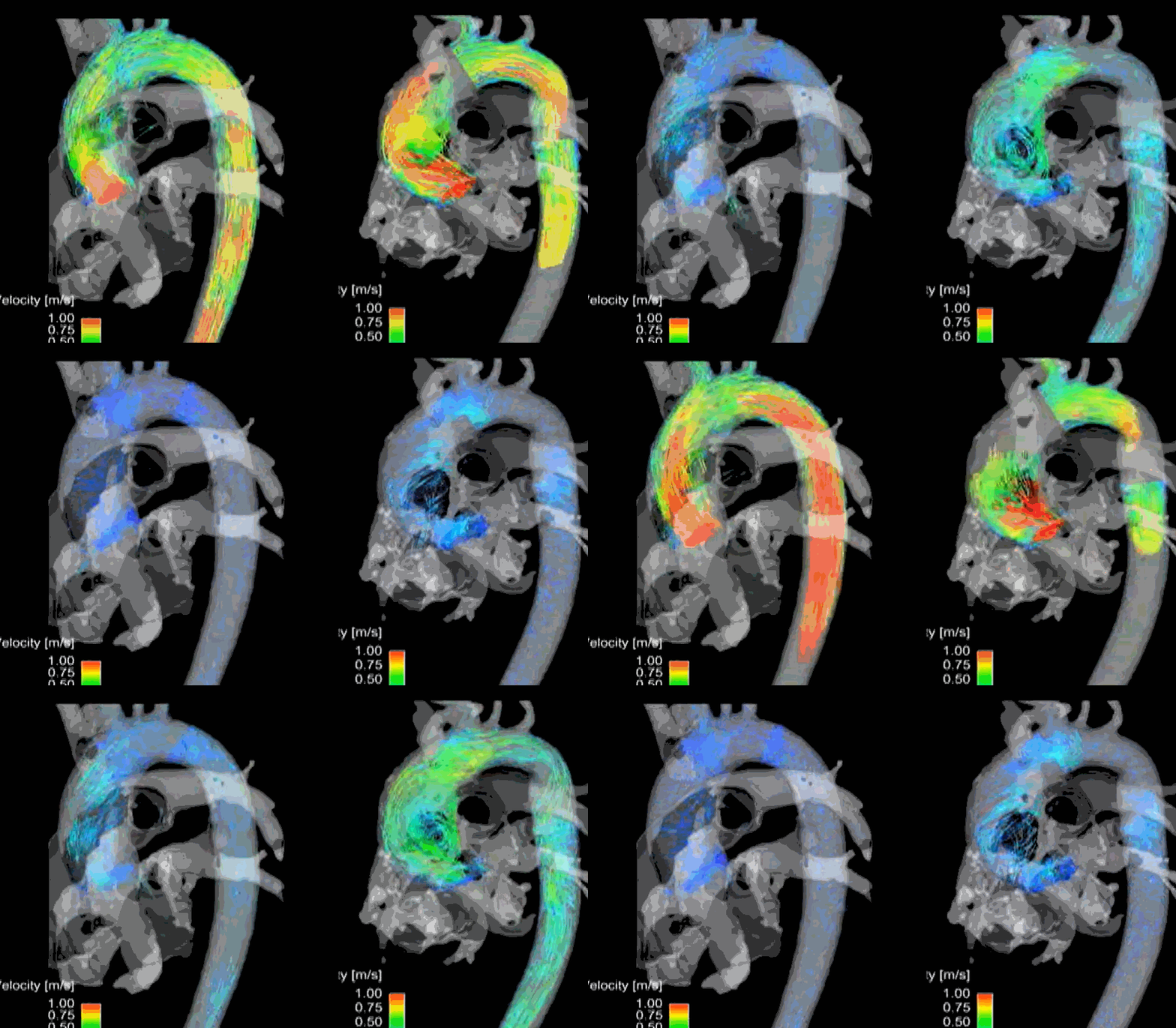
Hemodynamics of flow across LVOT. MRI 4D volumetric model of normal Aortic stenotic flow in the bicuspid valve (On the left). The more we know, the more we tend to miss! Image courtesy: Northwestern Medicine

The current AS algorithms, though scientific, I am afraid, appear much complicated with some frightening terminologies at least for the beginner. One such category is PLF-LG-AG.

Let us first answer this. What is LG-AS?

We diagnose a case of significant aortic stenosis but desperately miss to pick an adequate gradient across the valve. It is indeed a low gradient AS, still, you are not convinced, since the 2D look of the valve looks severe. Then you find the culprit. It is the dysfunctional ventricle pulling down the gradient. This is called  LG-AS.(one type )

*What is paradoxical -Low flow-Low gradient Aortic stenosis? (PLF-LG AS)

Now, we have another patient. Again it is  LG-AS, but the LV function and EF are normal. Now, you get confused and label it as PLF-LG-AS. 

PLF-LG AS is known to account for approximately one-third of patients with severe AS and preserved LV EF.PLF-LG severe AS is defined by AVA <1.0 cm2, indexed AVA <0.6 cm2/m2, mean gradient <40 mmHg, LV EF ≥50%, and low transvalvular flow (indexed stroke volume <35 mL/m2).

What is the paradox?

AS is severe, but the gradient is not showing at the valve. Wait, don’t think that is the paradox, since this can happen in any category of LG-AS.  So, the real paradox in PLF-LG-AS denotes to the fact that the gradient is low, in spite of normal LV  function (Rather, normal EF %)

Why the paradox? Why gradient is not showing? (In spite of good Ejection fraction ?) 

  • Reduced stroke volume increased afterload due to associated HT are the major hemodynamic mechanisms of PLF-LG AS.
  • The low-flow state can be related to small LV cavity 
  • Significant diastolic dysfunction (Associated Amyloidosis is a new age problem kid on the block. EF is not the only parameter that can compromise the flow you know !)
  • Atrial fibrillation (Ofcourse some cycles will pick up the high gradients, but are they spuriously low or high is the question  ) 
  • Associated mitral valve disease leaks, as well as blocks, will ration the flow to LVOT.

*Finally, every cardiologist should be aware of the following two subsets that could wrongly enter this conundrum of PLF-LG-AS  without much fanfare but with lots of implications.

1. Most importantly, technical issues are the key confounders. Malaligned  LV / LVOT with that of distorted out-of-plane AVO is the commonest cause of failure to pick up the gradient. (Never diagnose PLF-LG-AS  without confirming it is not due to technical ). A tip: Don’t complete AS doppler study without a meticulous search for a good doppler signal from the suprasternal/right parasternal window. 

2. Next one can be named with a provocative term “Paranoid aortic stenosis*”. Once, a  fellow was reporting a shabby-looking calcific valve as low gradient, severe AS with normal LV function. He made this diagnosis solely based on AVO. Later, when it was assessed more scrupulously it turned out to be a true mild aortic stenosis, and none of the decorative echo features he was showing were really pathological. It was an error in the aortic valve area calculation due to LVOT area/VTI measurement errors that got mathematically amplified. An important teaching point emerged from this echo lab fiasco. Mind you, any true mild aortic stenosis (If the area calculation is wrong for some reason) will readily fulfill the criteria of PLF-LG-AS. One simple tip: Never diagnose severe Aortic stenosis without significant LVH.

What is the role of Doubtamine stress echo in PLF-LG-AS ?

It does help in both forms of LG-AS. You need to read about the contractile reserve, the response of dobutamine to flow (Cardiac index), gradient, and the valve area.

How to manage PLF-LG-AS ?

Many of them might be argued to end up in TAVR. So, follow the guidelines carefully but don’t apply them blindly

Final message 

In the evaluation of Aortic stenosis let’s make things simple. Gradients are indeed important. But, realize Doppler gives only pressure data. Converting them to flow and volume data is always error-prone. Instead, let us believe our eyes too.(Need not always depend on o MDCT vision)  Concentrate more on LV morphology, valve pathology, and careful assessment of LV function, finally take a decision to intervene based on true symptomatology and comorbidity.

Reference 

1. For the most authentic knowledge base

2.An excellent review on the topic 

Guzzetti Ezequiel Frontiers in Cardiovascular Medicine 2020

Further thoughts

Is there a “high flow-high gradient”- True mild AS?

High gradients across the AV  generally do not cause much confusion. If the mean gradient is > 40mmhg Aortic stenosis is always severe. Is that right ?. I think so. Exercise-induced paradoxical high flow high gradient AS as an entity is not reported as such. But, what really can happen in high output states, hyper contractile ventricles with high EF? We have observed doppler gradients overestimate the severity of Aortic stenosis. I think there is some dynamic component even in the so-called fixed valvular AS that alters the gradient in response to flow. Do we have proof for this?  OMG, it’s right there in echo lab every day, we are failing to notice it. Look at the AS gradients during AF. It is changing every beat, right.


Doppler E/A ratio reversal is probably the most reported abnormality in clinical echocardiography. We are also pleased to label it as a grade 1 diastolic dysfunction. Making a significant population who come for regular health checks anxious and worried.

Sharing a presentation from the Annual conference ECHO INDIA 2019, I participated in a symposium on Diastolic dysfunction.

Topic : Issues in diagnosing grade 1 diastolic dysfunction: Pearls and Perils

How did we get into this academic trap? Should we continue this practice?

The current ASE guidelines 2016 have a clear message. It has taken off the E/A ratio from the Initial screening for diastolic dysfunction.

Summary & Final message 

Are we ready for the change? By understanding a simple concept, one can reduce the incidence of indiscriminate diagnosis of grade 1 diastolic dysfunction.

  • E/A ratio apparently has a no role in diagnosing diastolic dysfunction in the normal population who have normal EF %.
  • Hence, never report E/A ratio in Isolation as grade 1 diastolic dysfunction.
  • However, in patients with HFrEF it does help in triaging diastolic dysfunction.
  • Always look for symptoms and 2D features  (Unexplained dyspnea, LA enlargement, LVH ) before considering diastolic dysfunction.

*For advanced readers and researchers grade 1 diastolic dysfunction does have a deep meaning and always continues to puzzle.

Patient corner

For all those anxious patients who ramble around with a report of grade 1 diastolic dysfunction, I can assure you this. Please realize, 9/10 times, this is just a decorative echocardiography abnormality meant to add some spice to the report  does not have any significance.

*Will post a PPT presentation shortly.