Feeds:
Posts
Comments

Caution: This is a fairly lengthy article . Optimal Reading time  15  minutes

Cardiac failure is a progressive systemic disease  ,  even though the primary problem originates in the heart .Most of the symptoms and clinical features are related to Neuro-Endocrine activation instigated by poor pumping function.When the diminishing cardiac function exceeds the compensatory mechanisms , full blown cardiac failure sets in and get into a vicious downward spiral unless  intervened.

The conventional treatment model involves  on three targets.

  • Reduction in pre -load(Diuretics)
  • Improving  contractility (Inotropics)
  • Reduction in afterload  (Vaso- dilators)

Though the concept looked attractive  there are many missing links . Medical treatment   lags far  behind  the desired goals. Still , it  can stabilize most of the patients with cardiac failure till they reach very late stages.

Nomenclature

Inadequately  treated  CHF is not  synonymous  with refractory failure  . But  ,  practically it is the commonest cause for refractionaries . Hence  , every patient must be scrutinised meticulously for adequacy of treatment.

Primary mitral  , aortic valve  lesions causing cardiac failure need  not be considered as refractory  cardiac failure . In the strict sense myocardial disease /damage  either  idiopathic or secondary to CAD  would form  bulk of refractory failure .

(For example a patient with critical aortic stenosis with severe LV dysfunction is   technically  refractory cardiac failure but functionally it could be a  simple  expression of  after load mis- match )

COPD -Cor pulmonale /Primary pulmonary  hypertension  / End  stage congenital  heart disease  and   Eisenmenger syndromes   form separate  group of  CHF and would not be discussed  here.

The valves , the fibrous skeleton, the  pericardium are integral parts  of the heart . Individual disease process can affect these compartments in a differential pattern .

When we  refer to  refractory heart failure   it amounts only two  large disease groups.Ischemic and idiopathic  cardiomyopathy.The whole myocardium is a single unit. If it is destined to fail  it will fail in toto.  There can be reversible factors that can be addressed.

The coronary artery   though not a part of heart has a major say in the outcome of cardiac failure as they determine the cardiac muscle  integrity.In every patient with refractory cardiac  failure , an attempt must be made to rule out  any  re-vascularisible  lesions.

The primary difference between ischemic and Idiopathic DCM   is ,  in ischemic DCM left ventricular  segments  are predominantly involved . RV function  is relatively   preserved until very late stages.

Patient factors

Age , gender, body weight , systemic illness that increase metabolic demands have an adverse impact . Diabetic patients fare poorly .

Fluid management  and  diuretics

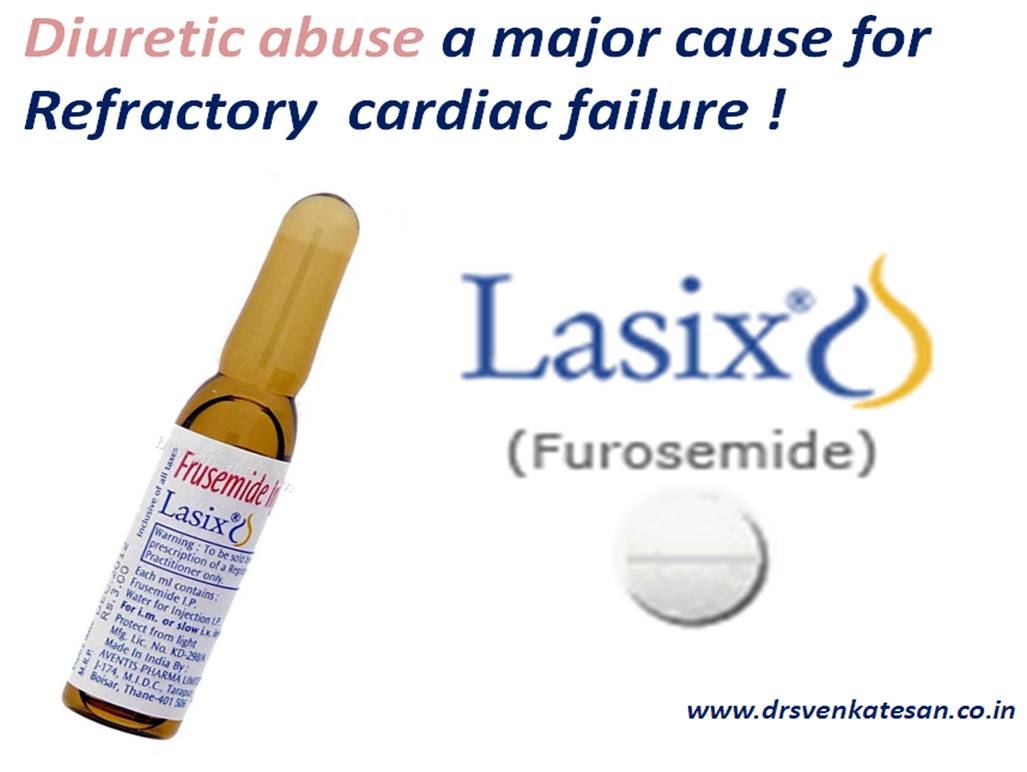
In refractory cardiac failure the renal blood flow is reduced .Diuretics usage will further worsen this if ECF is depleted .

So it is obvious we have to use it very judiciously .

Why only  certain patients with cardiac  failure   develop significant edema while others do not ?

This lies in the response of neuro -humoral  activation of secondary RASS system.

Both inadequate  and excess diuretic can perpetuate the  status.

Intra vascular hypovolemia and effective renal blood flow reduced
Diuretic strategies

  • Increasing the dose
  • Adding another ( Switching over to another loop diuretic like Bumetanide, or Toresemide  can be tried )
  • Sequential nephron blockade ( Add  metalazone a powerful thiazide acting in proximal tubule  to be used with caution risk of hypokalemia)
  • Continuous IV infusion  is an option

Ultra filtration  can be  used  in severely volume over loaded  patients.

Refractory diastolic failure .  How common is that ?

The incidence of significant LV filling defect are more commonly observed.There is no specific  drugs  available to tackle this .It may be argued digoxin and other positive inotropes worsen diastolic dysfunction.This  may not be true in the bed side.Unless severe  LV restriction feature are present  digoxin can be continued.

The simple and effective way to improve LV filling in the presence of diastolic filling defect ,  is to slow down the heart rate. At low heart rates  diastolic filling period prolongs and dysfunction tend to vanish.Beta blockers usefulness  in   DCMs  is attributed to this phenomenon

Specific  therapeutic targets

RV dysfunction

RV dysfunction is responsible for systemic congestion .RV function improvement alone can improve the functional class in  many .Controlling and targeting pulmonary hypertension is beneficial . There can be a role for off  label use for chronic pulmonary hypertension associated with DCM.

Importance of  weight reduction :

We can comprehend  complex equations  in  cardiac failure  , still we often  forget a simple logic  . Body wieght is an  indirect but powerful determinant of aortic after load.  A 80kg body needs more heart power than a  body with a 40 kg  mass. If a  patient with EF of  25 %  loses 50 % of his body mass,   his heart can serve  his body  for   100 % longer duration.   (Of course ,  this happens  in certain patients  by a mechanism  called  cardiac  cachexia !  shall we call  it as  natural adaptation ?  )

 Inflammation   control

Tumor necrosis factors and Interleukins are responsible for systemic reaction . These levels are high in CHF. Anti -Inflammatory drugs and diet would help. Statin usage is shown to be beneficial.

Metabolic modulation

ATPs ,fatty acid are fuels for the  heart .Ailing hearts  require  it in plenty. Certain drugs like Trimetazidine, L carnitine has been shown to be useful .

Cardio-Renal syndrome

This is nothing but raising renal parameters  as heart failure worsen .This  essentially  involves fluid and electrolyte management.

Natural course of refractory cardiac failure

It is sort of a  delayed near death sentence . 5 year survival is comparable to many cancer inflicted patients.Basic medical care  remain the corner stone. CRT /ICD*  , LV  assist devices are slightly more effective with substantial  risks and cost involved. Indicated only for  rich  and  insurance infested  population who can tolerate both scientific and  financial excesses.

ICDs* do prevent sudden electrical deaths.

 There is a  fundamental flaw  of  electrical and mechanical device concepts  in refractory heart failure .It  forgets  ,  CHF is a  systemic disease .A  cardio centric approach rarely works to perfection .

Cardiac transplantation  is the ultimate . It works well beyond any doubt. In best centers  like  Stanford 85 %   for 5 year survival is expected. Heart transplantation is limited by donor  availability and  surgical infra structure.Total artificial heart is a distant dream , but will be definitely accomplished

Role of surgery

CABG ( Strictly Indicated only in absolutely deserving .The habit of  revascularising scarred, akinetic DCMs to be abandoned )

Ventricular reduction( Batisda -seems to work only in Brazil!)

Mitral valve  interventions

Some  exotic interventions in cardiac failure
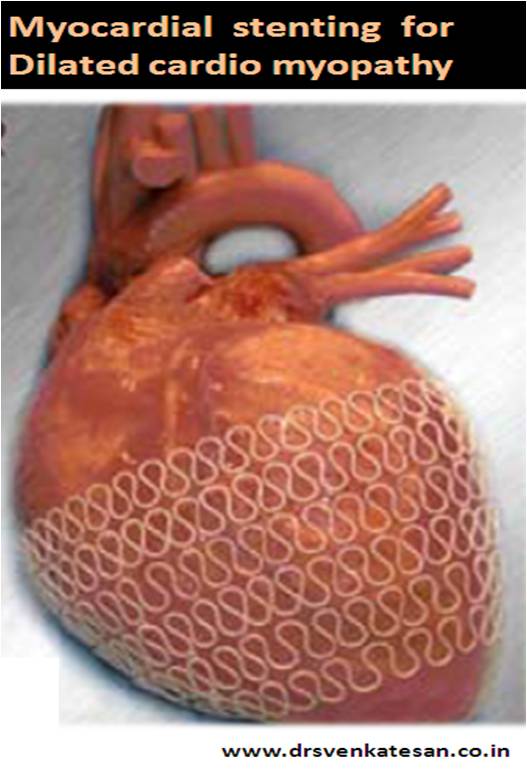
Mitral splinting to  reduce secondary mitral regurgitation in DCM


Newer drugs  and experimental drugs

Nesiritide, (Synthetic Brain naturetic peptide )  Tolvapton ( Vasopressin antagonist) are used with varying  success .

20  point bed side prescription tips  for refractory failure.


  1. Correct the  underlying causes  and triggers.Try to correct any  critical coronary lesion if any by PCI /CABG ( Not a major game changer ! )
  2. Restrict activities (Better to remain in class 3)
  3. Admit  only if  persistent  class 4 .(Intermittent class 4 does not require admission )
  4. Do not try vigorously to move up to class 2  with inotropes  you may  end up in class 4 !
  5. Advice mild passive and active movements. (6 minutes walk > 300 -400meters)
  6. Educate the entire  family / Ask them to shun Internet  (Internet acquired half baked medical knowledge is more injurious to health )
  7. Restrict salt intake
  8. Continue  Digoxin till toxicity develop  or maximum  dose  is reached  (Milrinone /Amrinone make  no major difference )
  9. Optimse diuretics.  Add Metalazone to Frusemide.
  10. Maintain good hemoglobin level (Erythropoitin does not work !)
  11. Add beta blockers  in every one including many of the  class 4 (Not necessarily Carvidilol)
  12. ACEI remain a key drug . Titrate to maximum tolerated dose. (Additional ARBs not much useful)
  13. Aldosterone antagonist has  unique role (Anti-fibrotic ? )  Caution required in diabetic patients  in monitoring renal function .
  14. At-least One metabolic modulator like  Trimetazide  could be tried (ATP utilisation amplified)
  15. Fatty acid metabolism enhancer  L carnitine  may be useful (Recall 1st year medical school basics  . . . Heart thrives on fat energy more  !)
  16. Nephrologist consult  is recommended if electrolyte / ECF status fluctuations are more.
  17. Avoid dobutamine infusions unless patient  insist.
  18. Narcotics like morphine can be used liberally in terminal heart failure  (Both for hemo-dynamic  and  neural benefits )
  19. As far as possible do not send these  patients  to big tertiary hospital unless heart transplantation is planned.
  20. Don’t  be a party  in  exhausting the  personal finance resources of the patient by ordering exotic investigations . Let him not suffer from additional worry ! (By the way . . .  having a hefty health insurance limit  is not an excuse  . Depleting  it  for futile purposes   would make the national economy weaker ! )

Final message

 Three  principles of  management in  refractory  cardiac failure  

  1.   Systemic approach  is the key .
  2.   De-mystifying   cardio centric  interventions  is essential.
  3.   Psychological support is vital .

Functional capacity   has a  poor correlation with LV contractile function . The skeletal  muscle  integrity , blood flow , and its  metabolism has critical say in this. Optimal medications  , properly regulated  locomotion  , weight reduction   can have a major impact.

The secrets of living a good quality of life    in  cardiac failure   ,  lies  not in modern technology  but in the  rare commodities  called  common sense and compassion.

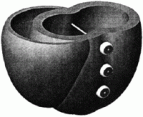
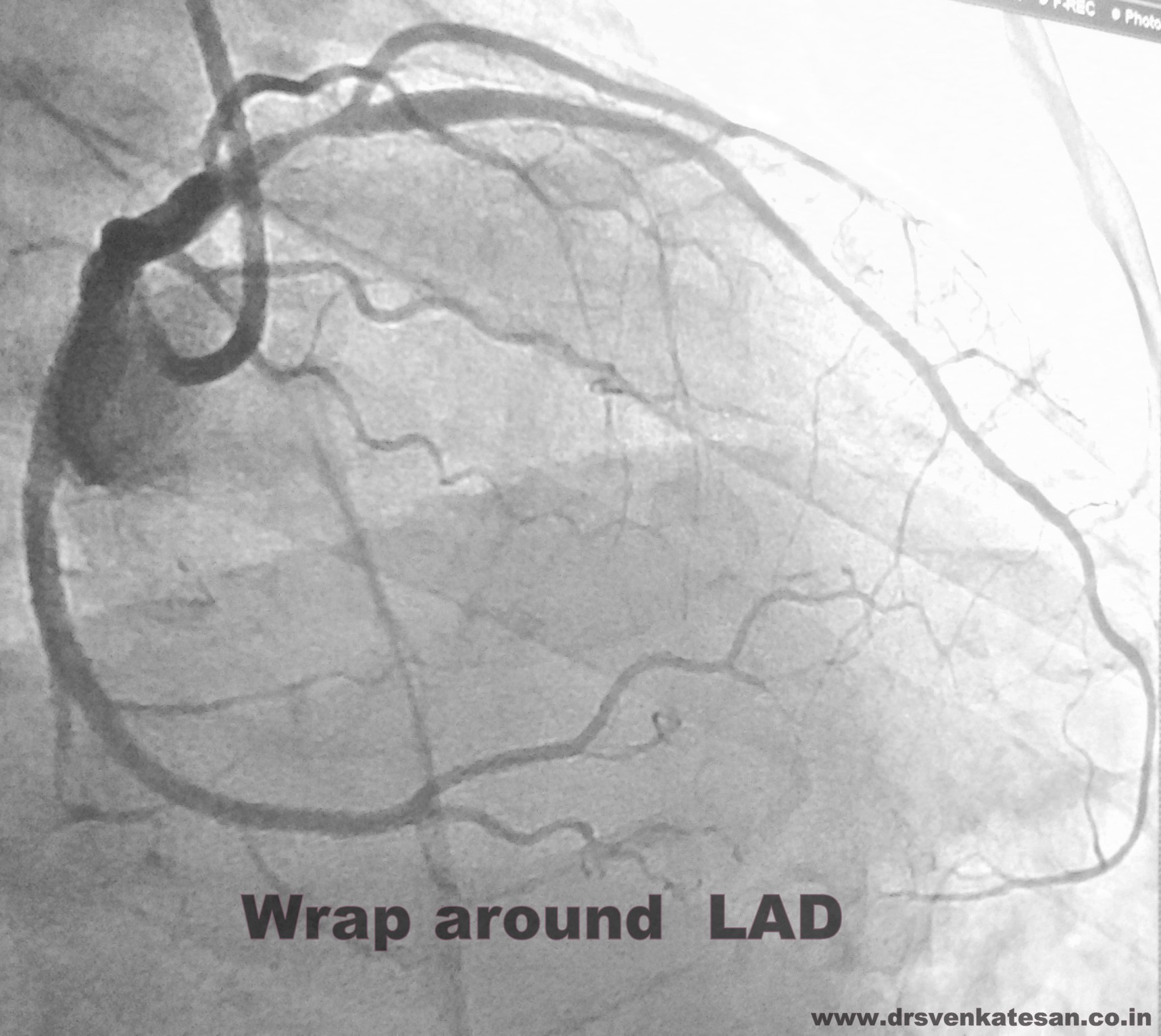
LAD is  graded into three types according to

Type 1  :  Falls short  of Apex

Type 2 :   Reach up to the LV apex

Type 3 : Wraps around LV apex and travels some distance in the posterior Inter-ventricular groove.

Clinical  Importance of Wrap around LAD

As the name implies , LAD   should descend only in anterior aspect  in about 15 %  population it can take a posterior descending course as well .

When LAD  wants to conquer more areas of heart is it a clinical advantage  ?

When LAD wraps around the LV apex,  anterior MI due to LAD occlusions can show changes in inferior leads. (Antero Inferior MI )

In ideal anatomic /Physiologic conditions  LAD  should nearly  meet the  PDA   to prevent any water shed  area.

There is usually a trade off between the  terminal LAD and  length of PDA ( whether it arises from LCX or RCA.)

There is some evidence to  suggest the site of ventricular rupture in anterior MI is related to the gap  in the LAD/PDA drainage zones.

Patients with Type  1 LAD  are at risk of   LV apical  ischemia if the  dominant LCX /RCA is  not supportive .

Final message

A long LAD is definitely a  hemo-dynamic  advantage   in physiology ,   Of course  it goes  without saying    . . .   when  it’s   likely  to get  obstructed it is always better to have a Type 1 !

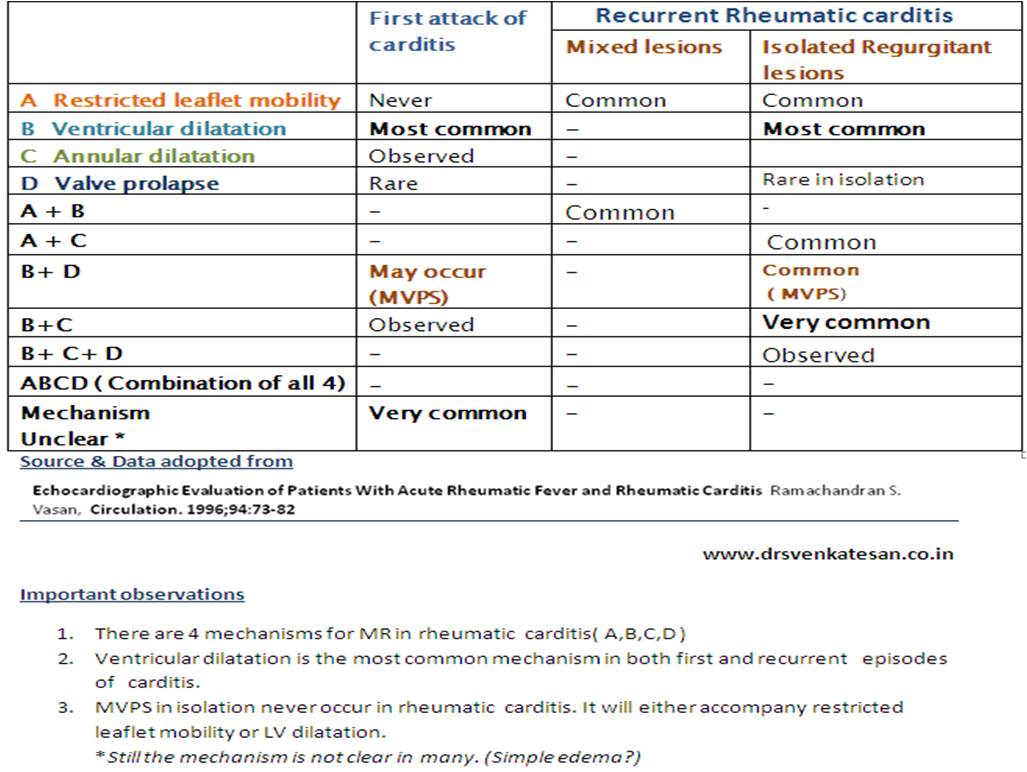
Rheumatic valvulits , Valvular inflammation and edema  is the traditional answer .A detailed Echocardiographic study from All India Institute of medical sciences New Delhi  ,India  which was published in circulation 1996 answers this question most authentically .

From a meticulous  Echocardiographic  study of about 70 patients  (with both first and recurrent episodes of carditis ) the following findings were observed.

After reading this article one should be able to answer variety of  questions in RHD  such as

  • How common is MVPS in RHD ?
  • How often MR dissapear with Aspirin etc ?
  • Echocardiographic correlates  for care -coombs murmur ?

Reference

http://circ.ahajournals.org/content/94/1/73/T5.expansion.html

It is estimated multi-vessel CAD occur in about  70 % of NSTEMI/UA.In high risk NSTEMI early invasive strategy is popular (Though it is not yet  an undisputed choice !) .Tackling the culprit artery and restoring the blood flow ,   providing immediate  relief from angina is the primary aim  . Myocardial salvage is a lesser aim !

The lesion that is immediately  responsible for  angina is referred to as culprit  lesion and artery .(Ideally may  be called as Angina related artery ARA .)

If we have  multiple culprit like  lesions  it is difficult to identify the target lesion. Inexperienced cardiologists  may not consider  this as an    issue !

The following features  may be helpful

  1. The tighter the stenosis , it is  more likely to be a culprit . (Of course , blind  belief on this rule  can result in huge errors ! )
  2. Eccentric lesions
  3. Thrombotic lesions
  4. Grafts /Post PCI lesions if present carry high chances of becoming culprits.
  5. ECG characteristics may  be use full (Global ST depression can not occur with isolated  RCA/LCX NSTEMI   .It  generally indicate LAD  lesion to be  the  culprit.
  6. Deep ST depression in V1 to V3 would indicate LCX a definite culprit .(It could even be a STEMI equivalent )
  7. Echo – Angio correlation can provide a useful clue in identifying the culprit. (Example : In a patient with Multi vessel CAD  , if there is severe resting wall motion defect in Infero -Lateral segments with relative sparing of septum   LCX lesion should be the culprit .)

Exceptions

  • It is not always easy to identify the culprit artery .There can be multiple active  plaques .
  • Diffuse inflammatory vessel are reported in few with NSTEMI
  • Occasionally there can be no  culprit lesion at all (No active plaques ) ,  as the rest angina may be related to excess demand like fever or anemia with  a stable non critical plaque.

Final message

The  delicate   exercise of identifying the angina related  artery is  important  for two reasons.

  1. We can not afford to   prolong the PCI procedure in the setting of ACS  as increased procedure time is clearly related to peri- procedural events.
  2. Secondly , stenting a wrong lesion   and persistence of angina after a  PCI  will take  away  the  hard earned credentials  of  cardiologists  instantaneously !

Reference

Read a related presentation

While their cardiology colleagues are extravagantly indulging in coronary arteries   ,It is heartening to note the pediatricians our country has  silently come out with the first India specific  criteria for Acute Rheumatic fever diagnosis and management.

It was long over due . . . three cheers to them !

* It is ironical  these guidelines came in 2008,many of us are aware about the  existence  such guidelines , still  every one is after PTMC  for a full blown mitral stenosis !

http://www.indianpediatrics.net/pdf/acute_rheumatic_fever.pdf

Highlights and Summary

  • WHO criteria  of 2001 is adopted
  • ASO titre positivity alone has less value  in the diagnosis .Hence the importance of which is down graded
  • Steroids  are mandatory in all grades of carditis for 12 weeks
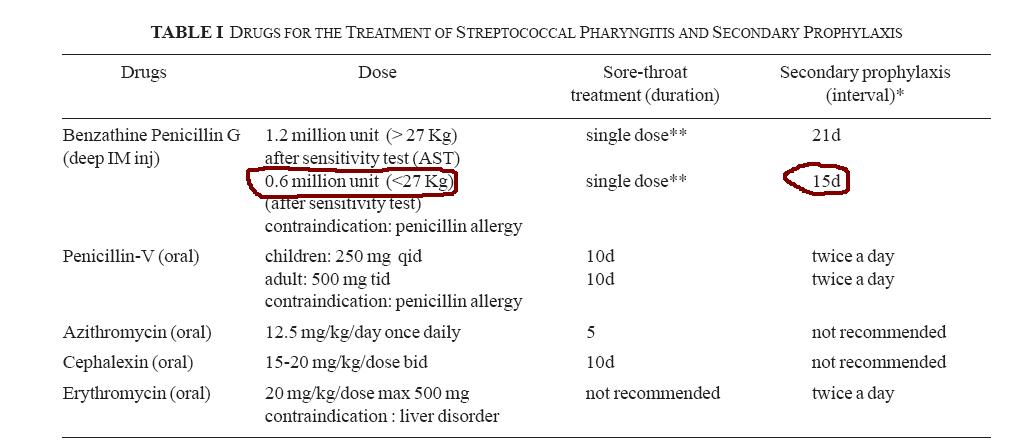
  • Benzathine  penicillin  should be administered weight  based and to be given  every 15 days in children less than 27 kg.

More high lights will be posted.

Secondary prophylaxis of  for Rheumatic fever

Note the Important advice regarding weight based penicillin prophylaxis.


//

What are  the blind spots of aorta in Tans thoracic  Echo ?

What are pseudo  dissection flops in aortic arch ?

How to differentiate true from false lumen ?

Can  TEE  also  miss any  segments  of  Aorta ?

How is  Aortic Intra mural hematoma differentiated form true dissection?

Spend a minimum of 30 minutes in this 14 page  article.  You will  be able to answer all these and much more The knowledge gained ,   would easily beat  a  day  long   crash course on   Echocardiogram   !

Please thank  the European society of cardiology for providing this article free of cost !

Reference

http://ehjcimaging.oxfordjournals.org/content/11/8/645.full.pdf+html

Tachycardia – Bradycardia syndrome is the hall mark of sinus node dysfunction.

  • The commonest tachycardia in sinus node dysfunction is Atrial fibrillation . Followed very closely by sinus tachycardia . In fact alteration between sinus tachycardia and sinus bradycardia without other pathological arrhythmia is rare . (Of course , we have a name for such an entity as inappropriate sinus tachycardia / bradycardia )
  • Atrial tachycardia occurs a distant 3rd
  • Ventricular tachycardia may be an exception (Please note , extreme bradycardias which lead to pause dependent VT is not directly related to sinus node disease )

The commonest bradycardia in SND is

  • Sinus bradycardia (This fact is undisputed unlike the tachycardia component of SND !)
  • Followed be sinus pause , SA blocks and sinus arrest .
  • AF with slow ventricular response ( Bradycardic AF) We are not sure about the rhythm here (Is it truly junctional /or conducted atrial ? )
  • Associated AV block can occur up to 20 % of patients .If AV block is present the true nature of SA node disease is masked and it’s function becomes almost irrelevant .

Stress related wall motion defect  is a well-known entity . It is referred to as Takotsubo cardiomyopathy .

These stress are often

  • Emotional
  • Neurological
  • General systemic stress

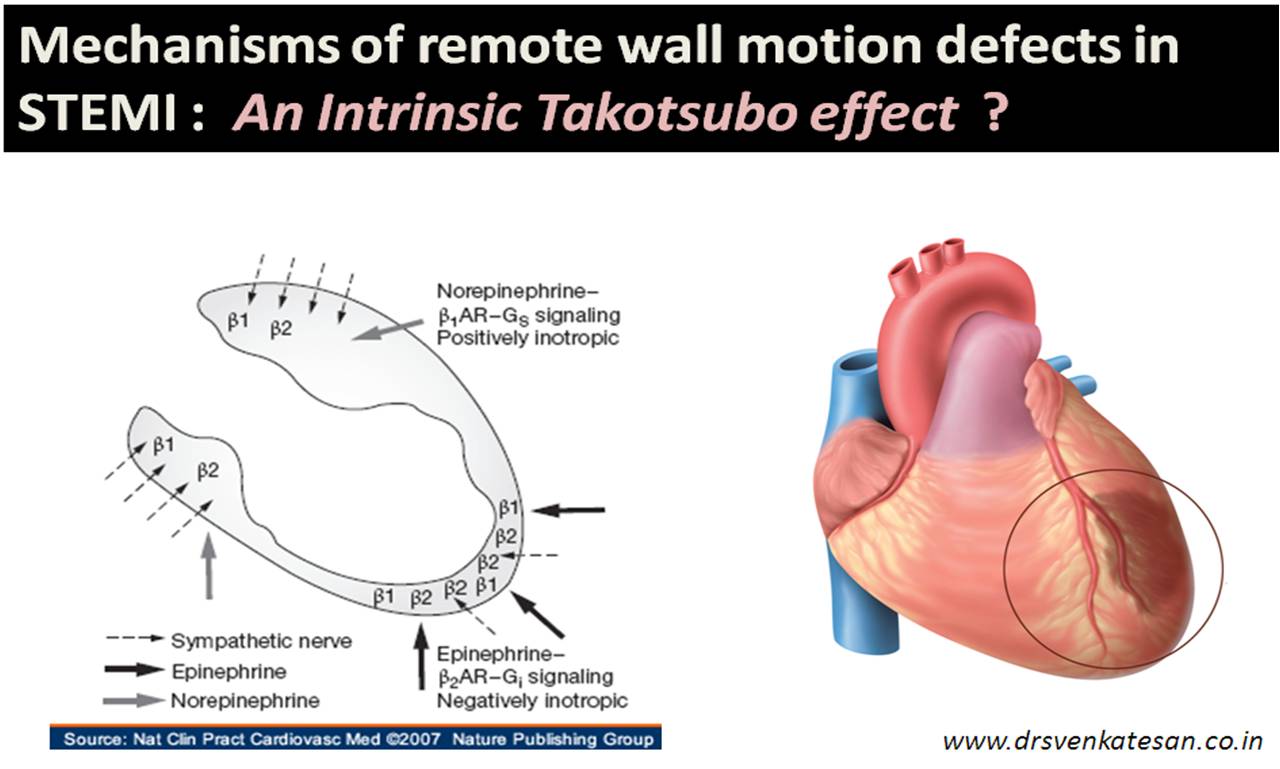
The culprit seems to be pooling of adrenaline and nor adrenaline in myocardium .These remote  neurogenic stress can cause significant wall motion defect due to adrenergic  downpour

The image depicts the wide variation in the density of beta receptors in heart.The stress of MI can result in varying degrees of wall motion defect .It is important to realise the wall motion defect in STEMI has two components .One is related to ischemia and other is due to excess catecholamines. This explains many of the unexplained remote wall motion defects during STEMI .This  may be referred to as Intrinsic Takosubo effect !

Then   . . . the following    questions arise

When systemic stress can have a profound  effect on myocardium , what   about local stress ?

Acute STEMI  is  a huge stress for the heart   . . .   isn’t  . If  so , can it   alter  the wall motion defect in adjacent  or remote myocardial segments  independent of ischemia ?

With the distribution  of adrenergic receptors  showing  huge variation ,  we do not know how an acutely ischemic heart  spills the adrenaline all over .  Is there a pattern to it  ?  or it happens at random ?  Further , the  response to  accumulated  catecholamines  is  not  going to be  uniform. This will explain why certain patients  go into ischemic  LVF  , very early in the course of STEMI  even before the myocardium is necrosed. It will  also explain  the  benefits that accrue in selected patients  who receive early IV beta  blockade  ( Which is  of course currently not popular after COMET study ! )

Final message

We  have seen at least  two patients  with severe  transient ballooning  wall  motion defect in LAD region  (LV apex)  with isolated RCA lesion and inferior Infarct .

The question raised is this 

Can  the  stress of  Inferior  STEMI   . . . result in  apical Takatsubo  like  effect ?

Reference

http://www.medscape.org/viewarticle/567069_4

http://www.takotsubo.com/

IRA localization for both LAD and RCA , LCX  is a fascinating  exercise for cardiologists.I suspect  our understanding  about this crucial issue is  far from complete .While  localizing  level of lesion within LCA  or RCA requires more precise data and erring is acceptable  , it is not uncommon to  call  even the  IRA wrong  especially in multi -vessel disease.

Why current   criteria of IRA localisation goes awry many times  ?

The  factors  that operate are not few   . . .  it  runs into a dozen  at least  !

  1. Dominance  is never considered during IRA localization  (A right dominate system can vastly influence the LAD localization  algorithm PLV branches  can protect LV postero- lateral segments in spite of proximal LAD lesions )
  2. The length of  mid LAD   IS  controversial entity ( Traditionally  it refers  to  the  segment  between first major diagonal to second  major diagonal or septal  leads to faulty   coronary mensuration .It is not uncommon to have a  mid LAD measuring few  mm  when  full the full  length of  LAD  is about 15-19cm
  3. Diagonal vs OM  trade off occurs  in every alternate patient which is ignored  !
  4. Ramus  is never considered worthy enough  to be included in the IRA  localization scheme (In spite its presence  in 20 % )
  5. Type of LAD is not given allowance.
  6. Finally &  most importantly these rules of IRA localization will not apply in  the setting of  multivessel  CAD
  7. In the presence of Pre existing CTO
  8. STEMI following chronic stable angina
  9. Extensive collaterals
  10. Re Infarctions
  11. Post CABG etc

Final message

Decide for yourself  . . .  how good is the value of IRA localization  after  considering all the above variable. . It is not a great thing to predict  correctly RCA from LCX in an  inferoposterior MI  with a  70 % accuracy  . (It actually means  20 % accuracy  )    statistically when there are only two options  . . .  we are blindly  right 50% of times   !