An awkward argument for routine EST following primary PCI
Please remember, primary PCI is not the end of the management of STEMI. Primary PCI is an IRA focused intervention. We need to study other lesions and their the flow pattern as well. Logically we need to do a test for adequacy of baseline vascularity and the current revascularisation . Simple deployment of a stent in IRA (without documentation of good flow during exertion ) is not acceptable to believers of scientific medicine . Resting TIMI 3 flow conveys no meaningfor a patient who is going to be ambulant and active. A stress test will come in handy .
The micro-vascular integrity and resistance following an extensive STEMI is best studied by the adequacy of exercise induced coronary hyperemia (This is physiologically equivalent to the much fancied FFR in cath lab ) . One can consider EST following a primary PCI as an non invasive substitute for the collective FFR of all three vessels including the IRA that is stented .
Does any cardiologist have guts to do a pre- discharge EST after a successful primary PCI ?
Typical responses would be
Why the hell I should do it ?
Do you know how risky it is to do a EST early after a primary PCI ?
If at all I have any doubt , I would prefer a non invasive PET or Thallium to study the adequacy of revascularisation.
If you think , it is too risky to exert a successfully revascularised patient early after a STEMI . . . at the same time argue to do it in non revascularised patient routinely . Do we not see a huge irony here ?
Other inference could be . . . we are still suspectingthe quality of our revascularisation during PCI !
If EST is contraindicated after a primary PCI , are we going to advice these patients against indulging in any activity requiring moderate exertion fearing a stent occlusion ?
. . . What a way to interpret the aftermath of a ‘state of the art ‘ procedure called primary PCI !
In science , correctness is more important than politeness !
There are many wonderful books for learning clinical cardiology.J.K.Perlof’s clinical cardiology, Jonathan Abrams , are popular ones. Clinical chapters in Noble O Fowler is a wonderful reference .
My choice for the top slot is by “Signs and symptoms in cardiology” by Horwitz and Groves .They wrote this master piece
Should the vegetation disappear to call it a cure ?
Vegetation’s rarely disappear following treatment . Very small vegetation may dissolve – 20% . Many times it regress in size .
Often our aim should be restricted to sterilise the vegetation. This invariably happens in most of the patients who receive complete course of antibiotic. But healing and sterilizing is not enough in many vulnerable patients.If the vegetation is large the embolic risk is still there even with a healed vegetation.
So if there is a relatively large (>1.5cm) vegetation it is always better to remove by surgery.
Interventional techniques may soon allow capturing these vegetation by basket catheters .When technology is there to retrieve small bits of a thrombus inside a coronary artery it should be possible to remove a large vegetation with temporary aortic filters in place.
Whatever is your answer . It will be far off from the truth .
What causes Atheroscerosis ?
The perception that , circulating lipids directly damage the coronary endothelium is an ill proven concept. Isolated hyperlipidemia rarely leads to full blown Atherosclerois .
If LDL moelcules can penetrate the endothelium , why the circulating LDL at a normal concentration of 130mg/dl fail to do so in vast number of humans as they criss cross the human circulatory system at-least a trillion times every year ? So , there must be something else operating *It requires a high blood pressure, diabetes , smoking or some form of endothelial injury (That includes chronic Inflammation ) for the lipids to enter the sub endothelial planes and start depositing.
The relationship between serum lipids and plaque burden lacks clarity.
* The argument that 130mg LDL is injurious to endothelium while 100mg is not , can easily be disputed !
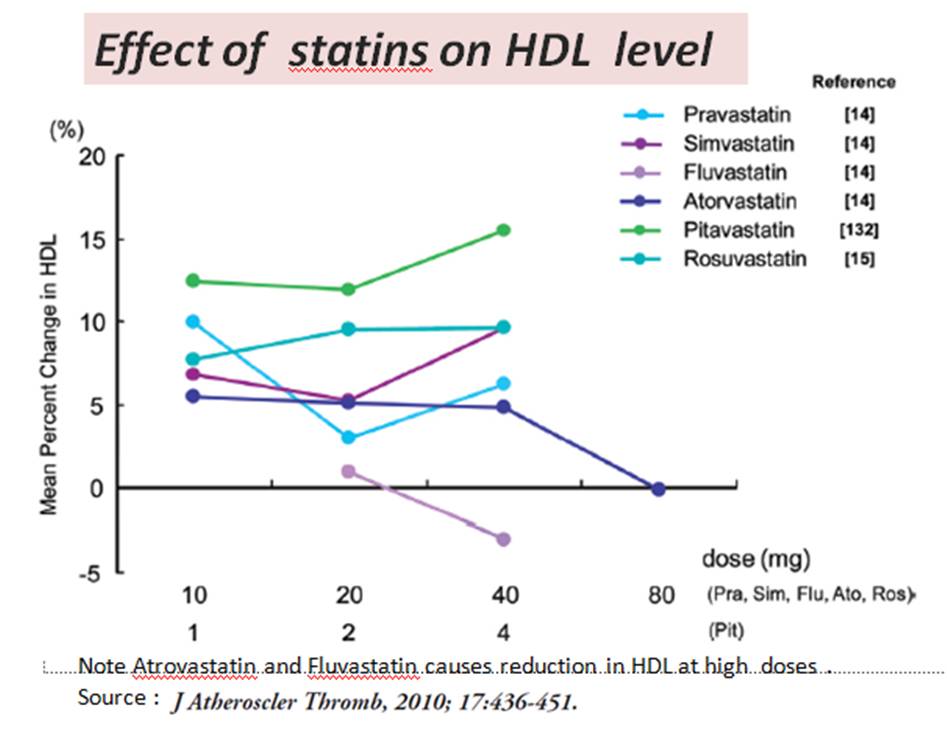
Statins have revolutionised the treatment of coronary artery disease .Intensive lipid lowering is the fundamental prerequisite in the management of both acute and chronic coronary syndromes. One question is always difficult to answer , ( rather reluctant to find the answer ) “The effect of statins on the HDL cholesterol”.Logic and the mechanisms of action would suggest HDL is not much affected , but in reality I believe , in a given patient statins do reduce the HDL by at-least 10-20 % .This might have some significance. However , the marked reduction in LDL may nullify the adverse effects of lowering HDL. Does this happen in all
What does the scientific evidence say ?
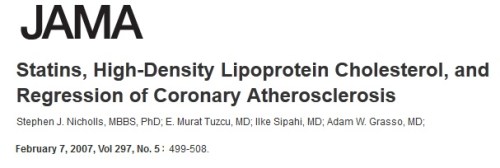
It says the opposite . It seems HDL is raised by statins that too significantly . The following paper also suggests mechanism of HDL elevation by statins .It is Independent to that of LDL reduction , I believe .
This paper from the premier Journal of Lipid research agrees to the mechanism of HDL reduction by statin is a complex process but still it vouches for it .
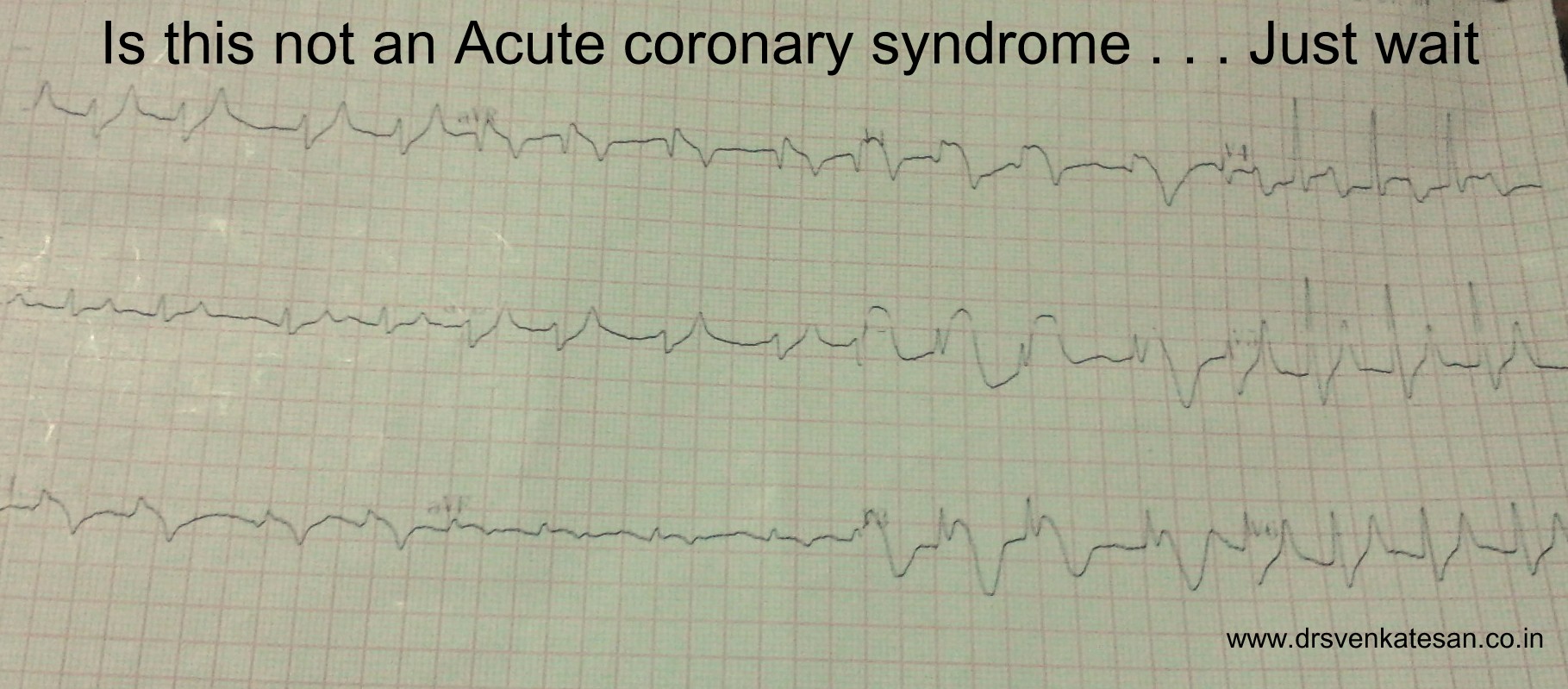
A 38 year old man presented with acute breathlessness and chest pain .His ECG is posted below . The ER in charge medical officer promptly handed over the patient to STEMI alert group (This is how cardiologists are referred to ! in one of the leading corporate hospital in India )
Note Atrial fibrillation , ST segment elevation, in pre-cardial leads
A team of white coated humans in various gender and ages swarmed the patient . ECGs and text where shared among the STEMI alert group through I pad 3 which transmitted HD quality ST elevation with a retinal precision . A senior consultant insisted to shift the patient to cath lab direct . Since he had signs of cardiac failure , one of the wise Junior fellow wantedto correct the failure with Nitroglycerine and Dobutamine before rushing him to cath lab . Hence he was put on hold in the side room of ICU .
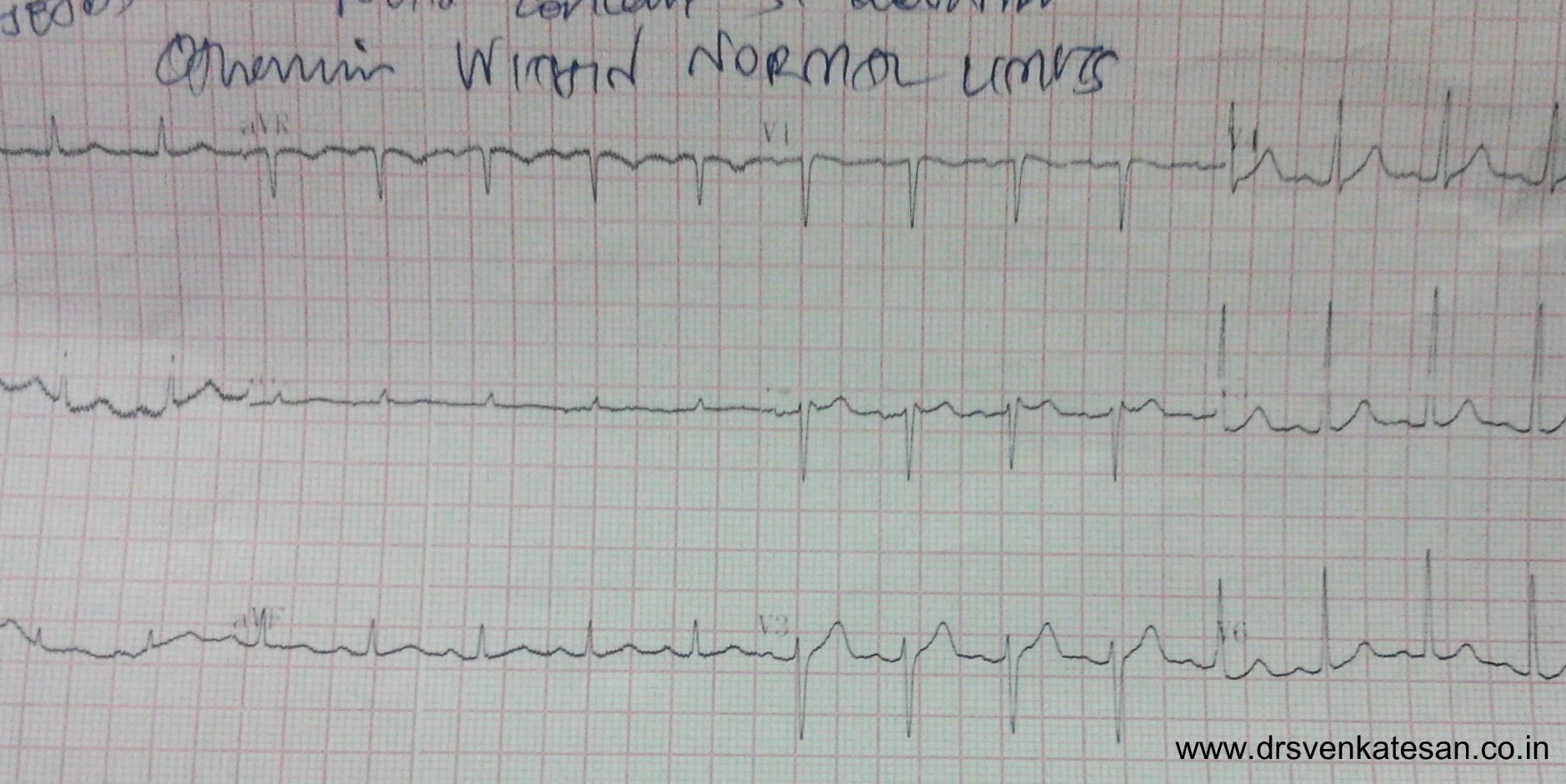
Echo examination showed LVH and wall motion defect could not either confirmed or ruled out . Initial Troponin was negative . In the mean time the bio chemistry results came. He had a creatinine of 5.2 and Potassium of 6 meq . Hence the patient was diverted to Nephrology unit and dialysis was done. The next day morning his ECG looked like this .
It may sound a pessimistic , but still I would consider the above episode is a rare example of appropriate care happening ! This patient was diverted in a timely fashion from cardiology care to the Nephrology . Please note , it is not the the clinical acumen that helped here. If he had not presented with LVF he would have been a victim of inappropriate care and landed on the cath-lab table directly !
Final message
Every moment in clinical medicine is important , especially during the genesis of diagnosis. Where the patient lands . . . in a frighteningly large hospital is as important asthe disease process itself. In this scientifically arrogant medial atmosphere most of us, are tuned to view every problem as their own ! This is the default modeof modern medical thinking process . How faulty we are ?
The future is worrisome as the field of Internal medicine is at risk of dying a premature death (or is it dead already !)
By the way what is the mechanism of ST elevation and Tall T waves in hyper-kalemia ?
Many factors contribute .
Is it a true ST elevation ? There is reason to believe the tall T waves drag the fag end of ST segment along with it .
Next is related to QT interval . Hypo-kalemia widens while hypo-kalemia does the opposite .( though not classically) .
When QT is shortened the segment gets squeezed in within a limited space , in order to accommodate the ST segment it gets rolled up and elevated . (Like an up sloping ST segment in extreme tachycardia during stress testing)
Whatever be the mechanism it is something to do with potassium ion flux .Transient intra-cellualr hyper-kalemia.
Another possibility is diffuse uremic peri-carditis , which is a common accompaniment of renal failure.In fact this patient did have a peri-cardial rub
Doppler Mitral Inflow velocity profile is the key to assess LV diastolic function . The ratio between E and A has become most popular parameter .
In the absence of atrial contraction what shall we do ?
The answer is simple . We have 2 D parameters of LV diastolic function.
LA dimension ( > 30 % basal dimension which is usually > 4 cm ) is a most specific marker of diastolic dysfunction in the absence of mitral regurgitation or stenosis.
The only available velocity E wave profile can help .A short E deceleration time in a short cycle would suggest significant diastolic dysfunction.High amplitude E wave > 2 M/sec in the absence of MR will suggest diastolic dysfunction .
Curiously , it can be assumed an episode of lone AF per-se , be an indicator of diastolic stress for the left atrium .
After all , why should a person all of a sudden develop an episode of AF .(Hypoxia, Ischemia , excluded )
Other parameters.
Mitral annular velocities / E propagation velocity / E/E’ are other tissue Doppler parameters can be used.
Pulmonary venous flow velocity is largely not useful (Since A reversal does not occur )
Medical science and commerce grow hand in hand . Many believe the field of medicine has ceased to be a pure science long ago . Both are mutually inclusive . We have no other option ! If there is no commercial interest . . .Who will fund cardiology research ? Then . . . How are you going to develop a biological pacemaker or the eagerly awaited total artificial heart ?
Without involvement of the commercial forces , no break through is possible . If you take medical science , majority of growth has occurred by the motivational force of medical industry . Here is an exclusive website for sub specialty called cardiopulmonary business .
But do we have the medical research in safe hands ?
Why a hastily developed cardiac device enter the human domain and recalled within 2 years fearing grave Injury ?
Why a drug known to cause serious side effect was purposefully blinded with a hidden agenda till the drug earns a billion or two ?
What is in store for future generations ?
When the profession is at the mercy of forces other than patient care as a primary aim there is every reason for it go awry and become a dangerous health hazard . If any medical professional who does not see this , as an important issue for man kind , requires a rebooting for reality !
Public should realise , what they often get in the name of science is a huge human body trial and victims of biological shopping . It has wide-ranging Implication . It is ironical , we are in a piquant situation , where our bio-system has to fight not only against the diseases but also the misplaced scientific methodology and fraudulent practices.
Ventricular septal rupture is a major mechanical complication of STEMI . Excruciating chest pain , is the sine qua non of any myocardial tear , dissection and rupture . It is surprising , VSR following STEMI is rarely a painful event . I can recall number of such events , when a stable patient with persistent ST elevation in the coronary care unit , wakes up next morning with a systolic murmur.And echo reveals a septal defect promptly.
Three reasons can be proposed for relatively pain free rupture of IVS in STEMI.
Typically VSR occurs in 3rd or 4 th day of infarct . By this time myocardium can be as soft as an ice cream ! . There is not much stress and strain at the site. The necrotic debri just gives way to spikes of LV systolic pressure .
For rupture to occur there must be transmural infarct .The pain nerve terminals also die in the process .
Further , it is a cavity to cavity rupture (LV to RV ) . Direct pericardial stretch does not occur .
* Ventricular free wall tear is a near fatal event is extremely painful .This often occurs in the first 24 hours when the nerve terminals are alive . The free wall rupture is more of a tear in the plane of myocardium . The pericardial (epicardium) layer has rich somatic nerve supply .
In summary
Early myocardial tear involving the epicardial surface can be severely painful . Late giving way of softened , necrotic often hemorrhagic muscle ( especially in the IVS ) is less painful or totally painless.
Coming soon . . .
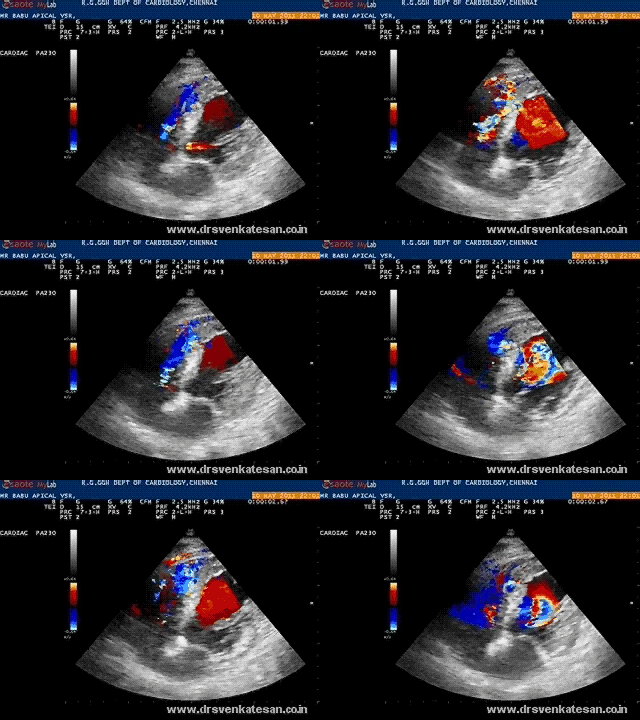
By the . . . what happens to pieces of septal myocardium as it gives way and enter the right ventricle ?
A pulse wave is generated with each heart beat when the potential energy is converted into kinetic energy.
For the pulse wave to travel from the heart to periphery Aortic integrity is vital.
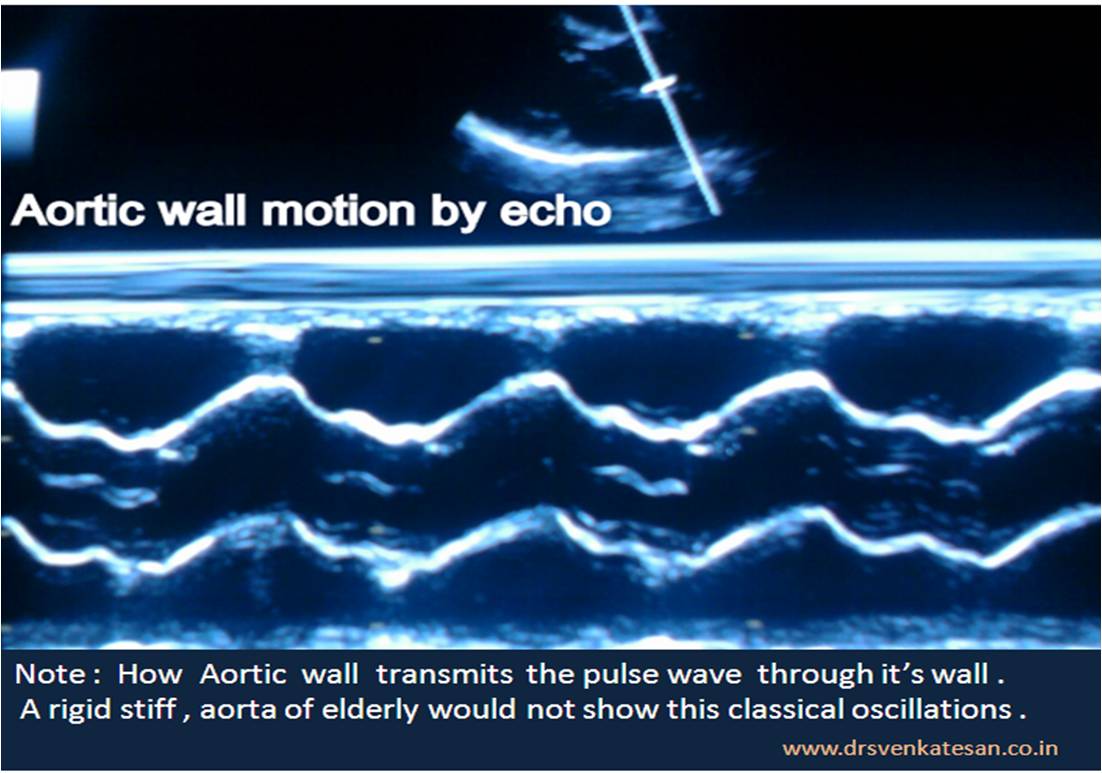
The pulse wave travels through the walls of arterial tree , in the process the wall itself is set into oscillations .
Whether the moving blood imparts the pulse on the walls or the walls itself vibrate independently is not clear.
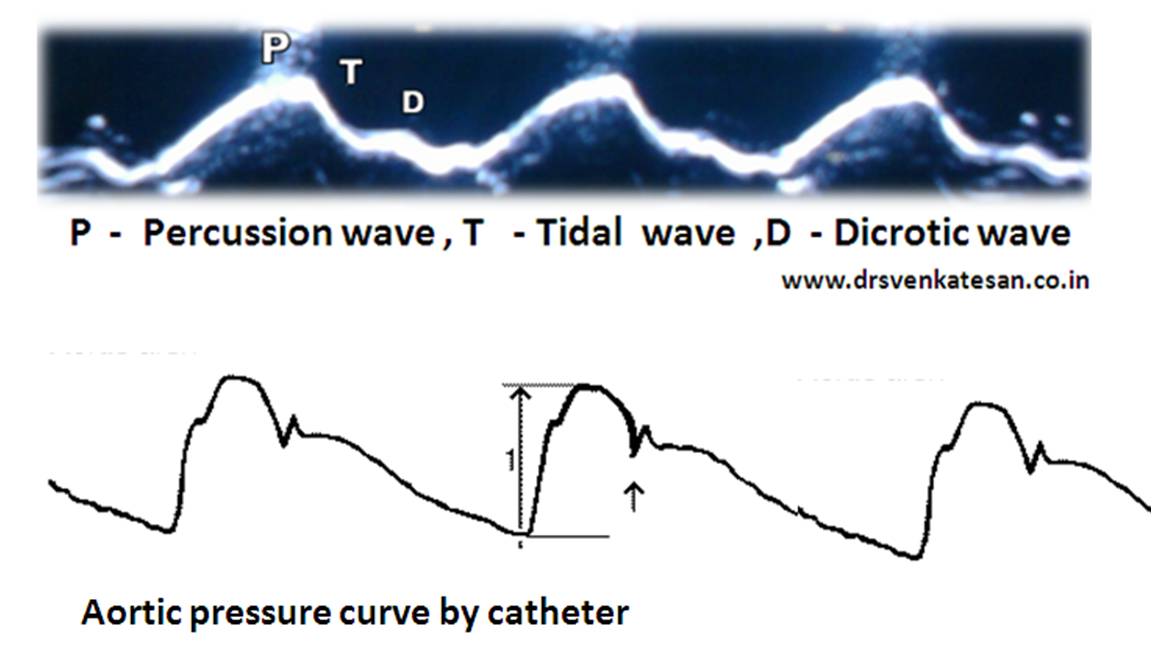
The following M -Mode echocardiogram of aorta from young man stunningly documents the morphology of central aortic pulse wave . Note how closely it resembles the Intra- aortic pressure curve recorded with a catheter.
The anterior aortic wall motion was slicedfrom the above motion image to create a non invasive recording of aortic pulse wave
This simple observation was made in a crowded echo lab our hospital. Cardiology fellows can explore further , the link between aortic pulse transduction (From mechano -hemodynamics)
Further studies are warranted regarding the rate of raise(Slope) of aortic wall motion , and the quantum of motion,its correlation with central aortic pressure etc. This would unravel the the mechanisms of Isolated systolic hypertension , where a stiff aorta amplifies the systolic pressure due to loss of elasticity .
The contents of the this blog is being published as Kindle E book , as per the request of many of the readers. Every article will continue to be open source in this site. Again I shall reiterate the book format is not aimed at any commercial intent. It is only to facilitate learning in a single book format Here is the link to book https://amzn.in/d/euhL5vu
Click below to see who is watching this website live !
This site will never aim for profit. Still ,this donation link is added at the request of few visitors who wanted to contribute and of-course that will help make it sustainable .
Please Note
The author acknowledges all the queries posted by the readers and wishes to answer them .Due to logistic reasons only few could be responded. Inconvenience caused is regretted.
 “
“






 Dr.S.Venkatesan MD