Feeds:
Posts
Comments

I  wonder  this  question is being  asked  over many  generations in medical schools ,  yet to be answered clearly. The traditional explanation  given is   ”  mitral valve is  kept  open wide till onset of systole and it closes with a bang due to a long excursion it has to make ”   This concept is no longer tenable and acceptable ( For the simple reason  if the valve is wide open  . . .  hemodynamically significant  mitral stenosis  cease to exist !)

There are  two major factors that determine the loudness of S1 in mitral stenosis

  1. Hemodynamic
  2. Valve structure and morphology

Mitral valve closes whenever the ventricular pressure  curve crosses above the LA mean pressure . This is the pressure crossover point (LV/LA) .

In normal persons it happens very early after the onset of  ventricular contraction  .(ie  the LV pressure has to raise only to  about 8-12mmhg . At this point the LV pressure curve has  certain  force of contraction (Dp/Dt) .Since in mitral stenosis the mean pressure is raised well above normal  (Often 20-30mmhg)  the LV pressure cross over point is slightly delayed  and more importantly occur at a higher  slope  of LV pressure curve  . Even this slight delay adds a punch in the ventricular contractility .The impact of LV contractility on mitral valve closure especially the  AML is forceful .

(Imagine the force of  impact of a  stone hitting you  from a distance of 1 meter from above ,   is different from a stone hitting you from 10 meter above   as it gains the momentum )

The second phenomenon is  probably  more important as it involves acoustics the final step in the genesis of loud  S1  .

The mitral valve need to be  not only pliable  but also the conduction properties should be intact.

Acoustic principles state that even a speck of calcium in the AML  can dampen the sound that is generated  by leaflet motion.

(Try touching a speaker cone while it is playing  .The sound immediately drops and dampens.)

Similarly for S1 to be loud  the valve should pliable without any significant calcification or extreme rigidity or subvalvular  fusion .)

It is important to realize the PML  contributes less to the intensity of S1 . Hence even if some calcium present in PML it won’t  affect the intensity of S1

Other important factors that affect the intensity of S1 include

  • LV function ( Onset of LV dysfunction elevates LVEDP reduces the net gradient across mitral valve )
  • Presence of  mitral regurgitation .
  • Aortic valve disease (Especially AR )
  • Heart rate
  • Rarely associated Tricuspid stenosis make T 1 component of S 1 louder

Final message

The loud S 1 is due to both physiological and anatomical factors  of mitral valve   .The condition of valve may be  more important  for the simple reason , whatever be the hemodynamic  predispoistion  for loud S1 ,  the  prevailing  valve morphology  has a potential to nullify it !

Acknowledement

The image modified from  http://www.texasheart.org

A 55  year old man came with a BP of  1o0/70 with vague symptoms of back  pain to our ER.

Troponin T  was positive

Can we thrombolyse ?

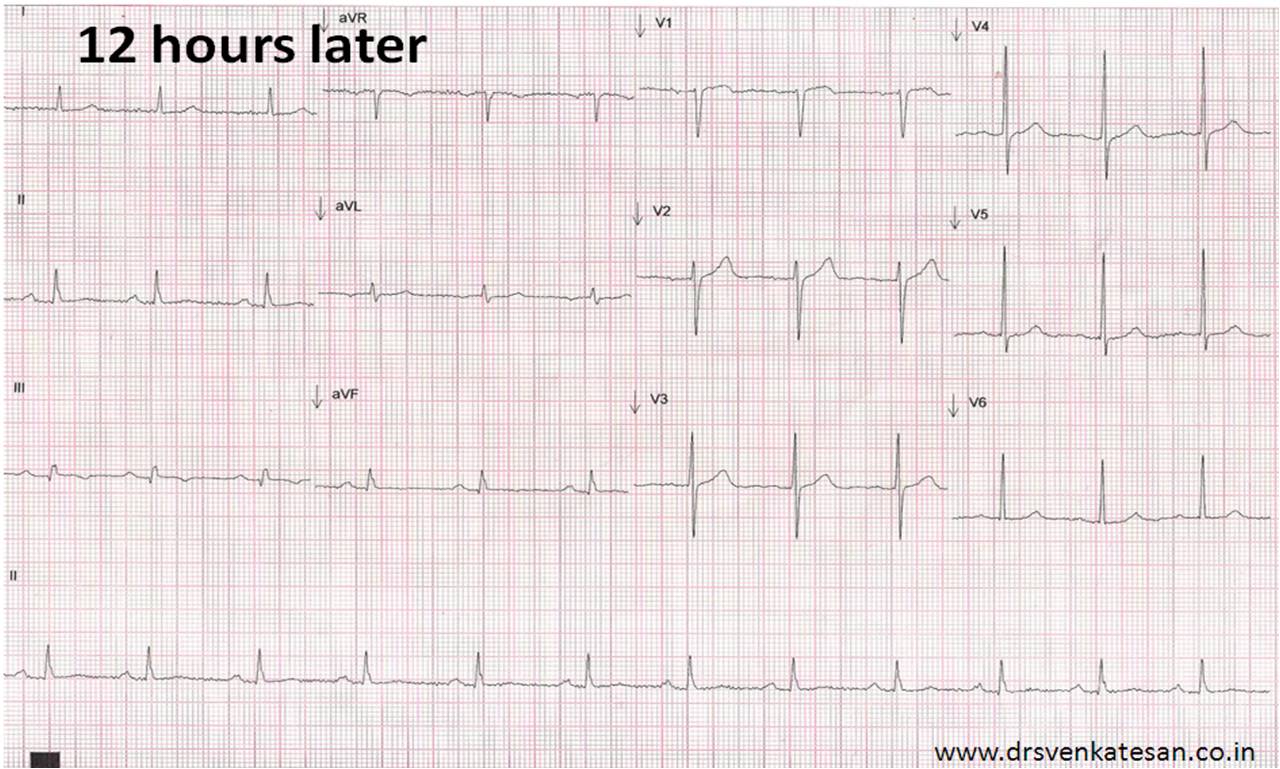
There is a minimal ST elevation in inferior leads  but not amounting to  the required criteria 1 mm

Technically No , Academically yes , scientifically No , logically  yes

*I wont thromolyse but i will take him to cath lab maybe the modern answer

 What we did ?

We did neither !

Just observed in CCU with heparin infusion , Aspirin and clopidogrel .

Note: The ECG becomes almost normal .The initial suggestion of inferior MI is stands questionable

Serial ECGs  were taken .

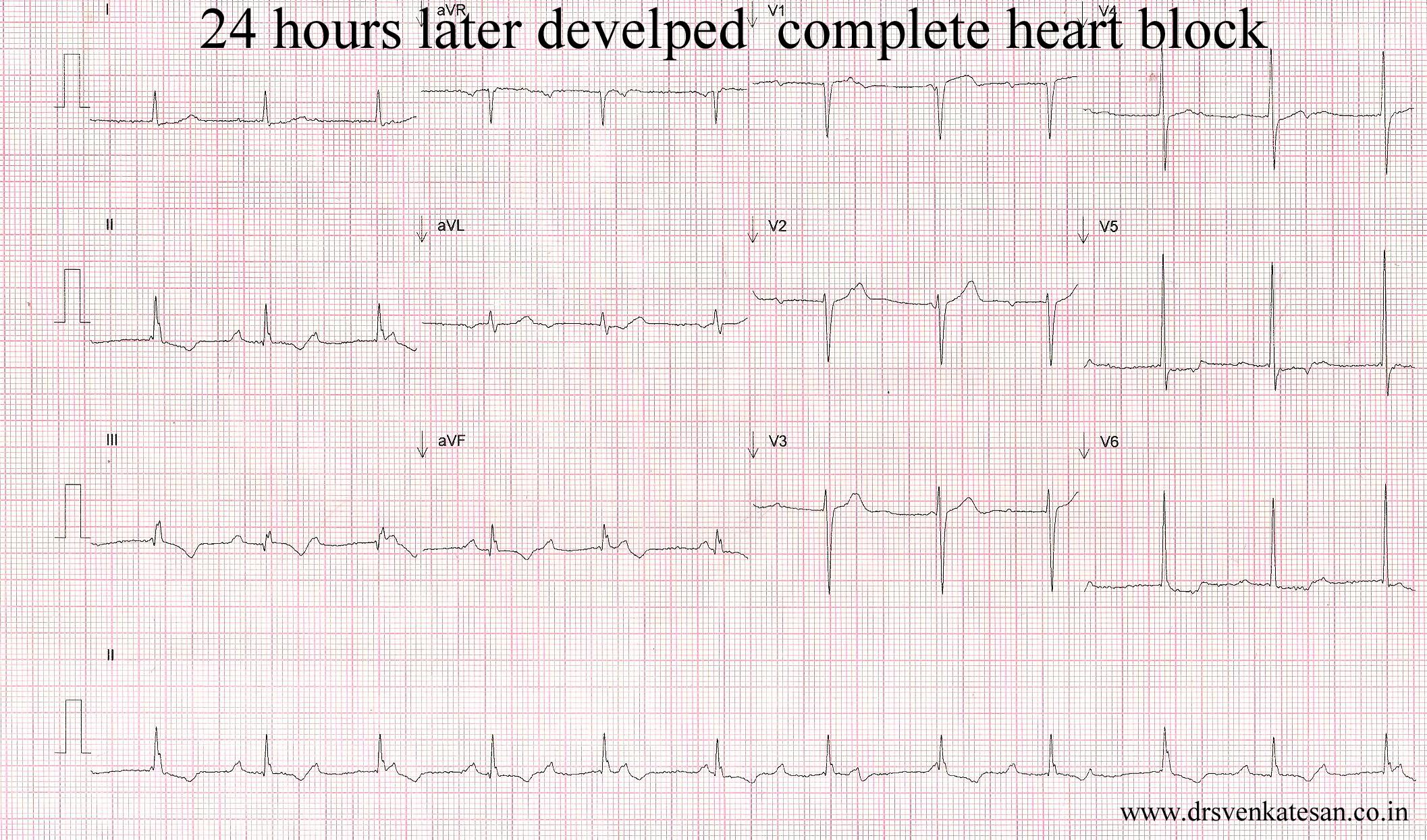
And now . . . after 24 hours a new complete heart block appear with classical evolved pattern of inferior MI.The most interesting feature is patient has been comfortable all along even as his posterior aspect of heart is experiencing terrible electrical earth quakes.

Is troponin Guided thrombolyis  an accepted  concept  ?

Yes ,  only in few situations like , posterior MI ,   LBBB  , pacemaker rhythm, re infarction .(Note , true posterior MI do not elevate the ST segment but depress it ) .

One may be surprised why we shouldn’t lyse a patient  whenever  troponin is elevated in acute coronary syndrome  (After all it denotes myocardial necrosis and infarct !)  The point here  is ,  troponin can raise in all forms of MI (NSTEMI, even in some cases of chronic stable angina )  Read in this link Why thrombolysis is contrindicated in UA/NSTEMI

The benefits of thrombolysis  is not proven in small and micro infarcts.  ECG  ST  eelvation   remain the  sole criteria for thromolysis for STEMI because  of  high degree of  correlation with total coronary occlusion .

In this era of rapid interventions the treatment concepts has blurred as we tend to do PCI and stenting  most cases of ACS including UA/Unstable angina

OK , what happened to this patient ?

Temporary pacer  was kept stand by with a sheath and catheter in situ.

Next day  morning  AV block disappeared .Patient was comfortable .

To our surprise , in the same  evening his ECG showed a complete heart block with AV dissociation . Still the heart rate was good . The demand temporary pacemaker didn’t take over .

On the third day , every conduction disturbance disappeared and  patient was sent to the wards. He is being discharged in a  stable condition with std drugs .there was  a minimal wall motion defect in infero-posterior segments with an ejection fraction of 50 % . He is  scheduled for coronary angiogram  2 weeks later.

What is the pathology ?

Pathologicallyit could be a small focal area of Infarct  incidenataly invloving the AV node .(This is alss refered to as vital area Infarct”  )It is hard to differentiate whether AV block is due to revrible ischemia or necrosis  , simple tissue edema ,  high vagal tone . or combination of above .If the block recovers it can be concluded necrosis is not the dominant theme.


Final message

STEMI presenting  primarily as heart block is less common .  When such a presentation occurs extra caution is required.

Many  of these patients  may not show a classical ST elevation  and hence do not permit us to thrombolyse   as per criteria.

It is  the  individual physician’s discretion to do so ( or not to do  ! ) . No body is going to fault. After  all  5 % of thrombolyis world over is for  benign early  repolarisation syndromes.

The above description is  an example of complicated inferior MI  . . .  still managed effectively by conventional methods.

Further reading

Why inferior MI is considered Inferior ?


      After  years  of   of experience  I  realised  knowledge and  Ignorance  share  an     intimate relationship !  

       venkat.quotes@2012


I stumbled upon this image from the Heart journal. A good depiction of  IAS aneurysm in three dimension.

Image courtesy  : Heart 2012;98:79-88   Three dimensional echocardiography in congenital heart disease   by  Joseph John Vettukattil

Further  reading

Clinical implication of IAS aneurysm

Echocardiogram in pulmonary HT has many aims .

  •  Identify the etiology
  • Assess the effects of PAH  on the right heart
  •  Estimate the severity of PAH.
  • Possibly prognosticate

Echo helps us to confirm the valvular, myocardial or congenital heart diseases in the evaluation of PAH. Apart from these etiological diagnosis of PAH predominantly lies in a systematic medical work up .(Read Dana Point classification )

2-D features

  • RA RV dilates
  • RVH*may occur (Dilation is more common )
  • IVS assumes  a D shape  ( RV pressure is close  to or   even > than  LV pressure )
  • Tricuspid annulus dilates

* For some reason RVH  does not occur commonly in pulmonary hypertension ,  while LV hypertrophies promptly in systemic hypertension .

Doppler

  • Tricuspid valve begins to leak  and RV ejects   with giant “cv”  waves into RA/JVP

Other Echo  findings

  • MPA may dilate
  • Pulmonary regurgitation

At what pressure RV begins to dilate  in PAH ?

It is  not known .It is highly variable . But most will dilate their RV at a systolic pressure > 50mmg.

It is also possible the onset of TR and the magnitude of  TR has a major say in the  timing  of RV enlargement .

We know RV is more sensitive to volume overload than pressure overload .

Paradoxically , it is often observed   acute elevation in RV pressure  dilate the RV faster than chronic ones.

Right atrium and right ventricle are significantly

The tricuspid annulus is dilated .Note the severe TR with twin jet morphology.

Estimating Pulmonary artery pressure

PA systolic pressure  :  TR jet + 10 mmhg

PA diastolic pressure : PR end diastolic jet + 10

PA mean pressure  :  Peak PR gradient

Other complex methods to arrive ar PAP in the absence of TR or PR

The Dabestani -Mahan  ‘s equation*   – The  mean PA pressure = 90 – (0.62 X acceleration time).

It is popular   for  calculating PAP by measuring pulmonary artery Doppler  acceleration  time  .

Many   believe  it is  neither  sensitive  nor practical  in real  clinical setting.

*Even though Dabestani is the first author of this paper   Mahan  got the full credits for the simple reason his name is easily remembered   !

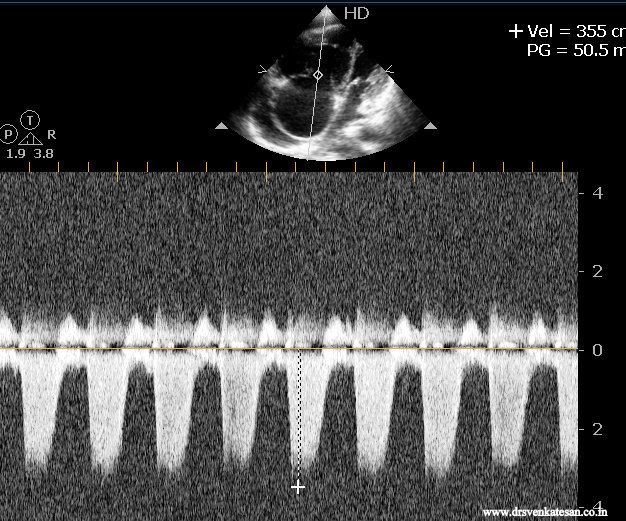
Note the peak TR jet is around 50mmhg and predicted RVSP would be 60mmhg.One would have expected still higher RV pressure but since the RV is dysfunctional the true PAP may be underestimated.

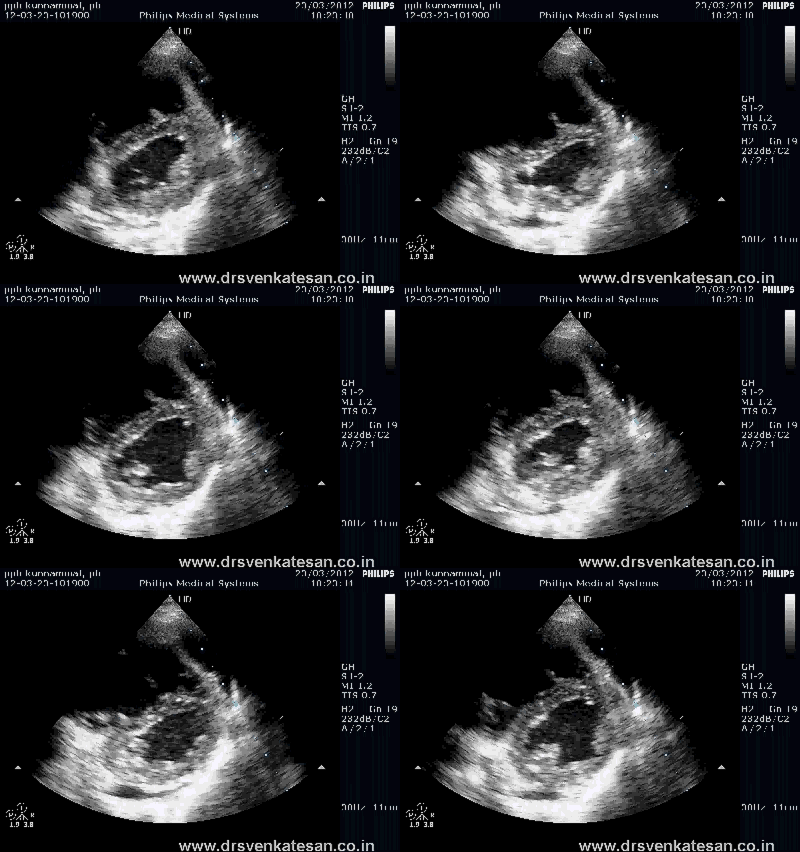
The classical D shaped IVS during systole . D shape indicates RV pressure during systole is almost equal or even higher than LV. ( Please recall D shape occurs in Volume overload also but the timing is in diastole !)

Pulmonary valve  M-Mode

According to Wyeman  the following M mode signs are useful in diagnosing PAH.

  1. Presence or  absence and the amplitude of the “a” wave
  2. magnitude of the e-f slope
  3. presence of mid-systolic closure or notching
  4. fluttering of the posterior pulmonic leaflet

Currently ,  one may consider M-Mode echo to be  an obsolete  ,  but still the foundations help us understand the hemo-dynamics.

The most important principle in  the motion of  pulmonary valve ,   is  the relationship between pulmonary “a” wave and right atrial “a” wave

Normally atrial contraction produce an inward movement* on the closing pulmonary leaflet . This  happens because the MPA  end diastolic  pressure is usually lower than  right atrial a wave    .In severe PAH  the elevated pulmonary diastolic pressure  does not  allow  the atrial contraction to   intend the pulmonary leaflet in pre-systolic atrial contraction .Hence pulmonary valve  a wave in m -mode  is  diminished or even absent .

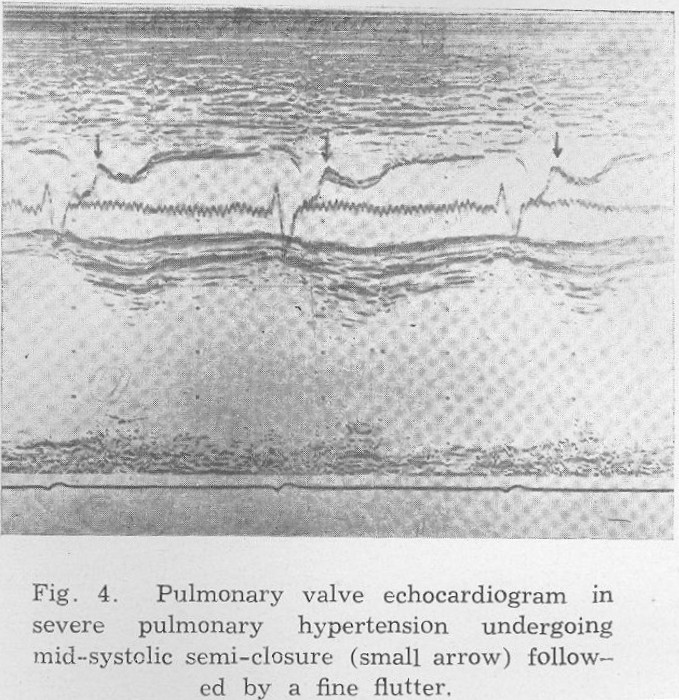
In PAH even   premature closure of pulmonary valve may occur resulting in mid systolic notch   .This  is referred to as flying “W” -Mid systolic notch.   (See below)

* The motion  we see in  short axis M-Mode is that of   left pulmonary cusp that moves  posteriorly.

Image source : Karmarkar SG. Pulmonary valve echocardiography. J Postgrad Med 1979;25:219-23

Absence of a dip is a hemo-dyanmicaly important sign pf PAH  but with one important caveat  .This absence of a dip is valid  only until RV failure occur.In th presence of elevated RVEDP a begin to appear again

Reference

1 Karmarkar SG. Pulmonary valve echocardiography. J Postgrad Med 1979;25:219-23

2.http://circ.ahajournals.org/content/50/5/905.full.pdf

4.Kitabatake A, Inoue M, Asao M, Masuyama T, Tanouchi J, Morita T. et al. Noninvasive evaluation of pulmonary
hypertension by a pulsed Doppler technique. Circulation. 1983; 68(2): 302-9.

5.Stevenson JG. et al, Comparison of several noninvasive methods for estimation of pulmonary artery pressure. J Am
Soc Echocardiogr. 1989; 2: 157-71.

 6.Yock PG, Popp RL. Noninvasive estimation of right ventricular systolic pressure by Doppler ultrasound in patient  with tricuspid  regurgitation. Circulation 1984; 70:657-62.

RR interval in Atrial fibrillation is irregular because . . .

  1. The Atria  fires irregularly
  2. AV node conducts irregularly
  3. Atria confuses the AV node  with  its random firing  and varying penetration *
  4. The ventricle just reflects  irregular  response of atria .

The answer is all of the above. Response 3  explains  best.

*Please note , the AV nodal property is predominantly  responsible for the irregular RR interval in AF  . Atria confuses the AV node  with its random firing .The varying penetration into different depths of AV nodal structure and  the resultant concealed conduction make the   the AV nodal refractory period into continuous oscillation .This  random delays in AV node  is reflected in RR interval as irregularity   )

The response we get in ventricles  in AF  can be summed up as  “A filtered atrial rhythm”

Paradoxically,  amidst the chaos in atria  the rate  is fairly constant within the atria (Fibrillatory   wave firing  at up-to 600/mt )  Of course  , the FF interval in the atria will also be varying  .  At a rate of 450-600 this is difficult to quantitate  especially in fine AF.

When does RR interval becomes regular in AF ?

  • When the patient develops complete heart  block.
  • Digoxin toxicity
  • Associated Sinus node dysfunction

For advanced readers in EP : A mystery explanation for irregular  rhythm in AF  in the offing ?

AV node is a physiological and electrical sink .

When atria fires at 600/mt it absorbs about 60-70  % of the atrial response .Whether it releases the original impulse or initiate a new rhythm in the junction  is not clear.

There is some evidence to suggest the rhythm that control the ventricle in AF may not be  filtered original rhythm from the atria .Instead it could be a fast junctional  escape rhythm (Is that a junctional fibrillation ?)


I recently came across an unusual LIMA  arterial  branching pattern .

Random thoughts

  • A naturally dividing LIMA faciliates multiple sequential grafting of LAD or diagonal branches.
  • As branches steal the LIMA flow it is not good for the patient
  • Surgeons struggle to clip the branches.
  • A branching LIMA has tendency to have  small diameter (As in the above patient )

I need a surgeons Input here.

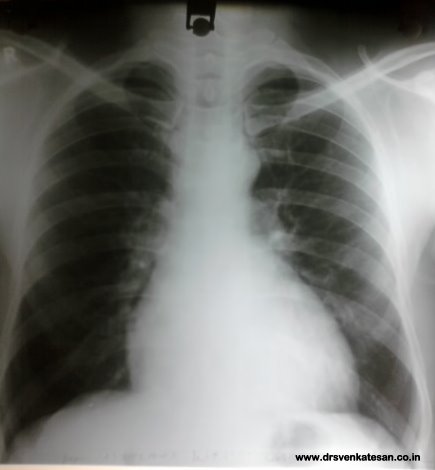
By statistics cardiomegaly   often implies  ventricular enlargement (especially left ventricular) .Right ventricle generally do not enlarge the  CT ratio until late stages .

More important  is the impact of right atrial enlargement on the CT ratio. Here was a  patient referred to echo lab for evaluation of cardiomegaly

The x-ray chest  was suggesting a definite LV enlargement.  To my surprise  the LV was perfectly  measuring a normal dimension .

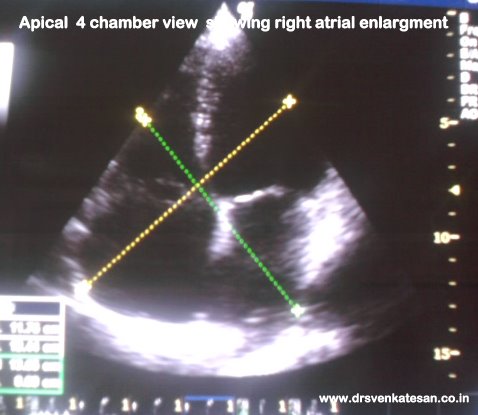
The right atrium was huge and measuring  more than 5 cms . This increased the CTR.

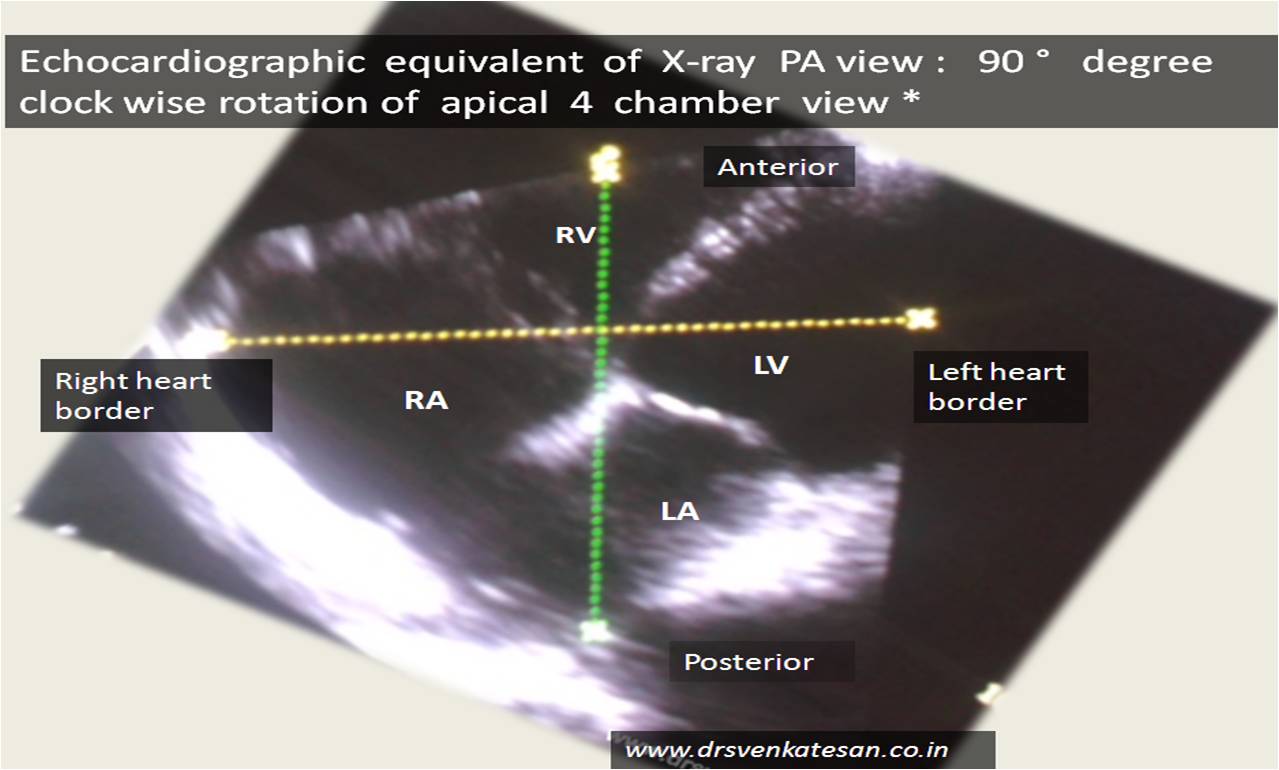
The following illustration  tries to create echo equivalent of transverse CT diameter by rotating apical 4 chamber view by 90 degrees.

The right and left atrium was significantly dilated . This patient had atrial fibrillation and the atrial enlargement was due to chronic AF.

Final message

Cardimegaly in  X- ray chest do not  necessarily  mean ventricular enlargement.

Pure atrio-megaly  especially right atrial enlargement can dramatically increase the CT ratio.

This is not a big  discovery , still fellows need   to reinforce  this fact  , as  mistakes are most often committed in well  known things !

I recall the guilty days during my fellowship  where many lives were lost due to delayed or  faulty intubation  in patients with cardiogenic shock. If only these devices were available those days  . . .

It is ironical , why we took such a long time to make a  scope  to see a structure just beneath the oral cavity ,  while we were able to see remote  duodenum and jejunum  with video  scope  some 25 years ago !

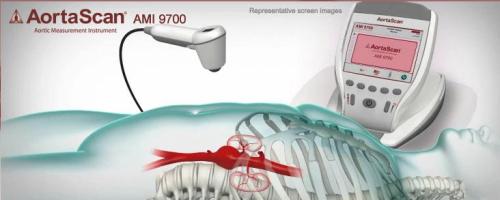
Another device ,  which will come as handy would be the rapid bed side measurement of Aortic dimension .

Image courtesy : Verathan

It doesn’t require an expertise of a sonographer I believe .

Both these innovation come from  Verathan

Reference

Video Laryngoscope  &  Aortic Scan

http://www.verathon.com/products/glidescope/avlsingleuse.aspx