Feeds:
Posts
Comments

Internet is  a  wonderful gift for  for mankind   but  only  occasionally we find great resources .

Hats off to Dr .Pybus from Australia for his efforts

A must read for  all cardiologists rather  everyone involved with echocardiography

Click on the Image to reach the site

http://www.manbit.com/ERS/ERSAZ.asp

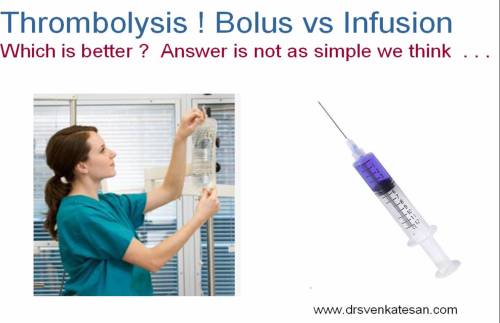
Thrombolytic therapy was a  mini revolution  when it was introduced two decades ago .It has since evolved  , not only in the  molecular structure  but also in it’s usage pattern.

The first generation streptokinase is continued to be used even today  . While the latest generation thrombolytic agent TNKTPA(Tenekteplase) is threatening  to push the  old warrior out of  CCU.
(Of course the  American Physician & Pharma  community  never  gave the due respect to  streptokinase  !)

The two common indications  for thrombolytic therapy  are

  • STEMI
  • Acute pulmonary embolism

Uncommon indications

  • Stroke( Can be common in few institutions)
  • Prosthetic valve thrombosis
  • Rarely DVT

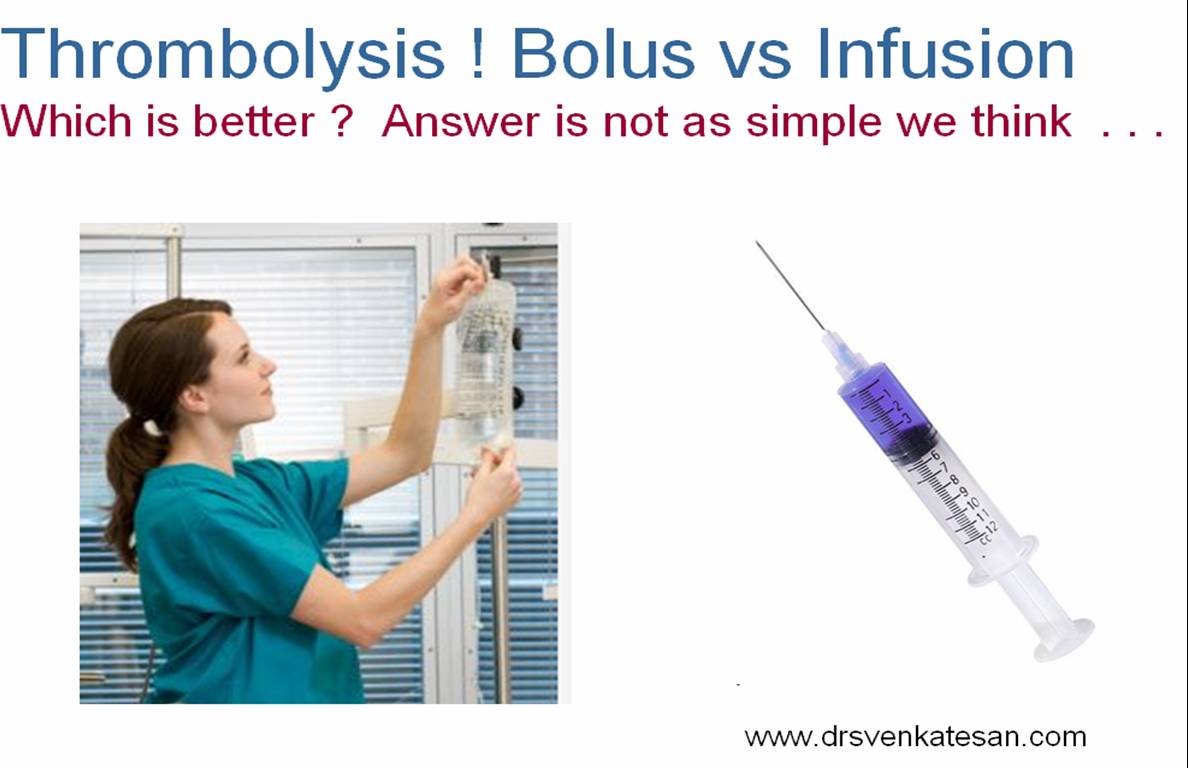
From the beginning , there has been a controversy  about the thrombolytic  dosage and  the speed with which it is to be administered .Let us recall , streptokinase was initially  used  in  various regimes ( 5-30lakh units between a 10 -3hr infusion )  Later ,we arrived at a consensus at  15L units  in 1 hr infusion . TPA also experienced the same . Which  settled  for front loaded regimen(35 + 65mg)  . The confusion reappeared when we developed bolus thrombolytic agents( TNKTPA) .

In STEMI thrombus formation  is  often a one time process  while thrombolysis is a continuous process. In pulmonary embolism both  thrombus formation  and lysis  is often continuous process  .

The success of thrombolysis depends on the sustained  drug concentration ,  the pressure at which the drug interacts  the thrombus.

Many times it is prudent to administer  intensive heparin after thrombolysis  to prevent recurrent thrombosis. Further ,  most of the pulmonary embolisms  will require long term anticoagulants.

How to maximize the success of thrombolytic agents ?

  • Local catheter based thrombolysis can be tried  within the coronary ostium (Largely unpopular)
  • Within the pulmonary artery for pulmonary embolism (Still considered an useful option )

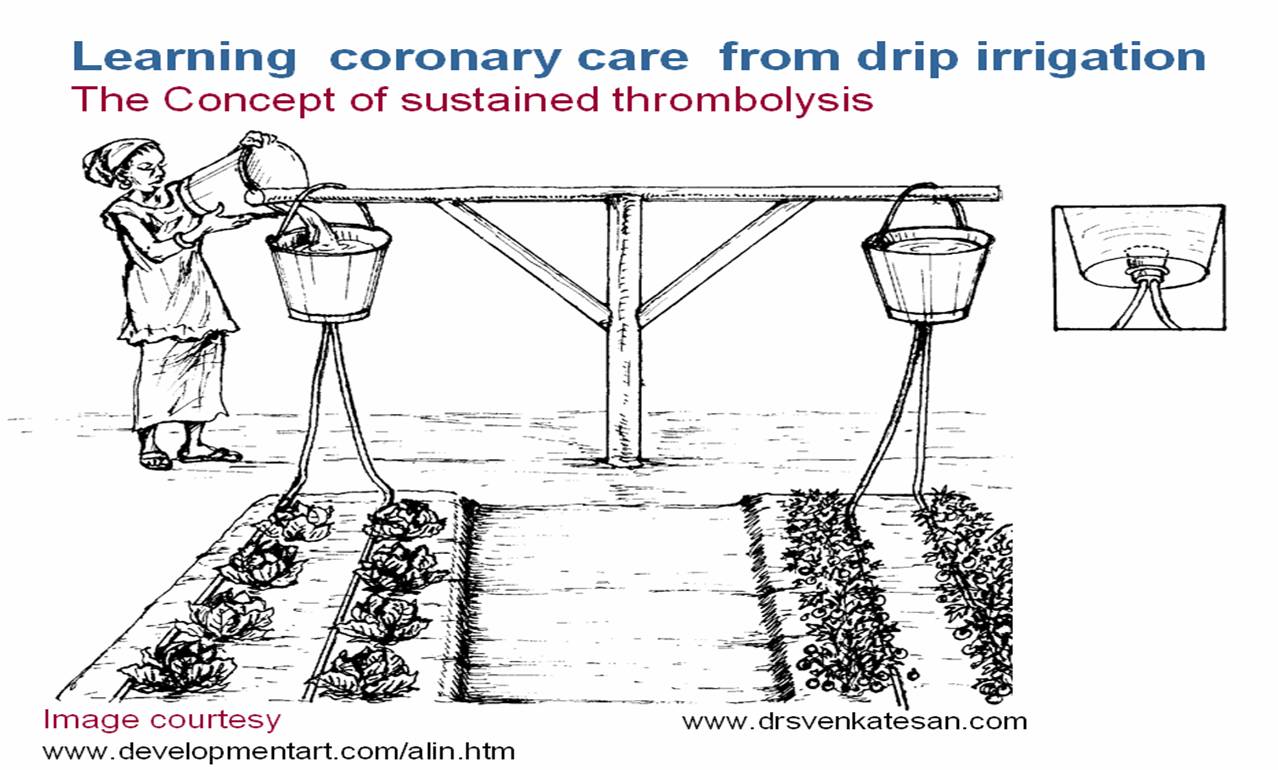
It  makes sense , to administer these thrombolytic agents over a prolonged period of time so that the lytic process gets wider recruitment of the natural lytic mechanisms.
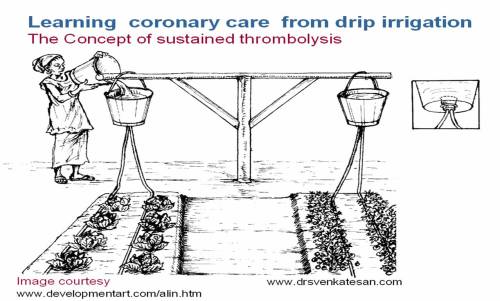
When a drug is infused continuously , the drug  reach the thrombus in  a pulsatile manner , which facilitates thrombus dessication  (Like drip irrigation ) . A long acting drug even with a high concentration may not be  very effective , since  the  drug is required to produce a mechanical effect  here . (Unlike say a long acting antibiotics !)

TPA in Pulmonary embolism

The inadequacies  of  2 hour infusion of TPA is  glaring in acute pulmonary embolism .We believe   a 48-72 hour streptokinase infusion   has a definte edge   over a short and brief TPA infusion.

Issues need answer

It is yet , not understood why we can’ t infuse TPA as  a   long term infusion like streptokinase .

Advantage  of bolus TNK TPA  in  pre-hospital phase of STEMI

The argument in favor of bolus dose  thrombolytic agent  is  the ease of administration .

The other the major advantage claimed  is ,  a 10 second  TNK TPA   in STEMI  can  substantially  reduce the time window   and facilitate  early completion of thrombolysis .

Counter point

But , the  later concept is hard to prove  . . .

In fact , there  are  no controlled studies  available for assessing the   efficacy of TNK-TPA   vs  Streptokinase   with reference to various time windows. We presume so many things. An  incomplete   early thrombolysis  may not be better than a  more  successful  but  slightly delayed TIMI3 flow .

As scientists,  when  we try  to answer these  question we  ask for data .  Are we getting it any way ?  Are the existing data reflect  fact ?     We  wonder,  will we may never get   an  hourly  angiographic  data base  about the IRA  patency  in  TPA bolus  vs streptokinase infusion .

It is most unfortunate,   with  many of the critical questions   still to be answered ,  the cardiology community believes ,  they  have  reached the  summit  of  knowledge  about thrombolytic therapy . Current perception is , the research on  existing  thrombolytic drugs  is  deemed to have been complete .

In this hyped  era of interventional coronary  care  ,   it is a remote possibility   to have any  further comparative studies on thrombolytic agents .

The greatest threat faced by  us  today  is the destiny  of  modern medicine is   often  decided in  few corporate board rooms  and   hence   research questions  rarely  emanate from bed side !

In this scenario, where we are not likely to generate   genuine  clinical  data ,  the only way to move   forward is   to go  by  our experience – ” Genuine  experience to be precise . . .”

Final message

Ease of administration should never be the criteria in choosing a thrombolytic agent . It   can severely    compromise the quality of thrombolysis  ! especially in pulmonary embolism and to a certain extent in STEMI.  Success   rarely  comes  with ease  . . .
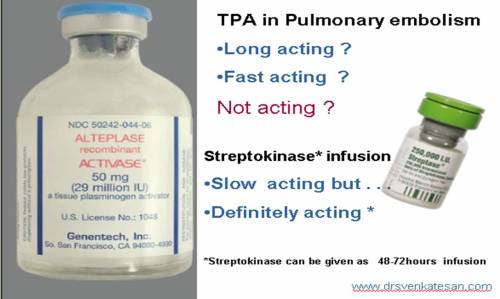
Many believe , the choice  between  streptokinase   & TPA    goes much beyond it’s academic reasons.  TNK TPA (Tenektepalse) has come in a big way to replace streptokinase  even   in developing countries.  Ofcourse it is backed by a huge study  ! (ASSENT) .

The cost effectiveness and worthiness  of TPA over streptokinase  was  never proved comprehensively.

Note of caution :

The observation made above is   based on personal  opinion  in  about   20 patients  . Readers are  argued to do their own  analysis on this issue and come to a conclusion .
Coronary artery anomalies are relatively common . It can be either in it’s origin, course ,  or termination etc.

There are two major sub groups.

  1. Anomalies associated with other congenital heart diseases (Both cyanotic and acyanotic)
  2. Isolated coronary artery anomalies .

The second category  which we encounter in cath labs frequently  does not have major implications . RCA and LCA arising  away from it’s respective sinuses ,Separate origin for LCX, or conus, RCA from left sinus or a high take off of RCA are the common anomalies.

While  coronary anomalies are commonly associated  in complex congenital heart disease (TOF, DORV, TGV, etc )

Isolated  complex anomalies of coronary arteries are extremely  rare

This happens , when one coronary artery arises from pulmonary artery instead of aorta and   it becomes a fascinating disease !

The ALCAPAs  and ARCAPAs

When the LCA originates from PA it becomes a  rare cause  of  left to right shunt .it is referred to anomalous origin of LCA from PA (ALCAPA) .

The ALCAPA is many times common than the “ARCAPA”

We report a case of ARCAPA (Anomalous orgin of RCA from PA )

The unique features of ARCAPA  could be

  • Isolated ARCAPA is very rare.
  • Only a handful of  patients reported in literature
  • These children present with more of right heart failure as RV function is compromised .
  • A continuous murmur in 2nd LSCS without cyanosis gives a clue
  • Angina is rare unlike ALCAPA
  • Mitral regurgitation is uncommon as LV function is relatively intact.
  • The q waves in V5 V6 we see in ALCAPA is conspicuous by it’s absence
  • ARCAPA is often ssociated with bicuspid aortivc valve, VSD etc
  • Left to right shunting can be significant .
  • 64 slice MDCT is a great investigation in this entity
  • Surgical ostial transfer is preferred so as to restore twin coronary circulation

Image and video of the ARCAPA will be uploaded shortly

Reference

1 http://asianannals.ctsnetjournals.org

2 http://ats.ctsnetjournals.org

3 http://ats.ctsnetjournals.org

The bundle of his divides into two

  • Anterior fascicle
  • Posterior fascicle
  • Middle septal  fascicle*

Middle fascicle * Many  dispute  it’s presence .  One may wonder , how  can anatomy be  under  dispute  ? If you cut a heart you should be able to clear the dispute .  But medicine is not that simple . . . What you do not see may be more important than what we see.

The anterior  fascicular block (LAFB) is one of the common conduction disorder. It ‘s significance :  Can  be a  benign  or a  dangerous entity depending upon the clinical situation .The  problem with  LAFB  is , it is diagnosed primarily by the axis shift it inflicts on the QRS complex.

In a strict sense, it is not a ideal way .There is  a tendency to label all significant left axis (> -60*) deviations  as LAFB. This  practice has made diagnosing LAFB very common in elderly, hypertensives, etc. In these situations it may not mean anything ,  except to suggest a  delay in conduction in  left anterior  fascicle.

If we filter out all these  benign  axis shift  ECGs  , the true organic pathological LAFB  may  not be that common .

Organic , LAFB occurs in the following situations.

  • Degenerative  blocks (Part of Lev & Lenegre’s disease)
  • Aortic valve disease .
  • Hypertensive heart disease
  • Post MI (Either alone or part of bifascicular or trifascicular block )
  • In association with dilated cardiomyopathy

Even in degenerative  , ischemic conduction defects LAFB is far more common than LPFB why ?

The traditional explanations are

  1. Anterior fascicle is relatively sub epicardial in location
  2. It is a  long and thin  structure prone to damage easily
  3. Exposed to the mechanical   stress of   LVOT **
  4. Anterior fascicle has  only a single blood supply(LAD)

** Which experiences  the peak LV  pressure  at > 100mhg and a dp/dt  up to  2000mmhg  (While,  the posterior fasicle is located  away  in the inflow portion of LV  , which is exposed  to low pressure – at best 10mmhg filling pressure )

Human body is  now  approached by many of the physicians as  collection of  multiple  organs . This is  the price we pay for modernity in medical science. The era  of great physicians  in general medicine has gone . Now, a  super specialist  of one organ  is  rarely concerned about what is happening to the patient’s  other organ ,  it is  considered    foreign to him  ! While ,  this is the dominant thinking pattern of   modern-day specialist

Let us  travel intime  and  go to the year 1954 . . .

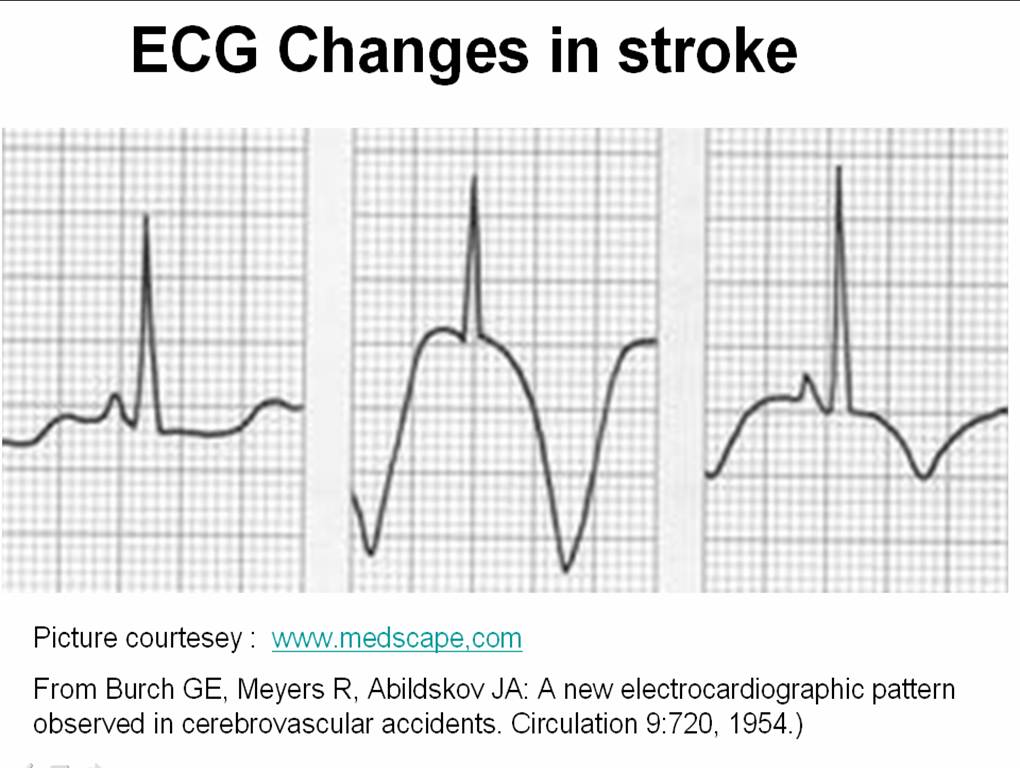
Three  physicians from Michigan ,USA  published  one of greatest observation in clinical sciences , namely the ECG changes in various forms of stroke .

Now , a shrewd physician  , will  suspect a subarachnoid hemorrhage (SAH) by looking at the ECG when the clinical situation demands . But , what we need is every one should develop that skill . We have seen errors happening  even in big institutions (or is it because it is big ?)  when  an elderly person comes with deep T  inversions with or without  altered sensorium being rushed into  CCUs  & cath labs instead of  neurology units.

We  need to teach  our junior  colleagues  . . .  That ,  ECGs of patients with  acute neurological syndromes  (ANS)  can mimic as acute coronary syndromes (ACS) ( especially in elderly ) .

The following ECG changes * are observed during stroke

  • Deep  T wave inversion –   Sub arachnoid hemorrhage
  • Cerebral thrombosis   –      Prolonged QT interval, U WAVES
  • Cerebral hemorrhage –      ST segment  shifts /T inversion


The ECG changes tend to occur very early after CNS injury.May last up to 1 week. They are not useful to identify the type of stroke. But , deep T wave inversions strongly suggest SAH rather than ICH or thrombotic stroke.

What is the mechanism of these ECG changes ? 

It is a clear proof that heart and brain are interconnected by neural network. All the noted changes occur during myocardial repolarisation . (ie ST segment )  The current thinking is  (Ofcourse , it is same as our thinking  in 1950s !)  it is mediated by adreneergic surge  initiated by CNS insult  transmitted to  myocardium by the sympathetic system.

Why should SAH produce more  ECG changes than others ?

It is possible the net adrenegic drive from the brainstem and spinal cord will be greater in SAH as it  spreads the entire CNS  through the cerbro spinal fluid. While localised ICH and infarct is  likely to generate less adrenergic impulse. 

Reference

Read the link to circulation 1964 .With courtesey to circualtionaha.com

http://circ.ahajournals.org/cgi/reprint/9/5/719.pdf

This came 50  years  ago , we still quote their work and no one has improved their work . 

Final message

If  only  we make the  clinical bed side teaching as a  regualr habit ,  we  do  justice to   our  great  physicians of the past ,   who enriched  our  life  with their  clinical  skills  and  passion for knowledge  sharing .

Imaging  coroanry artery is  generally  in the   domain of interventional cardiologists. MDCT has helped us to change that.

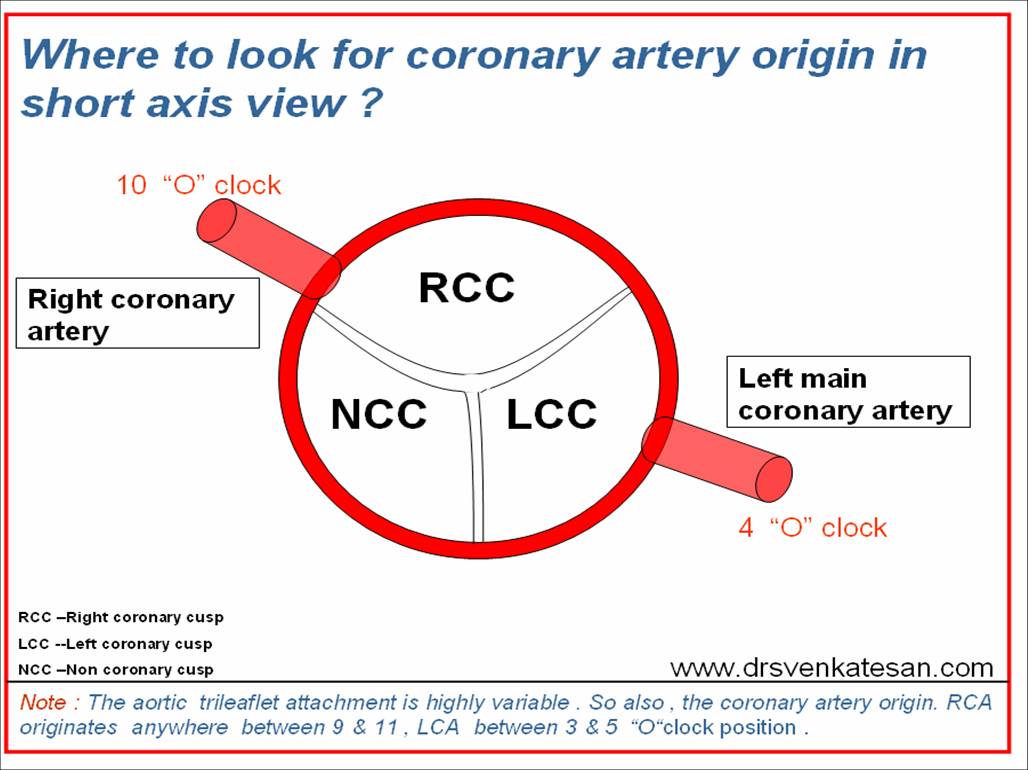
The  humble echocardiography can   identify the origin* of   coronary arteries   in  most   persons. The resolution power of modern day echocardiography is  2mm and the left main  ostium is >3.5mm in 99%  of population . If some body says one can’t  visualise the coronary artery by echo ,   it can only reflect their ignorance or lack of patience to get an optimal image. Of course technological limitations are there.

*  To be emphasised again , only the origin can be identified.

Can we identify ostial leftmain or proximal  left main disease  by echocardiography ?

It should be possible in  few .

Can we place  a doppler sample volume  within  the left main and measure coronary flow velocity ?

When obsterticians are able to  assess the  uterine artery flow  in a bulky uterus ,  it should be possible to do the same in  a coronary artery . Motion artifacts is the issue in the heart.  Micro sample voulme (<1mm) are expected in the future  that will make a non invasive coronary flow assesment a distinct possibility.

Hypotension is one of the dreaded complication of acute STEMI.

  • It can be due to either a  mechanical complication or hypovolemia.
  • The hypotension in inferoposterior MI is  often related to enhanced vagal tone and easily correctable with atropine  and fluid  administration.
  • RVMI is the classical example of hypotension that may improve with fluid resuscitation
  • Hypotension,  if  not reversible within 12  hours  ,  is more likely to  represent a more sinister mechanism like pump failure, MR or ventricular  septal tear etc .

A new mechanism for persistent  hypotension is increasingly recognised.

This is due to the

1.Loss of LVOT dynamic activity.

2.Excessive  dynamism of LVOT.

LVOT contractile and ejectile falure

Even though LV  outflow tract  contain  less  contractile myocytes  , it has an important mechanical  job to do. We know , it’s  primary job is that of a  conduit  but  it also  has to  eject the blood into aorta with sufficient force.  In fact, it is thought much of the acceleration of blood velocity occur in LVOT . So, LVOT  plays a key role in maintaining the cardiac index.  An excessively dynamic LVOT will impede the forward blood flow as in HCOM.  Similarly  less dynamic contraction  of LVOT  results in  low velocity propulsion , that interferes with   proper delivery of blood from LV cavity into the aorta .

These factors get amplified in  acute MI , as it is a compromised situation with fluctuating HR and contractility. So a properly functioning  LVOT conduit is  absolutely mandatory.

STEMI due to a proximal LAD obstruction   located can involve the septal .If the first septal branch  happens to be a major one,  there will be  definite impact on the LVOT function.

Excessive dynamism  , LVOT   desynchrony  LVOT collapse .

LVOT has a medial border formed  by IVS , an  anterior surface and  a posterior surface .The lateral border is relatively boundary less , except it is guarded by  the anterior mitral leaflet.

But one should recall , the AML comes towards the LVOT only in diastole . When it comes in systole it becomes a pathological event  called  SAM  (Systolic anterior motion )

The LVOT wall desynchrony can occur in both anterior and posterior MI.In a mulivessel CAD  this can happen when there is disproportionate inferior to anterior wall motion defect.

Management.

  • There is no specific management strategies aimed at restoring LVOT function.
  • Emergency revascularisation will attenuate the mechanical dysfunction
  • Dosage of powerful inotropic agents should be moderated in dynamic LVOT obstruction.
  • Spontaneous recovery  may occur in few

http://circ.ahajournals.org/cgi/reprint/116/5/e110.pdf

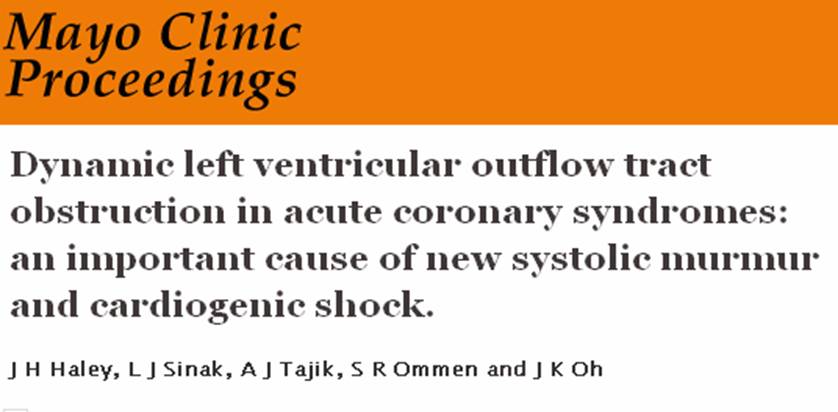
Haley et all Mayoclinciproceedings 1999

  • It is only rarely a journal of International caliber is published from India . IJEP is one such journal.
  • Cutting edge articles on Electrophysiological science  break here !
  • This is an online journal . No print issues . Enjoy, it is free !

Here is the  Link

Just sample an article  : A great review about cardiac arrhythmias in congenital heart diseases , Must read by  all cardiologists    http://www.ipej.org/0906/khairy.htm

  • It is going to be the era of non invasive imaging  in  cardiovascular  diseases .Future looks very exciting
  • We have now ability to slice the heart 356 times a second !
  • Image resolutions are getting sharper .
  • The only worry ( Of course a major one !)  would be the radiation , that has to be addressed .

Now we have a dedicated journal for cardiovascular CT scan .

Does it surprise you  ?   For me  . . . It  is  !

Link to the current journal page . Get updated  !

http://www.journalofcardiovascularct.com/current

There are millions of  articles in cardiology . Some  simply  occupy   valuable spaces without any purpose  . Some give us knowledge . Some enlighten  us. While few are  so vital , it is almost a crime  if we do not read such articles and apply  it in day to day  practice .

This an article  written by Henri Justino that has a immense importance for the patients as well as the physicians .

Do not think  the article which came in pediatric radiology  is not applicable in adults !