Feeds:
Posts
Comments
  • Here is a site which has dedicated  resources for learning echocardiography .
  • The site has collection of various work shop and conference highlights
  • The basic echocardiography with classical line diagrams  would be very much useful for the beginners,

Cheers to duke university for sharing ! www.echoincontext.com

Vasovagal syncope is the commonest cause for syncope in our population.It is also referred to as simple syncope .The mechanism is thought to be  an abnormal overshoot  response  by the vagus  in response to a  sudden surge of  adrenegic activity  usually occurring  in erect posture following   , often an emotional or physically stress full situation .The  receptors for  this  reflex pathway is thought to be located  left ventricular myocardium .

There are  two components  for  the VV syncope

  • Cardio inhibitory
  • Vaso depressive.

The quantum of contribution  by each component in a given episode of syncope varies. Pure vasodepressive or cardioinhibitory forms can occur .

Diagnostic issue

Before labeling  a patient as simple vasovagal syncope all potentially serious , cardiac causes must be ruled out. this may require a fairly extensive investigation in some

Read the related blog  : Why syncope is rarely  fatal ?

https://drsvenkatesan.wordpress.com/2008/09/30/why-syncope-is-rarely-fatal/

Management of vasovagal syncope.

  • Reassurance is the mainstay . By this we mean , V V syncope may never kill . . .
  • Prevention  – Involves  identifying syncope prone situations  & taking precaution
  • Emotional support
  • Pharmacological approach

Some will benefit from beta blockers, fludro cortisone(Increase the intra and extra cellular  fluid space )

Since  these are   simple ,   cheap  treatments ,  we worked over time to innovate  &   find some interventional solutions for this life threatening condition !!!.  Thus ,  the indication for cardiac pacing for vasovagal syncope came into vogue .

DDDR pacemaker was implanted worldwide for thousands of patients with vasovagal syncope .

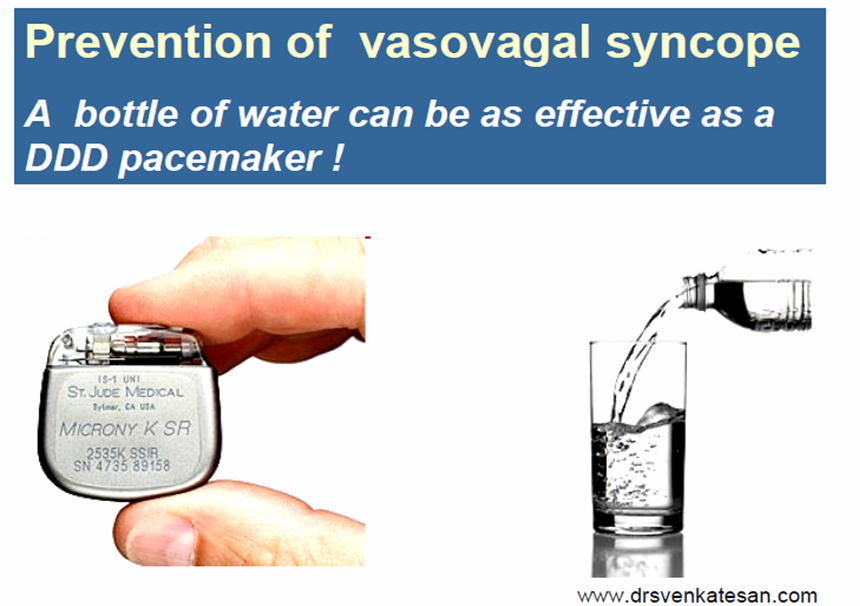
It took  many years  for our  intellectual brains  to realise ,  there are  two limbs to vasovagal syncope Pacemakers ,  at  no stretch of imagination  is expected to counter vasodepresssive component of the syncope.

And then this article came !

http://circ.ahajournals.org/cgi/content/full/108/21/2660?ijkey=ba86da897c167581c498c81743c32afe14fc9393

Water ,  (Simple  H2O ! ) administered at right time in right quantity can prevent most  episodes of vaso vagal syncope . When a tumbler of water can be substituted for a  10000 $ misadventure  (DDD pacing)  , and  further  we have  hundreds  of similar examples in modern  day health care  ,   no surprise  why our health care system is  sinking  along  with our economy !

Epilogue :

In this  21st century   medical “AVATAR ”  , we need to realise   in a strong manner,   low cost  medicines  often   provide   high  quality  cure  ” while ,”   many of the  high cost  therapies  may  end up in  low quality  treatment !

It took 50 years of intense research of  medical comunity to realise ,  a good diet , physical activity and quitting smoking has the greatest way to control  and reverse  the cardiovascular epidemic . Please , note all of them come at free of cost .

Many times , human coronary arteries are the sacred sites upon which  mankind’s history and destiny is written.We now have an pandemic of CAD in our hands. It has a  great impact not only on the cardiovascular  health but also the productivity of this world .

  • We  , work hard ,  day and night in cath labs  ,  to remove the blocks from the suffering CAD patients
  • Some  treat it medically.
  • Few others work in preventing CAD
  • Not even a handful  work on the anatomy of the problem !

How and why the human coronary arterial system behave so bizarrely ?

  1. From where does  coronary artery originates ?
  2. What determines the coronary collateral seeding and genesis ?
  3. Why some have only anatomical collateral without functional  use ?
  4. Why artificial  neoangiogenesis  has  not helped much in  CAD ?
  5. Why ,  one human being   lives  comfortably with a totally occluded coronary artery ,  while others suffer  with severe angina even with a 70% occlusion ?
  6. Why the COURAGE  and OAT study had the surprising  conclusion ?

Answers to  all these lingering questions   may be  clarified soon !

Read this  gem of an article   from Brazil in   a  less fancied   “Journal of morphology “

International Journal of Morphology – Origen y Desarrollo de las Arterias Coronarias

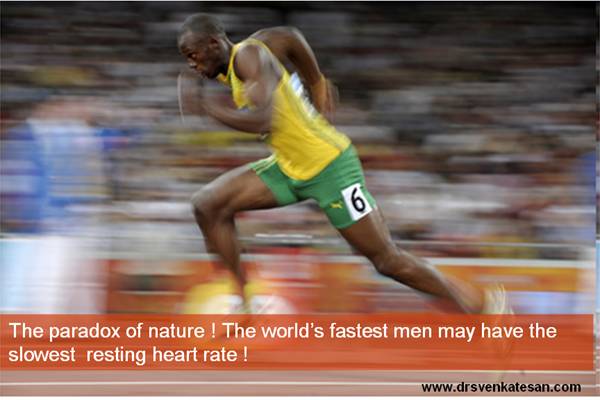
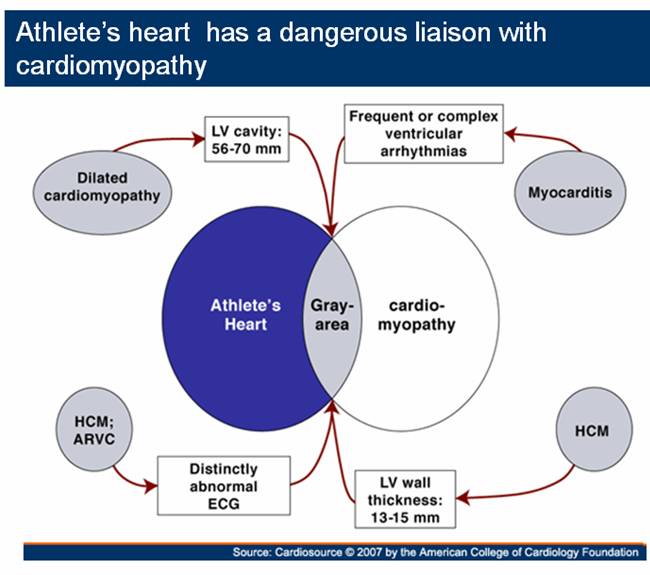
ECG of an athlete is many times difficult to interpret. The influence of autonomic tone in  athlete’s heart is an complex one.Contrary to our expectations the parasympathetic tone is higher in well trained athletes. The resting heart rate can be as low as 30/mt which is 99.9 times pathological in non athletes.This happens due to a concept called accentuated antagonism.The athletes who have episodic surge of high catecholamines keep stimulating the para sympathetic neurones in a constant fashion.

LVH is the most common feature.Here there is simple myocyte hypertrophy, without pathological fibrosis.This differentiates athlete’s, heart from HOCM .

Many ECG abnormalities are reported in athletes.

Excerpts from the ACC recommendation

1. Electrocardiographic findings that are common and training-related and that do not require additional evaluation are sinus bradycardia, 1° atrioventricular block (AVB), incomplete right bundle branch block (BBB), early repolarization, and isolated voltage criteria for left ventricular hypertrophy (LVH).

2. Uncommon and training unrelated electrocardiographic findings that mandate further evaluation include T-wave inversion, ST-segment depression, pathological Q waves, atrial enlargement, a hemiblock, right ventricular hypertrophy, a BBB, or a Brugada-pattern of ST-segment elevation.

3. Training-related electrocardiographic findings are more common in men than women, athletes of African descent, and high-endurance athletes such as cyclists.

4. Sinus rates <30 bpm and sinus pauses >2 seconds are common in highly trained athletes, particularly during sleep.

5. A normal chronotropic response to exertion and the absence of bradycardia-related symptoms distinguishes training-related sinus bradycardia from sinus node dysfunction.

6. 1° AVB and Mobitz I 2° AVB are common, but Mobitz II 2° AVB or 3° AVB should not be assumed to be training-related and require evaluation.

7. Early repolarization in Caucasian athletes most commonly consists of upwardly concave ST-segments and tall and peaked T waves; in black athletes, there often is convex ST-segment elevation and negative T waves, mimicking a Brugada pattern.

8. In the presence of voltage criteria for LVH, pathological hypertrophy should be suspected if there is left atrial enlargement, left-axis deviation, repolarization abnormalities, or pathological Q waves.

9. T-wave inversion ≥2 mm in ≥2 adjacent leads should prompt evaluation for structural heart disease.

10. Electrophysiological testing for risk stratification with possible catheter ablation is appropriate in athletes with ventricular pre-excitation.

Source :  Fred Morady, M.D., F.A.C.C.

http://www.ncbi.nlm.nih.gov/pubmed/19933514?dopt=Abstract

For an excellent article on the topic click here

” This is post is 5 years old , Newer developments should be given considerations”

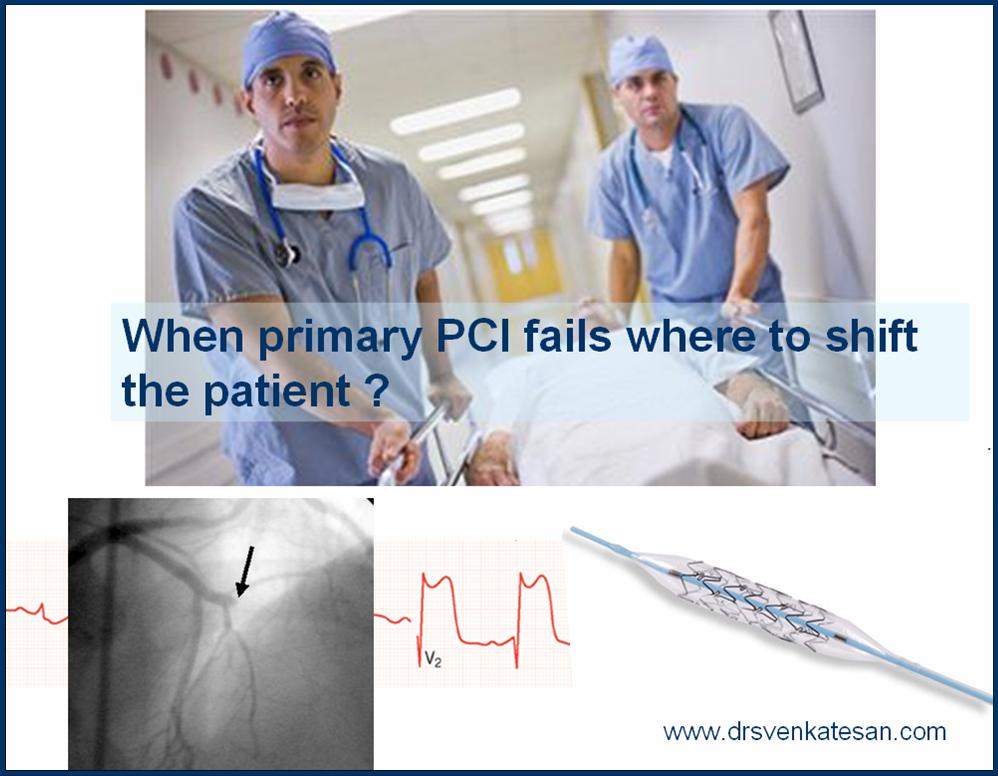
STEMI is the “Numero Uno” of  cardiovascular emergency .The  treatment has evolved over decades,  right from   the primitive  arm chair approach to the  air dropping of  patients  over the cath  lab  roofs  for primary PCI ! We realise by now ,both are extreme forms of treatment and  may  have unique  hazards. What we forget is the , the natural history of STEMI is too  much dependent on the degree of initial damage to the myocardium , and it is very difficult to alter this,  however good is the therapeutic strategy .  We are yet to find an answer regarding the mechanism of primary VF and modes of preventing it. We also have no answer for  ,  why  some  develop myocardial damage  very fast and  the  cardiogenic shock occur in an  accelerated fashion. (Fate ?)

Many would consider  ” non availability of   infrastructure and expertise ”  is the major issue  for  primary PCI . But the real problem is much more than that .When an  illusion of knowledge is  created by constant bombardment of data  , it is natural for human beings to believe whatever is told or printed in books and journals. We cardiologists are made to believe thrombolysis is a far . . .  far  inferior treatment than primary PCI in STEMI .  It is not so in any stretch of imagination !

The fact that,there is no entity called ” Failed primary PCI ” in cardiology literature  , would  suggest how biased we are against thrombolysis. Every cardiology  resident will  recognise  thrombolysis fails  at least 40% of time .Yes , it is  a  fact  , but the irony is , this   is  often  used   to convey a surrogate  meaning , that  is , primary PCI is  near 100% successful !

How  do you assess success of primary PCI ?

Unlike elective PCI where the criteria is too liberal, we can not afford to adopt the same in an emergency PCI. Here the aim of the procedure is entirely different (Salvaging dying myocardium vs pain relief  ).

It’s still a  mystery ,  while  thrombolysis is vigorously assessed  for it’s  effectiveness   primary  PCI is rarely  subjected to the same scrutiny  . A check angiogram  after the procedure ,  is all that is done . . . and every one  leaves the cath lab happily. The  effect of primary PCI on ST segment ECG resolution must be documented immediately after PCI. While ,  It is mandatory to take ECG after 60 -90 mts after thrombolysis , this sort of protocol is rarely  followed after PCI.

If the ST segment  fails to retract  > 50% immediately  following PCI  the procedure  should be  deemed to have failed . Further , unlike thrombolysis  in primary PCI , the ST segment has to regress within 10  mts , as IRA patency occur instantly .If we apply this criteria , the success rate of primary PCI would be far less than what we believe*

* Not withstanding the official lesion , hardware, related failure. If we encounter a severe triple vessel disease , with a bifurcation lesion and thrombus it’s  a tough exercise as we are racing against time .

Primary PCI  Camouflaging  in semantics

  • A successful but  delayed   primary PCI  is actually a failed PCI
  • A  complicated  primary PCI  often  reach the equivalence  of   failed PCI
  • No  reflow is almost synonymous with failed primary PCI as successful correction of no reflow occur in minority.
  • Not all TIMI 3 flow is converted into myocardial flow.
  • Renal dysfunction following excess dye has a  high  morbidity
  • If patient  develops significant  LV dysfunction following primary PCI it is a failed PCI.
  • Finally if the cost of primary PCI exceeds the insurance limit it is  economically a  failed primary PCI as the patient  has to spend double or triple  the amount of sum insured .This stress has resulted in many recurrent coronary events .

Why is it important to recognise failed primary PCI ?

For failed thrombolysis we have a strategy . Unfortunately , even in this modern era  we have  no useful  strategy for failed primary PCI . Handing over a patient to a surgeon in a such a situation is considered by many as a great rescue strategy but in real world it does no good in most of the patient.

Doing an emergency CABG in a sinking patient with a battered coronary artery is no easy job /Many times it only rescues the cardiologists from the embarrassing situation of facing the relatives who ask for explanation.

So , what can be done at best , in failed primary PCI ?

  • CABG can be an option but still questionable !
  • Most times  there is  no other option except to fall back on the medical management.
  • Intensive anticoagulation and one need to consider even a rescue thrombolytic treatment !
  • Some times we can only prey !  Failed primary PCI for a patient in cardiogenic shock with IABP support is near death sentence !

Final message

  • Remember ,  success of primary PCI   is  not in  wheeling out a  patient  alive out of cath lab   , with a TIMI 3 flow  in the IRA ,  but in  garnering significant   myocardial salvage   which  should have an impact on   intermediate and long term  outcome .
  • Do not ever think primary PCI is a sacred treatment modality in STEMI  and the job of the cardiologists ends there. It is vested with  lots of important complications – defined, undefined , recognised,  unrecognised, reported, and unreported ,  concealed ,denied, poorly understood, etc etc.
  • There are  equally  effective, less dangerous treatment modality available .
  • Decision  to do primary PCI  must not be based   only on the  “affordability and  availability”  of  cath lab and expertise !
  • In  clinical cardiology practice,  no  procedure  is  great   & nothing is inferior either  !  Every thing has to be used judiciously , appropriately  and  intelligently (Intelligence is synonymous with common sense many times!)

Coming soon

Surgeon’s real time experience of operating  on a failed primary PCI. To our surprise , only a handful of surgeons  have this experience

Persistent ST elevation is the  general technical term for  failed thrombolysis.Regression of 50%  of admission ST elevation is the required criteria for susccesful thrombolysis .

Thrmobolysis fails in about 40-50% .

Main determinant is the timing of thrombolysis – not the thrombolytic agent ! do not get carried away with all those curent hoopla  about Tenecteplase stuff

If we take 100 patients with persistent ST elavation 90-95 will be in anterior LAD territory .

This is a stunning a cardiology secret no book of cardiology address . . . Implication of which could be very significant . Primary PCI  will always struggle to  prove it’s superiority over thrombolysis  in the right coronary artery .(Note LCX STEMI is different , infact it is more tricky than even even LAD .This issue will be addressed seperately in my blog.)

Read the following link  for  answer to the title question .

How common is persistent ST elevation in inferior leads following STEMI ? https://drsvenkatesan.wordpress.com/2008/09/22/why-thrombolysis-rarely-fails-in-right-coronary-artery/

It is a well known fact  ,   CABG and PCI  provides immediate relief  for patients with angina ,  which is refractory to medical therapy. Of course , this happens only if a critical occlusion of  at least one epicardial coronary artery is  opened . It need to be realised ,  angina  due to  microvascular  disease can not be cured by maintaining  epicardial  patency .

While angina  relief is prompt ,  dyspnea is not ! . If we  believe,  opening  up a  coronary artery  in a patient with LV dysfunction will  restore the LV function  ,  it  is grossly mistaken !

Why is it so ?

Angina  relief requires  simple  restoration  of  oxygen supply and correction of local ischemia .  This happens without any issue as the blood  seeps in to the ischemic cells and soothes the ischemic nerve fibres that trigger the pain signals   . While  ,  for LV function to improve , the blood flow has to be converted to mechanical activity in the form of myocyte actin/myosin interaction. For this,   there need to be an intact  cellular contractile mechanism . The myocyte architecture should be appropriate .In post MI ventricles we know there is  zig zag  orientation of myofibrils due to myocyte slippage that interfere with mechanical recruitment . Further , integrity of  extracellular matrix  namely the collagen frame work is also vital . Note ,  angina relief  is not concerned with any of the above .

And now ,  we also realise  dyspnea  in failing ventricles  is vitally  dependent on diastolic function ,  which is also very much  impaired in ischemic DCM .There is little proof for  PCI/CABG  to correct the  molecular   mysteries in  diastolic dysfunction !

Dysfunctional LV means what ? (read the link )

It is a collection of  variety of myocardial tissues . Viz : Fully  necrosed , partially necrosed ,  ischemic viable, non ischemic viable, ischemic non viable, non ischemic non viable , Apart from this patchy necrosis, patchy ischemic, areas are common. Finally , necrosed segments   may  also be perfused normally by  spontaneous reopening of an IRA.

One can imagine the complexity  of events in these segments  once we do the  PCI /CABG . The response  is highly variable and unpredictable. The major concept we  , the physicians  believe or ( to be precise made to believe !) is  the  sanctity  devoted to  the viable myocardium .For  many us ,  it is considered a  holy  exercise  to identify viable myocardium in patients following MI and then revascularise them if  found to have significant viable myocardium (Atleast 20% of infarcted area )

A full 2 decades were lost or (shall  we   say wasted on this futile exercise !) as   we have since  realised most of the cardiologists do not follow this rule .

Now , even a scarred myocardium is revascularised in the hope of recovery .As such , we have reached a stage where  there is no contradiction for not doing a PCI /CABG   with reference to LV dysfunction.

Now every  patient  with post MI  LV dysfunction  is considered to  have  some amount of viable myocardium that is  fit   enough  for revascularization

Are we justified in doing  this ?

Many clinical  trials  have revealed  , the  recovery of LV function  in these segments  has not been consistent at all .

The most surprising discovery is  a viable myocardium need not  be ischemic   .It might get adequate blood supply either  from invisible collaterals or trickle of antegrade flow .  Hence an adequately  perfused myocardial segment can  still be   non contractile . This shatters the myth  that  revascularisation must have a dramatic effect on the recovery of contractility in all viable segments.

The other major finding is  ,  even ischemic   viable   myocardium ( documented by metabolic activities PET etc)  need not regain it’s original contractility  after the ischemia is fully corrected .

*reference for  both the above statements are available from variety of sources including real life experiences .(Type C evidence )

Final message

  • Do a PCI/CABG promptly for patients with refractory angina.
  • Never  advocate PCI/CABG  for  a primary relief of dyspnea .  (Never is a harsh word,  let it be  “use it  with caution ” ! and  the  patient  should be  revealed  the whole facts  about  what we know and what we do not know regarding the complex  hemodyanmic events  in  revascularisation   )

Counter point

If  the above statements are really true ,   How does PCI/CABG   help  relieving  dyspnea  and functional class  what is your answer for thousands of patients  with CAD and ischemic DCM who have greatly benefited from CABG ?

The answer could  be  simple , The revascularization  piggybacks  over the   medical management (which , these patients pursue vigorously)     like  ACEI,  statins, salt restriction, betablockers  , optimal diuretics and tend to hijack the credits from the poor  drugs !

Read a related blog

Revascularisation for ischemic DCM

Acute MI is a major medical emergency encountered in ER . Prompt adminstration of thrombolytic agents or rapid   triaging for a  primary PCI   may be required . The whole concept of management of STEMI  revolves around time as a therapeutic   target .Every minute counts . The beneficial effects of  reperfusion   and the resultant  myocardial salvage  rapidly declines over time . Hence ,  the symptom to door time  remains the ultimate determinant of  outcome in most situations.

So , estimating the  time window of  “Symptom to door time ” becomes an all important parameter. This is often done by paramedics .

The apparently  simple  job  measurement of time window  can be  misleading at times especially in elderly, diabetic and alcohol abusers .

When  a patient  says he has chest pain since yesterday straightaway he is excluded from reperfusion strategies as 12 hours  would have elapsed

When a patient  describes  chest  pain since two days , but  more intense  only since today morning what does it imply ?

  • The first episode of pain could  either  preinfarction angina or infarct
  • The second episode of pain could again be the continuation of same  angina or conversion of that angina into infarct

So ,  calculating the time window  when a  patient has recurrent episodes of angina prior to an MI is a real difficult issue.For the benefit of doubt, we have to take the last episode of chest pain  which was continuous and more severe as the infarct pain.

How does ECG help to time STEMI ?

When it is difficult  , to differentiate pre infarction angina from infarct pain, the ECG may give  useful clues to time the STEMI.

  • Degree  ST elevation
  • T wave inversion
  • Q waves

Among the  above three ,T wave inversion is most useful to time an infarct. If T wave begins to invert, it can generally assumed the acute  infarct process is  almost complete . Q waves are less reliable  to time a acute MI as ischemic stunning can in the  very early phase of STEMI   inscribe a q wave over the infarct territory.

How will you time a STEMI in silent MI ?

There is no symptom to door time in patients with silent MI . Many do not even reach the door , for the simple reason there is no symptom that drives them to hospital. Those who are refered  have vague non cardiac symptoms and incidental ECG  which shows STEMI like changes. Here , the decision to thrombolyse is taken entirely on the basis of ECG *finding .

Note : Cardiac enzymes are can also be  used  to  diagnose  to estimate the time window .

When we get contaminated with excess  knowledge , we lose our ability to think !   &  Common sense is the casuality . . .

Human beings differ from other forms of life by their sixth sense . Our planet is  few billion years old . Life came into existence over a million years ago .Our life has  evolved over many  thousands of years .The average life span of  human race   is  75 years . We need to realise , our life constitutes  only a fraction of our planet’s life (<.0000001% ) . A  may fly , which lives a life of  less than a  day ,   does it in style  , looking for the light  throughout  the night ,  says good bye ,  to earth by morning  leaving  it  unharmed . Actually ,  in terms of time , the life of the fly is  just a  fraction less than  human life span , when compared  to  our planet’s life !

When these children are  longing for food , some of  earthly humans go to  spend millions for  obesity surgery ! That is  the progress of knowledge driven society . . .

It is  extremely common to  experience the following  scenario  in any corporate hospitals of  both developing and developed country .A   uninsured  or half insured !  person is  refused entry into a hospital even for an  emergency care  while a wealthy person is lying comfortably watching TV in a five star suit of the same hospital after an inappropriate coronary angioplasty for  an   innocuous   lesion of his heart !

The irony is ,  in this short span  of  earthly life  ,  we want to prevail over the nature and conquer the planet . God is watching  this human  behavior silently . And he is smiling  . . .

With all our knowledge base ,  modern science  have done the maximum possible  damage to our  planet  .We have made many lives extinct. If  we  tend to  think , with the help of  6th sense  we can become immortal , it would be the ultimate foolishness. When every one of us ,  is  obsessed with our own  health  , we are deaf  to  the silent cries  of  our beloved planet earth .

Now , all of a sudden we realise all the accumulated knowledge & development has actually worked against us. We find our knowledge is dissociating our thoughts   and now , we are fighting  vigorously  over acquiring the rights to damage our planet  .

So it seems ,  the more we learn,  less wisdom we have  ! We may need to  learn important lessons  of living  from  all those  species   which  do not  boast to have  the  6th sense  !

Read a related article , excellent one published in British medical journal  nearly 2 decades ago

Knowledge disease BMJ. 1993 December 18; 307(6919): 1578.

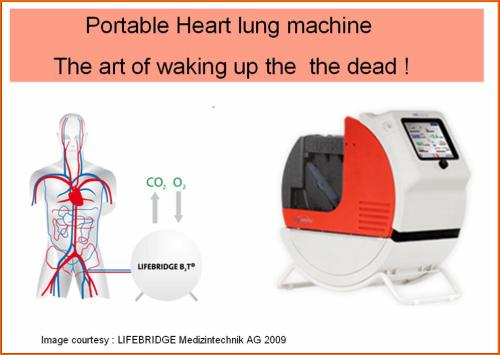
Can  modern technology  bring back  the life from a   dead person ?

Yes it is possible  ,  not in the near future !  but  in the present era  . . .

This revolutionary new portable heart lung machine may just do that .

Imagine  this scenerio : A cardiac arrest  victim  – failed resuscitation  with  ACLS  ,   the patient  needs  to be taken for an emergency cardiac surgery or intervention .You need time at least ,  few hours .Till that time  this simple device   takes  over the  role  of GOD    i e  sustaining life   by   pumping  and oxygenating  6 liters of blood !

Learn more about this award winning wonder machine from lifebridge .Germany

LIFEBRIDGE Medizintechnik AG / Product / LIFEBRIDGE B2T®