Feeds:
Posts
Comments

Scientific studies can be fun .In our spare time we often Indulge in rapid  fire sessions. We tested 30  wide qrs ECGs from our archives  (All proven VTs)  and  asked  our  cardiology fellows to apply Brugada criteria . They could   correctly  diagnose  VT  in 18* patients.The same ECGs were shown to the staff nurses of coronary care unit . 24  VTs were correctly identified  it.They did it by  their clinical sense and Instinct. (*12 vs 6  VTs missed)

wide qrs tachycardia svt with aberrancy and vt brugada verecki  griffith002

And now , four  clinical data was  provided. (Age , sex , Blood pressure , and  past H/o  MI were given )   The Nurses were able to predict it  28/30  VTs correctly.(97 % accuracy ) and the cardiologists  were able to equal the score now. So obviously clinical sense  was far superior .

Cardiology fellows were more likely to  mistake VT as SVT. This is far more common than SVT mistaken as VT. It is a strange academic  irony ,even the junior most nurses never missed a VT !

Summary

Simple sequence of history and clinical presentation is still far more powerful than ECG data in predicting wide qrs  arrhythmias . Nurses guess work is far superior than cardiologists  in predicting a wide QRS tachycardia as VT.

In fact , the  cardiology fellows are  preconditioned to   get confused   whenever they get a wide qrs tachycardia . Why  not aberrancy ?  In my  experience I have seen this question keeps  erupting inappropriately .Even  shrewd fellows suffer  from an  oscillatory  mind between VT and SVT .This is primarily because , every wide qrs ECG  is likely to  have at least two  criteria that fulfill both VT and SVT.

The implications are  genuine  and far reaching . While nurses  show a patient centric thinking  cardiology fellows  thought process revolves around ECG . Many modern-day cardiac physicians  are disconnected from clinical reality  and are obsessed with  complex EP concepts  and end up with a miserable face in the bed side !

This is not a new  revelation in 2013 . Masood Akthar told this  three decades ago.

Caution
Never try to glorify  guess-work . EP is a great science .The  pioneering concepts have made us understand how a VT emanates, travels , and exit from myocardium . We are able to localise it and ablate it .All credit goes to science . But , when it comes to bedside recognition of VT ,  clinical  sense  is a clear winner .With a  consistently > 90 % predictive value   it  can no longer be called as  a  guesswork   and becomes a hard scientific fact. Especially so , when the  intellectual  analysis of surface ECG   could predict  it  with paltry 70 %  accuracy (Read Reference 1)
Reference
This  analysis startlingly reveal  a fact .The over all accuracy  rate of predicting the wide qrs criteria  by  popular algorithms  is   between 66-77% ,  just 16 numerals   more than  gross   guess work  of 50 : 50 ( This  . . . or  . . . that )
Link to  Masood Akthar article

A 25 year man ,  hotel  manager  who had a documented DVT , since 2011 was on tablet warfarin . He discontinued  the drug by sheer miscommunication as he was told he should stop the  drug  beyond INR 3 by his general practitioner.He stopped it permanently  instead of titrating the dose of warfain .Six months later he landed  in August 2013 with an episode of minor hemoptysis . Clincally he was normal .His lower limbs were fine.

He was investigated and  his image file showed .

pulmonary embolism  3  total occlusion of LPA

pulmonary embolism  3  total occlusion of LPA

pulmonary embolism total occlusion of LPA

Living with one lung

  • He is comfortable with one lung function (Akin to  Pneumonectomy )
  • His saturation was 100 % at room air
  • Pulse -80/mt .BP 110/80mmhg
  • His physical activity  did  not show any significant limitation (At worst class 2)

One of the cardiac surgery consultant wanted to do pulmonary embolectomy and endarteriectomy .

In fact , he was admitted in the critical care unit driven by the dramatic CT images.

One enthusiastic cardiologist wanted  thrombus aspiration and pig tail catheter based thrombolytic  irrigation within LPA !

How did we manage ?

  • The risk of major vascular surgery was considered high in an absolutely asymptomatic individual .
  • Intervention was considered too adventurous.
  • He was  put on oral anticoagulant with target  INR 2.5-3.(After a 1 week Heparin overlap)
  • We hope the thrombotic CTO will open up gradually but for surely .As the power of  natural lytic  molecules should not be underestimated as we have witnessed in LV and LA clot disappearing over months.
  • However the option of putting IVC filter was strongly recommended for him , as he has only  functioning  lung  which  is threatened by a potential  embolus from DVT . The patient wanted to come back for IVC filter next month.
  • He was also worked up for all those protein C, S,  Lieden mutation stuff.
  • The patient was discharged in stable condition (By the way he  was never unstable either !)

* Meanwhile the hemoptysis  did not recur. CT scan showed a small wedge infarct in left lung that was in the healing mode.

Final message

This is a perfect example of  CTO of pulmonary artery being  managed conservatively* .We will let you know the follow up .

Link to related topics in this site.

Deep vein thrombosis-Therapeutic dilemmas

What do we mean by conservative management ?

I wish to  be in New Zealand , not only because of the stunning  natural beauty but also to pay tribute to one of the great  cardiac surgeons  of our time from Auckland .
An alluring  country side cricket ground  abutting the runway  . . . Queenstown I think !

Sir Brian Gerald Barratt-Boyes (1924-2006), Who pioneered all forms of  heart surgery that  specifically included  complex congenial heart disease . Thousands of Kiwi   children are alive and leading a  magnificent life today  because of this  man from Green lane an alumni of Mayo .

barret boyce tof intra cardiac repair cardiac surgeon

Many heart surgeons from India and Asia pacific have trained under him .

greenlane

Green lane Hospital Auckland.

This is the  hospital where Barrat Boyes worked headed the department of cardiac surgery .He had to over come large bureaucratic hurdles before becoming world ‘s leading cardiac surgery center. And , he lives everyday  in all cardiac units   through this book .

barratt boyce kirklin

Here is a link to pay tribute to this extraordinary man.

I’m trying to get  a right  answer for this question for quiet some time. The literature on lipids is so vast  , one can never finish reviewing it.There are   nearly two dozen journals that  deal with lipids ,Atherosclerosis, obesity ,and vascular biology .

Yet  , the answer to this simple question is elusive to us .The Irony is complete when we have evidence for   two diagonally  opposite responses 4 and 5 .

My interpretation of the issue

Any lipid molecule if exceeds a critical  level ( Only  if   . . . associated with hypertension, or diabetes or smoking ) can penetrate the vascular endothelium. ( HT-pressure injury , Smoke- Endothelial dysfunction  due to Nitric oxide depletion) DM -Glycation of cell membrane  , finally some  unknown inflammatory component )

Though evidence  for direct endothelial  injury is more for LDL ,  less for TGL (Almost nil  for VLDL , but  TGL has more VLDL in it !)

Strangely ,these molecules , express a mob psychological behavior .In isolation they appear innocuous. But ,in an  unfavorable   setting it shows signs of  revolt. If a group of  LDL molecule start attacking a  dysfunctional segment  of endothelium , the other molecules  like TGL and VLDL fractions would love to join the crowd  and inflict further  damage . (Of course ,the lonely HDL may watch the chaos silently !)

Questions to ponder

If LDL is a sharp knife like molecule  trying to injure the blood vessel , every normal human being is potentially threatened  by this  lipid fraction . Mind you,  this is a physiological molecule  traversing the human vascular system  at concentration  of 130mg/dl  at the  velocity of blood .

So it is  foolish  to blame this  physiological molecule for all our ignorance.

I recall one recent definition for hyperlipidemia

The lipid levels at which a patient develops vascular injury is considered high for him !

Of late many drugs are entering the  market  for human  consumption backed up by  Non -Inferiority trials (NIT ) .Few examples.

“The ONTARGET trial: Telmisartan is non-inferior to Ramipril in  New Study Results Published in the New England …”

Feb 20, 2013 – in the New England Journal of Medicine Show Dabigatran Etexilate ... daily was non-inferior to warfarin (p=0.01) in preventing recurrent VTE, …”

What is the logic behind these  Non inferiority trials ?

Why it came into vogue ? 

Do you agree with the concept of NIT ?

I have taken the  privilege  of putting my answer in the title. Believers  of NIT please excuse me.

Reference

Non inferiority drug trial

Non inferiority drug trial 2

Cannon waves occur when Atria contracts against a closing tricuspid valve of  right ventricle .( There  would be a equivalent left atrial cannon which  goes into pulmonary vein as well  , it is discussed elsewhere !)

Cannon waves  happen only when P waves fall within QT interval in ECG as QT represents the electro-mechanical systole of  ventricles.  (Since P wave represents atrial systole , it is simple to understand when it falls within QT both atria and ventricular contractions collide to produce a cannon wave into the neck or pulmonary veins.)

The following two images of cannon waves  taken from the legend  Dr Paul woods own tracing  .

irregular cannon waves in jvp  complete heart block

regular cannon waves in jvp  svt avnrt  11 va conduction  002

Regular cannon waves

Occur during SVT  with 1:1 VA conduction.*

1 : 1  VA conduction  can be considered as  absence of  AV dissociation  (Rather  disciplined  VA association with every beat ) This is essential to create a hemodynamic  milieu for regular cannon waves.

* In AVNRT , VA conduction in strict  sense  is a misnomer  .It is simply a retrograde conduction thorough  the AV node .

Irregular cannon waves 

  1. Complete heart block .
  2. Multiple random VPDs
  3. Some patients with VT.*(Who are those patients ?  Those with AV dissociation when retrograde “P” wave falls  within QT interval cannon occurs. As expected this occurs in random fashion  which makes  the cannon fire irregular.

Can we get regular cannon in VT ?

Yes , but rare . As explained earlier this can happen only if AV  association occur on a retrograde fashion.

Further reading in this site

What-is-a-cannon-sound  , how is it related to cannon wave ?

PTMC is a revolutionary    interventional cardiology procedure .A fibrosed obstructed  mitral valve is  opened up just like that , with few wires and a balloon  .The procedure  performed within 30 minutes .No  anaesthesia . No surgery .No scar.

Thousands of procedures are done world-wide (Rich countries excluded    they do not have RHD) .We in our institute , have gained considerable experience in PTMC ,  and  have  completed  nearly  200 procedures  in the last  few years .

As we gain experience surprises also galore ! .Suddenly I realised this  funny (At least for me !) phenomenon  from the unique PTMC balloon design.

The other day  , there was an intense argument between two of my  fellows , who were in a dispute  .One was arguing  , the PTMC  balloon  had dilated the tricuspid valve erroneously  while  other was adamant , and  wholesomely convinced  , since the waist  had disappeared it must be the stenotic mitral valve.

The issue came to me  . . .  ended after a nice  debate !

PTMC balloon accura Inoue waist mitral stenosis percutaneous mitral commissurotomy .

Both PTMC balloons  (Inoue ,Accura) are made with innovative design  conceptualized by Japanese genius Kanji Inoue . The balloon has two layers of latex with a nylon mesh sandwiched in between.The latex  is compliant while nylon limits  it  and generates the required pressure .

The balloon is glued in a such a way ,  central part is  constricted  like narrow band .This makes sure the distal part of balloon inflates first , followed by  the proximal and finally the central .This  also help us  to  geographically to fix  the balloon across the narrow mitral valve orifice .

While , we must agree  this a great  concept , there is an an inherent issue when handling a hour glass shaped balloon with a  natural waist .There would  be great deal of confusion when we take disappearing waist as an index of relief of mitral stenosis.

We know ,the key  requirement is that ,  balloon’s waist  should match anatomical MVO .But , it is estimated  exact match  happens in a minority.  The issue gets further complex  with  subvalvular disease , double mitral orifice, eccentric orifices . The efficacy of PTMC is also determined by the appropriate contact of the balloon’s various pressure points . ( It is a balance of intra balloon pressure(3-4 ATMs)  and  the surrounding tissue pressure !)

Disappearing waists is not synonymous with opening  MVOs .All PTMC balloon inflations will shrug of the waist at peak inflation wherever you inflate .(Intra chamber inflations included !)

Final message

Please realise ,  falling pressure gradients and echo  documentation of  MVO  rules supreme  in assessing successful PTMC. Often times , disappearing waist  is  meagerly an optical  Illusion or gratification.

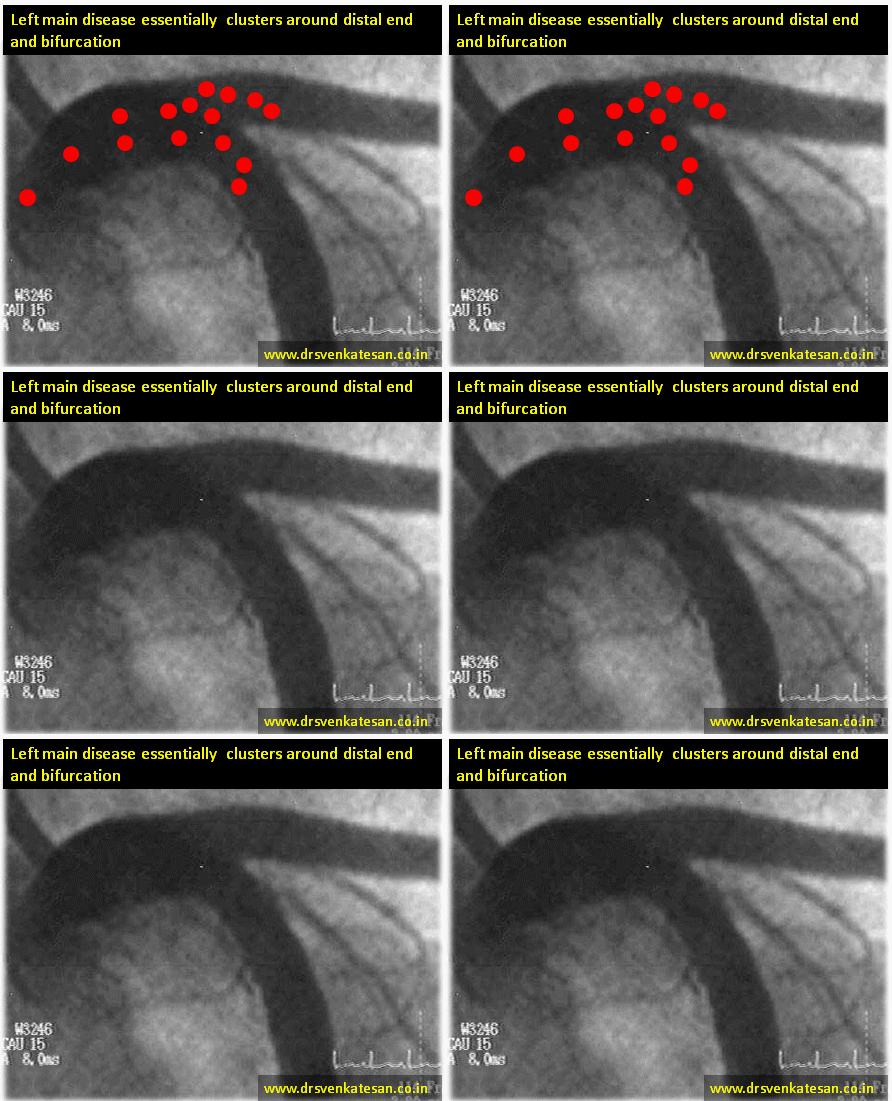
We do know about left main equivalent . Do we have a proximal LAD  equivalent ?

Proximal LAD lesions deserve a special attention and probably urgent intervention. Medical management is not an option in most  patients. (Proximal alone is not suffice , it should be critical as well )

But we have another issue on hand .What really is proximal LAD ? .

  1. First 5 Cm of LAD ? (LAD normally measure about  15cm so 1/3rd becomes proximal .How logical it looks  isn’t ?  )
  2. Before any  S1 or D1 ?
  3. Before any major S1 or D1 ?
  4. Septal branch is not considered at all  . A lesion is said to be proximal if it is before a major D1
  5. Some others may argue if there are  three major branch  distal to lesion it should be considered proximal.

Proximal LAD equivalents .

LAD first or second   bifurcation  lesions ( Medina1 1 1 , 1 1 0 , 1 0 1)

Mid LAD lesion with major D1 ostial  lesions

For  a super-dominant LAD  even  mid segment  lesion  can  be a   proximal equivalent (By area at jeopardy )

If LAD is giving collaterals  to LCX /OM  /  due to  associated  lesions ,   LAD lesion at any level  becomes  a left main equivalent .

Read the related article in this site

Medical facts  exist in a  dynamic  fluid state . Finding the truth is often a herculean  task .Disagreeing is  easy . ( Proving  a point  may require   a hundred  experiments   . . .  but  for disproving  needs only one !)

Still , the essence of medical knowledge  is about distillation of medical facts and myths and extracting the truth.

Do  you  know  the levels of  scientific  argument ?

There are seven levels  of  arguing .

Argument , agreement and disagreement are central to the growth  of science  especially so in medical science. It can vary between polite  refusal  to blunt antagonism . Graham’s levels  of disagreement  throws light  on this aspect of human intellect .

grahams grading og disagrrement argument

By default , most human brains live in the bottom of this triangle. Where  does the  medical professionals stand  in academic forums ?  I am afraid  they show  little  difference  from  that of  lay public . Ad Hominem is extremely common in medical journalism . I have  personally experienced  this from elite peers ! A paper sent from   a  third world country like India  is straightaway  rejected or regretted  without even  looking at  core content .

By  the way   . . . where do you like to  stand on Graham’s scale ?

Any structure which has a foundation on which it  stands is generally called base or basement. By tradition   base is  synonymous  with bottom .Ironically , for  heart this rule does not apply. This is the core area of confusion. The heart is a complex shaped  3D organ with multiple surfaces with  4 chambers connected  each connected to its own  great vessel .

shape of the heart base and apex of heart

We know  heart is  simply suspended by these vessels inside the middle mediastinum and  anchored  with ligamentous attachment to chest wall, diaphragm  through pericardium .

Now, traditionally the heart was thought to  be cone like stricture with  apex located near the left mid clavicular line .

base of heart apex  waht is the shape of the heart

If there is  an apex there must be a base  .So ,  we  reasoned the highest and farthest part of the  heart  must be  the base .  Paradoxically , this base is at the top ,  and  not in the  traditional sense  of bottom .

Like wise ,  during auscultation  the  events  in the base represent the great vessel  and semilunar activity  (Anteriorly )

Baseless  base

Clinical base is not the anatomical base . When a patient lies  on his back  essentially  the atria and posterior aspect of ventricles form the  base . In  erect posture the  diaphragmatic surface becomes  the true anatomical  base  of the heart .

Further confusion during  Echocardiography

It is well known , basal LV function is a critical determinant of LV function .But we should be very clear  what area we are talking about ! Basal  aspect   can  lie   either  superior , inferior , anterior  even  posterior surface  of left ventricle .(It took me years to realise this simple fact !)

Similarly   basal septum  can mean either a LAD zone or even RCA zone one has to specify basal  anterior septum to define LAD zone ischemia .

(Please note , this is contrast to clinical cardiology where  the  base of the heart refers only to anterior aspect of heart ! )

FInal message

Calling  a  particular portion of the heart as base  would be an  anatomical misnomer . This  nomenclature is based ,  more  by  tradition and  our faulty  perception .(As visualized   by anatomists and pathologists )

We have come a long way  from the Da Vinci  days. Modern cardiologists  with  sophisticated imaging techniques would like to  call  the basement of heart  differently  in the future and correct the nomenclature issues.