Feeds:
Posts
Comments

Posts Tagged ‘cardiology’


                            Amlodipine , the most popular anti hypertensive drug  used world wide has an very important action on coronary blood flow.When nifedipine was introduced three decades ago it was  known for it’s powerful anti anginal properties. Subsequently  amlodipine was introduced with almost similar action. But over the years, amlodipine was projected primarily as anti hypertensive drug and gradually many of the physicians are made to believe it is a drug that  should be used only if the blood pressure is high.The fear of reflex tachycardia in few was exaggerated.


                              In fact a cross section of  today’s general physicians were queried  about amlodipine  and none of them acknowledged  using this drug as an anti anginal drug. And few of them went to the extent of withdrawing amlodipine if it was used for the purpose of angina relief !

Why amlodipine’s  anti anginal action is in doldrums ?

The single word answer is unfortunate!   Marketing bias ,coupled with  the fact  that mainstream cardiology texts have ignored this aspect.

Final message

                                    Amlodipine , can still be used as a antianginal drug especially  in a patient who has angina with associated bradycardia  , significant LV dysfunction . Some reserve amlodipine and nifedipine exclusively for vasospastic angina where beta blockers alone are theoretically contraindicated .

Read Full Post »

.

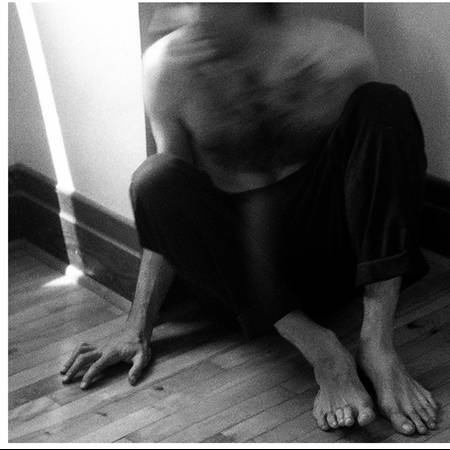
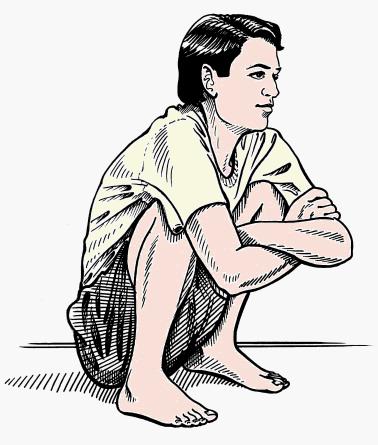
It is a well known fact squatting is a simple compensatory posture adapted by children with cyanotic heart disease during exertion to get relief from breathlessness. The children with tetrology of Fallot and related conditions have baseline hypoxia due to right to left shunting .This gets aggravated during exertion. Squatting promptly relieves this exercise-induced worsening of dyspnea. The oxygen saturation improves immediately after assumption of squatting posture. The exact mechanism by which squatting relives the dyspnea is not clear.

Apart from squat induced po2 raise there is a fall in the concentration of pco2 and raise in blood Ph that pacify the sensitive respiratory centers,thereby bringing down the tachypnea
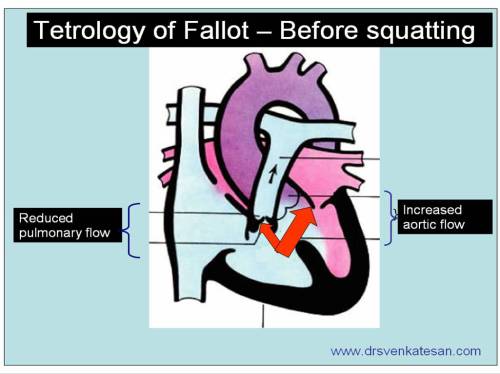
Hemodynamics of squatting has two phases

  • Immediately ( First 15 seconds) after squatting there is a sudden drop in venous return.
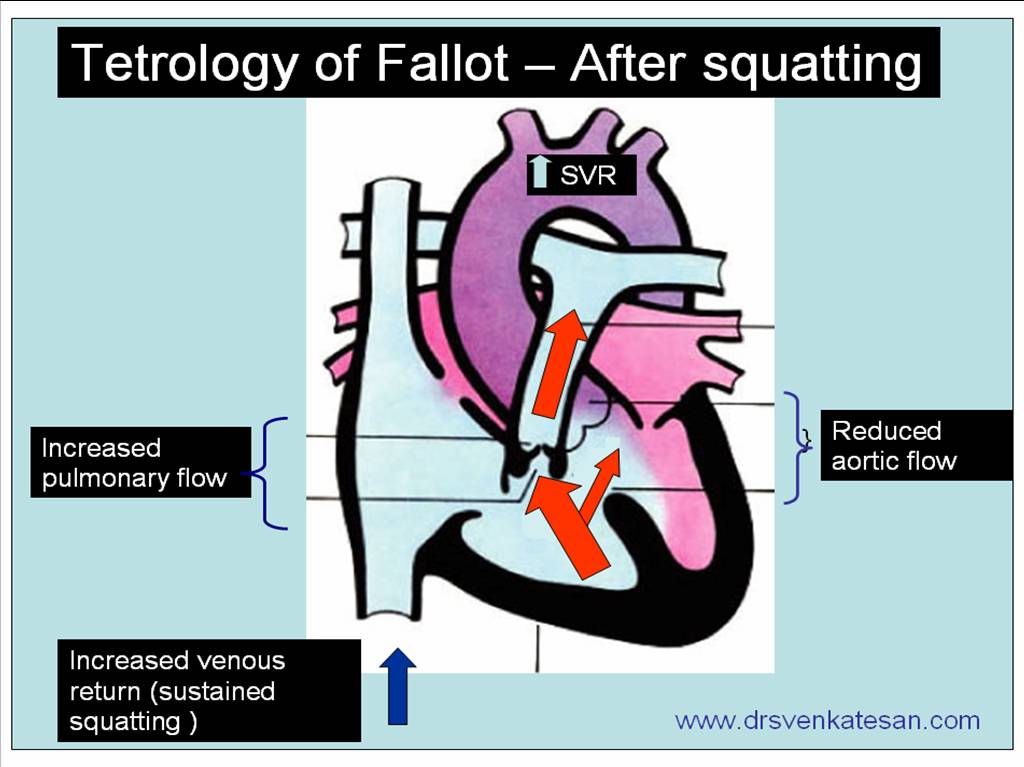
  • Sustained squatting for 1-2 minutes result in steady increase in venous return, raised systemic vascular resistance.
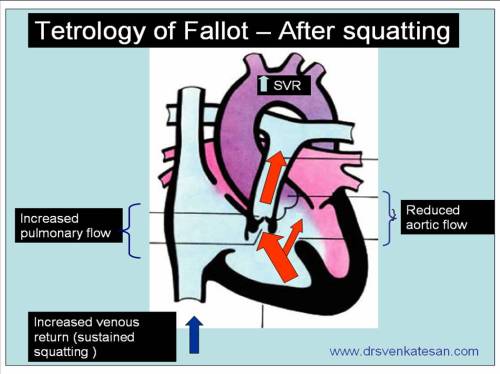
Both these effects help the children with TOF. The initial trapping of highly desaturated blood in the lower extremity gives a quick relief as soon as the child assumes this posture. In the next 15 seconds or so the systemic vascular resistance increases and bring the aortic after load sufficiently high to divert the blood into the pulmonary artery.

The net effect of squatting is there is a transient or sustained (as long as child squats) increase in pulmonary blood flow and this is made possible by the relative reduction of right to left shunt as the aortic and systemic resistance is raised by this posture.

Other explanations

There is one more possible effect of squatting. By, compressing abdomen (Knee chest) cause a mechanical push on the splanchnic blood pool into the aorta which has high o2 saturation. This is thought to provide immediate relief to brain hypoxia and avoid the vicious respiratory/ hemodynamic cycle

What is the clinical inference from squatting in cyanotic heart disease?

Squatting implies there should be a large VSD, associated with a delicate right to left shunting very much dependent on the degree of pulmonary stenosis or ( any RVOT obstruction) and the systemic vascular resistance.

How common is squatting history in pulmonary atresia with VSD ?

It can occur with collaterals are sparse.The mechanism of relief is slightly different.

The likely mechanism of relief with squatting in Pulmonary Atresia, VSD is two fold.

1. The Initial relief is due to trapping of deoxygenated venous blood in squat posture, which is similar to TOF

2.The sustained benefit is due to raised systemic vascular resistance which favors more flow across MAPCAs from Aorta.

The second one has no authentic reference , but its a hemodynamic plausiblity as there is zero RVOT flow in PA with VSD.

What are the other cyanotic heart diseases in which squatting is reported ?

  • Tricuspid atresia
  • Double outlet right ventricle with pulmonary stenosis
  • Any combination of large VSD and RVOT obstruction
  • Rarely in Eisenmenger syndrome*10%)

*Mechanism of squatting episodes in Eisenmenger is tough to explain. But, it does give relief. The most plausible mechanism is the raise in SVR with squatting tilts temporarily a favorable QP/QS as PVR -SVR ratio falls .(Venous return component doesn’t operate here as in squatting of TOF) It should be noted squatting is mainly reported only in VSD Eisenmenger.. ASD/PDA -Eisenmenger is extremely rare or doesn’t occur. This is understandable as Interventricular communication has to be present to shift in QP/QS with a response to a rise in SVR.

Squat equivalents

Assuming a squat position has cultural issues. Grown-up children may avoid these public places. Standing with legs crosse is a common posture. In fact, the mother holding a crying baby in a chest with knees folded promptly prevents a spell . This can be called “squatting by proxy”

*Though squat equivalents do give relief from dyspnea they are given less significance in terms of diagnostic value of TOF

Reference

1.Paul R. Lurie ,Postural effects in tetralogy of Fallot The American Journal of Medicine Volume 15, Issue 3, September 1953, Pages 297-306

2. Warren G. Guntheroth. M.D.Beverly C. Mortan. m.Venous return with knee-chest position and squatting in tetralogy of Fallot American Heart Journal Volume Volume 75, Issue 3, March 1968, Pages 313-318

Read Full Post »
                                                    

                                                             Syncope by definition is a transient loss of consciousness due to cerebral hypo perfusion and loss of muscular tone, and the patient falls but  recovers fully and gets up either assisted or spontaneous.The cardiac and vascular counter response to syncope is most often intact .This makes syncope characteristically transient . If a patient does not recover from syncope it could either be a prolonged loss of consciousness( Stroke etc)  or if he never gets up he will be called a victim of cardiac arrest or  a SCD ! (Sudden cardiac death ) . So technically by defintion ,  all  patients  will  have to  survive  the  syncopal episode.

But the following questions need to be answered   

  1. How prolonged  a syncope can be ?
  2. Can syncope lead onto  sudden cardiac death ?(SCD)  
  3. What are  life  threatening syncope and non life threatening syncope ?                           

What is the link between, syncope and SCD in patients with ventricular arrhythmia’s ?

Some case of long QT syndromes could be life threatening especially in children as they inherit sudden death. A patient with a non sustained VT  may develop syncope  if  the  VT  becomes sustained especially  if there is underlying heart disease and LV dysfunction . Among this  few , may degenerate into ventricular fibrillation and patient may die.  

How common is syncope in acute myocardial infarction ? 
 Syncope is a very  rare presentation of acute myocardial infarction. 
 
Can syncope precipitate  or precede a  cerebro vascular accident  ?   


Prolonged syncope , TIA,  stroke in evolution and completed stroke   can be a continuous spectrum in patients with carotid and cerebrovascular  disese . But when a syncope evolves in to a stroke the   patient is not considered to be a victim of syncope but  they enter the stroke protocol.

There is a big list for the causes of syncope

But to put it simply

A.Cardiac

  •    Purely electrical ( Arrhythmic- Brady, Tachycardia)
  •    Mechanical( Valvular obstruction, and other structural heart disease etc)

B. Non cardiac

  • Vasovagal (Commonest 90% of all syncope)

C. Metabolic*

  •  Anemia
  • Hypoglycemia
  • Hypoxia
*Metabolic causes  coupled with simple  vaso vagal(Neuro cardiogenic)  constitute the bulk of causes of syncope .Siezure disorders are very  common and a close  mimicker of syncope and need to be ruled out.

How to work up  a patient with syncope ?

                   First ,  one need to confirm  it is indeed a syncope . If the initial examination is not clearcut   one  need to  go back to the  history and ask for  circumstances under which the syncope occured  and  details of prodromal symptoms  if any . Patient’s  family members who witnessed the event can give useful information . It  is the most  cost effective ( Comes free of cost infact !)  investigative tool available .Cardiac syncopes are usually sudden, vasovagal often have environmental or emotional factor. Apart from routine investigations , ECG, Echocardiography, holter are done generally, head up tilt test, Loop, event recorders may be reuired in few.

Final message

                                          Syncope is one of the common symptoms in cardiology and  general medical practice. Many times the diagnosis is easy . Common syncope is  never fatal but , ruling out dangerous  tachy and bradyarrhythmias is a key aim.  In a significant number (20-30%) identifying the cause could be really  difficult and  may never be made in spite  of the modern diagnostic tools. These syncope of unknown origin is grouped along with the neurocardiogenic category.

The one,  positive thing about syncope is (unlike chest pain) , it is rarely fatal in it’s first episode ,  gives the physicians to  investigate and correct the underlying problem.

Read Full Post »

                                 The pleura and pericardium are very close anatomical companions within the thorax. Both contain minimal levels of physiological fluid.  It is quiet common to find combined pleural and pericardial  effusion. While the commonest explanation for combination of pleural and pericardial effusion is inflammation of both  in systemic disorders like polyserositis or malignancy . In cardiac failure also both effusions can  occur explained by raised venous pressure.

But there has always been a curious relationship between these two spaces.

                         Is there a antomical or physiological link between these two spacs ?  In fact a large pleural effusion some times result in sympathetic pericardial  effusion.  Tapping of pleural effusion may regress this pericardial fluid as well.

                         This is purely a clinical observation and needs an explanation .It is  believed , there is  some  non functional lymphatic channels shared between pericardial  and pleural spaces.This may get opened up in pathology of either of them.


Read Full Post »

Differential response of thrombolysis between left and right coronary system

  • Thrombolysis is the specific treatment for acute myocardial infarction. ( Privileged few , get primary PCI))
  • Failed thrombolysis occurs in significant number of patients ( 30-40%).
  • Persistent ST elevation  120 minutes after thrombolysis is best indicator of failed thrombolysis.
  • It has been a consistent observation  failed  thromolysis  is more frequent in anterior   or LAD myocardial infarction.

In a simple study we have documented  patients  with inferior MI  rarely had persistent ST elevation and thrombolysis  was   successful in vast majority  of  patients  ( Except in few patients associated lateral MI)


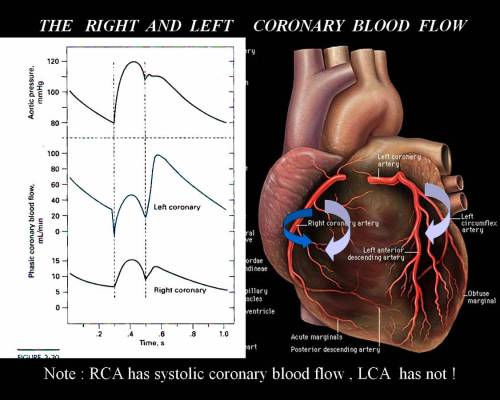
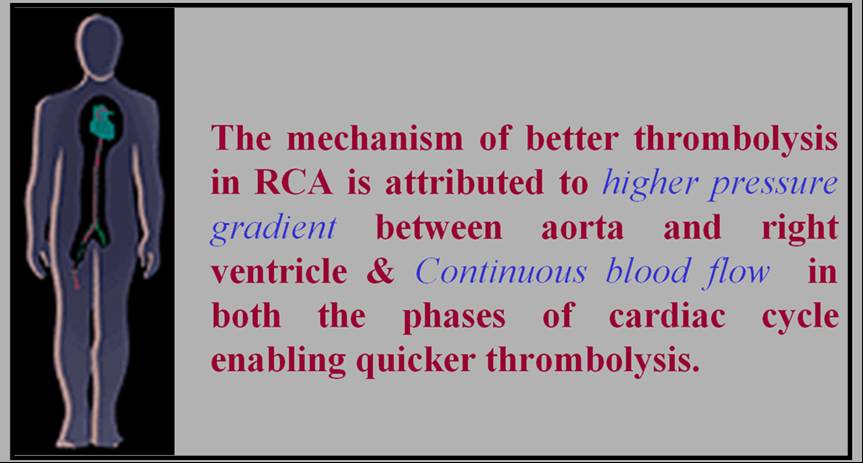
The mechanism of better thrombolysis in right coronary artery  is simple.The success of thrombolysis , apart from early time window , is directly correlated with pressure head  and the duration of contact between the thrombolytic agent and the thrombus. In right coronary circulation the  blood flow is continuous ,  occurs  both in systole and diastole that facilitates the maximum delivery of the thrombolytic agent . Further there is a favorable  pressure gradient  across RV myocardium  as the transmural occluding pressure across RV is considerably less then LV myocardium.

This paper was presented in the  “Annual cardiological society of India scientific sessions”

at Chennai, Tamil Nadu.India December 2000

Click to down load PPT full presentation

Read Full Post »

                              Cardioversion with DC shock  offers immediate cure in many of the dangerous ventricular and atrial tachycardias.  It is often  taught ,  any hemodynamically unstable tachycardia  refractory to  medical therapy respond to electrical cardioversion.  One should also  remember electricity is in fact be called  as a drug !  and it should be delivered in proper form and dose. Here it is the paddle size, paddle position and the axis of current flow all are important. Now we have bi phasic currents for better efficacy.

                             While it is true, most of cardiac arrhythmias respond to shock,  there are few which do not respond or respond very transiently.There are few arrhythmias  in which ,DC shock is not only ineffective but may precipitate a ventricular  fibrillation.

                            Generally arrhythmias of reentrant etiology respond well to DC shock were interuption of  electrical circuit by external current is easily possible. In arrhythmia’s of enhanced automaticity ,  and ectopic tachycardia  it is difficult  to extinguish  the tachycardia focus with DC shock .

Arrhythmias where DC shock is not going to work are

A. Mutifocal atrial tachycardia(MAT)

B. Digoxin induced arrhythmias.Patients who are on digoxin,  has  enhanced ventricular  automaticity.These patients if they  get a DC shock will unmask the  ectopic foci.

C. In elderly with atrial fibrillation and sinus node dysfunction it may be dangerous to shock them with out temporary pacing support as sinus node goes for prolonged sleep mode.

D.In electrical storm with VT ,  if more than three shocks are required within a minute,  the VT will most often going to be permanent and the  electrical therapy can be termed as a failure. These patients will require intensive pharmacological management( Including magnesium, bretyllium etc)

E. And finally , sinus tachycardia (whatever the rate)  is an absolute contraindication for DC shock.

 Verapmil is often effective in MAT  but correction of hypoxia and acidosis may be critical.For digoxin induced arrhythmias phenytoin may be tried.

What to do when the DC shock fails?

  • It will be a  tricky situation and one wonder what to do next when the so called  universal antidote for cardiac arrhythmia fails !
  • Cellular internal millieu  is altered  by hypoxia and acidosis .It may prevent the  effectiveness of cardioversion.So try to correct them .
  • Over dirve atrial  pacing  is one option for automatic tachycardia.
  • And now ablation of arrhythmic focus is possible with radio frequency waves  in some of these patients.( Diffiuclt as an emergency procedure)

Read Full Post »

                                  Indication for thrombolysis in ST elevation MI  is mainly determined by clinical and ECG features. ST elevation of more than 1mm in two consecutive leads with a clinical suspicion of acute coronary event demands immediate thrombolysis.

                                 Early repolarisation syndrome(ERS) is a  is typical mimicker of STEMI . In ERS , ST segment elevation occurs in many leads especially precardial .This entity is estimated to occur in nearly 3-5% of population where a genetic variation in the potassium channel activation is reported.

                              If they  land in ER with some sort of chest pain , chances are high for labelling  them as ACS . It is not uncommon for  CCU physicians  to  witness  an  ERS being lysed . Even in many of the land mark trials (ISIS ) there has been many inappropriate thrombolysis , recognised later on.

What can really happen if you thromolyse them inadvertently ?

Generally nothing happens . But they are exposed to the risk of thromolysis. The ECG changes persist. And troponin will be negative and  echocardiogram will not reveal any wall motion defect.

Are we legally liable if a patient  with ERS was thrombolysed and he ends up with a bleeding complication like stroke ?

                        While the physician may feel guilty , there is no reasons for him to feel so.The guidelines are kept little lineant  for  the indication for thromolysis. When we are promoting  a strategy of early  thrombolyis  on a population based approach  in STEMI ,  there is bound to have a overlap with normality .The benefits out of early thrombolysis for eligible  patients for outweigh the few inappropriate thromolysis.

When you want to catch  a   real criminal  it is unavoidable,  one gets hold of all suspected criminals before letting them free . Unfortunately  in this exercise , some of the innocent  might experience   intimidation or even a injury  at the hands of law enforcers.

                               Similarly if a patient with ERS develop a severe esophageal spasm and typical  angina like chest pain he is absolutely certain to receive thrombolysis. (Troponin, CPK come later , and the results never veto the clinical and ECG criteria ,except probably in LBBB) .Many times critical  time dependent decisions are prone for errors in CCU.   So it may be  unscientific to ask why an ERS was  thrombolysed !

 How can one prevent inadvertent thrombolysis in ERS ?

                            Always ask for the previously recorded ECGs .If it is available and  look exactly similar to the current ECG  chances are unlikely  for ACS. In ERS ST segment is generally concavity upwards . ACC/AHA  guideline for STEMI  ,is  aware of this fact , but still  advices thrombolysis for all ST elevation irrespective of the morphology of ST segment elevation. This is propably intentional,   not  to incorporate morphology cirteria of ST elevation  for thromolysis .It would potentially  make many true STEMIs  diagnosed falsely  as ERS and deny thrombolysis.


What is the latest news about ERS ?

                       Now data are coming up, ERS is not entirely benign condition.Some of them ( Even a fraction of ERS population could be a significant number) can have a overlap between Brugada syndrome and they  could be prone for dangerous ventricular arrhythmia when challanged with ischemic or other stress.

Read Full Post »

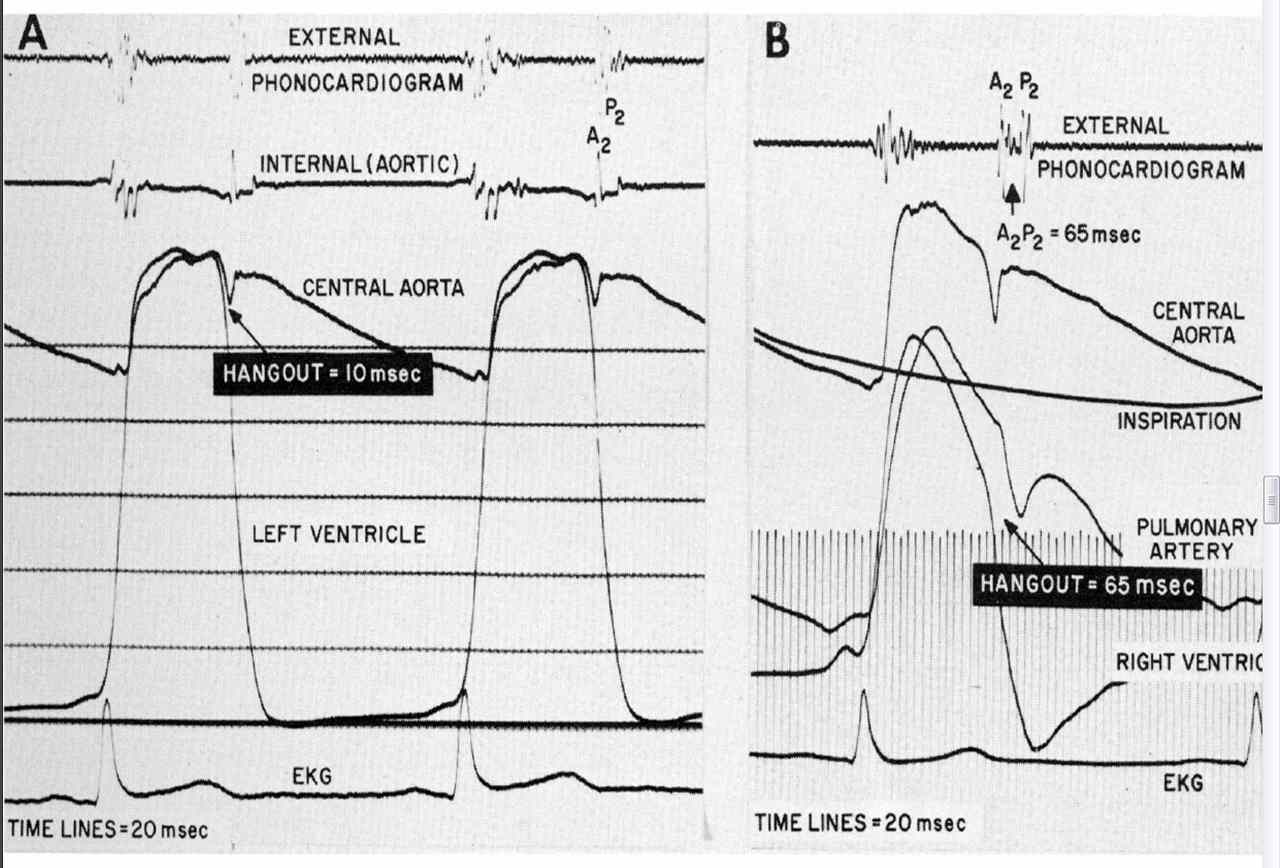
The pressure tracing between two chambers of the heart are distinctly different .

 Apart from the magnitude of the  pressure ,(LV at systemic pressure ) The morphology also changes.

  •  RV pressure curve is triangular in shape,
  •  Upstroke is not rapid , (Low dp/dt)
  •  There is no sustained peak ,
  •  There is an early fall and
  •  The pressure falls to zero which  never happens in LV.

Contary to this LV pressure curve is bullet shaped,  with a rapid upstroke, sustained peak, fall later, and does not touch zero.

RV/LV pressure curves in normal persons .Adapted from , Curtiss 1975 Circulation

Note : The shapes of RV curve will change in pathological states.Example in TOF, large VSD there will be left ventricularisation of RV pressure wave forms. Also  in pulmonary hypertension RV pressure may mimic a LV curve.

Read Full Post »

                                       Left atrium is the posterior most chamber of the heart.  It is almost a mid line structure.  The normal size of left atrium is about 4 / 4 cm. Normal left atrial volume is 46ml in men and 38 ml in women .(Atrial volume in a normal adult population by two-dimensional echocardiography Y Wang, Chest, Vol 86, 595-601.)  Left atrium  is not an easy chamber to identify in the  X ray chest as it does not form  the cardiac border.( Except a small circumference of left atrial appendage.(LAA)

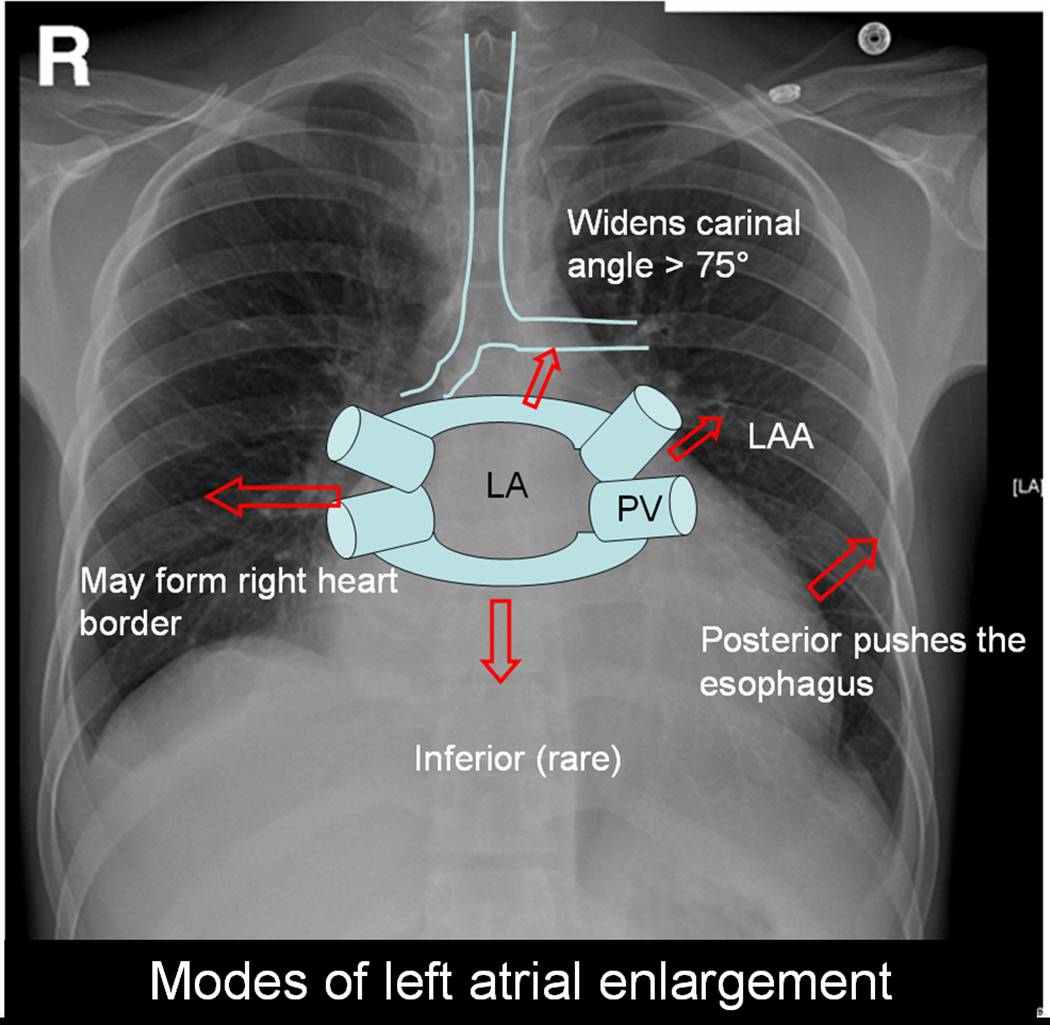
Left atrium can enlarge in multiple directions.Generally it dilates in the path of least resistance.


  • It is believed left atrial appendage  enlargement occur early .  LAA enlargemnet seen as a fullness beneath the pulmonary artery shadow. It may be the earliest finding of LAE in X ray. ( This may appear as straight left heart border , as in classical  mitral stenosis where MPA is also enlarged). The LAA enlargement is not necessarily in  in proportion  with LAE.
  • LA could  also enlarge posteriorly by pushing the esophagus towards the spine.This is visible only in barium swallow.
  • Then LA can enlarge either to left or right ( Usually towards right) and  reach the right heart border or over shoot it and form the right heart border by itself.This occurs very late in the course.
  • The other direction  LA goes on to enlarge is superiorly. When LA enlarges superiorly it hits on the left main  bronchus and lifts it.This is measured by the widened subcarinal angle which is normally less than 75 degrees.
  • LA can enlarge anteriorly  sometimes , but it is resisted by right ventricle but rarely right ventricle yields to the LA push and produce a left parasternal lift which could be mistaken  for RV enlargement.
  • Inferior enlargement can not happen in a significant way as it is limited by the AV groove and strong fibrous skeleton. 

With the advent of echocardiography X ray assessment of LA is redundant .(Academic value and in fellows training programs).The upper limit of normal LA size is around 4.5cm.

LA enlargement is commonly seen in

  • Rheumatic mitral stenosis, regurgitation. Gross enlargement up to 10 cms are common.
  • Hypertensive heart disese.
  • Cardiomyopathy, especially restrictive where both atria enlarge.

In all these conditions if  atrial fibrillation occurs  LA size increases further.

Read Full Post »

Chest pain is one  of the commonest presenting symptom  in any  hospital both as  an emergency  or non emergency. Reaching an accurate diagnosis is very important. The main  purpose of evaluation of chest pain is to recognise it as cardiac or non cardiac origin . Cardiac chest pain almost always means ischemic chest pain . That is called angina. (Of course there are few important causes for non ischemic cardiac chest pain which Will be discussed later).

Standard features of typical angina.

Chest pain which falls short of typical features are called atypical chest pain . Some recommend at least three typical features to label it as angina.
After the clinical examination patients  should be categorised in one of the following .

  • Typical angina
  • Atypical chest pain
  • Non cardiac chest pain** Non cardiac chest pain is not a diagnosis. Any physician (or a specialist)  should take some effort to localise it. (Muscle, nerve , pleura , anxiety  etc) . But  generally once these patients are ruled out of cardiac pain  they become less special and are simply referred back to their  family physician, only to return back  with  another cardiac  pseudo-emergency  in a different hospital .

    Why we are diagnosing atypical chest pain liberally ?

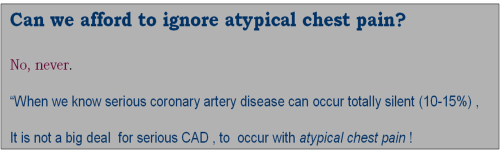
    Currently   more number of  patients as well as  the physicians  are   aware of the looming epidemic of CAD. The other major reason is the  lack of application of mind during  foirst clinical appraisal  and examination. Many of the patients with non cardiac chest pain  (Muscle, nerve , pleura )  are termed as atypical chest pain. Though some of the popular texts use atypical  chest pain  and non cardiac chest pain interchangeably , it is not  correct to do so. For example don’t ever label a  patient with chest pain with chest wall tenderness as atypical chest pain and order a cardiac work up .It  is a poor model to  emulate , that consumes time and resources!.Instead they should be diagnosed a confident non cardiac chest pain and dealt properly.

Once a patient is diagnosed  atypical chest pain what’s next ?

They should get a  complete physical examination,ECG, and  undergo exercise stress test.   In the  screening of CAD , angina can be termed a hard sign,  atypical chest pain is a soft sign,  resting ECG is surprisingly  a soft sign again (unless you record it during chest pain). Exercise stress testing is  the ideal  investigation in evaluation of  chestpain.( 70-80% accuracy). This can be improved upon by Thallium, SPECT, stress echo etc. As of now coronary angiogram is considered the ultimate gold standard (Not pure gold !) to rule out  CAD.

It is also worthwhile to remember non anginal  chest pain can also be an emergency and life threatening

  • Pulmonary embolism
  • Pneumothorax
  • Thoracic tumors
  • Aortic aneurysm (Dissection and non dissection)  The list is not  exclusive

Final message

What do we really mean by  atypical chest pain ?

In reality we don’t mean any thing !

When a  cardiac  physician is confused or rather , unable to  rule out angina , at the same time he is not confident of calling it as non cardiac chest pain,  he has the luxury of using this terminology . It is obvious  this terminology  should  minimally  be used.  Once diagnosed  these patients  can’t carry on with this tag  for long. They should be reinvestigated , (Right from history  and clinical ex) .They should either enter the cardiac work up  protocol  or  a non cardiac source for pain should be fixed  immediately.

Read Full Post »

« Newer Posts - Older Posts »