Transient ischemic attacks are not exclusive to cerebral circulation.
Many such episodes can occur in coronary circulation also .
TIA of heart PPT presentation
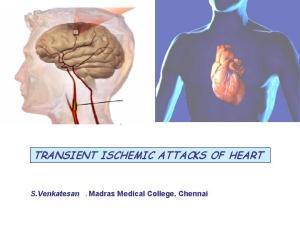
Click here to download tia-of-heart
Posted in cardiology- coronary care, My presentations, tagged angina, drsvenkatesan, nstemi, stemi, syncope, tia, transient ischemic attacks on August 6, 2008| Leave a Comment »
Transient ischemic attacks are not exclusive to cerebral circulation.
Many such episodes can occur in coronary circulation also .
TIA of heart PPT presentation
Click here to download tia-of-heart
Posted in Cardiology -Interventional -PCI, tagged acs, aorta, cardiology, cath lab, chest pain, coronary, dissection, drsvenkatesan, heart, madras medical college, nstemi, pci, stemi on July 19, 2008| 1 Comment »
Thousands of dissections happen in cath labs all over the world every day very rarely it is painful . The answer is not clear. Both have rich vasa nervorum. Aortic dissection involves media and smooth muscle . Coronary dissection may also be a equally painful , probably we are not recognising it ! or we attribute all chest pain in ACS to ischemia .
Deep dissections into the smooth muscle should be painful. Type c nerve fibers carry pain signals from heart
Answers welcome.
Posted in cardiology- coronary care, tagged acs, chest pain, coronary plaque, dissection, drsvenkatesan, interventional cardiology, nstemi, stemi on July 19, 2008| Leave a Comment »
Plaque fissure ,rupture and subsequent thrombois is the hallmark of acute coronary syndrome . Are these events painful ? We always attribute any chest pain in an ACS patient to ischemia of myocardium.Is that always true? Coronary artery also has a rich vasa nervorum that could be activated by plaque disruption.
Why we need an answer to this question ?
We are triaging patients for early invasive apporach based on chestpain .
Many patients may be subjected to revascularisation process for an non ischemic coronary pain !
Posted in Cardiology - Clinical, Infrequently asked questions in cardiology (iFAQs), Tutorial in clinical cardiology, tagged angina, angiogram, cardiology, coronary, drsvenkatesan, Heberdens, LAD, nstemi, RCA, STMI on July 2, 2008| 1 Comment »
How is LAD angina differnt from RCA angina ?
Can we localise the “Angina related artery ” from the the type of chest pain ?
Patients with stable angia many times have multivessel CAD. There has been some correlation with radiation of anginal pain and the culprit artery.If the angina spreads to jaw or neck it is possibleit might indicate RCA(RIGHT coronary angina) but rarely it indicates LAD/LCX lesions. if the angina radiates to left shoulder it virtually ruels out a RCA disease
Source .Braunwald 1992 Edition
Dr.S.Venkatesan ., Madras medical college. Chennai.
Posted in cardiology -Therapeutics, tagged acs, aspirin, clopidogrel, nstemi, stemi on July 2, 2008| Leave a Comment »
Aspirin confusion spreads to clopidogrel !
It all started with 75 mg clopidogrel in CURE study and others.
It went up to 150, 300, 600, and in some centres 900 mg.
No body knows how much clopidogrel optimally inhibits the platelet.
Aspirin had the same story three decades ago. It started from 40mg went up to 1200mg
and finally settled at 162mgs.
Why this confusion?
It is because there is no simple platletlet function tests available in bedside.
and also the wide safety margin of this drug.At what level clopidogrel is unsafe
is also not clear !
Answers are expected soon .
Posted in Cardiology-Coronary artery disese, tagged acc, acs, cardiology, europcr, jacc, nejm, nstemi, pci, ptca, scai, stemi, tctmd, time window for unstable angina, unstable angina on June 26, 2008| Leave a Comment »
ACS is the most common cardiac emergency . Management of STEMI is relatively straight forward. The only decision that to be taken is the modality of reperfusion. (Primary PCI or thrombolysis.) There is no need to risk stratify STEMI on arrival. All STEMI patients are considered high risk on admission. Whereas NSTEMI consists of a heterogeneous population. They need to be triaged into low intermediate or high risk categorizes on arrival.There is two management approaches for unstable angina .All high risk UA should enter early invasive strategy . And low risk and intermediate risk group will get early conservative management.
The principle of management of UA differ from STEMI in a fundamental way , as there is no issue of myocardial salvage in UA .The primary aim is to provide relief from pain and prevent an MI. So in the strict sense there is no time window in unstable angina /NSTEMI.
But it is generally considered 48 hours is the time limit for an early invasive approach.If the patient has crossed this time there is apparently no great difference in outcome for conservative and invasive approach.
Posted in Uncategorized, tagged Abxicimab, acs, coronary, drsvenkatesan, nstemi, pci, stemi on June 18, 2008| Leave a Comment »
2b -3a antagonists have revolutinised ACS management .
But the irony is Reo pro is approved for use only inside cath lab or on the way to cath lab ! when PCI is done .
If PCI with stenting is planned, then subsequently cancelled due to minimal coronary lesion or spontaneous reperfusion what will be the effect of Abxicimab on outcome ?
Message 1
Abxicimab (Reopro,Faximab)
Useful only if PCI and stenting is done.
Dont use it for regular managment of UA/NSTEMI



 Dr.S.Venkatesan MD