Feeds:
Posts
Comments

Archive for the ‘cardiology -Therapeutics’ Category

Modern  day cardiology can do wonders. It can revive a sinking  patient in cardiogenic shock with IABP , LV  assist ,   multivessel angioplasty and bring back  life . On  the other  hand  , a young man with an infected mitral valve who is put on  intensive  antibiotic  regimen   , progressively deteriorates  throws an emboli into brain ,  raise his urea  creatinine  , cardiac   failure worsens and finally succumbs .

This is a clear case of failure  of medical therapy in infective endocarditis .  It is almost certain  surgery would have saved him .

Why  the delay ?

So the question that is been debated for so long is   “When to intervene with surgery in IE”  ?

While we show extreme  urgency for ACS , the same is not shown  with IE.This is going to change in the future .Thanks to the  EASE trial (Early surgery  in  endocarditis )  This land mark study from Korea  is likely to revolutionise  the way we will look into the  problem  of infective endocarditis. It was presented in the just concluded AHA annual scientific sessions  in Orlando

This was  our  observation  too . The issue was discussed in  the year 2008 .It reminds me ,  every  learned  thought or opinion is in fact a paper  but unfortunately modern science does not accept a  fact without evidence of a  study . Until then  it remains  as a crap !

I am glad  to note   genuine concepts will some day  get ratified . Kudos to the Korean team.It is a great study to do with  many ethical issues.

Click below to read the related article

Link to EASE Trial  http://www.theheart.org/article/1313215.do

Next question  on the cards

Should there be  a time window above which medical therapy should be   deemed (Doomed !) to have  failed  , so that the patient becomes a default candidate for surgery.

Read Full Post »

  • Acute myocardial  infarction is the number one cardiac emergency .
  • About a million papers and articles are available in  medical literature about STEMI.
  • Management of STEMI when they present early is addressed by every text book.
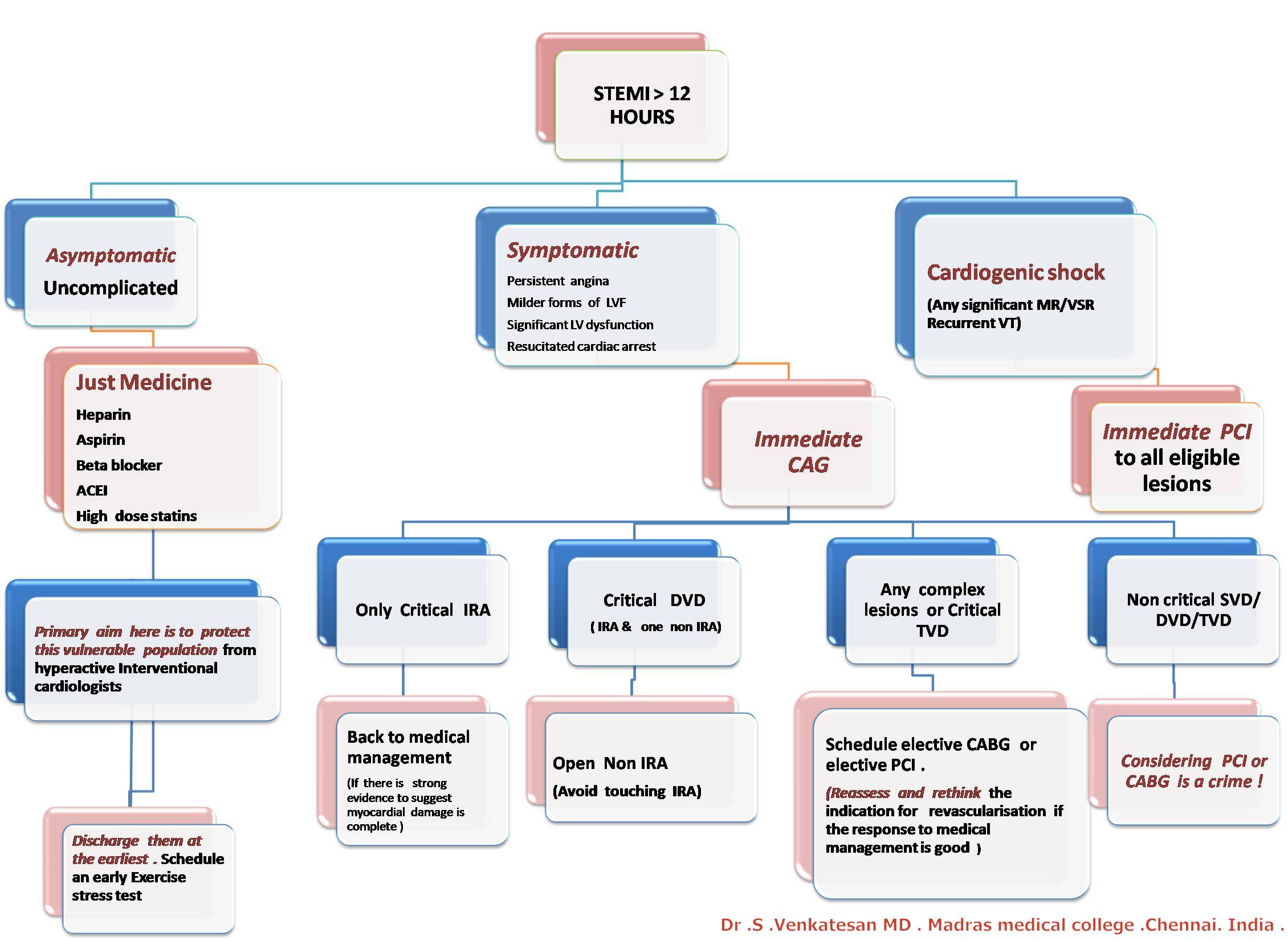
  • It is  really surprising to note there is no  simple and  specific guidelines  to manage STEMI when they present late to the ER .
  • Such a scheme is vital for physicians,  as experience suggest almost 40 % of all STEMI arrive late and are ineligible for specific reperfusion strategies.

The following  flow  chart is  exclusively meant for usage in STEMI when they  arrive late >12 hours .

This is a personalised version based on working in one of the oldest CCU in  Asia which handles  about  2000 acute coronary syndromes every year with a mortality rate of 6-7 %  Hope one can bear with it !

Please click on the chart for a high resolution Image

Comments are welcome

Read Full Post »

Mitral regurgitation is  one of  the most common lesion of rheumatic heart disease .Mechanism of MR in acute rheumatic fever is different from chronic rheumatic heart disease.

Acute Rheumatic fever

The following mechanisms contribute to MR of acute rheumatic fever

  1. Edema of leaflets (Carey Coombs murmur )
  2. Valvulitis
  3. Small verrucous  vegetations (See Image )
  4. Acute LV dilatation in fulminant cardiac failure.

* Note  : Acute rheumatic fever in its first episode can never  cause stenosis  however fulminant the fever may be  .There is no acute mitral stenosis .But ,  during recurrence and reactivation some amount of stenotic process may occur.  Still ,  recurrence and reactivation are more often related to significant MR rather than MS. ( Isolated mitral stenotic lesions  rarely  give h/o recurrent rheumatic fever )
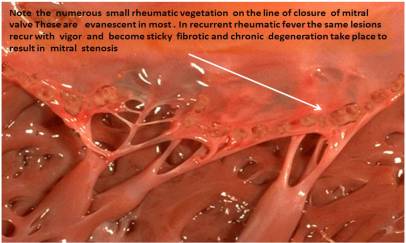
Chronic rheumatic  heart disease

As the mitral valve gets progressively damaged  any combination of MS or MR occur .The following mechanism are involved in  the genesis of MR. (Pathology of Mitral stenosis is not discussed here)

  1. Chordal shortening, tethering , pulling , prevent proper co-optation
  2. Chordal lengthening
  3. Chordal disruption (Minor > Major )
  4. Prolapse of either AML or PML (Not both ,unlike myxamatous MVPS)
  5. Infective endocardits  of  leaflet
  6. Perforations of  leaflet
  7. Annular  dilatation
  8. Fibrosis of posteromedial/Antero-lateral   pap muscle(Rare )
  9. Left atrial pathology

* The direction and the  width of MR jet is  related to the mechanism of MR.

If there is chordal shortening due to fibrosis  of mitral valve  co -optation plane is altered . The degree of chordal shortening , pap muscle fibrosis (rare)  symmetry of chordal involvement determine the MR.

Rheumatic mitral valve prolapse

  • This could be  more common than we realise.
  • It can be true or pseudo.
  • True prolapse occur due to chordal weakening or lengthening .
  • In chordal disruption the leaflet tips usually become flail

Since rheumatic process fixes the PML first , the AML   appear to overshoot the plane of PML and   appear as prolapse.(Pseudo )

The sail like AML commonly  directs the jet posteriorly and laterally .(Murmur conducted to axilla and back )

It is rare for PML to prolapse in RHD , if  it does occur ,  it directs the jet anteriorly (murmur conducted to aortic area mimic AS !)

It is rare to see a  perfect  central jet in RHD  . presence of  Central jet is a good sign to consider mitral valve repair.

Myocardial involvement in RHD.

Even though rheumatic fever is a classical  example for  pan-carditis , it is surprising   to note (Of course fortunately !)   how  myocardium escapes in the  chronic process of RHD.

Is it really true  ,  myocardium do not get involved in chronic RHD ?

Clinical cardiologists rarely discuss this issue. Pathogists indeed have documented significant lesions within myocardium  . Involvement of left atrial myocardium and  rarely  ventricular myocardium in the sub mitral  zone  can influence the  degree of  MR

* Even in acute rheumatic fever with fulminant carditis , myocardial involvement is  disputed by many  ! . My belief is ,  there will   definitely a subset  in   both acute and  chronic  forms of   RHD   , in which myocardium  gets  involved . In our institute LV dysfunction associated with RHD occur in  up to  5 % of  RHD population .

Importance of knowing the mechanism of MR

Two aspects  appear important

1. Is there a potentially  reversible component in pathology so that we can  wait  before intervention  ?

I have seen children referred for mitral valve replacement due to severe MR  . In due course   MR regress by the time they reach the tertiary center (waiting period included ) At least one child i remember,  the MV surgery was canceled  due to spontaneous regression MR.

It was later found the MR was  more of valve inflammation than degeneration .

* Always think about the possibility of reversible rheumatic MR  in every severe isolated  MR in children (Do not apply this rule in adults or in combined MS or MR  )  Do a ESR, ASO and start an  intensive anti inflammatory therapy  , aspirin with strict penicillin prophylaxis .With this  one can definitely postpone the surgery  in few cases  and  may avoid it altogether !

2. Surgical implication

If we could delineate  the  exact pathology of MR   it will facilitate  the   repair . Annular  reduction and  neo  chordae  etc . Of course ,the surgery could be  very  difficult in scarred mitral valves ,  Dr Sampath kumar *of AIIMS  New delhi , India  would  feel other wise !

*A pioneer in mitral valve repair in chronic  RHD (See reference 2 )

Questions  that need  answers

How is balloon/Surgery  related injury different from rheumatic process ?

Why is  rheumatic  mitral vale  prone for bacterial infection ?

What is the relationship  between  extent of  aortic valve involvement and  degree of mitral valve involvement in RHD ?

Reference

1.http://circ.ahajournals.org/content/94/1/73.full?sid=10599470-3563-4c38-b688-c5fc8c032f96
2. http://icvts.ctsnetjournals.org/cgi/reprint/5/4/356
Books

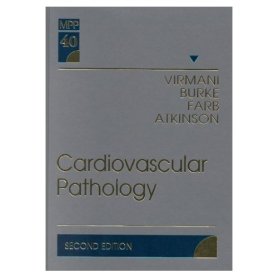
There two popular books exclusively  for cardiac pathology

1.Silver

2. Renu Virmani

Read Full Post »

Sustaining a STEMI  may be a  pathological  end  point  for  coronary  artery disease. But ,  from the  management point of view it is  actually  a starting point for CAD evaluation  .Strategies to prevent further   cardiac  events   must be formulated .

How do you manage a asymptomatic  un-complicated  post  STEMI   patient*  at discharge ?

  1. Do a sub- maximal symptom limited EST and then discharge.
  2. Advised  to come back after 2 months for a  stress test or Perfusion imaging
  3. Continue  with intensive  medical management without EST or  CAG and monitor only the symptoms
  4. Advice coronary angiogram   in all and decide depending upon the lesions (Pre -discharge CAG )
  5. I am a modern day cardiologist  . This question does not arise . . .  as I do only primary angioplasty for all my cases !

( *Please note ,  this forms the bulk of  STEMI population (up to 60 %  )

Answer : Your guess is the correct answer!

Why we need to risk stratify STEMI at discharge ?

The  morality and outcome in STEMI  though appears  to be a   continuously falling  curve ,  the slope is not linear.

The classical   mortality till discharge is about 6-8  %. Between discharge and 3oth day there is 1-2 % additional mortality

At end of first year there is  further   2 % mortality. From  second year onwards there is an annual attrition rate up to 3 %.

The aim of doing  a pre-discharge  EST is to do identify  ” patient  subset ” who are destined to die  within 30 days of STEMI.  If you schedule the   EST  after 6-8  weeks  one can not prevent these two deaths out of 100 !

( Of course ,  we assume   a prompt revascularisation in those vulnerable would prevent this !).  By doing so , we can avoid the bulk of unnecessary PCIs  that  happen  with  routine CAG following STEMI.

Pre discharge EST can be done safely  within 5-7 days  with  a symptom  limited test (70 % of  THR or up to HR of  120 /mt ) This  simple test if it is negative can virtually R/O  a  critical proximal  lesion with near 100% sensitivity.

Should we  risk stratify patients  who have undergone pPCI as well ?

Most of us  would love to believe ,   once  pPCI is  done to the  patient , he  reaches  a therapeutic end  point. But  it is not the truth . It is  the degree of  LV dysfunction ,  extent of contrary coronary lesion  ,   co existing risk   factors  and  the  intensity of medical treatment  only  would  determine the long term outcome.

It is very important to  realise  the pPCI is aimed at opening the IRA  and other lesions are  often left alone. So never  believe  pPCI   per se  would confer total risk reduction following a STEMI  .  There is considerable evidence to suggest  the opposite may be true at least in high high risk pPCI  ,where  metals are   placed  in  complex ,   vulnerable thrombotic milieu.  Hence it  seems logical  to risk  stratify  all patients   after primary PCI   (In fact, this population require  more vigilance )  .

When will you advice an  EST following  pPCI ?

It is usually not needed in the immediate discharge phase in single vessel disease which  would have been  tackled during pPCI.In multi-vessel CAD , where  only the IRA was tackled during pPCI  ,the same guidelines that of  thromolysed  STEMI shall apply  .Since we know the coronary anatomy already ,  EST helps us to evaluate the hemodynamic status of non IRA lesions if  there are any  . While ,  this is a  logical debate , logics has a rare place in medicine . It is ironical ,  stress test   is rarely  done  even after 6months following pPCI  in most centers.

Final message

It is  a  pity  ,  anatomical risk stratification  has squarely beaten  the scheme of   physiological risk stratification in most cardiology centers . A pre -discharge EST* was a  good concept that gave us an idea about the coronary reserve  after the ACS.  It was a collective wisdom of cardiologists  that has hanged this useful concept.  It is still more shocking ,  to note even the  scheduled  6 week   EST is  dropped from the  post MI work up in some  institutions.

* Many would consider  ordering an early EST in STEMI is an act of bravery ! The fear seems to be genuine   and most will agree with that.  But , please remember a physiological test  (Cheapest and simple is EST or a  Nuclear perfusion )  should precede  CAG  in all  asymptomatic  post STEMI  population  whenever possible . If  EST could not be done  prior to CAG for some reason   , at least do it following the CAG . It  will have  an  important impact  on the downstream decision making  which is often an  inappropriate  PCI  !

Read Full Post »

What is  the most important factor that  will decide  the revascularsation following a  STEMI  ?

  1. Patient’s  symptoms
  2. Residual Ischemia documented by stress  test /Perfusion scan
  3. Presence of  significant  LV dysfunction
  4. Coronary anatomy and lesion profile
  5. Wealth  of the  patient (Insurance  limit  and  other  financial  resources )

Response  2  is   academically correct ,   but    practically  and politically   response 5  would be   the right one  for most cardiologists . At  any given day  ,  affordability and availability  of PCI  will prevail over all other factors  .

Affluence based cardiology

Image courtesey : Jupeter images

What is the  height of  inappropriateness in modern cardiac care ?

This world will never forgive the medical profession , if they do not fight  against  grossly inappropriate medical  care system especially in the life saving situations  .While one  cardiologist    just watches   a  left main disease patient  with unstable angina die peacefully in a Govt institution ,  while  another  patient with asymptomatic  distal PDA lesion gets a 3rd generation drug eluting stent in a  nearby corporate hospital !

Please note : Harm is the ultimate outcome in both rich and poor.One suffers with non availability while the other is the victim  of   affordability .

Read Full Post »

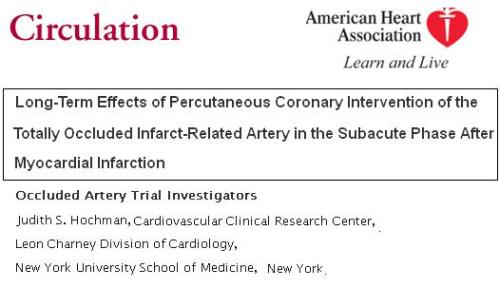
The  OAT   extension study  ,   a  6 year follow-up study on total occlusion following STEMI has just out in circulation 2011  October , online first . http://circ.ahajournals.org

There were two  important conclusions  from this study

  1. Long term follow-up  to  6 years  confirmed  the  lack of benefit of routine PCI  in  post MI total occlusions.
  2. Inappropriately   done  PCIs convert   stable coronary occlusive  disease into potentially dangerous subsets  with  risk of re-occlusion (Which  could  very well be an acute coronary syndrome )

The second one is  of critical  important than the first  .In a nut shell ,  it  suggests  routine PCI in  CTOs  could  increase the   risk of ACS many fold in other wise stable patients.

Final message

This OAT extension study  should  not experience the same fate  of  COURAGE and OAT -1  which  were  successful bitten and buried  by most  interventional cardiologists.

This time they   have to  swallow  the  unpalatable truth ! If they don’t ,  our  patients  would be the ultimate  losers and

will pay the  price dearly !

Personal foot note :

One of my colleague asked me  . . . Why am I  always  after the Interventional   cardiology  community !

I said ,  it is not my job to pull down any one group.  I am just exposing   the  irony of  “selective usage” or “selective  neglect”   of scientific  data by many of us !

Read Full Post »

Q : Beta blockers reduce  blood pressure mainly through

  1. Reduction in Heart rate
  2. Reduction in cardiac output
  3. Negative Inotropic action
  4. Vascular sensitization to circulating catecholamines
  5. Blocks  Renin secretion and  reduce vascular tone.

Answer : (May be  4 as well !)

Our understanding of beta blocker’s  action  in SHT has changed considerably over the years .The  negative inotropic action on the myocardium  attributed for BP reduction ,  is no longer considered  important . Now we know , beta blockers can  reduce peripheral vascular resistance significantly.(There were days , we presumed  the opposite to be  true ,  ie when beta blockers are blocked , alpha action will overshoot to cause excess vascular resistance ! ) This  is more of  perceived fear.  This concept was never proved convincingly even in the  dreaded  Prinzmetal  angina* where beta blockers are  relatively contraindicated for fear of  aggravating vasospasm.

*Note : This is may  still be valid in selected few  who  show a  tendency for  Raynaud  phenomenon especially in peripheral vascular  system.


Additional  factors   influencing  beta blockers in SHT

  • Suppression  of  central adrenergic drive  ,  modulation of   brain stem vasomotor centre  are aslo considered vital . This action is linearly related to the ability of beta blockers to cross the blood brain barrier which is more with lipophilic drugs like metoprolol.
  • The role of beta blocker in isolated systolic hypertension in elderly  is unique.Here it reduces the myocardial dp/dt (ie contractility )  and hence help them prevent  systolic spikes of pressure and the resultant  stroke.
  • The newer  vasodilating beta blockers  like Nebivolol, (Nitric oxide mediated ?)  and Carvidilol may have additional advantage in controlling BP.
  • It needs to be appreciated , beta blockers combine well with  diuretics like  hydrochlorthaizide  .This  makes it easier to control severe forms of HT  especially volume dependent ones in  both young and elderly. (SHEP trial )

Final message

The modification of vascular response to catecholamines  is  the single most important mechanism of reduction of blood pressure.

This may be a direct consequence  of  1.  Blockade of  vascular  adrenergic receptors . Indirectly  through suppression of  Rennin secretion.

Read Full Post »

We know primary PCI is a race against time  both for the  patient  and his  physician.

What is the upper limit for this unique race where the stakes  are high   and it involves  human lives  and  big  corporate  warfares  ?

  1. 6 hours
  2. 12 hours
  3. 24 hours
  4. 36 hours
  5. 54 hours
  6. Time does not matter . You can do a PCI as late as possible as long as  patient has sufficient insurance coverage and we have the expertise

Answer :

Please note there is  only one exception  . Cardiogenic  shock has been given a extended  lease of time window (Which can be technically up to  54 hours ) . PCI can be performed   if the onset of shock  is   within 36 hours  of STEMI  and to be performed within  18 hours after the onset ! )

* Even though we  have a  well set criteria for re-perfusion which bans primary PCI to be performed after 12 hours , cardiologists have enough technicalities to overcome this hurdle and keep doing the futile pPCI well after 12hours.

How they are   able to indulge in these futilities   without  any ethical issue ?

The answer  is very simple. Instead of calling it as primary PCI they refer to it as delayed PCI or rescue PCI !  Strict time specific guidelines are only for primary PCI . By changing the terminologies they   make a mockery of the concept of time window which  is vital for any intervention for STEMI !

Read Full Post »

Success of primary PCI is defined by  different yardsticks  by  different  cardiologists  , in different  institutions !  But , for the patient and his family,  getting  discharged   alive with out symptoms is a huge  success !

They  do not bother  even if they are charged  Rs 3-4 lakh for their stay ,  as they  believe  surviving  a heart attack  is a God’s grace   rendered thorough the hands of  the doctor.

But we know  the real success lies elsewhere. Cardiologist’s   perception of   success of  pPCI   should be based on scientific concepts. Unfortunately many  physicians  continue to  think like  their patients  . This  tendency to get self gratification  with a patient’s  frame of  mind is  common  and  needs  introspection .

This is esepcailly  true for primary PCI . It came with big fanfare  a decade ago . Soon ,many cardiologists developed  a habit  of criticizing   the  practice thrombolysis for STEMI .If primary PCI is such a superior modality  every patient   should be prevented from significant  myocardial damage following  STEMI .

Primary PCI  may be the the most logical method  still , for reverting the STEMI process  . But “A properly performed  primary PCI  as a  concept ” lies  mainly  on paper ,  not  been  replicated in real world for various reasons.

Please remember , a successful primary PCI

  • Is  not restoring TIMI 3 flow  in IRA
  • Is not relieving  the  angina
  • Is not discharging a  patient in stable condition

Even if  . . .  we accomplish each one of the above  . . .   if   the patient  carries  home  anything  equal  to ,  or more than moderate LV dysfunction ,  primary PCI  has  deemed to have failed.

Final message

What is the reality  check ?  In one  of  the  preliminary analysis   out of 20 randomly selected  patients  who have undergone STEMI*   within 12 hours  , significant LV dysfunction  was present in  12  patients making it pPCI only 40 % successful   in real world  .( Which  would struggle to beat the outcome of  promptly administered fibrinolysis )

* Primary PCI done in state of the art institutes .

Read Full Post »

When know   statins have  revolutionised  the management of  coronary artery disease , why  we  hesitate  to  say   the same thing    for  cerebro vascular disease ?

Is it because

       Atherosclerosis is different in  cerebrovascular disease   than coronary artery  disease

 or  Blood pressure control  becomes more important in preventing stroke than lipids?

Unlike  MI ,  Cerebro vascular system   have   variety of insults.

  • Embolic stroke
  • Thrombotic stroke
  • Ischemic stroke
  • Hemorrhagic stroke
  • Low flow – Water shed infarcts

Hemorrhagic , embolic and low flow mediated  myocardial infarction are very rare and  denova hemorrhagic MI is non existent.This is due  to  the fact ,  coronary autoregulation is  vastly different from cerebral vessels. Carotid plaque stabilisation  is a  major mechanism by which statins can prevent stroke . Still , statin  therapy( however aggressive)  has less impact  in the incidence  of stroke than MI.

This meta analysis claims statin to be very  effective  in prevention of ischemic stroke.

We have observed  ,simple statin administration without concomitant BP reduction has absolutely no effect on stroke prevention,   while  in  coronary  prevention even if the blood pressure optimisation is less than the desired levels,  significant number of  MI are still  prevented.

http://www.ncbi.nlm.nih.gov/pubmed/18187070

 The  SPARCL  trial  was big boost  for   statin   industry  in widening the Indication  for stroke prevention


Final message

Does statins remain a suspect in stroke prevention ?

If we  accept the  saying   ” Data won’t lie ” . .  . the suspicion  about  statins  is  a myth.

High dose Atorvastatin 80mg /day should be prescribed for every one with at high risk for ischemic stroke .

Read Full Post »

« Newer Posts - Older Posts »