Feeds:
Posts
Comments

Archive for the ‘cardiology -Therapeutics’ Category

It was  the year 1812 ,  exactly 100 years before the Titanic sank  over the Atlantic  , a  small bulletin from  Massachusetts General Hospital was  released .  It  later on became  the  single most  important  journal  for the medical community.  The appearance of  an article about  angina pectoris in the inaugural issue ,   reiterates the  importance of cardiology  even in those   days of primitive  medical care .

The volume. 1  : No. 1  issue of NEJM egan with a classical and critical observation of angina pectoris written  by Jhon Warren .

http://www.nejm.org/doi/pdf/10.1056/NEJM181201010010101
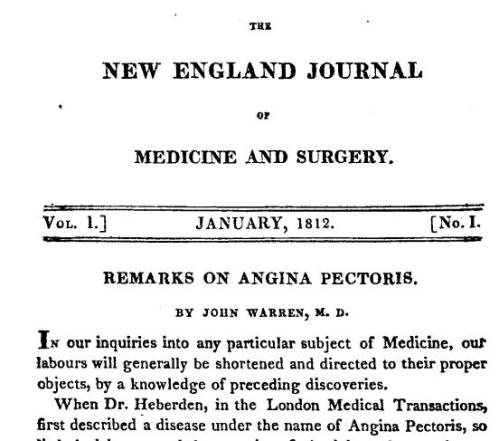
The first issue of NEJM . . . Witness to 200 years of medical excellence

Those were the days  when angina  was treated with tincture  opium and Fowler solution (Arsenic  potash ) .They  can be  termed as  height  of  inappropriateness  and  also  condemnable acts  . . .  is it not  ? 

200 years  later   . . .  in 2012  what  do you think has changed ,  in terms   of  appropriateness  of management   of angina pectoris  ?

What a surprise ,  two centuries  later ,  even as we are  treating  angina  in hi-tech cath labs  with bio-degradable stents and metabolic modulators   ,   bulk of our  population is  grappling with inappropriate therapy for angina pectoris .

Today ,patients are subjected to  questionable modalities  in the management of CAD ,  which the following paper   tries to expose !
Keeping the inappropriate flag high . . .200 years later in 2012


What a way to progress in Medicine !  The reason for this  “200 year  old ailment”  is  attributed to  extreme scarcity of common sense !

( A study , which says regular exercise  can be  as good as PTCA in multivessel CAD ,  would  sound  as a  “nonsense article”  for most  cardiologists  of  current  generation  !)

Finale

When we look  at human history , where billions  lived ( and continue to live ) in this  age old planet , it  would appear  a trivial matter  whether you treat angina pectoris with Tincture opium / Arsenical potash or  Prasugrel  / Rosuvsatin . . .

Whatever be the scientific advancement  the ultimate outcome on human health will depend on how we apply it. So, all young  medical fellows beware of this   !
Read Full Post »

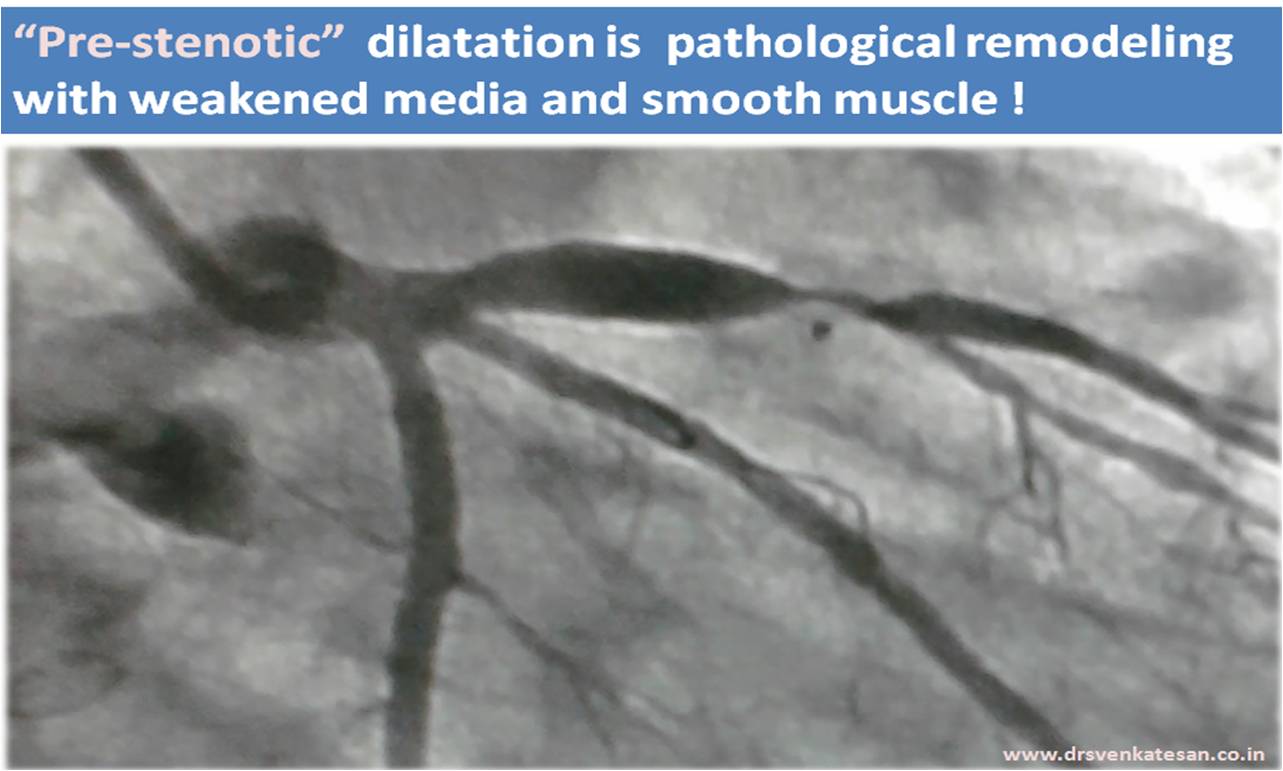
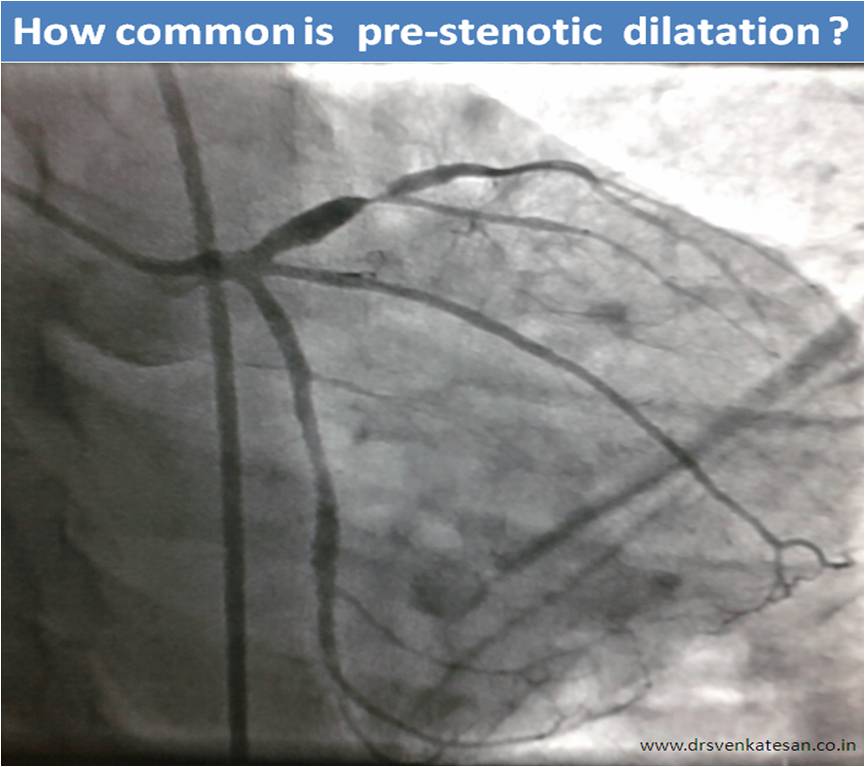
Laws of fluid dynamics dictate there is a pressure drop across   a point of narrowing  and recovery  thereafter  . At  recovery point if the vessel wall is weak it tends to balloon out .This is called post- stenotic dilatation .This is  the anatomical equivalent of Bernoulli or venturi  effect. This theoretically  occur only distal to obstruction .

How do you explain the common observation of pre- stenotic dilatation?

  • Intimal weakening due to disease process is the prime  suspect.
  • Pre stenotic  increment in mean pressure  also play a role .
  • Mechanical distention due to stagnated blood  proximal to  critical obstruction  is  a  logical explanation.
  • Finally and most importantly ,contagious , sub – angiographic  atherosclerosis.

How is  dilatation  different from ectasia ?

May be they are all related phenomenon. The definitions  of ectasia ,  dilatation, aneurysm are  more to do  with semantics than with academics.

Clinical and hemodynamic implication in cath lab

  • Sluggish  flow prone for thrombus
  • Stent selection errors likely
  • Stent dislodgment  and migration

Long term effects

  • In stent re-stenosis is more common if adjacent segment show dilatation.

Finale

Enlargement of vessel wall in both pre and post stenotic segments are possible . In small vessels pre- stenotic dilatation is  more common , while in large vessels post stenotic dilatation is  more prevalent .(Aorta, Pulmonary artery)  The mechanisms are slightly different. Apart from the lesion tightness ,  hemodynamic  and genetic factors are also responsible These dilatations are  often labeled as ectasia in coronary artery  and  most cardiologists  tend to   ignore this finding especially if  the margins are smooth.

But , newer imaging modalities like IVUS, OCT have given   better  insight about these dilatations.These   are  actually an  expression  of the  contagious  atherosclerosis .  Pre-  stenotic segments are prone for extensive disease  than even the diseased segment due to  more hemodynamic turbulence. There is some evidence atherosclerosis progresses  proximally more than distally.Smooth margins within the  pre -stenotic dilatation  does  not guarantee  disease free status.

During PCI  there could be  an  argument for covering the dilated  pre- and post stenotic segments  as well* . (We vouch for endovascular stenting when aorta is dilated why  do we hesitate  in coronary  ?)  .Careful selection of  coronary stent size  is  recommended  and  allowance should be given  for these two (Pre and post coronary dilatation ) patho -anatomic phenomenon.

* Stent missing a lesion is stylishly called geographical  miss ! This should logically include dilated segments also.

Read Full Post »

Very often in clinical  practice  cardiologists are asked to R/O significant coronary artery disease in asymptomatic persons .This population includes  people with multiple risk factors like diabetes, HT dyslipidemia  and non specific ST/T changes in ECG.

Many of us have lost the confidence of   ruling out CAD   in these population without looking at their  coronary angiogram.

Is it a right way of practicing cardiology ?

What we need to realise is,  we are asked  to rule out any critical lesions that are going to make a impact on these  other wise comfortable patients.  Nothing wrong if you miss a 30% lesion in PDA or OMs or diagonals !

Can we do this without doing coronary angiogram ?

Yes ,  we can .

Step by step  Ask these questions

  1. Ask the patient , if  he /she   can climb three  flight of  stairs  without any difficulty or
  2. Walk briskly for  20 minutes (5km/hr)

If yes , give  a   certificate   that he  has no critical  left main or proximal LAD  disease.

If you do not believe in his words , put him on a tread mill ,  if he crosses   stage  3   Bruce in TMT ( 9 mts)

give the above certificate  “with a frame”  now .

For still suspicious  physicians ,  We have  one more  investigation called  echocardiography !

Echo : The forgotten tool  for screening left main lesion.

Modern day echo machines have a  3mm resolution power (Many have 2mm ) .While ,  we are expected to look for 3mm vegetation to R/O Infective endocarditis , rarely is  a  cardiologist ,  tuned to  look for the left main ostium  in routine echocardiography  which averages 4-5mm is size. (Left main by echo link to another article)

In short axis  view just tilt at the level of pulmonary valves  (Atrio- pulmonary sulcus) one can visualise the left main ostium and the proximal left main emerging from the 4 o clock position. If you are lucky you can see the entire left main.

If nothing satisfies the physician (Or the patient)  ,Refer him for sliced CT scan , catheter coronary angiogram , or a  nuclear Imaging .Be ready for the attendant anxiety, interpretation errors, corporate  pressures , urge to  balloon ,  kick backs etc etc

By the way , how can  one  be happy by ruling out only left main disease ?  Is it not other lesions possible ?

Experience (Not science) has taught us  no  critical coronary obstruction is  possible ,  if  a patient walks for  9 minutes  in treadmill (10METS).

Even if it is there (A remote chance)  there is little documented benefit of any revascularisation procedure.

Counter point ?

Is it not a “crazy idea  to rely on patients history in ruling out  CAD   in these era , where   angiograms relayed  live  into   cardiologists  ipad  ?

Science has no value if it is not applied  for the patients welfare. Meticulous clinical  examination (And application of mind)  is the foundation stone on which  any medical investigation and therapy  should be based  upon. Most of the inappropriate coronary revascularisation are due to  neglect   of  this vital  component of clinical examination.

(I wonder ,  is it  really possible  these ” acts of omission”   be  deliberate some times  ! )

Final message

Clinical interrogation  may  miss an insignificant  CAD  ,  but it can never miss a critical CAD* .


Do not do coronary angiogram routinely to R/O  CAD.

It is not the way cardiology is to be practiced !

If only we apply  those  simple,  time tested concepts in every day practice we not only  save millions of  Rupees ,   but also thousands of futile   diagnostic tests and associated untoward effects can be avoided.

* Senstivity of  ruling out any CAD is about 70% , but it’s capcity to R/O critical CAD approaches 100%.

Reference:

Please refer your own Brain.

Read Full Post »

Management of  severe  pulmonary hypertension continues to be a difficult task .Medical therapy is not definitive, in-spite of the new prostocyclins, endothelin antagonists and  sildenafil analogues.Natural history  depends mainly on  the presence of  any treatable cause ( Especially ,connective tissue disorders)  ,  supportive management along with anticoagulation.

Ultimate  strategy  would involve a   plan  for a “Lung “or  “Heart -Lung”transplantation  , if feasible. Last decade saw an innovative modality of creating an  artificial inter atrial  shunt to decompress the right heart .This had varied response in the  real world  , still  most  showed some benefit .In fact , in 1998 the world symposium on PHT ,  formulated guidelines for BAS (Balloon atrial septostomy)

Principle of  Balloon atrial septostomy (BAS)  and mechanism of benefit

The symptomatology  of  pulmonary HT  is largely  determined by mean RA pressure .

Puncturing  the  IAS and diverting blood  flow into left atrium would decompress the RA ( or even the RV )  and reduce the Mean RAP.

The resultant  right to left to shunt  can   increase the cardiac output  only  slightly ,  still  good enough to  provide   relief from the fatigue.(Though at the cost of  desaturation.)

What is the risk involved in the BAS.

Procedural risk of  a cath study in a sick  patient with hypertensive lungs (Can be really high !)

In some patients  even a small  fall in systemic  oxygen saturation can be counter productive.

What is the balloon used ?

Mansfield or Tyshak balloons are good choices .

Balloon diameters are between 5 -14 mm

Technique

Involves standard Brockenborough needle /Mullin sheath /Guide wire in pulmonary vein.

Atrial anatomy to  be well  analysed prior to BAS  . (Please note even though it is similar to PTMC , anatomically we encounter a large right atrium rather than left atrium .)

Fluroscopy with  TEE guide optimal

Pulmonary angiogram might help.

Intra-cardiac  Echo may be  ideal.

Blade septostomy may be preferred if hardware is available

The endpoint of procedure

  • Size of ASD > 5mm
  • Fall of arterial saturation < 80 %
  • Sustained atrial fibrillation with hypotension
  • Any  disabling complication

Hemodynamic impact

  • Cardiac output increase by 750 ml to 1 liter
  • It is expected ,  RA  mean pressure  would fall at least 5mmhg from  the baseline value.
  • PA pressure , no significant impact expected.
  • Tricuspid regurgitation regresses.
  • RA,RV size marginal reduction observed.

Follow up and outcome

  1. Greatest  relief is from syncope.
  2. Functional class improvement  in >50% .
  3. One year survival benefit is substantial (75-90%)  .Beats the  natural history (40%) convincingly.
  4. Late deterioration  can occur as ASD gets closed in few.

When  BAS is contraindicated ?

  1. Critical RV failure
  2. Patient in class 4
  3. Mean RA pressure > 20mmhg
  4. Pulmonary vascular resistance index> 55 Wood units / sq.meter

* BAV should not be considered as a  live saving  procedure  in any dying patient with PAH.  It needs to be  selected early and carefully .In fact,  the very high procedural complication  rate is related to late selection of patients.

Natural foramen  PFO better than BAV ?

We do not know yet.It is highly possible  natural opening up of PFO is good thing to happen for patients with severe pulmonary hypertension.

Reference

1 . SS Kothari  et all  Indian heart journal 2002

2. http://content.onlinejacc.org/cgi/reprint/32/2/297.pdf

3. http://www.ncbi.nlm.nih.gov/pmc/articles/PMC484602/pdf/heart00028-0066.pdf

  4. http://erj.ersjournals.com/content/early/2011/02/24/09031936.00072210.abstract

Read Full Post »

Myocardial infarction is the self-inflicted ,  modern-day death sentence  especially  among the  young generation who are   addicted to the affluent life style .

We know the  cardio vascular events  are  precipitated  due to a  sudden trigger in those  people  who have a base line risk profile. The major  risk factors are ,

  • Diabetes
  • Smoking
  • Hyperlipidemia
  • Hyper tension
  • Obesity

When one or more of the above factors   progress unabated he or she is at high risk for acute coronary event .

Is that a fatal stock market rhythm !

A loaded gun  needs a trigger to fire  , similarly  in a vulnerable patient (Plaque )  any of the following can act as a  trigger to precipitate an MI.

  • Hemodynamic stress (Fall or raise of BP )
  • Any  systemic illness( fever etc)
  • Physical stress
  • Mental stress , any strong surge of  emotion (Negative or positive)*
  • Non cardiac surgery

*Anger, fear , euphoria , guilt , bereavement ,

Now there is evidence pouring in  ,   natural calamities (  perceived fear of death) can  act as trigger  for MI.

We have reports  of  excess cardiac events   following  . . .

  • Earth quakes
  • Terrorist attacks
  • Flight scares

Any events which can release  sudden pulse of adrenaline into the plaques can trigger an acute coronary event.

Now,  this study from Shangai ,  documents how the coronary events dance to the tunes of stock market movements in the financial capital of  China .

http://eurheartj.oxfordjournals.org/content/32/8/1006.abstract

Final message

Chaos theory states no two events are isolated in this world  !   When stock market swings it can  pull down your heart too .

be cautious !

Read Full Post »

The link between migraine and PFO is  . . .

  1. Incidental  & man-made
  2. Almost certain
  3. Definite
  4. A wild imagination

Answer : One of the above  is correct  , but  we do not know  which one is   !

There has been many  patients with TIAs , cryptogenic strokes , who  had  documented PFO  ,complain of prolonged  head aches . This was the beginning of suspicion of PFO as a cause for migraine .Then the device industry foresaw a huge opportunity . Things began to unfold and  the concept is currently as nebulous as it can be .

Mechanism of migraine in PFO

(All are  presumptions )

  • Right to left shunting of  vasoactive amines from venous circulation (Serrotonin)   which bye- passes  the lung where they are supposed to get filtered.
  • Venous micro emboli (Antiplatelet agents reduce migraine as well as TIA ! )
  • Hypoxia transient – cerebro vascular hypersensitivity
  • Atrial naturetic  peptide spills more into systemic circulation through  PFO

Counter arguments

  • If right to left shunting is causing the migraine , why it  is not fully disappearing even after closure of  PFO (MIST data with  starflex  device ,  migraine persisted in a significant chunk !)
  • What is the incidence of migraine in the  prototype  right to left to shunt situations like TOF, Eisenmenger , pulmonary AV fistula ?  if shunting is the mechanism , logically  migraine incidence  should be very high  in this population , but it is not .
  • Migraine occurs in 10 % of population, PFO  is present in 20%  .  What are  the chances of over lap ?  It could be the simple statistics at play !

Where is the evidence  ?  The mystery called MIST study.

This study , done in UK generated more controversy , which  it was supposed to remove  . Still  this  study is considered to be a major evidence for the link between PFO and migraine . Star flex device  was promoted by NMT medical Boston .

http://www.medscape.com/viewarticle/541260

Link to  best review article on PFO

http://chestjournal.chestpubs.org/content/130/3/896.full.pdf+html

Final message

The link between migraine and PFO can be a fact or myth depending upon our belief in current  methods of  research in  science. The issue is  debatable . Of course ,  one issue is probably  closed  forever  , even  if they  are  linked casually (or seriously )  device closure can  never be a  sensible treatment  option for migraine ! *

We  expect a  proof / disproof  in this   mysterious migraine -PFO  hypothesis very  shortly.  Of course , many  cardiologists  already  have their  own conclusions !


*Please note , PFO  device closure  for  stroke in young is a different story

Read Full Post »

  1. Left to right
  2. Right to left
  3. Can be in both directions
  4. No significant flow at all !

Answer :   Every response can be correct

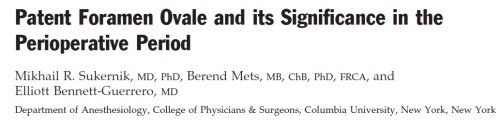
The patent foramen ovale is a physiological orifice , which  becomes  pathological if persist into  adult hood .The incidence is estimated to be about 20 %  of the population (Amounts to 100 crore PFOs roaming  in our planet!). It makes  no sense  to  believe  just spotting  a  PFO  in routine echocardiography be termed  as pathological . But recently  (Adding much to  interventionist’s  delight ! ) the presence of which is being linked with migraine and stroke in young.

The size of the orifice can be from a single millimeter to one centimeter* . The direction of blood flow in PFO   is determined by the mean gradient across the orifice. It has to be  left to right  as the LA pressure is  generally   higher by few mm mercury  ,hence there is a small  tide of flow entering into RA with each left atrial filling or contractile wave .(v and a ). This  quantum is miniscule and has no hemodynamic significance in most life situations.

* Some call( Wrongly ) 1cm PFO  as small ASD.

When can Right to left to flow occur ?

When the right atrial pressure increase more than LA pressure it is obvious  blood can enter LA . It is well-known this occurs  in any pathological situations like RVOT obstruction severe PHT , tricuspid valve obstructions etc.

Physiological  Right to Left flow :

Forced expiration (Valsalva) can cause transient  right to left flow. This  may happen in many real life situations like straining, heavy isometric exercise, blowers, muscians  etc.

Which is clinically  significant ?

Left to right or right to left  ?

Left to right shunting is rarely an issue as there is no systemic  desaturation.

Right to left  shunting  can be  important for two reasons

  1. Arterial desaturation( transient )
  2. Shifting of venous debris into arterial side  can result  in potential paradoxical embolism .(This can be air, clot fat , amniotic fluid etc)  This is the reason stroke in young is closely linked to presence of PFO.

PFOs during positive pressure ventilation

PEEP is a classical example where a right atrial positive pressure ,  shunts the blood in pulsatile manner into left atrium .

Platyponea  hypoxia  syndrome .

This is  postural right to left shunting  across PFO .It  is a less recognised (but a common entity) where -in ,  when the patient  lies down there is a  right to left PFO shunt and transient hypoxia .This is often corrected as the patient sits up. The reason being  the valve of PFO , the   door like flap  which guards  the orifice  ,  is aligned   in such a fashion , it  opens up in a  lying posture(Aided by gravity ?)  , shuts down in  sitting posture .It should be noted  The PFO valve is not a constant feature  . The size  of this valve , the stiffness , the hinge points , ability to  float  are highly variable .Hence the clinical variation in PFO syndrome.

The IAS septal aneurysm is an  important variation where the valve of PFO balloons out into left atrium  may become a nidus for thrombus or a focus for atrial arrhythmias .

Stroke in young  and PFO  :This  topic  deserves a separate article

Reference

Anatomy

Excellent PFO images from Yale university library  ( http://www.yale.edu/imaging/chd/e_pfo/index.html)


http://chestjournal.chestpubs.org/content/100/4/1157.full.pdf+html

http://chestjournal.chestpubs.org/content/118/3/871.long

http://www.anesthesia-analgesia.org/content/93/5/1137.full.pdf

Excellent PFO images from Yale university library

Read Full Post »

Human body is a bundle of mystery.   In an  average  life span of human beings,   millions of   afflictions come and go . Most are benign . Our body has a  full-fledged defense ministry    armed with sufficient weaponry in the form of , immune cells, thousands of regulating enzymes, hormones ,  cell service molecules  etc  .It can tackle most of  the ailments our body encounters  with out a doctors help (Jungle animals rarely die of disease!)  .

Of course , the body  needs  external help  when it’s  intrinsic resources fail . There are few   serious disorders that has to be intervened .However ,a big  fraction of them  will   die  in spite of whatever we do .

Is it not  fascinating to know more than  100s  of chemicals  act day in, and  day out ,  to  prevent our  blood  from clotting and keep it flowing .  If only the natural lytic mechanism fails  for an hour , and  create a  vascular  chaos   we will realise  importance of it !

Even as we debate appropriateness of medical care  in this  21st century   here is startling scenario ,

When a child  presents  with physiological hypertrophy of lymphoid tissue  , as their body begin to  learn and record the micro biological mysteries  of our environment  , it is  often “cross labeled ” as  tonsillitis  or appendicitis and  end up in surgical tables.

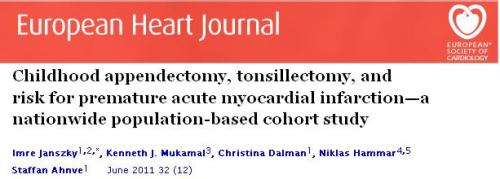
This article just released  in  European heart journal , tells us ,  how the rampant use of appendectomy and tonsillectomy in the early child hood  may make them susceptible for CAD in later age group.

The role of medical professionals is identify the trivia ! and prevent unnecessary interventions.

Unfortunately  or (Should I say dangerously)   many of  the   professionals  understood it  in a diagonally  opposite manner . Identify the trivia ,  instill fear in our patients  and intervene ,   in the process injure  our great biological system.This is also applicable to many cardiac  interventions.

Final message

Heavens sake ,  youngsters  , please  remember  , medical  profession is all about removing suffering from patients  . Do not fish out “non -existing” illness from your patients  body !   Let me remind you ,  professional approach means  , whatever you do it should be in the  interest of our patients . The moment  you deviate ,  you cease to be professional .

Also realise  ,  good   intentions can never be an excuse for  inappropriateness !

Reference

http://eurheartj.oxfordjournals.org/content/early/2011/05/27/eurheartj.ehr137.abstract

Read Full Post »

It is  a well proven concept   beta adrenergic blockers have a useful role in controlling   the  frequency, and intensity  of  vaso- vagal syncope .

One may wonder how an anti adrenergic drug help to counter hyper vagotonia syndrome !

This is because  during  vaso -vagal  syncope ,  the  inital trigger is  sympathetic . A   sudden hyper adrenergic  surge occurs   that stimulate the vagus, ( Which  overshoots the   initial  quantum of adrenergic signal)   and  cause a systemic vasodilatation ,  hypotension and bradycardia.

How does adrenergic surge stimulate the  vagus?

By two ways

  • Brain stem spill over effect in medulla (Vasomotor to tractus solitarius)
  • Cardiac  stretch caused  by hyperadrenergic activity . This stretch initiates a  vagal reflex  especially from  the base of the heart (Similar to Bazold Zarish reflex ). This  mechanism is  thought to be more important than brain stem spill over  , that’s why  it is referred to as  neuro-cardiogenic syncope .

How does beta blocker help?

  1.  It   sedates  the  adrenergic centre which  modulates the trigger  .It  also blocks the  sympathetic  afferent limb of the syncope circuit.
  2.  Anxiety  and panic reactions are close associate’s of vaso- vagal syncope. They are  not only  considered as  prodrome for syncope  but also act as  important triggers.This is effectively tackled by beta blockers .
  3. Finally , beta blockers  soothes the mycardial  stretch  receptors by reducing the  ventricular shear stress (Reduced contractility and wall stress )  hence neuro-cardiogenic  axis is  pacified.

It is important to remember beta blcokers can only  prevent/  reduce  episodes  of  vaso vagal syncope. It  may aggravate  the situation   if administered  shortly  after the event , as bradycardia and hypotension  is dominant  in the recovery phases.

*During an episode of vaso vagal syncope atropine group  of drugs is most useful .

Which beta blocker ?

Propronolol is the prototype  as it has non selectivity and good penetrance  of  blood brain  barrier ,  which is  the most appropriate site for suppressing hyper adrenergic drive.

Cardio selective beta blockers  do have a role as cardiac stretch  receptors is  one of the two target sites .

Final message

Ironically ,   in the long term management of  vaso-vagal syncope , anti adrenergic drugs  have a major role  rather than atropine like drugs .

Read Full Post »

There was a time  , even  cardiac catheterisation was contraindicated if the aortic valve  is  significantly calcified. LV angiogram was judiciously  avoided in all such patients . Why ? A significant increase in disabling strokes were witnessed .Those were the time  a sense of  fear (common sense ?)   prevailed . Every one was following this dictum with sanctity .

Now in 2010 .TAVI has  arrived with great fanfare . We not only cross the calcific valve , we literally play  a violent contact sport   in the aortic root  for over two hours with all sorts of pushes  and passes  on  a  fragile valve.And  we are happy to  claim that  stroke rate is comparable to aortic valve surgery and TAVI is not-inferior to AVR in high risk surgeries .

How is this possible ? As the times  changed ?  Is it true , our stroke  fears are just imaginations  or have we lost our  faculty of  reasoning and  sense ? (Will it be logical to  fund a research  if someone claims a  surgical  technique  to replace  aortic valve in  a beating heart without aortic cross clamping !)

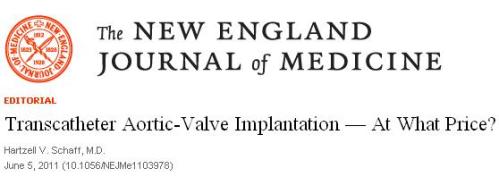
Data shows  even if  distal protection devices are  used the stroke rates  can reach to  objectionable levels .It remained  a mystery ,  at least to me how no body was  questioning this ? I was happy to find this editorial in NEJM which  just stopped  short  of   banishing  this modality in its current form.

http://www.nejm.org/doi/full/10.1056/NEJMe1103978

What price it asks ?  and leaves the readers to guess  the answer ? NEJM wants to be too decent and polite , but in science politeness is generally not required  ,  as long as  your  observations are  correct !

For all those enthusiastic  interventional cardiologists  here is  a positive message .

Nothing comes easy in science.Great  inventions do have problems  initially .  Without  major hurdles  there can be no progress ! It is  because of   you  modern cardiology is making giant strides . Remember  the early days of angioplasty , early days of pacemaker  .  But  please realise  the most important issue  is ,  whatever  we   innovate or discover it  should be shown   superior to the  best  existing modality in all aspects(Technique,  procedural  complications, long term  outcome ,costs, side effects etc  ) .It is awful  to note   new drugs or devices  are  rarely compared with  the best treatment that is currently available .

A  new  treatment that simply  complements  or proves  non-inferiority  can never be considered an invention. How can we   portray radio frequency  renal denervation (  a complex  lab procedure ) for controlling blood pressure   as a great innovation for man kind  while we  have   so many drugs and  modalities  available  at a fraction of the cost  with  little  consequence .

Reference

http://www.escardio.org/congresses/esc-2009/news/Pages/Transcatheter-Aortic-Valve-Implantation.aspx

Read Full Post »

« Newer Posts - Older Posts »