Feeds:
Posts
Comments

Archive for the ‘cardiology -Therapeutics’ Category

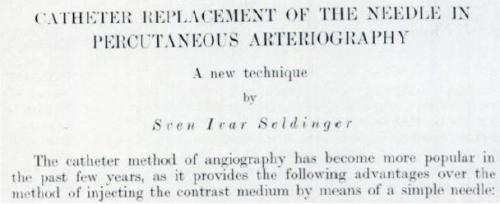
Interventional  cardiologists should revere  few  names for ever  . . .

They are

  1. Werner Forssman
  2. Masan Sones
  3. Andreas  Gruentzig
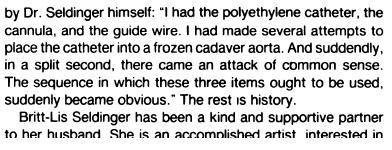
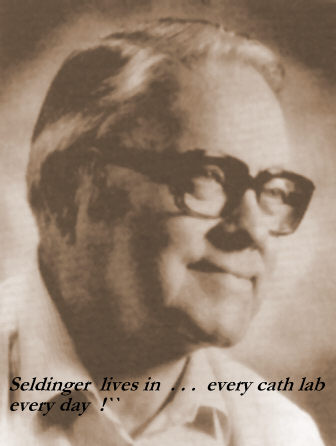
  4. Sven-Ivar   Seldinger

Sweden's Pride and cardiologist's ultimate Hero !

The  other men  in the  above  list  gave us insight  to enter the heart and do cardiac catheterization  and selective  angiograms

Ironically ,   the  man who  provided an easy access* to cardiovascular  system  from the  periphery is less often  remembered.  Still , it is because of him millions of procedure  are done every  year .

Every cardiologist should  read the life history of this great man.

*Previously all interventions are done in laborious  arterial or venous cut down

How the invention came about ?

“It is a  sudden attack of common sense”   That  is how seldinger described in his own words

Why not a Nobel prize for  Seldinger’s  sense which was so  uncommon to others  ?

If common sense has to be rewarded Nobel price ,  Seldinger’s    would probably will rank   first  among  all !

Reference

  1. http://ww.ajronline.org/cgi/reprint/142/1/8
  2. http://www.ajronline.org/cgi/reprint/142/1/8.pdf

Read Full Post »

We  are at the mercy  of  the three major coronary arteries (LAD,LCX,RCA) that sustain our life . Their  job is clear cut  .It has to perfuse   about 300 Grams of   live bundle of energy  for  an average of 6-7 decades.

What are the hurdles it  faces ,  how it overcomes these obstacles  forms the fascinating story of   “survival  of  human heart”

When coronary blood supply is confronted with a sudden compromise  as in ACS  ,  often the heart has little  time to respond . Hence the damage  and risk of death is  more. Even here there are lots of safety mechanisms and natural lytic process that limit the loss of life to less than 30 %  of all STEMIs. This implies nature protects against the death in 70 % of individuals and help  them  to reach hospital.*

*Among those  who reach hospital , we  the cardiologists  try to reduce the  mortality to about 6-7 % (20% without treatment ) with all  those hi-tech gadgets .It is a  different story and will be addressed elsewhere .

When it comes to  chronic insults ,  the heart has a unique potential to  stage  long haul battles. It has many tricks  under its  sleeves when challenged in a slow fashion.

The main weapons are two

1. Coronary collateral circulation.

2. Ischemic preconditioning.

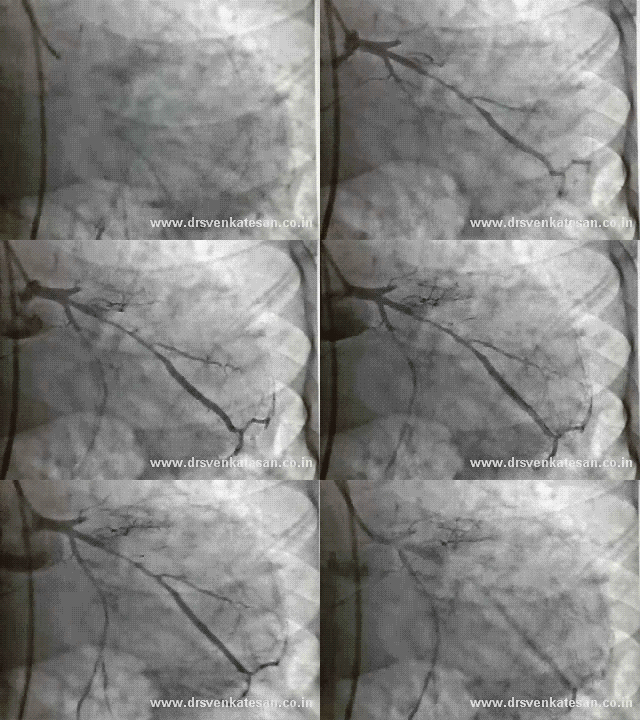
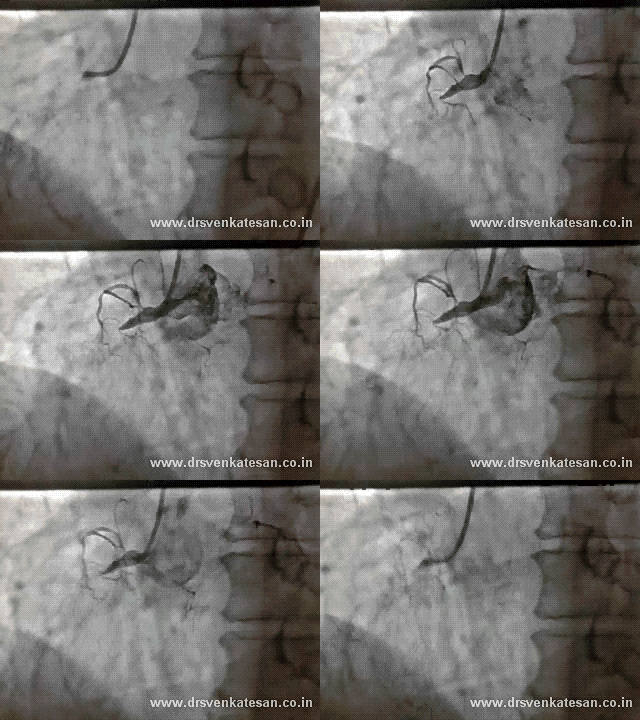
Here is a patient who fights his life even after all his  three coronary arteries   totally blocked and surviving with one of the branches of left main -Ramus intermedius .

If you have thought his RCA was the savior  you are  mistaken  .

To every one’s   surprise  his  RCA was awful  as well !

He had angina which was  troublesome  but manageable .Was able to live a life with acceptable standards (Indian standard )  After the angiogram he  received  CABG.  A turbulent post operative course ensued  due to various reasons . He  struggled but   fully recovered  . . .  and  ultimately  reached the  previous  standard  of life !

Final message

Modern cardiology is all about not trusting  powers of nature .

But youngsters should realise the enormous potential of those invisible powers.It may sound philosophical , but please  remember  . . .after all . . .  philosophy  is nothing but  search for truths. Atleast believe in them  once in a while !

Read Full Post »

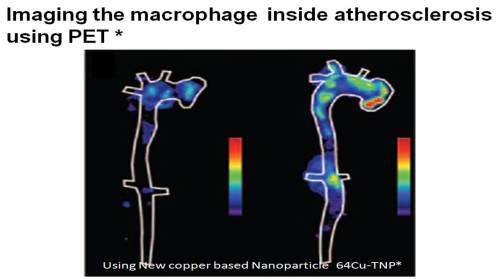
Non invasive imaging of inflamed macrophages  within athersclerosis

The medical  imaging science is  reaching new heights. With most of the  research so far within the anatomical arena we are moving into the  physiologic  and metabolic  imaging. Identifying vulnerable  plaques  within the coronary  artery is a separate field. Most of them are catheter based and invasive investigations.

We  have ben  searching for an  ideal PET scan based metabolic imaging of atherosclerosis. Macrophages are the key elements in an inflamed plaque.

Image Source : Circulation. 2008;117:379-387 .Note the Acttive Macrophages in the Aortic arch area and Coronary ostia

Can we take a photograph of these  inflamed zones   within  the  atherosclerotic plaque  ?

  • It seems we are approaching  that possibility. Every time we screen a person for CAD we can risk stratify on the basis of  percentage inflammation of their coronary artery or aorta .
  • This will complement the CT  or conventional angiogram .
  • If this technology is perfected it can be useful in the evaluation of response to medical interventions .
  • It  could also tel us  the  significance of  raised CRP /cytokines in other wise asymptomatic individuals

PET scan with newer tracers are constantly evolving . One such tracer is  based on copper molecule   64cu-TNP.

Reference

http://jnm.snmjournals.org/cgi/reprint/45/11/1898.pdf


Read Full Post »

For  a police officer who visits a crime site  every one looks like   a culprit. For a cardiologist  sitting in coronary  care unit  all chest pain  will have to look like  an infarct  !  Then only he is a cardiologist !

A rare , but costly mistake occasionally  happens . When a  patient with severe chest pain in the  retro sternal region with ST elevation in ECG , enters the ER  there is little  reason to suspect any condition other than STEMI !

This is how medical  errors takes place

Medicine is an art , we can not take it as granted .Acute MI can present with normal ECG and a dramatic ST elevation need not be MI

Here  was  a patient who presented with this ECG and one our fellows correctly diagnosed the condition .

Most  physicians would have thromolysed this patient or  might have wheeled into cath lab.  We have such events reported from primary  PCI registry .

Key differentiating points

  • Diffuse ST elevation not confining to a arterial territory
  • Absence of reciprocal changes
  • ST  segment with concavity upwards.
  • Echocardiogram and enzymes will be useful

iFAQs  in pericarditis

What is the mechanism of ST elevation  pericarditis ?

It is actually a zone of epicardial or Sub epicardial injury.

What will be the ECG finding if STEMI is associated with fibrinous pericarditis ?

Double dose of ST elevation .Mimics  a re infarction.

What are the dangers of thrombolysing a patient with diffuse pericarditis ?

It can bleed into pericardial  space

What happens

What will be the ECG finding in localised pericarditis ?

Read Full Post »

Action to  control cardiovascular risks in diabetes (ACCORD ) : The accord long-term follow-up results are just out  in NEJM  March 2011   http://www.nejm.org/doi/full/10.1056/NEJMoa1001286

The ACCORD study which created a huge buzz in 2008 when it was prematurely terminated  for fear of  bad outcome ,  with aggressive blood sugar lowering (Hb A1 c <6 %)  .The  negative  trend was confirmed in the aggressive* group even after switching to non aggressive group  at further 1.7 years follow-up  till late 2009.

*Intensive /Aggressive is used interchangeably in this article .

Why should aggressive glucose lowering be harmful ?

This  question is  struggling to get  a  logical answer for over 5 decades. To answer this question,  it  need to realised  our  fundamental understanding of  diabetes  itself  is  flawed ,   as  we have equated it with high blood sugar.

                                                    A  persistent state of  high blood sugar   can never be  used  as a  synonym for diabetes melites.  There is much . . . much  more , to it  !    Patients ,  lay persons and pharma industry  may  think  like  that   but  it is unfortunate many  physicians  have the same thinking   pattern .  The fault lies there .

Diabetes is a systemic metabolic disorder  apparently due to lack of insulin( or relative excess of it ! as in insulin resistance ) in which hyperglycemia is one of  grossly visible abnormality.

It is estimated there can be at least 100 invisible or less visible  biochemical abnormality in every diabetic individual.In fact , DM has more profound effect on lipid metabolism  than carbohydrate metabolism. Almost every microproteins   in our body  gets glycated . That  can be either be  reversible or irreversible .We know how difficult it to reverse diabetic nephropathy or retinopathy

If we realise the above reality there is absolutely no surprise why lowering blood sugar alone  does not reverse diabetic complications !

The second major issue is the modalities we  use  to target the  blood sugar 

Right from the days of early sulphonyl ureas  and biguanides ( of  Tolbutmide and Phenphormin etc ) one thing was very clear (or unclear  ! ) vigorous control of blood sugar has always been a doubtful intervention in controlling  diabetic complications .

                                                If  high blood sugar causes  excess mortality,   why  bringing it to  normal levels  does not reduce long-term mortality convincingly  ?

Is the Madness  lie in the methods ?

It seems so.  ACCORD study has strong reasons to suggest the  worse outcome in aggressive management is due to multiple , drugs used in a random fashion.

Then there  is always this  question  . . .How good is HB A1c  to assess the adequacy of DM control.  ? Biochemically this molecule still has lots of issues regarding its reproducibility.

Individuals who control blood sugar  by  natural means and by minimal drugs seem to do well. Early diabetics and  pre diabetics  should be our targets.

One should also remember the drugs we have today to control DM  have yet to prove the long-term safety records (Say for a span of 30-40 years)

Modern medicine  usually does not bother about the future  . . . it simply shrugs of the issue  with a caution statement . . . that the ” Drugs  you take  are well-tested and  thought to be  safe and useful with the current level of research !”

What is aggression in DM management ?

No one has defined it so far. But the any of the following may fit in with the  definition

  • Any DM patients prescribed more than  two drugs and Insulin
  • Premature start of Insulin
  • Lack of diet and exercise management  and  trying to substitute them with  incremental drugs and insulin 
  • Finally ,any patient who is always tensed up about his HBA1C and switches his physician  frequently  end up in  early complication   than the ones who follow simple non pharmacological approach.


How good is the idea  ,   to define aggressive thrapy  with reference to HBA1  levels ?

ACCORD defines aggressive approach  with HBA1C   as less than 6 %  and   Non aggressive as  7-8%  ( or  is it 6-7 %)

Not withstanding the limitations of HBA1C , there can be many patients who will require multiple drugs and insulin to maintain the HBA1C  even  at  7-8 %

How do yo label  them ?  Aggression by  number of  drug used   . . .  but still  considered  Non aggresive control  by HBA1c  criteria .

If ACCORD study fixes the indiscriminate use of drugs as a cause for bad outcome ,  then the very definition of aggressive approach need to be changed !

 Final message

ACCORD says it all . Never be aggressive on diabetic patients. The aggression we show with drugs can be more dangerous than the deadly diabetes itself.

Read Full Post »
Anticoagulants are different from  antiplatelet agents. One acts on coagulation cascade  , while  the other acts on platelet aggregation. That’s what ,we have  been taught  for over a century.The reality is , there is a huge functional  overlap between these two .

Some of the questions   which struggle to get  a clear answer  ( Atleast for me !) 

 What will be the bleeding time in patients  who are on  oral anticoagulants ?

Ans :  Since it  affects only clotting mechanism bleeding time will be normal or near normal .(Is this reasoning correct ?)   But ,we clearly know , Warfarin  increases systemic bleeding risk : Does this risk occur without affecting the  platelet  function ?

If bleeing and clotting are two different phenomenon how warfarin increases bleeding risk ?  If warfarin alone increases bleeding risk  heavily   why  Warfarin – Aspirin  combination  is used  in many  patients with prosthetic valve  ?

In a patient who is  receiving full intensity heparin( say in Acute coronary syndrome )  can we afford to withhold aspirin or clopidogrel ?

Heparin is given  for preventing recurrent  STEMI and antiplatelets are given  for preventing recurrent  NSTEMI !  Is that the answer  ?  How solid is the concept of white clots in  Unstable angina and red clots in STEMI ?  Can a  blood  really clot without help from platelets ?  Can a person really bleed with intact platelet function ?

Final message

We are  far . . . far away  from fully understanding   science of   human  coagulation and bleeding   ! Meanwhile it is a common sight  to prescribe  all in one cocktail  (A LMW Heparin* , an aspirin,  clopidogrel    ) to most of our ACS patients believing   at least one of them will take care !

* Remember the original caution message when LMWH was introduced said ,   LMWH   should not be used along with Aspirin !

Read Full Post »


Ever since  Barlow reported  this entity , mitral valve prolapse was made  a fascinating disease of  the heart . Cardiologist’s honeymoon with this disorder lasted  for too long   . . .  four  decades ?. It is probably the most  common valvular disease physicians diagnose .The importance of which was  exaggerated  and at one point of time  the term was  getting  abused.

So the criterias  were made strict in later decades . Now unless MR is present along  with valve thickening MVPS should not be diagnosed.

Clinical presentation

  • Atypical chest pain
  • Palpitation
  • VPDS
  • Asymptomatic pre excitation
  • Anxiety state  including  panic attacks (More common after informing the patient about MVPS.) 


Here is Monograph with excellent Images.I think this is available  free with Google Books. 


MVPS -Auscultation

Classical finding is mid systolic click with late systolic murmur.

But in reality,   It can present with  any of the following

  • Early -mid systolic click,   with  murmur
  • Only murmur
  • Only click
  • No click,  no murmur -Only Echo evidence of MVPS
  • Clinical Click  but no MVPS in echo*

The timing of click and murmur depends on the LV volume and the contractile force.Status of pap muscle is also important.There are studies which  show dehydration can induce MVPS and hydration corrects it  .One can guess the anatomical importance of this entity.

Currently myxamatous  valves with clear prolapse with at least  grade 1 MR (Not the often reported trivial MR !) only be labelled as MVPS.All other  forms increase patient  anxiety , lead to unnecessary echocardiogram and of course promotes   physician    affluence !

*Chordal clicks

This was first described by Reid .A redundant  lengthy chrordae  folds unfolds  making a noise. Mitral valve as such may not  prolapse into LA and hence echocardiogram would be normal.

Origin of chest pain in MVPS

It is still a mystery  out there regarding the origin of chest pain in MVPS.

It is thought to be a  mechanical pain from any of the following

  • Valve
  • Chordae
  • Myocardial stretch
  • Ischemic unlikely

*currently it is  believed  to be a pain perception problem at cortical level.

ECG

  • Non specific T wave inversions in inferior and lateral  leads common
  • Early repolarization patterns are common
  • WPW has a  rare association

TMT

False positives excercise stress tests are  reported  often .

Echo

  • Echo  is to be primarily blamed for the  rampant diagnosis of this entity .
  • In deserving patients Echo is vital to define valve anatomy and MR assessment.
  • TEE will help us the exactly identify  culprit  scallops (Commonly P2 A2)  and facilitate the surgeon during repair.

Coronary angiogram

Many of the MVPS patients end up in inappropriate CAGs ( Decent term for guideline violation !).As a rule  , almost all will have normal coronary angiogram.

Incidence of  Ventricular arrhythmias

VPDs can be common in MVPS. ( Myocardial /Pap muscle Stretch induced ?)

Sudden cardiac death is no more common than general population .So no worries .

IE prophylaxis

Generally not required unless significant MR present

Management

Most( 99.9%) will require no treatment . Only reassurance .This , if properly done shall be a one time process.There are many young persons  who report to the physicians  periodically to get reassured (Each time  spending 500 Rs !) This is called reassurance failure .Here , the  physician needs  to be urgently  changed.

Many times , parents , spouse and relatives  will  require more  counselling  than the victim  of mvps !

Few with progressive MR will need close monitoring  (Eg Associated Marfan )

Tall,  thin individuals will require aortic size monitoring as well.

Highly anxious persons will do well with beta blockers. Panicky individuals require sedatives as well.

Very severe MR needs surgery .Surgeons   are encouraged  to repair a  myxamatous valve than to replace it .

Secondary MVPS

(MVPS in association with other structural disease  like Ischemic, RHD, Infective endocarditis are important pathological entities that need to be discussed separately )

Final message

MVPS is a benign disorder (Rather it can be called as  a variation in mitral valve morphology  ).  Only  In  a  fraction of  population it  can take a true  pathological course. Cardiologist and physicians should  disseminate this message widely to their draining population.Unfortunately  in the current state of affairs , MVPS  seem to be  less dangerous for human community than the  events  that   follow  the  misplaced diagnosis of this entity. In the name of health awareness  huge costs , time and resources are wasted in dealing with this almost  . . .non entity !

Read Full Post »

Is there a bio chemical way to measure time window in STEMI ?


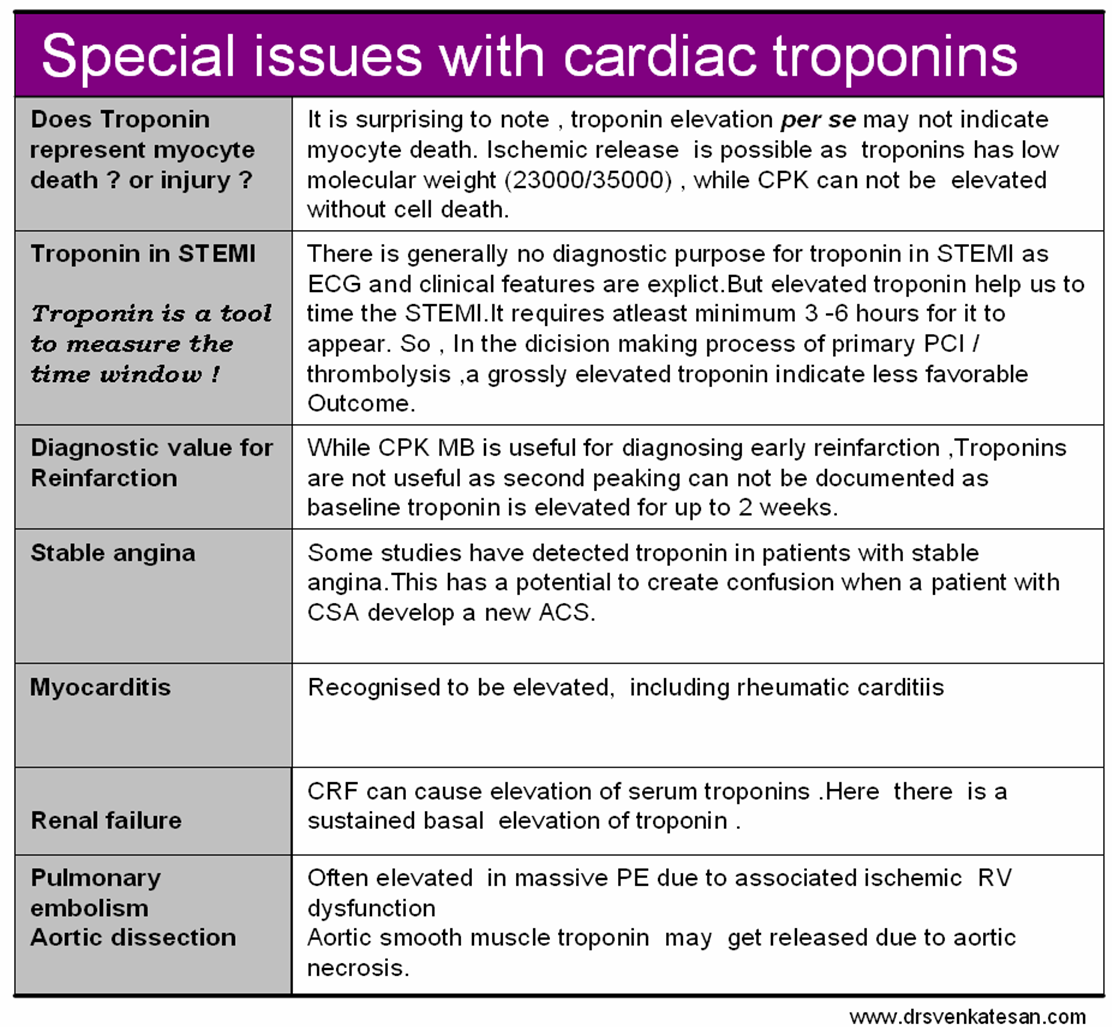
It seems so. In this era of hyperacute PCIs  , we are supposed to diagnose STEMI very early .If you wait for troponin  to assit you in diagnosis it  implies  one has missed the golden hour already (At least Three  golden hours to be precise !)

Cardiac enzymes have a unique value in timing a STEMI as  time of   onset of  chest pain is   unrealiable

as the patient (Even the physician !)  may not be able to differentiate pre infarction angina from infarct pain.

In these situation cardiac enzymes provide us a clue.

The time of realse of these molecules are fairly predictable.

  • Myoglobin -2 -3hours
  • Troponin elvation -3 -6 hours
  • CPK –  8 -12hours

Remember  ECG  rarely show a  time lag   in diagnosing STEMI  !

Message

For  maximum benefit . . . try to perform the  primary PCI before the troponin  appear in blood .

Does this  sound a crazy   tip ? What to do . . . truths are very often crazy .

Read Full Post »

When  PTCA was introduced  by Gruntzig  in 1977 the whole world was awestruck. All he did was . . . to dilate a coronary stenosis with a balloon. No scaffolding  was ever thought off at that time.  It was a huge achievement .   PCI version 1 was  performed for over  20  years in nearly a million  patients   . Till his death stenting  was  an unknown concept.

When the stents first came in,  it was first used with extreme caution .  From the days of  bail out stenting, it  has evolved  into provisional  stenting, elective stenting ,and  now  what is called  “mandatory stenting”

When  Greuentzig was able to  perfuse the obstructed coronary arteries  successfully  in thousands  of patients  in the 1980s,    with a simple balloon

. . . what is the difficulty for us  to replicate it  in 2011 ?

Unfortunately  advocates of POBA (Plain old balloon angioplasty) are considered  to be  un-scientiifc cardiologists or even carry a risk of labeled as quacks.

But please remember . . . POBA   is alive and doing well  too ,  in spite of the serious threat  it faces from the current generation interventionists  . It  will continue to have an  important role in  many  situations.

1.In patients with multivessel  disease while the  proximal lesion  deserve a stent  , POBA is preferred in distal lesions  to reduce the overall metal load .

2.POBA has a major role to play in Primary PCI .We need to realise  dying myocardium does not demand  for stents. It simply requires  quick and prompt restoration of  blood flow. POBA can achieve this with flying colors in most situations.

3. Further , stenting  may be  difficult in complex lesions   during primary PCI .Experience tells us , it  is  dangerous to prolong the primary PCI  procedure time. Here POBA is the only choice ,  may be assisted by thrombus aspiration. Stenting may be delayed or even avoided in many STEMI patients. . We know there is huge STEMI population with  pure thrombus with no atherosclerosis.

4.Patients  with  co morbid conditions , who are  likely to have a non cardiac surgery in the near future  and those who  can not take antiplatelet  drugs  POBA will score over BMS/DES.

5.Finally a POBA costs nothing . .All it requires is a stiff  balloon . In this recession prone world  and ever increasing incidence of  CAD  , POBA  could be the  answer.

6. Acute recoil in POBA (Sudden deaths in POBA is  a rare event !) are more of a perceived fear rather than a reality. It can be argued stents  are  primarily used  to make  cardiologists job easy and  comfortable.

7.Cost effectiveness of plain balloon verses stenting was never  properly tested .

Final message

When sudden deaths  due to subacute   thrombois in DES population   is accepted with all those attendant  pride . . . why not we accept a risk of  less sinister event  namely the  late onset restenosis with POBA.

This is a funny world . The DES fiasco is driving us towards stent less world and a bio degradable stent is already being projected as new savior.

Meanwhile no  one can kill POBA thats for sure !  It  will  ultimately   be reinvented  with another exotic study  soon !

Read Full Post »

Atherosclerosis  probably ranks first among all  human diseases that cause maximum suffering  to  mankind.Since it is a disorder of blood vessel  it has an easy  access to every  vital organ  in our body to inflict the damages . Histo pathologically , atherosclerosis is an all in one disorder where inflammatory , degenerative and lipid injury  collectively  contribute to the disease progression. Diabetes and hypertension play a vital amplification role.

Atherosclerosis begins very early in life as fatty streaks in every individual and takes different avatars ( or remain indolent)   depending upon the risk factors and life style.

How to estimate plaque burden ?

It has  always been a difficult task to estimate the  atherosclerotic  plaque burden inside the  coronary  arteries.The fundamental flaw for many years is ,  we always thought  if there is a plaque it must  encroach  into the lumen.

Coronary angiogram  , has become the  default investigation  in clinical cardiology . Since it   can  visualize  only the coronary lumen ,  this  flaw  got further  curious  with skewed  interpretation as well.

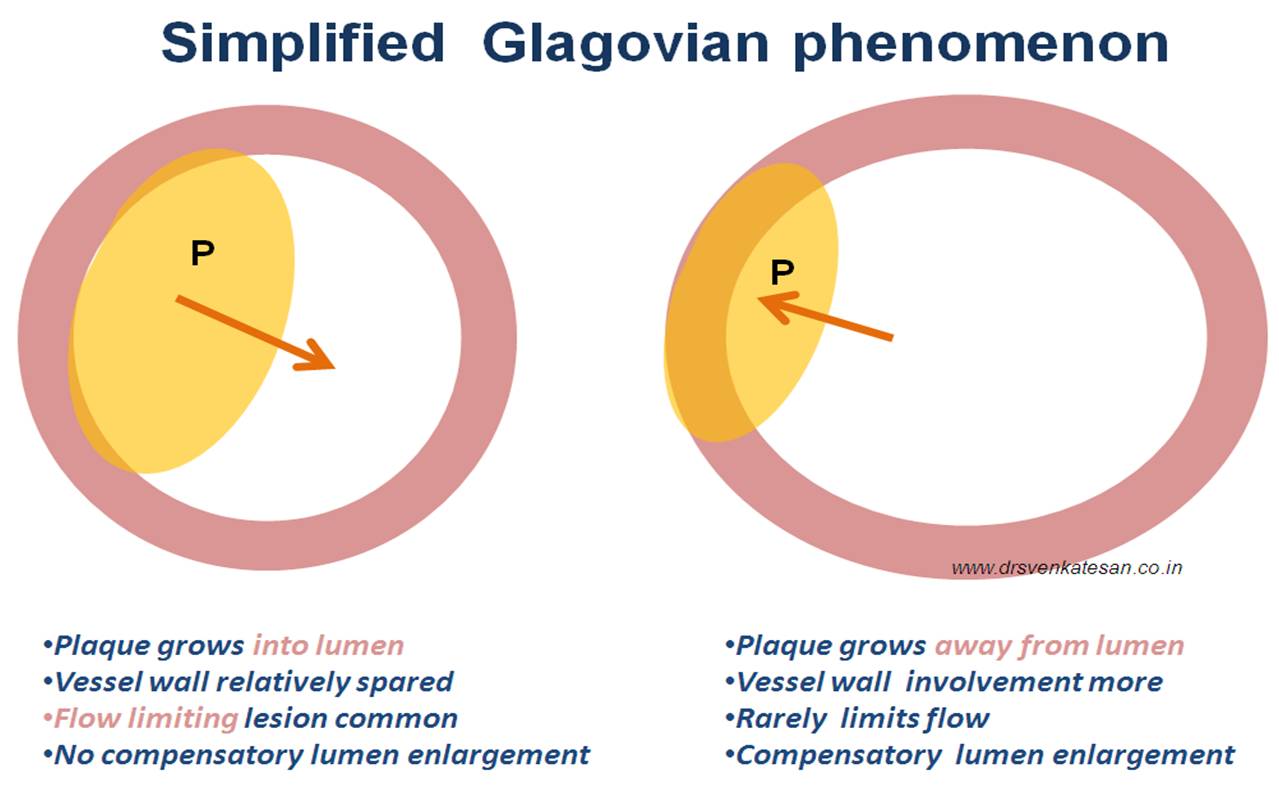
When things were as it is . . .  Glagov suggested , what  could  possibly be   the  most important  concept in the interpretation of coronary  angiogram .

The concept  suggested  the  atherosclerotic  process  could  actually spread  within the  vessel wall  in a predictable manner .

What determines a plaque to either grow into the lumen or grow away from the lumen?

If we could decode the mechanism of direction of plaque growth we will probably conquer the atherosclerosis  at least by mechanical means . The implications are too many.

A stented coronary artery may be re-engineered to grow the atherosclerosis  towards  the adventia .This could grossly reduce  the incidence of restenosis.

Further , in post Glagov days we realised  mechanical factors like plaque stiffness, eccentricity , plaque mass effect, drifting , lipid core density, medial lysis , elasticity of elastic lamina all could determine the   plaque  movement.

Why compensatory lumen enlargement does not occur in some lesions ?

We do not know the exact reasons . We may call it a fate . . . shall we ?

Curious blessing  : Atherosclerosis  for  some unknown  reason  blesses a  few with coronary artery  dilatation rather than narrowing .

This is called coronary  ectasia . Medial necrosis , weakness of internal elastic lamina or  destruction paves way for plaque shift towards the adventia . It is estimated , if the medial necrosis occurs in at least  50 %  of  circumference of vessel wall   it will  result in ectasia .And  paradoxically if  the media  shows resistance   the plaque grows into the vessel wall.

Endoleak  and Glagovian phenomenon.

Endo leak is the Achilles heel of   endovascular intervention . In fact , many would  consider  it as  a dignified terminology  for graft failure . Endo Leak   occurs when  the artery outgrows the stent  graft and bllood starts  collecting  in the graft vessel -wall interface . When the  scaffold is  placed  within the lumen ,  one may wonder how it is going to prevent  the  artery  dilatation . (Which is basic defect in any aneurysm}In fact , the aneurysm does continue to grow  along with   centrifugal  atherosclerotic  forces ,  possibly by  Glagovian phenomenon .

This makes it obvious  endo- leak is a distinct threat in every vascular  intervention.


Final  message

Most cardiologists  think their ultimate  job  in this world is to  deploy  a stent deep inside a LAD  or RCA.  While a few others indulge in more exotic  adventure of  crushing a plaque ,  trap the debris and  catch it with a  with  a basket .

There  are bigger and bigger   blind areas  in the vessel wall ,  infiltrated with  deadly atherosclerosis which is conveniently ignored  .If only we realize   this fact  , we  can move forward in our war against coronary atherosclerosis.

Of course the good old   medical  interventions  . . .  exactly try  to address  these issues . Let us  think  straight , and  not succumb to glamor  in cardiology !

http://heart.bmj.com/content/84/5/461.extract

Read Full Post »

« Newer Posts - Older Posts »