Feeds:
Posts
Comments

Archive for the ‘cardiology -Therapeutics’ Category

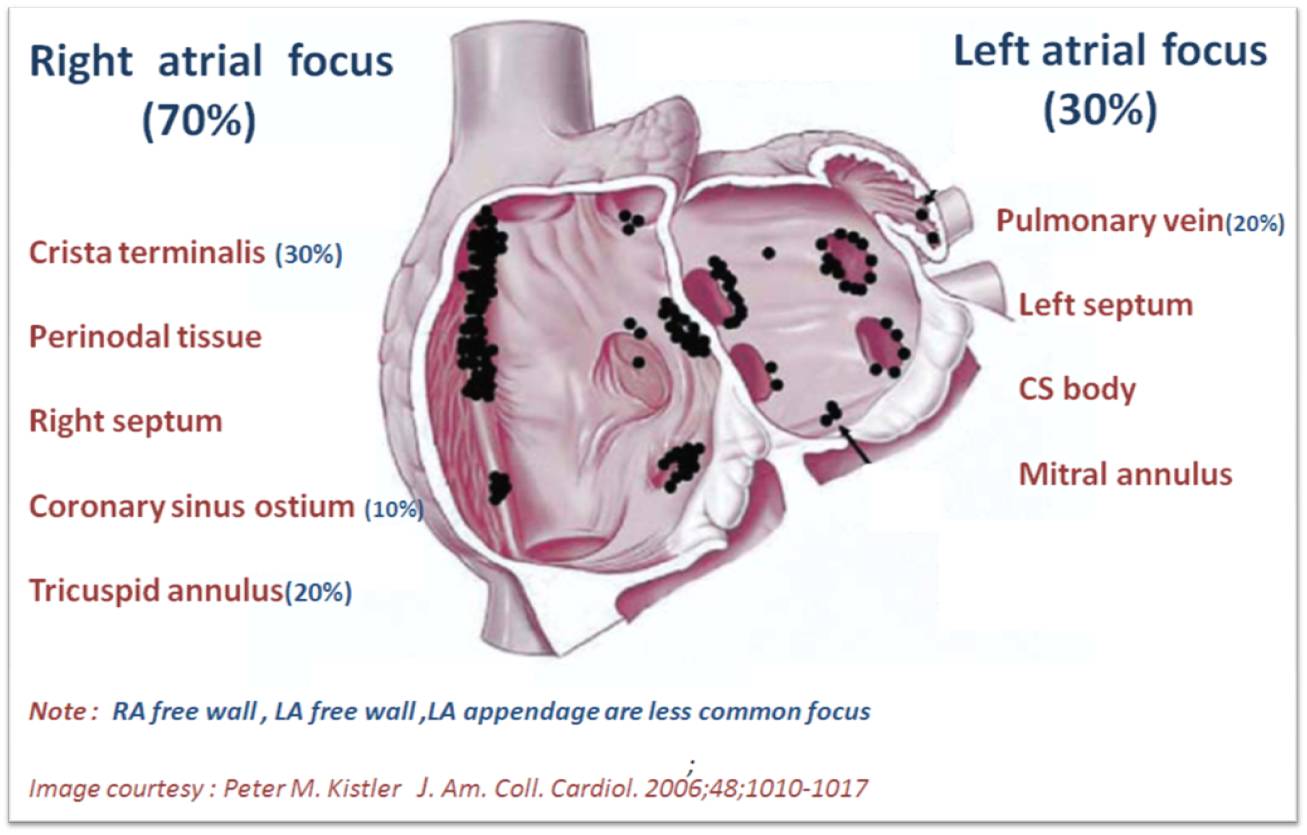
Human atria is a rough terrain infested with peaks and  troughs like the  Himalayan range . The two atria together has a minimum of ten entry or exit points . Cardiac arrhythmias are   something similar to the  uneven  earth plates  triggering an  earth quake.  Like the earth surface there are  areas in the atria  with high seismic activity !

It is now discovered there are nine vulnerable points in human atria that can initiate focal electrical activity at times of hemodynamic/ischemic/metabolic stress .

The common causes for Focal /Ectopic atrial tachycardia are

  • Hypoxic AT -COPD ( Probably the most common cause .If persistent it will degenerate to MAT- AF )
  • Structural atrial disease
  • Hypertensive heart
  • CAD
  • Valvular heart disease
  • Drug induced

Note ,  all these  vulnerable points are located either in the  junction of  an anastomosis  with a venous structure or valve or septum.

Further, these sites are often the  embryological fusion points making it still more vulnerable due to tissue defects.

Why free wall of atrium  is  a less common  focus ?

They are relatively smooth, lack ridges and joints. Unless the walls of atria are diseased  focal tachycardias are less common from these sites .

Other forms of Focal atrial tachycardias

Indian perspective  and Rheumatic atrial tachycardia.

In developing  countries  focal atrial tachycardia in rheumatic heart  differ very much from the tachycardia described above. In fact many of the rheumatic atria present straight away  to atrial flutter or fibrillation.

Pulmonary vein focus should rarely be considered in atrial tachycardia that occur in RHD.

Post operative tachycardias

Surgical scars can result in what  is called  Incisional tachycardia.(Especially after complex atrial  surgeries like Sennings, Glean/TCPC  etc )

Multi focal atrial tachycardia .

This is nothing but a focal tachycardia which tend to fire from different angles towards different targets  often lead to a chaotic atrial rhythm .  Digoxin and DC shock paradoxically aggravate this arrhytmia.

Atrial epicardium/pericardium interface as a focus

When pericarditis is the predisposing  event  then it can emanate from anywhere from  epicardial surface .

Since left atrium is only  partially covered by pericardium it is not logical to assume pericarditis related AT arise from RA epicardium.

Atrial tachycardias in congenital heart disease.

Complex atrial anomalies, SVC type ASDs, PAPVCs can  give raise to abnormal  electrical focus

Reference

An excellent original work from  Royal Melbourne Hospital, Melbourne  Australia.

A must read  . . . http://content.onlinejacc.org/cgi/reprint/48/5/1010.pdf

//
Read Full Post »

Platelets  are the major culprits in initiating arterial thrombus.Platelet  inhibition is  the key  modality  to treat /prevent  acute and chronic coronary syndromes. It is  an approved indication for primary and secondary prevention of CAD.

Anti platelet  agents are the biggest drug  market among the cardiac drugs. It is  a billion dollar  medical game  played  with two  million  human  platelets !

Aspirin is the best anti-platelet agent known .It is not only most effective but also  available at a fraction of the cost other  drugs. Unfortunately  it is  a generic and not a patented one .Being cheap  ,   good safety profile  is the biggest  disadvantage of aspirin  !  So ,  consistent efforts were made to make this drug appear weaker. Hence came many new anti-platelet agents .

After analyzing  the available literature ,  I have compiled the following conclusions ( Mostly biased observation ! but I strongly believe the  bias is more  towards truth . . . )

All of the following statements can be termed either  true ,were true , believed to be true may  be  true ,  at some point of time  (Between the  last decade and today !)

  1. Aspirin alone is good enough in both  ACS and chronic CAD
  2. Clopidogrel is   equally effective like aspirin in ACS.
  3. Aspirin alone is dangerous in ACS.
  4. Clopidogrel alone is more  dangerous than aspirin alone in ACS,
  5. Aspirin + Clopidogrel  provides the best anti-platelet  action.
  6. Aspirin + Clopidogrel combination is still dangerous .
  7. Prasugrel is more effective than clopidogrel
  8. Prasugrel can never be as effective as aspirin *
  9. Never use clopidogrel alone in DES patient.
  10. Aspirin can be safe in most stented patients
  11. Mono platelet inhibition is a crime !
  12. Risk of  sudden death continues to be significant in spite of dual antiplatelet agents in many with DES.
  13. For prasugrel to be  really useful  it should always be prescribed with aspirin.
  14. Prasugrel alone can be dangerous in stented patients.
  15. If the patient is  getting heparin  simultaneously none of the above seems to be  really  important (Of course all patients with ACS will be getting this )

Above are my inferences in all those trials on platelets in the last three decades

What do you infer  ?

To  a discerned reader all of the above statements  may appear wrong   !

*Finally , it looks to me  both clopidogrel and prasugrel ride  a fake  ride on the shoulders of trusted war horse called Aspirin . There is  a strong basis for this  suspicion  as none of the researchers are ready to do a one to one direct comparison between aspirin and prasugrel  or clopidogrel !

Read Full Post »

A well researched article on a difficult topic. By Kim et all from Cornell university , New york.

A must read by all cardiologists . The link is placed with the courtesy of Jacconline

http://content.onlinejacc.org/cgi/reprint/49/20/2035.pdf

After reading this article   one  should be able to answer the following questions.

  1. What is Gallavardin VT ?
  2. Classification of RVOT VT
  3. How a non sustained VT becomes a sustained one ?
  4. Why some VTs cause syncope ?
  5. What is the association  between idiopathic VT and Idiopathic VF ?
  6. How does exercise  trigger a  VT ?
  7. What do we mean by structurally normal heart ?

Readers are encouraged to post link to good articles on this topic.

Read Full Post »

The review published in the prestigious NEJM seems to suggest

PCI  , the most  commonly  performed  therapeutic cardiac intervention  may  result in  more  myocardial  infarction in the community  than  the deadly atherosclerosis itself.


Can it be true in any  stretch of imagination ?

Yes , it seems so . But the only issue  is the  criteria   used to define MI  .

Comments are welcome on this article .

You won’t get the full text article free  .Try to get it from your library .It is worth the time spent  !

http://www.nejm.org/doi/full/10.1056/NEJMra0912134

Read Full Post »


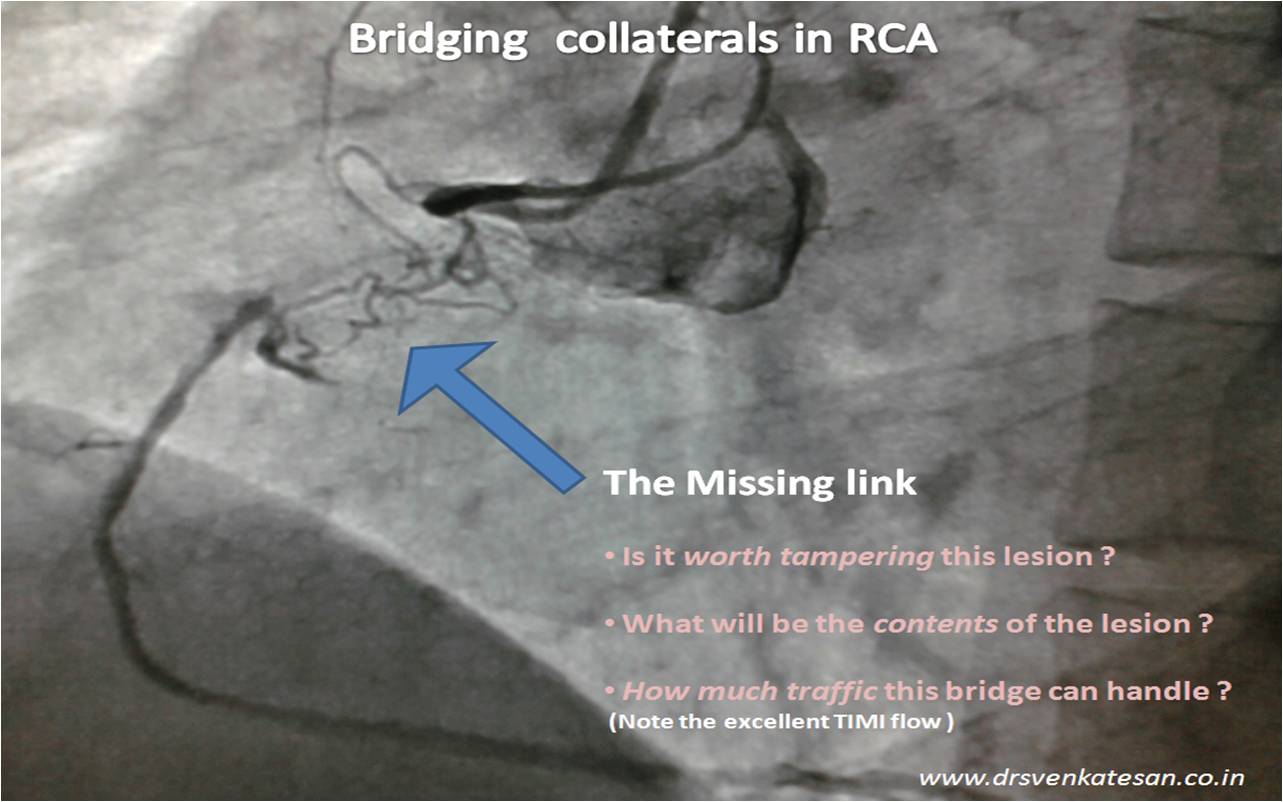
  • Coronary collateral circulation continues to be a poorly understood phenomenon.
  • It reduces the impact  of ischemia , salvage myocardium, keep it viable, and  can  even  be  life saving during a STEMI
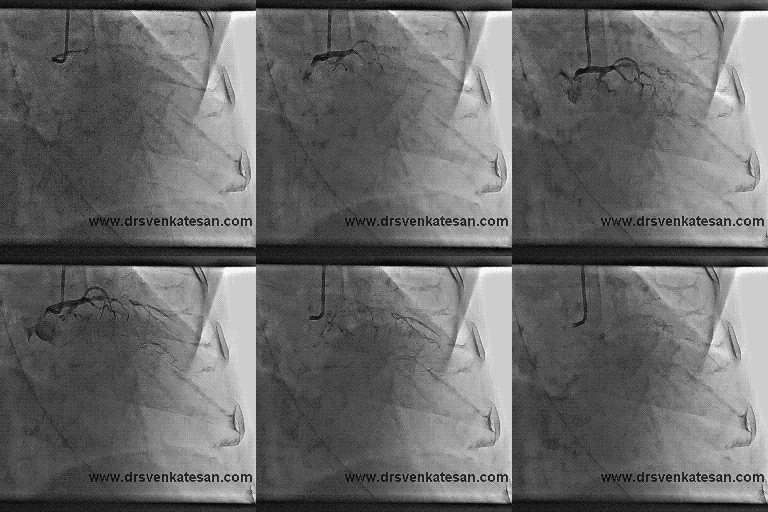
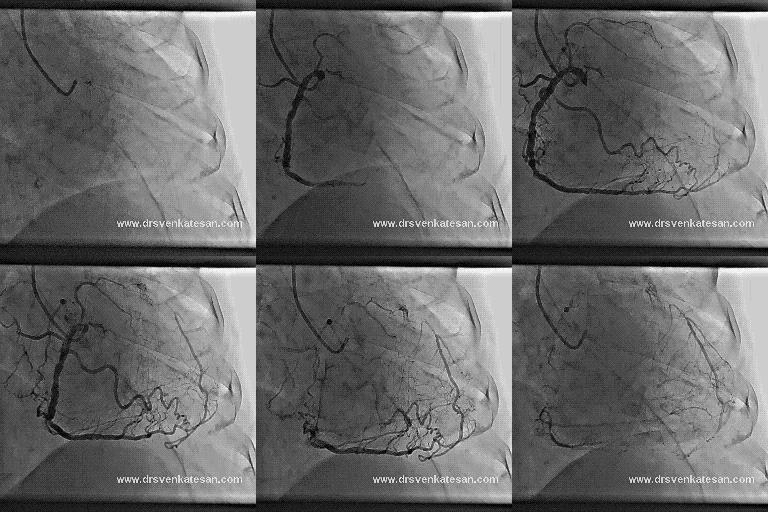
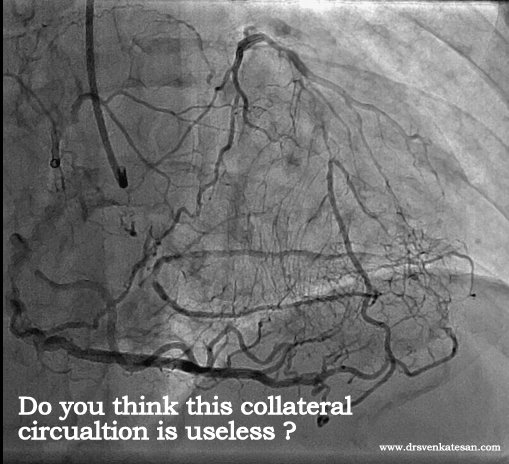
  • It can support either the same coronary artery  or the contra lateral coronary artery (Like the above patient )
  • The usefulness of  collaterals  at times of exertion is controversial .Most interventionists do not believe in  it . (Facts are opposite of course !)
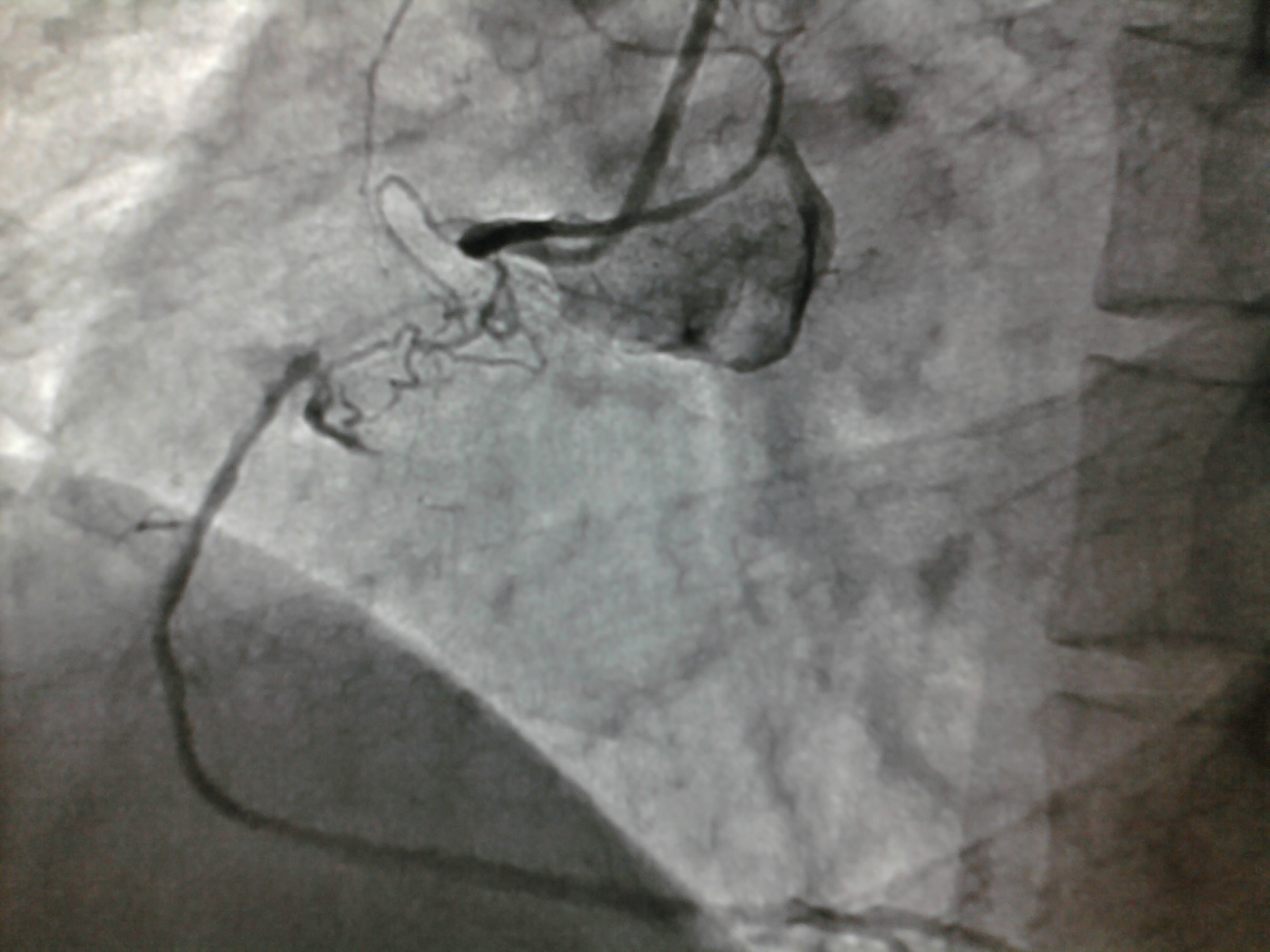
  • Bridging coronary  arterial collateral often indicate hardened total occlusion and success of  PCI is reduced

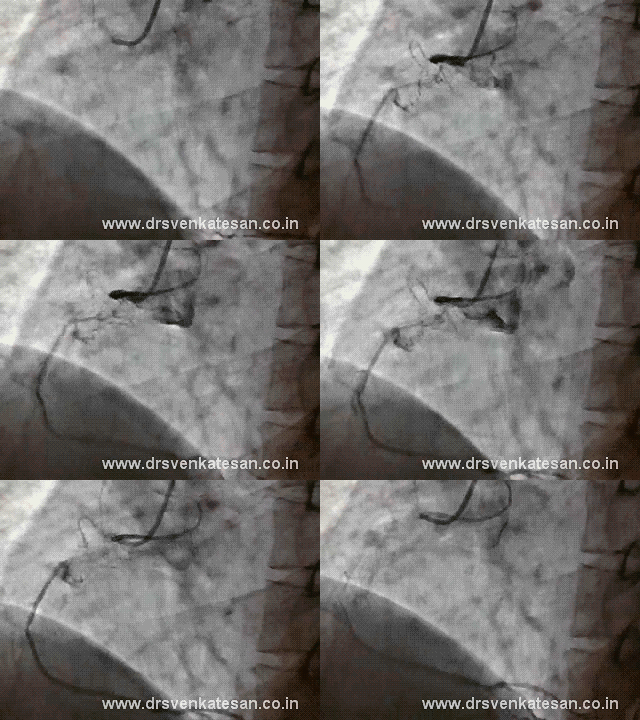
Here is  the  angiogram  which shows classical intra coronary bridging  collaterals.


Read Full Post »

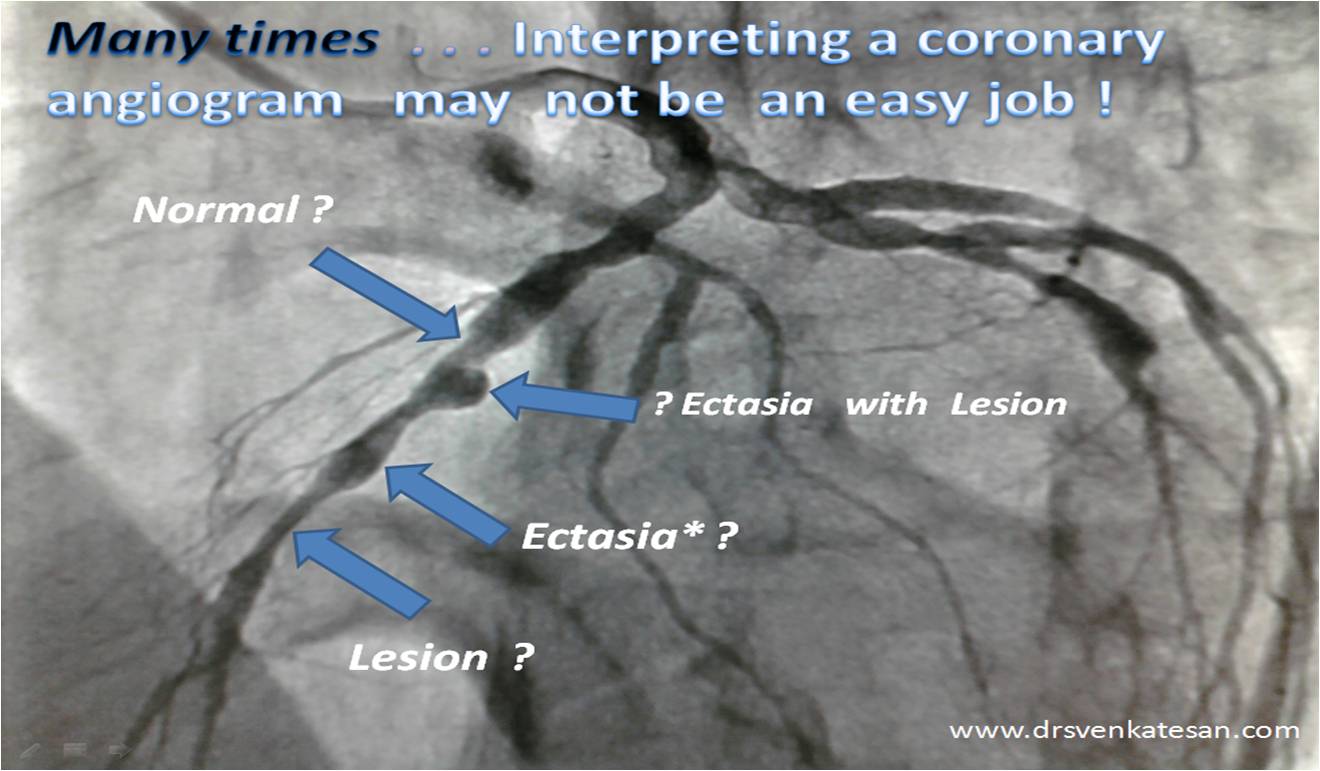
Coronary angiogram is probably the commonest invasive cardiac investigation done  world wide. It should run into millions every year. The procedure once thought dangerous  is now performed in few minutes in day care centers . While doing a  coronary angiogram  has become a minuscule task to most cardiologists, interpreting  it correctly remains a huge task !

Many  of the young cardiologists  get fascinated in   doing a coronary  angiogram and hardly spend enough time and mind in interpreting it.

Most of  us  succumb to the popular occulo  coronary reflex and describe a coronary  artery  lesions as though it is a  number game . It is very rarely we use the quantitative angiography tools available  in the machine. We need to meticulously  analyse   the length , morphology , distal flow, thrombus  , collaterals  etc . (FFR a new avatar tries to do some justice )

Calling   atherosclerois   by numbers alone,   such as  50 %  LAD  and 70 %  diagonal    20 % left main  is a huge  insult    to the deadly  & diffuse  disease process of atherosclerosis .We are paying the penalty for it .This is  the fundamental  flaw in our  reporting , that  makes every coronary intervention redundant.We must first  remember  we are looking at the lumen not the wall of coronary  artery.

Coronary  interventions is not about removing obstructions but  regression of  atherosclerosis  load within the coronary artery , prevent progression of it and ultimately reduced cardiac events and improve  survival. It  is obvious, it can not be achieved by wires and catheters alone . At best they can be adjuncts.One can  easily understand  why medical therapy  scores over wires  as it can take care of the overall disease process.

But still  ,  most* of  the  learned cardiology community  considers medical therapy   to be an adjunct to coronary intervention  , which  is  a  gross ignorance at it’s best !

* This is my perception. If  I am proven wrong ,  I am happy our patients  will be benefited !


Final message

Do not reduce  the importance of coronary angiogram   to a  farce  number game !

Do not get excited  by visualizing your patient’s  coronary artery. It may make you richer by few thousands. Realise , what you are seeing in a CAG is a fraction of coronary  circulation.

It is estimated coronary  circulation we visualize  daily in cath lab as epicardial coronary arteries  is less than  2  % of entire cross section of coronary  circulation.

This means we are 98 % blind ! ( or  2 % wise  !) .Spend  adequate  time and  mind to interpret it correctly  , so that logical and useful  ( non ) interventions can  be done .This only can make you a  true cardiac professional and your patients will respect you.


//

Read Full Post »

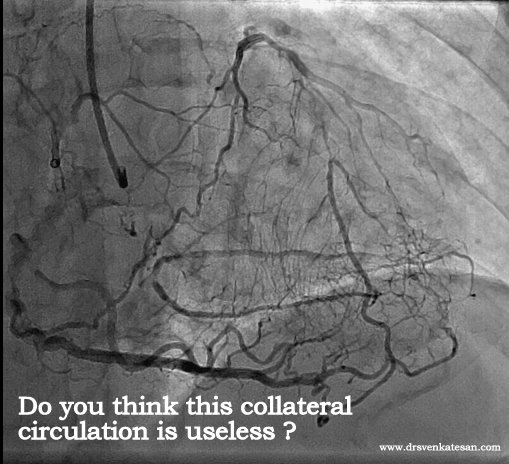
Coronary collateral circulation is probably the most poorly understood circulation than any other.This  is ignorance at it’s best ,  in spite of the life saving potential  of this circulation. A popular  (mis )perception is  coronary collaterals  can support only  resting blood flow and it would  struggle  to compensate at times of exertion. This is based on few case studies and not based on large , authentic scientific data.

Does this reasoning mean  , coronary  collaterals   can never / ever be complete  ?

If we believe so   . . .we are grossly underestimating the power of  nature .(In fact , mankind  was humiliated by the nature  time and again !)

Lessons  from  a unique patient we have  encountered.

Here is an example of total LAD/LCX  occlusion with good collateral  from  RCA. He was having  stable  angina on medical  management . This patient  was not only  asymptomatic and was also negative for exercise  stress test at moderate work load .


There was an  intense debate about the management  when this angiogram was presented in the cath meeting .


  • Most of the cardiologists believed so !  But they had no answers why his stress test was negative.
  • The other argument for CABG was one can not allow a patient with a functionally single coronary  artery (RCA) However good is the collateral circulation.This at least  has some logic. not the first one !
  • One more suggestion was to quantitate  and map the real extent of ischemia by PET scanning and then decide about revascularisation.
  • One critical opinion was , since he was doing well with medical management what was the need to do coronary  angiogram at all ?

Any answers  . . .

He  ultimately went on to receive CABG (By popular opinion ) , but the point here is the collaterals were  good enough to support exertion.We have  documented quiet a few similar patients with collateral circulation supporting exercise.

What  happened to the collaterals  and (of course ) the patient after surgery ?

I will post you the  curious story soon   . . .

Final message

Coronary  collateral circulation , if well developed  can provide hemo-dynamically useful support even at times of exertion *

* The existing literature  is  biased against this concept. It generalizes all grades of collaterals into a single   entity. It is better  if we  spend more time to understand the nuances of coronary collateral circulation .

This is the  message from our observation. Do not ever believe whatever is published as facts in scientific literature. Observe, analyse , create your own inference ,  and concepts. Mainstream cardiologists would brand it unscientific  , Simply ignore it . Many times it is rewarding  to our patients.

Read Full Post »

Life cycle of PTCA : Let us hope it do not become extinct !

Does PTCA  , a great Innovation for mankind,  is facing a threat of  extinction ?

It seems so . . . the stents  are losing its shine  in most situations. A simple evidence  . . . for that . . . can  be found in answering the following question

What drives the extensive research in biodegradable stents now ?

The simple answer is , we are fed up with the metals inside the coronary  artery. We want to get rid of it !

Too much of knowledge , often blunts our senses . Our track record clearly  reveals this fact. We needed a major study INTERHEART to tell the world   that  ,exercise is good and tobacco is bad for heart  !  Now ,we forgot a  simplest solution for  getting rid of  metal inside the coronary artery ,  which  is  “not to implant  the stent”  at all ! (Instead we do billion dollar research for making  bio – absorbable stents ,  which in the first place may not be required in the majority !

Read the related article . Does POBA has a role now ? in my site

The only situation  , where PCI   may  withstand the test of time could be in ACS (Both in STEMI and high risk NSTEMI !) PCI is cosmetic in most of the chronic coronary syndromes .

Final message

Our fight against human atherosclerosis will have to be , by medical means .PCI at best will  provide  a supportive role in selected patient group. It requires lots of common sense  and   scientific ignorance to achieve this.   Risk reduction ,  prevention , optimal   medical therapy  will have to play a dominant role in the next few decades .  This is something similar to the environmental issues we face in protecting our planet .No amount of green industry  will protect  the earth . It requires better social and  behavioral  ethics  from  mankind   and their  rulers !

Read Full Post »

Nothing in this world is black and white. In fact,  most events are in between . The irony is , our brain  always wants to view  things in two distinct entities !

  • Success or failure
  • Beautiful or ugly
  • Good or bad
  • Win or lose,
  • Rich and poor etc . . . etc

So it is no  surprise !  cardiologists  also travel in the same boat !

They classified  the events after thrombolysis   into two dogmatic categories . Successful  thrombolysis or failed thrombolysis   . . .  as if no other event  can occur in between .

Traditionally 50% regression of ST segment is called successful .   What  about 30%  and 40 % ST regression ?

Further , there is an important caveat  in the timing,  as we  traditionally assess ,  90 minutes of thrombolysis .

Consider the following  situation  :

  1. Thrombolysis  is failed at 90 minutes, but  succeeds  at 120/180  minutes ?
  2. Is 50 % ST regression at 180 minutes is as bad  or as good as 25 % regression at 90 minutes ?
  3. How to label a patient who  is extremely comfortable in spite of ECG criteria of failed thrombolysis ?(Surprisingly this situation is fairly common !)

So, without finding answers to some critical questions , we have defined the success  of thrombolysis with  half baked data .

This is exactly , is the reason we  are unable to do a  valid  study on failed thrombolysis, rescue PCI etc .  We know the results of rescue PCI  ,  always  been  contradictory to the general logic !

It is estimated a substantial number of  STEMI patients following   thrombolysis   fall into a category of partially successful thrombolysis implying partial restoration of blood flow and salvage. The correct definition for  successful thrombolysis and reperfusion should be at the myocardial mass level , and  not at the level of coronary artery.The ECG  is the best available indicator.

Implication for having a  poor definition  of  failed thrombolysis

It is not a rare sight to wheel  in , a patient to a cath lab  with label of failed thrombolysis dangling in his neck  who is clinically  stable  (Has a less than required 50%  ST regression , but a definite, favorable trend with a 30 % ST regression  at 90 minutes  )

How many cardiologists will be willing to abort a CAG/PCI  , as a repeat ECG just  before puncturing  in the  cath lab reveals    successful  thrombolysis ? (little  delayed though !)

If only we have better methods to risk stratify patients following thrombolysis , we can avoid

  • Huge costs incurred
  • Expected and unexpected hazards of doing an emergency  intervention in an adequately salvaged STEMI
  • Hundreds of cardiology man hours can be saved  for better purposes .

Final message

Classifying thrombolyis into  success  or  failure  is a  skewed  way of looking  at this important  issue .

It is an irony ,  cardiologists often  triage LV dysfunction , valve disease , cardiac failure  etc  into 4  grades (  minimal  , mild , moderate or severe  ) . It is  still a mystery ,  why thrombolysis  is never graded  like that ,  and it is always considered as  all or none phenomenon !

There is a substantial number of patients  with partially successful ( or shall we call partially failed !) thrombolyis  .This group must be given adequate attention or inattention  . There  is a urgent need for a through review of how we look at  the post thrombolysis status  . It is better to use the newer imaging modalities like PET/MRI more  liberally to identify  exact sub group  of failed thrombolysis who will benefit form revascularisation .

Read Full Post »

Prosthetic valve implantation has revolutionized the management of  valvular heart disease . The original concept valve  was a ball in a cage valve  , still considered as a  fascinating discovery.  It was conceived by the young Dr Starr and made by Engineer Edwards  .This was followed   by long hours of arguments,  debates and  experiments that ran into many months . The  silent corridors of  Oregon hospital Portland USA remain the only witness  to their hard work and motivation.  At last,  it happened , the first human valve was implanted in the year 1960. Since then . . . for nearly  50 years these valves  have done a seminal  job for the mankind.

With the advent of  disc valve and bi-leaflet valve in the  later decades of 20th century , we had to say a reluctant good-bye to this valve.

There is a  lingering question among many of the current generation cardiologists and surgeons why this valve became extinct ?

Starr and Edwards with their child !

We in India , are witnessing these old warrior inside the heart functioning for more than 30 years.From my institute of Madras medical college  which probably has inserted more Starr Edwards valve than any other  during the 1970s and 80s by Prof . Sadasivan , Solomon victor , and Vasudevan and others .

It is still a mystery why this valve lost its popularity and ultimately died a premature death.The modern hemodynamic  men  working from a theoretical labs thought  this valve was  hemodynamically  inferior. These Inferior valves worked  like a  power horse  inside the hearts  the poor Indian laborers  for over 30 years.

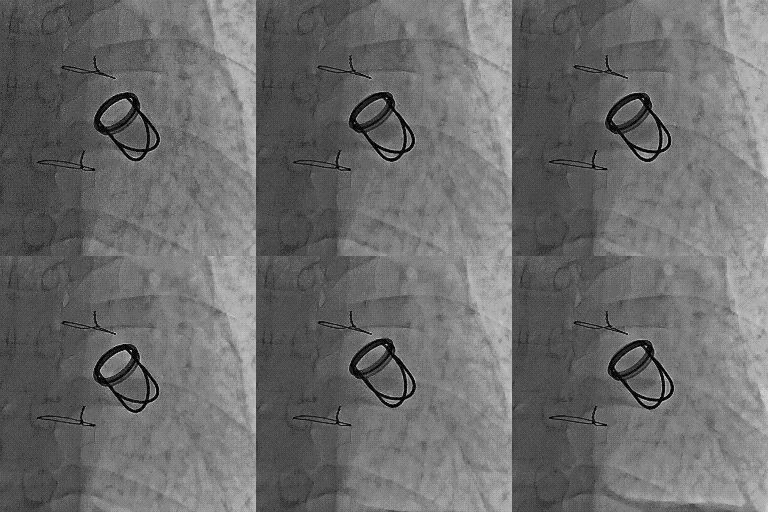
A Starr Edwards valve rocking inside the heart in mitral position

The cage which gives  a radial support* mimic  sub valvular apparatus, which none of the other valves can provide.

* Mitral  apparatus has 5 major  components. Annulus, leaflets, chordae, pap muscle, LV free wall.None of the artificial valves has all these components.  Though , we would love to have all of them technically it is simply not possible.  The metal cage of Starr Edwards  valve partially satisfies this  , as  it acts as a virtual sub valvular apparatus.Even though the cage has no contact with LV free wall, the mechano hydrolic  transduction of  LV forces to the annulus  is possible .

Further , the good hemodyanmics of this valve indicate , the cage ensures co axial blood  flow  across the mitral inflow throughout diastole. .Unlike the bi-leaflet valve ,  where the direction of  blood flow is determined by the quantum of leaflet excursion  in every beat . In bileaflet valves  each leaflet has independent determinants of valve  motion . In Starr Edwards valve the ball is the leaflet . In contrast to bi-leaflet valve , the contact area  of the  ball and the blood in Starr Edwards  is a smooth affair  and  ball makes sure  the LV forces are equally transmitted to it’s surface .

The superiority of bi-leaflet valves and disc valves  (Over ball and cage ) were  never proven convincingly in a randomized fashion . The other factor which pulled down this valve’s popularity was the supposedly high profile nature of this valve. LVOT tend to get narrowed in few undersized hearts.  This  can not be an  excuse , as no consistent  efforts were made to miniaturize this valve which is  distinctly possible.

Sudden deaths from  Starr Edwards valve  .

  • Almost unheard in our population.
  • The major reason  for the long durability of this valve is due to the  lack of  any metallic moving points .
  • Absence of hinge  in this  valve  confers  a huge mechanical  advantage with  no stress points.
  • A globe / or a ball  has  the universal hemodynamic advantage. This shape makes it difficult for thrombotic focus to stick and grow.

Final message

Science is considered as sacred as our religion Patients believe in us. We believe in science. A  good  durable valve  was  dumped from this world  for no good reason. If commerce is the  the main issue ( as many still believe it to be ! )  history will never  forgive those people who were  behind the murder of this innocent device.

Cardiologists and Cardio thoracic surgeons are equally culpable  for the pre- mature exit of this valve from human domain.  Why didn’t they protest ?  We  can get some solace  ,  if  only we can impress upon  the current valve manufacturers  to  give a fresh lease of life to this valve .

http://www.heartlungcirc.org/article/S1443-9506%2810%2900076-4/abstract

Read Full Post »

« Newer Posts - Older Posts »