T waves attract less attention in STEMI ,except for the fact tall T waves implies hyper acute phase of STEMI.
What is the duration of hyper acute phase ?
- Few seconds
- Few minutes
- An hour
- Few hours
- Any of the above
Answer
No one exactly knows .It can be highly variable . So , 5 could be the correct answer .
* Most importantly hyper acute phase need not occur in all patients with STEMI as suggested in experimental models.
Some observations in T wave behavior in STEMI
Mechanism of hyper acute T waves
It is the pottsium channel dynamics.Transient intracellular hyperkalemia is thought to be responsible.
T wave as marker of reperfusion
Inverted T wave in precordial leads are a good marker of IRA patency especially in LAD
Slowly evolving STEMI
This is relatively new concept . STEMI with a prolonged hyper acute phase , ie , T waves ” dilly dallying” for hours or even few days have been recognised. (This was refered to pre-infarction angina in the past )
This sort of T wave behavior makes it difficult to diagnose STEMI.Enzymes will help , still thrombolytic guidelines demand us to wait till ST elevation to occur. This is unfortunate .But as physicians we are justified to thrombolyse tall T waves with a clinical ACS .The other simple solution is to shift the patient to cath lab to find what exactly is happening in the LAD !
Now , what is new about T waves in STEMI ?
It is the localizing value in LAD infarct
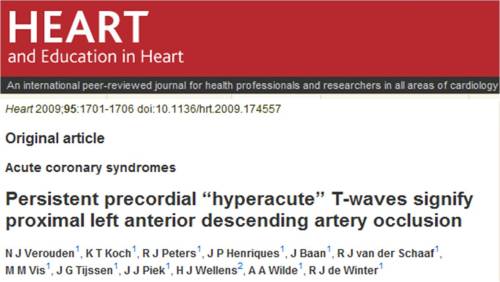
A tall persistent hyper acute T wave helps us to localise a LAD lesion .This paper from Netherlands , clearly confirms this observation. The study was done from a primary PCI cohort, a perfect setting to assess the T wave behavior in the early minutes /hours of STEMI .
Other mysteries about T waves in STEMI
Does hyperacute T waves occur in infero-posterior STEMI ?
I would believe it is very rare .Our CCU has not seen any tall T waves in inferior lead. Further analysis of the data from the above study could answer this question .
How often a hyperacute T waves transform into NSTEMI ?
This again is not clear.Most of the hyper acute T will evolve as STEMI .But , nothing prevents it to evolve as NSTEMI a well . After all , a hyper acute T MI can spontaneously lyse in a lucky few , ( Who has that critical mass of natural circulating TPA ) .If these natural lytic forces are only partially successful , it may evolve into de nova NSTEMI.
Bi-phasic T waves in ACS.
A benign looking T waves with terminal negativity in precordial leads can some times be a deadly marker of critical LAD disease.This has been notorious to cause deaths in young men which often correlates with the widow maker lesion in LAD.
What is a slowly evolving STEMI ?
Prolonged tall T wave phase possibly indicate , the myocardium is relatively resistant to hypoxic damage .
The most bizarre aspect in our understanding about ACS pathophysiology is the concept of time window , based on which , all our ACS therapeutics revolve !
Does all myocardial cells have a same ischemic shelf life ? Can some patients be blessed with resistant myocardial cells when confronted with hypoxia or ischemia ?
It is well-known , in some hearts , the muscles go for necrosis within 30 minutes of ischemia, while some hearts can not be infarcted even after 24 hours of occlusion .So , slowly evolving STEMI is a feature of myocardial ischemic resistance .This is not a new phenomenon as we have extensively studied about the concept ischemic preconditioning .
We wonder there is something more to it . . . the quantum of preconditioning can be inherited .Further , we are grossly ignorant about the molecular secrets of non ischemic metabolic preconditioning .
Final message
T waves attract less attention in STEMI . Cardiologists are often tuned to look only the ST segment , after all , ACS itself is classified based on the behavior of this segment.(STEMI/NSTEMI) . We need to recognise ,there is a significant subset of ACS affecting exclusively T waves. Shall we call T elevation MI ? ( TEMI )
Do not ignore T waves in STEMI. It has more hidden electrophysiological treasures that is waiting to be explored .
Read Full Post »





 Dr.S.Venkatesan MD
TRANSFER-AMI study : Transfer with caution . . . bumpy roads ahead !
Posted in Cardiology -Interventional -PCI, cardiology -Therapeutics, Cardiology -unresolved questions, cardiology journal club, cardiology journals, Uncategorized, tagged comments about transfer ami, facilitated pci, FAILED THROMOLYSIS, journal watch transer ami, letters to the editor transfer ami, nejm transfer ami, REACT STUDY, rescue pci, routine early pci, stemi, tenecteplase failure, time window for pulmoanry thromolysis, TRANSFER -AMI STUDY on January 14, 2011| Leave a Comment »
Preamble
The much published TRANSFER -AMI study has few important queries to ponder about.It was supposed to test the role of routine PCI following thrombolysis. In other words it compared rescue only strategy with routine strategy.The caveat is , even among failed thrombolysis, the rescue strategy has not convincingly proven superior to medical management (if the time is lapsed ) as much of the damage is done .
Will the investigators share their experience ?
Finally
Why the title of the paper says it is about “Routine angioplasty” and the conclusion emphasizes it is indeed “high risk subsets ofangioplasty” (While the study itself involves a 92 % least risk Killip class 1 ) . Why this double dose of confusion ? (Is it deliberate ! Which i think is unlikely )
NEJM please take note of this . . .
All that glitters are not natural glitter . . .some are made to glitter !
Rate this:
Read Full Post »