Feeds:
Posts
Comments

Archive for the ‘echocardiography’ Category

Learning and sharing of  knowledge is one of essential qualities of  that make the man kind unique.

But not everyone is ready to do that . A cardiologist from Paraguay shows the way .  . .

Probably a model web site for all academicians .It exemplifies ,  how a medical web site is  to be created and presented .This one is for learning echocardiography .

Though the author calls  , it as  basics it has fairly advanced contents , so it should be useful at levels .

With  due  courtesy  to   Dr  Derliz Mereles I am linking his web site  in my blog .

http://www.echobasics.de/tte-en.html

Read Full Post »

The principles of pre-discharge EST  

This concept came about 20 years ago (1980s) to risk stratify patients following  ACS to triage early coronary angiogram and revascualrisation. Generally patients are discharged by 5-7 days after an MI  (May be  3-5 days in some hospitals)  . Doing an exercise stress test  early within  2 weeks has not been very popular with many cardiologist even though it was recommended by many guidelines.The type of stress recommended  here  , is heart rate limited sub maximal 70% of  THR (Usually around  140 /mt )  is performed . This is due fear of precipitation another ACS.

Still,  there are definite  advantages for  pre-discharge EST .It help us  identify  high risk  subsets of  STEMI and reduce the  intermediate term mortality .More importantly it  gives  us an opportunity  to  exclude  inappropriate  revascualriations  even without an angiogram . (The well known coronary dogma  ie  if a post STEMI patient performs > 10  METS ,  his  heart carries little  risk  for  future events  still holds good  !)

With the advent of liberal usage of CAG and improved techniques of revascularistion ,  most  patients  directly undergo pre-discharge CAG rather than EST !

Further reading

Does any cardiologist have guts to do a pre- discharge EST after  a successful primary PCI ?

Read a related article in this blog .

Read Full Post »

A 32 year old unmarried female with rheumatic heart disease   presented with class  3 dyspnea . She had severe mitral  stenosis with significant calcification , subvalvular fusion , and  a LA appendage clot . She had an aortic valve  which showed mild to moderate AR*  was  and  mild  Aortic stenosis ( Peak  Aoric gradient 30mmhg ).LV diastolic dimension was 40mm and systolic 26 mm .LA was huge 48 X 56 mm  EF was 66 % .

* The patient was having three echo reports done in various parts of the state ranging from mild  to severe  AR . I did the echo myself and I  was convinced  ,  it can at best termed as Mild AR . Let us take it as moderate AR for discussion  

To my surprise  , this patient  was   being planned for double valve replacement . (MVR  and AVR ) .

I agreed with MVR since the valve was completely  damaged and neither PTMC or mitral valve repair  is possible.

However  , I was taken aback   , how can  one  plan for a  AVR for mild aortic valve disease ? I  asked the surgeon  ?

The answer was even more a shocker to me .

Since we are  opening the chest for MVR it is better to replace Aortic valve as well . Since  repeat surgery can be avoided .

The surgeon seemed to be very much convinced about this argument .

I asked him ,   is the mortality /morbidity due to DVR is too high  to take a risk .

The LV dimension is absolutely  normal (In fact it is less than normal !)  so  the AR is definitely not significant .

The surgeon was in no mood to leave me . He argued ,  Since the mitral stenosis is severe , the AR is  probably underestimated .   ” We have quiet a few experience of AR worsening after MVR” ? he asserted !

I still fail to  understand  the reasoning of the surgeon .

How is that ,  indication for AVR could vary if it is  accompanied by  mitral valve disease . If the same patient has  isolated moderate AR  AVR is  forbidden  . Poor patient !

By the way , we have problems with our patients as well .I recall an event ,   a  disappointed  patient’s  spouse  arguing  with his the doctor for not fulfilling his Initial  promise of  replacing two valves . We are living in difficult times , I agreed with the surgeon !

Do we have  alternate solutions ?

  1. Assess on table after MVR by TEE if the AR seems worsen proceed with  AVR .
  2. Modern technology might answer .Let us dream  TAVR for rheumatic valve . . . not too far ?

*Transcutananeous Aortic vale replacement .

Final message

Cardiologists and cardiac surgeons should take extra care before finalizing a decision on DVR in any combined valve disease. It may seem  easier to replace two valves . Please spend few moments silently and think about these young men and women  . Valve replacements are  not like replacing  worn tires of your car.  Do not  burden the heart with multiple artificial valves without a real need for it !

The rate of progression of Aortic valve disease following MVR  can be slower than we think . With surgical techniques and  expertise   improving every year ,   repeat aortic surgery may be done safely in selected few ,  in case it becomes necessary !

Read Full Post »

Doppler Mitral Inflow velocity profile   is the key to  assess LV diastolic function . The ratio between  E and A has become most popular parameter .

In the absence of atrial contraction what shall we do ?

The answer is simple .  We have 2 D parameters of LV diastolic function.

LA dimension ( > 30 % basal dimension which is  usually >  4 cm  ) is a most specific marker of diastolic dysfunction in the absence of   mitral regurgitation or stenosis.

The only available  velocity E wave profile  can help .A short  E deceleration time in a short cycle  would suggest  significant diastolic dysfunction.High amplitude   E  wave  > 2  M/sec in the absence of MR  will suggest diastolic dysfunction .

Curiously  ,   it can be  assumed    an episode of   lone AF  per-se   ,  be an indicator of diastolic stress for the left atrium .

After all ,  why should a person all of a sudden develop an episode of AF .(Hypoxia, Ischemia ,  excluded )

Other parameters.

Mitral annular velocities / E propagation velocity   / E/E’  are other tissue Doppler parameters  can be used.

Pulmonary venous flow velocity is  largely not useful  (Since A reversal does not occur )

Read Full Post »

A pulse wave is generated  with each heart beat  when  the potential energy is converted into kinetic energy.

  • For the pulse wave  to travel from the heart to periphery  Aortic integrity is vital.
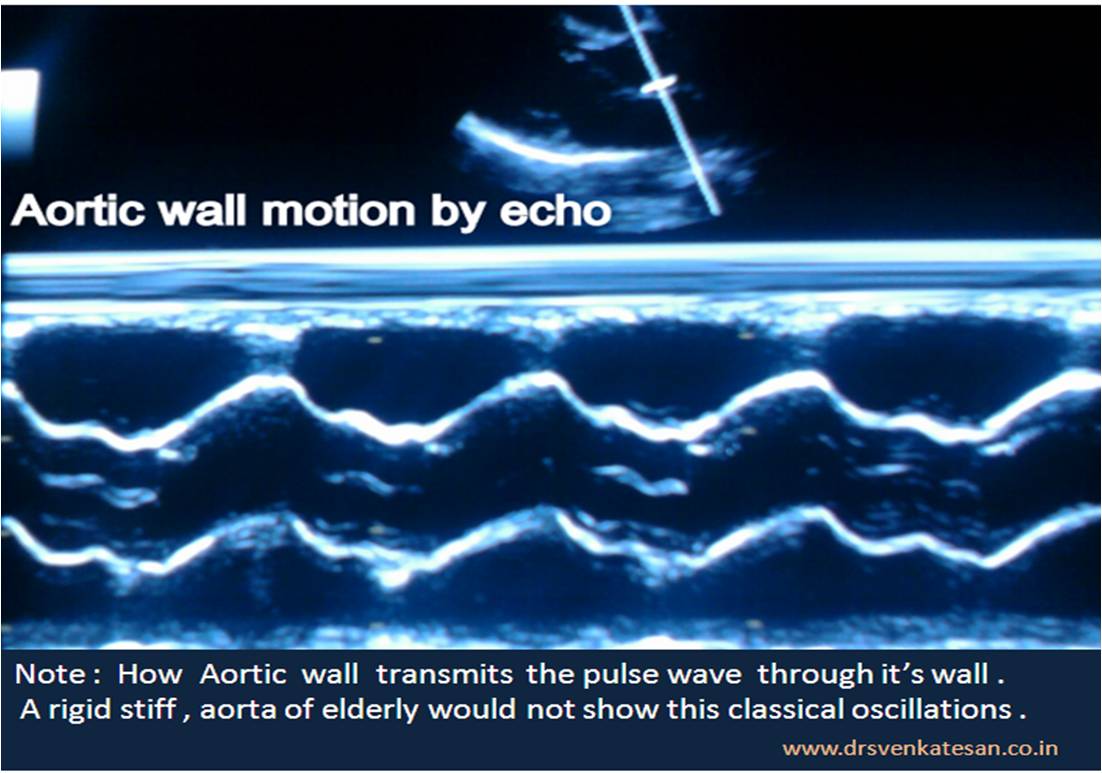
  • The pulse wave travels through the walls of arterial tree  , in the process the wall itself is set into oscillations .
  • Whether the  moving blood imparts the  pulse  on the walls or the walls itself  vibrate  independently is not clear .

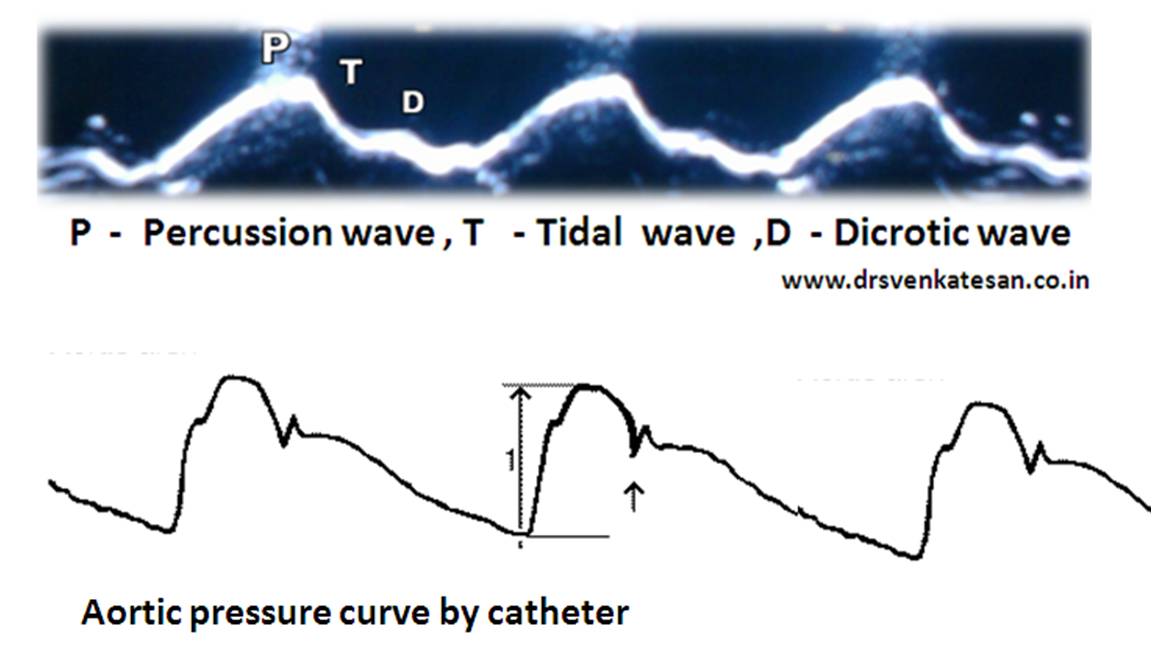
The following   M -Mode  echocardiogram  of  aorta from young man   stunningly  documents  the  morphology  of  central aortic  pulse  wave . Note how closely it resembles the  Intra- aortic  pressure curve recorded with a catheter.

The anterior aortic wall motion was sliced from the above motion image  to create a non invasive recording of aortic   pulse wave

This simple observation was made in  a crowded  echo lab our hospital. Cardiology fellows can explore  further  ,  the link between aortic pulse transduction (From mechano -hemodynamics)

Further studies are warranted regarding the  rate of raise (Slope)  of aortic  wall motion  , and the quantum of motion ,its correlation with central aortic pressure etc. This would unravel the the mechanisms  of Isolated systolic  hypertension  , where a stiff aorta amplifies  the systolic pressure due to loss of elasticity .

Read also

Rail roading of  Aorta in Severe  LV dysfunction

Wind Kessel effect

Read Full Post »

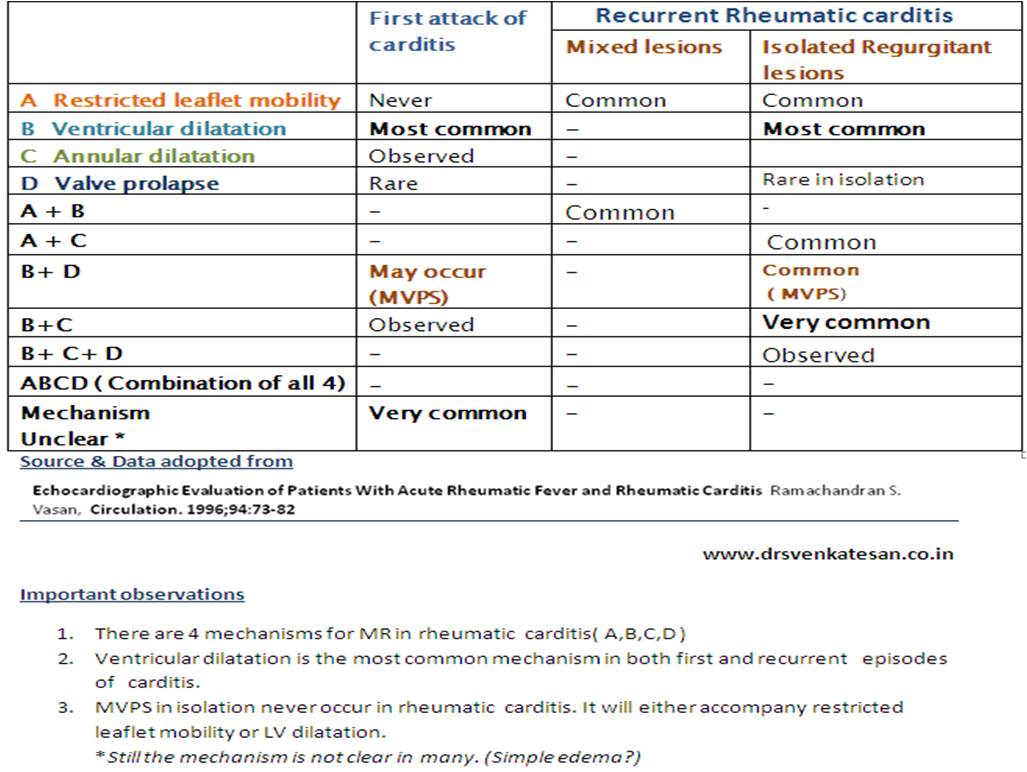
Rheumatic valvulits , Valvular inflammation and edema  is the traditional answer .A detailed Echocardiographic study from All India Institute of medical sciences New Delhi  ,India  which was published in circulation 1996 answers this question most authentically .

From a meticulous  Echocardiographic  study of about 70 patients  (with both first and recurrent episodes of carditis ) the following findings were observed.

After reading this article one should be able to answer variety of  questions in RHD  such as

  • How common is MVPS in RHD ?
  • How often MR dissapear with Aspirin etc ?
  • Echocardiographic correlates  for care -coombs murmur ?

Reference

http://circ.ahajournals.org/content/94/1/73/T5.expansion.html

Read Full Post »

I stumbled upon this image from the Heart journal. A good depiction of  IAS aneurysm in three dimension.

Image courtesy  : Heart 2012;98:79-88   Three dimensional echocardiography in congenital heart disease   by  Joseph John Vettukattil

Further  reading

Clinical implication of IAS aneurysm

Read Full Post »

Echocardiogram in pulmonary HT has many aims .

  •  Identify the etiology
  • Assess the effects of PAH  on the right heart
  •  Estimate the severity of PAH.
  • Possibly prognosticate

Echo helps us to confirm the valvular, myocardial or congenital heart diseases in the evaluation of PAH. Apart from these etiological diagnosis of PAH predominantly lies in a systematic medical work up .(Read Dana Point classification )

2-D features

  • RA RV dilates
  • RVH*may occur (Dilation is more common )
  • IVS assumes  a D shape  ( RV pressure is close  to or   even > than  LV pressure )
  • Tricuspid annulus dilates

* For some reason RVH  does not occur commonly in pulmonary hypertension ,  while LV hypertrophies promptly in systemic hypertension .

Doppler

  • Tricuspid valve begins to leak  and RV ejects   with giant “cv”  waves into RA/JVP

Other Echo  findings

  • MPA may dilate
  • Pulmonary regurgitation

At what pressure RV begins to dilate  in PAH ?

It is  not known .It is highly variable . But most will dilate their RV at a systolic pressure > 50mmg.

It is also possible the onset of TR and the magnitude of  TR has a major say in the  timing  of RV enlargement .

We know RV is more sensitive to volume overload than pressure overload .

Paradoxically , it is often observed   acute elevation in RV pressure  dilate the RV faster than chronic ones.
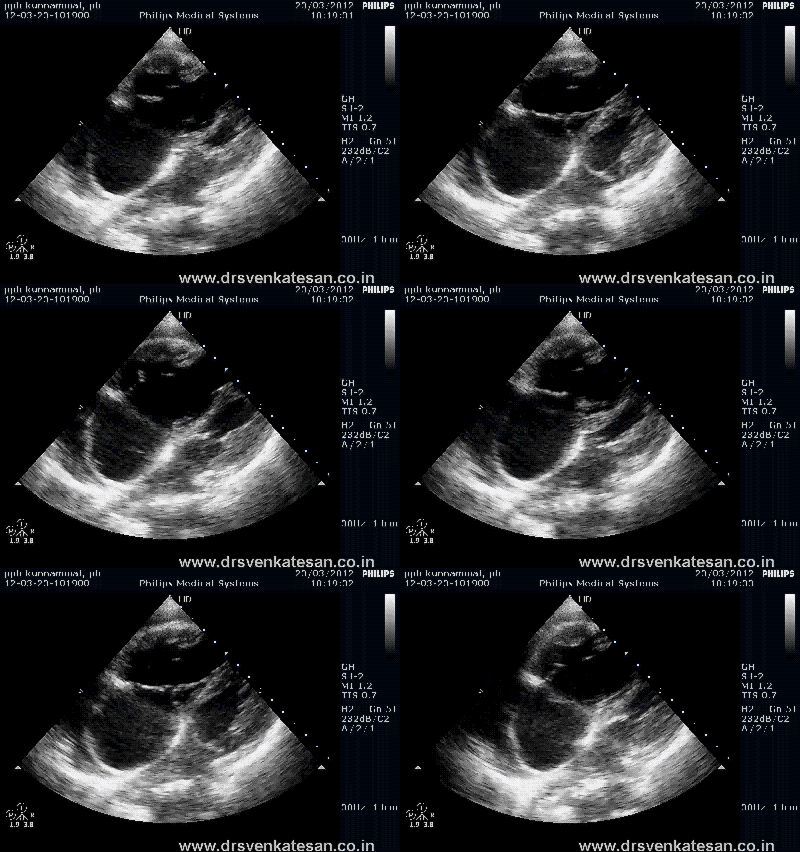
Right atrium and right ventricle are significantly
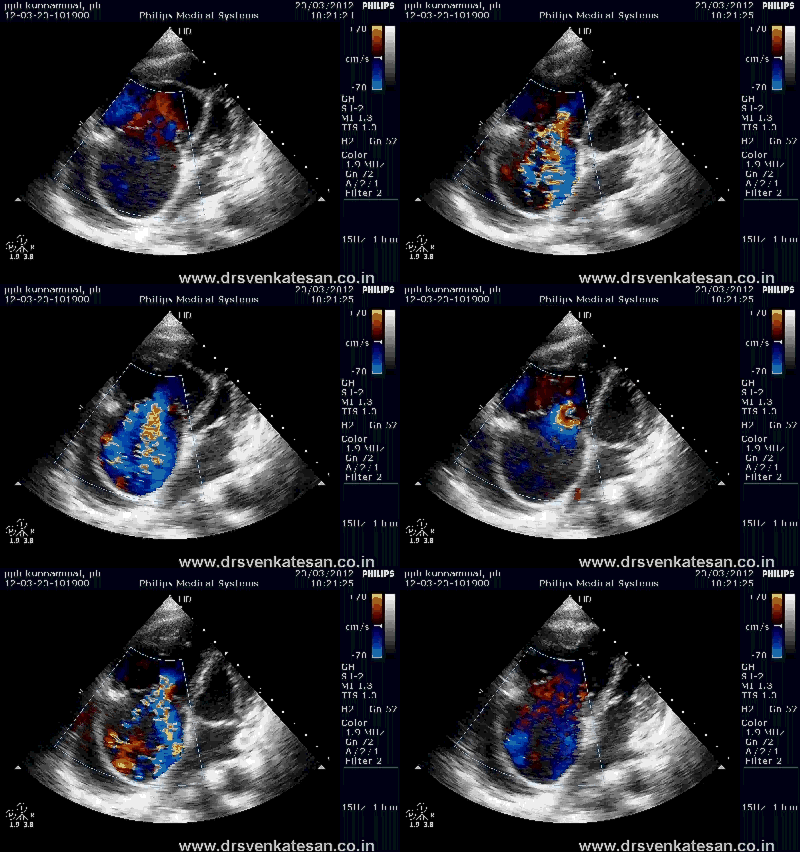
The tricuspid annulus is dilated .Note the severe TR with twin jet morphology.

Estimating Pulmonary artery pressure

PA systolic pressure  :  TR jet + 10 mmhg

PA diastolic pressure : PR end diastolic jet + 10

PA mean pressure  :  Peak PR gradient

Other complex methods to arrive ar PAP in the absence of TR or PR

The Dabestani -Mahan  ‘s equation*   – The  mean PA pressure = 90 – (0.62 X acceleration time).

It is popular   for  calculating PAP by measuring pulmonary artery Doppler  acceleration  time  .

Many   believe  it is  neither  sensitive  nor practical  in real  clinical setting.

*Even though Dabestani is the first author of this paper   Mahan  got the full credits for the simple reason his name is easily remembered   !
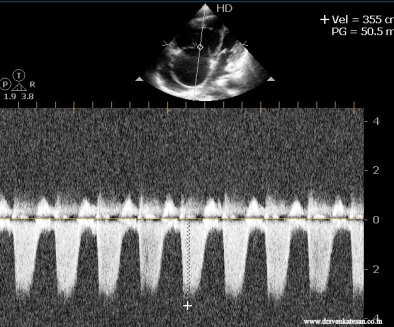
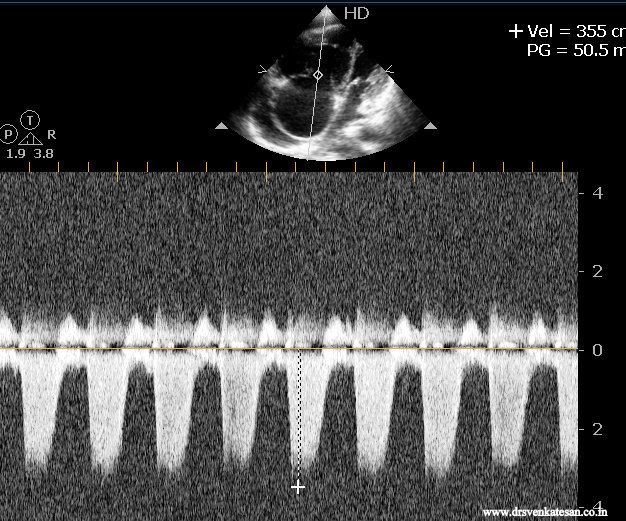
Note the peak TR jet is around 50mmhg and predicted RVSP would be 60mmhg.One would have expected still higher RV pressure but since the RV is dysfunctional the true PAP may be underestimated.
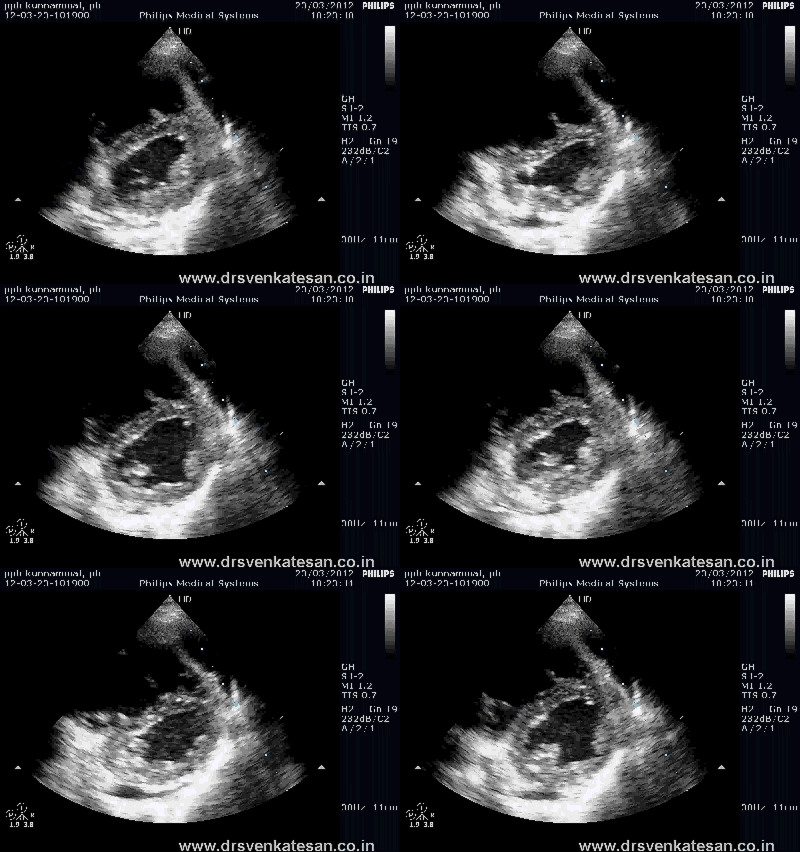
The classical D shaped IVS during systole . D shape indicates RV pressure during systole is almost equal or even higher than LV. ( Please recall D shape occurs in Volume overload also but the timing is in diastole !)

Pulmonary valve  M-Mode

According to Wyeman  the following M mode signs are useful in diagnosing PAH.

  1. Presence or  absence and the amplitude of the “a” wave
  2. magnitude of the e-f slope
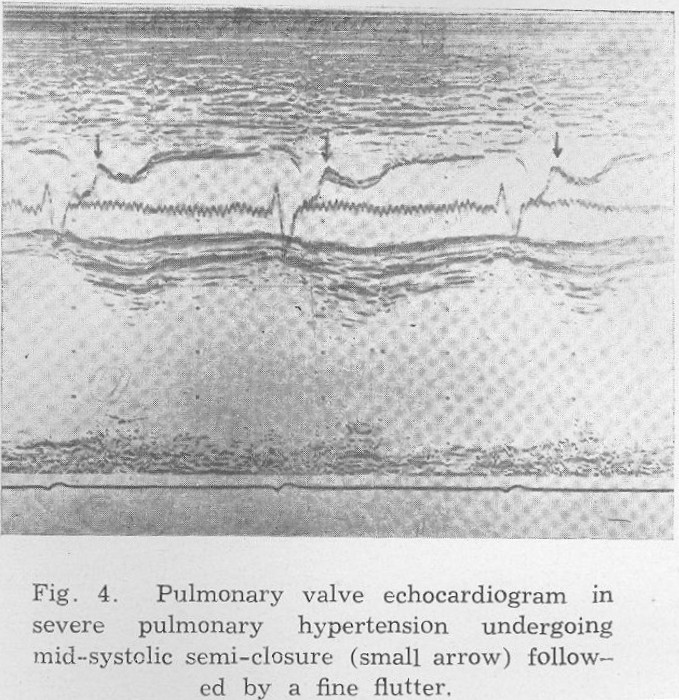
  3. presence of mid-systolic closure or notching
  4. fluttering of the posterior pulmonic leaflet

Currently ,  one may consider M-Mode echo to be  an obsolete  ,  but still the foundations help us understand the hemo-dynamics.

The most important principle in  the motion of  pulmonary valve ,   is  the relationship between pulmonary “a” wave and right atrial “a” wave

Normally atrial contraction produce an inward movement* on the closing pulmonary leaflet . This  happens because the MPA  end diastolic  pressure is usually lower than  right atrial a wave    .In severe PAH  the elevated pulmonary diastolic pressure  does not  allow  the atrial contraction to   intend the pulmonary leaflet in pre-systolic atrial contraction .Hence pulmonary valve  a wave in m -mode  is  diminished or even absent .

In PAH even   premature closure of pulmonary valve may occur resulting in mid systolic notch   .This  is referred to as flying “W” -Mid systolic notch.   (See below)

* The motion  we see in  short axis M-Mode is that of   left pulmonary cusp that moves  posteriorly.
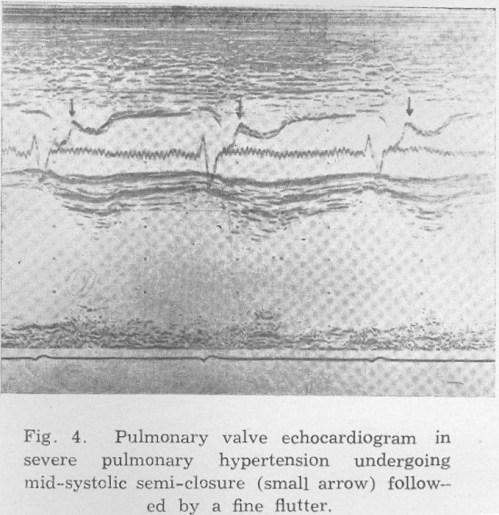
Image source : Karmarkar SG. Pulmonary valve echocardiography. J Postgrad Med 1979;25:219-23

Absence of a dip is a hemo-dyanmicaly important sign pf PAH  but with one important caveat  .This absence of a dip is valid  only until RV failure occur.In th presence of elevated RVEDP a begin to appear again

Reference
1 Karmarkar SG. Pulmonary valve echocardiography. J Postgrad Med 1979;25:219-23

2.http://circ.ahajournals.org/content/50/5/905.full.pdf

4.Kitabatake A, Inoue M, Asao M, Masuyama T, Tanouchi J, Morita T. et al. Noninvasive evaluation of pulmonary
hypertension by a pulsed Doppler technique. Circulation. 1983; 68(2): 302-9.

5.Stevenson JG. et al, Comparison of several noninvasive methods for estimation of pulmonary artery pressure. J Am
Soc Echocardiogr. 1989; 2: 157-71.

 6.Yock PG, Popp RL. Noninvasive estimation of right ventricular systolic pressure by Doppler ultrasound in patient  with tricuspid  regurgitation. Circulation 1984; 70:657-62.

Read Full Post »
What will be the  pulmonary capillary wedge pressure ( PCWP ) in grade 1 LV diastolic dysfunction ?

  1. Significantly elevated
  2. Marginally elevated
  3. Usually Normal
  4. It depends upon  age, LA size and LV  function.

Answer is 3 . (Of course  it depends on  4 )  Normal PCWP  is  4-12mmhg

Are these patients with grade  1 LV diastolic dysfunction  are at  risk for  acute pulmonary congestion at times of stress ?

Probably not ( in  most )*

                                             The grade 1  LV diastolic dysfunction or defect is the most used (abused ! )  echo terminology .The diagnostic simplicity of this condition namely  a simple documentation of “a”velocity more than “e” , has made it  as an epidemic in echo labs  world wide. After all  , it reflects a simple  fact that  left ventricle  has  summoned   the atria  for assistance   (Which is  all the more  physiological   at times  of stress   !)

When does this physiology becomes pathology ?

As long as  the atria is  doing its job of assisting the LV without any fuss  ,  the mean pressure of LA(PCWP) is maintained  within  normal level . Only if the atrial function is stretched  beyond the limits ,  PCWP begins to raise.  It can happen  in a variety of  ways . Most commonly it happens   elderly hypertensive /Diabetics  especially with LVH .

It can also occur in healthy individuals when they become physically deconditioned. (Left ventricle   goes  for  disuse and find it difficult to relax)

Final  message

Isolated  grade 1 LV diastolic dysfunction in people  > 40 years   generally do  not indicate a serious  abnormality.

Only if they have DM/HT and myocardial  disease they need to be evaluated further.

One practical clue is ,  if LA size is normal one can rule out  significant  diastolic dysfunction.

Caution

* In elderly population ,   when they undergo any major  surgery ,  presence of even grade 1 LV diastolic dysfunction can be a marker for peri -operative LVF and  lung congestion .

Read Full Post »

Left main coronary artery is  considered as the sanctum sanatorium  for  the cardiologists .

One would wish  to rule out  disease of left main  in any given  patient with CAD.

Though there are strong clinical predictors of  LMD, this  segment of the coronary artery  tends to  throw   surprises.

A  strongly positive stress test,  ST elevation in AVR  , fall in blood pressure with exertion  are good markers of left main disease.

Still,  in the era of  optical coherence tomography (OCT )  and IVUS  , we do  have a simple tool that can image the left main coronary artery fairly accurately .

We know the  resolution power of  routine trans thoracic echo  is 3mm and above  . (It can detect vegetation of that size easily !)

So , it can easily accomplish  the task of  imaging the  left main ostium .(which is a minimum of  4-5mm diameter )

How to image left main by echo ?

  • Parasteranal long axis  or short axis  the ideal view. Short axis would also  help.
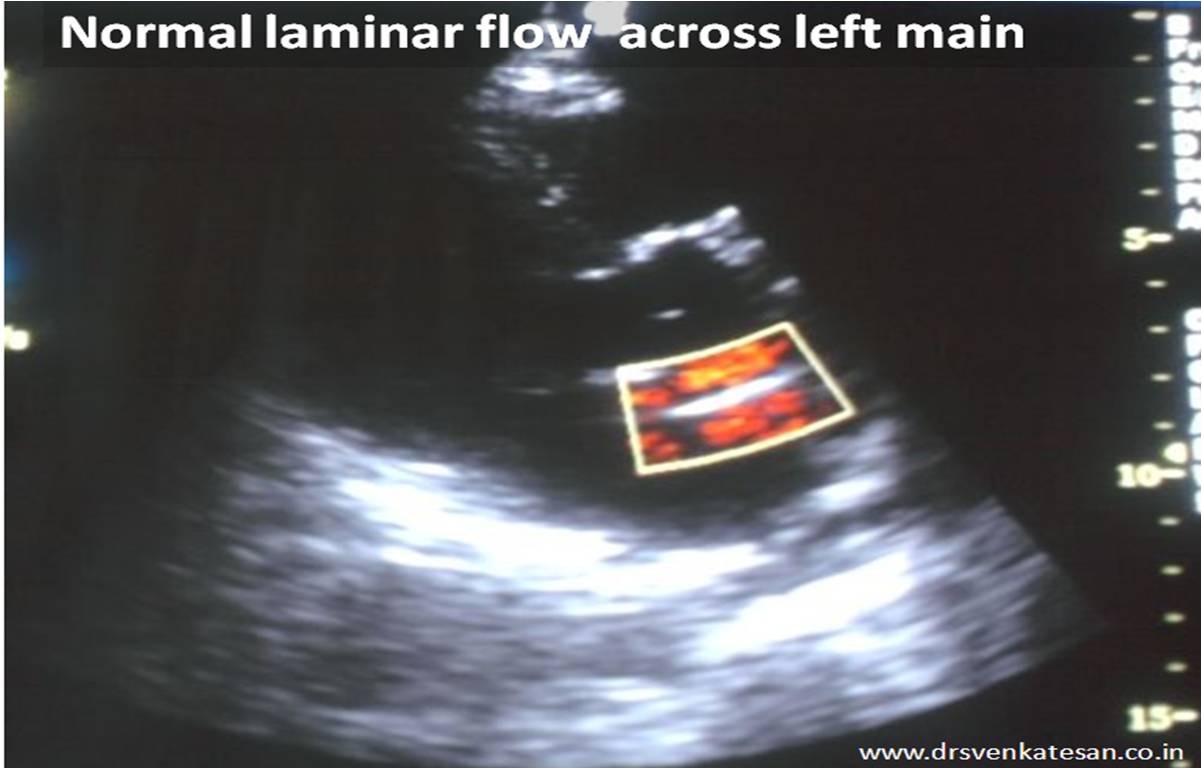
  • Normal left main is easily diagnosed  by two parallel  lines . ( See above picture )
  • Plaques are  diagnosed when this line is  distorted  and filled by haziness.
  • Significant ostio proximal  lesion must never be missed by TTE .However distal left main can not be assessed in most .
  • Doppler assessment may not be possible in all as pulse doppler sample volume can not be placed in left main.
  • Trans esophageal echo would increase the yield.

Final message

Processing power of echo machines  and  their image quality has improved  vastly over the years. The existing literature about left main imaging  by echo are based on old generation machines. The data are as obsolete as those  machines . This has to be kept in mind.

I wonder why most cardiologist are averse ( rather feel guilty ) to report  the  status of  left  main  artery  by  echo cardiography .

Every patient with  a  positive TMT must undergo a  focused echocardiogram  of  left main . You will be rewarded with a  good glimpse of the sacred segment  of coronary artery 9 out of 10 times  !

So , can we shoot the Left main  at the bed side  ?

Yes definitely  . . . if only we wish to !

* A correction

The left coronary visualised in this parasternal Long axis view is in fact exceptional. The ostium and shaft often better seen in short axis in around 3-4 O clock position.

Read Full Post »

« Newer Posts - Older Posts »