Feeds:
Posts
Comments

Archive for the ‘Uncategorized’ Category


                                          CRT , cardiac resynchronisation therapy  is being  projected  as a revolutionary treatment for cardiac failure , where a failing heart is rewired electrically through multiple leads and make it contract  more effectively.The success rate of CRT was highly variable.The basic question here  is,  there should be a  significant  documentation of desynchronisation  prior to CRT , for resynchronisation to be effective. Further , the sites of  myocardial  stimulation ( Coronary sinus/LV epicardial) , dose of electricity and the sequence of stimulation and the  electrical delay  are very  critical. Achieving this into perfection  is not a simple job and is  real rocket science ! ( If we can achieve 5 % of what  the normal purkinje network do within the LV we can term it a huge success.) Let us hope we catch up with nature . Finally , it is ironical  the sites of LV pacing ,  electrophysiologists  select currently  is infact not selected by them but pre selected by the patients coronary venous anatomy ! .So as on date ,  one can imagine how scientific this treatment could be !

                                         Initially it was adviced for patients with only wide qrs later for even normal qrs patients.When people started using it indiscriminately  insurance companies started to rethink and thus came the   RETHINQ study in NEJM  and brought a full stop to CRT in normal qrs CHF.

How to identify who will benefit from  the costly CRT  ?

It is a million dollar question. So millions of dollars were spent to identify the correct tool to identify the true responders to CRT.Echo cardiography with sophisticated methods tissue doppler, tissue tracking and , 3 D echo ,velocity vector imaging were done .These methods are not only costly but also time consuming and  hugely expertise driven.

Does all this  efforts with  advanced echo techniques worthwhile ?

This simple question was addressed in PROSPECT study in circulation

Click to read the article

Read Full Post »

     The greatest discovery in medicine is  “ common sense” and

    “democracy”.           

                       The greatest medical discovery  is the realization that medicine is an constantly evolving science. It needs lot of knowledge to know our ignorance . Common sense has probably saved more lives and reduced suffering in this world than any other single discovery. Note this glaring irony ! It has required a large multi national long term follow  up study (INTERHERT) to prove exercise and physical activity is good for health. Whatever science is teaching us it is we, with our sixth sense have to act appropriately .It is the only defense against the potential exploitation against man kind by various forces.

Another great development is the freedom of expression and democracy in medicine,  for which journals like BMJ, Internet are striving hard . . .

Dr .S.Venkatesan ,Assistant professor of cardiology . Madras medical college Chennai , India


 Click on the title to view the article and all nominations . 


Read Full Post »

Ventricular fibrillation is invariably fatal if not treated . When can atrial fibrillation be fatal ? 

                                     Atrial fibrillation is relatively a benign arrhythmia especially when it occurs in isolation with  structurally normal heart.This is sometimes referred to lone atrial fibrillation . Even otherwise, atrial fibrillation is rarely fatal except in few situations.But AF commonly destabilises the patient  who have baseline valvular or myocardial disease.(Post MI, dilated cardiomyopathy etc)

There are few situations where AF can be life threatening

  • In patients  with WPW syndrome*where , AF  enters into a electrical short  circuit , downhill to enter the ventricle and make it fire at the same rate as that of atria . ( ie 400-600) and result in ventricular  fibrillation.Note , even here it is the VF that kills  not , AF per se.
  • AF in acute MI  often precipitates LVF , but rarely fatal.
  • In patients with critical aortic stenosis, or hypertrophic cardiomyopathy, sudden onset of AF can result in acute cardiac failure.
  • AF is often a terminal event in primary pulmonary hypertension

While atrial fibrillation is  less likely to cause  death , it is  a highly morbid arrhythmia .It is one of important cause of stroke in elderly as well as young !

Read Full Post »

Ventricular tachycardia is considered as one of the most  dangerous  cardiac arrhythmia .Rather , it is the label  VT  that spreads more  fear than the arrhythmia itself. It is a fact many patients with VT walk into hospital , still  VT will always be a sinister arrhythmia as long as it carries a risk of degenerating into ventricular fibrillation.

What determines hemodynamic stability in VT ?

  • Origin and location of VT
  • The ventricular rate
  • Presence or absence of AV dissociation
  • Impact on mitral inflow pattern
  • Associated left ventricular dysfunction or valvular heart disease.
  • VT in the setting of acute coronary syndrome.(Ischemic VT)
  • Inappropriate drug selection

Origin and location

VTs originating high up in the ventricle( High septal VT,Proximal VTs) have more organised ventricular contraction  and they are more stable.Distal VT  originating  in the myocardium away from the conducting system has chaotic myocyte to myocyte conduction.These are very unstable.

The term fascicular VT is nothing but VTs originating  in the His bundle and it’s branches( Can also be termed Septal VT ).These VTs are also stable and some of them respond well to calcium blockers indicating that they are very close to the AV junction and carry the properties of junctional tachycardia. QRS width gives  a rough estimate about the location of VT. Narrower the VT higher it’s origin.( But remember even in VT ,  qrs can further widen on it’s way downhill !)

LV dysfunction.

This is probably the most important determinant of the outcome in VT. Patients with severe LV dysfunction (EF <30%) fare badly .Hence the land mark concepts from MADIT 1& 2 demanded ICDs in these patients.The most common clinical setting is  dilated cardiomyopathy.SomE of them have bundle branch re entry(BBR).This particular  VT can be stable for many  hours.

Ventricular rate.

Usually VT has a rate between 120-200.Higher the rate of VT more the chances of instability .This rule is also not always true as fascicular VT can be well tolerated at high rates.So location of VT focus  and LV dysfunction usually over rides the impact  of ventricular rate.

Mitral inflow pattern

Proper left ventricular filling is the key to hemodynamic stability in VT. In proximal, septal,fascicular, LVOT VTs doppler studies  suggest (ACC /AHA Type C evidence : Personal observations in CCU during VT) near normal preservation of  bi modal filling of mitral valve inflow.In ischemic myocardial VT  the mitral inflow profile is critically affected . There is no distinctive forward filling was observed .In fact  at rapid rates a short pulsatile MR jets are noted instead.

Associated valvular diseases

It is obvious,  aortic  and mitral valve disorders can aggravate the hemodyanmic instability.

Final message

The clinical behavior of  ventricular tachycardia is widely variable and dependent on multiple factors.

Associated LV dysfunction and  structural heart disease ultimately determine the outcome.


Read Full Post »


                                                             Syncope by definition is a transient loss of consciousness due to cerebral hypo perfusion and loss of muscular tone, and the patient falls but  recovers fully and gets up either assisted or spontaneous.The cardiac and vascular counter response to syncope is most often intact .This makes syncope characteristically transient . If a patient does not recover from syncope it could either be a prolonged loss of consciousness( Stroke etc)  or if he never gets up he will be called a victim of cardiac arrest or  a SCD ! (Sudden cardiac death ) . So technically by defintion ,  all  patients  will  have to  survive  the  syncopal episode.

But the following questions need to be answered   

  1. How prolonged  a syncope can be ?
  2. Can syncope lead onto  sudden cardiac death ?(SCD)  
  3. What are  life  threatening syncope and non life threatening syncope ?                           

What is the link between, syncope and SCD in patients with ventricular arrhythmia’s ?

Some case of long QT syndromes could be life threatening especially in children as they inherit sudden death. A patient with a non sustained VT  may develop syncope  if  the  VT  becomes sustained especially  if there is underlying heart disease and LV dysfunction . Among this  few , may degenerate into ventricular fibrillation and patient may die.  

How common is syncope in acute myocardial infarction ? 
 Syncope is a very  rare presentation of acute myocardial infarction. 
 
Can syncope precipitate  or precede a  cerebro vascular accident  ?   


Prolonged syncope , TIA,  stroke in evolution and completed stroke   can be a continuous spectrum in patients with carotid and cerebrovascular  disese . But when a syncope evolves in to a stroke the   patient is not considered to be a victim of syncope but  they enter the stroke protocol.

There is a big list for the causes of syncope

But to put it simply

A.Cardiac

  •    Purely electrical ( Arrhythmic- Brady, Tachycardia)
  •    Mechanical( Valvular obstruction, and other structural heart disease etc)

B. Non cardiac

  • Vasovagal (Commonest 90% of all syncope)

C. Metabolic*

  •  Anemia
  • Hypoglycemia
  • Hypoxia
*Metabolic causes  coupled with simple  vaso vagal(Neuro cardiogenic)  constitute the bulk of causes of syncope .Siezure disorders are very  common and a close  mimicker of syncope and need to be ruled out.

How to work up  a patient with syncope ?

                   First ,  one need to confirm  it is indeed a syncope . If the initial examination is not clearcut   one  need to  go back to the  history and ask for  circumstances under which the syncope occured  and  details of prodromal symptoms  if any . Patient’s  family members who witnessed the event can give useful information . It  is the most  cost effective ( Comes free of cost infact !)  investigative tool available .Cardiac syncopes are usually sudden, vasovagal often have environmental or emotional factor. Apart from routine investigations , ECG, Echocardiography, holter are done generally, head up tilt test, Loop, event recorders may be reuired in few.

Final message

                                          Syncope is one of the common symptoms in cardiology and  general medical practice. Many times the diagnosis is easy . Common syncope is  never fatal but , ruling out dangerous  tachy and bradyarrhythmias is a key aim.  In a significant number (20-30%) identifying the cause could be really  difficult and  may never be made in spite  of the modern diagnostic tools. These syncope of unknown origin is grouped along with the neurocardiogenic category.

The one,  positive thing about syncope is (unlike chest pain) , it is rarely fatal in it’s first episode ,  gives the physicians to  investigate and correct the underlying problem.

Read Full Post »


Chronic renal failure and CAD are common companions.Severe CAD  in patients with renal failure  pose an imposing task on the treating physicians.CABG  and kidney transplantation  both are major interventions.When a patient  requires both the decision making becomes much more difficult.

The possible  choices are

A. Do CABG first follow it with renal transplant .

B. Do  renal transplant first follow it with CABG.

C. Do CABG first  and  defer transplant &  advice life long dilaysis

D.Do  renal transplant and offer medical management / PCI for CAD if feasible.

E.Simultaneous CABG & renal transplant is a remote possibility .

F.In terminally ill , combined cardiac and renal transplantation is the ultimate option. (Possible in very few centres in the world)   

G.In severe co-morbid condtions avoid both and support life. Success is not in completing   the procdeures but in providing useful life !

Among the options the most prefered worldwide is option no 1. This has a caveat. If angina is dominant  CABG should precede transplant. If cardiac failure is dominant the issue need further scrutiny.

Given a situation ( DCM & End stage renal disese) , your patient could  undergo only one procedure,  which will you prefer ?

              This again is highly emprical but logic could still be applied. Never do  CABG with a sole  aim of improving severe LV dysfunction in ischemic DCM .It happens only in  journal articles & major clincal trials!.Of course mitral valve correction and LV reduction surgery might help.But in a patient with  renal failure prolonging the CABG on table time , with add on surgery is highly risky. So it would be logical to think intensively  for  postponement of  the CABG in a patient with class 4 cardiac failure and renal failure. Do only the transplant .

 What is the impact of end stage renal failure  on LV dysfunction ?

 End stage renal failure has a great adverse impact on LV function. Many times it is reversible.We will never ever know, if you do a CABG first on them. So always think twice or even thrice before voting  on this vital issue . Correction of renal impairment can improve the cardiac status dramatically in some.

Read Full Post »


The debate of rate control verses rhythm control in atrial fibrillation  goes on and on. The AFFIRM, RACE,PIAF, STAF the HOT CAFE all went against sinus rhythm in the last 10 years . This was one of the settled contoversies in cardiology . The conclusion was ventricular  rate control was no way inferior to rhythm control in patients with SHT, CAD population .This made the electrophyiologists wonder how can a natural rhythm fare bad ! . But the findings  were consistent .Rhythm control neither improved the quality of life nor  it reduced the incidence of stroke. The later finding was very surprising but the explanation was convincing as stroke in elderly was more related to SHT, CAD, DM etc than  AF itself. The source of emboli in ischemic stroke could come any where distal to LA .The big assumtion that all strokes in elderly  should come from LA appendage or the body  of LA was  premature and  wrong. What prevented stroke in AF was not restoration of SR but administration of oral anticoagulants with adequate INR.(2-3)

Having failed to document superiority in elderly  population   , the  logic machine  strongly suggested restoring SR  in patients with CHF,  will atleast provide hemodynamic and also survival  benefit .

And thus came the AF-CHF trial  published in NEJM 2008

Alas !  AF-CHF  also found there is no useful purpose of restoring sinus rhythm in patients  with atrial fibrillation and cardiac failure. In fact patients in SR fared little worse !

 Why . . .  why . . . why ?

Should we ask the seemingly absurd question !

Is sinus rhythm poorly tolerated by cardiac failure  patients ?

It is some times possible atrial fibrillation by itself could be a mechanism to amplify the  cardiac reserve by which it provides a  relatively high ventricular rate to improve the cardiac index  . Even though the optimal ventricular rate in AF is around 80-90 at times of need it has to increase to 120-130. Patients in class 3 CHF and AF often achieve this in times of demand .This is not possible in patients who are getting rhythm control drugs and further patients in SR can  not increase the HR suddenly from 80 -130  .

So is this a  wild imagination !   AF could be a safety valve mechanism in CHF to increase the HR . Where the atria come to the rescue of ventricle like a rate adaptive pacemaker .

The other logical* ! argument is that  there  is nothing wrong with restoring  SR , but the  methods to achieve and  maintain SR  is too cumbersome and results in adverse outcome .The currently available  drugs are too toxic for the purpose  .

If we have a simple and safe way to restore SR in these patients it should always be superior to AF .

But it is a well  known fact  that , whatever be the rhythm or rate the ultimate outcome will be dictated by the LV function, mitral valve function etc.

 Read abstract of AF-CHF

Rhythm Control versus Rate Control for Atrial Fibrillation and Heart Failure

Denis Roy, M.D., Mario Talajic, M.D., Stanley Nattel, M.D., ., for the Atrial Fibrillation and Congestive Heart Failure Investigators

<!–

Rhythm Control versus Rate Control for Atrial Fibrillation and Heart Failure

Denis Roy, M.D., Mario Talajic, M.D., Stanley Nattel, M.D.,  the Atrial Fibrillation and Congestive Heart Failure Investigators* –>ABSTRACT

Background It is common practice to restore and maintain sinus rhythm in patients with atrial fibrillation and heart failure. This approach is based in part on data indicating that atrial fibrillation is a predictor of death in patients with heart failure and suggesting that the suppression of atrial fibrillation may favorably affect the outcome. However, the benefits and risks of this approach have not been adequately studied. Methods We conducted a multicenter, randomized trial comparing the maintenance of sinus rhythm (rhythm control) with control of the ventricular rate (rate control) in patients with a left ventricular ejection fraction of 35% or less, symptoms of congestive heart failure, and a history of atrial fibrillation. The primary outcome was the time to death from cardiovascular causes.
Results A total of 1376 patients were enrolled (682 in the rhythm-control group and 694 in the rate-control group) and were followed for a mean of 37 months. Of these patients, 182 (27%) in the rhythm-control group died from cardiovascular causes, as compared with 175 (25%) in the rate-control group (hazard ratio in the rhythm-control group, 1.06; 95% confidence interval, 0.86 to 1.30; P=0.59 by the log-rank test). Secondary outcomes were similar in the two groups, including death from any cause (32% in the rhythm-control group and 33% in the rate-control group), stroke (3% and 4%, respectively), worsening heart failure (28% and 31%), and the composite of death from cardiovascular causes, stroke, or worsening heart failure (43% and 46%). There were also no significant differences favoring either strategy in any predefined subgroup.
Conclusions In patients with atrial fibrillation and congestive heart failure, a routine strategy of rhythm control does not reduce the rate of death from cardiovascular causes, as compared with a rate-control strategy.


Read Full Post »

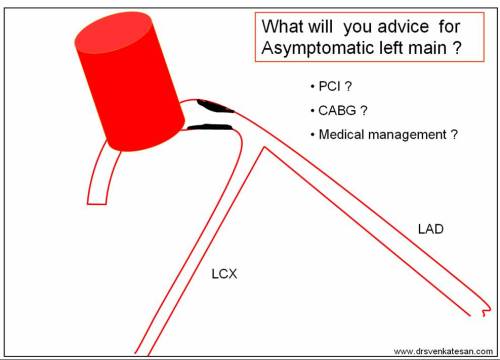
                                                          Left main coronary  lesions are  fairly common  during routine coronary angiogram.These may be a critical or a innocuous lesion.The  word “left main” triggers a sort of alarm reaction to many cath lab staff as well as the cardiologists and surgeon.Many times, these left main lesions are detected in patients   with chronic stable angina who have stable symptoms. Left main disese has not been graded  clearly in literature . Often it is perceived , any lesion in LM is serious.

There is an unwritten rule,  rather a medical compulsion  to take a patient  with left main disease  for emergency CABG ( Now some centres ,emergency PCI) .Some institutions make it  a rule these patients  are posted  in the  next available slot in the theatre.

 The basic question we raise here is   “Should we consider all  left main  disease  as  an  emergency”?

Not really , especially when it occurs in a stable angina .One can wait , buy some time to fully evaluate and prepare  the patient  and may be the patient can be posted  as an elective case. It is a well recognised fact that, CABG carries adverse outcome when done as an emergency procedure. This is primarily due to inadequate pre op work up and resultant complications. It is also well known ,  surgical  back up team may not be available in full strength in odd hours .

This post is  to convey the message , that left main is  a serious disease but that doesn’t  mean it should elicit  a panic reaction and be taken as an ultra emergency . There has been many morbid and fatal outcomes in many hospitals due to this apparent  pseudo emergency !


Note* 1.Left main  disease during acute coronary syndrome is to be seen in different perspective.2.Some of the proximal LAD lesions are so tight and  could be more significant than left main lesions.

Read Full Post »

Is reciprocal ST  segment changes  occur  only in STEMI ? Can it occur in UA/NSTEMI ?   


                      Even   after   100 years of electro cardiology   the electrophysiological mechanism of ST elevation in STEMI  and ST depression in Unstable  angina is   still in the hypothetical stages. One popular theory   says that the   current of injury   as we see   as  ST  segment elevation  in surface ECG  is  actually   an illusion. It’s   apparently due to   constant negative current    pushing down the   rest of ECG segments. Ironically   the concept   of  reciprocal ST depression in patients who have  ST elevation is well debated  for over 3 decades and  is considered  a  settled issue. It   probably   represents , a  purely electrical phenomenon where the  tail end  of the  lead   picks up the opposite vector. Even   as   conflicts   continue to confront the basic electro physiological   concepts management    strategies   of   acute coronary syndromes is witnessing   great strides.
Aim
                                     We   hypothesized   if   ST depression occurs as response to ST elevation it’s logic to expect strong ST depressive forces should  possibly elevate The ST segments in the reciprocal leads .
In fact  we have seen this phenomenon in three distinct  clinical situations. 
1) ST   elevation   in posterior leads: Patients who present   with isolated   ST depression in V1,  V2 , V3  and  ST elevation in posterior chest leads V7, V8 .These patients were initially thought to have isolated posterior MI. But later the cardiac enzymes were found to be normal   indicating no myocardial necrosis   echo evaluation revealed wall motion defects in anterior segments rather than in posterior segments. CAG revealed critical   LAD disease .  This we believe a pure reciprocal ST elevation in the posterior leads to  a  ST depressive forces in anterior leads.
 2) Inferior  ST   elevation   with ST depression   in   V4- V6 : Few  patients who present with  infero    lateral STEMI   later  do not  evolve into  Q  MI but as a NSTEMI .The initial ST elevation  was found  be transient and  disappeared  much earlier,  while the  ST depression  lateral leads persisted.
 3) ST elevation in AVR   in high risk unstable angina :As   already reported in the literature,  we have seen  ST  elevation in AVR  in patients with  high risk unstable angina. This was   more often observed when there is > 3mm ST depression in V4-V6. The AVR  ST elevation  possibly   represents   the  reciprocal  vector.
    Conclusion
                                            ST elevation in certain   specific leads in   some of the patients with ACS,   could   be   a pure reciprocal   electrical phenomenon   to   dominant ST depressive forces in Opposite leads .  And hence   ST elevation in the surface ECG during early hours of ACS   should be interpreted more cautiously. The   sanctity   assocociated with ST segment   elevation   could  be  opened   for debate. 
 
                                     To down load full PPT  click on  the slide

//

Read Full Post »

LV clot formation is one of the important complications of acute myocardial infarction. Preventing this is difficult and managing this problem is still more difficult.Some of these clots are linear and laminar along the shape of LV apex and carry less risk of dislodging.

 While mobile LV clots , even if it is small can cause a embolic episode. Most of these patients have a significant LV dysfunction and they are candidates for early CAG and revascularisation. Even If the coronary anatomy is very ideal for a PCI these patients are often sent for CABG and physical removal of LV clot . If  only ,we have an option to remove these LV clots by a catheter based modality, we can offer them a totally non surgical cure.

This is not impossible,  considering  we are in the era of percutaneous implantation of prosthetic valve in Aorta ! The only issue is potential embolism into carotids and periphery .A temporary distal protection at the level of aortic root will prevent that .

Device companies shall produce one such exclusive catheter system to remove LV clot.

Dr .S.Venkatesan, Madras medical college, Chennai,India

Read Full Post »

« Newer Posts - Older Posts »