Here is a video recipe !
Posted in dr s venkatesan -Personal, general medicine | Tagged best cardiologist india, cardiologist, cardiology fellows training, crash course on cardiology, dr s venkatesan, drsvenkatesan, ethical cardiologist, good cardiologist, madras medical college, teaching video in cardiology, venkatesan sangareddi | 11 Comments »
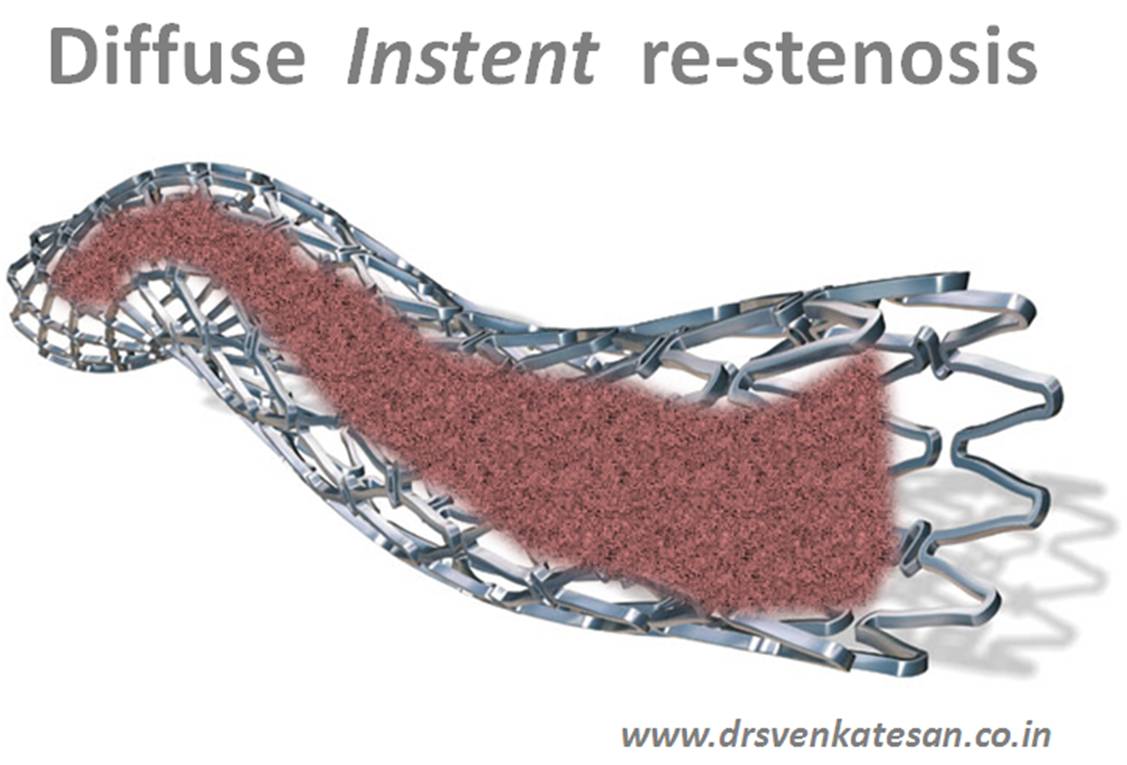
How do you tackle In-stent restenosis (ISR) ?
- Deploy another BMS
- Use a third generation DES
- No . . . first generation DES(Paclitaxel )
- Consider Plain balloon angioplasty.(POBA)
- Refer for CABG.
- Fall back on medical management.(Ingloriously referred to as “No option” patient !)
Answer: Please note , there is no single response answer for this question .
Instent restenosis (ISR) is commonly seen with BMS .This is primarily because we are busy blaming DES for stent thrombosis and we do not want to give a double blow to DES .There is a significant population roaming with ISR involving DES . BMS is in vogue for nearly 2 decades, hence it is natural to see more of it. In due course , DES is expected to catch up with BMS and would lead in ISR as well .
The issues in PCI for ISR
Though any of the above 6 strategies may be appropriate ,the urge to put another stent within the IRS , prevails over all other options in most centers. This is more off an Interventionist talent show off !
Please remember , the common principles must apply in all patients before an PCI . Simply stated , this principle involves assessing symptoms, residual resting ischemia, myocardium at risk during stress, viable muscle mass etc .Lesion characteristics should come last in the work up. ( A cardiologist should not report a coronary angiogram , if does not not know basic clinical parameters.)
It is good to have a rule that “reserves intervention” for ISR only if the patient has refractory angina.
Can you promise relief from dyspnea
Contemplating PCI for patients with dyspnea as the main symptom is really tricky one.Unlike angina , dyspnoea can be attributed to so many factors other than coronary blood flow.(Apart from LV EF , Iscehmic MR, A transient diastolic dysfunction , lung function , volume status, renal function , physical conditioning etc)
Opening ISR in the belief it would improve LV function is highly questionable even if viability is documented.
What is the most important step in the decision making prior to PCI for ISR ?
* Most important step in ISR management is probably spending sufficient time , involving experts , ” democratically debating” the indication and techniques in your institutional cath conference.
Once you document the necessity of intervention* The following things are possible .
- If the patient has diffuse in-stent stenosis , especially the proximal ones or that involves branch points, it is wiser to refer them for CABG.
- Discreet and focal ISRs can safely be attempted for repeat PCI.
- BMS or DES ? This is debated. Current preference is to use a DES. (Many feel ,first generation DES -(Paclitaxel) scores over Everolimus in this situation )
- Is POBA possible for IRS ? Can a balloon do a job where a stent has failed ? . No body is trying it .Many Feel guilty to do it . POBA for IRS is a failed concept without even trying it ! One way of reasoning is IRS occurred only because stent was never indicated in the first place in that location and a POBA would have been the choice in the initial attempt itself .So let us not make the second error ! ( May be , if Gruientzig is alive today , might have used POBA for ISR very effectively ! )
Issues for which we will never ever know the answer !
In future any of the following combination of stents will occur in tackling ISR.
- DES covered BMS
- BMS covered DES
- Two BMSs
- Two DESs
- Paclitaxel covered Everolimus
- Everolimus covered Cypher.
- Overlapped DES and BMS
- DES covered beta irradiated IRS
- Rotablated BMS (Yeh metal crushing !) followed with DES jacket !
How does the two metals , two drugs in various combinations interact with the tender coronary endothelium ?
Endothelium is an endocrine organ. It has to secrete as many pro and anti homeostatic molecules (Nitric oxide, endothelin etc).This has to be kept in mind when we develop newer and exotic devices. Of course , we claim our aim is primarily to provide relief to our ailing patients , but, as things stand today , there is a distinct risk of converting human coronary arteries into corporate playgrounds !
Reference :
http://circ.ahajournals.org/content/100/18/1872.full.pdf+html
Posted in Cardiology - Clinical, Cardiology -Interventional -PCI, cardiology -Therapeutics, cardiology- coronary care, Cardiology-Land mark studies | Tagged bms vs des for instent restenosis, des for irs, instent restenosis, irs, mehrans classification of irs, stent occlusion | Leave a Comment »

Surprisingly it is common !

A .Abandon the procedure call the surgeon for an emergency CABG
B. Open the most critical lesion.*
C.Attempt to open and stent all possible lesions.
D.Send the patient back to CCU for a conventional thrombolysis or attempt a intracoronary thrombolysis.
Answer : All can be a right response depending upon the available expertise , time window, associated complication and hemodynamic stability etc .
* Please note ,the most tight lesion may not be the culprit artery. Though there is high chance for that being the culprit , it can be very deceiving especially when there is multi-vessel CAD with chaotic collaterals.
The site of lesion and site of infarct can unimaginably remote. (A traffic snarl at remote flyover can have its impact right on the busy commercial street due to diversions ! ).
What will happen if you open a non culprit artery first mistaking it for a culprit ?
This could lead to dangerous turn of events as whatever little perfusion the patient was getting through the ill-fated IRA will be challenged by the fresh diversion facilitated by non IRA angioplasty. Extreme caution is required.
Emergency CABG within 3 hours of MI even though advocated by few , is still considered a risky way to reperfuse the heart.(In India there is nothing called primary CABG!)
An energetic interventional cardiologist would vouch for opening all lesions . Only thing , he has to make sure is , the patient also has enough energy to withstand his onslaught. Never non culprit lesion if a patient is stable . 0ur aim is not that.If the patient is in shock or impending LVF one can justify opening few more lesions that improve total muscle function which can be vital.
What about fall back on thrombolysis?
This may be seen a defeatist attitude , but when the aim is in the well being of patient , there is no defeat or success. If severe CAD is encountered and both CABG / PCI or not an option, the cardiologist need not feel guilty or humiliated to refer him back for thrombolysis. (Of course , Intracoronary thrombolysis is an option !)
Final message
Primary PCI is often made to appear ” As a kids play” by many modern day cardiologists . It is not so. It requires a team effort. It is race against time. Feasibility depends largely on the coronary anatomy. The failure rate of primary PCI is often camouflaged .(Currently Success of pPCI is boasted at 95%) Logically it should include pPCI ineligible anatomy as well . Many still do not understand the real purpose of pPCI. The aim is to salvage the myocardium at risk , sure and fast. Never attempt for total revascularisation in an emergency situation however tempting it is !
In young persons with discrete single vessel disease the procedure is simple and outcome is straight forward. In elderly , diabetic , STEMI on preexisting CAD, diffuse multivessel disease , complex main left, bifurcation lesions , one requires lot of brain sense to provide optimal outcome . Many times that sense includes abandoning the procedure !
Please read a related article in this site Primary CABG
Posted in cardiac surgery, Cardiology - Clinical, cardiology -ECG, Cardiology -Interventional -PCI, cardiology -Therapeutics, cardiology- coronary care, Cardiology-Coronary artery disese | Tagged culprit vs non culprit, issues during priamry PCI, multivessel disease during priamry pci, non culprit vessel angioplasty during priamry pci, priamry pci in stable stemi, primary pci in cardiogenic shock | Leave a Comment »
A man in his 40s presented with an episode of syncope and followed by recurrent episodes of near syncope.
His ECG showed (See image)
- ECG shows absolutely no evidence of sinus activity . That is sinus arrest.
- He lives by the mercy of his AV node.(“Great escape” junctional rhythm ! ) . Please note , It fires at less than its intrinsic rate indicating AV nodal sickness as well.
- The Heart rate is around 18/mt.
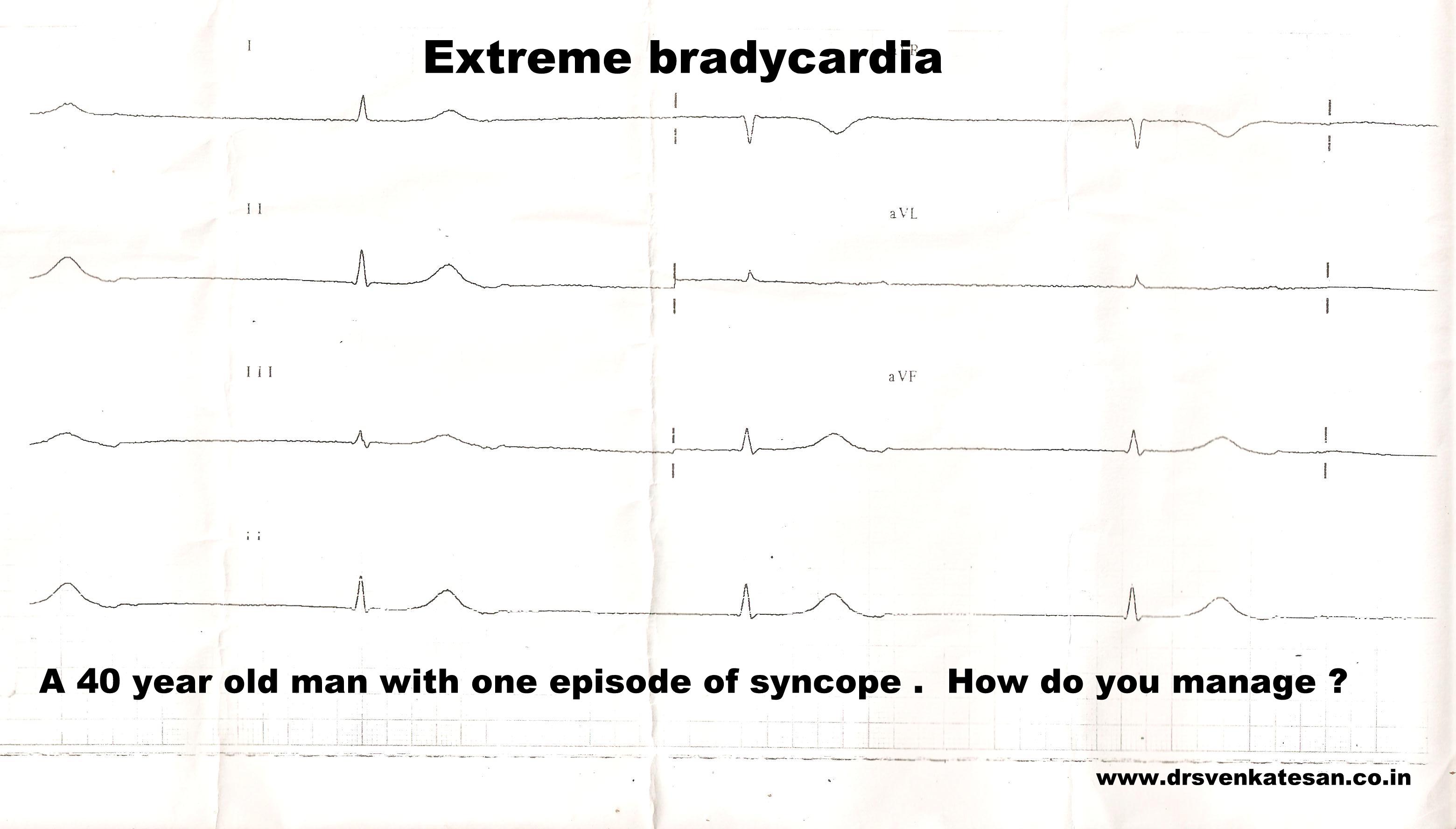
SA node is dead(Sinus arrest ) as evidenced by absent p waves. AV node is sick(Depressed) because the junctional rate is less than 20 /mt.
At what heart rate a person would develop syncope and near syncope ?
There is no fixed cut off rate for syncope. It all depends upon the baseline LV function, his exercise capacity, vascular tone etc.
Most will develop some symptoms at a heart rate less than 40/mt .
Dizziness occur and 30, syncope is sure when hear rate dwindles less than 20 /mt.
A heart rate of 10-15 circulation tends to stall. But still few men are found alive at this rate.
What is the risk of this patient dying suddenly ?
Contrary to the expectation SCD is not common in isolated sinus node dysfunction .
It is more common with AV block. The reason being as long as the AV node is fine it will support the rhythm at least at about 30 or s0.
The cause of death in SND is extreme bradycardia induced phase dependent VT /VF.
Will you do a EP study for him ?
No. He does not require it. He is symptomatic , and his ECG shows tell- tale evidence for SND with AV node depression.
So the there is not even the necessity to assess AV nodal status. But .one should be aware , there is a battery of tests for SND evaluation (SNRT, cSNRT SACT, etc*) .These are done only when diagnosis is in doubt or for an academic purpose in teaching hospital.
What pacemaker will you use ?
- DDDR
- AAIR
- VVIR
AAIR can not be used as we have evidence for AV nodal slowing .
DDDR may be ideal. In India we still use VVI mode extensively . Ventricular pacing always safe when you have no EP facilities. It makes EP study to assess AV nodal function redundant.
* In all patients with severe bradycardia , a complete workup for systemic diseases like hypothyroidism and other chronic inflammatory pathology must be ruled out. Drug induced bradycardias can exactly mimic pathological SND. Recognizing these entities could avoid inappropriate pace maker implantation for transient reversible bradycardias.
* SNRT – Sinus node recovery time. cSNRT -Corrected sinus node recovery time .SACT-Sino atrial conduction time.
Posted in Cardiology - Clinical, cardiology -ECG, cardiology -Therapeutics, Cardiology-Arrhythmias | Tagged dddr pacing vs vvvir pacing, sick av node syndrome, sick sinus syndrome, sinus node dysfunction, syncope | Leave a Comment »
How common is edema legs in diastolic heart failure ?
- Can not occur.
- As common as systolic failure
- Can occur in significant number.
- Rare.
Answer : 4
Response 3 may be correct as well .
When cardiac failure was originally defined by Framingham criteria many decades ago , the entity of diastolic heart failure was non existent .The classical triad of edema legs, raised JVP, basal rales invariably meant systolic , congestive hart failure. We will , never ever know how many of the Framingham cohort had isolated diastolic heart failure .
Mechanism
For edema to occur there need to be water and sodium retention .For sodium and water to accumulate either of the two things should happen (Hypoprotienemia, Lymphatic dysfunction excluded)
- Increased venous pressure
- Reduced renal clearing of water and salt.
When both join together edema is classical and full blown.
In isolated LV diastolic heart failure the raise in systemic venous pressure is less pronounced .So , edema legs is less conspicuous. but in any type of failure the net cardiac index tend to decline at least marginally . Kidneys are the first organ to sense this , and the nephrons goes for a huddle and begin to retain sodium and water as if body is going to face severe water and salt scarcity .(It is a false alarm actually ! )
Neuro humoral mechanism is “Alive and well” in any heart failure whether it is systolic diastolic , forward ,backward etc. so , edema can indeed occur in isolated diastolic heart failure
Please note , the classical edema that occur in restrictive cardiomyopathy , constrictive pericarditis are due to severe impediment to right sided filling and elevated the lower limb venous pressure .

Other important determinants of edema legs.
- The baseline renal function.
- Intra vascular volume status.
- The associated HT induced vascular changes.
- Serum protein levels.
- Venous tone.(A good venous pump in conditioned legs develop edema late )
- Integrity of lymphatic circulation.
- Subcutaneous fat density and interstitial tissue resistance.
All can modify the local hydro static pressure .These factors operate in various quantum’s and for this reason only selcted few develop significant edema in cardiac failure .
Also read . Why some patients with cardiac failure never develops edema legs ?
* Please note , the terms diastolic dysfunction and failure can not be used interchangeably. Dysfunction is often a echo parameter while failure is its clinical counterpart .Both can be dissociated in time , failure may never follow dysfunction .Most episodes of diastolic dysfunction is transitory in nature.
Posted in cardiac physiology, Cardiology - Clinical, cardiology -Therapeutics, Cardiology -unresolved questions | Tagged diastolic dysfunction vs diastolic failure, edema legs in diastolic heart failure, framingham criteria for cardiac failure, hydrostatic pressure, mechanism of edema legs, venous edema | Leave a Comment »
In one of the corporate hospitals which I visited in my city(Chennai*) , happened to see a nurse taking blood sample from a patient who has been just admitted in a Hi-tech coronary care unit for UA-NSTEMI.
It included blood tests for CRPs,homocysteine,Apo-lioprpitein B etc . She was being supervised by a capitation fee fed , just delivered , neo- medical graduate from a country side medical college.
I asked her what for you’r doing these tests.
She said , it is to detect risk of developing CAD.
. . .I reminded her , the patient had already developed full blown CAD .
She was too innocent to say ” I do not know all those things sir , my consultant asked me to do it !
This is how some corporate coronary unit* functions and handle their prized possession . And every one enjoys it , as science prevails over common sense !
* Shall I name the hospital ? . . . No , it would invite trouble . . . oh , what a freedom of expression we enjoy !
Posted in bio ethics, cardiology-ethics | Tagged cardiology ethics, cost of care in medicine, crp apolipoprotien b, ethics in coronary care unit, homocysteine, homocyteine, inappropriate investigations in ccu | Leave a Comment »
Patent foramen ovale (PFO) is the new generation hole in the heart for 21st century cardiologist. Present in about 20% of population , would correspond to 140 crore “man holes” as on 2012 in this planet. PFOs are embryological remnants across the inter atrial septum.
These minute holes measuring few mm are largely a benign finding .In the recent decades , it is being increasingly debated these holes may not be innocent after all .Extensive use of echocardiography in recent times has contributed to the awareness as well as anxiety.
Evidence is mounting linking PFO to
- Migraine,
- Stroke and
- Peripheral embolism.

While the above observation may be true , the fact that >100 crore people have this entity , raises a serious question , as labeling all of them as heart disease will create chaos among the already health obsessed population .
So , the main purpose should be , to identify the high risk subsets* of PFO population .(This will be a <5 % at the most). People with PFO may carry a mental stigma because it is referred to as a hole in the heart by the general public .For many the sense of living with a hole in heart is often more damaging than the hole itself ! (Incidentally , many develop migraine only after reporting about this hole !)In a strict sense PFO is not a hole , rather it is a communication it may be tunnel or slit like .It is argued physician should avoid calling PFO as a hole .
*What is a significant PFO ?
- Large PFOs >5mm
- PFOs that shunt blood
- PFOs with septal aneurysms
- PFOs with documented stroke or embolism
- PFOs with atrial chiary network
- PFO in persons with systemic pro-coagulant states (Except probably in pregnancy )
Final message
PFO is a common residual congenital atrial septal anomaly . Usually benign . One can live with it perfect harmony. Only occasional patients are at risk.
So the prime job of cardiologists is to not diagnose and create panic about this entity. rather reassure them (Is it better do not reveal to them if it is found incidentally ? Patient empowerment group would call this a foul ! I do not support blind empowerment )
At the same time our main aim is to identify the high risk subsets who are prone for events.
Closure of PFO with device is required in a fraction . (*By the way , if PFO is really dangerous , why It is never an indication for surgical closure ? )
Reference
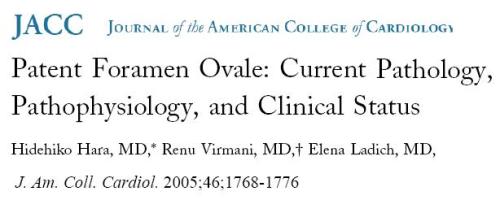
Your search for best information on PFO would end here . Here is a land mark article in JACC by Hara also contributed by Renu Virmani . A US Japan combines initiative : A must read by every cardiologists
Posted in cardaic physiology, cardiac surgery, Cardiology - Clinical, cardiology -congenital heart disease, Cardiology -Interventional -PCI, cardiology -Therapeutics, Cardiology -unresolved questions | Tagged asd, hara virmani pfo jacc article, patent foamen ovale, pfo, pfo and migraine, pfo and stroke | Leave a Comment »
Hypertrophic cardiomyopathy(HOCM) is a relatively common inherited myocardial disease.Since it predominately involves LV myocardium and we know LV muscle mass is an integral part of mitral valve apparatus , it is natural HOCM has a major impact on mitral valve function .

The mechanism of MR in HOCM is attributed to the following .
- Asymmetric septal hypertrophy (ASH ) related abnormal pap muscle alignment (Geometric distortion )
- Exaggerated SAM(AML is attracted towards LVOT with every systole that tend to keep the mitral valve unguarded and MR results)*
- Intrinsic abnormalities of mitral valve.
- Associated MVPS
- VPDs and Non-sustained VT can result in transient MR
- Pacemaker mediated MR (DDD pacemaker was used to induce desynchrony of LVOT vs LV free wall .This concept is almost a failed one now !)
- End stage HOCM -Left ventricular dilatation
* This mechanism is considered less important , as SAM is almost universal in HOCM but MR occurs in less than 20% patients with HOCM.
Eccentric MR vs central MR
In HOCM the MR is more often eccentric .This is understandable as the primary mechanism is related to faulty angle of pap ,muscle vs leaflet attachment.
If SAM is primary mechanism jet is directed posterior.
Murmur of MR in HOCM
Is rarely pansytolic as the mechanism of MR begins to operate well after the systole starts .
Many times it is difficult to differentiate LVOT murmur from MR murmur . Th ever confusing and tentative maneuvers might help in few shrewd cardiologists.
Issues during echocardiogram
Very often MR jets are mistaken for LVOT gradient.Ideally two gradients in isolation (or overlapping each other) one bell shaped other dagger shaped must be documented.

Please note : LVOT jet is different from MR jet in size, shape, timing and site of maximum signal . Still it is often be confused with one other. Most common reason for this is technical .A careful apical 4 chamber view with well opened LVOT will reduce the error . Never record a HOCM echo without ECG gating . The MR jet may be very trivial in color flow but doppler will still pick the signal well . Realise ,for hemodyanmic reasons MR jet must be always more than LVOT jet.Finally if you get a report a LVOT gradient > 100mmhg in HOCM suspect it to be MR ! More often your suspicion will prove to be right !
Can mitral regurgitation occur in non obstructive HCM ?
Yes , in few . This is due to intrinsic abnormalities of mitral valve .
What happens to MR with surgical correction ? Can medical management regress the MR ?
It is expected to regress.But many patients don’t. Effect of beta blockers on MR severity is not studied well.
Management
- Most cases of MR do not require specific intervention.Just reassure them.
- Correction of LVOT obstruction is expected to relieve MR considerably.
- Intensive beta blocker or calcium blocker can regress the MR.(Negative inotropy)
- Mitral valve repair may be necessary in few with re-engineering of pap and chordae .
- Mitral valve replacement should be a last resort. It may be highly tempting .But restraint is warranted. Much damage has been done by showing undue haste in replacing mitral valve in HOCM
Final message
It needs to be realized whatever we do for the HOCM patients , the ultimate outcome is determined by the quantum myocardial disarray the patient has inherited from their parents.The myectomy , the alcohol ablation, mitral valve repair, DDD pacing , beta blockers all are palliative. Except a few , most HOCM patients generally live their natural history .
Posted in Uncategorized | Tagged ash, ddd pacing, geometric distortion of pap muscle, hocm and mitral regurgitation, hypertrophic cardiomyopathy, maronhocm, mechanism of mitral regurgitationinhocm, mitral valve in hcm hocm, mitral valve repair in hocm, mitral valve replacement in hocm, mvps and hocm, vpd induced mitral regurgitation | Leave a Comment »
Atherosclerosis is an inflammatory and degenerative disease of blood vessel.The common belief is (Of course , it is a fact ) it mainly causes vascular obstruction and compromise vital organ function(heart, Brain, Kidney etc)
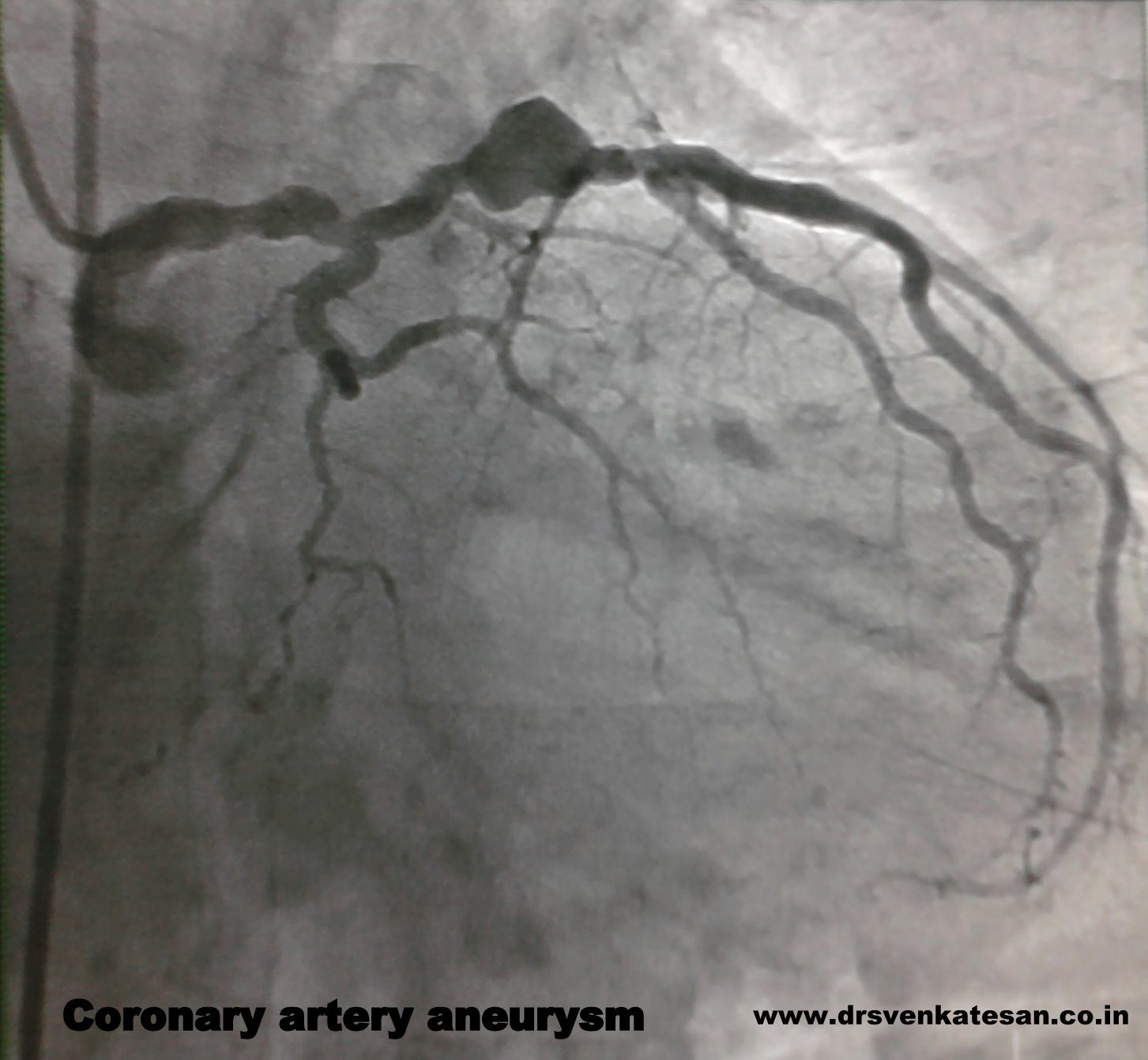
Here is a different facet of atherosclerosis , A middle aged man surprised us with this coronary angiogram . Instead of obstructing the flow the coronary vessel begins to dilate. This is due to a medial weakness .(The media for some reason begins to give way rather than proliferate to the atherogenic stimuli.)
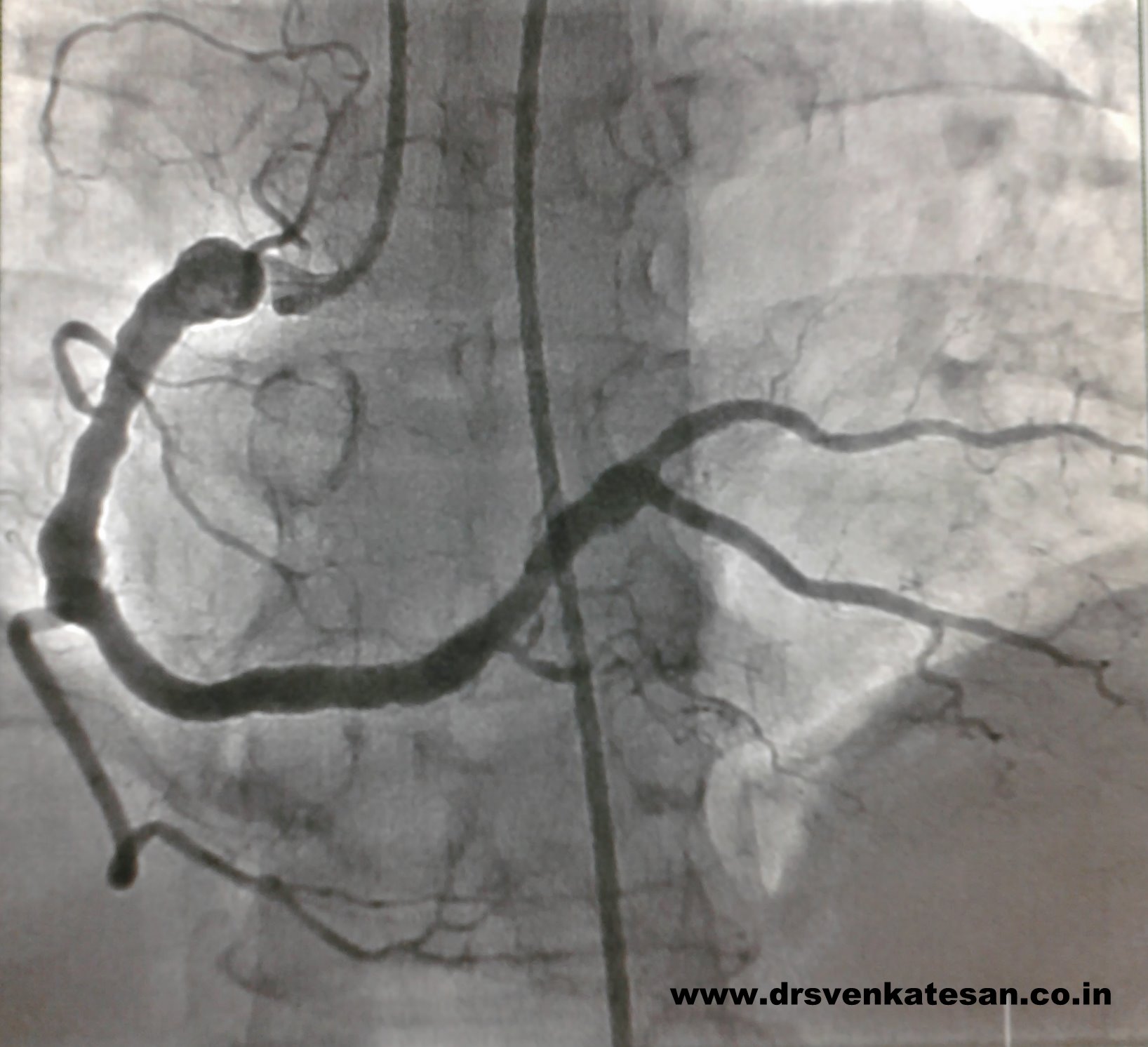
Same patient's RCA
One may wonder why he underwent CAG when obstruction is least expected in such a vessel ! It was paradox of sorts , this man in spite of his wide bore coronary artery , was prone for coronary thrombus and one such episode landed him in our CCU . ( Please note both faces of atherosclerosis “obstructive and dilatory” can manifest in the same vessel in different combination.)
This angiogram may be reported as any one of the following
- Diffuse atherosclerosis
- Diffuse atherosclerosis with focal dilatation and aneurysm formation
- Coronary ectasia
These patients should get life long medium intensity (INR 2-2.5) oral anti coagulants for preventing coronary thrombosis.
Watch out for similar aneurysmal changes elsewhere (Renal, Cerebral, Aorta etc )
Counter point
How are so sure it is is due to atherosclerosis ? Can it be a congenital coronary medial weakness ?
Your guess is not my guess . . . My vote is for atherosclerosis .
Posted in Cardiology - Clinical, Cardiology -Interventional -PCI, Cardiology-Coronary artery disese | Tagged atherosclerosis, coroanry artery dilatation, ectasia coroanry, glaowian phenomenon | Leave a Comment »
In this politically and scientifically uncertain world nothing is in black and white. How can you expect EST to behave differently ?
Even as we are fully aware of the limitations of EST , it does not make sense to categorize EST result into either positive or negative .
In fact , our estimate suggests a significant bulk of the patient would fall in the grey zone .
It is referred in various terms by the reporters of EST .
- Borderline positive
- Mildly positive
- Equivocal
- Inconclusive

What does all these terms mean to the patient ?
It mans only one thing . . .
Physician who reports the EST is unable to conclude whether his patient has significant CAD or not . It is a dignified way of expressing the limitations .
Many factors may play a role. (See the illustration above )
- Patient factors : Poor exercise stress levels and conditioning
- Lesion factors: Collateralised CAD, treated CAD can result in partial or mild changes.
- Machine factors :Caliberation errors.
- Interpreter : (Physician ) factors
Error in measurement of ST segment . What is borderline for one doctor may indeed be true positive for the other and vice versa .
How will be the EST in a revascularised or medically treated CAD ?
If revascularization is a complete success , stress test would revert back to normal or it can be a borderline as we have just mentioned.
To our surprise , it may remain positive in spite of apparently successful procedure.(Residual wall motion defects , scar mediated ?)
How to proceed after this borderline EST/TMT ?
Few options are available for the physician/patient
Talk with the patient again , assess the baseline risk of CAD if it is low ignore the TMT result and reassure.
- Repeat stress test after a month.
- Stress thallium
- Doubutamine stress
- CT angiogram
- Regular Cath angiogram* (May be the best , of course it also carries a risk of labeling the condition as mild CAD / non critical CAD etc )
For the patient the easiest option may be , self referral to a different cardiologist . (Also called second opinion )
Final message
There is indeed an entity called borderline EST . Do not dare to ignore it or else face the consequences .
Read related articles in this site .
Posted in cardaic physiology, cardiac physiology, Cardiology - Clinical, cardiology -ECG, Cardiology -Interventional -PCI | Tagged 64 slice ct scan mdct, border line positive stress test, collaterals and tmt negativity, coronary angiogram, does medical mangement reverse tmt positivity, exercise stress testing, mildly positive est, mildly positive tmt, thallim stress, tmt, tread mill testing, treted cad and st segment, upsloping st segment |
Categories
-

-
The contents of the this blog is being published as Kindle E book , as per the request of many of the readers. Every article will continue to be open source in this site. Again I shall reiterate the book format is not aimed at any commercial intent. It is only to facilitate learning in a single book format Here is the link to book
https://amzn.in/d/euhL5vu Archives
- April 2026 (9)
- March 2026 (10)
- February 2026 (8)
- January 2026 (8)
- December 2025 (11)
- November 2025 (7)
- October 2025 (8)
- September 2025 (7)
- August 2025 (9)
- July 2025 (10)
- June 2025 (8)
- May 2025 (9)
- April 2025 (7)
- March 2025 (10)
- February 2025 (4)
- January 2025 (9)
- December 2024 (11)
- November 2024 (8)
- October 2024 (10)
- September 2024 (5)
- August 2024 (5)
- July 2024 (6)
- June 2024 (5)
- May 2024 (4)
- April 2024 (7)
- March 2024 (4)
- February 2024 (8)
- January 2024 (6)
- December 2023 (8)
- November 2023 (13)
- October 2023 (14)
- September 2023 (5)
- August 2023 (6)
- July 2023 (10)
- June 2023 (5)
- May 2023 (5)
- April 2023 (4)
- March 2023 (5)
- February 2023 (2)
- January 2023 (7)
- December 2022 (3)
- November 2022 (5)
- October 2022 (5)
- September 2022 (4)
- August 2022 (3)
- July 2022 (9)
- June 2022 (2)
- May 2022 (1)
- April 2022 (2)
- March 2022 (1)
- February 2022 (3)
- January 2022 (7)
- December 2021 (3)
- November 2021 (5)
- October 2021 (8)
- September 2021 (4)
- August 2021 (6)
- July 2021 (6)
- June 2021 (7)
- May 2021 (5)
- April 2021 (4)
- March 2021 (3)
- February 2021 (6)
- January 2021 (8)
- December 2020 (4)
- November 2020 (5)
- October 2020 (7)
- September 2020 (7)
- August 2020 (10)
- July 2020 (6)
- June 2020 (9)
- May 2020 (9)
- April 2020 (5)
- March 2020 (7)
- February 2020 (3)
- January 2020 (4)
- December 2019 (4)
- November 2019 (6)
- October 2019 (3)
- September 2019 (6)
- August 2019 (3)
- July 2019 (1)
- June 2019 (3)
- May 2019 (2)
- April 2019 (2)
- March 2019 (2)
- February 2019 (4)
- January 2019 (2)
- December 2018 (2)
- November 2018 (2)
- October 2018 (2)
- September 2018 (1)
- August 2018 (2)
- July 2018 (3)
- June 2018 (1)
- May 2018 (3)
- April 2018 (1)
- March 2018 (3)
- February 2018 (3)
- January 2018 (1)
- December 2017 (3)
- November 2017 (3)
- October 2017 (3)
- September 2017 (2)
- August 2017 (2)
- July 2017 (2)
- June 2017 (2)
- May 2017 (4)
- April 2017 (3)
- March 2017 (3)
- February 2017 (5)
- January 2017 (3)
- December 2016 (2)
- November 2016 (5)
- October 2016 (4)
- September 2016 (3)
- August 2016 (5)
- July 2016 (3)
- June 2016 (4)
- May 2016 (3)
- April 2016 (6)
- March 2016 (4)
- February 2016 (3)
- January 2016 (5)
- December 2015 (6)
- November 2015 (5)
- October 2015 (8)
- September 2015 (2)
- August 2015 (5)
- July 2015 (7)
- June 2015 (4)
- May 2015 (6)
- April 2015 (5)
- March 2015 (7)
- February 2015 (15)
- January 2015 (8)
- December 2014 (5)
- November 2014 (9)
- October 2014 (7)
- September 2014 (9)
- August 2014 (5)
- July 2014 (11)
- June 2014 (5)
- May 2014 (4)
- April 2014 (5)
- March 2014 (8)
- February 2014 (8)
- January 2014 (5)
- December 2013 (7)
- November 2013 (7)
- October 2013 (14)
- September 2013 (12)
- August 2013 (15)
- July 2013 (15)
- June 2013 (15)
- May 2013 (15)
- April 2013 (15)
- March 2013 (15)
- February 2013 (15)
- January 2013 (15)
- December 2012 (15)
- November 2012 (15)
- October 2012 (15)
- September 2012 (15)
- August 2012 (15)
- July 2012 (15)
- June 2012 (15)
- May 2012 (15)
- April 2012 (15)
- March 2012 (15)
- February 2012 (15)
- January 2012 (15)
- December 2011 (15)
- November 2011 (17)
- October 2011 (17)
- September 2011 (17)
- August 2011 (21)
- July 2011 (20)
- June 2011 (17)
- May 2011 (15)
- April 2011 (17)
- March 2011 (25)
- February 2011 (20)
- January 2011 (20)
- December 2010 (18)
- November 2010 (21)
- October 2010 (21)
- September 2010 (25)
- August 2010 (20)
- July 2010 (10)
- June 2010 (11)
- May 2010 (19)
- April 2010 (16)
- March 2010 (14)
- February 2010 (22)
- January 2010 (18)
- December 2009 (20)
- November 2009 (20)
- October 2009 (3)
- September 2009 (21)
- August 2009 (19)
- July 2009 (12)
- June 2009 (12)
- May 2009 (11)
- April 2009 (15)
- March 2009 (21)
- February 2009 (4)
- January 2009 (12)
- December 2008 (13)
- November 2008 (9)
- October 2008 (22)
- September 2008 (20)
- August 2008 (16)
- July 2008 (14)
- June 2008 (7)
Blog Stats
- 6,658,507 hits
Please give your feed back .
Click below to see who is watching this website live !

- This site will never aim for profit. Still ,this donation link is added at the request of few visitors who wanted to contribute and of-course that will help make it sustainable .

Please Note

 Dr.S.Venkatesan MD