Feeds:
Posts
Comments

BMS, the original stent technology with meticulous metallurgy and design has been silently replaced by the drug eluting stent (DES) for over a decade. DES was introduced to bail out BMS from perceived high rates of  restenosis . It was a fundamental flaw, we failed to give due  weightage to the multiple variables like  operator expertise, lesion morphology, patient factors that determined the restenosis  rate .

There was never a single study done in large scale that compared a well deployed BMS with a poorly deployed BMS/ DES in terms of restenosis rate.This would have clearly quantified the technical component in the  restenosis rate that brought  pseduo -bad name for BMS in early days.

Without applying mind, wrong questions were asked and tested. No body could refute a “novel concept” , when some big names in industry  suggested  we must involve an anti cancer drug to prevent cell growth and neo-vascularisation  and hence restenosis. But , in reality  the technology of DES essentially complicated the metal behavior by adding a drug and drug adhesive agent(Polymer)  to the otherwise inert metal. Further , the , metallurgy  engineers had to restart / reduplicate from the scratch since we had  already well developed stent technology for BMS . The manipulation was  to add a drug to the metal.

The  irony of DES lies in the fact it Intentionally allowed to interfere /damage the endothelial healing and make the extended anti-platelet mandatory.  Still , DES was able to rule the world backed up by hyped data  with   bloated  reduction in restenosis rate. (Now we realise  the true benefits of DES  are nil  or at best marginal or even harmful in certain subsets of ACS .Read NORSTENT Trial linked below  )

Yes DES has a concern , but its not the drug you know !, 

Off late , since the polymer was  assumed as  culprit, variety of new generation stents with disposable /Non durable /Zero poylmer were developed. Still, polymer could not be proven as true culprit , some have started blaming  the drug again. Recently, It led to one famed DES based on Paclitaxel (which has a pride of place in the Land mark SYNTAX  study ) exited the human domain  with disgrace . (I wonder can  we conclude then SYNTAX study is also become invalid !)

This study done with over 9000 patients  concluded  like this  . . .

The DES industry was (is) so powerful it could easily shrug  the challenge of truth that came out briefly  in early 2000s when DES got hit with increased  acute complications.

Now, in 2016 NORSTENT study again showed us BMS is as good as DES in all walks of CAD.  Let us see what happens , still  its very unlikely mature cardiologists do not trust BMS.

*I have a belief  (Paranoid or not time will tell !) one of the reasons  DES are strongly promoted  is to sustain DAPT market alive and kicking for a long haul !

Scenerio  in India is frightening.

While the developed countries have DES usage rate around 65 % , India leads the world with DES constituting 95% (NIC registry 2017) of all deployed stents.What a way for a poor country  to  tackle CAD , which doesn’t even have prompt prehospital Aspirin for  bulk of their ACS patients, ready to waste  its resources in DES.

India , a country Infested with an unregulated health industry  became the perfect battle  ground for abusing the stents. With direct collusion with the large hospital managements the issue got exploded recently  .The Govt was compelled to come out with urgent restrictions and price control  in the use of stents.

Funny world this. World’s richest economies  are worried about the cost and want to phase out inappropriate therapy whenever possible, its absolute arrogance most of us feel shamed to keep BMS in their cathlab.

Final message

A  good metal based flexible ,trackable , thin struted  BMS should be the default choice for coronary stenting .( We used have one , now it vanished !)It avoids unnecessary prolonged DAPT .Most importantly one BMS costs 25 % of the cost of DES   . . . think of 4 critical proximal LAD lesions of a poor man can be fixed at the cost of one DES , that’s  definite way forward. Govt of India can pass another regulation in this regard. If you think  NORSTENT is NONSENSE  let us atleaset  insist for a large scale Indian  study for BMS /DES and  Cardiological society of India has much work to do !

Future for BMS  . . . looks bright !

While the  superiority  of DES is being increasingly questioned , the concept of surface modified BMS is being tested .This I believe is a face saving way to bring back the BMS in lieu of DES. There is a distinct  possibility of many of the new generation  DES going the BVS way in the near future.

Reference 

1.Hassan AK1, Bergheanu SC, Stijnen T, van der Hoeven .J Late stent malapposition risk is higher after drug-eluting stent compared with bare-metal stent implantation and associates with late stent thrombosis.Eur Heart 2010 May;31(10):1172-80. 

2.Zhang K1, Liu T, Li JA, Chen JY, Wang J,   Surface modification of implanted cardiovascular metal stents: from antithrombosis and antirestenosis to endothelialization.J Biomed Mater Res A. 2014 Feb;102(2):588-609.

3. https://www.pcronline.com/eurointervention/114th_issue/volume-12/number-17/350/ultra-hydrophilic-stent-platforms-promote-early-vascular-healing-and-minimise-late-tissue-response-a-potential-alternative-to-second-generation-drug-eluting-stents.

4.Drug-Eluting or Bare-Metal Stents for Coronary Artery Disease NORSTENT Investigators N Engl J Med 2016; 375:1242-1252

Post-ample : Only For non believers  ( who think this article is near rubbish ) 

I am  very much  convinced DES should be superior  for the simple reason it elutes a drug and the whole world believes it works !

Do you know, what these drugs do, and what they are expected to do ! In this elegant study  by Hassan AKEur Heart J. 2010 May;31(10):1172-80.  Its proven with IVUS , DES is many fold likely to cause late stent apposition than BMS.( Thus carrying the risk long term )  Reason is simple , patchy and incomplete endothelisation on the luminal side and pathological metal vessel wall interface  in abluminal promoting late mal-apposition.

True patients* present with symptoms , please , don’t ever think all your patients  bring their coronary artery for general servicing !

Ofcourse , we are the service provider to our patients . Though  heart is a mechanical pump it can never be considered equivalent to automobile engine .

For a Heart service station equipped with 24/7 lab,  the benefits may be  more if you treat the angiogram rather than the  patient.

Let us not misunderstand the word service , please show restraint, your patients will thank you forever.

* Silent significant CAD are indeed a problem in minority that requires selective wisdom.However, we can’t be aggressive hunters for CAD in population, as there is huge cost for human hunting !

Reference

Recent article which debates the issue of PCI in CTO
http://circ.ahajournals.org/content/135/15/1382?etoc=#sec-1

Coronary artery lumen has unique character . Its well-known  LAD diameter is not constant , it tapers in its distal course.(Unlike RCA which is more tubular ) It is estimated LAD looses 15 % of its diameter for every 30mm length.Fortunately LCX has no such long course to make tapering a visible threat. (Though it may still be an Issue !)

Is there a hemodyanmic purpose for this tapering in LAD ?

Should be, God never designs anatomy without a physiological purpose.We have to find it  out.(Can it be meant for  flow acceleration as the flow is entriely diastolic in LAD while in RCA its both in systole and diastole ?_

What is the relationship between tapering angle and final distal diameter?

Schematic of an artery with a tapered angle of 0:16 .Ref XIANG SHEN Journal of Mechanics in Medicine and Biology Vol. 16, No. 8 (2016)

So, if you have a long lesion in proximal LAD and planning to stent with a 40 mm or long  stent the distal end is hyperinflated by atleast 1.5mm, if we use a non tapered stent. Though , gain of extra  diameter  in distal segments might appear attractive, this may not work to our advantage , since it defies and distorts  the natural hemodynamic flow pattern. Further , when you have tapering vessel, proximal optimisation becomes more important.

How about a tapering coronary stent ?

It should be a welcome addition to our already overflowing coronary hardware in fixing long lesions . Its still a surprise why only very few are making this type of stent.

Meril has developed a  tapered stent up to 60 mm long  (Biomime morph).It should be useful in specific lesions sub types.Its worthwhile to note  tapering stents are used more often in carotid artery .

Advantages of long tapering stent over two stents of different sizes.

  • It avoid the vulnerable overlapping zone with double metallic load.
  • Possibly cause less restenosis
  • Low risk for stent fracture
  • It reduces procedure time and of course the cost of stent by 50 %

Why the concept of Tapered stent is not that popular ?

I can only guess, probably lack of free availability and  to a certian extent ignorance as well !  However ,current status about tapering stents is expected to evolve, though many cardiologist still  feel it’s not clinicaly important issue to use a tubular stent in tapering vessel.

Alternative  interventions in tapered vessel.

  • Wall stent and other self expendable stents
  • Tapered balloon Angioplasty (Laird Am Journal of card 1996)

Experts  in this modality are  welcome to share their experience.

Reference 

1.Zubaid MC, Buller C, Mancini GB. “Normal angiographic tapering of the coronary arteries”. Can J Cardiol 2002; 18: 973-980

2.Timmins LH, Meyer CA, Moreno MR, Moore JE Jr. “Mechanical modeling of stents deployed in tapered arteries”. Ann Biomed Eng 2008; 36: 2042-2050

3.Javier SP, Mintz GS, Popma JJ, Pichard AD, Kent KM, Satler LF, Leon MB. “Intravascular ultrasound assessment of the magnitude and mechanism of coronary artery and lumen tapering”. Am J Cardiol 1995; 75: 177-180

4.Laird JR, Popma JJ, Knopf WD, Yakubov S, Satler L, White H, Bergelson B, Hennecken J, Lewis S, Parks JM, Holmes DR. “Angiographic and procedural outcome after coronary angioplasty in high-risk subsets using a decremental diameter (tapered) balloon catheter. Tapered Balloon Registry Investigators”. Am J Cardiol 1996; 77: 561-568

5. YONG-QUAN DENG, ZHONG-MIN XIE and SONG  ASSESSMENT OF CORONARY STENT DEPLOYMENT IN TAPERED ARTERIES: IMPACT OF ARTERIAL TAPERING XIANG SHEN*, Journal of Mechanics in Medicine and Biology Vol. 16, No. 8 (2016) 1640015 

Improper or technically deficient stent deployment is a major factor for post stent events .Few terminologies are used in assessing stent deployment.

Under expanded stent (UES) 

A stent is not fully  expanded to the desired or to its specified diameter.

This is often due to inadequate balloon pressure during inflation .

Many times its technical and It requires post dilatation.

Under-deployed stent is  often  due to a struts hitting a  hard surface or calcium .

What is mal-apposed stent  ? (MPS)

It’s a fine gap between the vessel wall and the stent.

It can be observed immediate or late. Immediate is usually due undersizing of stent.

Intermediate or late malapposition  can be due to many  reasons

  1. Due to dissolution of thrombus in the  vessel stent interface
  2. Positive vessel remodelling creating new gap between vessel wall  and stent remodeling
  3. Vessel wall regaining vasomotion and  ? ( Is it the culprit with bio vascular scaffold)
  4. Stent rejection hypersensitivity and inflammatory reaction is a rare possibility.

What is the acceptable mal-apposition ?

No stent deployment is perfect . Mal-apposition can be focal confined to one or two struts or can be diffuse . (Branch vessel are naturally malapposed)Doing a routine OCT /IVUS is inviting trouble as no cardiologist can sleep in  comfort even after a reasonably good procedure.So we have created a safe  dead space with a width of 200 micron as an acceptable mal-apposition  (As if , the 7 micron RBCs and 2 micron  platelets can’t  get trapped in this dead space)

Is routine post-dilatation the  answer for all  mal-appostion?

Not really , still It is most logical step. Liberal post-dilatation  can be a problem as it may increase plaque prolapse and may re-release or dislodge  the  thrombus trapped during the initial expansion and triggering a no- reflow.

Undersizing vs underexpanded stent

Selecting a smaller stent for a given vessel diameter is another common error that result in MPS. This again can be tackled(Though not ideal)  by high pressure inflations.

under-expanded-stent-vs-malapposition-post-dilatationstent-malapposition-vs-underexpansion-mal-apposition-under-expansion-ivus-oct
under-expanded-stent-vs-malapposition-post-dilatation-200-microns

under-expanded-stent-vs-malapposition

Is self expanding stent best option for preventing mal-apposition ?

May be.It has more radial strength, and it is expected to take care of the current and possible  future gaps of created by positive remodeling.

Other stent related issues 

  • Plaque prolapse
  • Stent edge dissection
  • Longitudinal miss
  • Stent fatigue and fracture

Final message 

UES and MPS , though discussed separately by cardiologists , from the patient point of view , the difference is  camouflaged in technical semantics since both carry risk significant risk of recurrent ACS or restenosis .It has become fashionable to believe one needs to  be worried more about visible UES than invisible MPS.

Reference

Bifurcation  angioplasty is a  newly conquered(Or not yet !)  target  for Interventional cardiologists.We have come a long way  in planning  interventions  for left main  with state of the art  hardware, expertise and  image assistance .However , every  classification , approach, strategy  for BFL talks about tackling the main and  side branches meticulously.

Still . . . one question  is not answered clearly is  . . .

A mini MCQ.

Answer: Open for contribution.

My inference

*It all depends upon the Indication and Individual arterial ischemic burden. In ACS, if  LAD territory is infarcted and beyond 24 hours.LAD becomes a  side kick to the vital LCX which supplies  the remaining life sustaining myocardium which includes the critical basal segments.

Final message 

Since , the risks involved in the interventions of  left main and its bifurcation is inherently linked  with , what exactly we mean (and do ! ) to the side branch .Its mandatory we spare few intellectual moments before our hands invade the coronary battle zone.

Here is an Interaction between  a ER physician  and a cardiologist !


“I should say I am happy for this cartoon cardiologist , It at least thinks , verifies ECG . . . and resists entry for a dubious STEMI to cath lab ”


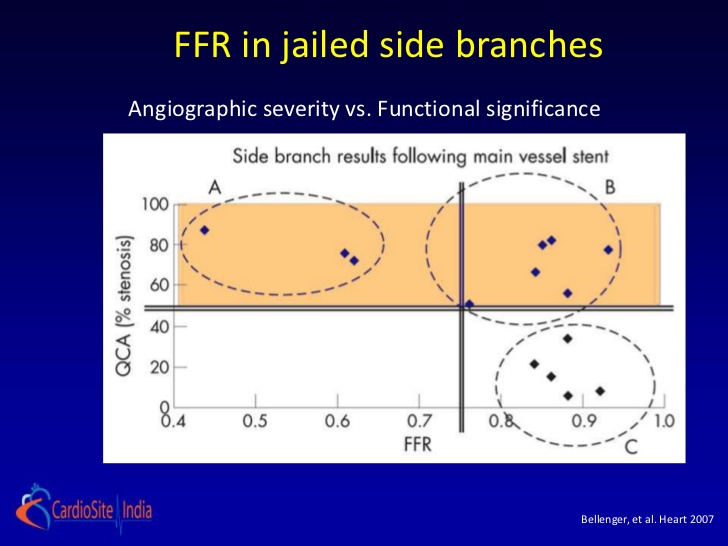
It has become fashionable for many current generation cardiologists to stent the LAD   with proximal end  liberally extending into left main shaft  in Medina 0, 1, 0 or (1,1,1 )lesions involving distal left main often  jailing the LCX . This concept came into vogue as it helped bail  out few  hemo-dynamically  unstable patients with true left main bifurcation lesions during primary PCI .Of course , it’s potentially useful strategy in  emergency , if  extended into routine situations (like all stable proximal LAD/Bifurcation ) we are bound to create few problems.

the-only-thing-more-dangerous-than-ignorance-is-arrogance-quote-1

Rapidly protecting the left main with a long single stent down into LAD is an easy way out for tackling distal left main /LAD combined lesions.  Conceptually it asks you to forget the LCX outright.(Coronary outrage for some to call LCX as  a side branch of left main ! ).Of course, one can reconstruct the LCX  ostium by other means or a second stent if required.

Final message

Conquering  left main disease  with a long stent right from its origin or mid shaft to  LAD (Some times  from Aortic ostium ! ) may be an  interventional pride for the cardiologist. But , in no way it  imply we have crossed the  final frontier in LM disease.In fact,  putting a left main coil is the  easiest task among all  PCI since there is little expertise required to cross the lesion .Maintaining its patency   medium  long run and thus beating the CABG  is  true achievement  ! Achieving  an acute patency  of left main and wheeling out the patient live from cath lab can not  be reason for permanent rejoice ! One should realise his life is at the mercy of DAPT and its pharmakinetics which we know can be unpredictable !

“Protecting the patient is more important than a protecting left main” 

Just because a technique is easy to accomplish it doesn’t confer the right to misuse it .The argument “my patient” is doing fine with this type of stenting  is not an appropriate way of justification.

PCI and coronary stents are revolutionary concepts , still , they may not be great life saving devices . . . though the collective cardiology wisdom may seem to suggest so !

stents-india
The ideal way to describe a stent could be “Its a metal coil , if inserted properly in certain population of severely obstructive forms coronary artery disease may save some lives in acute situations or give relief to pain in non acute situations”
*While the true benefits for the patient population is unsure . . . it’s absolutely certain stents confer highest quality of life to the manufacturers and their chain of associates including the Noble professionals !

sir-william-osler

I wonder , what would be his comment about ubiquitous stents that rule the current era !

Learnt cardiologist’s will know the true life saving potential of these stents (In the way its been currently used ) Their conscience will also tell how Inappropriate and Indiscriminate usage of stents has possibly injured or consumed more human lives , that may even beat the number of lives saved .(Oh, Its a wild, rude statement friend!)

I sincerely believe the move by Government of India to control the stent price ( to enable all our countrymen to get it) . . . as if “stents are the only staple diet” for heart patients is ill-founded and dangerous .

What the Government may not be aware of is . . .This 45000 crore omnipresent stent industry is playing havoc in the life of patients not only financially but also biologically to harm their blood vessels.

It is near foolish to tackle the scourge of human beings -Atherosclerosis, a diffuse medical disease with a lesion specific intervention .This is especially true when we want to tackle it in population based approach . Yes, some super rich and elite get sophisticated stents thinking that they are privileged .Please understand rich tend to suffer more with technology. Often times non affordability is also a bliss for the poor .(You can’t write any rubbish man !)

Who will tell this to our policy makers ?

Never ape the private sector health care , states must have different priorities.There are Infinite number of studies that very clearly reveal medical management and life style modification is the sure and successful way to tackle CAD.(I think I need not dwell into this as evidence is explicit .)

Meanwhile, let me give one example of the futility of innovation and perils of premature release of half baked science .While one section of Industry is coming out with stents made up of exotic new metals , simultaneously other group is innovating and experimenting the exactly opposite , how to get rid of the metal ie bioreabsorable stents. Mind you, one of the latest generation stents was severely reprimanded in a Landmark trial ABSORB 2 and 3. Its a comical irony some of the hospitals and cardiologists feel bad to miss this red flagged stent that are taken out of their cath lab because of price cap. ( A pat for the Govt for this !)

Its a multi billion dollar Industry (Note : there is no pardon for Indian companies to exploit either !) trying to disseminate a commercially motivated concept intelligently including the stake holder Government in their loop. The move to liberalise stent usage is most unfortunate thing as the Govt has inadvertently increased the risk of abuse .Let the new age Indian not be proud about “Stent for all ” movement since the Govt will ultimately have to shell out for this imperfect therapeutics through public insurance .

Final message

Though capping the price of the stent by Government do carry some sense . . . ultimately I feel its a trap . It’s akin to let loose a dubious modality in public domain within easy reach . Already the companies want to increase per capita metal consumption. That process will only get accelerated now.In a country where bulk of the ACS patients not even get prehospital Aspirin, we talk about primary PCI for all.It is a shocking medical economic hijack played in day light by a new generation thrombolytic called TNK -TPA is able to jack up the cost of coronary care with marginal benefits based on dubious off shore studies. I guess , very shortly the thrombolytic warrior Streptokinase is likely to be declared as endangered species and perilious for STEMI patients.If Govt really wants to tackle population based emergency cardiac care they should first upgrade country wide taluk or municipal level hospital with 24 h coronary care facility with trained doctors who can save more lives than the combined efforts of socially concerned corporate care takers.

Some one should tell the Govt, cath labs would never come into the scheme of things for mangaing ACS in bulk of our country men.The Law makers and the corridors of power should be “forced to realise” there is an urgent & broader issue to be addressed.Its not only in cardiology but in all walks of health delivery system. How to prevent “contamination of medical science by pseudo cost effective scientific interventions fueled by corporate greed ? They should start sensitizing the young medical professionals in medical schools that will help the Noble profession remain Noble !

Postamble

Its heartening to note Govt of India is Indeed taking some harsh steps to make drugs and devices affordable in a fair manner .The new authority National pharmaceutical pricing authority (http://nppaindia.nic.in/ ) has clear targets and are in hot pursuit towards righteousness in health care. Still, they have to be very watchful and work in tandem with medical council of India since commerce masquerades as science , price control alone is not a solution and there needs to be body regulating the true Indications as well .

Visit the site for more Info

http://nppaindia.nic.in/

Now , some one wanted to know,  Can we diagnose unstable angina without Chest pain ?

Crazy question isn’t , Angina by definition  should have chest pain .There is nothing called silent angina , only silent Ischemia  .

  • We know Ischemia can occur silently .
  • We also know STEMI can occur silently (About 10 % of MI do occur without any symptoms )
  • If STEMI occurs  silently  why not UA/ NSTEMI combo ? (Collectively called as  NSTE-ACS)

The debate goes like this .If stable angina can present with equivalents ? what prevents  “Unstable angina”  to present with  Anginal  equivalents without chest pain ?

If  a diabetic patient who had a silent MI in the past  . . .  subsequently  experience  severe episodes of resting ischemia  , will he feel the pain , that is supposed to occur  with his  “unstable angina”  or not ?

Hmm , difficult to guess right,   So it seems highly plausible  UA/NSTEMI  do  occur silently ! Literature hasn’t looked into this specifically. Chest pain is built integral  into definition of UA , infact it is a symptom  complex rather than an disease entity by itself, while NSTEMI is ECG and enzyme combo ! Making the term  NSTE-ACS  look  perfect.

Any other technical explanation ?

The concept of Ischemic cascade says angina occurs last, well after biochemistry , wall motion defect and ECG , hence its distinctly possible for UA/NSTEMI present to be painless !

Final message

Anginal pain perception is related to intactness of neurogenic circuits and also probably the severity of Ischemia.If full thickness myocardial necrosis can be painless in few, nothing prevents from an episode of UA/NSTEMI  be truely painless .

Clinical implication of this conundrum

Can we admit a patient as UA/NSTEMI with out chest pain ?

Yes, it would seem so .

No, we can’t .

Indeed we can , if ECG changes are there .

No, we can admit even with normal ECG if its real unstable angina.

This is the crux of the problem in ERs all over the globe. Our knowledge base is simply not good enough. Every one of us has seen Troponin positive silent NSTEMIs ! but . . . to me still something is missing in the link .

Modern day approach 

Pain or no pain,any  fresh ECG changes ( Both T and ST shifts*) should be rushed to cath lab.Whenever you are not sure .Always better to err on the side of over investigation.That’s the mantra ! So ,you do an Angiogram , find an Incidental intermediatroy lesion which may not be responsible for the ECG changes but you are compelled to go after it FFR//iFR , OCT, IVUS and so on !

*There is huge list of non Ischemic ST/T shifts in ECG that can be read elsewhere .

Counterpoint

Can’t agree with this article. Foolish to diagnose UA without chest pain. Never  treat ECG  in isolation unless its a convincing  ST elevation or depression with clinical input and thorough scrutiny of  past record . Realise , how important is  the basics principles of medicine taught  by Oslers and Cushings a  century ago.


Medical practitioners often need to refer a patient from small clinics and hospital to a higher center  for providing state of the art care provided by specialty hospitals armed with ultra  modern Imaging , gadgets and devices.

Recently, I happened to see an elderly women with ca breast, radiculopathy, dilated cardiomyopathy, triple vessel disease , stented  /by passed  with 3  CABG grafts later, followed by an  ICD and CRT, .Her CRT became non responsive after a failed attempted AF ablation.

.evidence-based-medicine

After a prolonged stay in the posh AC suit of a renowned corporate hospital the patient was feeling exhausted and weak with multiple tests and procedure.The patient found things annoying as every consultant and support staff behaved like a programmed robots with artificial smiles and compassion.

She and her family  was tolerating things, but desperately required a break from 24/7 attention (which was without much progress either ) . After a mini family confabulation, they decided to request the treating consultant to refer her to a lower center for a more humane care.

From here on its  fiction . . .

The doctor agreed (after Initial amusement ) and asked his secretory  to write  a letter which sounded something  like this,

Please get permission from the hospital desk for referring this 70 year old gentlewoman to a “lower health care center” as she feels exhausted with our treatment and decided to opt for a more simplistic, supportive , compassionate  and humane care that’s is devoid of claustrophobic gadgets and  machines .

We also acknowledge we are neither equipped , nor has personnel  and expertise to provide that sort of human care,  you demand ,! We have to respect science more than individual patient needs . We are taught, paid and live for science first ! so please forgive us.

But, we respect your concern and will transfer you to a primary health center.Thank you for being with us this long , and helping us the master some cutting edge skills and helped science to grow.

picture2

By and large, the concept of tertiary health care can very well be a myth.(With few exceptions)  It means  mechanised  care that primarily involving aggressive organ specialists who want  attack the  disease without mercy for the patient.

The uttering  here  might sound provocative , especially  for the families who have benefited from cutting edge medical technology , . . .

Still ,  the rate of growth of irrational organ or system based  tertiary care is growing in dangerous proportions , and very soon we will realise the disastrous consequences of this pathological mindset of modern medical intellect.

What we need , ?  Emergency bulk supply of  “right and straight” thinking “whole body specialists‘ . Who are they ? they include the  Internal medicine graduates ,humble general practitioners ,family physicians and geriatricians .These genre are currently in the sidelines suffering from artificial low self-esteem (atleast In India !) Soon I expect they should emerge stronger and take control of the sagging medical profession from the clutches of pseudo scientific specialty hospitals who keep the cost of medical care Insaningly high that  drains the  global GDP in a meaningless manner.

Will WHO act ? Should they be conferred the veto power and tightly control when to refer a patient  from a lower to higher center and vice versa !

For those of you who don’t know who is who  ?

WHO stands for World Health Organisation , a united Nation organisation which is the apex medical body & guardian of human health .One of their Job functions is ,they are expected to act when there is Inappropriate health delivery and expenditure .( Unfortunately even most of the medical professionals think WHO exists for only one reason  to eradicate mosquitoes and vaccinate children ).

WHO need not think they exist only to guard health of poor under privileged , they have a critical responsibility to prevent wrong therapies committed to rich and affluent as well ! and more so  these unnecessary modalities  spill over from rich to poor in the name of  equality !