Feeds:
Posts
Comments

Traditionally , vegetations are sine qua- non for diagnosing Infective endocarditis.

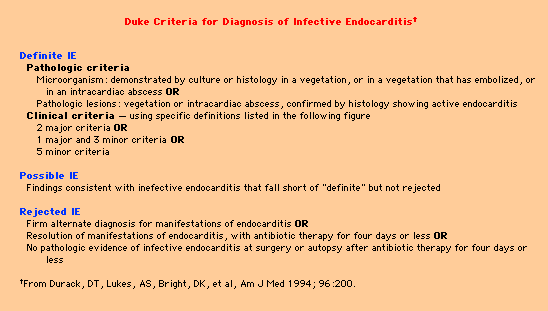
The following  are major criteria to diagnose IE

  1. Evidence for endocardial involvement in the form of  visible vegetation or New onset regurgitant murmur.
  2. Positive blood culture

There are six minor criteria .

To diagnose IE we need

  • Two major or
  • One major and 3 minor or
  •  5 minor criteria alone

Duke criteria for infective endocarditis


duke_ie1

Now ,we realise  IE do  occur in the absence of visible vegetation.This happens because, vegetation can appear late, it is too  small and missed , burroughs inside tissue plane instead of entering cavity , may form  micro abscess or vegetation growth is prevented by prompt empirical antibiotics.

Final message

Vegetation is still a prime sign  to diagnosis of IE. However , please do not insist  on it .There can be significant endocardial infection  without formation of vegetation.The current criteria allows us to make a diagnosis of IE without documenting a clear cut visible vegetation.


The major mechanism of exertional dyspnea in HOCM is due to

  1. Hypercontractile LV
  2. LVOT obstruction
  3. Diastolic dysfunction
  4. Mitral regurgitation
  5. Unrelated to HOCM

Answer : 3*

*This has been proven by a simple fact , dyspnea continues to be  a prime symptom in both obstructive as well as non obstructive HCM

Though LVOT obstruction appears to be the core issue , the myocardial disarray is a global one and lies scattered .That is why , myomectomy , septal reduction , may not reduce the symptoms  grossly as one would expect.

Paradoxically , preload reduction with diuretics  (That works well  for most  dyspnea with  raised LVEDP) ,  is vested with the risk of worsening the symptoms in HOCM . Diuretics underfill the  LV and tend to aggravate dynamic LVOT obstruction.

Probably ,the best way to reduce  symptom of dyspnea is to keep the heart rate low with betablocker.Further, betablockers smoothen the LV wall stress and calm down the LV baroreceptors which  indirectly suppress the  afferent input in  the brainstem dyspnea circuit.

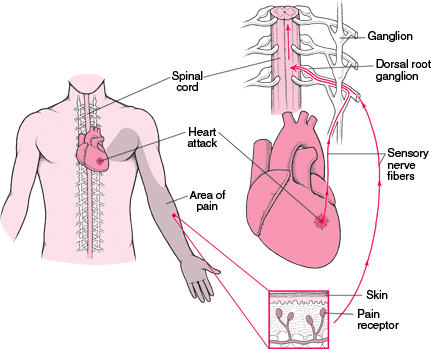
We know cardiac pain is often  referred to Jaw and neck .

What prevents the neck pain of cervical spinal disease to be referred over the  heart ? Can pure spinal lesions mimic angina ?

The answer seems to be “Yes” . The neuronal  circuit is  there .Only , the traffic has to be reversed. Medical logic is always puzzling. There is indeed an entity called cervical angina.

The cardiac pain  can be  referred any where between  dermatomes  C3 to T 10 It is generally  believed cervical radicular pain  can go only one way . . . ie towards the nape of neck and  arms .Dermatomal overlap ,neural cross talks  thalamic inputs and cortical  reflection and perception always make the subject of referred pain too  complex.

Now,It seems possible ,the neck  pain can  spill over into the anterior chest wall ,mimicking  angina .Imagine the  confusion  if the patient  has both  cardiac and cervical entities ! Does the pain signals from the two sites  collide in the local spinal network ? Does one extinguish or amplify the other ?


refered pain

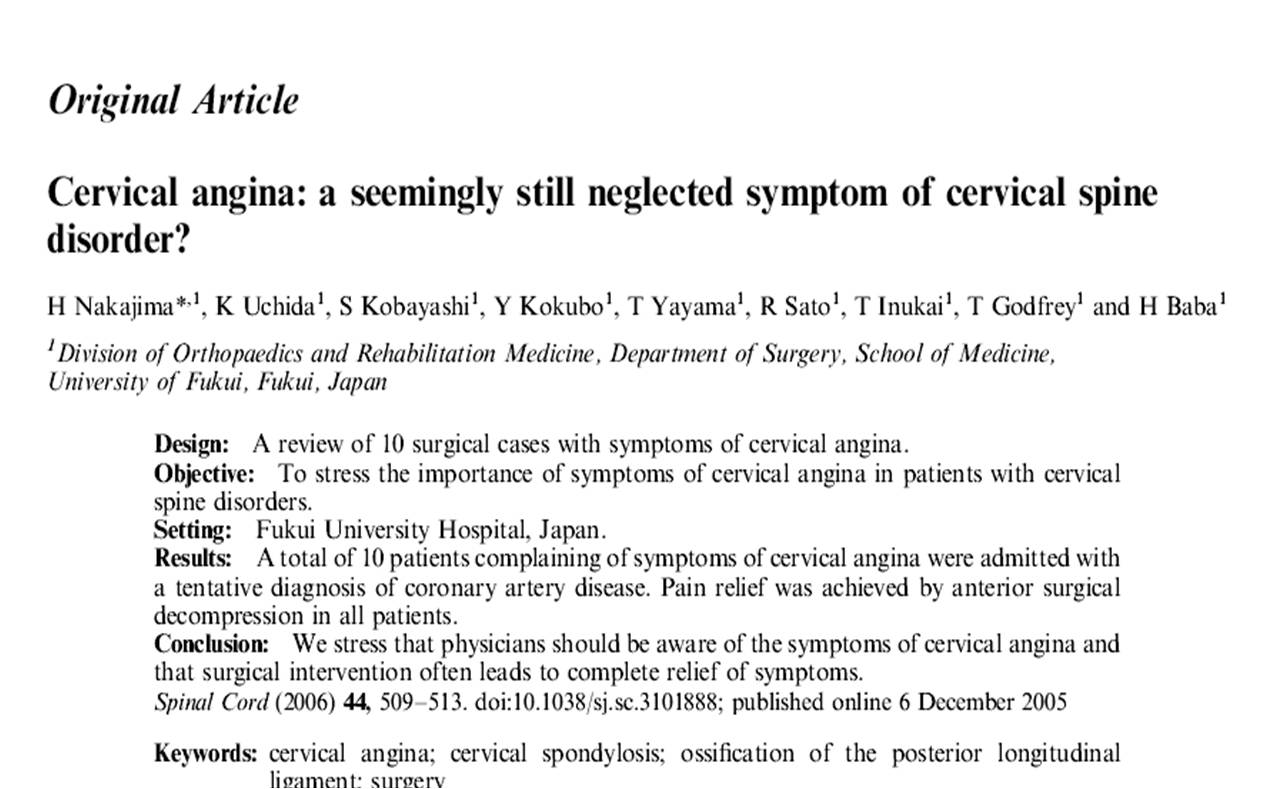
This article which was published  in the Spinal Cord .

cervical angina  reverse referral pain

Read also linked angina

http://www.nature.com/sc/journal/v44/n8/pdf/3101888a.pdf

 1.Guler Net al.Acute ECG changes and chest pain induced by neck motion in patients with cervical hernia: a case report. Angiology 2000; 51:861–865.
2.Wells P. Cervical angina.Am Fam Physician1997;55 2262–2264.
3.Jacobs B. Cervical angina. NY State J Med 1990;90: 8–11.
 4.Baba H et al. Late radiographic findings after anterior cervical fusion for spondylotic myeloradiculopathy. spine 1993;18: 2167–2173.

When a culprit thrombus keep the  myocardium as hostage . . . don’t storm the coronary artery  indiscriminately   !

When a single gun men  keeps 100 innocent people as hostages , threatening their  lives, rescue mission should start .No can can afford to wait. But, without knowing  the  culprit’s true nature the process of rescue mission is always going to be tricky .There are so many instances Newton’s third law  was reversed , when reactions  evoke more chaos  than the index action.

In the recent world terrorist events ,  the  rescue missions  were so delicate and  it was very  unfortunate we  lost  many   innocent hostages !  The reasoning is ,there  is no way we can avoid these. I wonder is it really true ? !

rescue missionNot all culprit lesions  are true ones.They simply threaten  our myocardium with  thrombus and plaques  in various forms .Don’t show aggression to pseudo threats  you may  ultimately end up with more damage.(What I call as crazy culprits!)

(  Read here , why unstable angina even though thrombus is sitting right inside the coronary artery attempting to lyse it causes more  damage !)

After thought

Iam sure ,bulk of  the Interventionists wouldn’t agree with this thought . They would decry , watching a person  silently when the myocardium  is on  fire is a serious crime !

But . . . we  need to  remember the process of extinguishing  the fire  with some more fire arms is a delicate game played in undefined  philosophical turf.

The only way to introspect  such events in life is , to accept any eventuality    arising out of “not pursuing”  a  presumed rescue mission with vigor. No need to be guilty about that,after all , it can be a myth !

Modern human cognition , growing with a staple  scientific  feed  on a 24/7  basis  is  unlikely to realise , restraint can be an effective tool  even in critical moments !

Oh,is all that I have  scribbled so far  is just a repetition  of 1000 year concept of  “Primum non nocere”

Hi ,

It all started in 2008 with two posts and about a handful of visitors.It gladdens me to note it’s helping  so many  followers. Iam  posting  herewith the official annual report of my blog  for the year 2014.

Wishing you all a Happy , Healthy and energetic New year !

Thank you  once again.

Dr S.Venkatesan

Chennai,India.


The WordPress.com stats has  prepared a 2014 annual report for this blog.

Here’s an excerpt:

The Louvre Museum has 8.5 million visitors per year. This blog was viewed about 520,000 times in 2014. If it were an exhibit at the Louvre Museum, it would take about 22 days for that many people to see it.

Click here to see the complete report.

Picture4

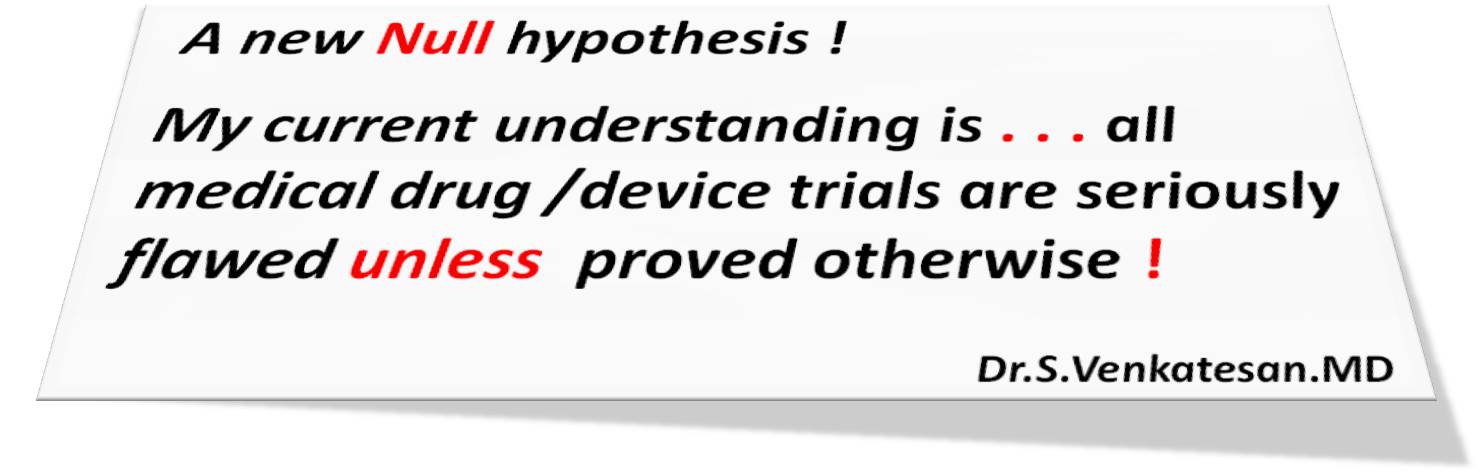
After nearly three decades of , treating patients , teaching students and little involvement in research , created a new definition for null hypothesis in medical research  !

Picture7

This cartoon succinctly  depict all the options we have in our fight against end stage heart failure .We know , a failing heart is often compared to a sick , aged and tired horse.

cardiac failure cartoon tired horse whicpping lionel opie book

Image courtesy Heart Physiology: From Cell to Circulation :Lionel H. Opie Lippincott Williams & Wilkins, 2004


1.Don’t whip the horse (Except in emergency)

  • Avoid all Inotropics ( Doubutamine and Milrinone were shown to improve quality of life marginally but  with dramatic reduction in quantity of life ! However , the same thing does not apply for Digoxin as it is the  the only Inotropic with a soothing para-sympathetic comfort  !
  • Please be reminded, CRT wires could act as  “multiple whip equivalents” right inside the heart , especially in advanced class 3 or just recovered class 4 patients. Beware!

2.Unload the horse

Vasodilators

  • ACEI/ARBS

3.Slow the horse

  • Never exert too much (Not more than 70% of capacity)
  • Beta blockers
  • Ivabradine (Slow the sinus node and expect a reduction in MVO2 )

4.Change the horse

  • Heart transplant may be the best solution

5.Switch to an Artificial Horse(Tractor )

  • ie  LV assist device

6.Finally try to heal the horse (Still largely in research labs!)

  • Genetic engineering
  • Tissue repairing
  • Stem cells
  • Holistic and spiritual healing etc (Has really  worked in few )

Every one talks about  coronary excesses ! It happens  both  in acute and chronic  fashion , not withstanding the inappropriately  understood  . . .   appropriately  released  guidelines  on inappropriateness ! The  burden  of coronary syndromes of the humanity, I am afraid would  include these man made excess as well !

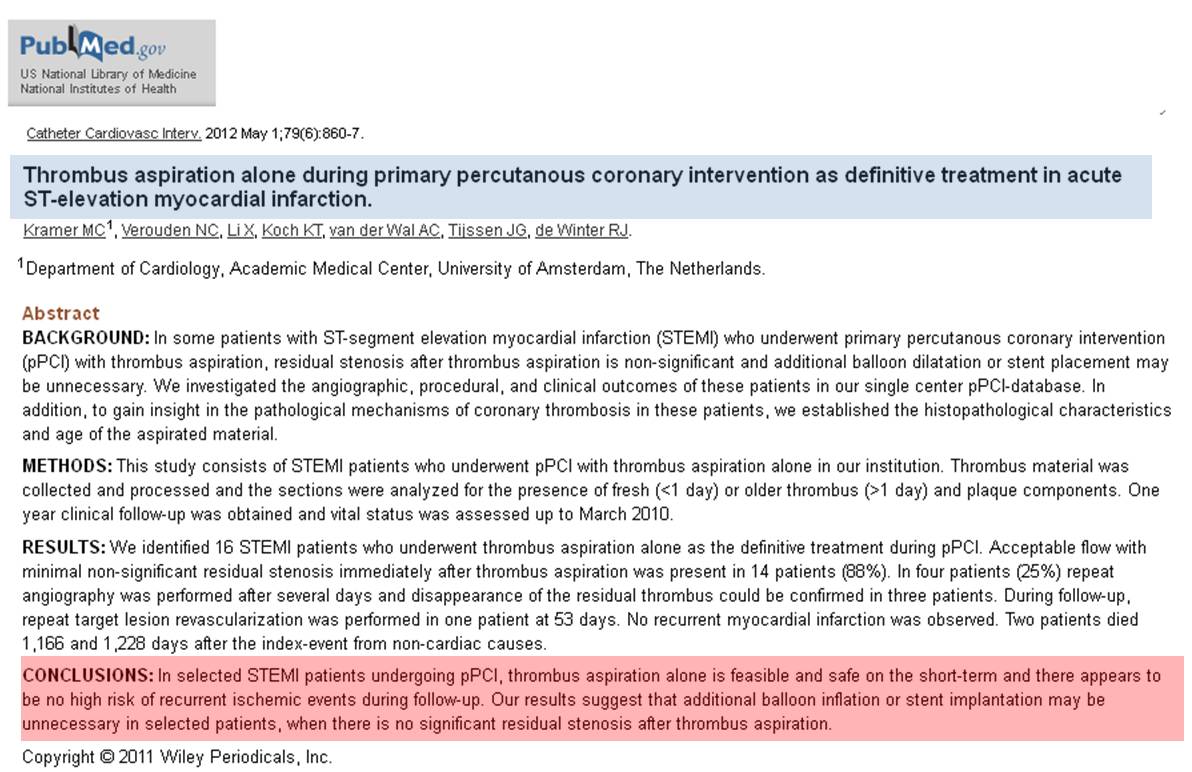
I stumbled upon two  small  “gems ” in this other wise wild dark  cardiology literature  .One from Kamaer , Netherlands and other from  Escaned from Spain.

Both  talk about a  simple and logical modality in the management of STEMI . If bulk of the STEMI events are due to coronary thrombosis just tackle it  . No more  . . . no less” Stent only , if there is tight residual lesion.

1. From Amsterdam , Holland.
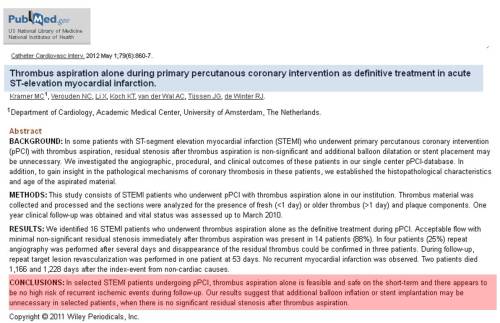
krammer thrombus aspiration alone priamry poba for stemi no stent

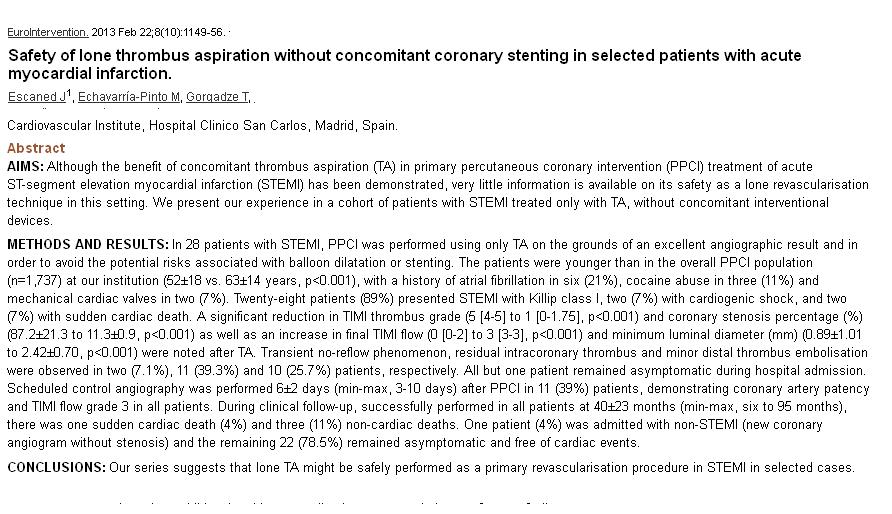
2.This one is from Spain.These studies I am sure , only a fraction of the interventional community would have read .Reason ? We are always hijacked by the moments of glamor ! I am just sharing them .hope few are benefited
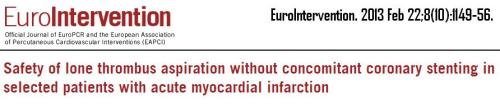
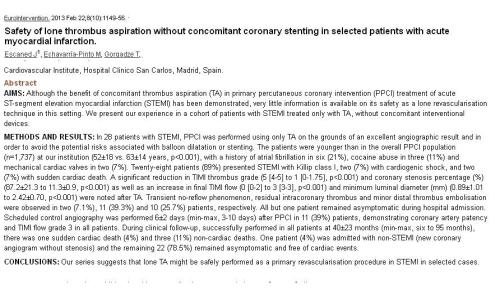
primary POBA thrombus aspiration alone for stemi no stent stemithrombus aspiration alone for stemi no stent priamry pobaThese two studies with total number of 44 patients has a potential to redefine  the entire practice pattern of acute interventional coronary care.(Of course , if only , we are ready to make sense out of it !)

But , the concept will be heavily banished by strong visible and invisible forces   for the simple reason it suggests a true possibility  of knocking  out the role of  stent from acute STEMI arena.

When I discussed with my colleagues  for a large scale study  on isolated thrombus aspiration in STEMI , they told it  is not possible for ethical reasons !

I was amused , denying such a study is biggest ethical blow to the field interventional  cardiology !

Final message

Proof of concept does not require numbers .A study with less than 50 subjects  can be far superior than multi-centre ,multi-blinded , self steered ,peer reviewed largesse ! The truth of the study lies in the core consciousness  of people who do it , not in the numbers and exotic statistical methods !.

After all , one of the greatest medical study  was  done by James Lind  (Father of RCT) who discovered vitamin c as an antidote for scurvy,  with a hand full of sailors  while they crossed the Atlantic many centuries ago !

After thought

You say , thrombus aspiration is great , Why the hell , TAPAS , INFUSE AMI, and TASTE studies  confuse us regarding thrombus aspiration  ?

Don’t blame it on thrombus aspiration .We do it perfectly . It is because of what  we do after that ! We decorate the coronary lumen finally with a piece of metal cherry  undoing all the goodness of a great pudding !

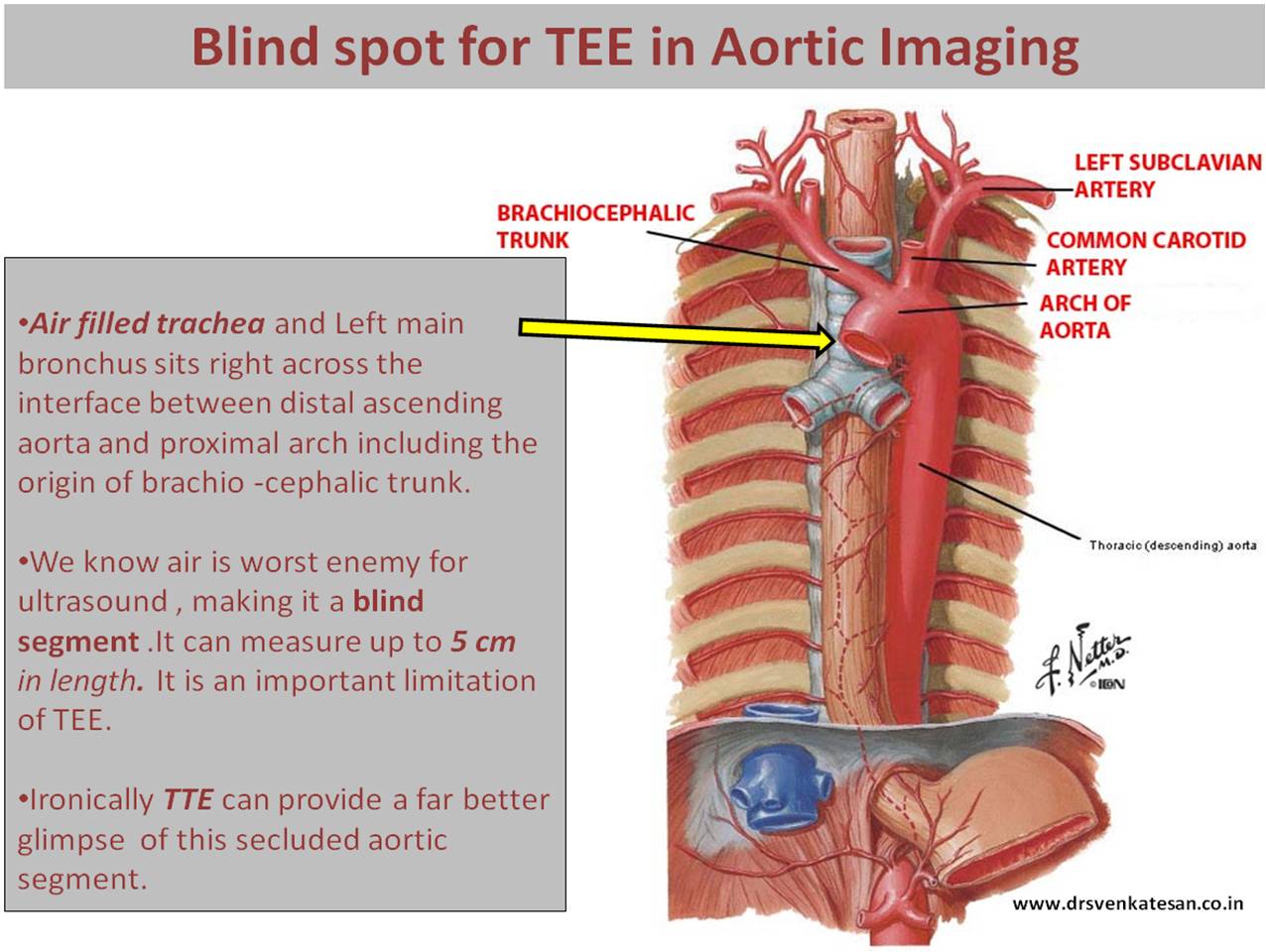
Meticulous Aortic imaging is vital for assessing  atherosclerotic plaques in stroke evaluation ,  aneurysms of aorta ( Both dissecting and non dissecting.) and during aortic surgeries. Peri  procedural  aortic imaging has become mandatory in many of the complex aortic endovascular repair as well .

TEE is an extremely useful investigation and has revolutiolised our appraoch to aortic disorders .

However , we have an issue .

blind spot for tee in aortic imaging distal ascending aorta and proximal arch bracho cephalic trunk

How to overcome it ?

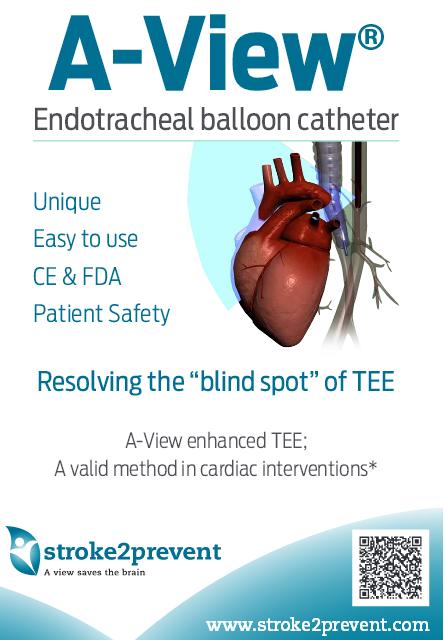
During peri-operative TEE a simple but innovative idea is to displace  the tracheal air with saline filled balloon and capture the aortic arch with ultra sound . What a way to un-blind our vision deep inside the thorax  !

A specific catheter is available for this purpose .

a view endo tracheal balloon catheter how to overcome the aortic blind spot in tee

Product catalog

The success of primary PCI  is defined on the basis of acute vessel opening and deployment of stent and wheeling out the patient out of the cath lab. Most PCI cath report promptly mentions TIMI 3 flow with Grade 3 myocardial blush.

I recently encountered 3 patients over a period of 2 months in my echo lab. All three had a recent primary PCI for STEMI found to have scarred IAS with moderate LV dysfunction.

These patients were medically savvy and asked a simple question after glancing at the report signed by me.

Doctor , If my myocardium has  been allowed to die a silent death  in a matter of 30 days and replaced by a  whitish scar , what is the point in calling the much hyped  primary PCI successful and charging me about 4 Lakh Rs . They wanted to know ?

I told them you have to direct this query o the supposed state of the cardiac Intervention team.I also told them it may not be proper to criticize anyone. The science of myocardial revascularisation is yet to be fully understood.

Why the myocardium goes for long-term scarring in spite of prompt early revascularization?

  1. Time window errors (What you think is early PCI may be in fact a late one!)
  2. Intermittent patency
  3. Re- occlusion
  4. Individual variation in hypoxia resistance
  5. Contra-lateral significant CAD.
  6. Recurrent  coronary events
  7. Poor compliance with medications.

Final message

Just because your patient has received a state-of-the-art primary PCI  in a high-end hospital does not negate the possibility of myocardium going in for scarring and resulting in significant LV dysfunction. There is something more hidden in coronary hemodynamics than it appears!

The so-called acutely successful PCI in your discharge summary actually may mean nothing. Unfortunately, we the pundits of cardiologists never bothered to include myocardial status as one of the criteria to define the success of the procedure.

Ideally, we may defer calling a primary PCI successful or not by at least a few months, when the true story unfolds ie how your myocardium has responded to the treatment and the after-effects of a stent.