Feeds:
Posts
Comments

Posts Tagged ‘drsvenkatesan’

                                        Angina pectoris , classically occur on exertion and gets relieved on rest .This is called typical chronic stable angina as described by Heberden (CSA ) .  Unstable angina(UA), the term originally described by Noble O Fowler in early 1970s. ( Also being referred as  intermediate coronary syndrome , preinfarction angina etc).The definition for unstable angina has evolved  over the years  and currently  refers to .

 1.All new onset angina of any degree* Some include severe angina only ! New onset angina of very mild degree on exertion could be the onset of the first episode of  stable  angina. 

 2.Rest angina of more than >30 mts not relieved by taking sublingual nitroglycerine.

 3.All Post MI angina

 4.Any angina in patients who have been stented by PCI.

How to recognise a patient  who is shifting from  stable angina to  UA ? 
UA is  to be suspected when  a patient develops. 
5.More frequent episodes than usual
6.Angina occurring at lesser level of exertion than before 
7.Angina radiating to new site ( Example : Chest pain radiating  to jaw rather than to the usual left arm or vice versa)

Why the first episode of angina is given a special status and often considered critica ?

Angina is the  clinical expression of   myocardial ischemia.The course of  the  first  episode of angina , can not be predicted.It could be a the beginning of a chronic disease process, or it could be a progressive coronary occlusion as in unstable angina /NSTMEI , or the onset of even a STEMI.
In contrast a patient with chronic stable angina  has a predictable chest pain , at a particular level of exertion, radiation to same site, same character, and the patient knows for sure the pain  would promptly dissappear  when he takes rest or nitroglycerine  tablets.

What is the underlying pathology in UA ?  

Generally it is very rare for  a stable plaque to produce a  serious episode of unstable angina .It  requires  an unstable plaque* to  precipitate an unstable angina !
Unstable plaque refers to any plaque which is eroded, fissured, ruptured or  hanging  eccentrically ,  with
an active thrombus.

What is the significance of post PCI angina?

It is an irony, any angina following PCI is to be considered unstable as sudden occlusion of stent is quiet common.This is a paradox of sorts as one would wonder in a patient  with CSA who undergoes PCI with stenting  of left anterior descending coronary artery  (LAD)  all his subsequent episodes of angina  will be labelled as UA  even if a stable angina occur in his other coronary artery.And these patients would go for early invasive approach and potentially inappropriate interventions even if they are at low risk !

Is all angina at rest can be termed as unstable angina ?

No, but many times ,  rather most of the times  cardiologist believe all rest angina to be unstable.

What are the situations where stable angina can occur at rest?

An episode of angina during mental stress, or post prandial* state are very common in patients with CSA. This gets relieved after the stress. Some times  patients with CSA during episodes of fever may get angina at rest .These are considered variants of stable angina.
Post prandial angina , may be considered by some as unstable

How often a diagnostic confusion occur between CSA and UA ?

Generally, this issue is rarely addressed in cardiology literature , for the  simple reason it is never considered an  issue at all !
According to Canadian cardiovascular society grade 4 stable angina  is almost similar to unstable angina , as it denotes angina occurs with minimal effort or even at rest. In fact CCSC grade 4 should be termed as UA.

Can ECG be useful to identify stable angina from unstable angina ?

                                    ECG will some times  come to our rescue when one is confused between stable and unstable angina even though resting ST depression can occur in both stable and unstable angina . Statistically , if ST depression is noted during an episode of angina it is more likely to be UA rather than CSA. . Apart  from ECG , Troponin T or I levels may be elevated in some of the patients with unstable angina. Rarely stable angina can also show elevated troponin.

In patients with systemic hypertension and LVH or cardiomyopathy resting ST depression may not indicate UA 

So differentiation between, stable and unstable angina even though appear simple and  straight forward, it requires a diligent appraisal of history , physical examination (Aortic stenosis /HCM  may cause stable angina)  and ECG, enzyme evaluation.

Final message

In any coronary care unit ,  admissions with initial diagnosis of  ACS/UA/NSTEMI , subsequently turn out to be simple stable coronary artery disese . This error happens because the chest pain  or ECG changes  are aggravated by non cardiac factors like a mental stress or a post operative stress  or fever etc.
There could  be another school of thought, that is to err on the side of  safety, and manage all  rest angina as UA  .But the hazards of unwarranted therapy might exceed the risks of leaving these patients alone.
In this context ,there is a need for a new definition for unstable angina .
One ideal version could be . . .
  • Any angina , of any degree  which is caused  mainly by the supply side defect (By a acute thrombotic /disruptive plaque   occluding the  coronary lumen  with a imminent danger of myocardial infarction is to termed as real UA.
  •  All post MI and post PCI angina are unstable angina
  •  Rest angina which occurs due to increased demand situations need not be  labelled  as unstable angina for the simple reason  there is neither an active plaque nor a  fresh thrombus likely  in these patients. They rarely develop  recurrent angina or MI . The mechanism of angina at rest here is most often due to a tachycardia and resultant increase in MVO2 .(myocardial oxygen consumption) .Currently they are called as secondary unstable angina.In fact , anti thrombotic drugs are misused in these situations as they satisfy the criteria of UA/NSTEMI.


Read Full Post »

                                Coronary artery  by pass graft surgery has become the most common cardiac surgery done world over ever since it was first introduced by Favalaro in 1969.The common indications  are, triple vessel disease and left main disease in any of the following situationsE.

Elective CABG(Non emergent)

1.Chronic stable angina

Either emergent or elective

1.Unstable angina

Emergency CABG*

1.Acute myocardial infarction.-Cardiogenic shock

2.Failed thrombolysis

3.Failed primary PCI

4.Complications during routine PCI(Cath lab crashes !  etc)

5.As an associate procedure after a  mechanical complication during MI (Septal rupture, Acute MR etc)

*In emergency situations even a single vessel disease would require a  CABG

Hybrid CABG

Combining CABG and PCI in the same patient is followed in very few centres .(Example LAD graft and RCA angioplasty)This is done in patients who have co morbid conditions who can not tolerate prolonged surgical times.Further there can be situations  one lesion is very ideal for PCI  while for other grafting is the only solution.

Controversial CABG

1.CABG as a primary revascularisation  in STEMI*

(Rarely done now , almost obsolete , primary PCI has almost replaced it  . . . but it is still  useful if performed within 6 hours of MI )

2.Incidentally detected CAD*  following routine coronary angiogram.

( *CABG for incidentally detected asymptomatic CAD is  increasing in many parts of world )

Inappropriate CABG

         If it’s triple vessel disese it must be CABG -CASS study (1980s)

                       Coronary artery surgery study (CASS) still has considerable influence among the  cardiology  community in the decision making process  for CABG , even though it is many decades old .There has been a phenomenal development in both medical as well as interventional techniques since  CASS . (Thrombolysis, Statins, ACEI, PCI  DES to name a few) .

                     When CASS study was done many decades ago,it was believed triple vessel disese constitute a  homogeneous population and  carry  the same clinical significance . For example a 90% proximal LAD , 50% RCA and 50% OM technically qualify for a CABG and unfortunately , some of them are  subjected to it even in  2008 !  Now we clearly know, it is not the number of diseased vessels  that is important, but it’s location, severity , LV function, presence or absence of diabetes . Finally , the presence of revascularisation eligible myocardium must be documented in all post MI patients . (Technically referred to viable & ischemic myocardium ).              

              Currently , with the  PCI  & medical management has grown so much, CABG should be reserved only for, critical triple vessel disese , with at least one proximally located lesion (Mostly  LAD  or Left main ), especially in diabetic individuals.

Read Full Post »

Which is  the most important factor that determines thrombolysis failure in STEMI  ?

  1. Thrombus load .
  2. Drug efficiency
  3. Time delay
  4. Presence of a mechanical lesion
  5. Hemodynamic instability

Answer : 3 .(Though all 5 factors operate )

Failed thrmbolysis occur in about 40-50% after streptokinase and slightly less with TPA   and TNK-TPA . Delayed arrival and late thrombolysis are  most common cause of failed thrombolysis. As the time flies , the  myocardium gets damaged and the intra coronary  thrombus gets organised .Both these processes make delayed thrombolysis a futile exercise.

               Not all STEMI patients have large thrombus burden. There need to be a critical load of thrombus for thrombolytic to be effective

Some may have a major mechanical lesion in the form of plaque fissure, prolapse and it simply blocks the coronary artery mechanically like a boulder on the road  . The poor  streptokinse  or the rich Tenekteplace !  nothing can move this boulder .The only option here is emergency PCI .

How will you know when the patient  arrives in ER with STEMI whether his/ her coronary artery is blocked with soft thrombus or hard mechanical boulder ?

It is impossible to know.That’s why primary PCI has a huge advantage.  But still thrombolysis is useful as some amount of thrombus will be there in all patients with STEMI.Lysing this will provide at least a  trickle of  blood flow that will jeep the myocardium viable and enable us to take for early PCI.

Final message

The commonest cause for thrombolytic failure is the time of administration and the degree of underlying mechanical lesion  . So  it does not make sense  to blame  streptokinase always !

Read Full Post »

What is herd behavior ?

It is a behavioral pattern where in animals and humans in large numbers , tend to behave in the same way at the same time without application of mind .


Herd behavior in human societies

Herd behaviour describes how individuals in a group can act together without planned direction. The term pertains to the behaviour of animals in herds, flocks, and schools, and to human conduct during activities such as stock market bubbles and crashes, street demonstrations, sporting events, episodes of mob violence and even everyday decision making, judgement and opinion forming. This is very much applicable to medical profession also.(Ref:Wikipedia)

Herd behaviour in animals and human how they are different ?

“surprise ! surprise ! There is  very little difference  noted , according to Hamilton”

A group of animals fleeing a predator shows the nature of herd behavior. In the often cited article “Geometry For The Selfish Herd,” evolutionary biologist W. D. Hamilton said each individual group member reduces the danger to itself by moving as close as possible to the center of the fleeing group. Thus the herd appears to act as a unit in moving together, but its function emerges from the uncoordinated behavior of self-seeking individuals.

Among humans for example when panicked individuals confined to a room with two equal and equidistant exits, a majority will favor one exit while the minority will favor the other.

Medical professionals as a herd


The practicing habits of  medical professionals  move , symmetrically as a herd . When a top journal or a opinion leader utters something every one tend to move in that direction .

If a herd leader says a particular treatment is great, every one will say yes . If he says nay every one will say nay !

No one will really question the direction they move ? Unless the correction occurs from within the herd. No external forces usually are effective.Herding is also benefitial many times as rapid propogation of scientific facts needs such behavior ,but it needs constant scrutiny.


Herd behavior example 1 : The most  typical example is the drug prescribing pattern of anti hypertensive agents over the past half century.The movement  from diuretics to beta blocker , from beta blockers to calcium blockers and to ACE inhibitor and again to diuretic  , then to ARBs and currently shying strongly away from beta blockers, in between  have a brief encounter with alpha blockers and finally  back to diuretics.

If a  particular physician by his insight , had clinged onto  diuretics ( Away from the herd ) for over three decades he is a real exemption , although branded old timed  and unscientific , he has been the most scientific medical professional indeed !

Herd mentality example 2 : Every one says so !  so it must be true ! Hormone replacement therapy good or bad goes with the leader of the herd . 

Herd mentality example 3: Very few cardiologists will be ready to agree the fact that , simple digoxin and diuretic ,ACEI, beta blocker,  administration could be as effective as  the costly cardiac resynchronisation therapy in atleast some of patients with wide QRS cardiac failure ( As we know up to 30 %  wide QRS CHF population do not respond to CRT) 

Defying Herd mentality resulted in major break throughs in medicine

               When every one was  saying beta blocker was harmful in CHF one person from Briton defied it ( Wagenstein, and now beta blockers are the mainstay in the management of CHF! )

There are hundreds of treatment modalities popularised by such herd behavior

Who is the watch dog  , whether science is moving in the correct direction ?


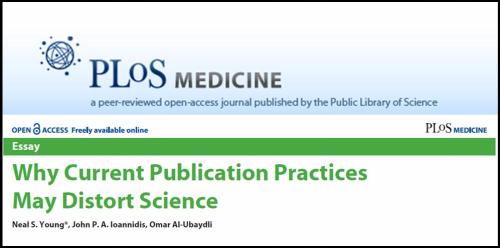
Read this land mark article  how medical research can be distorted by such learned behavior  and how scientific research should not be done .

Click on the image .

 This post is not intended to hurt anyone . It  reflects , human beings are not  fully evolved  yet , in the onging  process of evolutionary biology.

Read Full Post »

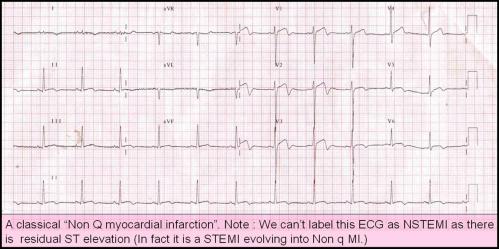
                                Acute coronary syndrome (ACS) is currently classified as STEMI and NSTEMI.This classification came into vogue  primarily to  triage patients for thrombolysis eligibility , as ST elevation is the  only criteria for thrombolysis.The  earlier term  non q MI  is largely used  to denote the  present day NSTEMI. In the past q  MI was referring to transmural MI non q MI  to non transmural  pathologically.(Of course , now we know  the relationship between q waves and transmurality is not good )

So when can we still use term non q MI ?

These terminologies of STEMI and NSTEMI are made on admission  at the emergency room.  ACS being a dynamic entity these  patients can  have rapidly changing  ST shifts , from depression to elevation and vice versa. Fresh T wave changes can also occur .Q waves  may or may not develop ,  depending upon the damage sustained to the myocardium and the efficacy of thrombolysis / PCI. So it should be emphasised here STEMI,  NSTEMI ,  q  MI ,  non q MI are the  descriptions of the  same group of patients in different time frames. The common mode of  evolution  of  STEMI  is  to q MI and NSTEMI  into non q MI. Cross overs can occur.


 The problem here is NSTEMI getting converted into STEMI  is quiet common and has no nomenclature issues . But  when   STEMI down grades  into NSTEMI  there is apparent  nomenclature incompatibility .This category of  patients have  no other labelling option other than “A STEMI evolving into non q MI”. Because one can’t label  STEMI  evolving into NSTEMI as  many of  them  will  have a residual ST elevation as well.

What is the final message ?

The term non q MI is still relevant and is used at discharge , in a patient with STEMI when he or she evolves without a q wave .In the setting of unstable angina , NSTEMI has largely replaced  the term  non q MI either on admission or at discharge.

Before I close

                 The important point to remember here  is NSTEMI getting converted into STEMI  is an adverse outcome and  in fact, it is  a complication and the patient should get an immediate  thrombolysis or PCI , while a STEMI getting converted into non Q MI is generally a  major therapeutic success.( Effective salvaging and preventing q waves )

//

Read Full Post »

                Human civilisation has met so many challenges.Man kind has enjoyed the benefits of modern medicine for over a century.Now comes the new threat.Threat from within.The onslaught of marketing force has contaminated the medical science .

              It is widely  recognised  commerce is masquereading as science , from stem cell research to futile and costly  drugs, and  questionable  devices and procedures . 

How is the medical  community responding to this  issue ? 

Silence  is the response !  Why silent ? Are we the part of the problem ?  Occasional articles in the  Annals of medicine, Lancet, BMJ, or JAMA talk about these issues and nothing happens next .

Click below  to read one such article from the recent issue of Annals !


Let us hope the world financial crisis currently we are witnessing , would be good for human health as all futile market driven  , enforced medical expenditure goes bust !

Read Full Post »

Answer: Do  coronary angiogram  for all patients  who had suffered from an acute myocardial infarction* ( Forget about all those mulitpage ACC/AHA  guidelines !).

For an  interventional cardiologist ,  it is often  considered a crime to  follow a conservative  approach !

*Caution This one line guideline is not based on scientific fact  but reality based . Ideally one should identify  high risk subsets among the patients who had an AMI .Patients who had complications during the MI get immediate CAG. Others need  a focused LV function asessment ,  pre discharge  sub maximal excercise stress test or perfusion studies .But this concept has been  virtually replaced by pre discharge coronary angiogram for all ,  in many  of the centres in the world.

Read Full Post »

Humans have roughly 5 to 6 liters of blood at any given time in their  body  . Out of  this*

50% (2500ml)  is located in the systemic venous compartment.
18% is within the pulmonary circulation participating in the vital oxygenation
12% (500-600ml) is within the cardiac chambers.
8%  is in the arterial tree of  the body.
5%  is  within the  capillaries.
2%  is in the aorta.
* Source : Best & Taylor Physiological basis of  medical practice 1966, 8th edition

What is the implication of this predominantly venous distribution of blood  at rest ?

  • A competent venous tone is essential  for the human beings to maintain the erect posture.
  • Bulk of the cause of syncope in humans is due to peripheral  mechanism like loss of vascular tone and resultant venous pooling.
  • The  concept of venous reservoir is so important in emergency situations like  hypotension  as  simple elevation of legs  is equivalent to  infusing 500 -800 ml of intravenous saline .
  • Similarly during acute left ventricular failure trunk elevation and legs dangling down can reduce the pulmonary congestion very significantly and reduce pulmonary capillary wedge pressure (LVEDP)

 Autonomic dysfunction and venous insufficiency

 Autonomic dysfunction and resultant  orthostatic hypotension is directly related  to venous reservoir dysfunction.Increasing effective circulatory volume by elastic stockings or administration of mineralocorticosteroids like fludrocortisone (.5mg/day ) can be useful in this condition

Read Full Post »

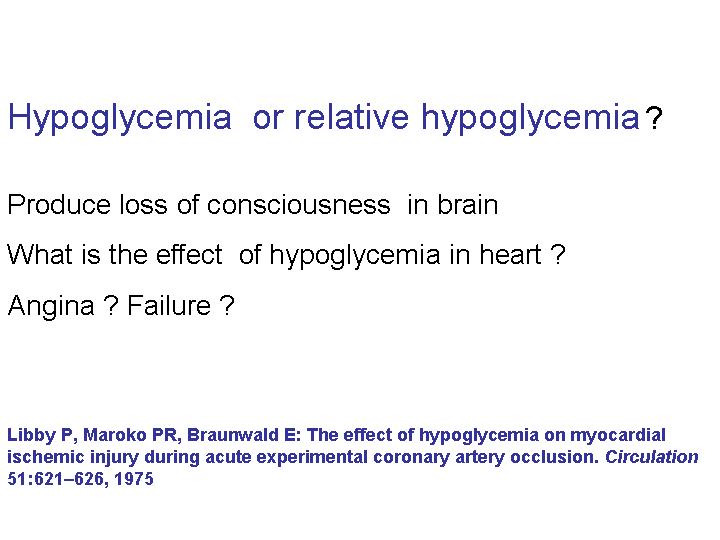
                             Glucose is the molecule of life   ,burnt every second inside the body at the energy store house called mitochondria. Heart , the most active organ in the body  gets  bulk  of it’s energy supply  from fatty acids,  glucose and a little from keto acids. Under anerobic conditions this energy substrates shifts towards glucose .

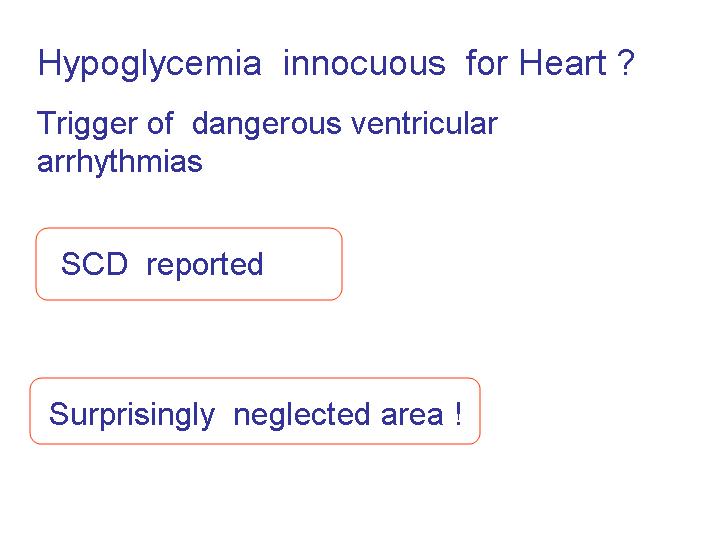
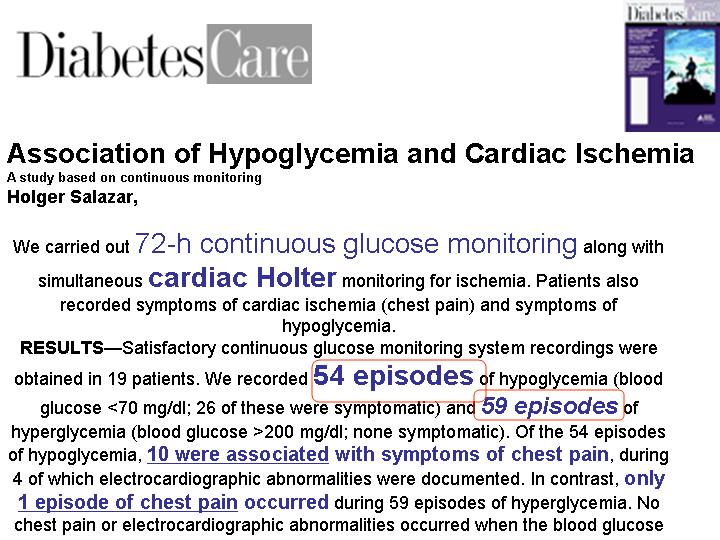
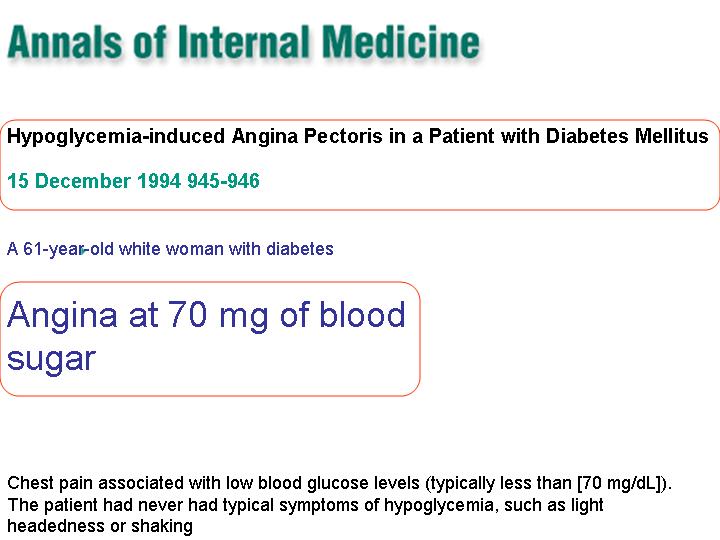
                             We are  rarely inclined to think  that heart  can ever suffer from hypoglycemia ! But hypoglycemia can have distinct direct and indirect effects on heart.  In fact indirect effects due to activation of adrenergic activation is more obvious.An episode of hypoglycemia can precipitate an arrhythmia . Glucose potassium insulin infusion


Final message

Hypoglycemia , can be a trigger of ACS .This aspect is poorly recognised and studied.

Read Full Post »

Ventricular fibrillation is invariably fatal if not treated . When can atrial fibrillation be fatal ? 

                                     Atrial fibrillation is relatively a benign arrhythmia especially when it occurs in isolation with  structurally normal heart.This is sometimes referred to lone atrial fibrillation . Even otherwise, atrial fibrillation is rarely fatal except in few situations.But AF commonly destabilises the patient  who have baseline valvular or myocardial disease.(Post MI, dilated cardiomyopathy etc)

There are few situations where AF can be life threatening

  • In patients  with WPW syndrome*where , AF  enters into a electrical short  circuit , downhill to enter the ventricle and make it fire at the same rate as that of atria . ( ie 400-600) and result in ventricular  fibrillation.Note , even here it is the VF that kills  not , AF per se.
  • AF in acute MI  often precipitates LVF , but rarely fatal.
  • In patients with critical aortic stenosis, or hypertrophic cardiomyopathy, sudden onset of AF can result in acute cardiac failure.
  • AF is often a terminal event in primary pulmonary hypertension

While atrial fibrillation is  less likely to cause  death , it is  a highly morbid arrhythmia .It is one of important cause of stroke in elderly as well as young !

Read Full Post »

« Newer Posts - Older Posts »