Feeds:
Posts
Comments

Archive for 2012

Brugada syndrome continues to fascinate  us for two reasons.

One , it deals with mysterious sudden  deaths of young  men and women

Two , it is one of the  fine  examples  of how  advances in molecular biology , links  physical defects in ionic channels to  sudden electrical  death (Most of them  are due to inherited defects  sodium channels  of myocyte cell membrane )

While high risk subsets of Brugada are easily managed , it is  the asymptomatic  ones  that bother us.

The following are some of the  difficult  questions ,   a  cardiologist faces when dealing with   patients , who exhibit  only Brugada pattern in ECG .

  1. Should I go for an EP study Doctor  ?
  2. Will  I  require an ICD  Doc ?
  3. Do I carry a significant risk of  dying  suddenly  ?
  4. Do  I need a genetic test for sodium channel mutation ?

Fortunately,  we can answer  all these questions with much  courage than before.

(Thanks  to the European Finger registry published in 2010  !)

“No” is the  clear  answer for all of them !

Summary from the FINGER registry. 

(France  , Italy, Netherlands, GERmany)
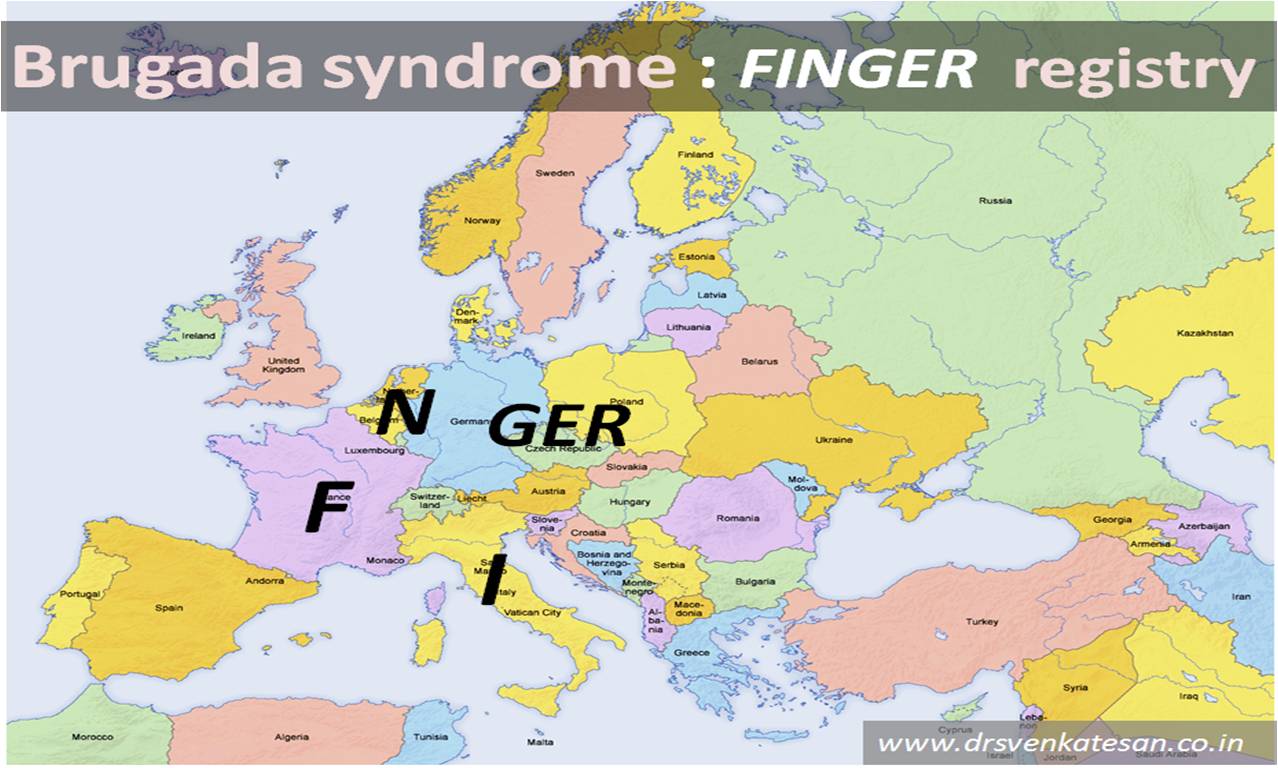
The registry included 1029 consecutive individuals

(1) Aborted SCD (6%);

(2) Syncope otherwise unexplained (30%);

(3) Asymptomatic patients (64%).

In the  follow-up of 31.9 (14 to 54.4) months . A total of  7 death occurred .

The cardiac event rates per  year was 

  • 7.7% in patients with Aborted SCD,

  • 1.9% in patients with syncope

  • 0.5% in Asymptomatic patients.

Predictors of cardiac  event

  1. Previous syncope
  2. Spontaneous type 1 ECG

Non predictors ( Surprisingly there were more non predictors ! )

  1. Gender has no predictive role
  2. Familial history of SCD,
  3. Inducibility of ventricular  tachy-arrhythmias during  EP study,
  4. Presence of an SCN5A mutation


Follow up

PRELUDE study  almost reaffirms  Finger data

(PRogrammed ELectrical stimUlation preDictive valuE)

Just publicized in JACC 2012 from the pioneer of   Brugada Silvia  Priori of   university of Pavia  Italy

Reference

http://circ.ahajournals.org/content/121/5/635.full.pdf+html

http://content.onlinejacc.org/cgi/content/abstract/59/1/37

Read Full Post »

Years ago ,  I  remember asking my professor during  a balloon mitral valvotomy workshop .

How  is that ,  you  are able to  puncture the  IAS  effortlessly and efficiently sir ?

Every thing is in the feel  Venkat ,  he used to say !

What  feel ?  I  used to wonder !

Now , I  realise the guide wires  and catheters are just an  extension of our hand and fingers.

When we   tackle  CTO lesions we should   be  able to feel  and differentiate the  capsule and dimple .

More sensitive hands (Brains)  can tell whether the guide wire  is poking the vessel wall or the lesion .

Of-course ,  now  we have sophisticated OCT, IVUS, and camera  tipped ( Is it really there ?)   guide wires to guide us.

Still ,  a cardiologist  who  is able to feel the  lesion intimately  . . .  would be  a clear  winner !

How to feel a lesion ? (Plaque palpation ,  Hitting the calcium  , Feeling  the  thrombus  !   Cuddling the  foramen ovale  etc )

Key word : Guide wire tactile sensitivity .We are familiar with   guide wire torque .Now , a new technology  that can transmit the feel of the target lesion  ,  to the hands  of  the operator  would be very much desirable .

Two point discrimination  and temporal cortex  plays a critical role here. Irrespective of  the hard ware  used   , how  the  brain  perceives  touch is going to determine whether you are going to cross  a difficult  lesion .

Can you electronically amplify tactile feeling like sound amplification ?

It may be possible in near future. But it has  other issues  like   hypersensitiveness

Can a physician with defective cortical sensory  system  face difficulty in catheter based  interventions ? 

I have observed at least  two  cardiologists with diabetes  , acknowledging  major  difficulty  to  feel the palque and  cross  the  lesion   (Due to autonomic  neuropathy ?) With many  cardiologists  rapidly aging  , the quest  for intervention  goes unabated   (Still  unwilling to quit !   )  one may  experience  cortical dementia  as a hurdle for  guide wire manipulation . These issues need  to be tested  in  real  world .

Final message

It  is   fascinating  ,  how the feel  of  coronary plaque  reaches  our brain . It is picked  by the tip of  guide wire , travels about 150cm , handing over the weak signals across the  gloved fingers ,  reaching all the way through cervical spinal cord and spino-thalamic tracts ,  brainstem  and finally to the  cortex.

There are  multitude of factors that determine   the success of   complex  angioplasties . I realised  suddenly , Intact  cortical sense  could  be an  important one,  among  them . Let us train our brain  centres for this specific sensation of cath lab hardware . After all ,  the brain is  maneuvering force in any cardaic intervention !

Read Full Post »

Time and again cardiologists are called to opine  in critically ill ICU patients with  hypotension.  The circulatory shock of septic shock  is often refractory  . Many  times it  degenerates  into multi -organ failure . The mortality remains high in- spite modern treatment .Even in those patients who recover , they require prolonged  inotropic support  (for days or even weeks)

Here is a  recent call I attended to .

A 44 year old   febrile   , ventilated patient  (With a pneumonitic patch , PEEP of  6 , near ARDS )  ,  precarious renal function and altered sensorium , maintaining a blood pressure of 100/70mmhg with high dose dopamine and nor- adrenaline  , monitor showing a heart rate of 125 /mt sinus  .This status -quo  has continued for more than 72 hours. To my surprise,  the ICU physician told  me there is  in-fact a  minor improvement in general condition than before  . After blinking  at the patient’s  file for few  minutes  , I did a customary bed side echocardiogram .The only positive finding  I  found was  his  heart was  structurally normal  and EF was  64 %  , still the right heart chambers were struggling  to do it’s job   fighting with the PEEP.

The physician had  a very  specific query  from the cardiologist . How to wean the inotropic support and shift him off  ICU ?

(The poor patient  has no  insurance  , and has to shell  Rs 10000 everyday  which is equal to his monthly income ! )

A very  valid question indeed   !   After all  , cardiologists  claim to  have special  knowledge  and wisdom about disorders of  vascular system .

Heart being normal , the crux of the problem is loss of vascular tone. (Autonomic dysfunction ) .How to improve it ? I  discussed the following suggestions.

  • Early passive muscle exercise (Augmenting  muscle tone and transforming it to  into arteriolar and venous tone )
  • Venous support ,stockings etc.
  • Ensure adequate intra-vascular  fluids
  • Sodium supplements
  • Corticosteroids.
  • Fludro-cortisone , the mineralo-corticoid may have a specific advantage as it could retain sodium in vessel wall that can be exchanged with smooth muscle calcium and improve vascular tone .
  • ECMO is  often a pre terminal intervention .
  • Will power . We know vascular  tone is in fact neurogenic in origin .The tone flows from brain stem .Administering  will power could be a useful intervention . (parental infusion of fighting spirit !)It can be done through pep talks from  close family  members   in   conscious patients .(One controversial advice is to allow  near and dear  into bedside , ICU phobia may delay recovery of vascular tone !)
  • Finally  I suggested , a  vascular consult from the GOD  . Organised prayer .  There is some evidence ,  even  proxy prayers do exert benefits in unconscious patients .

After a 15 minutes stay in the ICU , for doing nothing  I  received a significant consultation fee  , and I left the  place  sheepishly  with a  definite dose of guilt !

Reference for role of Hydrocortisone in septic shock

The CORTICUS study

It has no overall impact but hastens recovery from septic shock . Even though the study appears to denote a negative connotation

it has the role in selected individuals .http://www.nejm.org/doi/full/10.1056/NEJMoa071366

Read Full Post »

Who said  knowledge comes at a cost . Here is a great resource . Everything about 3D echo

A sample of   3D echo  evaluation of  mitral valve anatomy

http://www.escardio.org/communities/EAE/3d-echo-box/3d-echo-atlas/mitral-valve/Pages/normal-mitral-valve.aspx

Read Full Post »

In the management of STEMI , many  of us  believe  , contraindication  exists only for thrombolysis . In fact  , there is  a big list  of contra’s for primary PCI as well  . Few  books mention about it and  few discuss about it  . It comes under many broad categories .Time , technical, patient  and  concept  related

  • Late presentation > 12 hours (This is the most important  contraindication  . 12 h is the time taken for  death of  myocytes . Myocardium will not  bother by which modality it is going to be rescued ! It simply  won’t give any  grace time  and never feel privileged to be rescued by PCI !)  The supposedly time independent beneficial effects of PCI  was  never proved convincingly !
  • Uncomplicated , fully evolved, spontaneously re-perfused   ( successful  )  STEMI  (At-least  10 % of STEMI population  ) . This is  common in RCA STEMI .
  • Primary PCI  should not be done in  low volume centers with poor expertise  ( less than  2 -3 per month ?)
  • Lack of sufficient hardware .
  • Co-Morbid conditions
  • Very elderly ( Controversial … some may call it as an  absolute  indication ! Such is the status of EBM in 21st century !)
  • Any recent bleeding conditions carry equal risk as that of thrombolysis

The list of relative contradictions  that are  widely reported in literature  for thromolysis may apply in PCI as well .The risk of bleeding is many fold higher when  multiple anti-platelet agent /Heparin are used .The usage of 2b -3a is also rampant in many centers .  A recent hemorrhagic  stroke is  an absolute contraindication  for PCI as well.(If only you do a PCI without anti-platelet  agents).With number of complex anti-thrombotic drugs knocking the d0ors of cath lab , the problem is set to grow further.

Final message

Never underestimate the  potential  peri -procedural bleeding risk during PCI  .It can easily  exceed that of a thrombolytic agent  in susceptible individuals !

Primary PCI is a great innovation and is a gift  of modern science to human race . But , when  selecting the patients  ,  many of us  continue to interpret  this issue  wrongly. We seem to think , in a given patient  , if  thrombolysis is contraindicated  ,  he or she will automatically become eligible for  primary  PCI It is a dangerous assumption and  is rarely true  . There are umpteen number of situations were both are contraindicated . I  argue the  intervention community to publish specific guidelines with absolute and relative contraindication  for primary  PCI as well .

After thought

If  a patient is not eligible for both thrombolysis  as well as PCI what to do ?  Is it not a crime to watch a patient with STEMI simply losing his myocytes ?

It may seem so  , when we look at  superficially   but  be reminded even simple heparin therapy has saved many lives in such a situations .

Link to related You tube video

Reference

That  elusive  uncommon  sense

Read Full Post »

Hypoxia is most important feature of acute pulmonary embolism.

It occurs due to variety of mechanisms

  1. Ventilation perfusion mismatch is the major  mechanism  ( Normal ventilation /Reduced perfusion)
  2. Atelectasis of lung  ( Left to right shunt)
  3. Loss of lung volume due to pulmonary infarct  contribute later
  4. Low mixed venous Oxygen saturation  (Tissue hypoxia -more extraction )
  5. One more important cause is right to left shunting  across PFO  due to sudden elevation of right atrial mean pressure reflected from RVEDP .

Can  acute pulmonary embolism be diagnosed  with out Hypoxia ?

Surprisingly many standard text books mention hypoxia is a soft sign . In fact , Braunwald’s  text book of cardiology  do mention about it .

Significant acute pulmonary embolism can not occur without affecting o2 saturation .

However , it is possible sub acute  pulmonary embolism could occur with normal oxygen saturation.

Final message

Hypoxia is indeed a hard sign  for most events  of major pulmonary embolism . It can even be termed as an essential criteria .A hypoxic , tachypenic patient in  sinus tachycardia with echo evidence of  new onset RA or RV dilatation is almost 100 % specific for acute pulmonary embolism . ( This becomes 200 % if he or she has DVT as well !)

Read Full Post »

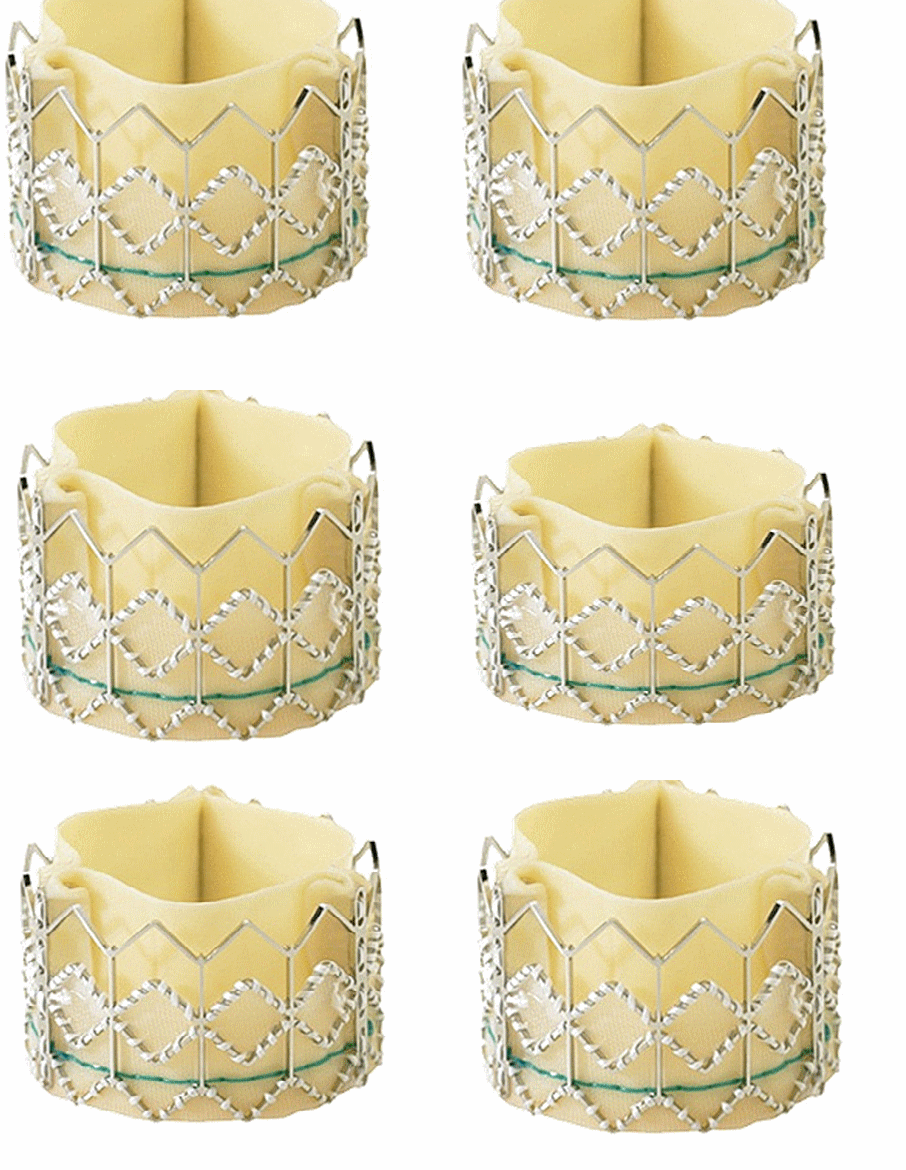
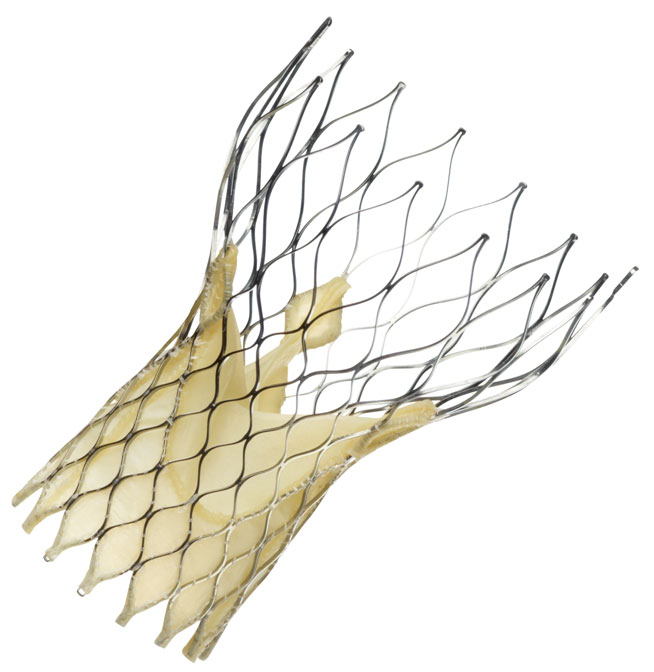
Cardiologists are  closing in ,  trying to capture the final frontiers. The  trans-cutaneous Aortic valve Implantation now has  a two year follow up. (NEJM March 2012  Issue) . The results are encouraging .

While two companies are fighting for the supremacy in TAVI ,   the real  threat is for the cardiac surgeons. Currently Edward  Sapiens  has an edge over Medtronic core valve as it  has a provision to redeploy or fine-tune the  final geo- position.

Reference

PARTNER 1

PARTNER 2

Medtronic core valve

Open access  article  by Martin Leon

http://www.rmmj.org.il/userimages/22/1/PublishFiles/25Article.pdf

Read Full Post »

We owe a lot to our past genius minds for our current understanding of  cardiology.Youngsters   should  know how the filed of cardiology  evolved .Few  great  brains  taught us how to think   hemodynamically  in the setting of  STEMI.

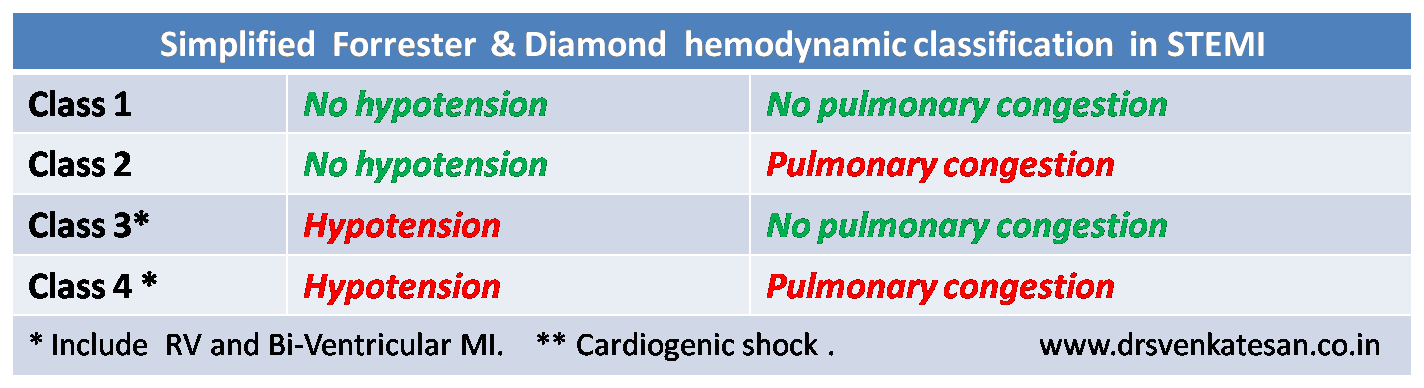
The Diamond and Forrester classification is  an  undisputed achievement of  modern cardiac  hemodynamics.They gently converted the  clinical classification of  Killip into more scientific  hemodynamic  one .Both these classification continue to fascinate  us even in the era of instant PCI for STEMI .

And youngsters  should read this again and again and critically evaluate their patients  within this system.The two key parameters he used was PCWP of  18mmhg /And cardiac Index 2.2liters . He also suggested a simplified version where  intra- arterial monitoring is not feasible.  The   cardiac Index could be replaced by systemic blood pressure  lung congestion   represents PCWP >18mmhg .

The DF classification would become

An important inference from DF classification !

The class 3  of   DF   grading  has no pulmonary congestion  but persistent hypotension . What does it mean ?

It is a stunning proof of a great concept.  As the patient moves (Worsens)  from  DF  two  to   DF three  , the lung congestion tends  to regress . This sub-set  actually  means   development of  bi-ventricular failure or isolated RV failure  . This is an ominous sign and indicate a bad prognosis . ( One may call it a paradox  , according to conventional thinking   “The more the lung crackles  , dismal  is the outcome”   DF  grading clearly proves this is  not  always true ,  as long as  the systemic pressure is maintained  crackles can be managed effectively  . In  DF 3  the right ventricle  as a pump is  becoming so weak it is not able to congest the lungs  at the same  process leads to  systemic hypotension.

James Forrester

http://www.cedars-sinai.edu/Bios—Physician/A-G/James-Forrester-MD.aspx

Forrester is also a pioneer in how we evaluate chest pain in the emergency rooms and cardiology OPDs .  His thoughts on utilization of Besean theorem revolutionized   the interpretation of exercise stress testing.

* Killip is a genius of different caliber would be discussed later .

Reference

Forrester, J, Diamond, G, Chatterjie, K, et al Medical therapy of acute myocardial infarction by application of hemodynamic subsets (first of two parts). N Engl J Med 1976;295,1356-1362


Read Full Post »

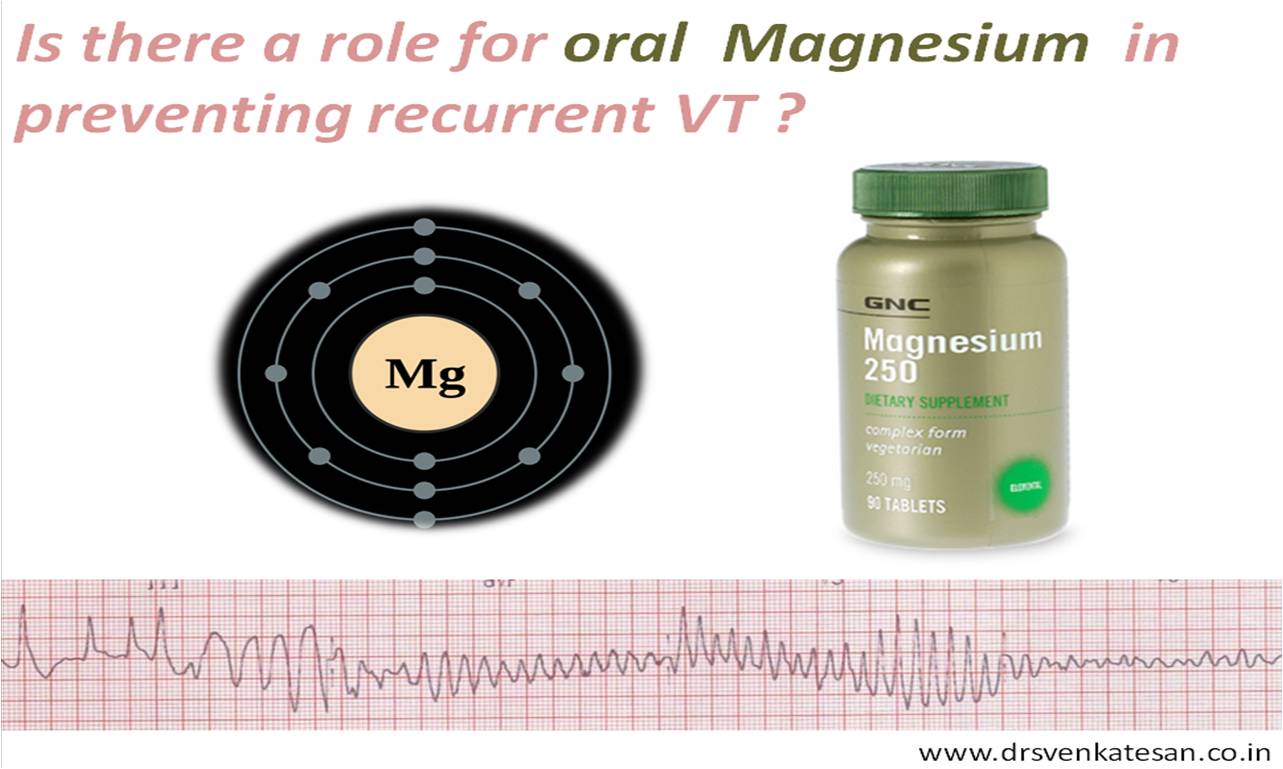
Magnesium   is a powerful anti-arrhythmic drug . It has a well  established role in controlling VT when administered  Intravenously   especially in polymorphic VT .

Mechanism of action

  • It acts at the cell membrane.
  • It has a unique action of blocking calcium channels  that reduces the number of oscillations of  both  early and late  after potentials

Link for more  on mechanism  of action

https://drsvenkatesan.wordpress.com/2010/01/13/how-does-magnesium-acts-as-an-antiarrhythmic-drug/

How often cardiologists administer oral magnesium for long-term control of VT ?

As for as I know ,  no one uses it ! but dietary  supplements are used for general well  being .

Why ? Is it because

  1. Magnesium does not get absorbed in the gut
  2. Magnesium levels are un- predictable in plasma if administered orally

Answer : No one has really tried  it as a  chronic therapy in VT  yet  !

Final Message

Tablet Magnesium can give a tough fight to Amiodarone and Flecanaide in refractory VT at a fraction of the cost !

Who has the audacity  to  compare Magnesium  with Amiodarone head on ?

Reference

Magnesium as health supplement . 

Magnesium is available  in tablet form as  Malate , Stearate, Taurate and Aspartate  along with calcium and Zinc etc .

Read Full Post »

The entity of stress cardiomyopathy ,  other wise referred to as  Takotsubo  cardiomyopathy is a popular clinical entity in recent decades.The heart and mind are closely linked entities even though they are  situated apart physically . Extensive neural and hormonal control  mechanisms  exist.

In extreme stress ,the hyper- sympathetic  drive triggers a rush of adrenaline ,  which some how makes the  left ventricle  to bulge out !

The clinical features  are varied .

  • It can exactly mimic an acute coronary syndrome .
  • ECG may  show ST elevation and mimic an anterior STEMI
  • Echo shows a wall motion abnormality  classically  described  as the apex alone dilates /Bulges or elongates
  • LV  may acquire a shape of a  banana. (See below )

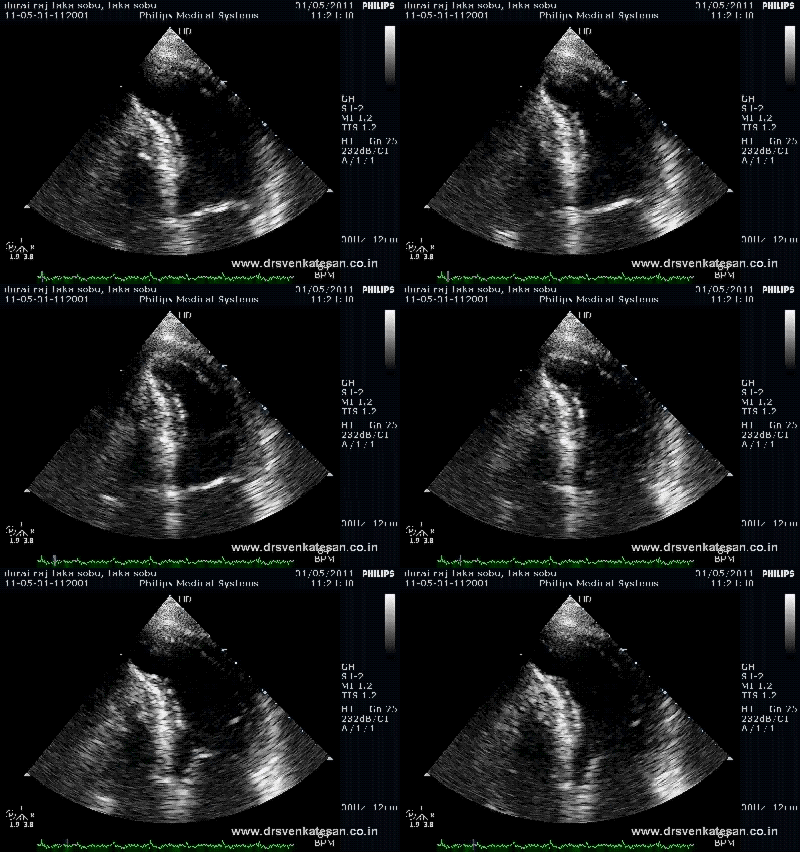
A 45 year old man came to the ER with severe chest pain , dyspnea and minimal ST elevation in anterior leads. He  was a smoker and was experiencing  recent major office stress  . Echo showed an elongated LV apex with some thinning .We made a diagnosis of stress cardiomyopathy .( It was disputed by my professor as the LV  apex was contracting well   ! but we  learnt later there are many varieties of Takatsubo )

Echo showed an elongated LV apex with some thinning . Note the LV apex goes  out of plane  with RV apex.

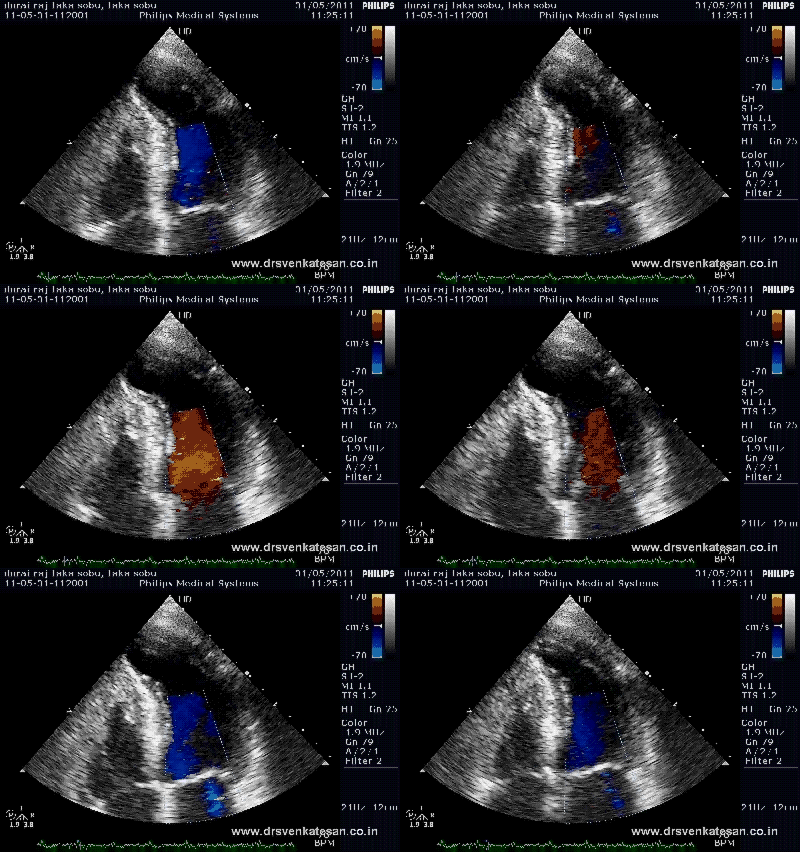
Color  Doppler revealed Trivial Mitral regurgitation

Follow up

He underwent coronary angiogram.  Had  no significant lesions ,   in 48 hours time the wall motion defect disappeared and was discharged with beta blockers.

Incidence

Up to 2 % of ACS could be related to Takatsubo . More common in women especially post menopausal  , with stressful/emotional background like loss of loved ones.

Synonyms

Apical ballooning , Broken heart syndrome ,  Stress cardiomyopathy.

Mechanism

Not clear . Microvascular spasm , excessive catecholamines  ,  are thought to be major culprits.

Echocardiography

Hyperkinetic base and akinetic or dyskinetic LV apex .

Lots of variations are reported .

Shimizu described 4 types

Courtesy : Shimizu et al J Cardiol. 2006 Jan;47(1):31-7.

  1. Apical akinesia and basal hyperkinesia,
  2. Reverse  Takotsubo  (Basal akinesia and apical hyperkinesia)
  3. Mid-ventricular ballooning   with  basal and apical hyperkinesia
  4. Localised  to any one segment

*The Banana type which  is described here (Elongation  of LV apex > Widening )

Histopathology

Focal myocytolysis are described. (Broken heart)   Monocytic infiltrations are common.These are  believed  to be transient .

How to differentiate it between a STEMI ?

  • Enzymes are only mildly elevated.
  • Wall motion defect do not confine to a specific arterial territory.
  • Most importantly coronary angiogram do not reveal any significant obstructions.

Prognosis and outcome

  • Generally good
  • The initial presentation may be turbulent in few with cardiac failure or arrhythmia .Other wise these patients do well

Treatment

  • Mainly supportive
  • Major principle is to avoid inotropic agents as they  are already  heavily expose to it
  • Beta blockers  could be the mainstay therapy .

Final messge

Think about  Takatsubo  whenever an acute coronary syndrome presents atypically . Not surprisingly few of them land in the cath lab !

Reference

http://www.cardiologyrounds.org/crus/cardus1206.pdf

Read Full Post »

« Newer Posts - Older Posts »