Feeds:
Posts
Comments

Archive for the ‘cardiology- coronary care’ Category

Read with caution . This  may either injure or cure your patient !

Click on the ECG to view what happend !


How does  verapamil  terminate a  VT  ?

Physicians  often  debate  vigorously before   labeling  a cardiac arrhythmia as ventricular , atrial junctional  , abberant or not etc etc .  But  for  an arrhythmia   it matters little  from what  chamber it is going to to originate . After all ,  any cell in the heart if excited can generate an arrhythmia .  The ion channel abnormality and the influx and efflux of ions  that determines how a drug is going to terminate an arrhythmia.

In fact , way back  in 1989 the Sicilian Gambit stressed this concept when classifying anti-arrhythmic drugs .This classification taught us  , even though there is a  huge list of  clinical cardiac arrhythmias  , from the therapeutic point of view there are only a handful of receptors  (scattered  all around ) to target  !

When we look at this angle , we realise  , many of  ventricular action potentials  have  important slow  calcium currents  similarly  junctional action  potentials do have some  sodium currents.  Calcium current  is present in every  myocardial cell  more so in the vicinity of AV junction.  Further , at times of ischemic or hemodyanmic stress these ion channels  may  take a different avatar altogether.Slow sodium channels and fast calcium channels etc !  (A wild imagination or is it a fact ?) Other important targets are potassium channels

Heart is a complex structure both macro and microscopically  .  In the three dimensional  histopathologic   interface between atrium  and ventricle (Especially in the  basal areas , outflow tracts  , around the AV grooves ) there  are  lot of sharing  and overlap of  different morphology  of cells . A high septal VT can behave  exactly like an SVT  which  includes the  tendency to get terminated by calcium channel blockers.

Amiodarone is a most popular  drug for VT termination ? Are we clear about the mechanism of it’s  action in terminating VT ?

It is  more of a perception and belief  that  class 3 action   may be   responsible for termination of VT by Amiodarone . In reality it is very difficult   to prove this point.  As Amiodarone  has all the  4 classes  action that includes beta and calcium blocking properties.. In fact ,  now  there is evidence  to  suggest   beta or calcium blocking action  may be more important in terminating  VT when  it is administered  IV  . (While  the class 3 action predominates in long term oral therapy )

A verapamil sensitive   VT may  successfully  be terminated by  Amiodarone  not by its  unique  action  instead it   may simply represent  its  calcium blocking  property.

Final message

Many  of the  VTs terminated by Amiodarone   could  also be verapamil sensitive . Since verapamil is never tried first we will never ever know the incidence of such phenomenon that gives pseudo credit  to Amiodarone

It may not be big crime to try injection verapamil in some of  the  stable ventricular tachycardias( As my fellow did ) especially  when we we know there is an entity called verapamil sensitive VT !


Q for the readers :

How many deaths are reported in cardiology  literature  regarding    fatality  following   verapamil  in   VT ?

I am trying to find  the answer the  data is very hard to come by !

Critical comments welcome.
 

Read Full Post »

We  are at the mercy  of  the three major coronary arteries (LAD,LCX,RCA) that sustain our life . Their  job is clear cut  .It has to perfuse   about 300 Grams of   live bundle of energy  for  an average of 6-7 decades.

What are the hurdles it  faces ,  how it overcomes these obstacles  forms the fascinating story of   “survival  of  human heart”

When coronary blood supply is confronted with a sudden compromise  as in ACS  ,  often the heart has little  time to respond . Hence the damage  and risk of death is  more. Even here there are lots of safety mechanisms and natural lytic process that limit the loss of life to less than 30 %  of all STEMIs. This implies nature protects against the death in 70 % of individuals and help  them  to reach hospital.*

*Among those  who reach hospital , we  the cardiologists  try to reduce the  mortality to about 6-7 % (20% without treatment ) with all  those hi-tech gadgets .It is a  different story and will be addressed elsewhere .

When it comes to  chronic insults ,  the heart has a unique potential to  stage  long haul battles. It has many tricks  under its  sleeves when challenged in a slow fashion.

The main weapons are two

1. Coronary collateral circulation.

2. Ischemic preconditioning.

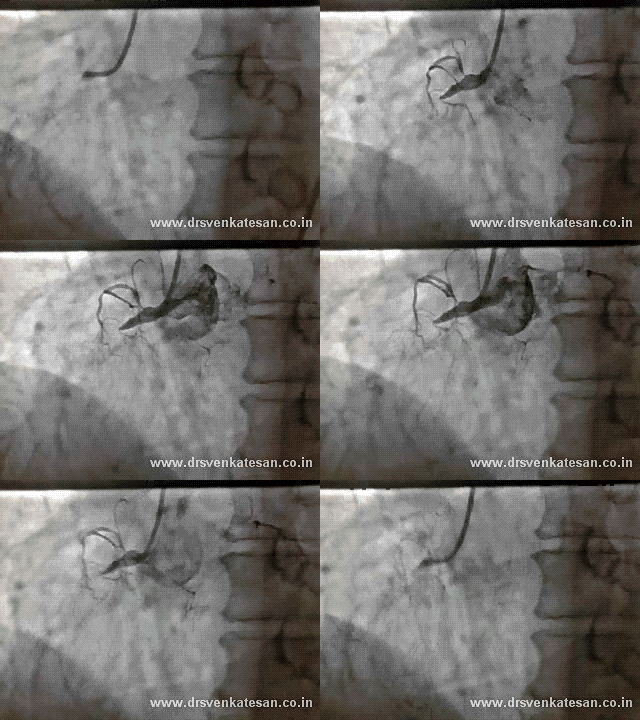
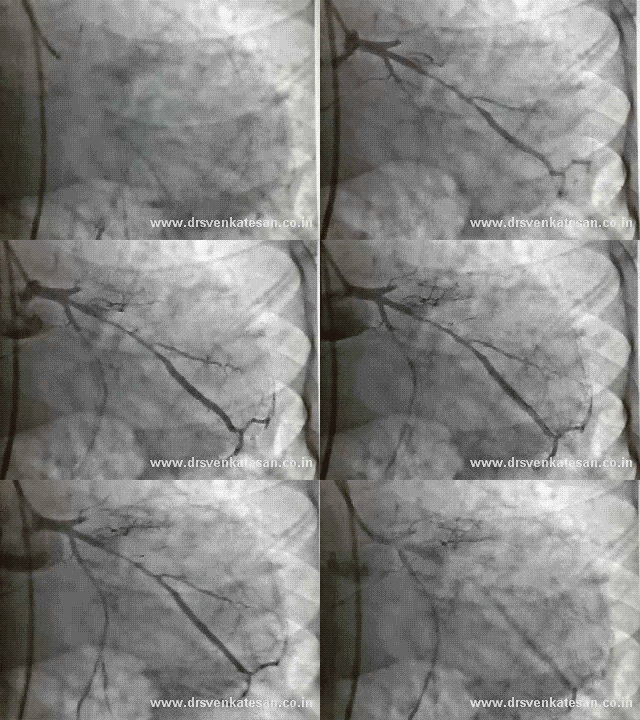
Here is a patient who fights his life even after all his  three coronary arteries   totally blocked and surviving with one of the branches of left main -Ramus intermedius .

If you have thought his RCA was the savior  you are  mistaken  .

To every one’s   surprise  his  RCA was awful  as well !

He had angina which was  troublesome  but manageable .Was able to live a life with acceptable standards (Indian standard )  After the angiogram he  received  CABG.  A turbulent post operative course ensued  due to various reasons . He  struggled but   fully recovered  . . .  and  ultimately  reached the  previous  standard  of life !

Final message

Modern cardiology is all about not trusting  powers of nature .

But youngsters should realise the enormous potential of those invisible powers.It may sound philosophical , but please  remember  . . .after all . . .  philosophy  is nothing but  search for truths. Atleast believe in them  once in a while !

Read Full Post »

Medical imaging technology is the fastest growing  sub specialty in medicine .Now,  we can image almost every organ in detail in our biological system.With capsule  endoscopy one can visualise deep interiors of intestines,  we can get into the coronary artery  by angioscopy.We can even image the molecular metabolism within the cells.

While  , we   feel elated about all these technologies , every emergency  physician  will awkwardly recall how difficult  it is  to  visualise a structure  , located  just few centi- meters  beneath our throat called vocal cords  .

I am sure more  lives are lost in this world by delayed and difficult  intubation than any thing else  in medical emergencies. Cardiac arrest can be tackled lot easier as the defibrillator is largely independent of  rescuer expertise .Intubation of airway is vitally  dependent on expertise.

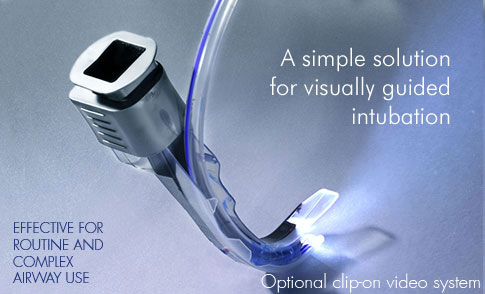
Click on the Image to reach Airtraq web site


When we are able to visualise the  deep segments of bronchus  with  fibro-optic scopy ,  why there has not been a  simple , practical ,cheap optical solution to the   superficial structure namely the larynx ? Human mind is too  funny ,  if  only larynx was deeper  our scientists  would have discovered such a  device very early .  Since it is just below the oral  cavity  no body  thought it is  worth to  discover a  scopy for that !

Now  the long wait is  over ,  we have a tool called Airtraq .There needs to be further refining of this device .

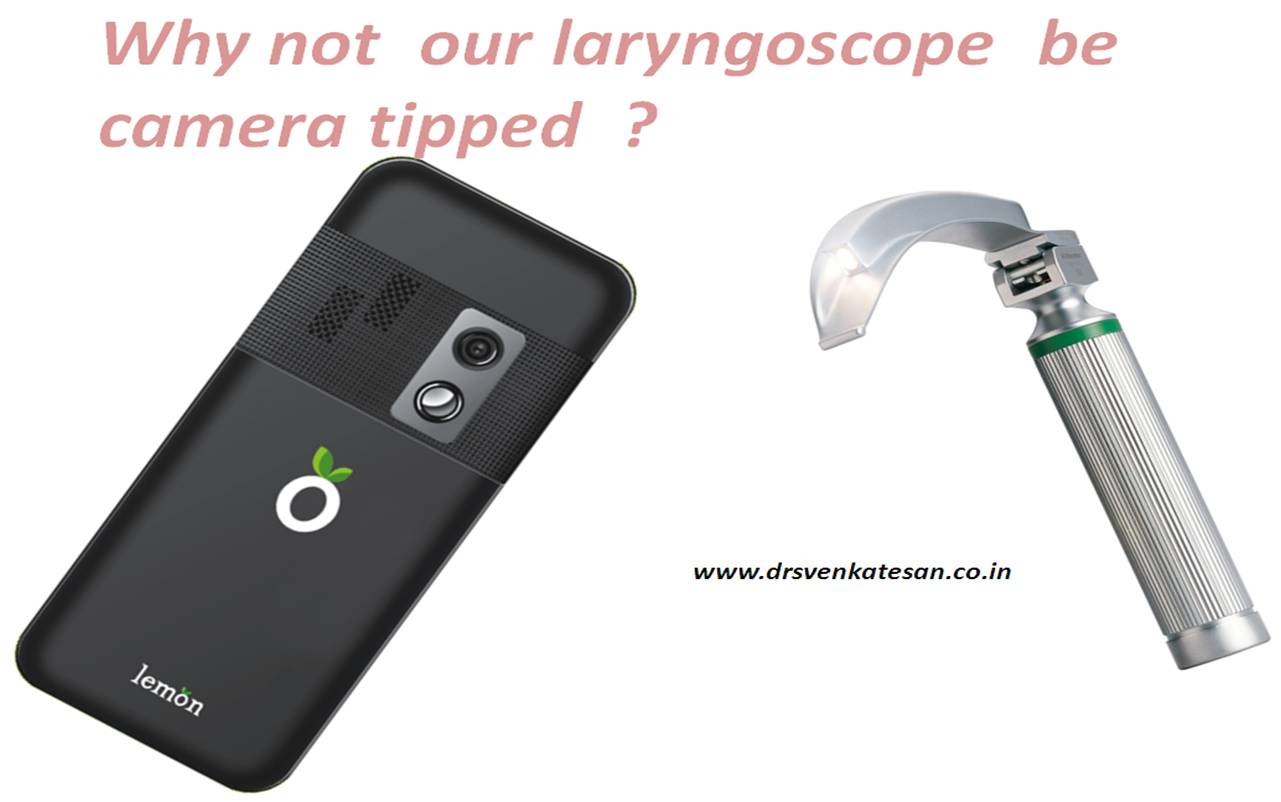
Is it possible for the tips of endotracheal tubes to  have  cameras  that  transmit  live images wireless ?  , which  can guide the tube   straight to the trachea .

We have twin cameras for our fancy cell phones while the life saving tracheal tubes are as blind as ever !

It is argued more such devices should flood the market . Every doctor and paramedical  worker should acquire one  ( Preferably  integrated to their phones ) Imagine if they  can beam the live pictures of the vocal card into their trendy  3 inch  screens of  i Phones . This could be the greatest revolution to occur in cardiopulmonary resuscitation .

(Airtraq please note this . . .I do not need a  royalty for  the  Idea !)

Final message

It  is vital for the   emerging technologies  , to be intelligently used  for the   betterment of our patients. When video  phones  calls transmit  live action  to  our mobiles  across the continents  ,   Is it not  funny we struggling    hard to get a good image of human vocal cords   that are  sitting  just few cm below the throat !

Let us think simple for complex problems .  Many breakthroughs  will automatically  happen.

Three cheers to the developer of this Airtraq device !

Read Full Post »

Some say medicine is a funny science . . .  it is true  at times. It will remain so , as long as we convert  a fact into a myth and a myth into a fact at our convenience . It  is  often   fueled  by the  whims and fancies of modern research  ! This phenomenon is happening in a regular  fashion  for  many decades now.

The number one killer disease of heart  is  the atherosclerosis  . Atherosclerosis means hardening  of arteries. The advent of coronary  calcium score with CT scans ,  it became a craze among many physicians . (It was   replaced later  by 64 /128 slice MDCT with unprecedented  commercial over tones !)

How can we  conquer the atherosclerosis ?   when the enigma of calcium in coronary artery is yet  to be solved.

The next few decades will be crucial   as  we are  trying to find answer to the following question .

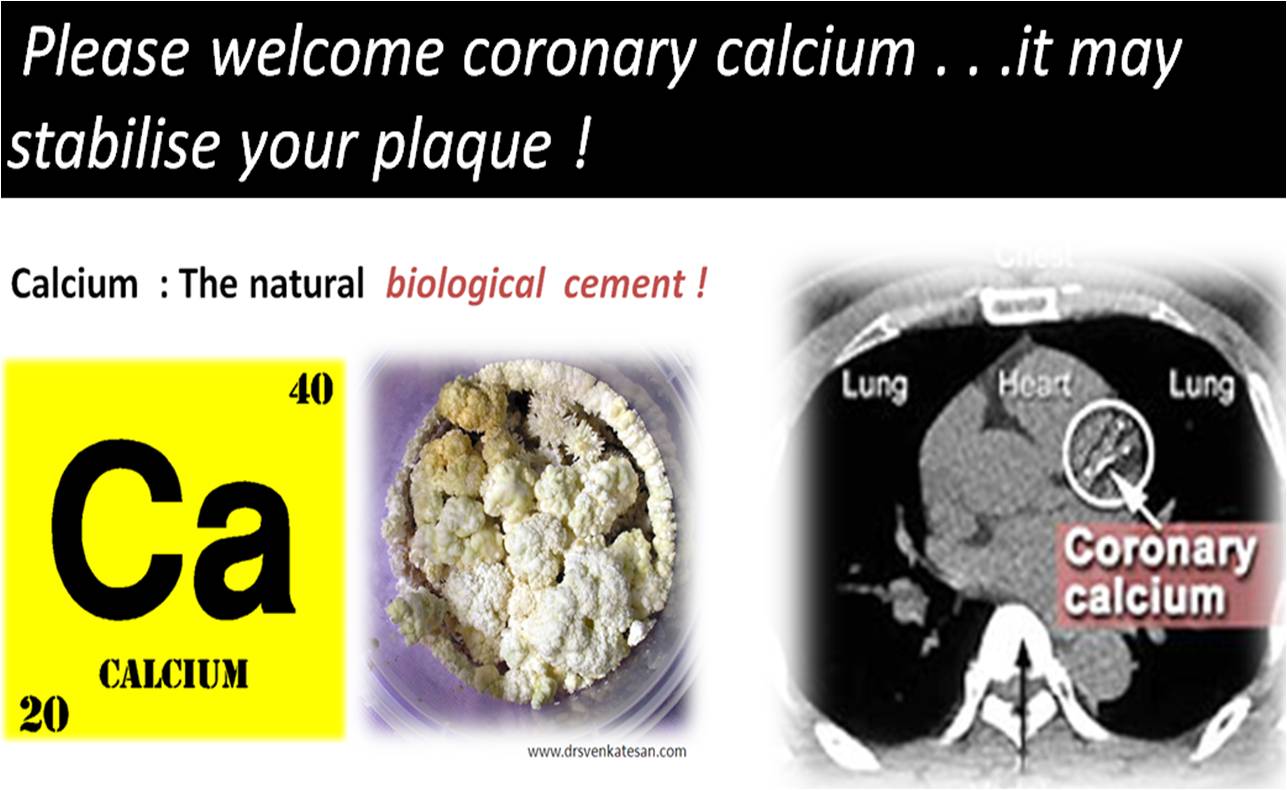
Is  coronary calcium  good ,  bad or neutral   in CAD  ?

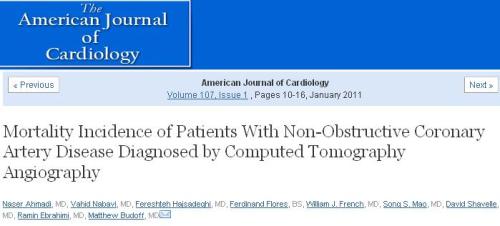
This article in American journal article begins the new year 2011  with good news for people , who show some calcium in their plaques.

What makes a plaque vulnerable ?

Plaque contents , it’s distribution and consistency make it vulnerable. Soft spots  formed by   lipids   may  result in  plaque cracks and fissure.   Semi solid  , mixed  ,  gel like soft  plaques   are dangerously prone for  rupture . Oxidation of LDL,  LDL  liquefaction and tissue metalloprotinase , thickness of fibrin caps , all promote softening.  If none of above  mechanism is operative in a given patient , the   plaque becomes  stiff and hard.

Calcification is the ultimate in hardening . Calcified plaque  is resistant to mechanical deformation.If  stiff  plaques   are less vulnerable , hard plaques ( ie calcified  plaques ) must be least  vulnerable . Calcification   can be called an end result of coronary atherosclerosis.

So , calcified  coronary artery  can be referred to as  a failed  mission of  atherosclerosis .It is  equivalent to  death  of atherosclerosis and denotes the end process of this dreaded disease process.

Calcification tames atherosclerosis  in it’s own den

What is the implication of a stiff hard, sharp calcified plaque lining  (or even projecting ) in the coronary lumen ?

As this study has shown , calcium in the walls of coronary artery is innocuous  . Of course , calcium should not be dense and obstruct the blood flow . This will  require  intervention. Many  consider , calcium as  a foreign body in the coronary artery . But the prevalent understanding is ,  presence of non obstructive calcium  is often  a  non issue or in fact a welcome issue in some.

After all , millions of  human beings  happily roam around  with the hardest possible substance  lining their  coronary artery called  stents.

Caution about calcium

This article does not portray calcium as a healing molecule in  CAD . In  the realistic senseit is  too complex to make such a generalization.  The  message is  , calcified lesions are less likely to result in acute coronary  events than soft , non calcified lesions.

It is well known ,  calcium can be problematic for the interventional  cardiologists  .It makes life tough for them in deploying  stents. Calcium rich lesions exerts  radial force in a diagonally opposite direction and interferes with stent approximation.

It is also believed localised , sharp calcium crystals may tear a plaque  and cause   plaque dissections. This  happens if the calcium is lying in an eccentric fashion overhanging the shoulder region of the plaque   abutting a soft spot.

Final message

It is now clear ,  why calcium  score in CT scans  failed miserably to predict  high risk subsets of CAD. In spite of repeated studies  the researchers failed  to show a positive correlation .  The studies are flawed  as they  were trying to look for a positive correlation  which is non existent . In fact , the above study seems to suggest calcium  score may indeed  predict low risk individuals!

Read Full Post »

Cleveland clinic is a leading centre for cardiac care .Major technological breakthrough occurs from this institute than any other place. Thousands of articles come out every year. Some articles , get global attention and make  a huge impact. These are usually related to a new hi- tech modality like CRT devices or percutaneous aortic valve deployment etc ,etc.

                                                Some articles , which are very important  may not get the due  attention . Journal editorial boards often  have a scorecard called impact factor .That is ,   how  a  journal  is  impacting the practice habits of  medical professionals . Ideally we need to have to grade individual   articles with impact factor .Many articles may not have any significant  impact  however good the impact factor of the journal.

Here is an article,  which excellently depicts the principles of management of ACS.  It was published in 2003 JACC,  by Steven Nissen  from Cleveland,  Ohio .It deserves more attention . Every cardiologist , involved in ACS management should read this, especially the interventionist.

Link to article placed her with courtesey of JACC

Read Full Post »

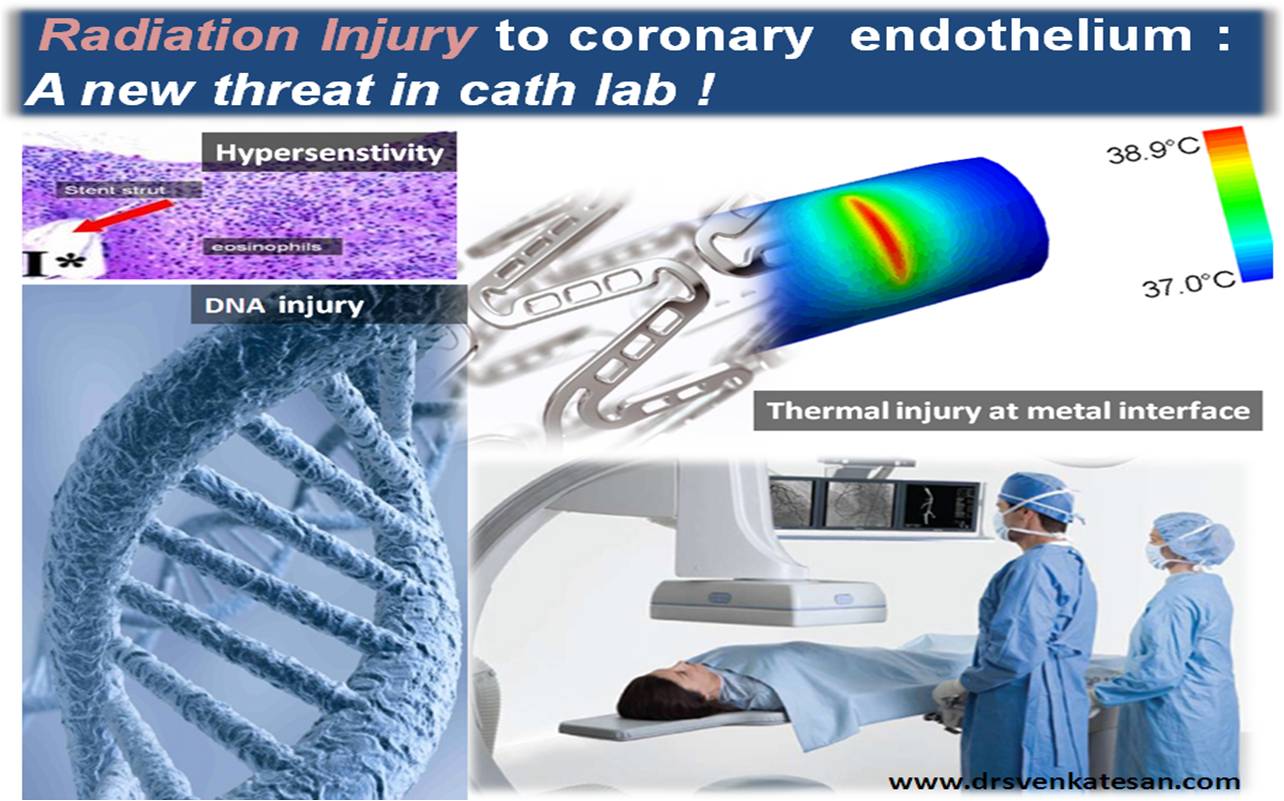
Radiation injury to coronary artery  is rarely given a thought , in spite of   prolonged fluro-scopic time  during  many complex angioplasties.While the cardiologists are fully protected the patient’s heart takes on the brunt of the attack.

What happens to the coronary endothelium -metal interface when X -rays pass through it ?

It is well known the radiation delivered to a tissue is many times  amplified if a metal interface is present. Further , the metals can produce heat on exposure to radiation . This absorption and heat varies with different metals .

The radiation injury to coronary endothelium  could be  significantly higher with DES , as the polymer in it absorbs more radiation than the bare metal stent. This could be responsible for late complications of DES.

The above  concept (unproven though !) is  proposed  by  http://circ.ahajournals.org/cgi/content/full/104/5/e23 .In this study Gold coated coronary stents were found to be less safe than conventional stent

It may take many years to know the truths  about  radiation injury caused by  of coronary stents  .

But always remember , unproven concepts are  not synonymous with wrong concepts !

Read Full Post »

Thrombolysis is specifically indicated when there is  ST elevation in ECG. ST elevation is a surrogate marker for  total coronary occlusion. It occurs due to current of injury flowing   towards* the lead  facing the  infarct territory . There is only one situation where you can safely and effectively administer thrombolysis in the presence of ST depression ie

Note : There is no accepted terminology  to label a MI as  ST depression MI . Here it is used to emphasise ST elevation is not the only indication for thrombolysis .In posterior MI there is infact ST elevation but it is failed to pick up by standard 12 lead ECG.

NSTEMI is a different entity altogether and  thromolysis is never indicated.

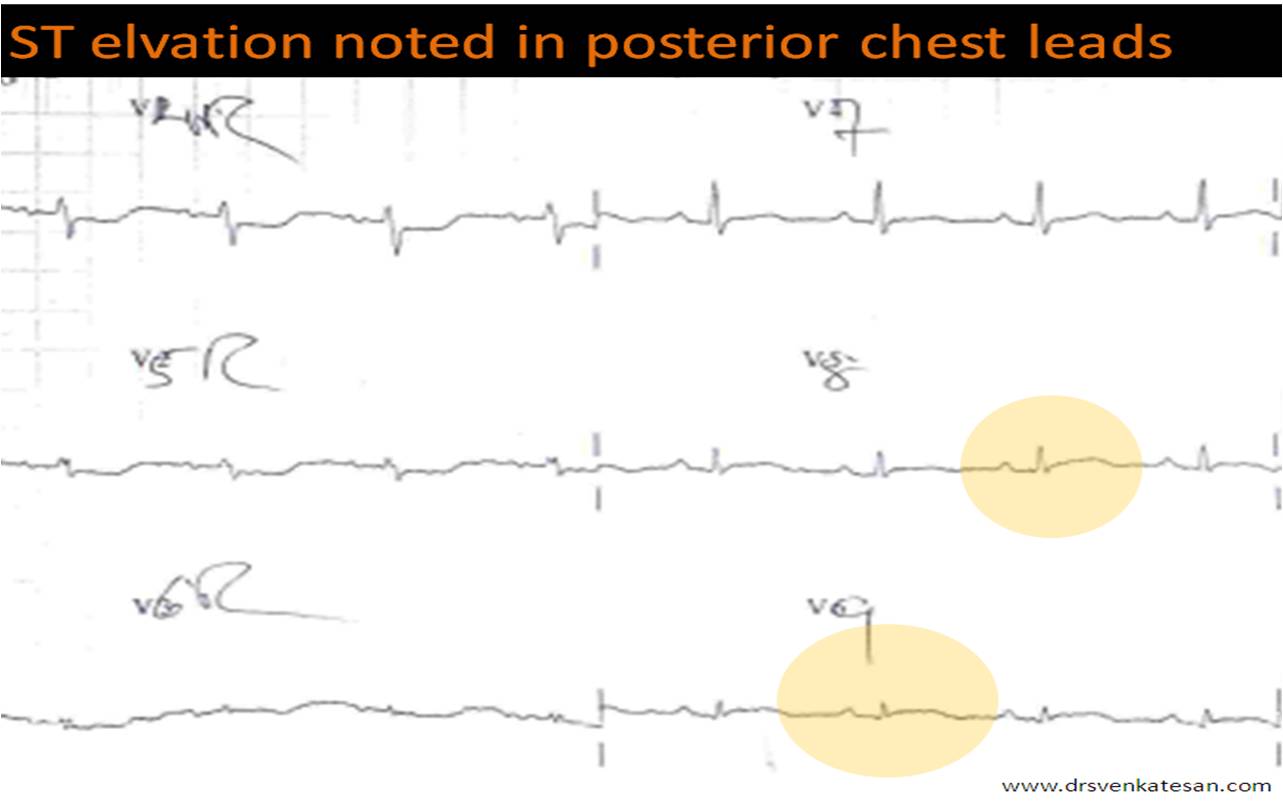
Isolated ST depression in V1 V2 V3 .It almost always indicate isolated posterior STEMI. This can be confirmed by posterior chest ECG leads V7-V10 .

*One will be surprised, to know  the mechanism of ST elevation in STEMI is still not fully elucidated .Technically speaking the net movement of current is away from electrode as  there is only a baseline  diastolic shift  which  gets neutralised in systole  mimicking an ST elevation .(Electro-optical illusion !)

How sensitive is these leads to detect isolated posterior STEMI  ?

Fairly sensitive. Both scapula and  para spinal muscles can be a  significant electrical  barrier that can prevent ST elevation from inscribed .In case of doubtful ST elevation in posterior leads , mit is always better to rely on the clinical presentation.Acute chest pain , consistent with ACS and a new onset ST depression >2mm V1 to v3 is a definite indication for thrombolysis .

Link between posterior MI and RV MI ?

They are closely linked entities .In fact posterior surface of heart is contributed significantly by RV.

What is the angiographic correlation of  isolated ST depression in V1 to V3 ?

It almost always localise the lesion to left circumflex artery . If it is dominant , it can involve lateral and RV territories.

Is isolated posterior MI  less dangerous ?

May be yes , but only after the patient reaches the hospital as electrical risk is same in every STEMI .

The area of infarct  is less , LV failure is less common. While conduction disorders and ischemic mitral regurgitation   can occur  significantly.

Also read ,  Why thrombolysis is contraindicated in UA/NSTEMI ? in this blog

Read Full Post »

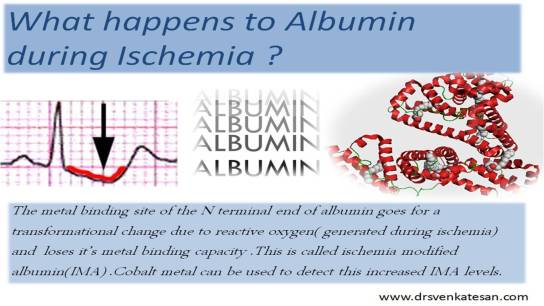
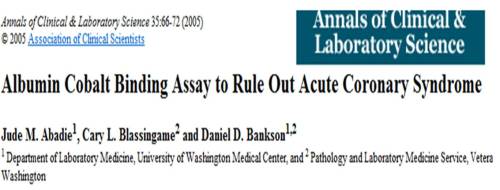
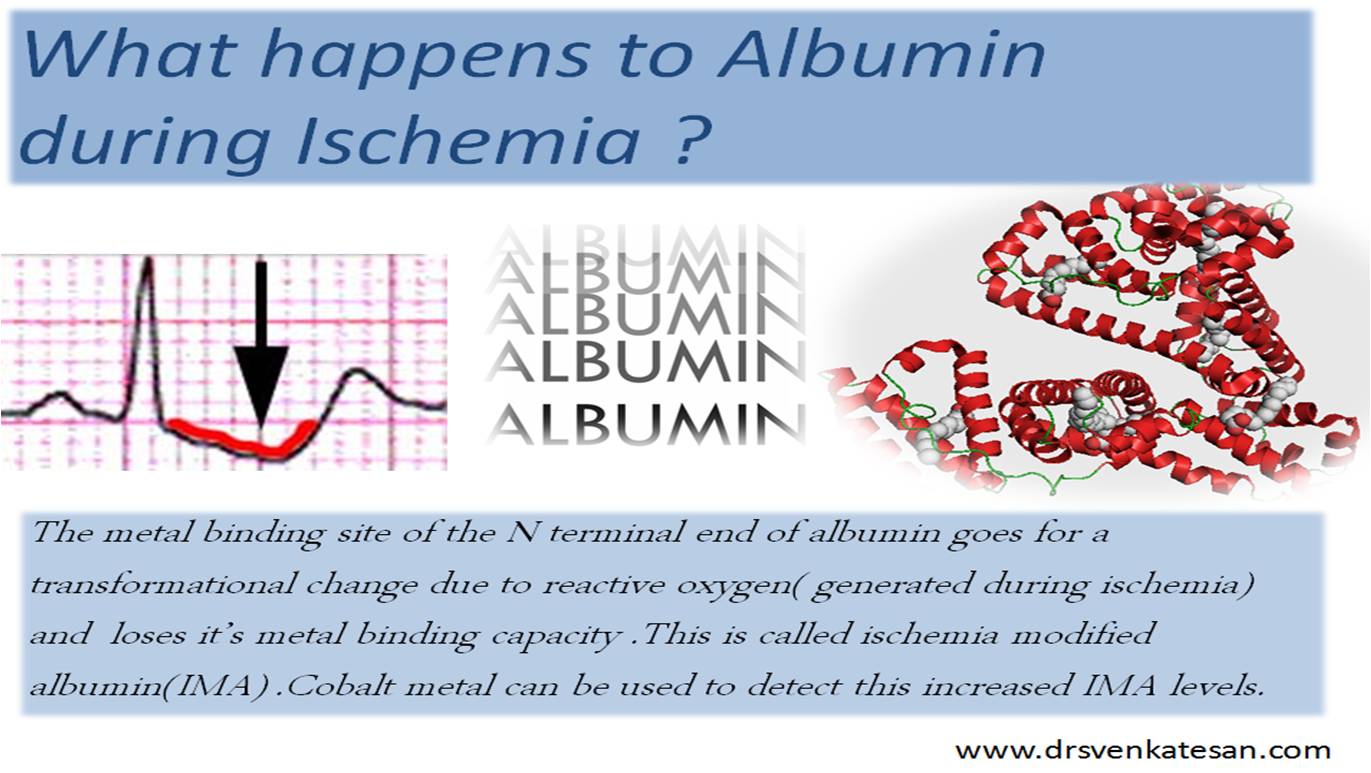
In the diagnosis of ACS, we have definite bio  markers for acute MI . Further, ECG  has a good  spcecificity  for STEMI . While ,clinical and ECG features of ischemia are not perfect. A bio marker for ischemia is the ultimate dream of cardiologists  and  emergency room physicians. . In this context , the IMA -ischemia modifed albumin  has come  with   great expectation .

Ischemia modifies what ?

Normal albumin moleule has  a metal binding site (Copper ) .There are few free binding sites available .During ischemia this metal binding capacity  reduces .  A cobalt containing  reagent when added to ischemic blood  finds binding sites scarce , and hence  excess free  cobalt  will color the sample  and a  posiitve test for  ischemia is diagnosed.

*Normal human albumin  may contain  2%  of ischmia modifed albumin which is expected to increase up to 6% during ischemia

IMA raises not only during ischemia it can also  raise during oxidative stress

  1. Stroke, 
  2. Chronic kidney disease 
  3. liver disease,
  4. Maligancy

It can also  be elevated following

  • Routine coronary angiogram
  • PCI
  • DC shock

Increased lactic acid for example in sepsis may reduce the IMA level and can miss an episode of true ischemia

Final message

IMA can be a useful tool to identify  ischemia early .But lacks senstiivty . New improved immunoassays may be more sensitive and specific

Reference

1 .Medscape review  

2. Circulation article

3. PRIMA study which  was done in ER in risk stratifying ACS proved IMA is not vey useful  http://emj.bmj.com/content/23/10/764.abstract

Read Full Post »

Acute MI and ventricular tachycardia are closely related entities.In fact ,  the earliest response to ischemia could be a VT .But what  is peculiar about this VT is,  it  almost always degenerates into VF  within a minute or so.(Unlike idiopathic VTs /RVOT/LVOT VTs)

This arrhythmia in  every sense  can be called as  “primary VT which is the cause for “primary VF”

It is strongly  believed VF cannot occur without  a  brief episode of VT preceding it .Logic would also suggest  the ischemic myocardium  can not suddenly  become chaotic  “with the first  beat  “. There is little documentation available to unprove this presumption.

In spite of  this intimate relationship between VT and STEMI ,  it is very rare for a STEMI patient   to enter  ER with a sustained stable  ventricular tachycardia .  While  many VTs are known for it is hemodyanmic stability and immunity against degeneration   into  VF  , it is extremely rare  for  VT to remain as VT  in acute STEMI.

*Note : NSVT can be common   in  hospitalised patient in the coronary care unit . In our experience a sustained  VT in STEMI  will enter the VF mode within 60 seconds .If not , it is a highly  unusual phenomenon .

“But surprise is the other name of medicine ”

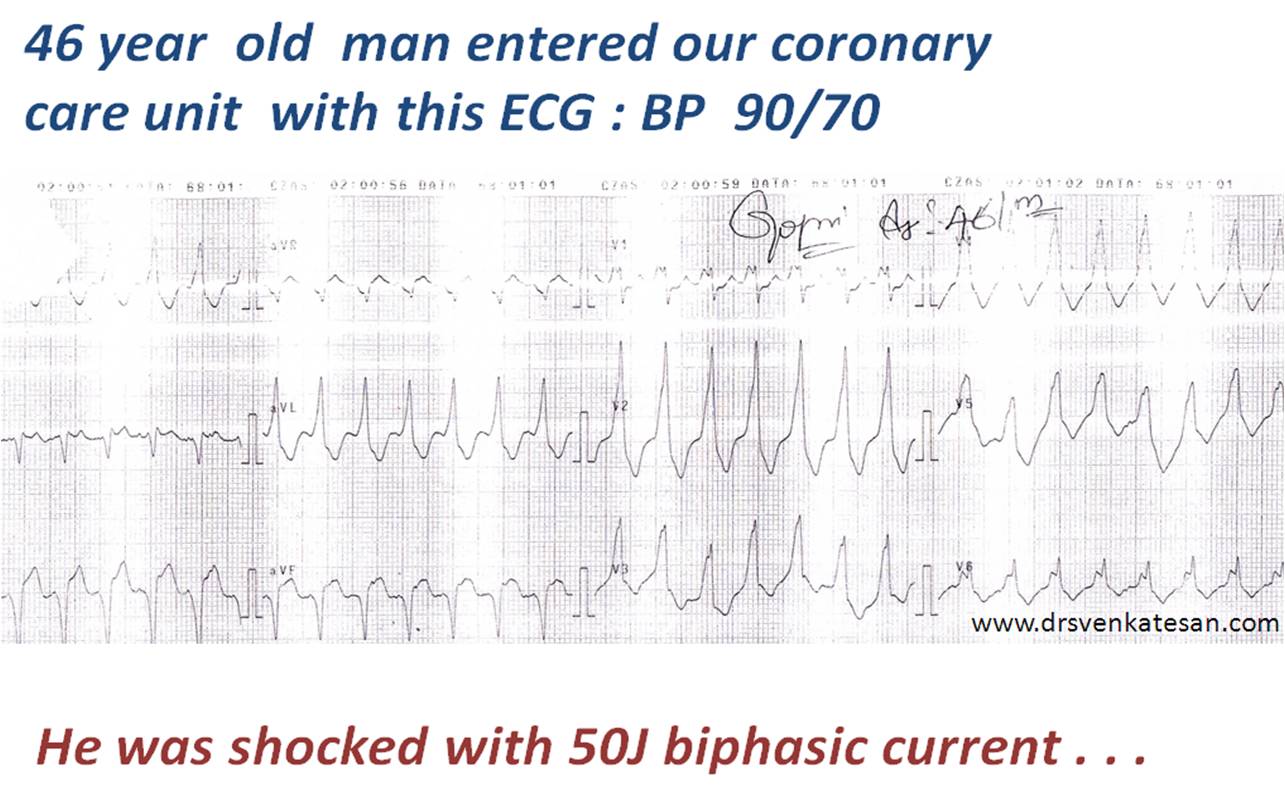
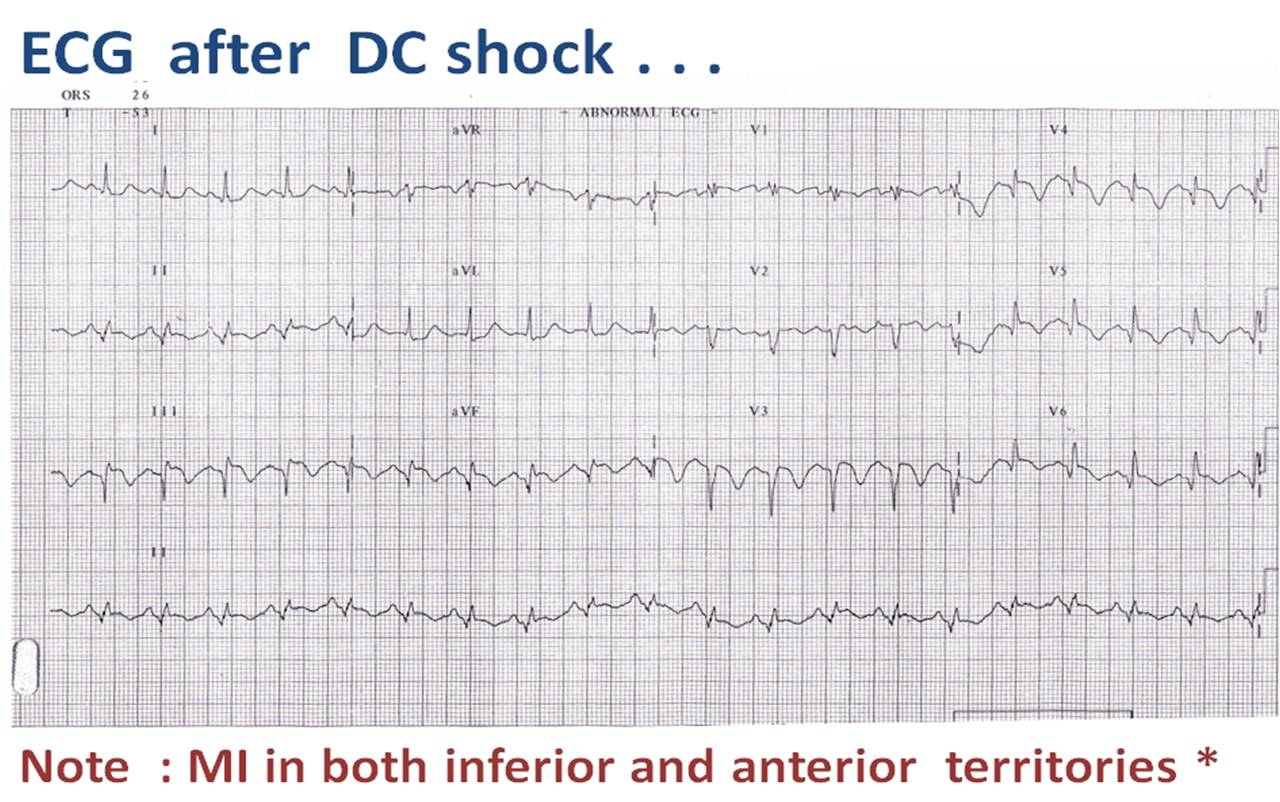
Here is  case report, a patient walked into coronary care unit with sustained( relatively stable) VT with LBBB morphology .We thought  it was   a  non- ischemic VT  (cardiomyopathy  , RVOT etc) .As we were examining him,  he became  unstable  and  was shocked 50 J biphasic .To our surprise a classical STEMI was unmasked and he was immediately  thrombolysed.

* It is possible ,  the patient had  suffered a  old MI  which got infarcted again and the VT  was scar mediated .

But it is still uncommon  for  it  not to degenerate into VF  with fresh  STEMI

Final message

Nearly all episodes of  ventricular tachycardia , that occur in the early minutes/ hours of  STEMI would degenerate into VF.This includes  VTs  that  occur within the CCU . Most  of the times , the CCU physicians and staffs  revert this VT  promptly and deny the  ventricles  from performing the dance of death !

It is extremely rare for an acute ischemic VT associated with STEMI to walk in to the hospital,  which our patient did !

Further reading and unanswered questions

  • What determines a VT to degenerate into VF ?
  • Why macro-reentrant , scar dependent VTs  often  are well tolerated ? ( In spite of LV dysfunction !)

Read Full Post »

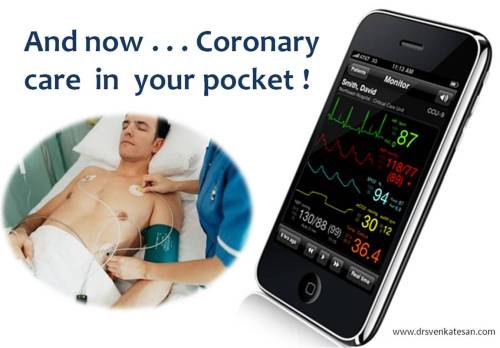
Welcome to the new era of “medical avatar “

Cardiologist’s ultimate dream  of  monitoring  their patients

Live ECG feed in your cell phone  !

Thanks to the American “scientific  pursuit” and the mankind  will be  the beneficiary !

Courtesy :

Airstrip technologies

What’s next ?

Remote DC shock and pacing  .

Watch out  . . . it is going to happen in next 5-10 years !

Read Full Post »

« Newer Posts - Older Posts »