Feeds:
Posts
Comments

Archive for the ‘Cardiology -Interventional -PCI’ Category

Thrombus formation  and subsequent lysis  either spontaneous or pharmacological is the key events in acute vascular emergencies .We know both STEMI and acute strokes can get aborted  naturally.

The thrombus which initially forms , triggers a natural lytic mechanism and this fights vigorously against the clotting process , and tries to get rid  of the intravascular clot.

The early  minutes are vital. (Like the T 20 cricket )  the win or loss is decided in the first few overs . The mantra is unrelented attack of the ball . . .ie thrombus !  In some patients  the clot  can never grow big to fill the lumen.These are lucky few .The mechanisms are common in both cerebral and coronary circulation. Here is were comes the role of antiplatelet agesnt .An aspirin or clopidogrel administered within minutes can prevent the genesis of  central core of the thrombus .(This is the  secret of aspirin scoring over stretokinase in STEMI in ISIS2 study done three deaceds ago !)

It should be realised,  our understanding about spontaneous lysis is very little considering explosive growth of other aspects of cardiology. It is mediated by circulating  TPA and antithrombin 3  .  Remember  every humans have it in their  blood .But how much ? How to augment it ‘s power at times of thrombotic crises ?

What could be the clinical correlates of spontaneous thrombolysis ?

  1. In brain classically it is TIA .
  2. In heart do we have TIA equivalents ?  .Yes it transient rest angina

Link to video on TIA of the heart

Read this article to get a glimpse of  natural cerebral thrombolysis  and shall we   extrapolate it to coronary spontaneous thrombolysis  .Why not ?

Arch Neurol — Nonocclusion and Spontaneous Recanalization Rates in Acute Ischemic Stroke: A Review of Cerebral Angiography Studies, December 2002, Kassem-Moussa and Graffagnino 59 (12): 1870

Read Full Post »

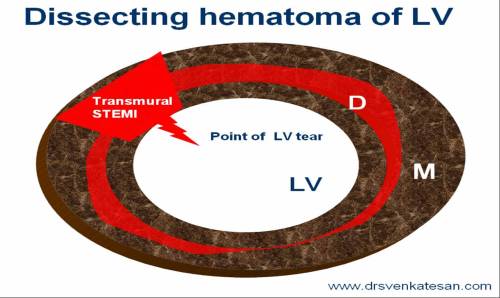
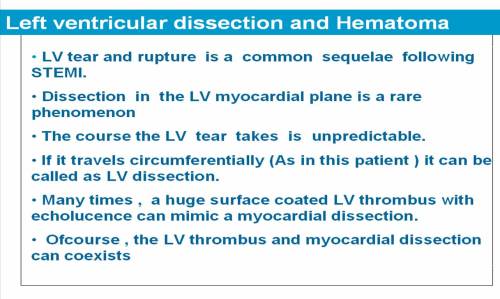
Left ventricular dissection is a rare complication of STEMI .A case report

Click on the slide to see the video  hosted in  youtube

Slide 1

Slide 2

Reference

http://www.ingentaconnect.com/content/bsc/echo/2009/00000026/00000003/art00006

http://resources.metapress.com/pdf-preview.axd?code=g4kqby7wnkjepetx&size=largest

Read Full Post »

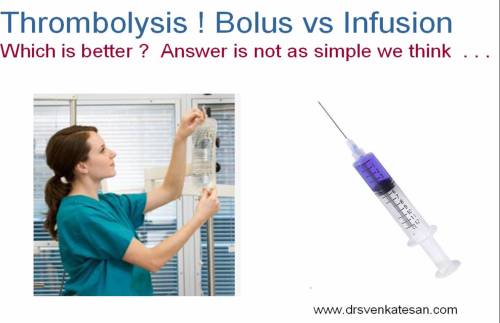
Thrombolytic therapy was a  mini revolution  when it was introduced two decades ago .It has since evolved  , not only in the  molecular structure  but also in it’s usage pattern.

The first generation streptokinase is continued to be used even today  . While the latest generation thrombolytic agent TNKTPA(Tenekteplase) is threatening  to push the  old warrior out of  CCU.
(Of course the  American Physician & Pharma  community  never  gave the due respect to  streptokinase  !)

The two common indications  for thrombolytic therapy  are

  • STEMI
  • Acute pulmonary embolism

Uncommon indications

  • Stroke( Can be common in few institutions)
  • Prosthetic valve thrombosis
  • Rarely DVT

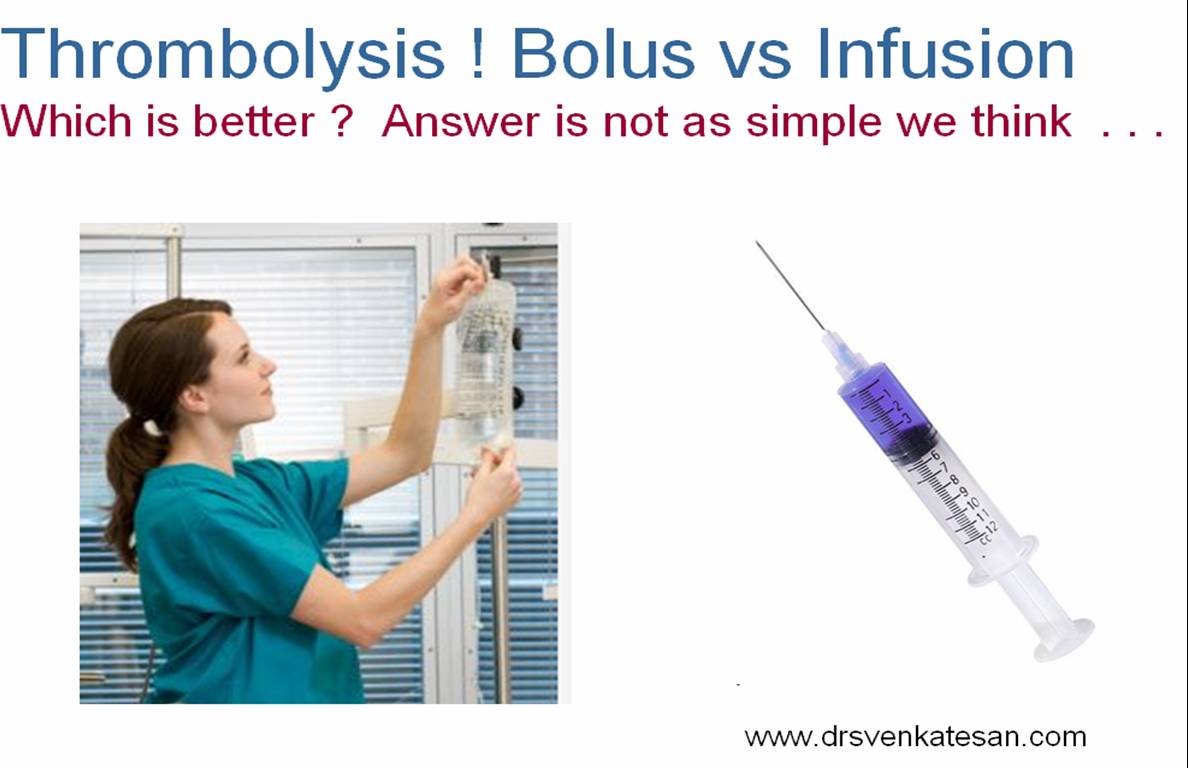
From the beginning , there has been a controversy  about the thrombolytic  dosage and  the speed with which it is to be administered .Let us recall , streptokinase was initially  used  in  various regimes ( 5-30lakh units between a 10 -3hr infusion )  Later ,we arrived at a consensus at  15L units  in 1 hr infusion . TPA also experienced the same . Which  settled  for front loaded regimen(35 + 65mg)  . The confusion reappeared when we developed bolus thrombolytic agents( TNKTPA) .

In STEMI thrombus formation  is  often a one time process  while thrombolysis is a continuous process. In pulmonary embolism both  thrombus formation  and lysis  is often continuous process  .

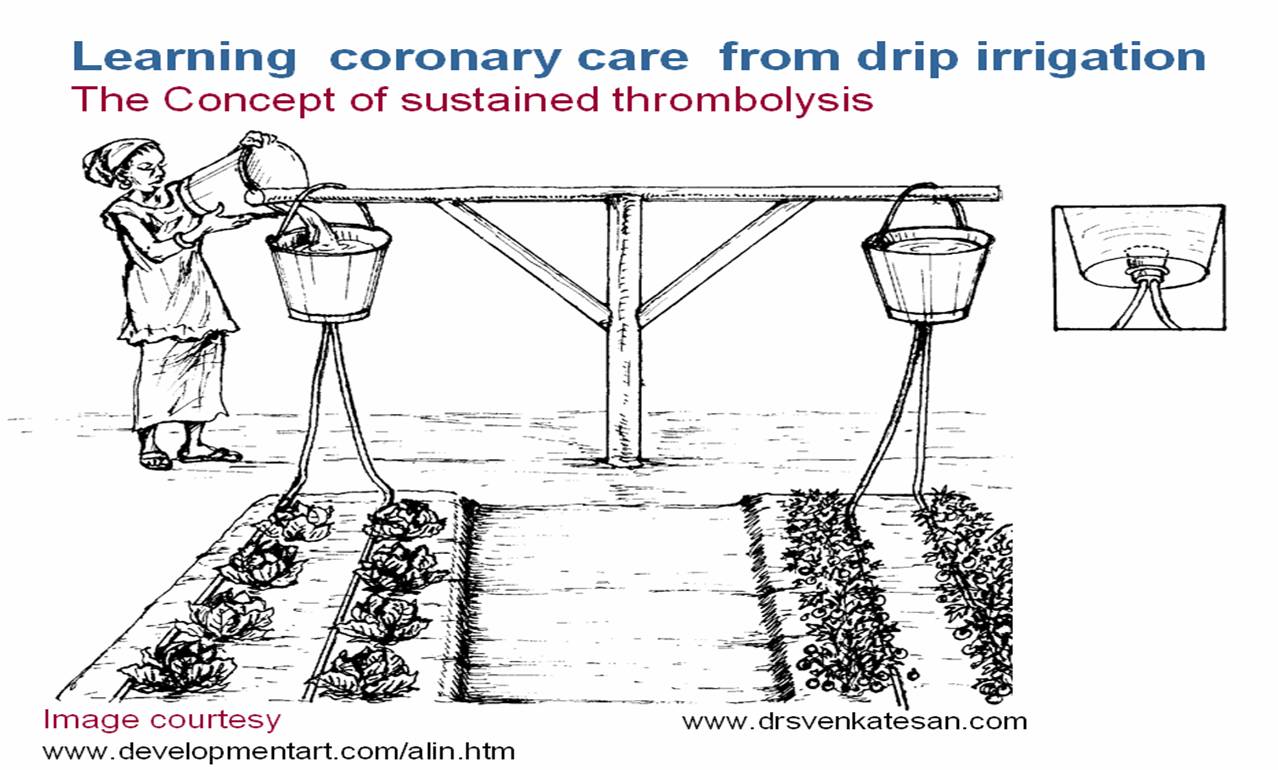
The success of thrombolysis depends on the sustained  drug concentration ,  the pressure at which the drug interacts  the thrombus.

Many times it is prudent to administer  intensive heparin after thrombolysis  to prevent recurrent thrombosis. Further ,  most of the pulmonary embolisms  will require long term anticoagulants.

How to maximize the success of thrombolytic agents ?

  • Local catheter based thrombolysis can be tried  within the coronary ostium (Largely unpopular)
  • Within the pulmonary artery for pulmonary embolism (Still considered an useful option )

It  makes sense , to administer these thrombolytic agents over a prolonged period of time so that the lytic process gets wider recruitment of the natural lytic mechanisms.
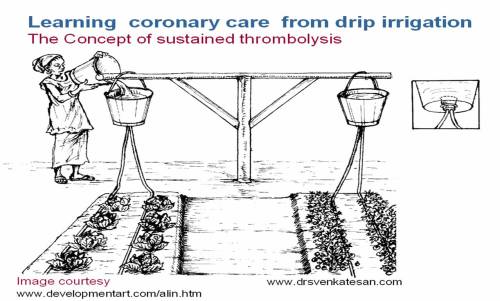
When a drug is infused continuously , the drug  reach the thrombus in  a pulsatile manner , which facilitates thrombus dessication  (Like drip irrigation ) . A long acting drug even with a high concentration may not be  very effective , since  the  drug is required to produce a mechanical effect  here . (Unlike say a long acting antibiotics !)

TPA in Pulmonary embolism

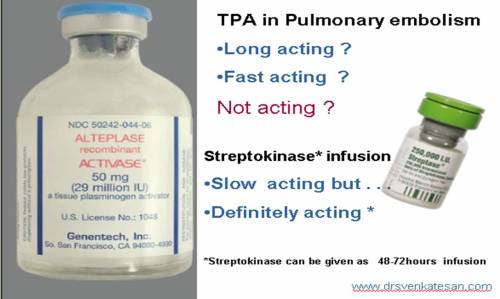
The inadequacies  of  2 hour infusion of TPA is  glaring in acute pulmonary embolism .We believe   a 48-72 hour streptokinase infusion   has a definte edge   over a short and brief TPA infusion.

Issues need answer

It is yet , not understood why we can’ t infuse TPA as  a   long term infusion like streptokinase .

Advantage  of bolus TNK TPA  in  pre-hospital phase of STEMI

The argument in favor of bolus dose  thrombolytic agent  is  the ease of administration .

The other the major advantage claimed  is ,  a 10 second  TNK TPA   in STEMI  can  substantially  reduce the time window   and facilitate  early completion of thrombolysis .

Counter point

But , the  later concept is hard to prove  . . .

In fact , there  are  no controlled studies  available for assessing the   efficacy of TNK-TPA   vs  Streptokinase   with reference to various time windows. We presume so many things. An  incomplete   early thrombolysis  may not be better than a  more  successful  but  slightly delayed TIMI3 flow .

As scientists,  when  we try  to answer these  question we  ask for data .  Are we getting it any way ?  Are the existing data reflect  fact ?     We  wonder,  will we may never get   an  hourly  angiographic  data base  about the IRA  patency  in  TPA bolus  vs streptokinase infusion .

It is most unfortunate,   with  many of the critical questions   still to be answered ,  the cardiology community believes ,  they  have  reached the  summit  of  knowledge  about thrombolytic therapy . Current perception is , the research on  existing  thrombolytic drugs  is  deemed to have been complete .

In this hyped  era of interventional coronary  care  ,   it is a remote possibility   to have any  further comparative studies on thrombolytic agents .

The greatest threat faced by  us  today  is the destiny  of  modern medicine is   often  decided in  few corporate board rooms  and   hence   research questions  rarely  emanate from bed side !

In this scenario, where we are not likely to generate   genuine  clinical  data ,  the only way to move   forward is   to go  by  our experience – ” Genuine  experience to be precise . . .”

Final message

Ease of administration should never be the criteria in choosing a thrombolytic agent . It   can severely    compromise the quality of thrombolysis  ! especially in pulmonary embolism and to a certain extent in STEMI.  Success   rarely  comes  with ease  . . .
Many believe , the choice  between  streptokinase   & TPA    goes much beyond it’s academic reasons.  TNK TPA (Tenektepalse) has come in a big way to replace streptokinase  even   in developing countries.  Ofcourse it is backed by a huge study  ! (ASSENT) .

The cost effectiveness and worthiness  of TPA over streptokinase  was  never proved comprehensively.

Note of caution :

The observation made above is   based on personal  opinion  in  about   20 patients  . Readers are  argued to do their own  analysis on this issue and come to a conclusion .

Read Full Post »
It is said every clinical diagnosis needs to be substantiated with  documented objective  evidence .

Probably,  the commonest cardiac emergency , that can be  diagnosed purely by history is UA.

Yes , unstable angina is a symptom not a  disease entity !

By definition UA is

  • Any  new onset angina  of severe grade
  • Progressive crescendo angina
  • Angina with radiation to new site
  • Angina not controlled by nitroglycerine
  • Any angina after a PCI /CABG

If you read the definition again, you will realise ECG or enzymes never come into the  diagnostic picture .UA can be diagnosed even before one has a look at  the ECG ! So, it is too obvious one can diagnose UA irrespective of whatever is recorded in the ECG. Normal ECG is one such possibility.

When a patient is having severe  compromise  in the  blood supply to his / her heart  , how  on earth ,  it  is possible to have a normal ECG ?

It only tells us,  ECG is not a fool proof method to exclude ongoing ischemia . When we know , ECG can miss even a STEMI  it is not a big deal it misses a UA.

Apart from  the electrical blind spots of conventional 12 lead ECG, following are the other  explanations offered for a normal ECG in UA.We know UA occurs with ST depression(Classical ) , T inversion,  rarely ST eelvation

So UA can occur with

  • Pseudonormalised t waves
  • Pseudo normalised ST depression
  • Cancellation effect of two  opposing  subendocadrial ST segment vectors ( As in multiple active plaques PDA   and LAD lesion )
  • Even Ischemic cascade

Final message

Even though  UA  CAN  occur with normal ECG  , we are uncomfortable to   diagnose  UA without   documenting ECG changes . We should realise this fact , as missing a diagnosis of UA , just beause the ECG is normal  could have very costly consequence !

Read Full Post »

STEMI is the commonest cardiac emergency . Many believe , we  are close to  conquering  it .  It is hardly the truth .

  • The  mortality is  up to  30 % out of hospital and another 6-8  % within CCU  and another 2 %   at  30 days due to recurrent ACS   .This  is followed by an   annual attrition rate OF 25  due to progressive LV failure  .
  • The commonest mode of death is electrical,  ie primary VF.
  • Mechanical deaths are also equally important. Free wall rupture carries 100% mortality . Ischemic MR, Ventricular  septal rupture (VSR ) may also result in deaths.

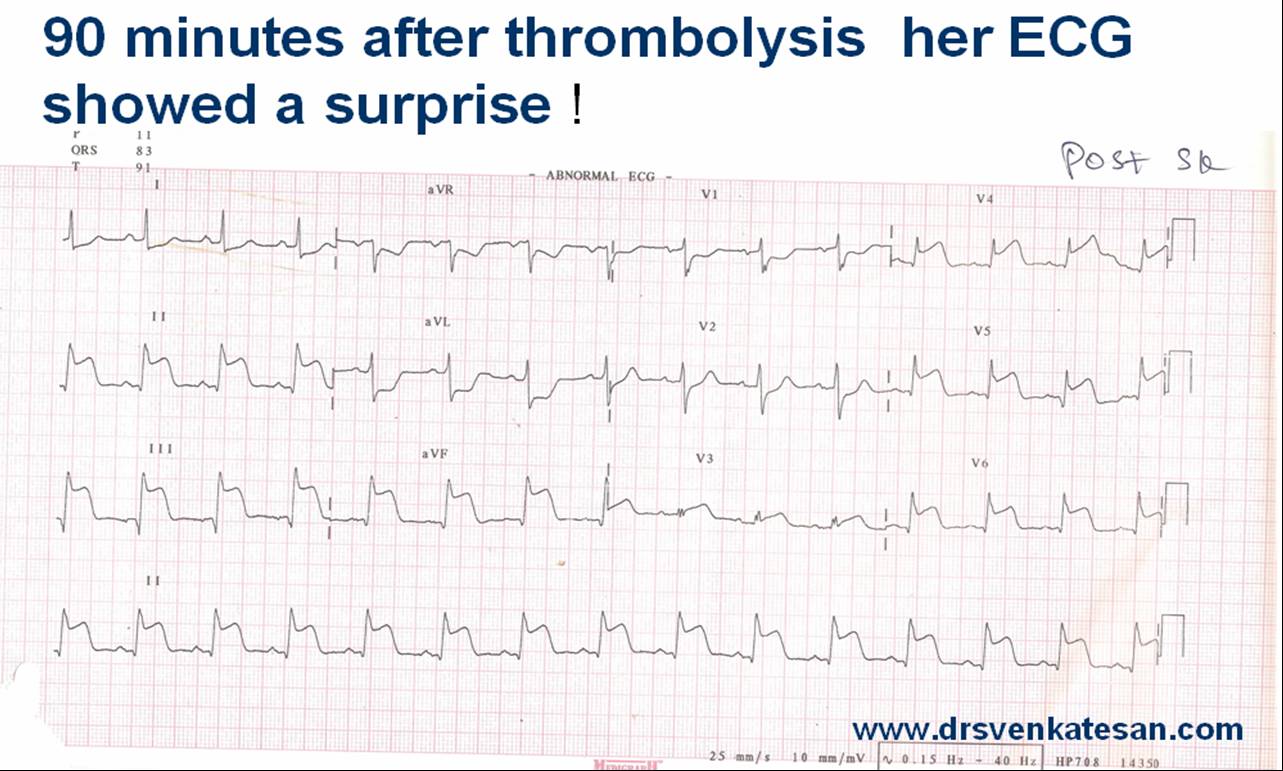
Here is a case history and ECG of a  patient with STEMI .

After thrombolysis , the paradox happened . ST elevation  increased by 4mm and soon the patient became restless with worsening pain and became silent instantaneously ,  with monitor showing EMD and asystole .A diagnosis of free wall rupture was made.

What we used refer  in our CCU (Madras medical college Chennai .One of the oldest CCU in  South Asia )

as   “Action pontentialisation”  of surface ECG . This ECG finding has  great  clinical significance .

Here is a zoomed up view of a qrs complex of  the patient , which is very

closely resembles an action potential

Picture courtesey  http://ocw.tufts.edu/Content/50/lecturenotes/634488/634591

Pathological basis of  “Action potenial”  Like ECG

  • When the ST elevation is huge and wide it mimics  an action potential .
  • Myocyte action potentials are normally recorded epicardially in physiology lab where a  micro electrode with glass pipettes directly enter the myocyte.
  • A giant ST elevation and a sustained dome indicate , the quantum of  electrical injury is  very large and the  ECG electrodes is picking up the myocyte electrical events like that of a intra cellular electrode.
  • It is to be recognised  ,  ST elevation in chest leads is substantially taller than limb leads   because the exploring electrode  is located just above the myocardium . But,    when a  huge  ST elevation  is recorded  over a limb lead (as in this patient )  one can imagine ,   how intense the electrical  charge  of  the myocardium  should  have been  !

This heavy downpour of electrical energy that  emanate from the myocardium   means two things

  • The area of infarct is very substantial
  • The tissue in question is  very unstable .

Clinical correlates of  action potential ECG

  1. Damage is transmural , the   infarcted area is soft, friable and often hemorrhagic .
  2. The pericardium is also  likely to get involved in the injury process .
  3. The myocardium is  rupture prone or already torn .
  4. Even minor hemodynamic stress can be fatal in these patients
  5. An episode of vomiting, a fall in blood pressure,   an episode of  LVF or a short run of VT is suffice  to result in a fatality.

The death happens by a sudden rupture ,  EMD and asystole .

Can a life be saved  by the much fancied Emergency PCI  ?

Not really. The PCI  can not reverse the myocardial damage ,  so it’s role is little . But , any way it should be done and  .  .  . it  will  be done  in most institutions to give the benefit of doubt (Of course , with  a definite the risk of doubting  !)

What is the risk  of  PCI in these situation ?

The infarct related artery * if opened up can convert a bland infarct into a  “angry red”  hemorrhagic  infarct .This   is as good as  giving  the patient ,  a  farewell  party for his journey to heaven !

Note : Primary PCI  definitely  saves life in STMI . The  * is applicable only in persistent ST elevation , late after an acute MI.

How could  have the above death prevented ?

As one of the comments to this article  suggested, we need to have methods to identify impending rupture early and accurately .This should  followed by a prophylactic  surgical intervention (Reinforcing the friable myocardium – with a patch or mesh  )  .This is again not  a easy decision to make .

Final message

When the ECG  assumes  a shape of an  action potential ,  it is often a sign of  imminent  death  . Even though it may sound a pessimistic  view  it is often the truth  . Of course , an  emrgency PCI or  CABG  are  the only options available , we have  to be remember the above truth  ,   as we   play  those sophisticated  games  within their coronary arteries.

Read Full Post »

Hypotension is one of the dreaded complication of acute STEMI.

  • It can be due to either a  mechanical complication or hypovolemia.
  • The hypotension in inferoposterior MI is  often related to enhanced vagal tone and easily correctable with atropine  and fluid  administration.
  • RVMI is the classical example of hypotension that may improve with fluid resuscitation
  • Hypotension,  if  not reversible within 12  hours  ,  is more likely to  represent a more sinister mechanism like pump failure, MR or ventricular  septal tear etc .

A new mechanism for persistent  hypotension is increasingly recognised.

This is due to the

1.Loss of LVOT dynamic activity.

2.Excessive  dynamism of LVOT.

LVOT contractile and ejectile falure

Even though LV  outflow tract  contain  less  contractile myocytes  , it has an important mechanical  job to do. We know , it’s  primary job is that of a  conduit  but  it also  has to  eject the blood into aorta with sufficient force.  In fact, it is thought much of the acceleration of blood velocity occur in LVOT . So, LVOT  plays a key role in maintaining the cardiac index.  An excessively dynamic LVOT will impede the forward blood flow as in HCOM.  Similarly  less dynamic contraction  of LVOT  results in  low velocity propulsion , that interferes with   proper delivery of blood from LV cavity into the aorta .

These factors get amplified in  acute MI , as it is a compromised situation with fluctuating HR and contractility. So a properly functioning  LVOT conduit is  absolutely mandatory.

STEMI due to a proximal LAD obstruction   located can involve the septal .If the first septal branch  happens to be a major one,  there will be  definite impact on the LVOT function.

Excessive dynamism  , LVOT   desynchrony  LVOT collapse .

LVOT has a medial border formed  by IVS , an  anterior surface and  a posterior surface .The lateral border is relatively boundary less , except it is guarded by  the anterior mitral leaflet.

But one should recall , the AML comes towards the LVOT only in diastole . When it comes in systole it becomes a pathological event  called  SAM  (Systolic anterior motion )

The LVOT wall desynchrony can occur in both anterior and posterior MI.In a mulivessel CAD  this can happen when there is disproportionate inferior to anterior wall motion defect.

Management.

  • There is no specific management strategies aimed at restoring LVOT function.
  • Emergency revascularisation will attenuate the mechanical dysfunction
  • Dosage of powerful inotropic agents should be moderated in dynamic LVOT obstruction.
  • Spontaneous recovery  may occur in few

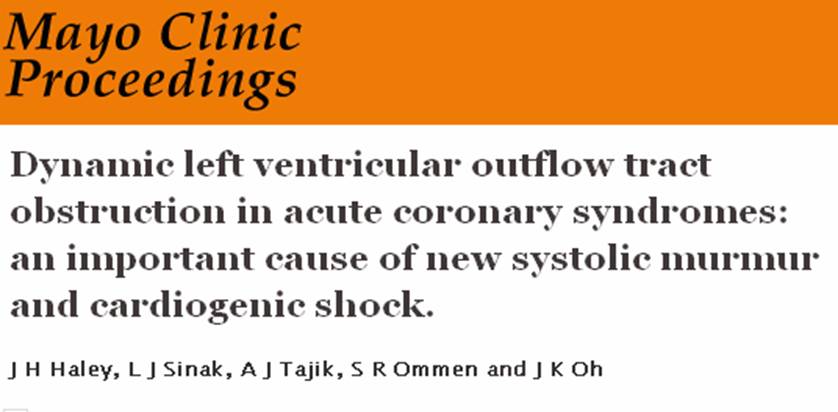
http://circ.ahajournals.org/cgi/reprint/116/5/e110.pdf

Haley et all Mayoclinciproceedings 1999

Read Full Post »

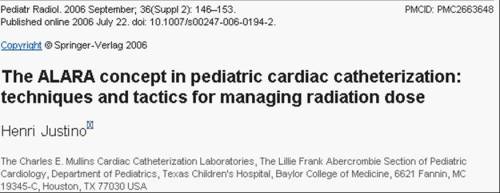
There are millions of  articles in cardiology . Some  simply  occupy   valuable spaces without any purpose  . Some give us knowledge . Some enlighten  us. While few are  so vital , it is almost a crime  if we do not read such articles and apply  it in day to day  practice .

This an article  written by Henri Justino that has a immense importance for the patients as well as the physicians .

Do not think  the article which came in pediatric radiology  is not applicable in adults !

Read Full Post »

It is a well known fact  ,   CABG and PCI  provides immediate relief  for patients with angina ,  which is refractory to medical therapy. Of course , this happens only if a critical occlusion of  at least one epicardial coronary artery is  opened . It need to be realised ,  angina  due to  microvascular  disease can not be cured by maintaining  epicardial  patency .

While angina  relief is prompt ,  dyspnea is not ! . If we  believe,  opening  up a  coronary artery  in a patient with LV dysfunction will  restore the LV function  ,  it  is grossly mistaken !

Why is it so ?

Angina  relief requires  simple  restoration  of  oxygen supply and correction of local ischemia .  This happens without any issue as the blood  seeps in to the ischemic cells and soothes the ischemic nerve fibres that trigger the pain signals   . While  ,  for LV function to improve , the blood flow has to be converted to mechanical activity in the form of myocyte actin/myosin interaction. For this,   there need to be an intact  cellular contractile mechanism . The myocyte architecture should be appropriate .In post MI ventricles we know there is  zig zag  orientation of myofibrils due to myocyte slippage that interfere with mechanical recruitment . Further , integrity of  extracellular matrix  namely the collagen frame work is also vital . Note ,  angina relief  is not concerned with any of the above .

And now ,  we also realise  dyspnea  in failing ventricles  is vitally  dependent on diastolic function ,  which is also very much  impaired in ischemic DCM .There is little proof for  PCI/CABG  to correct the  molecular   mysteries in  diastolic dysfunction !

Dysfunctional LV means what ? (read the link )

It is a collection of  variety of myocardial tissues . Viz : Fully  necrosed , partially necrosed ,  ischemic viable, non ischemic viable, ischemic non viable, non ischemic non viable , Apart from this patchy necrosis, patchy ischemic, areas are common. Finally , necrosed segments   may  also be perfused normally by  spontaneous reopening of an IRA.

One can imagine the complexity  of events in these segments  once we do the  PCI /CABG . The response  is highly variable and unpredictable. The major concept we  , the physicians  believe or ( to be precise made to believe !) is  the  sanctity  devoted to  the viable myocardium .For  many us ,  it is considered a  holy  exercise  to identify viable myocardium in patients following MI and then revascularise them if  found to have significant viable myocardium (Atleast 20% of infarcted area )

A full 2 decades were lost or (shall  we   say wasted on this futile exercise !) as   we have since  realised most of the cardiologists do not follow this rule .

Now , even a scarred myocardium is revascularised in the hope of recovery .As such , we have reached a stage where  there is no contradiction for not doing a PCI /CABG   with reference to LV dysfunction.

Now every  patient  with post MI  LV dysfunction  is considered to  have  some amount of viable myocardium that is  fit   enough  for revascularization

Are we justified in doing  this ?

Many clinical  trials  have revealed  , the  recovery of LV function  in these segments  has not been consistent at all .

The most surprising discovery is  a viable myocardium need not  be ischemic   .It might get adequate blood supply either  from invisible collaterals or trickle of antegrade flow .  Hence an adequately  perfused myocardial segment can  still be   non contractile . This shatters the myth  that  revascularisation must have a dramatic effect on the recovery of contractility in all viable segments.

The other major finding is  ,  even ischemic   viable   myocardium ( documented by metabolic activities PET etc)  need not regain it’s original contractility  after the ischemia is fully corrected .

*reference for  both the above statements are available from variety of sources including real life experiences .(Type C evidence )

Final message

  • Do a PCI/CABG promptly for patients with refractory angina.
  • Never  advocate PCI/CABG  for  a primary relief of dyspnea .  (Never is a harsh word,  let it be  “use it  with caution ” ! and  the  patient  should be  revealed  the whole facts  about  what we know and what we do not know regarding the complex  hemodyanmic events  in  revascularisation   )

Counter point

If  the above statements are really true ,   How does PCI/CABG   help  relieving  dyspnea  and functional class  what is your answer for thousands of patients  with CAD and ischemic DCM who have greatly benefited from CABG ?

The answer could  be  simple , The revascularization  piggybacks  over the   medical management (which , these patients pursue vigorously)     like  ACEI,  statins, salt restriction, betablockers  , optimal diuretics and tend to hijack the credits from the poor  drugs !

Read a related blog

Revascularisation for ischemic DCM

Read Full Post »

PAH  is  the major determinant of surgical outcome of left to right shunts. In this  modern era of cardiac care  allowing a child  with   left to right shunt   to progress to a  stage of   Eisenmenger syndrome  is  considered  as a  huge medical failure . But  , this is still rampant in many of the developing countries .

Cardiologists are divided over the issue of  operability of Eisenmenger syndrome .The confusion is largely due to the conflicting data of outcome in these patients. While  there is strong   data  when  PVR exceeds  SVR  ,  the death is imminent in the post operative period .

What has complicated the issue is   there are  many case reports  where severe PAH patients have been successfully operated. Most would think it is a statistical exception and one can  not alter the traditional criteria based on few case reports.

But ,it remains an irony as on 2009 ,  we do not have a proper methodology to assess reversibility of PAH in Eisenmenger syndrome . Further ,  there is a  significant number of  patients with high PVR  , who continue to experience  an  unabated left to right shunting .  We do not have an answer  for either the mechanism of such shunts and  how to manage these patients.

Click over the slide  to view full  PPT  presentation in PDF format .

This short paper was presented in the Annual scientific sessions of cardiological society of India 2009 regarding the usefulness of a new parameter to assess reversibility of PAH. This may not be called as  a study rather a report of  our experience  in  five  patients  with eisenmenger syndrome

Download the full PPT presentation in PDF  format.

pulmonary artery pulse pressure

Read Full Post »

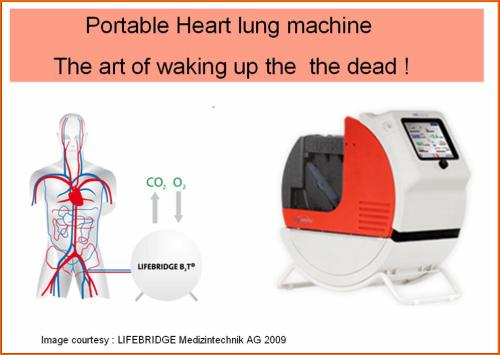
Can  modern technology  bring back  the life from a   dead person ?

Yes it is possible  ,  not in the near future !  but  in the present era  . . .

This revolutionary new portable heart lung machine may just do that .

Imagine  this scenerio : A cardiac arrest  victim  – failed resuscitation  with  ACLS  ,   the patient  needs  to be taken for an emergency cardiac surgery or intervention .You need time at least ,  few hours .Till that time  this simple device   takes  over the  role  of GOD    i e  sustaining life   by   pumping  and oxygenating  6 liters of blood !

Learn more about this award winning wonder machine from lifebridge .Germany

LIFEBRIDGE Medizintechnik AG / Product / LIFEBRIDGE B2T®

Read Full Post »

« Newer Posts - Older Posts »