Feeds:
Posts
Comments

Archive for the ‘Cardiology-Land mark studies’ Category

Cleveland clinic is a leading centre for cardiac care .Major technological breakthrough occurs from this institute than any other place. Thousands of articles come out every year. Some articles , get global attention and make  a huge impact. These are usually related to a new hi- tech modality like CRT devices or percutaneous aortic valve deployment etc ,etc.

                                                Some articles , which are very important  may not get the due  attention . Journal editorial boards often  have a scorecard called impact factor .That is ,   how  a  journal  is  impacting the practice habits of  medical professionals . Ideally we need to have to grade individual   articles with impact factor .Many articles may not have any significant  impact  however good the impact factor of the journal.

Here is an article,  which excellently depicts the principles of management of ACS.  It was published in 2003 JACC,  by Steven Nissen  from Cleveland,  Ohio .It deserves more attention . Every cardiologist , involved in ACS management should read this, especially the interventionist.

Link to article placed her with courtesey of JACC

Read Full Post »

American journal of epidemiology in a land mark analysis has found , spouses share the same profile of coronary risk factors .This is a huge finding , considering the fact that , genetic factors are not involved here . So , it is something to do with family diet ? domestic issues, sibling effect ?

It is well-known lipid profile of family members are comparable . There are many Indian families who have high basal triglycerides .Mind you, husband and wife is the least (Zero link) linked genetically for familial dyslipidemia ,still they often share a similar lipid profile

Related issues without answers !

When a spouse gets a coronary event what are the chances of other to develop an event ?

Any body’s guess

In this era of bi- polar family life, can spouse behavior /unrest be a coronary risk factor ?

Yes . No surprises here .Apart form passive domestic smoking which is a well established coronary risk factor , in our coronary care unit , an initial survey of acute coronary syndrome patients revealed , a recent quarrel with their spouses, was a potential trigger for ACS. Further analysis of these data is being done

Spouse Ego : A powerful health risk

Spouse Ego : A powerful health risk

Divorce and coronary events ?

These are hypothetical observations in few families we have come across .

  • Forced divorce can be a definite coronary risk factor
  • Consensual divorce is not .
  • Women seeking divorce is more a risk for men than they inflict on women

Reference
Augusto Di Castelnuovo and others, Spousal Concordance for Major Coronary Risk Factors: A Systematic Review and Meta-Analysis, American Journal of Epidemiology, Volume 169, Issue 1, 1 January 2009, Pages 1–8, https://doi.org/10.1093/aje/kwn234

Read Full Post »

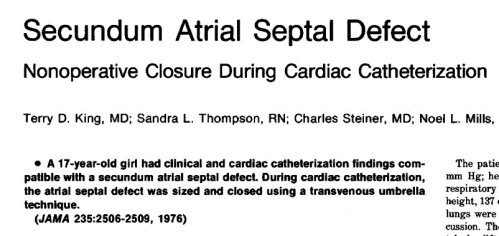
It was those great  years  1974 -1976.  Even before the concept of  PTCA was born, few  committed cardiologists  of New  Orleans were on a mission. Closing the ASD in cath lab. They  achieved it successfully with a umbrella device.


But 35 years later as on 2010 ,the concept though proven still struggles to prove itself.

Link to related article .

Read Full Post »

In 1960 , exactly 50 years ago , a group of doctors from Jhon Hopkins published their observation in 20 cases. It went on to become , one of the most remarkable discovery  in the history of cardiology .

They taught us how to use  a pair of hand  ,  as an  artificial  heart and save lives

They are . . .

  1. Dr Kouwenhoven*
  2. Dr  James R. Jude, and
  3. Dr G. Guy Knickerbocker .

* He was not a medical doctor but an electrical engineer at Hopkins but he worked in the medical school as well .

They meticulously documented , each patient’s case history ,  whom they were able to successfully revive , (It was in the same  period , the  AC/DC shock was also invented  in the  Hopkins ) .One of  the  highlights of their paper was ,  with each chest compression  they were  able to elevate the carotid pressure  up to 90mmhg and was recorded in a pressure tracing .

We have to thank the  JAMA (Journal  of American medial   association )  for  making this  original  article   available  free in their website .

Must read for every cardiologist

http://jama.ama-assn.org/cgi/reprint/173/10/1064?ijkey=33bb40fe3062331bae50e10c8a04263f3e26b317

Read Full Post »

Cardiac myxomas are rare tumors. But they present in a dramatic way. It can have  severe  systemic symptoms and present even as  fever of unknown origin ! While , physicians  of  previous era were struggling to make a ante-mortem diagnosis we are blessed  to make a instant  diagnosis with echocardiography !

Want answers  for all these  from the original researchers ?

  • What is the pathology  myxoma ?
  • What  are the  classical Locations ?
  • Difference between Sessile Vs pedunculated
  • Soft vs Hard
  • Benign vs malignant / Locally invasive
  • Recurrent myxomas
  • Vascularity  of myxoma
  • Calcification (RA myxoma> La Myxoma)
  • Non atrial  myxomas(Valvular  papillary myxoma)
  • The  Cell of origin (Stellate , polyhydral )

You  will not get a better reference than the following article , including extensive illustrations . An 1980 article from  Mayo clinic published in American journal of pathology

http://www.ncbi.nlm.nih.gov/pmc/articles/PMC1903582/pdf/amjpathol00223-0227.pdf

LA myxoma  : A Video

A case reported from my hospital Hosted as Video presentation  Follow the link

http://www.youtube.com/watch?v=SD2LrK1mdic&feature=related

Read Full Post »

Management of  atrial fibrillation has been a  big puzzle for cardiologists  for many  decades  till  it became a corporate game , and  now in the era of recession it has become  medicare’s  night mare !

So , we  were  made to dance to the tunes of the so called evidence based cardiology . . .

  • From only rhythm control to . . . in 1990s
  • Either rhythm or rate control  . . .       in early  late 1990s
  • Then cost control  was found  more important than rate control  . . .
  • . . . So rate control became superior to rhythm control in early 2000s

In 2010 , even the  rate control  became  a luxury ,  here comes the  real ace !   ” Casual rate control may be  suffice in most cases of AF “

Read this article  from  NEJM , which tries to  make  sense out of nonsense  and judge for yourself

Probably the most influential  article  in electrophysiology over  the  next decade

Click  below to reach Nejm article

http://content.nejm.org/cgi/content/full/NEJMoa1001337?query=TOC

http://content.nejm.org/cgi/content/full/NEJMe1002301?query=TOC

Gist of the trial

Technically and literally it  means a  “Take it easy attitude” as long as patient is comfortable , even a rate  of  more than 100 is allowed . Few years back the above concept could be termed a “non sense”

Final message

In this  perennial  management issue  of AF  ,  Whether ,   we were successful in  restoring   sinus rhythm or not , we have restored  the common sense*  Thanks to RACE 2 investigators.

* Do not unnecessarily trouble a  asymptomatic  patient with those powerful  and costly  antiarrhythmic drugs .

Read Full Post »

Beta blocker use in cardiac failure has come a full circle from a “contraindication to indication”

You don’t need gimmicks of statistics for science to progress. What you require is meticulous observation.

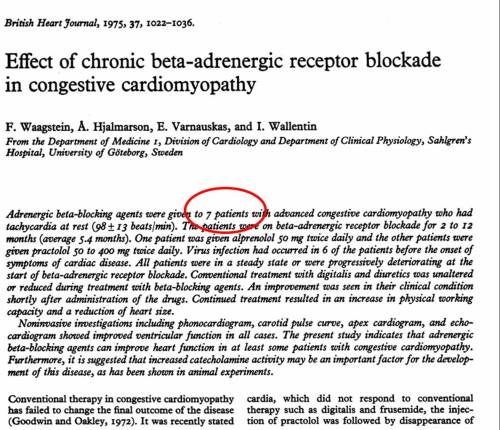
F .Waagstein of    Sweden just did this  with a  study population of seven  patients .

This land mark study , was least significant statistically , but most significant clinically

Today , as on 2009 , if any one submits a manuscript of a study  to a journal  ,  done with seven patients   he or she   will be called as a  fool  !  BMJ  , in 1975 had a courage in not  doing  so  and thus a break through concept was born.

So young scientists , should not  get bothered about sophisticated statistical method.

Science is not about number gimmicks it is about truth and nothing but truth  ! Truths  may  come out from  single digit study or even a single patient study

beta-blocker

To read & download  this land mark article click here

Read Full Post »

What is the simplest and accurate way to predict  the   origin of Right atrial tachycardia(RAT)  from left atrial tachycardia(LAT) ?

Look at the P waves in V 1 ( Don’t look further ! )

  • A  negative  or  a biphasic (+/- ) P wave in V 1  is 100% specific  for a right atrial tachycardia
  • A positive P in V1 or  a biphasic ( –/+ ) P-wave in lead V1  has 100%  sensitivity  for a left atrial tachycardia

What are the incidence of left and right atrial tachycardia ?

RA- 75%

LA -25%

What are the common focus of right atrial tachycardia ?

  1. Crista terminalis (60% of all RAT)
  2. Tricuspid annulus
  3. Coronary sinus ostium
  4. Perinodal tissue
  5. Right side of IAS
  6. Right atrial appedage

What are the left atrial focus in Left atrial tachycardia ?

  1. Right & left pulmonary vein (50% of all LAT)
  2. Superior mitral annulus
  3. LAA
  4. CS body
  5. Left septum

(Please note  this rule is not applicable for re-entrant tachycardias, atrial flutter, AV nodal tachycardias)

Source :

P-Wave Morphology in Focal Atrial Tachycardia

Development of an Algorithm to Predict the Anatomic Site of Origin

peter M. Kistler  et all. 

This paper  from  Melburne, Australia is a rare gem of  an article for understanding  atrial tachycardia .This  paper won the  the Eric and Bonny Prystowsky Heart Rhythm  society Fellows Clinical Research Award, New Orleans, Louisiana, 2005.

Click on the Link  to reach the article

http://content.onlinejacc.org/cgi/content/full/48/5/1010


//

Read Full Post »

                                                 It is now mandatory for all  journals  to declare the  conflict  of interest by the authors  who are involved in medical research .The purpose apparently is to make all transactions or links  between the researchers and their funding agencies transparent .Even major journals  do not go beyond this . Some ensure it , to appear in the first page of  the article.

 What does the the journals tend to  convey to the reader by publishing the conflicts of interest ?

  •  Does it  mean the article in question  may have a bias or indeed have a bias  ?  and readers are warned  hereby !
  •  Do they send across a message  that the  article may not be really a genuine one and the judgement is left to the the consumers of the articles ?

How often a journal article is rejected purely on the basis of  conflicts of interest ?

Most of  journal articles are rejected  for poor methodology, statistical analysis and so forth .We don’t know how often a paper is rejected  due to a conflict issue per se.If this could happen ,bulk  of drug trials would face a torrid time from the editors.

Why , even the leading scientific  journals never indulge in grading the significance of the conflict ?

Here is an example .

accomplish

nejm1

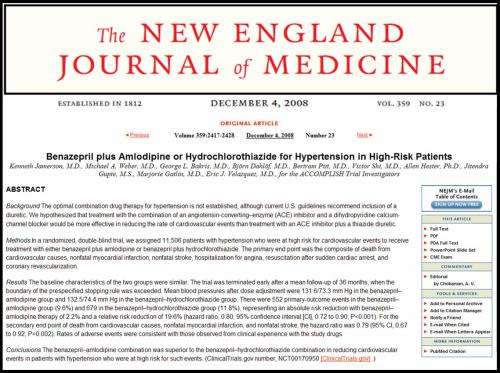
The much hyped drug trial on Hypertension “ACCOMPLISH”  was published in the  world’s most prestigious medical journal recently .It  left  it to the readers to  have their  own assessment  on the conflict issue.

  The consequence of not , grading and investigating  about the conflicts could have  serious  global health  implications both financially and academically .

This study was designed, formulated, completed and published  with a single hidden aim of neutralising the land mark trial  of ALLHAT which recommended diuretics as a first line drug in HT.Apparently diuretics are very  cheap  , effective  generic drugs.

 Is it a scientific rule  that  the  latest evidence  ,  should always prevail over the older evidence ?

No. Science can never have such a rule ! The question is how good and genuine is the evidence.
Just because an evidence is current , it does not  attain a scientific sanctity !

Read Full Post »


Is it true , once a patient is labelled as a hypertensive he remains  hypertensive life long ? Is it possible to withdraw antihypertensive drugs  permanently ?

  • Systemic  hypertension is the most common clinical entity and it forms the bulk of the physician consultations world over.
  • The anti hypertensive drugs are  one of the most commonly  prescribed medication  by the medical professionals .
  •  It is estimated , the major chunk of  revenue to pharma industry is contributed by antihypertensive  drugs.
  •  SHT , is being maintained  as a  major , global cardiovascular risk factor , by  periodically refixing the target blood pressure  to lower levels  by various committees.
  • The terminology of pre hypertension for blood pressure between 120-140 was hugely controversial    and some societies refused  to accept this entity.

Is there a case for withdrawal of anti hypertensive agents  among our patients ?

Yes , in fact there is a strong case for it.

While on the one hand there is a sustained effort ( By whom !)  to increase the drug usage , very early in the course of hypertension , there is also a silent progress in our knowledge ,  regarding withdrawl of anti hypertensive agents in all those undeserving patients .

It is estimated 42% *of the so called hypertensives especially elderly can be successfully weaned of anti hypertensive drugs with out any adverse effect.( Mark R Nelson BMJ. 2002 October 12; 325(7368): 815.)

What are the situations where we can successfully with draw anti hypertensive drugs?

  • The most common group of patients  are the ones, where  the anti hypertensive drugs are  started prematurely , with out giving an option for non drug life style  approach.These patients and their physicians continue to believe , anti HT drugs are sacred and essential !
  • There is another  major group of patients who have had a temporary  elevation of BP due to a stressful environment.These patients  get drugs permanently for a temporary problem . These patients need  to be reassessed.
  • Some of the elderly  patients,  with the onset of  age  related autonomic dysfunction ,these  drugs are poorly tolerated and  even have  disastrous effects .In this population  it is desirable , to wean off the anti HT drugs  and switched over to life style  medication whenever possible.

Final message

Essential or primary hypertension is not a permanent  disease, in bulk of our population. It reflects the  state of  the  blood pressure on a day to day basis  and is a continuous variable. All patients who have been labelled as hypertensives( Either by us or others) should be constantly reviewed  and considered for withdrawal of the drugs if possible.

* Note this rule does not apply in all secondary hypertensions, during  emergencies, uncontrolled hyper tension with co existing CAD /diabetes /dyslipidemias etc .

Please refer to these forgotten Landmark articles

Does Withdrawl of Anti hypertensive Medication 

Increase the Risk of Cardiovascular Events?

The TONE study

Source: The American Journal of Cardiology, Volume 82, Number 12, 15 December 1998 , pp. 1501-1508(8)

http://www.ncbi.nlm.nih.gov/pubmed/9874055

Conclusion of TONE study

The study shows that antihypertensive medication can be safely withdrawn in older persons without clinical evidence of cardiovascular disease who do not have diastolic pressure > or = 150/90 mm Hg at withdrawal, providing that good BP control can be maintained with nonpharmacologic therapy


Some of the references for successful withdrawl of antihypertenive drugs

1.Nelson, M; Reid, C; Krum, H; McNeil, J. A systematic review of predictors of maintenance of normotension after withdrawal of antihypertensive drugs. Am J Hypertens. 2001;14:98–105. [PubMed]
2.
Wing, LMH; Reid, CM; Ryan, P; Beilin, LJ; Brown, MA; Jennings, GLR, et al. Second Australian nationalbloodpressure study (ANBP2): Australian comparative outcome trial of ACE inhibitor- and diuretic-based treatment of hypertension in the elderly. Clin Exp Pharmacol Physiol. 1997;19:779–791.
3.
Lee, J. Odds ratio or relative risk for cross-sectional data. Int J Epidemiol. 1994;723:201–203. [PubMed]
4.
Lin, D; Wei, L. The robust inference for the Cox proportional hazards model. J Am Stat Assoc. 1989;84:1074–1079.
5.
Veterans Administration Cooperative Study Group on Antihypertensive Drugs. Return of elevated blood pressure after withdrawal of antihypertensive drugs. Circulation. 1975;51:1107–1113. [PubMed]
6.
Medical Research Council Working Party on the Management of Hypertension. Course of blood pressure in mild hypertensives after withdrawal of long term antihypertensive treatment. BMJ. 1986;293:988–992. [PubMed]
7.
Alderman, MH; Davis, TK; Gerber, LM; Robb, M. Antihypertensive drug therapy withdrawalin a general population. Arch Intern Med. 1986;146:1309–1311. [PubMed]
8.
Blaufox, MD; Langford, HG; Oberman, A; Hawkins, CM; Wassertheil-Smoller, S; Cutter, GR. Effect of dietary change on the return of hypertension after withdrawal of prolonged antihypertensive therapy (DISH). J Hypertension. 1984;2(suppl 3):179–181.
9.
Mitchell, A; Haynes, RB; Adsett, CA; Bellissimo, A; Wilczynski, N. The likelihood of remaining normotensive following antihypertensive drug withdrawal. J Gen Intern Med. 1989;4:221–225. [PubMed]
10.
Myers, MG; Reeves, RA; Oh, PI; Joyner, CD. Overtreatment of hypertension in the community? Am J Hypertens. 1996;9:419–425. [PubMed]
11.
Stamler, R; Stamler, J; Grimm, R; Gosch, F; Dyer, R; Berman, R, et al. Trial of control of hypertension by nutritional means: three year results. J Hypertens. 1984;2(suppl 3):167–170.
12.
Takata, Y; Yoshizumi, T; Ito, Y; Ueno, M; Tsukashima, A; Iwase, M, et al. Comparison of withdrawing antihypertensivetherapy between diuretics and angiotensinconverting enzyme inhibitors in essential hypertensives. Am Heart J. 1992;124:1574–1580. [PubMed]
13.
Whelton, PK; Appel, LJ; Espeland, MA; Applegate, WB; Ettinger, WH; Kostis, JB, et al. Sodium reduction and weight loss in the treatment of hypertension in older persons: a randomised controlled trial of nonpharmacological interventions in the elderly (TONE). JAMA. 1998;279:839–846. [PubMed]
14.
Heart Outcomes Prevention Evaluation Study Investigators. Effects of an angiotensin-converting-enzyme inhibitor, ramipril, on death from cardiovascular causes, myocardial infarction, and stroke in high-risk patients. N Engl J Med. 2000;342:145–153. [PubMed]
15.
Howes, L; Krum, H. Withdrawing antihypertensive treatment. Curr Therapeutics. 1988;November:15–20.
16.
Fotherby, MD; Harper, GD; Potter, JF. General practitioners’ management of hypertension in elderly patients. BMJ. 1992;305:750–752. [PubMed]
17.
Jennings, GL; Reid, CM; Sudhir, K; Laufer, E; Korner, PI. Factors influencing the success of withdrawal of antihypertensive drug therapy. Blood Press Suppl. 1995;2:99–107. [PubMed]

Read Full Post »
« Newer Posts - Older Posts »