Feeds:
Posts
Comments

Archive for the ‘Cardiology -unresolved questions’ Category

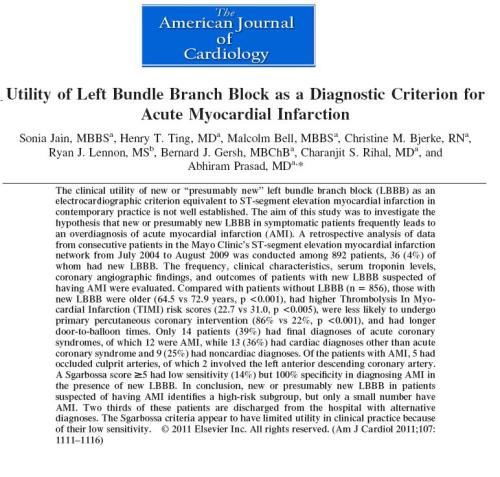
Left bundle branch block (LBBB)   has a curious but important relationship with  STEMI . LBBB inflicts a dramatic change in qrs morphology   with  a diagonally  opposite   polarity of ventricular activation . This masks    the initial qrs vector  and  makes it a difficult task  to diagnose acute MI in this setting. The ST segment which is of primary importance  in STEMI is   lifted  up due to altered repolarization .

LBBB can be associated  with  STEMI in the following ways

  • Acute necrotic LBBB  with massive myocardial damage – Impending shock
  • Chronic LBBB with acute STEMI
  • Transient ischemic LBBB during STEMI
  • Rate dependent  LBBB (Usually tachycardic  ,  rarely bradycardic  )
  • STEMI in pacemaker rhythms

While every one of the above can be experienced ,  the most common diagnostic conundrum  occurs ,  when a patient   comes with acute  chest pain and LBBB . There has been many criterias  suggested to diagnose STEMI in the presence  of LBBB.

The criteria  proposed  by Sgarbosa  (A  GUSTO   off shoot )  in 1996  caught our imagination .One prime reason for this is ,  it came from the prestigious NEJM and Duke university combine. Suddenly this became the de- facto standard to diagnose  STEMI 

In the  past 15  years  ,  our experience in one of largest coronary  care units in India , we have   found this criteria   to have  little utility value  in STEMI and LBBB  . Most of the time  a correct diagnosis was made  by   simple clinical guessing .

Next to  clinical assessment, we found cardiac enzymes (Troponin and CPK ) were reliable in diagnosing  STEMI with LBBB.

Surprisingly ,echocardiography  was as unreliable as ECG .( The paradoxical  septal motion invariably confuses the already  confused  cardiology fellow who usually does the emergency echo  !) 

Even as our  CCU documentation was  far from satisfactory  , now this article from Mayo exactly reflect  our observation.

Sorry   Sgarbosa . . . the criteria was  based  on  sound observation and a  good  electrical principle  . . . still LBBB is able to beat   it convincingly ! ( Very low sensitivity !)

Read Full Post »

WPW syndrome remains as  a   fascinating ECG entity ,  ever since it was described by Wolf , Parkinson and White in the year 1930.It is  primarily a  disorder of cardiac embryology . Heart is an organ made up of  tissues from mesoderm and neuro ectoderm.The muscle which comes from mesenchyme has to be incorporated with specialized conducting system. This is a complex  process .It is determined by the bio-genetic forces. When errors happen in the embryonal  tissue  flow  congenital anomalies occur.

In  WPW this  error   happens  exclusively in the conduction  tissue movement  . Normally the specialized conducting system    pierces  the  entire  AV ring and connect atrium  and ventricle  .Later ,   it regresses in  all areas  except in the AV nodal zone  . When  It  fails  to regress ,  these  remnants of  conductive  tissue act as AV accessory tissue  and create electrical  short circuiting .This is the reason , all these pathways are located in the close vicinity of AV ring.

Accessory pathway shows   varying conduction velocity , but generally devoid of  decremental conduction properties .  The presence of such pathways make these individuals prone for variety of cardiac arrhythmias .It can range from  simple AVRT  to  malignant antidromic  AVRTs  that can end up in  VT /VF.

Resecting  these  pathways surgically was once popular.  Effective blocking  of  the pathways with  drugs  is a good option. Currently ,  it is possible to  locate and  ablate  most of these  pathways   successfully.

Even though there are many protocols to locate accessory pathway the one that is very popular is  simple   Type A and type B  WPW , which locates the pathway either in the  left  or  right  ventricle  respectively.

Huge data base  has been accumulated over the past 80 years  regarding WPW syndrome,  still   many questions are unanswered.  One of the important clinical issue is  multiple  accessory pathways , scattered  at  random  across the  tissue planes of atrium and ventricle  .

The other issue is intermittent pre-excitation and shuffling  of path ways during tachycardia  .

It is very rare to see a patient who manifests both Type A and type B pattern during sinus rhythm .Here is an  article from  unexpected  quarters  , Colombo Sri-Lanka in the year 1972  candidly  describes a patient with classical  combination  of  Type A and  B  WPW . It is great to see such an interesting  observation in the pre  EP/Echo era from a remote island nation.

Now , let us ponder over  these questions

    1. Can a pre-excitation  happen simultaneously in both right and left free wall pathway ?
    2. How will the ECG look like  when impulse travels over multiple pathway ?
    3. When dual pre-excitation combines   with  normal AV  conduction  ,     will  it not make  a  triple AV pathway ?
    4. How does a supra-ventricular impulse decide ,  which pathway it is going to travel  when confronted with a choice of  three or  four pathways ?
    5. How do you plan ablation for such a patient  ?

Read Full Post »

Human heart is a compact elastic organ .  We know elasticity is lost when it is stretched beyond a point.This is what happens in dilated  cardiomyopathy .When the heart muscle fibers stretch  too long from the baseline  it loses its ability to contract and relax   efficiently.In fact  , after a cut of point even if it comes the original length the elastic fibers are fractured and suffer from irreversible damage.

Among  the systolic vs diastolic dimension it is the diastolic dimension that becomes important in defining dilatation.

When do you say a ventricle is dilated?

  1. When the EDD (End diastolic dimension) > 60mm
  2. EDD > 56mm
  3. EDD > 10 % from baseline
  4. EDD > 25 %  from baseline

Any of the above can be right.

The normal human ventricle measures  between 35 to 55mm in diastole .

Currently accepted  definition for enlargement of heart is EDD  of 56 mm and above. Some believe  in a more strict criteria of 60mm.

Consider the following situation

A man with 35mm EDD   can increase 20mm ( ie 60 % )  from of his baseline  and still be  labeled as  normal LV  dimension ! . If the above patient  is  destined to develop dilated cardiomyopathy    his  heart  would  begin  its  final  journey  slowly but   surely ( from 35 mm  ! ) . So ,  according to current criteria  we can diagnose  DCM only after it travels the half way towards hell .   What a way to define DCM  ! Be cautious LV dimensions can fool  you  . . .

If the EF is low and symptoms develop early ,  one may recognise  the above  entity ( at least erroneously !) as non dilated cardiomyopathy or RCM.

If  the patient is relatively asymptomatic and   if we   overlook  the  baseline  LV parameters ,  we are likely  to miss  most of the early  DCMs

Final message

We need to stress the importance of baseline LV dimension in defining DCM  . It is proposed  from this  site ,  an increase of 25 %   and above from baseline  can be   included as an   additional  criteria  for  LV dilatation . This  could  help us understand   the early muscle dynamics in DCM.

Un-Answered questions

  1. How to diagnose  early DCM ?
  2. When does the EF begins to decline in DCM ?
  3. What is the relation between EDD and EF %?
  4. Is HF with preserved LV function ( previously called diastolic dysfunction ) is the earliest point in the natural history of  DCM
  5. Is there a overlap  between non dilated cardiomyopathy , RCM and early phase of DCM ?

Read Full Post »

Diabetes is a systemic disease affecting  almost every cell  that metabolises  glucose .What begins  as  a minor  functional impairment  ,   worsens gradually and ultimately   end up in severe  structural changes.The basement membrane of  cells  face  the brunt of the attack .  (In the strict sense every cell has a basement  but it is well  developed only in kidneys ) . We also  know , diabetes  is able to inflict universal damage by targeting the vascular endothelial cells.

In the kidneys DM makes the  glomerulus  more porous causing protein leak*  and ultimately damages the tubules and end up in CRF. In the retina it excretes the  proteinaceous  material into the vital layers  and result in  retinopathy and progressive visual loss.

* Micro/Macro albuminuria

In fact , there is  a very close link between eyes  and the kidneys  Nephrologists   hesitate to make a diagnosis  of diabetic nephropathy without ocular  changes. The peripheral vascular disease and diabetic foot are  another expression of this microvascular  dysfunction.

What is the impact on cardiac micro-circulation ?

Whenever significant diabetic nephropathy is present there must be a significant cardiac micro- angiopathy as well.This is now  a fact than an assumption. We are not recognizing it rather  ! (If only we have a cardiac  creatinine we can easily identify diabetic myocardial protein leak !)

When kidneys lose protein , cardiac capillaries  lose proteins to interstitial   space  and result  in progressive  fibrotic reaction . We know  extravasaation   of high osmolar  proteins   can play havoc  in cardiac interstitium  !

Proteins are the particles of life   . . . but in wrong places  it can  transform into deadly  molecules  in a fraction of time !

Hence ,  the cardiac protein leak in diabetes can cause  any of the following clinico -pathologic entities.

  • A mild left ventricular  hypertrophy .
  • Increase global  cardiac  mass (Similar to bulky kidneys  seen in early diabetic nephropathy )
  • Simple diastolic dysfunction.
  • Severe restrictive features
  • NDCM (Non dilated cardiomyopathy )
  • Finally a DCM  like  transformation

How to recognize cardiac protein leak ?

  • Clinically it presents either as  angina or early heart failure symptoms ( not both usually ) .Diastolic dysfunction  in echo,  positive stress test , patchy thallium uptake abnormality  often with  features  of   syndrome X  is also recognised.
  • Many of the low flow or slow flow phenomenon  in coronary angiograms  might reflect micro-circulatory dysfunction .
  • This is recognised by prolonged TIMI frame counts  and  prolonged  coronary sinus filling and emptying time .

What about macro-vascular  complications  in diabetes ?  How is it different from micro-vascular complications ?

Though we expect a direct  link between  micro and macro  vascular complication ,   the later  appears  to a  patho-genetically  independent  process . This will be addressed later.

Read Full Post »

Read with caution . This  may either injure or cure your patient !

Click on the ECG to view what happend !


How does  verapamil  terminate a  VT  ?

Physicians  often  debate  vigorously before   labeling  a cardiac arrhythmia as ventricular , atrial junctional  , abberant or not etc etc .  But  for  an arrhythmia   it matters little  from what  chamber it is going to to originate . After all ,  any cell in the heart if excited can generate an arrhythmia .  The ion channel abnormality and the influx and efflux of ions  that determines how a drug is going to terminate an arrhythmia.

In fact , way back  in 1989 the Sicilian Gambit stressed this concept when classifying anti-arrhythmic drugs .This classification taught us  , even though there is a  huge list of  clinical cardiac arrhythmias  , from the therapeutic point of view there are only a handful of receptors  (scattered  all around ) to target  !

When we look at this angle , we realise  , many of  ventricular action potentials  have  important slow  calcium currents  similarly  junctional action  potentials do have some  sodium currents.  Calcium current  is present in every  myocardial cell  more so in the vicinity of AV junction.  Further , at times of ischemic or hemodyanmic stress these ion channels  may  take a different avatar altogether.Slow sodium channels and fast calcium channels etc !  (A wild imagination or is it a fact ?) Other important targets are potassium channels

Heart is a complex structure both macro and microscopically  .  In the three dimensional  histopathologic   interface between atrium  and ventricle (Especially in the  basal areas , outflow tracts  , around the AV grooves ) there  are  lot of sharing  and overlap of  different morphology  of cells . A high septal VT can behave  exactly like an SVT  which  includes the  tendency to get terminated by calcium channel blockers.

Amiodarone is a most popular  drug for VT termination ? Are we clear about the mechanism of it’s  action in terminating VT ?

It is  more of a perception and belief  that  class 3 action   may be   responsible for termination of VT by Amiodarone . In reality it is very difficult   to prove this point.  As Amiodarone  has all the  4 classes  action that includes beta and calcium blocking properties.. In fact ,  now  there is evidence  to  suggest   beta or calcium blocking action  may be more important in terminating  VT when  it is administered  IV  . (While  the class 3 action predominates in long term oral therapy )

A verapamil sensitive   VT may  successfully  be terminated by  Amiodarone  not by its  unique  action  instead it   may simply represent  its  calcium blocking  property.

Final message

Many  of the  VTs terminated by Amiodarone   could  also be verapamil sensitive . Since verapamil is never tried first we will never ever know the incidence of such phenomenon that gives pseudo credit  to Amiodarone

It may not be big crime to try injection verapamil in some of  the  stable ventricular tachycardias( As my fellow did ) especially  when we we know there is an entity called verapamil sensitive VT !


Q for the readers :

How many deaths are reported in cardiology  literature  regarding    fatality  following   verapamil  in   VT ?

I am trying to find  the answer the  data is very hard to come by !

Critical comments welcome.


Read Full Post »

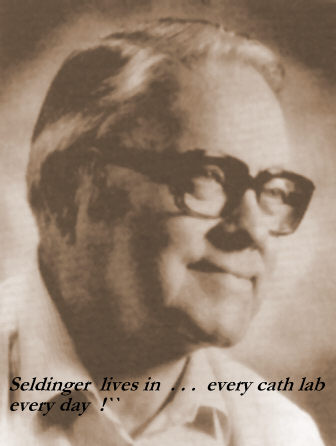
Interventional  cardiologists should revere  few  names for ever  . . .

They are

  1. Werner Forssman
  2. Masan Sones
  3. Andreas  Gruentzig
  4. Sven-Ivar   Seldinger

Sweden's Pride and cardiologist's ultimate Hero !

The  other men  in the  above  list  gave us insight  to enter the heart and do cardiac catheterization  and selective  angiograms

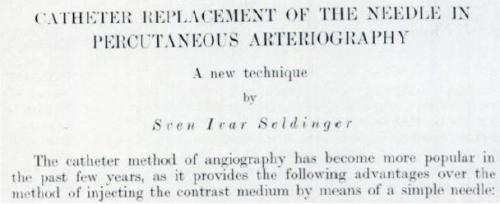
Ironically ,   the  man who  provided an easy access* to cardiovascular  system  from the  periphery is less often  remembered.  Still , it is because of him millions of procedure  are done every  year .

Every cardiologist should  read the life history of this great man.

*Previously all interventions are done in laborious  arterial or venous cut down

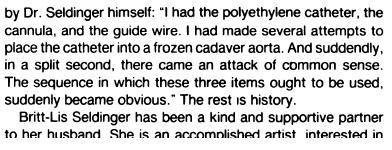
How the invention came about ?

“It is a  sudden attack of common sense”   That  is how seldinger described in his own words

Why not a Nobel prize for  Seldinger’s  sense which was so  uncommon to others  ?

If common sense has to be rewarded Nobel price ,  Seldinger’s    would probably will rank   first  among  all !

Reference

  1. http://ww.ajronline.org/cgi/reprint/142/1/8
  2. http://www.ajronline.org/cgi/reprint/142/1/8.pdf

Read Full Post »

We  are at the mercy  of  the three major coronary arteries (LAD,LCX,RCA) that sustain our life . Their  job is clear cut  .It has to perfuse   about 300 Grams of   live bundle of energy  for  an average of 6-7 decades.

What are the hurdles it  faces ,  how it overcomes these obstacles  forms the fascinating story of   “survival  of  human heart”

When coronary blood supply is confronted with a sudden compromise  as in ACS  ,  often the heart has little  time to respond . Hence the damage  and risk of death is  more. Even here there are lots of safety mechanisms and natural lytic process that limit the loss of life to less than 30 %  of all STEMIs. This implies nature protects against the death in 70 % of individuals and help  them  to reach hospital.*

*Among those  who reach hospital , we  the cardiologists  try to reduce the  mortality to about 6-7 % (20% without treatment ) with all  those hi-tech gadgets .It is a  different story and will be addressed elsewhere .

When it comes to  chronic insults ,  the heart has a unique potential to  stage  long haul battles. It has many tricks  under its  sleeves when challenged in a slow fashion.

The main weapons are two

1. Coronary collateral circulation.

2. Ischemic preconditioning.

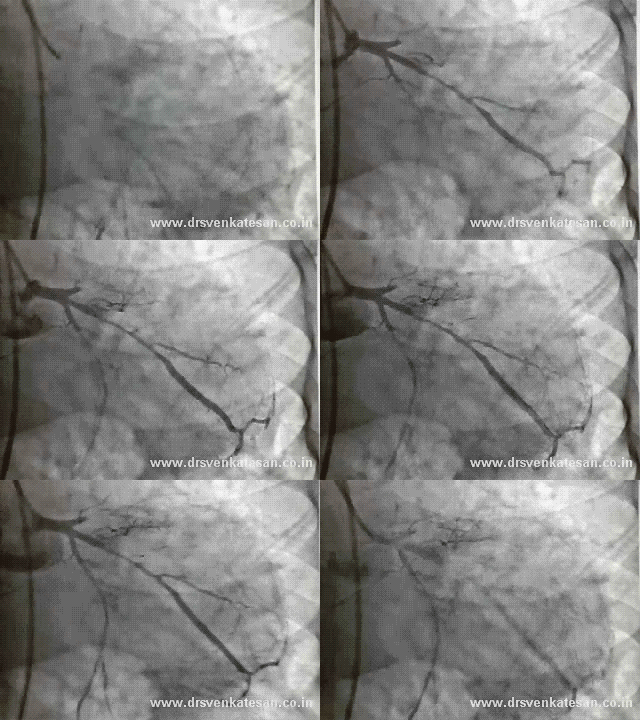
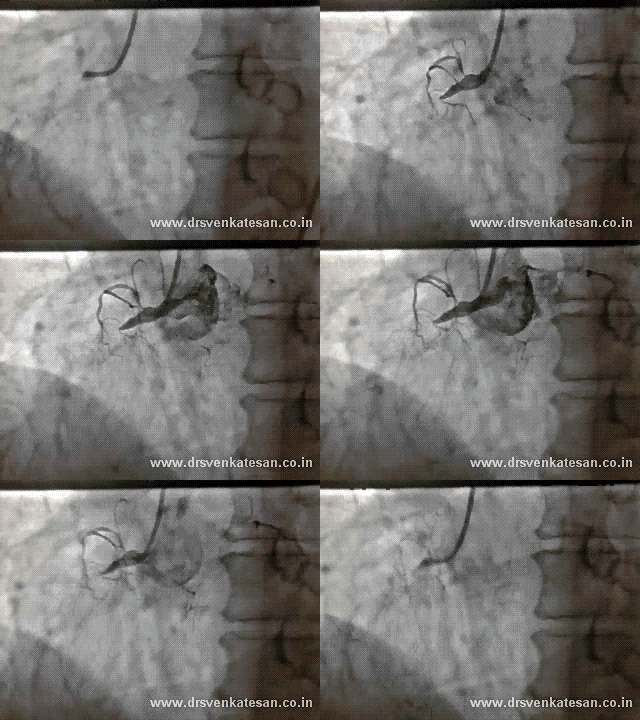
Here is a patient who fights his life even after all his  three coronary arteries   totally blocked and surviving with one of the branches of left main -Ramus intermedius .

If you have thought his RCA was the savior  you are  mistaken  .

To every one’s   surprise  his  RCA was awful  as well !

He had angina which was  troublesome  but manageable .Was able to live a life with acceptable standards (Indian standard )  After the angiogram he  received  CABG.  A turbulent post operative course ensued  due to various reasons . He  struggled but   fully recovered  . . .  and  ultimately  reached the  previous  standard  of life !

Final message

Modern cardiology is all about not trusting  powers of nature .

But youngsters should realise the enormous potential of those invisible powers.It may sound philosophical , but please  remember  . . .after all . . .  philosophy  is nothing but  search for truths. Atleast believe in them  once in a while !

Read Full Post »

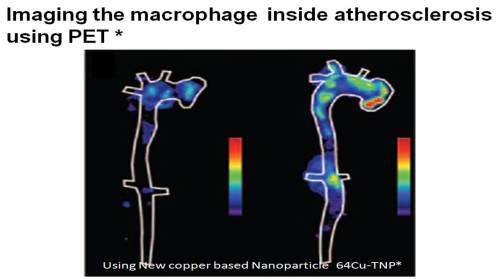
Non invasive imaging of inflamed macrophages  within athersclerosis

The medical  imaging science is  reaching new heights. With most of the  research so far within the anatomical arena we are moving into the  physiologic  and metabolic  imaging. Identifying vulnerable  plaques  within the coronary  artery is a separate field. Most of them are catheter based and invasive investigations.

We  have ben  searching for an  ideal PET scan based metabolic imaging of atherosclerosis. Macrophages are the key elements in an inflamed plaque.

Image Source : Circulation. 2008;117:379-387 .Note the Acttive Macrophages in the Aortic arch area and Coronary ostia

Can we take a photograph of these  inflamed zones   within  the  atherosclerotic plaque  ?

  • It seems we are approaching  that possibility. Every time we screen a person for CAD we can risk stratify on the basis of  percentage inflammation of their coronary artery or aorta .
  • This will complement the CT  or conventional angiogram .
  • If this technology is perfected it can be useful in the evaluation of response to medical interventions .
  • It  could also tel us  the  significance of  raised CRP /cytokines in other wise asymptomatic individuals

PET scan with newer tracers are constantly evolving . One such tracer is  based on copper molecule   64cu-TNP.

Reference

http://jnm.snmjournals.org/cgi/reprint/45/11/1898.pdf


Read Full Post »

For  a police officer who visits a crime site  every one looks like   a culprit. For a cardiologist  sitting in coronary  care unit  all chest pain  will have to look like  an infarct  !  Then only he is a cardiologist !

A rare , but costly mistake occasionally  happens . When a  patient with severe chest pain in the  retro sternal region with ST elevation in ECG , enters the ER  there is little  reason to suspect any condition other than STEMI !

This is how medical  errors takes place

Medicine is an art , we can not take it as granted .Acute MI can present with normal ECG and a dramatic ST elevation need not be MI

Here  was  a patient who presented with this ECG and one our fellows correctly diagnosed the condition .

Most  physicians would have thromolysed this patient or  might have wheeled into cath lab.  We have such events reported from primary  PCI registry .

Key differentiating points

  • Diffuse ST elevation not confining to a arterial territory
  • Absence of reciprocal changes
  • ST  segment with concavity upwards.
  • Echocardiogram and enzymes will be useful

iFAQs  in pericarditis

What is the mechanism of ST elevation  pericarditis ?

It is actually a zone of epicardial or Sub epicardial injury.

What will be the ECG finding if STEMI is associated with fibrinous pericarditis ?

Double dose of ST elevation .Mimics  a re infarction.

What are the dangers of thrombolysing a patient with diffuse pericarditis ?

It can bleed into pericardial  space

What happens

What will be the ECG finding in localised pericarditis ?

Read Full Post »

Action to  control cardiovascular risks in diabetes (ACCORD ) : The accord long-term follow-up results are just out  in NEJM  March 2011   http://www.nejm.org/doi/full/10.1056/NEJMoa1001286

The ACCORD study which created a huge buzz in 2008 when it was prematurely terminated  for fear of  bad outcome ,  with aggressive blood sugar lowering (Hb A1 c <6 %)  .The  negative  trend was confirmed in the aggressive* group even after switching to non aggressive group  at further 1.7 years follow-up  till late 2009.

*Intensive /Aggressive is used interchangeably in this article .

Why should aggressive glucose lowering be harmful ?

This  question is  struggling to get  a  logical answer for over 5 decades. To answer this question,  it  need to realised  our  fundamental understanding of  diabetes  itself  is  flawed ,   as  we have equated it with high blood sugar.

                                                    A  persistent state of  high blood sugar   can never be  used  as a  synonym for diabetes melites.  There is much . . . much  more , to it  !    Patients ,  lay persons and pharma industry  may  think  like  that   but  it is unfortunate many  physicians  have the same thinking   pattern .  The fault lies there .

Diabetes is a systemic metabolic disorder  apparently due to lack of insulin( or relative excess of it ! as in insulin resistance ) in which hyperglycemia is one of  grossly visible abnormality.

It is estimated there can be at least 100 invisible or less visible  biochemical abnormality in every diabetic individual.In fact , DM has more profound effect on lipid metabolism  than carbohydrate metabolism. Almost every microproteins   in our body  gets glycated . That  can be either be  reversible or irreversible .We know how difficult it to reverse diabetic nephropathy or retinopathy

If we realise the above reality there is absolutely no surprise why lowering blood sugar alone  does not reverse diabetic complications !

The second major issue is the modalities we  use  to target the  blood sugar 

Right from the days of early sulphonyl ureas  and biguanides ( of  Tolbutmide and Phenphormin etc ) one thing was very clear (or unclear  ! ) vigorous control of blood sugar has always been a doubtful intervention in controlling  diabetic complications .

                                                If  high blood sugar causes  excess mortality,   why  bringing it to  normal levels  does not reduce long-term mortality convincingly  ?

Is the Madness  lie in the methods ?

It seems so.  ACCORD study has strong reasons to suggest the  worse outcome in aggressive management is due to multiple , drugs used in a random fashion.

Then there  is always this  question  . . .How good is HB A1c  to assess the adequacy of DM control.  ? Biochemically this molecule still has lots of issues regarding its reproducibility.

Individuals who control blood sugar  by  natural means and by minimal drugs seem to do well. Early diabetics and  pre diabetics  should be our targets.

One should also remember the drugs we have today to control DM  have yet to prove the long-term safety records (Say for a span of 30-40 years)

Modern medicine  usually does not bother about the future  . . . it simply shrugs of the issue  with a caution statement . . . that the ” Drugs  you take  are well-tested and  thought to be  safe and useful with the current level of research !”

What is aggression in DM management ?

No one has defined it so far. But the any of the following may fit in with the  definition

  • Any DM patients prescribed more than  two drugs and Insulin
  • Premature start of Insulin
  • Lack of diet and exercise management  and  trying to substitute them with  incremental drugs and insulin 
  • Finally ,any patient who is always tensed up about his HBA1C and switches his physician  frequently  end up in  early complication   than the ones who follow simple non pharmacological approach.


How good is the idea  ,   to define aggressive thrapy  with reference to HBA1  levels ?

ACCORD defines aggressive approach  with HBA1C   as less than 6 %  and   Non aggressive as  7-8%  ( or  is it 6-7 %)

Not withstanding the limitations of HBA1C , there can be many patients who will require multiple drugs and insulin to maintain the HBA1C  even  at  7-8 %

How do yo label  them ?  Aggression by  number of  drug used   . . .  but still  considered  Non aggresive control  by HBA1c  criteria .

If ACCORD study fixes the indiscriminate use of drugs as a cause for bad outcome ,  then the very definition of aggressive approach need to be changed !

 Final message

ACCORD says it all . Never be aggressive on diabetic patients. The aggression we show with drugs can be more dangerous than the deadly diabetes itself.

Read Full Post »
« Newer Posts - Older Posts »