Feeds:
Posts
Comments

Which is  the most important factor that determines thrombolysis failure in STEMI  ?

  1. Thrombus load .
  2. Drug efficiency
  3. Time delay
  4. Presence of a mechanical lesion
  5. Hemodynamic instability

Answer : 3 .(Though all 5 factors operate )

Failed thrmbolysis occur in about 40-50% after streptokinase and slightly less with TPA   and TNK-TPA . Delayed arrival and late thrombolysis are  most common cause of failed thrombolysis. As the time flies , the  myocardium gets damaged and the intra coronary  thrombus gets organised .Both these processes make delayed thrombolysis a futile exercise.

               Not all STEMI patients have large thrombus burden. There need to be a critical load of thrombus for thrombolytic to be effective

Some may have a major mechanical lesion in the form of plaque fissure, prolapse and it simply blocks the coronary artery mechanically like a boulder on the road  . The poor  streptokinse  or the rich Tenekteplace !  nothing can move this boulder .The only option here is emergency PCI .

How will you know when the patient  arrives in ER with STEMI whether his/ her coronary artery is blocked with soft thrombus or hard mechanical boulder ?

It is impossible to know.That’s why primary PCI has a huge advantage.  But still thrombolysis is useful as some amount of thrombus will be there in all patients with STEMI.Lysing this will provide at least a  trickle of  blood flow that will jeep the myocardium viable and enable us to take for early PCI.

Final message

The commonest cause for thrombolytic failure is the time of administration and the degree of underlying mechanical lesion  . So  it does not make sense  to blame  streptokinase always !

The right to left shunt  in TOF  occurs by  which of the the following route ?

  1. RV- VSD- LV -Aorta

  2. RV-  Aorta

  3. RV – VSD- Aorta

  4. All of the above can occur

    Answer : 2   Most shunting occur by direct streaming of RV blood into Aorta . If the aortic  override  is near 50 %  it need not even cross the VSD in it’s  circuit. (Although theoretically all of the above can occur)


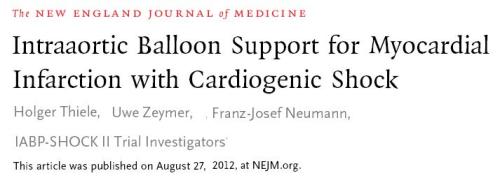
The last rites for routine   Swan Ganz catheterisation ( In STEMI ) was  performed  by a  land mark JAMA article  in 1996 .

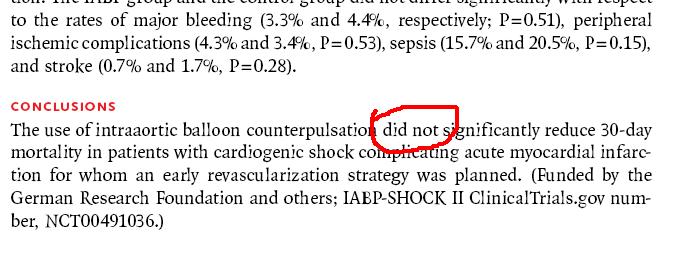
Now . . .  is the turn for intra aortic balloon counter pulsation (IABP) .

A conceptually attractive concept  was laid to rest in Munich ,West Germany , this week at annual  European society of cardiology ,  Scientific Sessions  .August 2012 .

What a crash for a great  hemo-dynamic  principle    in acute MI which ruled the roost for over three  decades !
Just Imagine ,   how many man hours , millions of  worth of consumables  wasted  . . .  better  not to talk about  associated   aortic injuries .

This is what we call   premature evidence based harm”

I  wonder  . . .  whether  I am  justified in making this extreme comment .

Please read for yourself  , this early online release alert  from  NEJM .

http://www.nejm.org/doi/pdf/10.1056/NEJMoa1208410

Reference

Connors A, Speroff T, Dawson N, Thomas C, Harrell FE Jr, Wagner D, etal. The effectiveness of right heart catheterization in the initial care of critically ill patients. JAMA 1996;276:  889-97.

http://www.ncbi.nlm.nih.gov/pmc/articles/PMC2352214/pdf/bmj00561-0005.pdf

The principles of pre-discharge EST  

This concept came about 20 years ago (1980s) to risk stratify patients following  ACS to triage early coronary angiogram and revascualrisation. Generally patients are discharged by 5-7 days after an MI  (May be  3-5 days in some hospitals)  . Doing an exercise stress test  early within  2 weeks has not been very popular with many cardiologist even though it was recommended by many guidelines.The type of stress recommended  here  , is heart rate limited sub maximal 70% of  THR (Usually around  140 /mt )  is performed . This is due fear of precipitation another ACS.

Still,  there are definite  advantages for  pre-discharge EST .It help us  identify  high risk  subsets of  STEMI and reduce the  intermediate term mortality .More importantly it  gives  us an opportunity  to  exclude  inappropriate  revascualriations  even without an angiogram . (The well known coronary dogma  ie  if a post STEMI patient performs > 10  METS ,  his  heart carries little  risk  for  future events  still holds good  !)

With the advent of liberal usage of CAG and improved techniques of revascularistion ,  most  patients  directly undergo pre-discharge CAG rather than EST !

Further reading

Does any cardiologist have guts to do a pre- discharge EST after  a successful primary PCI ?

Read a related article in this blog .

An awkward  argument for routine EST following primary PCI

Please remember,  primary PCI is not the end of the management of STEMI. Primary PCI is an IRA focused intervention. We need to study other lesions and their the flow pattern as well. Logically we need to do a test for adequacy of  baseline vascularity and the current revascularisation . Simple deployment of  a stent in IRA (without documentation of good flow during exertion ) is not acceptable to believers of  scientific medicine  . Resting TIMI 3 flow conveys no meaning for a patient who is going to be ambulant and active. A stress test will come in handy .

The micro-vascular integrity and resistance following an extensive STEMI is best studied by the adequacy of exercise induced  coronary hyperemia (This is physiologically equivalent to the much fancied FFR in cath lab ) . One can consider EST following a primary PCI as an non invasive substitute for the collective FFR of all three vessels including the IRA that is stented .

Does any cardiologist have guts to do a pre- discharge EST after a successful primary PCI ?

Typical responses would be

  • Why the hell I should do it ?
  • Do you know how risky it is to do a EST early after a primary PCI ?
  • If at all I have any doubt , I would prefer a non invasive PET or Thallium to study the adequacy of revascularisation.

If you think , it is too risky to exert a successfully revascularised patient early after a STEMI . . .   at the same time   argue  to do it in non revascularised patient routinely .  Do we not see a huge irony here ?

Other inference could be . . . we are still suspecting the quality of our revascularisation during PCI !

If  EST is contraindicated after a primary PCI , are we going to advice  these patients against indulging in any activity requiring moderate exertion fearing a stent occlusion ?

. . . What a way to interpret the aftermath  of a   ‘state of the art ‘ procedure called primary PCI !

In science ,  correctness is more important than politeness !

There are many wonderful books for learning clinical cardiology.J.K.Perlof’s clinical cardiology,  Jonathan Abrams , are popular ones. Clinical chapters in  Noble O  Fowler is a  wonderful reference .

My choice for the top slot is  by Signs and symptoms in cardiology”   by Horwitz and Groves .They wrote this master piece

from a relatively  unassuming  US city, University of  Colorado.  Denver .Published by J.B.Lippincott company in 1985.

I am  not sure , any further edition of this book  has come .

Young cardiology residents  must first  identify  good  books    . . . reading comes next !

What to buy this book ? .Try  at Amazon .

http://www.amazon.com/Signs-Symptoms-Cardiology-Lawrence-Horwitz/dp/0397505124

When do you call a infected heart as healed ?

Should the vegetation disappear to call it a cure ?

Vegetation’s rarely disappear following treatment . Very small vegetation may dissolve – 20% . Many times it regress in size .

Often  our aim should be  restricted  to sterilise the vegetation. This invariably happens in most of the patients who receive complete course of antibiotic. But healing and sterilizing is not enough in many vulnerable patients.If the vegetation is large the embolic risk is still there even with a healed vegetation.

So if there is a relatively large  (>1.5cm) vegetation it is always better to remove by surgery.

Interventional  techniques may   soon  allow  capturing these vegetation by basket catheters .When technology is there to retrieve small bits of a thrombus inside a coronary artery it should be possible to remove a large vegetation with temporary aortic filters in place.

Also read

https://drsvenkatesan.wordpress.com/2011/01/12/what-is-the-natural-history-of-infective-endocarditis-vegetation/

Whatever  is your answer .   It will be   far off from the truth .

What causes  Atheroscerosis ?

The perception  that , circulating lipids directly damage  the coronary endothelium is an  ill proven concept.  Isolated hyperlipidemia  rarely leads to full blown Atherosclerois .

If  LDL moelcules  can penetrate the endothelium  , why the circulating LDL  at a normal concentration of 130mg/dl  fail to do so in vast number of humans   as they criss cross the human circulatory system  at-least a  trillion times  every year ?  So , there  must be something else  operating *It requires a high blood pressure, diabetes , smoking or some form of endothelial injury  (That includes chronic Inflammation )  for the  lipids to  enter the sub endothelial planes and start depositing.

The relationship between serum lipids and plaque burden lacks clarity.

* The argument that 130mg LDL is injurious to endothelium  while  100mg  is not  ,  can  easily be disputed !

Usually co -morbid conditions are  relative contraindication  for renal transplantation . LV Myocardial   dysfunction is a  fairly common  association  in CKD.

The uniqueness of   this  LV  dsyfunction is  , there is no primary   myocardial failure . Further  features observed are   . . .

  1. Structural damage is less
  2. LV is not much dilated
  3. Wall thinning is less common , In fact more often than not LVH is associated . (Laplace law at work to reduce LV wall stress !)
  4. The systemic Blood pressure is  well maintained (Chronic HT related ?)

Mechanism of reversible LV dysfunction in CKD

Chronic pressure overload result in After load mismatch . 

(Normally pre-load , after load , and contractility should be  sequentially matching parameters . After load mismatch is an important concept where myocardial contractility is temporarily is depressed due to  lack of adequate pre-load for a given level of after load )

Evidence for reversibility

Very often one can observe improvement of LV function significantly  24 hours after dialysis .The  concept of    uremic biochemical dysfunction is still valid .Though it can not be exactly quantified .

If significant coronary artery disease is excluded , these patients   do well ( after transplantation )  from a  cardiac point of  view !

(64 slice MDCT may be a simple screening test to rule our significant  CAD .)

Final message

How wise it is to do renal transplantation in DCM patients ? .

  • Most patients with LV dysfunction of CKD do well after transplantation .
  • Presence of severe LV dysfunction especially   with  normal  or increased wall thickness should not be a contraindication to  renal  transplantation .

AVRT is  a second commonest cause of  narrow qrs tachycardia.  While , all narrow qrs tachycardia in AVRT must be  ortho-dromic. wide qrs tachycardia in WPW  can either be ortho-dromic or anti-dromic ,

The classical one is the much popular and fancied Antidromic  AVRT . Please be reminded  AVRT can conduct  orthodromically  through AV nodal tissue  but still  become  aberrant , as it travel downwards thorough the bundles   and result in a wide qrs tachycardia .

Among the two which  is more common ?

My observation is  ortho-dromic  wide qrs  AVRT  is  more  prevalent . Do you agree ?

Final message

Not all wide qrs tachycardia  in WPW  is anti-dromic !